
 Download PDF
Market Overview
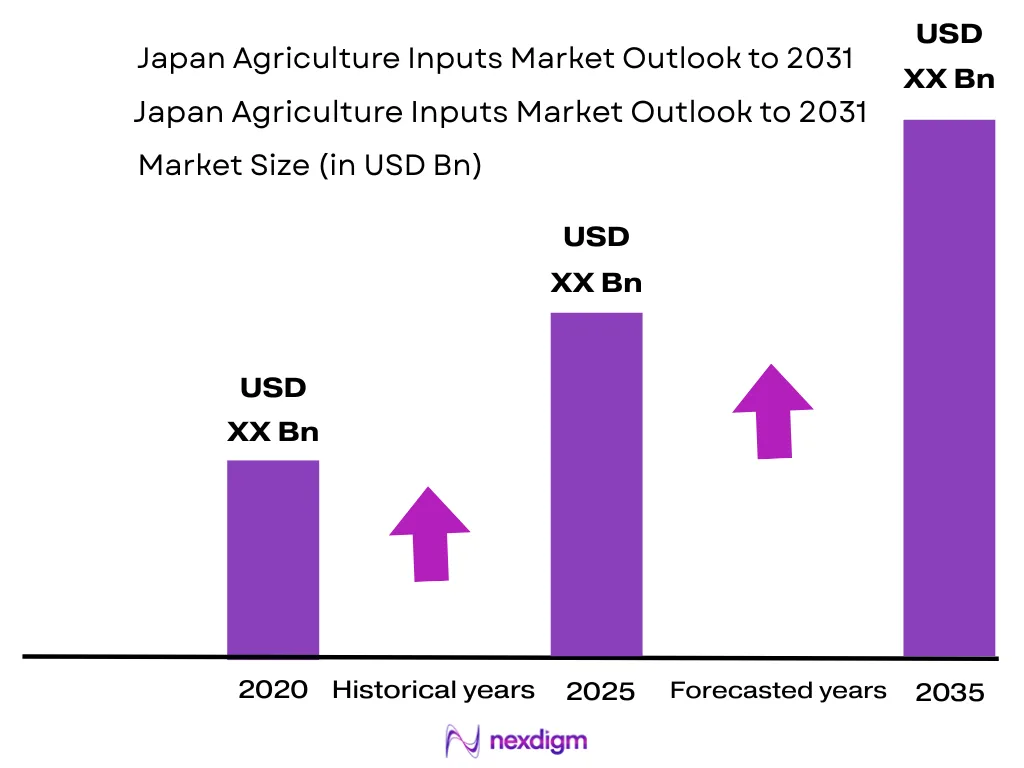
The Japan Agriculture Inputs Market is valued at USD ~ billion, based on a five-year historical analysis, and is forecast to grow at a 4.67% CAGR during 2026–2035. Demand is driven by fertilizers, crop protection chemicals, seeds, feed inputs, bio-inputs and soil amendments. Japan’s agricultural, forestry, fishery and food exports reached JPY ~ trillion, while the country maintained ~ million hectares of farmland, supporting continuous input demand across rice, horticulture, tea and livestock. Hokkaido, Tohoku, Kanto, Chubu and Kyushu dominate Japan Agriculture Inputs Market because they combine crop specialization, cooperative procurement and intensive input usage. Hokkaido leads broadacre fertilizers, forage inputs and dairy feed; Tohoku drives paddy herbicides, rice fertilizers and seedling treatment; Kanto supports greenhouse nutrients and vegetables; Chubu supports tea, fruits and orchards; Kyushu-Okinawa supports tea, sweet potato, livestock, vegetables and subtropical pest-control demand. Japan’s farm workforce stood at ~ million core workers, requiring productivity-focused input programs.
Market Segmentation
By Product Type
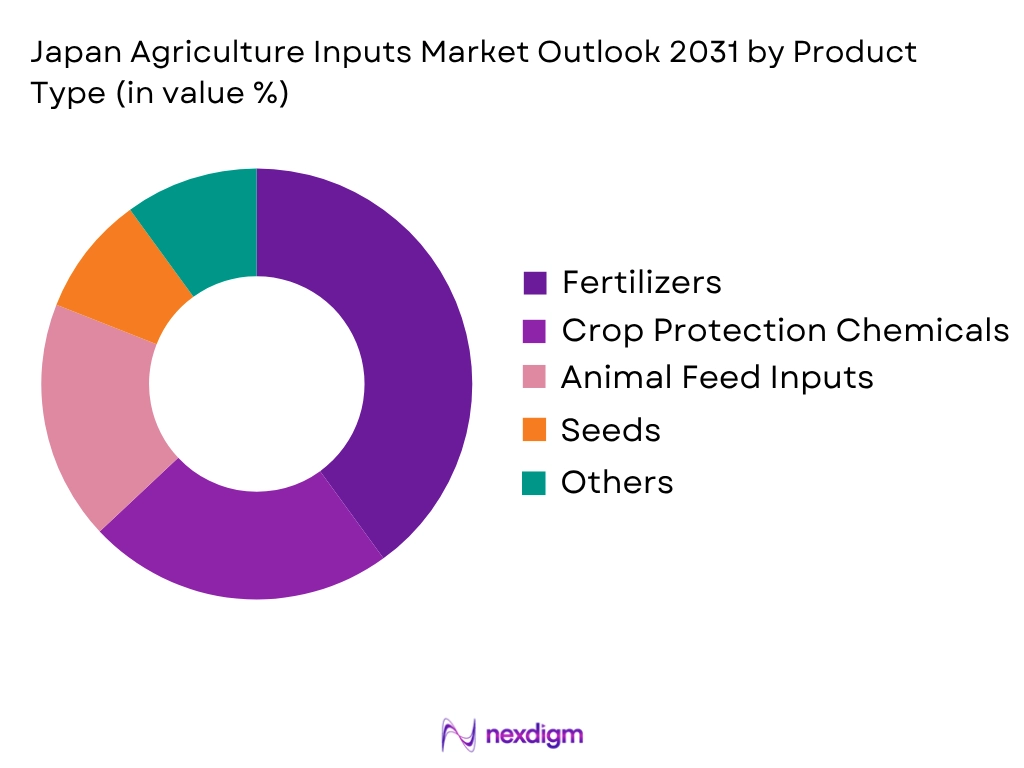
Japan Agriculture Inputs Market is segmented by product type into fertilizers and bio-inputs, crop protection chemicals, animal feed inputs, seeds and planting material, soil conditioners, adjuvants and specialty inputs. Recently, fertilizers and bio-inputs have a dominant market share in Japan under the segmentation product type, due to their direct role in maintaining soil fertility, paddy productivity, greenhouse nutrient control and horticulture quality. Japan’s fertilizer and bio-inputs market is reported at USD ~ billion, reflecting the importance of crop nutrition and sustainable input transition. Fertilizers remain critical in rice, vegetables, fruits, tea and field crops, while bio-inputs are gaining relevance under low-chemical and organic farming policies. Crop protection chemicals remain strategically important because paddy herbicides, fungicides, insecticides and seedling treatments are necessary for rice and specialty crops, but fertilizers form the broader recurring input base.
By Farming System
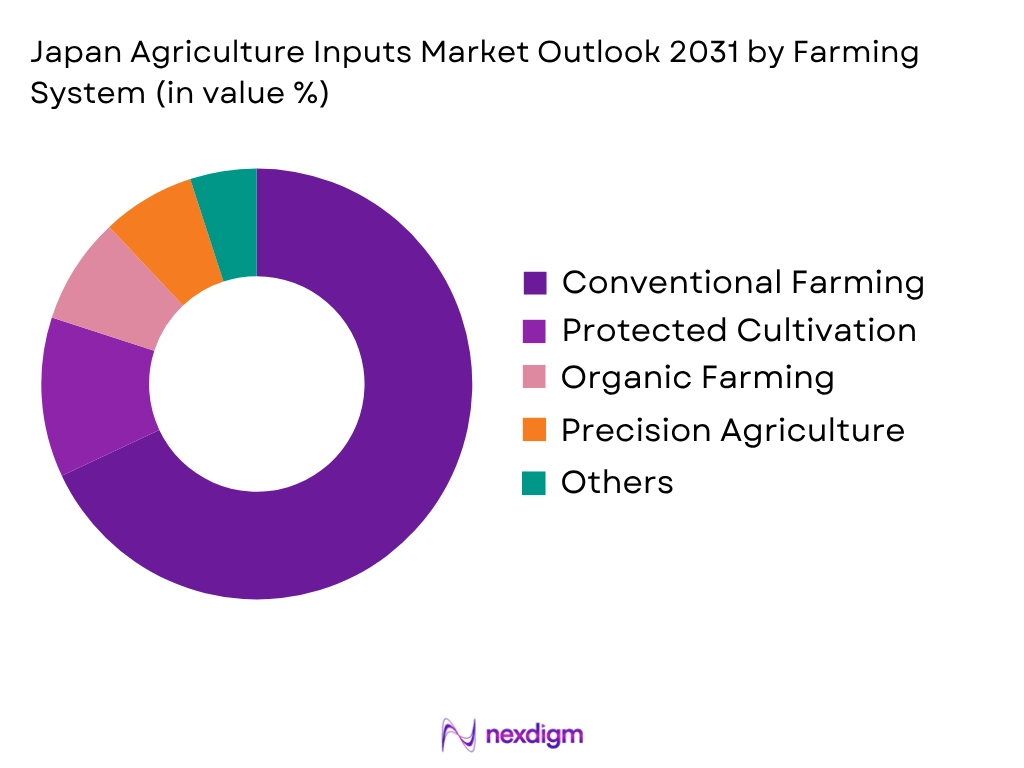
Japan Agriculture Inputs Market is segmented by farming system into conventional farming, protected cultivation, organic farming, precision agriculture and low-chemical/IPM farming. Recently, conventional farming has a dominant market share in Japan under the segmentation farming system, because most rice, vegetable, orchard, tea and livestock-linked crop production still depends on standard fertilizers, crop protection chemicals, feed inputs and certified planting material. Deep Market Insights identifies conventional farming as the largest segment in Japan’s agricultural inputs market, while organic farming is positioned as the fastest-growing future segment. Conventional farming remains dominant because Japan’s food-security priorities require stable yields on limited farmland. However, protected cultivation and precision agriculture are gaining commercial relevance because greenhouse operators need nutrient solutions, sensors, fertigation inputs and biological pest-control products. Organic and IPM systems are smaller but strategically important due to MAFF’s sustainability policy direction.
Competitive Landscape
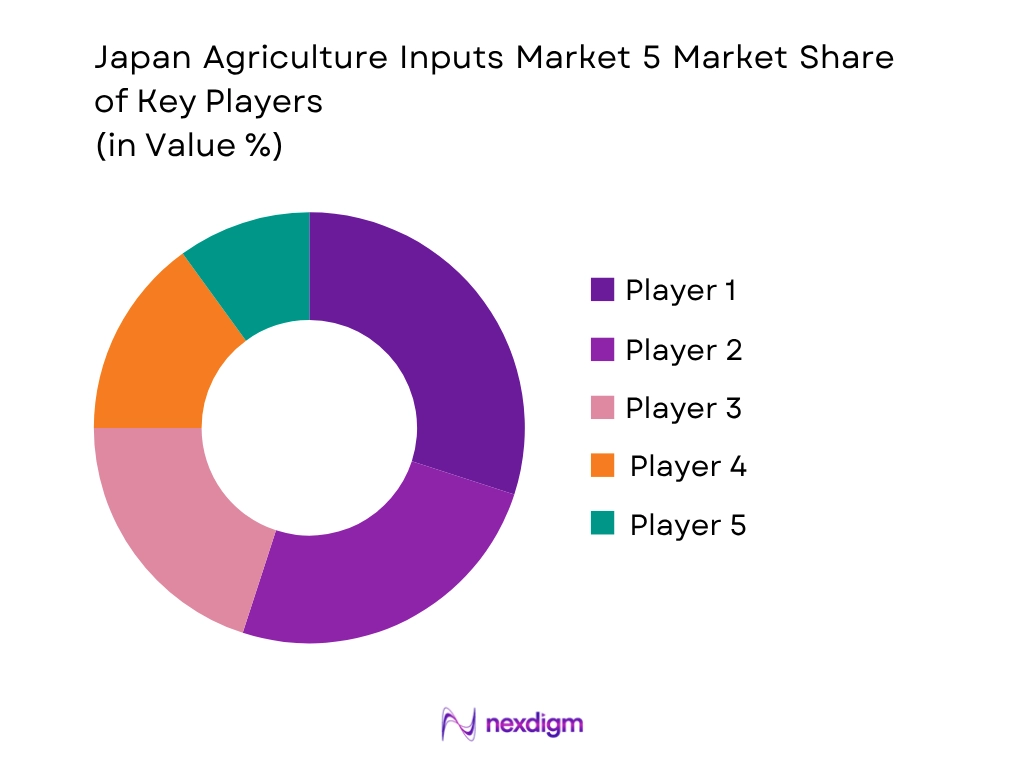
Japan Agriculture Inputs Market is dominated by cooperative procurement networks, domestic agrochemical companies, fertilizer suppliers and integrated farm input distributors. Zen-Noh and JA Group influence farmer access, input bundling and cooperative procurement, while Sumitomo Chemical, Mitsui Chemicals Crop & Life Solutions, Kumiai Chemical and Nihon Nohyaku compete through crop protection, rice-focused product portfolios, specialty chemistry and registration depth. Competition is shaped by fertilizer sourcing security, crop protection active ingredients, JA/dealer reach, biological portfolio, farmer advisory and compliance with Japan’s sustainability and residue standards.
| Company | Establishment Year | Headquarters | Core Input Portfolio | Key Crop Focus | Distribution Strength | Regulatory Capability | Sustainability Position | Strategic Role |
| Zen-Noh | 1972 | Tokyo, Japan | ~ | ~ | ~ | ~ | ~ | ~ |
| Sumitomo Chemical | 1913 | Tokyo / Osaka, Japan | ~ | ~ | ~ | ~ | ~ | ~ |
| Mitsui Chemicals Crop & Life Solutions | 2003 | Tokyo, Japan | ~ | ~ | ~ | ~ | ~ | ~ |
| Kumiai Chemical Industry | 1949 | Tokyo, Japan | ~ | ~ | ~ | ~ | ~ | |
| OAT Agrio | 2010 | Tokyo, Japan | ~ | ~ | ~ | ~ | ~ |
Japan Agriculture Inputs Market
Growth Drivers
Food-security pressure is sustaining demand for productivity-focused agricultural inputs
Japan Agriculture Inputs Market is being driven by food-security pressure because domestic production has to be maintained on a limited land base with fewer farm operators. MAFF’s Basic Plan reference states that domestic farmland stood at 4.27 million hectares in 2024, down from 4.83 million hectares in 2000, while Japan’s total agricultural output remained around JPY 9.5 trillion in 2023. The same MAFF source states that core persons mainly engaged in farming numbered 1.11 million in 2024, with an average age of 69.2 years. These figures support demand for fertilizers, crop protection chemicals, certified seeds, soil amendments, animal feed inputs and advisory-led nutrient programs because farmers must protect yields without relying on land expansion. World Bank data reinforces the national demand base, reporting Japan’s 2024 GDP at USD 4.03 trillion, GDP per capita at USD 32,487.1, and population at 123,975,371. For input suppliers, this makes productivity, residue compliance, nutrient efficiency and crop-specific programs central to market demand.
Smart agriculture and export-quality production are increasing demand for precision input programs
Japan Agriculture Inputs Market is supported by precision agriculture because fertilizer, crop protection and biological inputs are increasingly linked to application records, drone spraying, soil diagnostics and crop-quality management. OECD reported that MAFF allocated JPY 4,500 million in 2024 to promote smart agricultural technologies, including automation systems, precision farming technologies and AI-driven decision-making tools. This directly supports variable-rate fertilization, drone-based pesticide application, sensor-linked nutrient advice and traceable residue management. Export-oriented production also strengthens quality-focused input use: Japan’s agricultural, forestry, fishery and food exports reached JPY 1.507 trillion in 2024, and increased to JPY 1.701 trillion in 2025, creating demand for low-residue crop protection, crop nutrition, post-harvest quality inputs and certification-compatible production programs. Japan’s macroeconomic position supports this shift: IMF’s 2026 Article IV report lists nominal GDP at USD 4,190 billion, GDP per capita at USD 33,820, and population at 124 million in 2024. These indicators justify a move from volume-based input use toward precision, quality and traceability-led input systems.
Market Challenges
Imported fertilizer raw-material dependence exposes crop nutrition supply to external disruption
Japan Agriculture Inputs Market faces a market-specific supply challenge because key fertilizer raw materials are import-dependent. MAFF’s food supply material states that Japan mainly relies on imports for chemical fertilizer raw materials such as ammonium phosphate, potassium chloride and urea, and that the government is promoting recycling and domestic resource use to shift away from imported raw materials. This matters directly for fertilizer manufacturers, JA procurement networks, compound fertilizer suppliers and crop nutrition distributors because rice, vegetables, tea, fruits and field crops require stable nutrient availability. Domestic farmland of 4.27 million hectares in 2024 creates recurring demand for nutrient inputs, but supply risk is elevated when phosphorus, potash and nitrogen feedstocks depend on international conditions. World Bank data shows Japan’s large macro base, with USD 4.03 trillion GDP, USD 32,487.1 GDP per capita, and 123,975,371 population in 2024, meaning food production continuity has national economic relevance. Input companies therefore need sourcing diversification, recycled nutrient products, domestic formulation resilience and advisory programs that improve nutrient-use efficiency. Sources: MAFF, World Bank.
Aging farmers and farmland contraction restrict volume-led input growth
Japan Agriculture Inputs Market is constrained by the same structural issues that support input efficiency: a shrinking farmer base, aging operators and limited farmland expansion. MAFF’s Basic Plan reference records 1.11 million core persons mainly engaged in farming in 2024, with an average age of 69.2 years, while domestic farmland stood at 4.27 million hectares in 2024 after declining from 4.83 million hectares in 2000. MAFF also states that Japan’s agricultural land accounts for only about one-third of the area needed to cover total domestic food demand, indicating that supply security depends on productivity rather than acreage expansion. For input suppliers, this restricts conventional volume-led growth in fertilizers, crop protection chemicals and seeds. Older farmers may reduce application intensity, delay product switching or depend heavily on JA recommendations. At the same time, a smaller farm base raises the need for simplified products, controlled-release fertilizers, low-labour crop protection, precision spraying and biological alternatives. World Bank reports Japan’s 2024 population at 123,975,371 and GDP at USD 4.03 trillion, showing large food demand despite constrained domestic production capacity.
Market Opportunities
Biological, organic-compatible and reduced-chemical inputs can expand through sustainability policy alignment
Japan Agriculture Inputs Market has an opportunity in biological inputs, organic-compatible fertilizers, biopesticides, microbial products, compost-based soil amendments and low-chemical crop programs because national policy is pushing input systems toward lower environmental burden. OECD’s Japan agriculture policy review lists MIDORI-aligned targets including 50% reduction in risk-weighted chemical pesticide use, 30% reduction in chemical fertiliser use, and organic farming area expansion to 1 million hectares. The same policy direction supports sustainable sourcing for import materials and productivity improvement through automation. This creates room for inputs that help farmers maintain yields while lowering chemical dependence, including biofertilizers, botanical extracts, microbial pesticides, controlled-release nutrients and circular soil amendments. MAFF’s 2025 organic agriculture material also highlights local use of cow manure compost in Sakai City, Osaka, to reduce chemical fertilizer use and encourage organic transition. Japan’s macroeconomic base supports premium sustainable input adoption, with World Bank reporting USD 4.03 trillion GDP and USD 32,487.1 GDP per capita in 2024. Input companies aligned with sustainability targets can address rice, vegetables, tea, orchards and greenhouse crops.
Circular nutrient sourcing and smart input advisory create scope for differentiated input models
Japan Agriculture Inputs Market has a clear opportunity in circular fertilizers, recycled phosphorus, livestock-waste compost, soil-testing services, digital agronomy and precision advisory because Japan needs to reduce external raw-material exposure while maintaining productivity. MAFF states that Japan mainly relies on imports for chemical fertilizer raw materials, including ammonium phosphate, potassium chloride and urea, and that policy direction includes recycling and domestic resource use. OECD’s 2025 review also notes Japan’s sustainability targets for reducing chemical fertiliser use and improving labour productivity through automation, creating a pathway for products that combine input efficiency with smart agriculture. These conditions support supplier models that integrate fertilizer blends, soil-condition monitoring, variable-rate maps, drone spraying records, crop-specific advisory and application traceability. The opportunity is reinforced by farm structure: MAFF records 4.27 million hectares of domestic farmland and 1.11 million core farming workers in 2024, indicating that fewer farmers must manage nutrient decisions across a large production base. IMF lists Japan’s 2024 nominal GDP at USD 4,190 billion and population at 124 million, supporting investment in resilient, high-efficiency input systems.
Future Outlook
Over the next phase, Japan Agriculture Inputs Market is expected to shift from volume-led input usage toward precision, efficiency and sustainability-led input programs. Fertilizers, crop protection chemicals and feed inputs will remain core demand pillars, but growth will increasingly come from controlled-release fertilizers, biological inputs, biofertilizers, low-residue crop protection, organic-compatible soil amendments and sensor-linked advisory. Rice, vegetables, fruits, tea, greenhouse crops and livestock-linked forage will remain central to input demand. However, Japan’s aging farmer base and limited farmland will force suppliers to provide labour-saving products, simplified crop programs and advisory-led input bundles. This creates a stronger role for JA-linked procurement, digital agronomy, soil testing, drone spraying and precision nutrient management.
Sustainability will become a defining market theme. MAFF’s MIDORI strategy promotes lower environmental load across food systems, creating demand for products that reduce chemical risk, improve nutrient efficiency and support organic or low-chemical production. Biological crop protection, microbial fertilizers, compost-based soil amendments and circular nutrient products are expected to become more commercially relevant. The market will also be shaped by import exposure. Japan depends on imported raw materials for fertilizers, feed grains and some technical-grade agrochemical inputs. This increases the importance of domestic formulation, alternative nutrient sourcing, recycled fertilizers and secure procurement channels. Companies with strong regulatory capability, JA/dealer access and crop-specific advisory will remain better positioned.
Major Players
- Zen-Noh / National Federation of Agricultural Cooperative Associations
- JA Group
- Sumitomo Chemical Co., Ltd.
- Mitsui Chemicals Crop & Life Solutions, Inc.
- Kumiai Chemical Industry Co., Ltd.
- Nihon Nohyaku Co., Ltd.
- Nissan Chemical Corporation
- Nippon Soda Co., Ltd.
- Hokko Chemical Industry Co., Ltd.
- Ishihara Sangyo Kaisha, Ltd.
- Agro-Kanesho Co., Ltd.
- OAT Agrio Co., Ltd.
- Nitto FC Co., Ltd.
- Katakura & Co-op Agri Corporation
- Itochu Corporation / Food and Agri-Input Trading
Key Target Audience
- Fertilizer manufacturers
- Crop protection chemical companies
- Seed and planting material suppliers
- Animal feed input manufacturers
- Agricultural cooperatives and input distributors
- Greenhouse and specialty crop input suppliers
- Investments and venture capitalist firms
- Government and regulatory bodies, including MAFF, FAMIC, Consumer Affairs Agency, MHLW, METI and Japan Finance Corporation
Research Methodology
Step 1: Identification of Key Variables
The initial phase involves constructing an ecosystem map encompassing all major stakeholders within the Japan Agriculture Inputs Market. This includes fertilizer producers, crop protection manufacturers, seed companies, feed input suppliers, JA cooperatives, distributors, greenhouse operators, livestock farms and regulatory bodies.
Step 2: Market Analysis and Construction
In this phase, historical data is compiled across fertilizers, crop protection chemicals, feed inputs, seeds, biological inputs and soil amendments. The analysis reviews product penetration, crop-level input usage, distribution structure, import exposure, domestic formulation and farmer procurement behaviour.
Step 3: Hypothesis Validation and Expert Consultation
Market hypotheses are validated through CATI-style interviews with input manufacturers, distributors, agronomists, cooperative procurement stakeholders, greenhouse operators and large farms. These consultations provide operational insights on product adoption, channel dynamics, advisory demand, regulatory barriers and crop-specific input needs.
Step 4: Research Synthesis and Final Output
The final phase involves synthesizing secondary research, expert interviews and bottom-up input demand indicators. Market size, segmentation, competitive position, future outlook and opportunity mapping are validated against crop structure, regional farming systems, JA channel influence and sustainability-linked policy direction.

- Executive Summary
- Research Methodology (Market Definitions and Assumptions, Abbreviations, Agriculture Input Coverage, Market Sizing Approach, Top-to-Bottom Farm Input Consumption Validation, Bottom-to-Top Product-Level Sales Build-Up, Primary Interviews with Input Manufacturers/Distributors/JA Cooperatives/Dealers/Farmers/Greenhouse Operators, Secondary Research Validation, Regulatory Mapping, Limitations and Future Conclusions)

- Definition and Scope
- Market Genesis
- Evolution of Japan’s Agriculture Input Ecosystem
- Timeline of Major Players
- Business Cycle
- Supply Chain and Value Chain Analysis

- Growth Drivers (Food Security Policy, Rice and Horticulture Input Intensity, Smart Agriculture Adoption, Low-Residue Food Demand, Export-Oriented Production, Controlled-Release Fertilizer Adoption, Biological Input Transition)
- Market Challenges (Imported Raw Material Exposure, Fertilizer Price Volatility, Farmer Aging, Shrinking Farmland, Strict Pesticide Registration, Feed Grain Dependency, Dealer Margin Pressure)
- Opportunities (Biological Inputs, Organic Agriculture, Controlled-Release Fertilizers, Feed Efficiency Inputs, Precision Nutrient Management, Greenhouse Inputs, Export-Oriented Specialty Inputs)
- Trends (Input Optimization, Low-Chemical Farming, Bio-Based Product Launches, Cooperative Procurement Reform, Digital Input Ordering, Traceable Crop Programs, Sustainable Fertilizer Blends)
- Government Regulation (Fertilizer Regulation, Pesticide Registration, Agricultural Chemicals Regulation Act, Food Safety Standards, MRL Compliance, Organic JAS, MIDORI Strategy, Feed Safety Regulation, Environmental Policy)
- SWOT Analysis
- PESTLE Analysis
- Porter’s Five Forces Analysis
- Stakeholder Ecosystem

- By Value (2020-2025)
- By Volume (2020-2025)
- By Average Selling Price (2020-2025)

- By Input Type (In Value %)
Fertilizers
Crop Protection Chemicals
Seeds and Planting Material
Animal Feed Inputs - By Source (In Value %)
Synthetic Inputs
Organic Inputs
Biological Inputs
Mineral-Based Inputs
Circular and Recycled Inputs - By Distribution Channel (In Value %)
JA Cooperative Channel
Zen-Noh Procurement Network
Agricultural Dealers and Wholesalers
Direct-to-Farm and Corporate Farm Sales
Digital and Online Input Channels - By Region (In Value %)
Hokkaido
Tohoku
Kanto
Chubu
Kansai
Chugoku and Shikoku
Kyushu-Okinawa

- Market Share of Major Players on the Basis of Value and Volume
- Cross Comparison Parameters (Fertilizer and Crop Nutrition Portfolio Depth, Registered Crop Protection Active Ingredients, Seed and Planting Material Coverage, Feed Input and Livestock Nutrition Presence, JA/Zen-Noh/Dealer Channel Reach, Bio-Based and MIDORI-Compatible Product Portfolio, Domestic Manufacturing and Import Sourcing Security, Technical Agronomy and Farmer Advisory Capability)
- SWOT Analysis of Major Players
- Pricing Analysis of Major Players(Fertilizer SKUs, Crop Protection SKUs, Seed Packs, Feed Inputs, Bio-Based Products, Soil Amendments, Advisory Bundles)
- Detailed Profiles of Major Companies
Zen-Noh / National Federation of Agricultural Cooperative Associations
JA Group
Sumitomo Chemical Co., Ltd.
Mitsui Chemicals Crop & Life Solutions, Inc.
Kumiai Chemical Industry Co., Ltd.
Nihon Nohyaku Co., Ltd.
Nissan Chemical Corporation
Nippon Soda Co., Ltd.
Hokko Chemical Industry Co., Ltd.
Ishihara Sangyo Kaisha, Ltd.
Agro-Kanesho Co., Ltd.
OAT Agrio Co., Ltd.
Nitto FC Co., Ltd.
Katakura & Co-op Agri Corporation
Itochu Corporation / Food and Agri-Input Trading

- Market Demand and Utilization
- Purchasing Power and Budget Allocation
- Regulatory and Compliance Requirements
- Needs, Desires and Pain Point Analysis
- Decision-Making Process
- Customer Cohort Analysis

- By Value (2026-2035)
- By Volume (2026-2035)
- By Average Selling Price (2026-2035)


 Request a Sample
 Ask for Customization
 Get a Quote
 Enquire Now