
 Download PDF
Market Overview
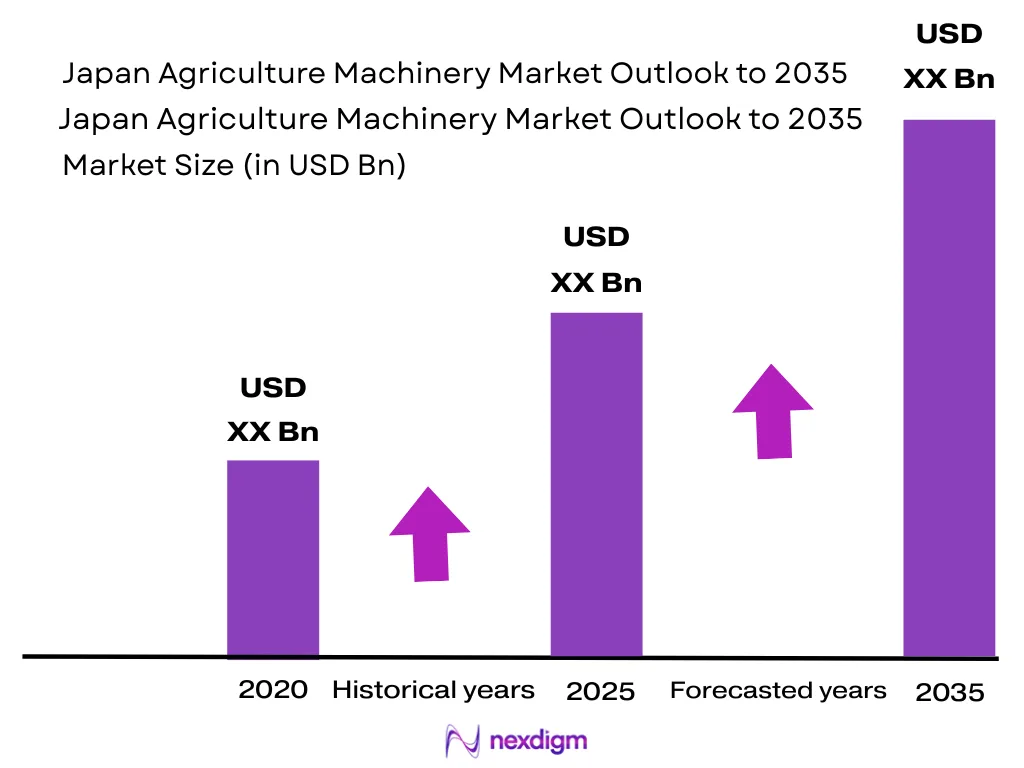
The Japan agriculture machinery market is valued at USD ~ billion, based on a five-year historical analysis, and is forecast to grow at a 2.4% CAGR during the outlook period. Demand is driven by rice mechanization, smart agriculture adoption, labor shortage, autonomous tractors, combines, rice transplanters and compact farm equipment. Japan’s GDP stood at USD ~ trillion, while GDP per capita reached USD 32,487.1, supporting capital-intensive agricultural modernization. Hokkaido, Tohoku, Kanto, Chubu and Kyushu dominate Japan agriculture machinery demand because they combine crop scale, regional specialization and mechanization intensity. Hokkaido leads large tractors, forage equipment and field-crop machinery because agricultural output reached about JPY 1.3 trillion in MAFF’s prefecture data. Tohoku and Niigata remain important for rice transplanters and combines, while Kyushu supports tea, vegetable, sugarcane and greenhouse machinery demand.
Market Segmentation
By Equipment Type
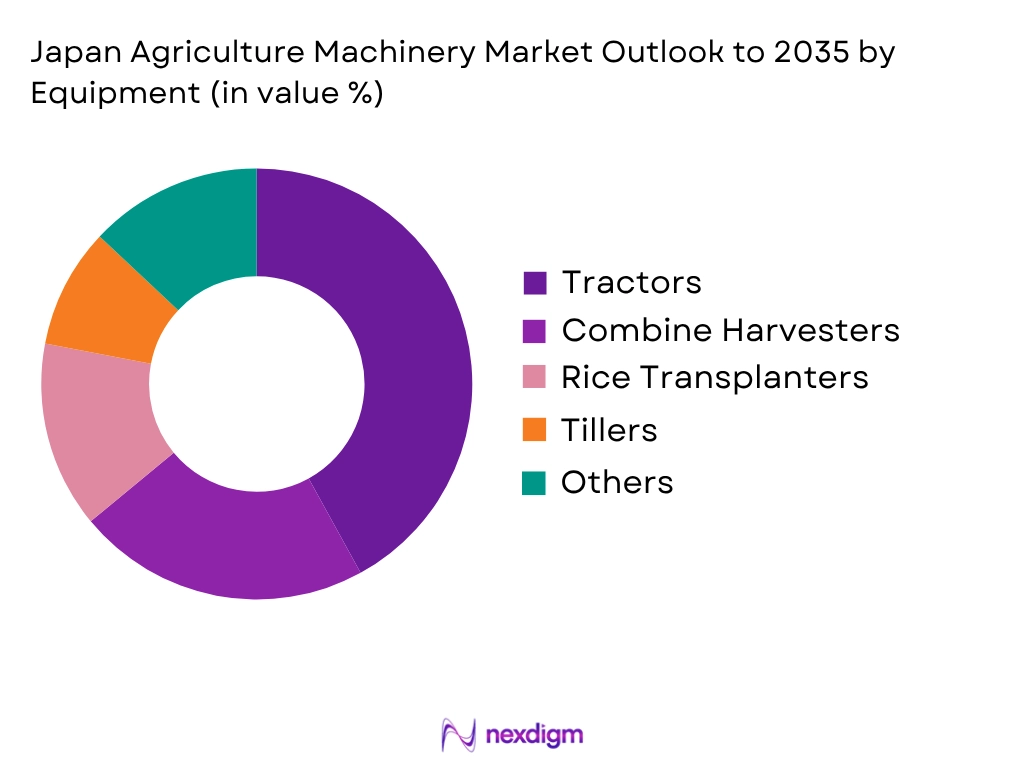
Japan agriculture machinery market is segmented by equipment type into tractors, combine harvesters, rice transplanters, tillers and cultivators, sprayers, seeders, planters and other machinery. Tractors hold the dominant market share because they are the primary power source for field preparation, haulage, paddy operations, horticulture and attachment-based farm work. Mordor Intelligence reports that tractors accounted for 41.30% of Japan’s agricultural machinery market in its latest published segmentation, reflecting their central role in farm mechanization. Tractors also remain relevant across both compact farms and larger Hokkaido farms, unlike rice transplanters and combines that are more crop-specific. Japan’s small and fragmented farm base supports compact and mid-horsepower tractor demand, while aging farmer demographics and smart agriculture policies are increasing adoption of auto-steering, autonomous tractors and easier-to-operate machines.
By Technology Level
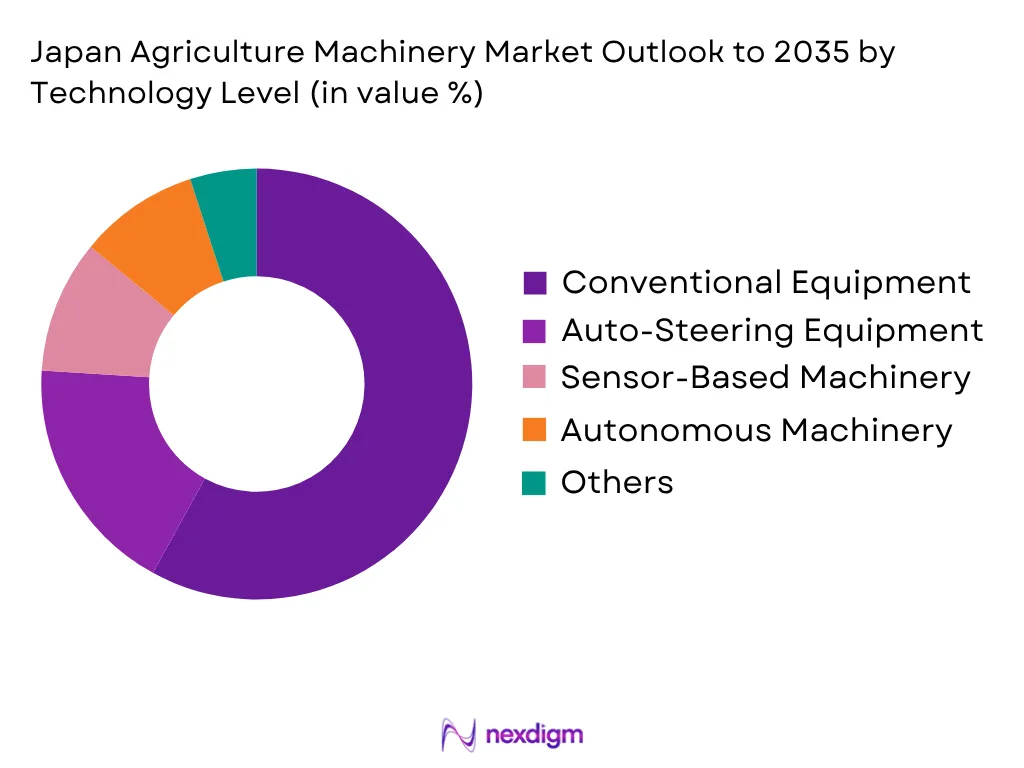
Japan agriculture machinery market is segmented by technology level into conventional mechanized equipment, GPS-enabled machinery, sensor-based smart machinery, autonomous machinery, drone-integrated farm equipment and electric robotic equipment. Conventional mechanized machinery currently dominates because Japan has a mature installed base of tractors, combines, rice transplanters, tillers and sprayers that support rice, vegetables, orchards and field crops. However, the market is shifting toward smart and autonomous equipment because Japan’s farm labor structure is under pressure. OECD notes that the agricultural workforce declined sharply, the average farm size rose from 1.4 hectares to 3.3 hectares, and the average farmer age reached 68.4 years in the latest MAFF-referenced data. MAFF’s smart agriculture program also promotes drones, automatic harvesters and data use from production to shipment, reinforcing the shift from conventional machinery toward connected and labor-saving equipment.
Competitive Landscape
Japan agriculture machinery market is highly consolidated around domestic OEMs with deep dealer networks, rice-machinery expertise and strong after-sales ecosystems. Kubota, Yanmar, Iseki and Mitsubishi Mahindra Agricultural Machinery dominate domestic farm equipment categories, while Deere, CNH, AGCO and CLAAS participate in high-horsepower, forage and large-farm applications, especially in Hokkaido. Competition is shaped by tractor strength, rice transplanter portfolios, autonomous machinery capability, financing, spare parts access and JA/cooperative-linked distribution.
| Company | Establishment Year | Headquarters | Core Japan Portfolio | Key Crop Focus | Technology Capability | Dealer / Service Strength | Smart Machinery Focus | Market Position |
| Kubota Corporation | 1890 | Osaka, Japan | ~ | ~ | ~ | ~ | ~ | ~ |
| Yanmar Holdings | 1912 | Osaka, Japan | ~ | ~ | ~ | ~ | ~ | ~ |
| Iseki & Co., Ltd. | 1926 | Tokyo / Matsuyama, Japan | ~ | ~ | ~ | ~ | ~ | ~ |
| Mitsubishi Mahindra Agricultural Machinery | 1980 | Shimane, Japan | ~ | ~ | ~ | ~ | ~ | ~ |
| Deere & Company Japan | 1837 | Moline, USA | ~ | ~ | ~ | ~ | ~ | ~ |
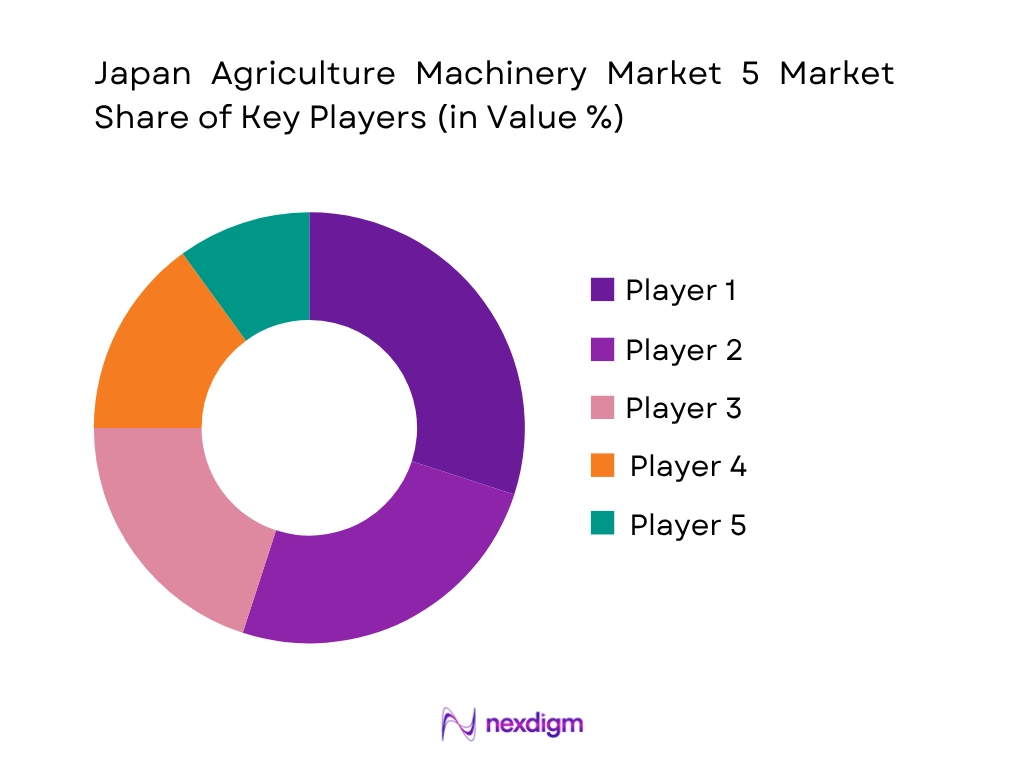
Japan Agriculture Machinery Market
Growth Drivers
Aging farm labour base is accelerating demand for labour-saving machinery
Japan agriculture machinery demand is strongly supported by the structural decline in farm labour and the need to maintain output with fewer operators. MAFF’s 2025 Basic Plan reference data states that core persons mainly engaged in farming numbered 1.11 million in 2024, with an average age of 69.2 years. The same MAFF material records domestic farmland at 4.27 million hectares in 2024, down from 4.83 million hectares in 2000, creating pressure to manage land with higher machine productivity. This directly supports tractors, combine harvesters, rice transplanters, autonomous tractors, robot mowers and drone-linked machinery because operators must complete seasonal work with less manual labour. World Bank macro indicators reinforce the investment base: Japan recorded USD 4.027 trillion GDP, USD 32,487.08 GDP per capita and 124 million population in 2024. For machinery suppliers, the market-specific implication is clear: equipment that reduces operator fatigue, simplifies fieldwork and supports older farmers will remain central to replacement and upgrade demand.
Smart agriculture policy is creating demand for autonomous and precision equipment
Japan agriculture machinery demand is being driven by policy-backed smart agriculture adoption, especially where technology reduces working hours and enables less-experienced operators to manage tractors, rice transplanters, sprayers and harvesters. MAFF’s smart agriculture material identifies robot tractors, rice planting machines with straight-drive functions, drones, remote water-management systems, high-speed direct sowing machines, yield-sensing combine harvesters and data platforms as key field technologies. In a Gifu rice-export case, MAFF reported managed area expanding from 164 hectares to 196 hectares, while exported rice output increased from 70 tons to 194 tons after introducing robot tractors and straight-drive rice planting equipment. In Miyazaki, smart machinery helped planted area increase from 16.7 hectares to 23.9 hectares. The same source highlights drones, automatic harvesters and data systems across vegetables, tea and sugarcane. IMF’s Japan country profile lists 122.656 million population and 2026 GDP at USD 4.38 trillion, showing a large advanced economy capable of supporting technology-led mechanization.
Market Challenges
Low farmer investment appetite is restraining replacement demand
Japan agriculture machinery faces a direct challenge from weak farmer investment appetite, particularly among small and aging farm households that delay replacement, repair old machines or depend on used equipment. The Japan Agricultural Machinery Manufacturers Association reported that the agricultural machinery market would remain sluggish in 2024, stating that farmers’ desire to purchase agricultural machinery remained low because farmers’ incomes had not increased. The same JAMMA country report identified agricultural material costs, logistics costs and foreign exchange risk from a weaker yen as key influencers of equipment sales. This challenge is market-specific because tractors, combines, rice transplanters and implements require substantial capital commitment and are often purchased only when farm scale, financing and seasonal utilization justify replacement. World Bank data shows Japan’s 2024 GDP per capita at USD 32,487.08, but this national macro strength does not directly translate into stronger machinery purchases among older farm households. With 124 million people and USD 4.027 trillion GDP, Japan remains a large economy, yet machinery OEMs still need financing, leasing, rentals and service-based models to reduce farmer purchase hesitation.
Small farmland base and fragmented operations limit large-equipment utilization
Japan agriculture machinery adoption is constrained by a limited and shrinking farmland base, which affects utilization economics for high-capacity tractors, large combines and advanced autonomous machinery. MAFF’s Basic Plan reference data records domestic farmland at 4.27 million hectares in 2024, compared with 4.83 million hectares in 2000. The same MAFF reference states that Japan’s domestic farmland area represents only about one-third of the farmland required to produce all food consumed domestically, reflecting structural land scarcity. OECD also notes that the average Japanese farm size increased from 1.4 hectares in 1990 to 3.4 hectares in 2023, but remains small compared with other OECD economies. This creates a market-specific challenge because high-horsepower machines are more suitable for Hokkaido and consolidated farms, while many rice, vegetable, orchard and hilly-area farmers require compact, narrow, low-turning-radius and terrain-specific machinery. World Bank’s 2024 population figure of 124 million and GDP of USD 4.027 trillion reinforce Japan’s large food-consumption base, but the production land structure limits broad adoption of oversized machinery.
Market Opportunities
Machinery sharing, rental and contractor models can expand access to advanced equipment
Japan agriculture machinery has a clear opportunity in machinery sharing, rental fleets, cooperative ownership and contractor-led operations because farmers need access to advanced machines without full ownership burden. MAFF’s smart agriculture material highlights Japan Agricultural Cooperatives owning smart agricultural machines and outsourcing harvest operations to reduce investment for farmers. The same MAFF document describes sharing rice-planting machines with straight-drive assist and combine harvesters with taste and yield sensors across three locations in Okayama to improve machinery utilization. This supports future demand for service-based models around rice planting, harvesting, mowing, spraying and smart-machine operation. The opportunity is supported by the structure of Japan’s farm base: MAFF reports 1.11 million core persons mainly engaged in farming in 2024 and an average age of 69.2 years, which makes outsourced equipment operation commercially relevant. IMF’s 2026 Japan profile records 122.656 million people and USD 4.38 trillion GDP, indicating that the broader economy can support organized mechanization services if models reduce individual farmer capital risk.
Specialty crop automation creates opportunities beyond conventional tractor sales
Japan agriculture machinery suppliers can capture growth by developing robots and specialized machines for vegetables, tea, orchards, sugarcane, greenhouse crops and steep-slope farming, rather than depending only on tractors and rice machinery. MAFF’s smart agriculture material lists field demonstrations for spinach, cabbage and carrot in Miyazaki, green tea in Kagoshima, and sugarcane in Okinawa, using drones, automatic harvesters, automatic sprinkler systems, robotic tea plantation management machines, automatic steering systems, environmental sensors and centralized data systems. MAFF also highlights compact agricultural robots usable on steep slopes, small electric trolleys, rice-planting machines and combine harvesters as technologies relevant for difficult terrain and labour-constrained farms. Organic agriculture data adds a further equipment angle: MAFF reported annual imports of about 60,000 tons of organic farm products into Japan, indicating local production gaps where labour-saving cultivation, weeding, monitoring and low-impact machinery can support domestic output. World Bank data places Japan’s 2024 GDP at USD 4.027 trillion and GDP per capita at USD 32,487.08, supporting demand for premium, specialized agricultural technologies.
Future Outlook
The Japan agriculture machinery market is expected to expand steadily as farming shifts from labor-intensive practices to smart, autonomous and service-based mechanization. Demand will be strongest in tractors, combines, rice transplanters, drone-linked spraying, autonomous vehicles, compact electric machinery and retrofit guidance systems. Government support for smart agriculture is also expected to improve adoption among aging farmers and agricultural corporations. The market will not be driven only by new unit replacement. Future growth will come from equipment upgrades, software-linked machinery, precision implements, rental models, cooperative machinery sharing and aftermarket services. Kubota’s autonomous Agri Robo series had around 700 machines shipped and in use on farms across Japan, showing that advanced machinery is moving from demonstration to commercial use.
Farm consolidation will increase demand for larger, high-utilization equipment, especially in Hokkaido and corporate farming clusters. At the same time, Japan’s fragmented plots will sustain demand for compact tractors, narrow orchard equipment, rice-specific machinery and small-scale tillers. Machinery makers will need differentiated portfolios rather than relying only on large tractor sales. Autonomous and smart machinery will become central to competitive positioning. MAFF’s smart agriculture material highlights use of drones, automatic harvesters and data collection across production and shipment, while OECD reported that MAFF allocated JPY 4,500 million to promote smart agricultural technologies. This policy environment supports machinery suppliers with robotics, telematics, remote diagnostics and farm management integration.
Major Players
- Kubota Corporation
- Yanmar Holdings Co., Ltd.
- Iseki & Co., Ltd.
- Mitsubishi Mahindra Agricultural Machinery Co., Ltd.
- Deere & Company Japan
- CNH Industrial Japan
- AGCO Corporation Japan
- CLAAS KGaA mbH Japan
- Mahindra & Mahindra Farm Equipment
- Honda Motor Co., Ltd. Power Products
- Maruyama Mfg. Co., Inc.
- Yamabiko Corporation
- Satake Corporation
- Shizuoka Seiki Co., Ltd.
- Takakita Co., Ltd.
Key Target Audience
- Agriculture machinery manufacturers
- Farm equipment dealers and distributors
- Tractor, combine and rice transplanter OEMs
- Smart agriculture technology providers
- Agricultural cooperatives and machinery service providers
- Farm equipment leasing and financing companies
- Investments and venture capitalist firms
- Government and regulatory bodies, including MAFF, METI, MLIT, Japan Agricultural Machinery Manufacturers Association and Japan Finance Corporation
Research Methodology
Step 1: Identification of Key Variables
The initial phase involves constructing an ecosystem map for the Japan agriculture machinery market, covering OEMs, dealers, JA cooperatives, component suppliers, farmers, contractors, leasing firms and smart agriculture companies. The key variables include equipment type, unit sales, farm size, crop application, technology level, dealer density, replacement cycle and regional farming structure.
Step 2: Market Analysis and Construction
In this phase, historical data is compiled across tractors, combine harvesters, rice transplanters, tillers, sprayers, seeders, planters and autonomous machinery. The market is assessed by equipment value, unit movement, regional demand, crop use, sales channel and aftermarket revenue, with triangulation through industry statistics and company disclosures.
Step 3: Hypothesis Validation and Expert Consultation
Market hypotheses are validated through CATI-style interviews with OEM executives, dealers, JA procurement participants, farm contractors, large farmers and smart agriculture providers. These consultations provide insights on replacement behavior, financing preferences, autonomous machinery adoption, service gaps, spare parts demand and channel margins.
Step 4: Research Synthesis and Final Output
The final phase integrates secondary research, expert inputs and bottom-up machinery demand indicators. Product categories, regional demand, competitive positioning and future outlook are cross-checked against farm demographics, rice production patterns, smart agriculture policy and dealer-level field intelligence to deliver a validated market view.

- Executive Summary
- Research Methodology (Market Definitions and Assumptions, Abbreviations, Farm Machinery Coverage, Market Sizing Approach, Top-to-Bottom Agricultural Equipment Demand Validation, Bottom-to-Top Unit Sales and Dealer Network Build-Up, Primary Interviews with OEMs/Dealers/JA Cooperatives/Farm Contractors/Large Farms, Secondary Research Validation, Smart Agriculture Adoption Mapping, Limitations and Future Conclusions)

- Definition and Scope
- Market Genesis
- Evolution of Japan’s Farm Mechanization Ecosystem
- Timeline of Major Players
- Business Cycle
- Supply Chain and Value Chain Analysis

- Growth Drivers (Aging Farmer Base, Labour-Saving Demand, Smart Agriculture Adoption, Rice Mechanization, Farm Consolidation, Hokkaido Large-Farm Equipment Demand, Government Demonstration Projects)
- Market Challenges (High Equipment Cost, Aging Smallholder Base, Declining Farm Numbers, Limited Replacement Appetite, Service Network Pressure, Terrain Fragmentation, Used Machinery Competition)
- Opportunities (Autonomous Machinery, Electric Compact Equipment, Drone-Linked Farming, Rental Models, Aftermarket Services, Smart Attachments, Greenhouse Robotics, Hilly Terrain Equipment)
- Trends (Smart Agriculture Demonstrations, Autonomous Tractor Commercialization, Drone Spraying, Farm Data Integration, Used Equipment Digitization, Dealer Consolidation, Aftermarket Digitalization)
- Government Regulation (Agricultural Machinery Safety Standards, Road Transport Compliance, Emissions Regulations, Smart Agriculture Subsidies, Drone Operation
- SWOT Analysis
- PESTLE Analysis
- Porter’s Five Forces Analysis
- Stakeholder Ecosystem

- By Value (2020-2025)
- By Unit Sales (2020-2025)
- By Average Selling Price (2020-2025)

- By Equipment Type (In Value %)
Tractors
Combine Harvesters
Rice Transplanters
Tillers and Cultivators
Sprayers - By Crop Application (In Value %)
Rice/Paddy Farming
Vegetables
Fruits and Orchards
Field Crops
Dairy and Forage Crops - By Sales Channel (In Value %)
OEM Dealer Network
JA Cooperative Channel
Independent Dealers
Online and Digital Sales Channels - By Region (In Value %)
Hokkaido
Tohoku
Kanto
Chubu
Kansai

- Market Share of Major Players on the Basis of Value and Unit Sales
- Cross Comparison Parameters (Rice Machinery Portfolio Depth, Compact Tractor Strength, Autonomous and Smart Agriculture Capability, Dealer and Service Center Coverage, Spare Parts and Aftermarket Strength, Financing/Leasing and Rental Support, Hokkaido Large-Farm Equipment Capability, Export and Used Equipment Network)
- SWOT Analysis of Major Players
- Pricing Analysis of Major Players
- Detailed Profiles of Major Companies
Kubota Corporation
Yanmar Holdings Co., Ltd.
Iseki & Co., Ltd.
Mitsubishi Mahindra Agricultural Machinery Co., Ltd.
Deere & Company Japan
CNH Industrial Japan
AGCO Corporation Japan
CLAAS KGaA mbH Japan
Mahindra & Mahindra Farm Equipment
Honda Motor Co., Ltd. Power Products
Maruyama Mfg. Co., Inc.
Yamabiko Corporation
Satake Corporation
Shizuoka Seiki Co., Ltd.
Takakita Co., Ltd.

- Market Demand and Utilization
- Purchasing Power and Budget Allocation
- Regulatory and Compliance Requirements
- Needs, Desires and Pain Point Analysis
Decision-Making Process

- By Value (2026-2035)
- By Unit Sales (20026-2035)
- By Average Selling Price (2026-2035)


 Request a Sample
 Ask for Customization
 Get a Quote
 Enquire Now