
 Download PDF
Market Overview
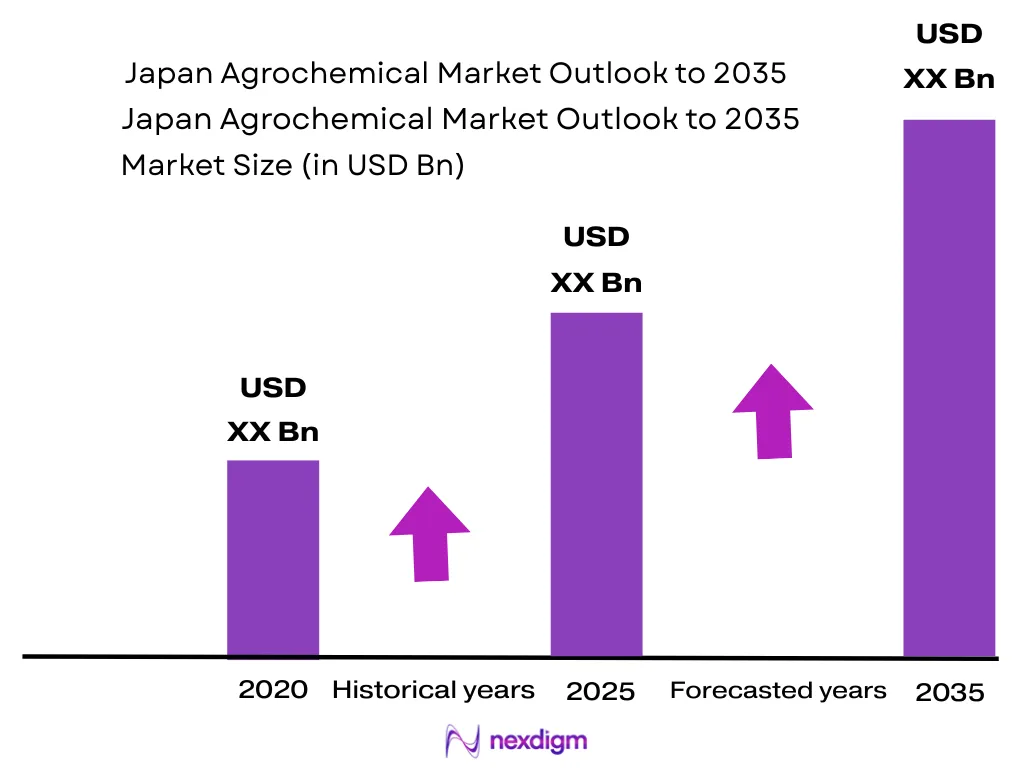
The Japan Agrochemical Market is valued at USD ~ billion, based on a five-year historical analysis, and is forecast to expand at a CAGR of 5.17% for the 2026–2035 period, reaching USD ~ billion by the end of the outlook period. Market demand is driven by high-intensity farming, limited arable land, rice and horticulture crop protection needs, and the shift toward sustainable inputs. Japan’s agricultural output reached JPY 9.5 trillion, while agricultural, forestry and fishery exports reached JPY 1.507 trillion, reinforcing demand for quality-compliant crop inputs. Japan’s agrochemical demand is concentrated in major agricultural production regions rather than only metropolitan cities. Hokkaido dominates because of large-scale field crops, dairy-linked feed crops, potatoes, wheat and sugar beet; its agricultural output exceeded JPY 1 trillion. Kagoshima and Ibaraki follow due to livestock-linked feed demand, vegetables, sweet potatoes, horticulture and proximity to food-processing supply chains. Rice-producing prefectures such as Niigata, Akita and Miyagi remain strategically important because paddy herbicide, blast fungicide and insecticide use is structurally tied to rice cultivation.
Market Segmentation
By Product Type
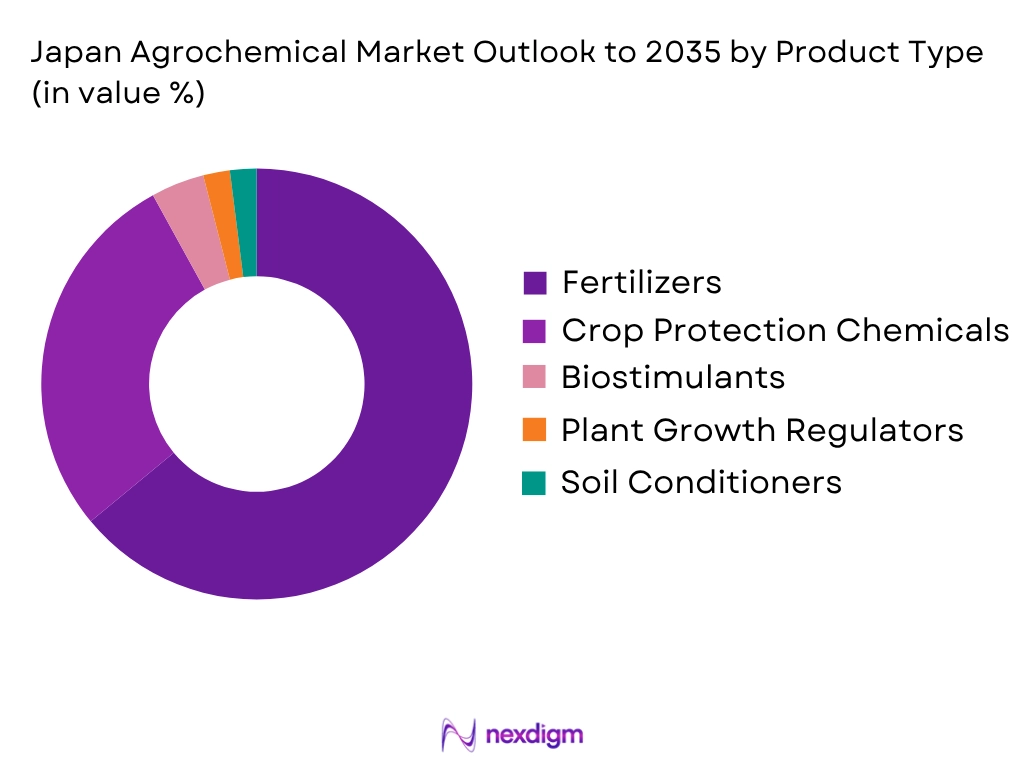
Japan Agrochemical Market is segmented by product type into fertilizers, crop protection chemicals, biostimulants and bio-based inputs, plant growth regulators, soil conditioners and adjuvants. Fertilizers hold the dominant market share because Japanese growers face pressure to maintain yield on limited agricultural land while managing soil fertility across rice, vegetables, fruits, tea and field crops. Spherical Insights identifies fertilizers as the largest product segment in Japan’s agrochemicals market, while crop protection chemicals remain highly strategic because of pest pressure, rice disease control, weed management and low-residue production requirements. Crop protection demand is supported by herbicides, fungicides, insecticides and biological solutions, particularly in paddy rice, orchards, greenhouses and vegetable production. Bio-based products are gaining relevance under Japan’s MIDORI strategy, but synthetic and conventional nutrition products remain the larger commercial base.
By Crop Application
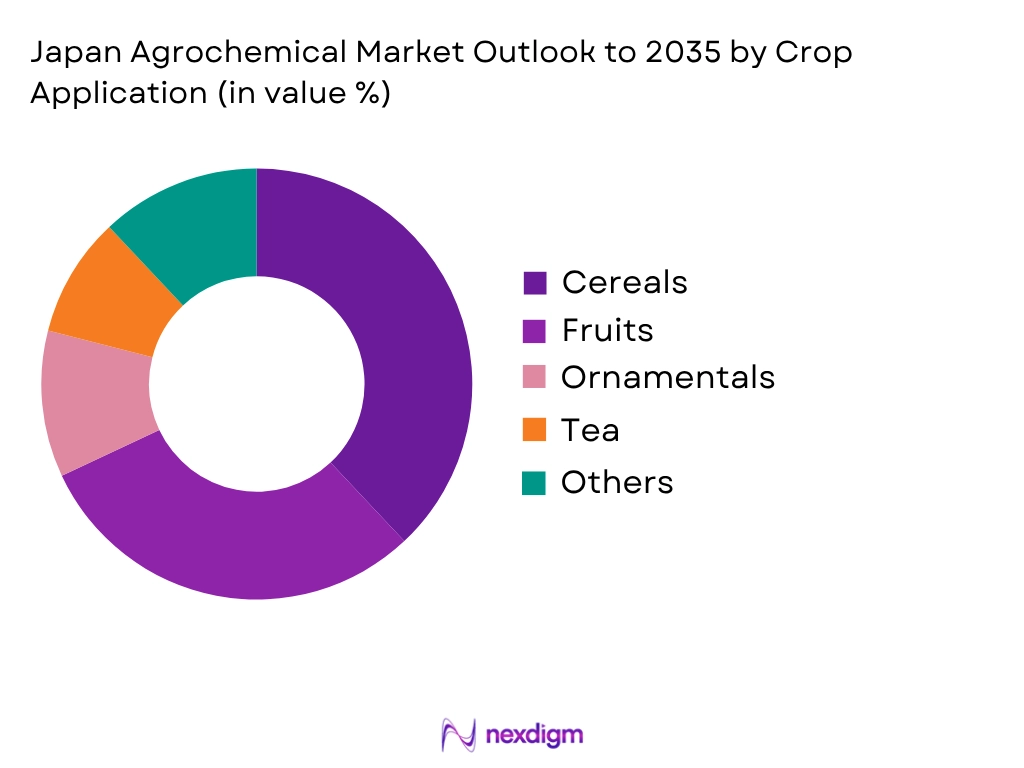
Japan Agrochemical Market is segmented by crop application into cereals and grains, fruits and vegetables, turf and ornamentals, tea and specialty crops, oilseeds and pulses, and greenhouse cultivation. Cereals and grains dominate because rice remains central to Japan’s food system and requires repeated input programs for weed suppression, seedling protection, blast disease management and planthopper control. Rice demand increased to 7.02 million tons during the latest reported demand cycle, while climate stress reduced the quality of major varieties, raising the need for crop protection and agronomic intervention. Fruits and vegetables form the second-largest segment because Japan’s horticulture sector requires high-value fungicides, miticides, insecticides and low-residue spray programs. Greenhouse and protected cultivation are smaller in value share but commercially attractive due to frequent pest monitoring, controlled-environment application and premium produce standards.
Competitive Landscape
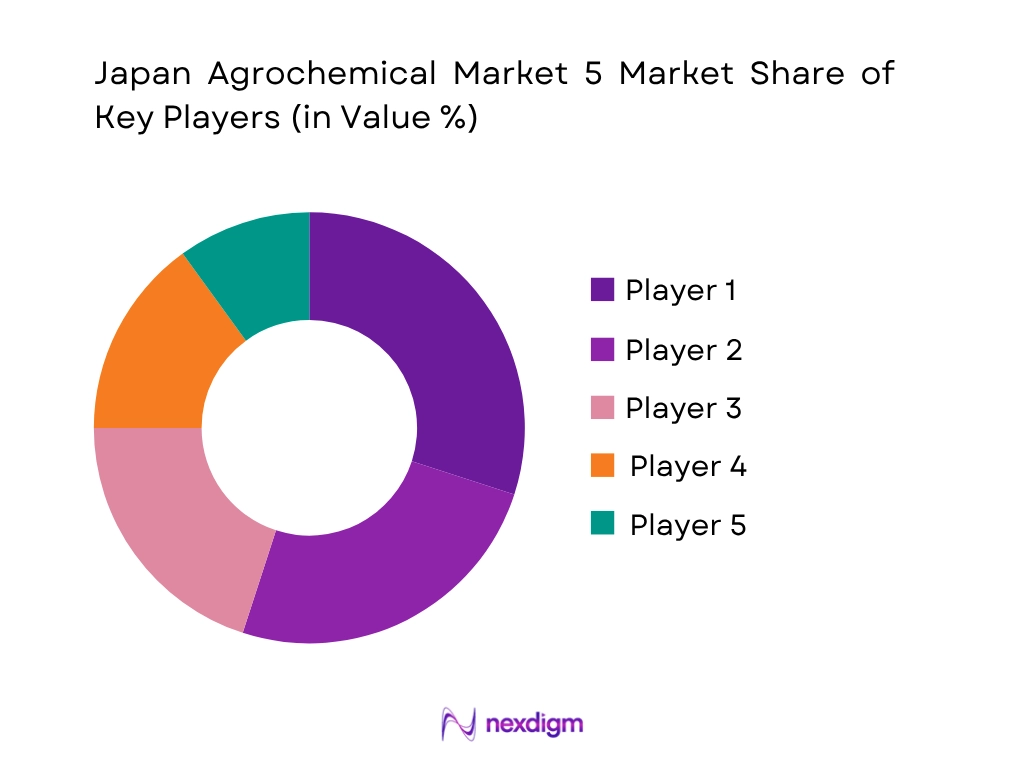
The Japan Agrochemical Market is moderately consolidated, with domestic innovators and global crop-science multinationals competing through registered active ingredients, crop-specific labels, dealer access, JA/cooperative channels and R&D-led product differentiation. Domestic companies such as Sumitomo Chemical, Kumiai Chemical, Nihon Nohyaku, Mitsui Chemicals Crop & Life Solutions and Nissan Chemical remain influential due to Japan-specific formulation know-how and rice/horticulture portfolios, while Bayer, Syngenta, BASF, Corteva and FMC compete through global pipelines and premium crop protection chemistry.
| Company | Establishment Year | Headquarters | Core Japan Portfolio | Key Crop Focus | Channel Strength | R&D Orientation | Biological/IPM Exposure | Regulatory Strength |
| Sumitomo Chemical | 1913 | Tokyo / Osaka | ~ | ~ | ~ | ~ | ~ | ~ |
| Kumiai Chemical Industry | 1928 business origin; 1949 company establishment | Tokyo | ~ | ~ | ~ | ~ | ~ | ~ |
| Nihon Nohyaku | 1928 | Tokyo / Osaka origin | ~ | ~ | ~ | ~ | ~ | ~ |
| Mitsui Chemicals Crop & Life Solutions | 2003 | Tokyo | ~ | ~ | ~ | ~ | ~ | ~ |
| Nissan Chemical | 1887 | Tokyo | ~ | ~ | ~ | ~ | ~ | ~ |
Japan Agrochemical Market
Growth Drivers
Rice and staple-crop protection intensity is supporting agrochemical demand
Japan’s agrochemical demand is strongly linked to rice, wheat and other staple crops because these crops require structured weed, disease and insect management across limited agricultural land. USDA FAS, citing MAFF estimates, reported Japan’s total rice acreage at 1.46 million hectares in 2024/25, while total rice production remained at 8 million metric tons and table rice production reached 6.79 million metric tons. Wheat also remains relevant for crop-protection and fertilizer demand, with Japan’s 2024/25 wheat output estimated at 1.08 million tons across 234,000 hectares. This crop base is supported by a large national food economy: the World Bank reported Japan’s GDP at USD 4.03 trillion and GDP per capita at USD 32,487.1 in 2024, sustaining purchasing capacity for food-quality compliance, farm mechanization and crop inputs. A population base of 123.98 million people keeps domestic food security strategically important, making disease control, paddy herbicides, seedling treatments and crop nutrition critical for maintaining reliable output.
Export-oriented food production is strengthening quality-compliant input use
Japan’s agrochemical market is also driven by export-linked production standards, especially for rice, green tea, fruits, vegetables, beef-linked feed crops and processed food supply chains that require consistent domestic raw material quality. MAFF reported that agricultural, forestry, fishery and food exports reached JPY 1.507 trillion in 2024, up from JPY 1.454 trillion in 2023, while exports to the United States reached JPY 242.9 billion and exports to China stood at JPY 168.1 billion. In 2025, the same export category increased further to JPY 1.701 trillion, and exports to the United States reached JPY 276.2 billion, reinforcing the importance of residue-compliant crop management and stable domestic production. This aligns with Japan’s macroeconomic base: the World Bank recorded Japan’s 2024 GDP at USD 4.03 trillion, while GDP per capita stood at USD 32,487.1, supporting premium food positioning and investment in compliant farming systems. Agrochemical suppliers benefit where products help growers meet residue limits, disease-control requirements and export buyer specifications.
Market Challenges
Aging farmer base and shrinking farmland constrain volume-led agrochemical expansion
Japan’s agrochemical market faces a structural challenge from declining farm labor and constrained cultivated land. MAFF-referenced data reported Japan’s total farmland at 4.3 million hectares in 2024, down from 6.1 million hectares at the historical peak, indicating a smaller physical base for crop-input application. The same MAFF-linked source reported core agricultural workers at 1.1 million people in 2024, compared with 2.4 million people in 2000, while the average age of core agricultural workers reached 69.2 years in 2024. These figures directly affect agrochemical demand because older and fewer farm operators tend to reduce labor-intensive spraying and accelerate consolidation, outsourcing, drone services or simplified crop programs. Japan’s macroeconomic scale remains large, with World Bank 2024 GDP at USD 4.03 trillion, but population pressure is negative for agricultural labor replenishment the World Bank recorded total population at 123.98 million people in 2024. For suppliers, this means growth depends less on higher sprayed area and more on labour-saving formulations, contractor channels, paddy granules, seedling box treatments and precision application services.
Strict pesticide registration and residue compliance create high entry barriers
Japan’s agrochemical market is highly regulated, making product entry, label expansion and continued commercialization complex for manufacturers. Under Japan’s Agricultural Chemicals Regulation Act, agricultural chemicals can be manufactured, sold and used only after registration, and applicants must submit dossiers covering efficacy, phytotoxicity, toxicity, crop residues and other safety data. This framework becomes more demanding because residue regulation is actively maintained Japan’s official pesticide residue database recorded updates based on Consumer Affairs Agency notification No. 129 dated April 8, 2026, covering test methods for MCPA, aminopyralid, clofentezine, dicamba, dithianon, sethoxydim and fludioxonil. The Japan Food Chemical Research Foundation also lists MRL information as current to May 20, 2026, showing that residue compliance remains operationally current. For agrochemical companies, the challenge is market-specific because rice, vegetables, fruits, tea and export-oriented crops require label precision and residue certainty. Macroeconomic resilience does not remove this hurdle: World Bank data places Japan’s 2024 GDP at USD 4.03 trillion, but regulatory failure can still block access to this high-value farming base.
Market Opportunities
Biological, organic-compatible and low-residue inputs offer expansion potential
Japan’s sustainability agenda creates a clear opportunity for biological crop protection, bio-based fertilizers, organic-compatible products, pheromone systems and IPM-supportive formulations. MAFF’s organic agriculture situation report states that approximately 60,000 tons of organic farm products are imported into Japan annually, equal to about 70 parts out of every 100 of the domestic graded quantity, indicating that domestic organic supply remains underdeveloped relative to consumption. The same MAFF update states that the government is promoting 100 organic villages in 2025, creating localized production areas where reduced-chemical and organic-compatible inputs can be adopted in clusters. This opportunity is supported by Japan’s broader demand base: the World Bank reported 123.98 million people in 2024, GDP of USD 4.03 trillion, and GDP per capita of USD 32,487.1. For agrochemical suppliers, the market-specific opening lies in replacing broad-spectrum chemical dependence with products that fit residue-sensitive vegetables, tea, fruits, greenhouse crops and export-oriented produce while still delivering reliable pest and disease control.
Smart agriculture and precision spraying create a channel for differentiated formulations
Labour scarcity and farm consolidation are creating an opportunity for drone-compatible formulations, ultra-low-volume sprays, robotic pesticide application, granular products and digital advisory-linked agrochemical programs. OECD’s Japan agricultural policy review reported that MAFF allocated JPY 4,500 million in 2024 to promote smart agricultural technologies, including automation systems, precision farming technologies and AI-driven decision-making tools. This matters directly for agrochemicals because precision tools change how products are applied, favouring formulations with drift control, compatibility with unmanned aerial spraying, stable dilution behaviour and targeted application performance. MAFF’s smart agriculture material published in 2025 highlights pesticide-spraying robots that can match furrow layouts through high-precision automatic driving, reflecting practical demand for labour-saving crop protection. The opportunity is reinforced by Japan’s farmer structure: core agricultural workers numbered 1.1 million and averaged 69.2 years in 2024, creating a strong operational case for outsourced and automated spraying models. A macro base of USD 4.03 trillion GDP in 2024 supports technology-led farm investment where products solve labor, precision and compliance constraints together.
Future Outlook
The Japan Agrochemical Market is expected to grow steadily as the country balances food security, aging farmer demographics, climate-linked pest pressure and environmental regulation. Growth will be strongest in low-dose formulations, biologicals, drone-compatible products, rice labour-saving packages, greenhouse pest control and high-value horticulture solutions. Japan’s policy direction is also shifting toward lower chemical risk and integrated pest management, creating opportunities for companies with registered products that combine efficacy, residue compliance and environmental safety. Demand for agrochemicals will not be volume-led alone; it will increasingly be value-led. Mature crop area, declining smallholder numbers and strict registration requirements will limit indiscriminate product expansion. However, replacement of older chemistry, re-registration pressure, precision application, export-compliant produce and climate adaptation will support higher-value portfolios. The strongest future opportunities are expected in bio-based crop protection, residue-sensitive fruit and vegetable programs, rice herbicide systems, seedling box treatments, foliar disease control, soil health products and data-driven crop advisory models. Regulation will remain a defining market force. Under Japan’s Agricultural Chemicals Regulation Act, agricultural chemicals must be registered before manufacture, sale or use, and applications require dossiers covering efficacy, phytotoxicity, toxicity, crop residues and safety. This creates high entry barriers, but it also protects premium suppliers with strong regulatory, trial and stewardship capabilities.
Major Players
- Sumitomo Chemical Co., Ltd.
- Mitsui Chemicals Crop & Life Solutions, Inc.
- Kumiai Chemical Industry Co., Ltd.
- Nihon Nohyaku Co., Ltd.
- Nissan Chemical Corporation
- Nippon Soda Co., Ltd.
- Hokko Chemical Industry Co., Ltd.
- Ishihara Sangyo Kaisha, Ltd.
- Agro-Kanesho Co., Ltd.
- OAT Agrio Co., Ltd.
- Bayer CropScience K.K.
- Syngenta Japan K.K.
- BASF Japan Ltd.
- Corteva Agriscience Japan Ltd.
- FMC Japan / FMC Chemical Co., Ltd.
Key Target Audience
- Agrochemical manufacturers
- Crop protection chemical companies
- Fertilizer and soil nutrition companies
- Biological crop input manufacturers
- Agricultural input distributors and dealers
- Investments and venture capitalist firms
- Government and regulatory bodies, including MAFF, FAMIC, Ministry of the Environment, Consumer Affairs Agency and MHLW
- Large farms, greenhouse operators and agricultural cooperatives
Research Methodology
Step 1: Identification of Key Variables
The initial phase involves constructing an ecosystem map for the Japan Agrochemical Market, covering manufacturers, importers, formulators, active ingredient suppliers, distributors, JA/cooperative channels, regulatory agencies and grower groups. The objective is to identify the variables that influence value creation, including registered product base, crop acreage, input intensity, application method and regional crop mix.
Step 2: Market Analysis and Construction
Historical market data is compiled using company disclosures, industry publications, registration databases, trade references and third-party market intelligence. The analysis reviews product category demand, crop-specific usage, import dependency, local formulation capacity, pricing benchmarks and distribution structure. Market sizing is validated through top-down agrochemical value assessment and bottom-up product/category reconstruction.
Step 3: Hypothesis Validation and Expert Consultation
Market hypotheses are validated through structured interviews with agrochemical manufacturers, distributors, agronomists, formulation specialists, regulatory professionals and large-scale growers. These consultations are used to confirm growth drivers, pricing behaviour, channel margins, farmer adoption patterns and the role of JA/cooperative procurement in different prefectures.
Step 4: Research Synthesis and Final Output
The final phase synthesizes desk research, primary insights, market sizing outputs and competitive intelligence into a validated market model. Segment shares, future outlook, competitive positioning and regulatory implications are cross-checked against crop demand, product registrations, application intensity and stakeholder feedback to ensure a consistent view of Japan’s agrochemical market.

- Executive Summary
- Research Methodology (Market Definitions and Assumptions, Agrochemical Product Coverage, Pesticide Registration Scope, Crop Protection Value Pool Mapping, Bottom-to-Top Channel Build-Up, Top-to-Bottom Import–Production–Consumption Validation, Primary Interviews with Formulators/Distributors/JA Channels/Farm Input Dealers, Secondary Research Validation, Price Basket Benchmarking, Active Ingredient Mapping, Limitations and Future Conclusions)

- Definition and Scope
- Market Genesis and Evolution
- Agricultural Landscape and Crop Protection Dependency
- Agrochemical Consumption Lifecycle
- Japan Farm Structure and Input Purchasing Behaviour
- Value Chain Analysis
- Supply Chain Analysis

- Growth Drivers (Aging Farmer Demographics, Labour-Saving Crop Protection, High-Value Horticulture Expansion, Rice Yield Protection, Smart Agriculture Adoption, Food Quality Standards)
- Market Challenges (Stringent Registration, Active Ingredient Review, Farmer Population Decline, Generic Price Pressure, Climate Variability, Public Scrutiny on Chemical Residues)
- Market Opportunities (Biopesticides, Precision Spraying, Greenhouse Crop Protection, Export-Compliant Produce, Specialty Formulations, Rice Labour-Saving Solutions)
- Market Trends (Sustainable Crop Protection, Digital Advisory, Consolidated Farms, Product Stewardship, Formulation Innovation, Domestic R&D Molecules)
- Government Regulation (Agricultural Chemicals Regulation Act, MAFF Registration, FAMIC Evaluation, Environmental Risk Assessment, Maximum Residue Limits, Proper Use Standards)
- SWOT Analysis
- PESTLE Analysis
- Porter’s Five Forces Analysis
- Stakeholder Ecosystem

- By Value (2020-2025)
- By Volume (2020-2025)
- By Average Selling Price (2020-2025)

- By Product Type (In Value %)
Herbicides
Fungicides
Insecticides
Nematicides
Plant Growth Regulators - By Crop Type (In Value %)
Rice/Paddy
Vegetables
Fruits
Tea
Cereals and Field Crops - By Distribution Channel (In Value %)
JA/Cooperative Channel
Independent Dealers and Wholesalers
Direct Sales to Large Farms and Corporate Farms
Online and Digital Channels - By Region (In Value %)
Hokkaido
Tohoku
Kanto and Chubu
Kansai, Chugoku and Shikoku

- Market Share of Major Players (Value Share, Volume Share, Product Category Share, Crop Segment Share, Channel Share)
- Cross Comparison Parameters (Registered Active Ingredient Portfolio, Crop–Pest Label Breadth, Rice Paddy Herbicide Strength, Specialty Horticulture Coverage, Biological/IPM-Compatible Product Portfolio, JA/Dealer Distribution Reach, Local Formulation and Supply Reliability, Regulatory Re-Registration and MRL Compliance Capability)
- SWOT Analysis of Major Players
- Pricing Benchmarking of Major Players (SKU-Level Price, Active Ingredient Concentration, Pack Size, Per-Hectare Application Cost, Dealer Margin, JA Procurement Price)
- Detailed Profiles of Major Companies
Sumitomo Chemical Co., Ltd.
Mitsui Chemicals Crop & Life Solutions, Inc.
Kumiai Chemical Industry Co., Ltd.
Nihon Nohyaku Co., Ltd.
Nissan Chemical Corporation
Nippon Soda Co., Ltd.
Hokko Chemical Industry Co., Ltd.
Ishihara Sangyo Kaisha, Ltd.
Agro-Kanesho Co., Ltd.
OAT Agrio Co., Ltd.
Bayer CropScience K.K.
Syngenta Japan K.K.
BASF Japan Ltd.
Corteva Agriscience Japan Ltd.
FMC Japan / FMC Chemical Co., Ltd.

- Farmer Demand and Utilization Pattern
- Purchasing Power and Crop Protection Budget Allocation
- Needs, Desires and Pain Point Analysis
- Decision-Making Process
- Switching Behaviour and Brand Loyalty

- By Value (2026-2035)
- By Volume (2026-2035)
- By Average Selling Price (2026-2035)


 Request a Sample
 Ask for Customization
 Get a Quote
 Enquire Now