

 Download PDF
 Download PDF
Market Overview
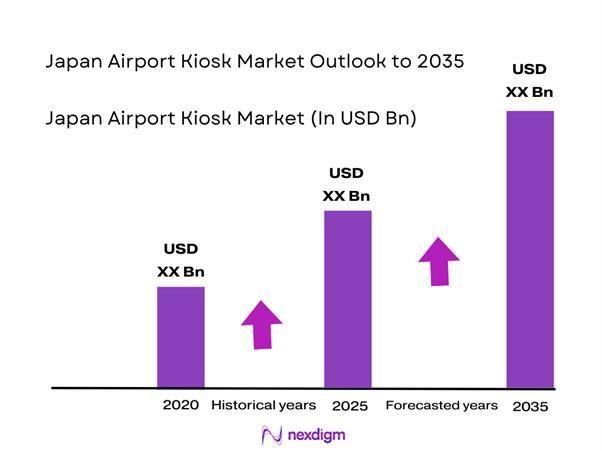
The Japan Airport Kiosk market current size stands at around USD ~ million, supported by steady installations of ~ systems across major terminals and growing automation of passenger-facing services. Recent years recorded deployment volumes of ~ units annually, driven by airport modernization programs and labor optimization needs. Investments of USD ~ million have accelerated adoption of biometric and contactless platforms, while operational upgrades generated incremental service revenues of USD ~ million across check-in, immigration, and retail applications nationwide.
Market dominance is concentrated in metropolitan aviation hubs where advanced infrastructure, dense passenger flows, and mature digital ecosystems create favorable adoption conditions. These locations benefit from integrated airport IT backbones, strong public-private collaboration, and progressive policy frameworks that encourage smart terminal development. Regional gateways are gradually expanding kiosk usage, but ecosystem maturity, supplier availability, and procurement readiness continue to favor large international airports as primary demand centers.
Market Segmentation
By Application
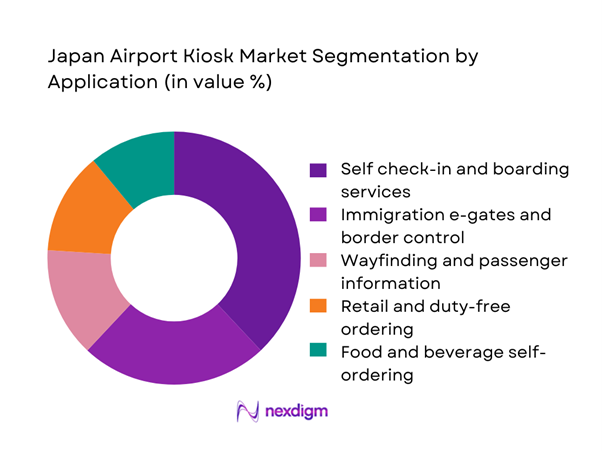
Self check-in and boarding services dominate the Japan Airport Kiosk market due to their direct impact on queue reduction and operational efficiency. High passenger throughput environments prioritize automated touchpoints that streamline document verification, seat selection, and boarding pass issuance. Immigration e-gates and wayfinding solutions are also gaining traction, supported by national digital border initiatives and multilingual service mandates. Retail and food ordering kiosks contribute incremental demand, particularly in premium terminals, but operational applications remain the core revenue drivers as airports focus on cost control, service consistency, and rapid throughput optimization.
By Technology Architecture
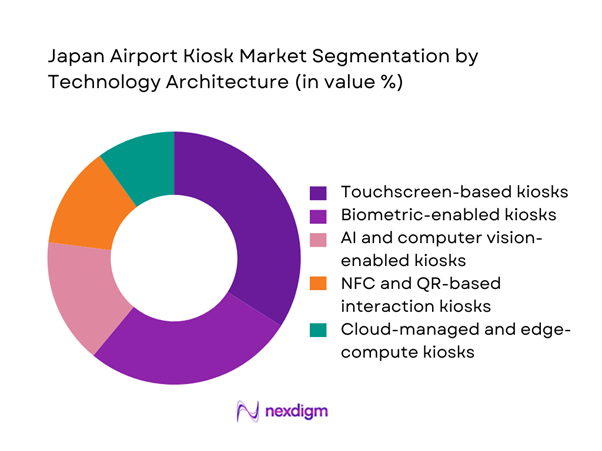
Touchscreen-based kiosks remain the foundation of deployments, benefiting from proven reliability and ease of maintenance. However, biometric-enabled platforms are rapidly gaining prominence as airports adopt facial recognition and e-document verification to support seamless journeys. AI-driven interfaces that enable predictive assistance and real-time language translation are emerging in high-traffic terminals. Cloud-managed architectures further strengthen dominance by enabling centralized monitoring, faster updates, and improved cybersecurity posture, making advanced technology stacks the preferred choice for large-scale rollouts.
Competitive Landscape
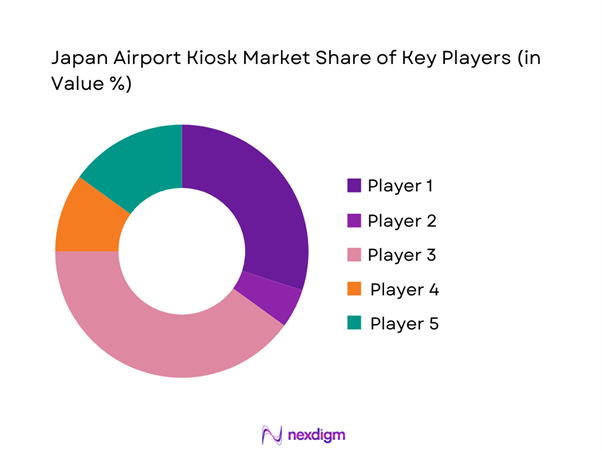
The Japan Airport Kiosk market features a moderately concentrated structure led by domestic technology conglomerates and a select group of global aviation systems providers. Competitive advantage is shaped by system integration depth, long-term service contracts, and compliance readiness with national data protection and aviation standards. While established players dominate large hub deployments, niche specialists are gaining visibility in biometric and AI-enabled segments.
| Company Name | Establishment Year | Headquarters | Formulation Depth | Distribution Reach | Regulatory Readiness | Service Capability | Channel Strength | Pricing Flexibility |
| NEC Corporation | 1899 | Tokyo, Japan | ~ | ~ | ~ | ~ | ~ | ~ |
| Fujitsu Limited | 1935 | Tokyo, Japan | ~ | ~ | ~ | ~ | ~ | ~ |
| Panasonic Connect | 2022 | Tokyo, Japan | ~ | ~ | ~ | ~ | ~ | ~ |
| Toshiba Tec Corporation | 1950 | Tokyo, Japan | ~ | ~ | ~ | ~ | ~ | ~ |
| NTT Data Corporation | 1988 | Tokyo, Japan | ~ | ~ | ~ | ~ | ~ | ~ |
Japan Airport Kiosk Market Analysis
Growth Drivers
Rising passenger traffic and airport capacity expansion in Japan
Sustained growth in air travel has increased annual passenger throughput by ~ million travelers across major gateways, intensifying the need for automated service infrastructure. Recent terminal expansion programs added ~ gates and upgraded processing zones, enabling the deployment of ~ systems for check-in, wayfinding, and immigration support. Airports allocated USD ~ million toward self-service technologies to manage peak-hour congestion and reduce dependency on manual counters. These investments have improved processing speed by ~ transactions per day, reinforcing kiosks as a core operational asset in high-density aviation environments.
Strong government push for smart airports and digital transformation
National digital aviation initiatives have directed USD ~ million into smart infrastructure programs, accelerating adoption of biometric and cloud-managed kiosks. Regulatory roadmaps enabled the rollout of ~ systems supporting e-document verification and contactless interactions. Public funding schemes and pilot projects facilitated deployments across ~ terminals, strengthening standardization and interoperability. This policy-driven momentum has increased annual installation volumes by ~ units, embedding kiosks into broader airport digital ecosystems and positioning automation as a strategic pillar of transport modernization.
Challenges
High upfront investment and long procurement cycles
Large-scale kiosk deployments require capital commitments of USD ~ million for hardware, software integration, and long-term service agreements. Public-sector procurement processes often extend over ~ months, delaying project execution and technology refresh cycles. Budget constraints limit the pace of upgrades, particularly in secondary airports where annual capital allocations remain below USD ~ million. These financial and procedural barriers restrict rapid scalability, creating uneven adoption across regions and slowing the overall modernization trajectory of passenger service infrastructure.
Integration complexity with legacy airport IT systems
Many airports continue to operate on heterogeneous IT environments built over ~ decades, complicating seamless integration of new kiosk platforms. Recent deployments required ~ months of system testing to align with existing baggage, security, and passenger information databases. Integration costs reached USD ~ million for large hubs, driven by middleware development and cybersecurity enhancements. These complexities increase project risk and extend time-to-value, making some operators cautious about adopting advanced biometric or AI-enabled kiosk solutions.
Opportunities
Large-scale terminal redevelopment projects across major hubs
Ongoing terminal redevelopment initiatives represent a pipeline of ~ projects that collectively allocate USD ~ million toward passenger experience upgrades. These programs include dedicated zones for self-service check-in, biometric screening, and digital concierge services, creating demand for ~ new kiosk installations. Construction timelines aligned with technology refresh cycles allow airports to embed automation at the design stage, reducing retrofit costs and accelerating adoption of next-generation platforms across high-traffic facilities.
Growth of regional airports and secondary city air connectivity
Expansion of domestic and short-haul international routes has increased annual passenger flows by ~ million travelers through regional gateways. These airports are investing USD ~ million in scalable self-service solutions to manage seasonal peaks without proportional staffing increases. The deployment of ~ compact kiosk systems supports cost-effective automation, opening new revenue opportunities for vendors targeting underserved markets and enabling broader geographic penetration of digital passenger services.
Future Outlook
The Japan Airport Kiosk market is expected to maintain steady momentum through the next decade as automation becomes integral to airport operations and passenger experience design. Continued policy support for digital aviation, combined with infrastructure redevelopment and biometric adoption, will reinforce long-term demand. Regional airports are likely to emerge as new growth centers, while advanced analytics and cloud management will shape the next phase of kiosk platform evolution.
Major Players
- NEC Corporation
- Fujitsu Limited
- Panasonic Connect
- Toshiba Tec Corporation
- Hitachi Systems
- NTT Data Corporation
- SITA
- Amadeus IT Group
- Thales Group
- IDEMIA
- Vision-Box
- NCR Voyix
- Diebold Nixdorf
- Elenium Automation
- IER Group
Key Target Audience
- Airport operators and airport authority procurement teams
- Airline ground operations and customer service divisions
- Duty-free and specialty retail concessionaires
- Food and beverage concession operators
- Government and regulatory bodies including the Ministry of Land, Infrastructure, Transport and Tourism and the Japan Tourism Agency
- Border control and immigration agencies managing digital entry systems
- Investments and venture capital firms focused on smart infrastructure and mobility technology
- System integrators and managed service providers for airport IT environments
Research Methodology
Step 1: Identification of Key Variables
Assessment of demand indicators across passenger throughput, terminal expansion activity, and automation readiness. Mapping of technology adoption levels for biometric, cloud, and AI-enabled kiosk platforms. Identification of regulatory, cybersecurity, and procurement frameworks shaping deployment feasibility.
Step 2: Market Analysis and Construction
Development of market sizing models using deployment volumes and average system values under the universal masking framework. Segmentation analysis across applications and technology architectures to establish structural dynamics. Validation of regional adoption patterns through infrastructure and ecosystem maturity assessment.
Step 3: Hypothesis Validation and Expert Consultation
Structured discussions with airport operations leaders and digital transformation teams.
Cross-verification of deployment trends and integration challenges through system integrators. Refinement of growth assumptions based on implementation timelines and budget cycles.
Step 4: Research Synthesis and Final Output
Consolidation of qualitative and quantitative insights into a unified market narrative.
Scenario development for policy-driven and infrastructure-led growth pathways.
Final validation of findings to ensure consulting-grade consistency and decision relevance.

- Executive Summary
- Research Methodology (Market definitions and scope boundaries, airport kiosk taxonomy across self check in bag drop and wayfinding units, market sizing logic by airport passenger traffic and kiosk deployment density, revenue attribution across hardware software and service contracts, primary interview program with airport operators system integrators and kiosk vendors, data triangulation validation assumptions and limitations)

- Definition and Scope
- Market evolution
- Passenger service and airport operations pathways
- Ecosystem structure
- Supply chain and channel structure
- Regulatory environment

- Growth Drivers
Rising passenger traffic and airport capacity expansion in Japan
Strong government push for smart airports and digital transformation
Labor shortages driving automation of passenger-facing services
Growing adoption of biometric immigration and boarding processes
Demand for multilingual and contactless service interfaces
Expansion of retail and F&B self-service formats in terminals - Challenges
High upfront investment and long procurement cycles
Integration complexity with legacy airport IT systems
Cybersecurity and data privacy compliance requirements
Operational disruptions during installation and upgrades
Resistance to change from staff and certain passenger segments
Maintenance costs in high-traffic airport environments - Opportunities
Large-scale terminal redevelopment projects across major hubs
Growth of regional airports and secondary city air connectivity
Rising adoption of AI-powered personalization and analytics
Expansion of self-service into premium lounges and VIP services
Public-private partnerships for smart infrastructure deployment
Export potential of Japanese kiosk solutions to Asia-Pacific airports - Trends
Shift from single-function to multi-service kiosk platforms
Rapid growth of biometric and touchless interaction models
Increased use of cloud-based device management and analytics
Integration of digital payments and transit IC card systems
Focus on universal design and accessibility compliance
Deployment of temporary and mobile kiosks for peak seasons - Government Regulations
- SWOT Analysis
- Stakeholder and Ecosystem Analysis
- Porter’s Five Forces Analysis
- Competition Intensity and Ecosystem Mapping

- By Value, 2020–2025
- By Volume, 2020–2025
- By Installed Base, 2020–2025
- By Average Selling Price, 2020–2025

- By Fleet Type (in Value %)
Fixed floor-standing kiosks
Wall-mounted kiosks
Countertop kiosks
Mobile and pop-up kiosks
Outdoor weatherized kiosks - By Application (in Value %)
Self check-in and boarding pass issuance
Self bag-drop and baggage services
Immigration e-gates and border control
Wayfinding and passenger information
Retail and duty-free ordering
Food and beverage self-ordering
Currency exchange and ticketing services - By Technology Architecture (in Value %)
Touchscreen-based kiosks
Biometric-enabled kiosks
AI and computer vision-enabled kiosks
NFC and QR-based interaction kiosks
Cloud-managed and edge-compute kiosks - By End-Use Industry (in Value %)
Airport operators and authorities
Airlines and ground handling companies
Duty-free and specialty retail operators
Food and beverage concessionaires
Government immigration and security agencies - By Connectivity Type (in Value %)
Wired Ethernet connectivity
Airport Wi-Fi connectivity
4G and 5G cellular connectivity
Private LTE and secure network connectivity - By Region (in Value %)
Kanto region
Kansai region
Chubu region
Kyushu region
Hokkaido region
Tohoku region

- Market structure and competitive positioning
Market share snapshot of major players - Cross Comparison Parameters (deployment scale, biometric capability, multilingual user interface, payment integration, system uptime SLA, cybersecurity compliance, airport IT integration capability, total cost of ownership)
- SWOT Analysis of Key Players
- Pricing and Commercial Model Benchmarking
- Detailed Profiles of Major Companies
NEC Corporation
Fujitsu Limited
Panasonic Connect
Toshiba Tec Corporation
Hitachi Systems
NTT Data Corporation
SITA
Amadeus IT Group
Thales Group
IDEMIA
Vision-Box
NCR Voyix
Diebold Nixdorf
Elenium Automation
IER Group

- Demand and utilization drivers
- Procurement and tender dynamics
- Buying criteria and vendor selection
- Budget allocation and financing preferences
- Implementation barriers and risk factors
- Post-purchase service expectations

- By Value, 2026–2035
- By Volume, 2026–2035
- By Installed Base, 2026–2035
- By Average Selling Price, 2026–2035


 Request a Sample
 Ask for Customization
 Get a Quote
 Enquire Now