
 Download PDF
 Download PDF
Market Overview
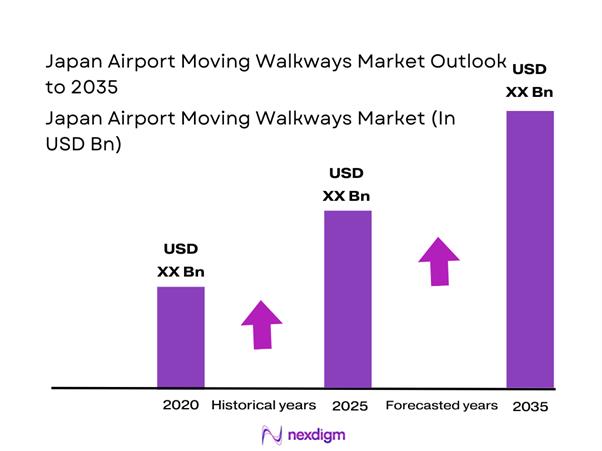
The Japan Airport Moving Walkways market current size stands at around USD ~ million, reflecting steady infrastructure-linked demand in the most recent period, where overall market value progressed from approximately USD ~ million to a higher consolidated level. This performance has been supported by sustained terminal redevelopment activity, replacement of aging passenger mobility systems, and the integration of accessibility-focused designs across major aviation hubs. Market momentum is further reinforced by operational efficiency targets, energy optimization mandates, and the growing role of automated people-mover ecosystems within airport master planning frameworks.
The market is primarily concentrated around large metropolitan airport clusters such as Tokyo, Osaka, and Nagoya, where passenger density, transfer complexity, and terminal scale create strong demand for advanced walkway systems. These regions benefit from mature contractor ecosystems, established elevator and escalator manufacturers, and supportive public infrastructure policies. The dominance of these cities is also shaped by continuous capacity expansion programs, higher standards for universal access, and stronger alignment between airport authorities and technology suppliers.
Market Segmentation
By Application
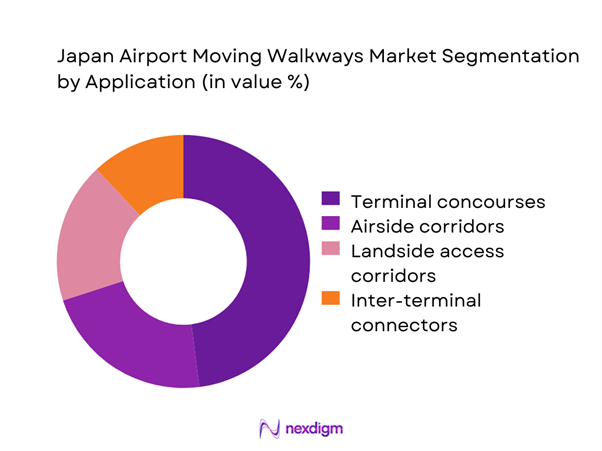
Terminal concourses dominate the Japan Airport Moving Walkways market due to their critical role in managing long-distance passenger circulation between security zones, boarding gates, and commercial areas. These zones experience the highest footfall intensity and demand continuous system uptime, driving consistent replacement and upgrade cycles. The dominance is further reinforced by the shift toward larger integrated terminals that combine domestic and international flows, increasing reliance on moving walkways for operational efficiency. In addition, concourse installations benefit from clearer return-on-investment metrics linked to reduced walking time, improved passenger satisfaction, and smoother transfer operations, making them a preferred focus area for airport authorities and private operators alike.
By Technology Architecture
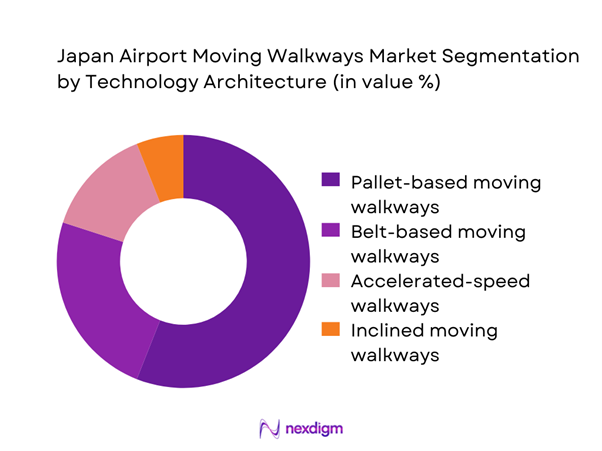
Pallet-based moving walkways hold a dominant position in the market due to their durability, higher load tolerance, and superior performance in high-traffic environments. Airports prioritize these systems for long-span and heavy-duty applications where reliability and safety margins are critical. The technology’s compatibility with accelerated-speed configurations further strengthens its adoption, especially in large terminals with extended walking distances. Additionally, pallet-based systems offer easier integration with modern safety sensors and monitoring platforms, aligning with airport digitalization strategies. As lifecycle cost considerations gain importance, this architecture continues to outperform alternatives in total cost of ownership evaluations.
Competitive Landscape
The Japan Airport Moving Walkways market is moderately concentrated, with a strong presence of domestic engineering leaders complemented by a limited number of global mobility solution providers. Competition is shaped by long-term service contracts, regulatory compliance strength, and the ability to deliver large-scale installations within complex airport environments.
| Company Name | Establishment Year | Headquarters | Formulation Depth | Distribution Reach | Regulatory Readiness | Service Capability | Channel Strength | Pricing Flexibility |
| Mitsubishi Electric Corporation | 1921 | Japan | ~ | ~ | ~ | ~ | ~ | ~ |
| Hitachi, Ltd. | 1910 | Japan | ~ | ~ | ~ | ~ | ~ | ~ |
| Fujitec Co., Ltd. | 1948 | Japan | ~ | ~ | ~ | ~ | ~ | ~ |
| KONE Corporation | 1910 | Finland | ~ | ~ | ~ | ~ | ~ | ~ |
| Schindler Group | 1874 | Switzerland | ~ | ~ | ~ | ~ | ~ | ~ |
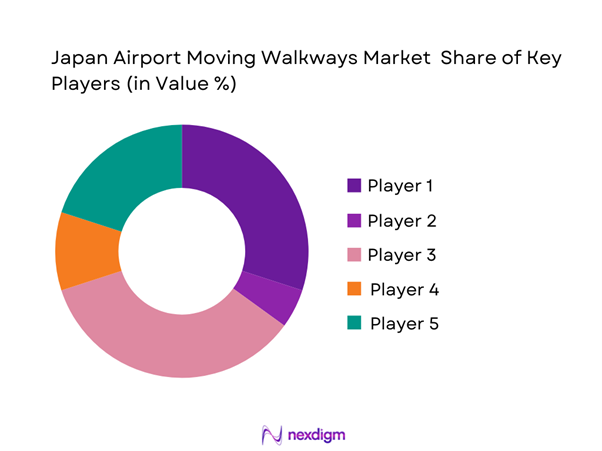
Japan Airport Moving Walkways Market Analysis
Growth Drivers
Rising passenger traffic and airport capacity expansion
Passenger throughput across major Japanese airports has expanded steadily, with annual traveler movement exceeding ~ million passengers in recent periods and terminal capacity additions crossing ~ square meters of new operational space. This expansion directly increases demand for moving walkways to maintain acceptable transfer times and reduce congestion in high-density zones. As airports add new piers and satellite terminals, the number of installed mobility systems has grown to over ~ units nationwide. These structural capacity upgrades consistently translate into repeat procurement cycles, reinforcing long-term demand stability for walkway manufacturers and service providers.
Government-led airport modernization programs
Public-sector investment programs have driven large-scale upgrades across strategic aviation assets, with cumulative infrastructure allocations surpassing USD ~ million for terminal automation and passenger experience enhancement. These initiatives have resulted in the replacement of more than ~ legacy walkway systems with modern, energy-efficient platforms. The government’s emphasis on universal design standards has also accelerated installations in older terminals, pushing annual deployment volumes above ~ systems. This policy-backed modernization cycle provides predictable project pipelines and reduces market volatility for suppliers focused on airport mobility solutions.
Challenges
High upfront installation and civil integration costs
The average turnkey cost for installing a single airport-grade moving walkway often exceeds USD ~ million when accounting for civil works, power integration, and safety systems. For multi-terminal projects, cumulative capital requirements can reach USD ~ million, creating budget constraints for regional airport operators. These high entry costs slow adoption in secondary airports, where passenger volumes remain below ~ million annually. As a result, procurement decisions are frequently delayed or phased, limiting short-term shipment volumes and stretching project timelines for equipment suppliers.
Complex retrofitting in space-constrained terminals
Retrofitting moving walkways in legacy terminals presents major engineering challenges, particularly in facilities handling more than ~ million passengers annually. Limited ceiling height, structural load restrictions, and continuous passenger flow complicate installation schedules, often extending project durations beyond ~ months. These constraints increase indirect costs and raise operational risks, making airport authorities cautious about large-scale replacements. The complexity also reduces the pool of qualified contractors, further constraining market scalability in mature urban airports.
Opportunities
Greenfield airport developments and terminal expansions
New airport projects and large terminal extensions create high-value opportunities, with each greenfield terminal typically requiring between ~ and ~ walkway systems depending on layout complexity. Recent development programs have allocated over USD ~ million toward passenger mobility infrastructure in upcoming facilities. These projects allow suppliers to deploy integrated solutions from the design phase, optimizing system placement and reducing lifecycle costs. As a result, greenfield developments offer higher-margin contracts and long-term service agreements compared with retrofit-heavy urban projects.
Upgrades of aging walkway fleets in major hubs
A significant portion of installed moving walkways in Japan’s primary airports exceeds ~ years of operational life, triggering replacement cycles driven by safety compliance and efficiency standards. Fleet renewal programs are replacing more than ~ units annually, representing a recurring revenue stream valued at approximately USD ~ million each year. These upgrades also open opportunities for digital retrofits, including sensor integration and predictive maintenance platforms, enabling suppliers to extend revenue beyond equipment sales into long-term service ecosystems.
Future Outlook
The Japan Airport Moving Walkways market is expected to maintain steady momentum through 2035, supported by continuous airport modernization, rising passenger mobility expectations, and the integration of smart infrastructure technologies. Future growth will be shaped by accelerated terminal expansion projects, increasing emphasis on accessibility, and the adoption of digitally enabled maintenance models that enhance system reliability and lifecycle performance.
Major Players
- Mitsubishi Electric Corporation
- Hitachi, Ltd.
- Fujitec Co., Ltd.
- Toshiba Elevator and Building Systems Corporation
- Nippon Otis Elevator Company
- KONE Corporation
- Schindler Group
- TK Elevator
- Hyundai Elevator Co., Ltd.
- SJEC Corporation
- Canny Elevator Co., Ltd.
- IFE Elevators Co., Ltd.
- Orona Group
- Sigma Elevator Company
- Stannah Lifts Holdings Ltd.
Key Target Audience
- Airport authorities and airport operating companies
- Ministry of Land, Infrastructure, Transport and Tourism of Japan
- Civil aviation regulatory agencies and safety certification bodies
- Terminal development and infrastructure project owners
- EPC contractors and airport system integrators
- Facilities management and maintenance service providers
- Smart airport technology platform providers
- Investments and venture capital firms
Research Methodology
Step 1: Identification of Key Variables
Demand drivers related to passenger traffic growth, terminal expansion scale, and infrastructure renewal cycles were identified. Key technology variables such as system architecture, energy efficiency, and digital integration levels were mapped. Regulatory requirements and safety compliance factors influencing procurement were also incorporated.
Step 2: Market Analysis and Construction
Historical deployment patterns, replacement cycles, and project pipelines were analyzed to structure baseline demand scenarios. Market boundaries were defined around airport-specific applications, excluding non-aviation installations. Segmentation frameworks were built around application and technology architecture lenses.
Step 3: Hypothesis Validation and Expert Consultation
Assumptions were validated through structured discussions with airport infrastructure planners, mobility system engineers, and maintenance service providers. Feedback loops helped refine demand elasticity, adoption timelines, and risk factors associated with retrofit projects.
Step 4: Research Synthesis and Final Output
All qualitative and quantitative inputs were synthesized into coherent market narratives. Scenario outcomes were stress-tested for policy shifts and capital spending cycles. Final outputs were structured to support strategic planning and investment decision-making.

- Executive Summary
- Research Methodology (Market definitions and scope boundaries, moving walkway system taxonomy across horizontal and inclined designs, market sizing logic by airport expansion and retrofit demand, revenue attribution across equipment installation and maintenance services, primary interview program with airports system integrators and MRO providers, data triangulation validation assumptions and limitations)

- Definition and Scope
- Market evolution
- Passenger flow and mobility pathways
- Ecosystem structure
- Supply chain and channel structure
- Regulatory and safety environment

- Growth Drivers
Rising passenger traffic and airport capacity expansion
Government-led airport modernization programs
Growing focus on accessibility and universal design
Demand for seamless inter-terminal connectivity
Increased adoption of automated passenger handling systems
Post-pandemic emphasis on contactless mobility solutions - Challenges
High upfront installation and civil integration costs
Complex retrofitting in space-constrained terminals
Stringent safety certification and compliance requirements
Long procurement and approval cycles in public projects
Maintenance downtime impacting passenger flow
Limited differentiation in mature product segments - Opportunities
Greenfield airport developments and terminal expansions
Upgrades of aging walkway fleets in major hubs
Integration with smart airport and digital twin platforms
Energy-efficient and regenerative drive technologies
Public-private partnership projects in regional airports
Export of Japanese engineering standards to overseas airports - Trends
Shift toward accelerated-speed and long-span systems
Adoption of predictive maintenance and remote monitoring
Growing preference for low-noise and low-vibration designs
Use of antimicrobial materials in high-touch surfaces
Standardization of modular walkway platforms
Increased lifecycle cost-based procurement decisions - Government Regulations
- SWOT Analysis
- Stakeholder and Ecosystem Analysis
- Porter’s Five Forces Analysis
- Competition Intensity and Ecosystem Mapping

- By Value, 2020–2025
- By Volume, 2020–2025
- By Installed Base, 2020–2025
- By Average Selling Price, 2020–2025

- By Fleet Type (in Value %)
New installations in greenfield airports
Replacement and modernization units
Temporary and modular walkways
Heavy-duty long-span systems - By Application (in Value %)
Terminal concourses
Airside corridors
Landside access corridors
Inter-terminal connectors - By Technology Architecture (in Value %)
Pallet-based moving walkways
Belt-based moving walkways
Accelerated-speed walkways
Inclined moving walkways - By End-Use Industry (in Value %)
International airports
Regional and domestic airports
Mixed-use airport complexes - By Connectivity Type (in Value %)
Standalone systems
Building management system integrated
IoT-enabled predictive maintenance systems - By Region (in Value %)
Kanto region
Kansai region
Chubu region
Kyushu region
Hokkaido region
Other prefectures

- Market structure and competitive positioning
Market share snapshot of major players - Cross Comparison Parameters (product reliability, installation lead time, lifecycle cost, service network depth, safety certification portfolio, digital maintenance capability, energy efficiency rating, customization flexibility)
- SWOT Analysis of Key Players
- Pricing and Commercial Model Benchmarketing
- Detailed Profiles of Major Companies
Mitsubishi Electric Corporation
Hitachi, Ltd.
Fujitec Co., Ltd.
Toshiba Elevator and Building Systems Corporation
Nippon Otis Elevator Company
KONE Corporation
Schindler Group
TK Elevator
Hyundai Elevator Co., Ltd.
SJEC Corporation
Canny Elevator Co., Ltd.
IFE Elevators Co., Ltd.
Orona Group
Sigma Elevator Company
Stannah Lifts Holdings Ltd.

- Demand and utilization drivers
- Procurement and tender dynamics
- Buying criteria and vendor selection
- Budget allocation and financing preferences
- Implementation barriers and risk factors
- Post-purchase service expectations

- By Value, 2026–2035
- By Volume, 2026–2035
- By Installed Base, 2026–2035
- By Average Selling Price, 2026–2035


 Request a Sample
 Ask for Customization
 Get a Quote
 Enquire Now