

 Download PDF
 Download PDF
Market Overview
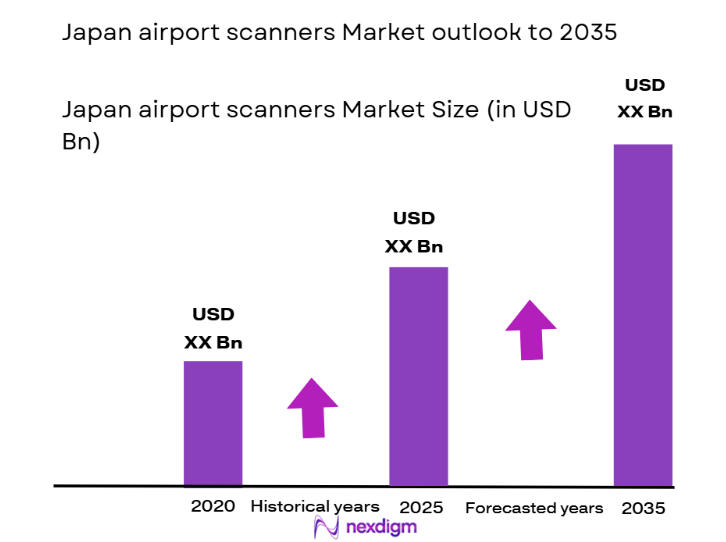
The Japan Airport Scanners market is valued at USD ~ billion in 2025 and is driven by the increased focus on airport security, technological advancements, and government regulations. With continuous improvements in screening systems, the market has been benefiting from both the rising demand for high-tech solutions and the growing number of air travelers. As the Japanese government focuses on enhancing public safety and modernizing airport infrastructure, airport scanners play a critical role in ensuring secure and efficient passenger and baggage screening at all entry points.
Dominant players in the Japan Airport Scanners market include major cities such as Tokyo, Osaka, and Fukuoka. Tokyo, being the capital and home to one of the busiest airports globally, Narita International Airport, leads in demand for advanced security systems. Osaka follows closely with its expanding airport capacity to accommodate increasing passenger traffic. Fukuoka, with its growing tourism industry, is also seeing an uptick in airport infrastructure investments. These regions dominate the market due to their high-volume traffic, government-led initiatives, and the continual demand for upgraded security systems.
Market Segmentation
By System Type
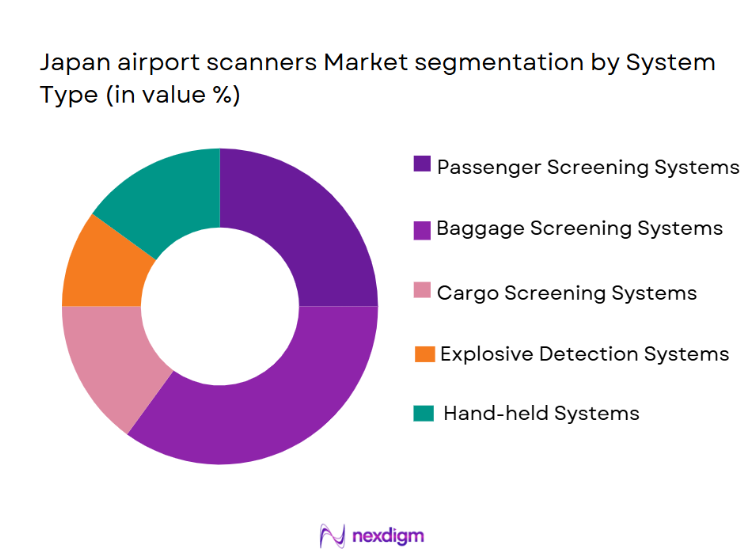
The Japan Airport Scanners market is segmented by system type into passenger screening systems, baggage screening systems, cargo screening systems, explosive detection systems, and hand-held scanners. Recently, baggage screening systems have held a dominant market share due to the increasing focus on handling larger volumes of checked luggage and ensuring high levels of security for both passengers and cargo. The rapid development of high-tech baggage screening systems, such as 3D CT scanners, has been a major factor in this dominance, along with the increasing automation of baggage screening processes at major airports in Japan.
By Platform Type
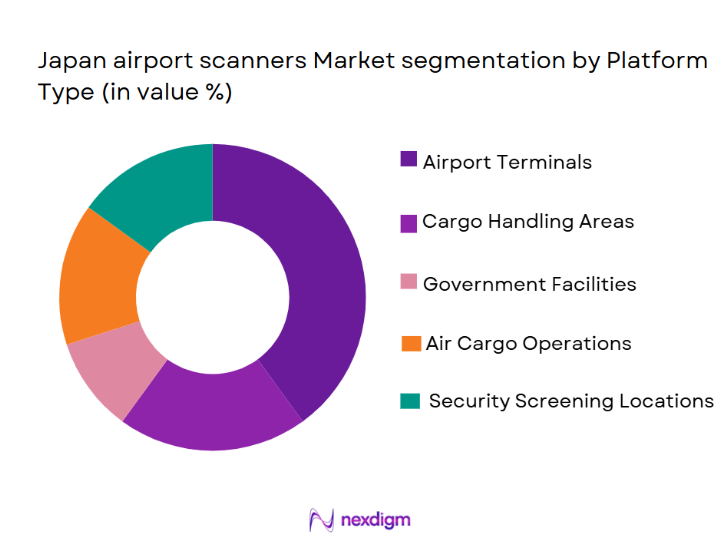
The Japan Airport Scanners market is segmented by platform type into airport terminals, cargo handling areas, government facilities, air cargo operations, and security screening locations. Airport terminals dominate the market due to the high passenger traffic passing through them. Major airports in Japan, such as Narita and Kansai, heavily invest in cutting-edge security systems at terminals to provide fast and secure screening. Furthermore, these terminals require robust, high-efficiency screening technologies due to passenger volume, fueling the demand for integrated scanner systems.
Competitive Landscape
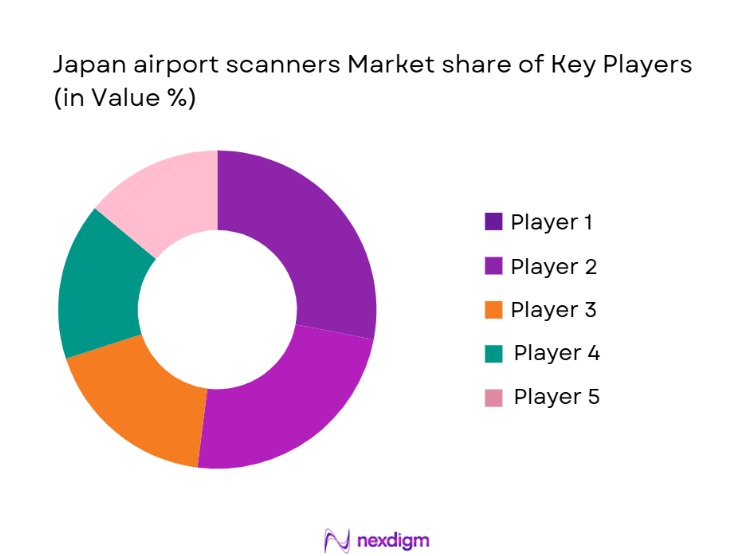
The Japan Airport Scanners market is dominated by a few major players, including global brands like Smiths Detection, L3 Technologies, and Rapiscan Systems. These companies leverage cutting-edge technologies, substantial research and development investments, and strategic partnerships to maintain a stronghold in the market. The consolidation of key players indicates their strong influence and ability to provide advanced security solutions for Japan’s bustling airport infrastructure.
| Company Name | Establishment Year | Headquarters | Technology Focus | Market Reach | Key Products | Revenue (2023) |
| Smiths Detection | 1982 | London, UK | ~ | ~ | ~ | ~ |
| L3 Technologies | 1997 | New York, USA | ~ | ~ | ~ | ~ |
| Rapiscan Systems | 1993 | Torrance, USA | ~ | ~ | ~ | ~ |
| Nuctech | 2000 | Beijing, China | ~ | ~ | ~ | ~ |
| Astrophysics Inc. | 1985 | California, USA | ~ | ~ | ~ | ~ |
Japan Airport Scanners Market Analysis
Growth Drivers
Increasing Air Travel Volume
The surge in international air traffic, particularly in and out of Japan’s major airports like Narita and Haneda, is a key driver of the airport scanner market. As travel demand grows, the need for efficient and secure screening processes escalates. The government’s focus on enhancing security systems to handle the rising volume of passengers ensures continued investments in scanner technologies. In response, more advanced scanners capable of higher throughput and better security features are being adopted, meeting the challenges of a growing number of travelers.
Technological Advancements
Advancements in scanning technologies, such as the integration of artificial intelligence, biometric systems, and high-resolution imaging, have been a significant growth driver. These technologies improve detection capabilities, reduce processing times, and enhance the overall passenger experience. The move toward more advanced security solutions, driven by the Japanese government’s commitment tomaintaining cutting-edge infrastructure, will continue to drive growth. As technologies such as AI-driven algorithms and machine learning continue to evolve, they promise even more sophisticated and efficient scanning processes, further boosting demand for these systems.
Market Challenges
Regulatory and Compliance Challenges
The need to adhere to ever-evolving government regulationsregarding airport security poses a challenge for manufacturers. Strict standards for data privacy and security often complicate the deployment of new scanning technologies. Compliance with these standards requires substantial investments in research and development, which can be a hurdle for smaller players in the market. Moreover, as security measures become increasingly stringent, ensuring scanners meet the latest compliance requirements without disrupting airport operations adds another layer of complexity to market expansion.
High Initial Investment Costs
The capitalrequired to install and maintain advanced scanning systems can be prohibitively high. Smaller airports or those with limited budgets may find it challenging to adopt the latest technologies. This creates a barrier to the widespread adoption of cutting-edge security solutions, particularly for facilities with limited financial resources. The upfront cost of implementing body scanners, baggage scanners, and cargo systems can prevent some airports from modernizing their security infrastructure quickly enough to meet the growing demands of air travel and regulatory standards.
Opportunities
Smart Airport Development
Japan’s vision of transforming its airports into smart hubs offers substantial opportunities for the airport scanner market. The integration of biometric identification, AI, and IoT technologies presents significant potential for scanners capable of seamless integration into smart security ecosystems. This transformation is expected to drive the demand for modern scanner solutions over the coming years. As airports evolve to become more connected and efficient, the market willbenefit from increased demand for next-generation scanning systems that enhance the passenger experience while maintaining high security.
International Events and Security Demands
The preparation for international events like the World Expoprovides a unique opportunity for the airport scanner market. Increased focus on high-security measures during such events will spur demand for more advanced and reliable screening technologies. These events provide a lucrative market for scanner manufacturers looking to supply large-scale, high-quality security systems. The heightened need for effective security solutions during such high-profile events will also drive innovation and technological development in airport scanning systems.
Future Outlook
Over the next few years, the Japan Airport Scanners market is expected to show steady growth driven by continuous advancements in scanning technology, government investments in airport infrastructure, and growing concerns about air travel security. The need for high-security measures in response to global threats and the increasing volume of passengers will further fuel the demand for more efficient and reliable airport screening solutions. Moreover, the development of AI-powered scanners and automated systems will enhance market growth.
Major Players
- Smiths Detection
- L3 Technologies
- Rapiscan Systems
- Nuctech
- Astrophysics Inc.
- Leidos
- SICK AG
- ZKTeco
- VOTI Detection
- Gilardoni
- CEIA
- Teledyne Technologies
- Bosch Security Systems
- Vanderlande
- X-ray Systems International
Key Target Audience
- Investments and venture capitalist firms
- Government and regulatory bodies
- Airport authorities
- Airport operators
- Airlines
- Security contractors
- Baggage handling companies
- Customs and border control agencies
Research Methodology
Step 1: Identification of Key Variables
The initial phase involves constructing an ecosystem map encompassing all major stakeholders within the Japan Airport Scanners Market. This step is underpinned by extensive desk research, utilizing a combination of secondary and proprietary databases to gather comprehensive industry-level information. The primary objective is to identify and define the critical variables that influence market dynamics.
Step 2: Market Analysis and Construction
In this phase, historical data pertaining to the Japan Airport Scanners Market will be compiled and analyzed. This includes assessing market penetration, the ratio of marketplaces to service providers, and resultant revenue generation. Furthermore, an evaluation of service quality statistics will be conducted to ensure the reliability and accuracy of the revenue estimates.
Step 3: Hypothesis Validation and Expert Consultation
Market hypotheses will be developed and subsequently validated through computer-assisted telephone interviews (CATI) with industry experts representing a diverse array of companies. These consultations will provide valuable operational and financial insights directly from industry practitioners, which will be instrumental in refining and corroborating the market data.
Step 4: Research Synthesis and Final Output
The final phase involves direct engagement with multiple airport scanner manufacturers to acquire detailed insights into product segments, sales performance, consumer preferences, and other pertinent factors. This interaction will serve to verify and complement the statistics derived from the bottom-up approach, ensuring a comprehensive, accurate, and validated analysis of the Japan Airport Scanners Market.

- Executive Summary
- Research Methodology (Definitions, Scope, Industry Assumptions, Market Sizing Approach, Primary & Secondary Research Framework, Data Collection & Verification Protocol, Analytic Models & Forecast Methodology, Limitations & Research Validity Checks)

- Market Definition and Scope
- Value Chain & Stakeholder Ecosystem
- Regulatory / Certification Landscape
- Sector Dynamics Affecting Demand
- Strategic Initiatives & Infrastructure Growth

- Growth Drivers
Increasing security concerns in airports
Advancements in scanning and detection technology
Government initiatives to upgrade airport infrastructure - Market Challenges
High capital expenditure for installation
Regulatory compliance and certification challenges
Complexity in integration with existing systems - Market Opportunities
Growing demand for non-intrusive screening solutions
Technological advancements in AI and machine learning
Increase in international travel post-pandemic - Trends
Integration of AI in airport scanning systems
Shift towards automated screening processes
Growth in demand for touchless and contactless screening technologies

- By Market Value 2020-2025
- By Installed Units 2020-2025
- By Average System Price 2020-2025
- By System Complexity Tier 2020-2025

- By System Type (In Value%)
Passenger Screening Systems
Baggage Screening Systems
Cargo Screening Systems
Explosive Detection Systems
Hand-held Scanners - By Platform Type (In Value%)
Airport Terminals
Cargo Handling Areas
Government Facilities
Air Cargo Operations
Security Screening Locations - By Fitment Type (In Value%)
Fixed Systems
Mobile Systems
Hybrid Systems
Modular Systems
Portable Systems - By EndUser Segment (In Value%)
Airport Authorities
Cargo Handling Services
Government & Law Enforcement
Airlines
Security Contractors - By Procurement Channel (In Value%)
Direct Procurement from Manufacturers
Distributor/Dealer Networks
Online Sales Channels
Government Contracts
Private Contractors

- Market Share Analysis
- CrossComparison Parameters (Product Innovation, Market Reach, Strategic Partnerships, Cost Efficiency, Technological Advancements)
- SWOT Analysis of Key Competitors
- Pricing & Procurement Analysis
- Porter’s Five Forces
- Key Players
Smiths Detection
L3 Technologies
Rapiscan Systems
Nuctech
AS&E
Gilardoni
Astrophysics Inc.
VOTI Detection
NCR Corporation
Leidos
SICK AG
Crisplant
Zebra Medical
Vanderlande
X-ray Systems International

- Airports upgrading to modern security systems
- Airlines seeking faster and more efficient passenger screening
- Government focusing on public safety through improved airport security
- Private contractors seeking cost-effective, scalable solutions

- Forecast Market Value 2026-2035
- Forecast Installed Units 2026-2035
- Price Forecast by System Tier 2026-2035
- Future Demand by Platform 2026-2035


 Request a Sample
 Ask for Customization
 Get a Quote
 Enquire Now