

 Download PDF
 Download PDF
Market Overview
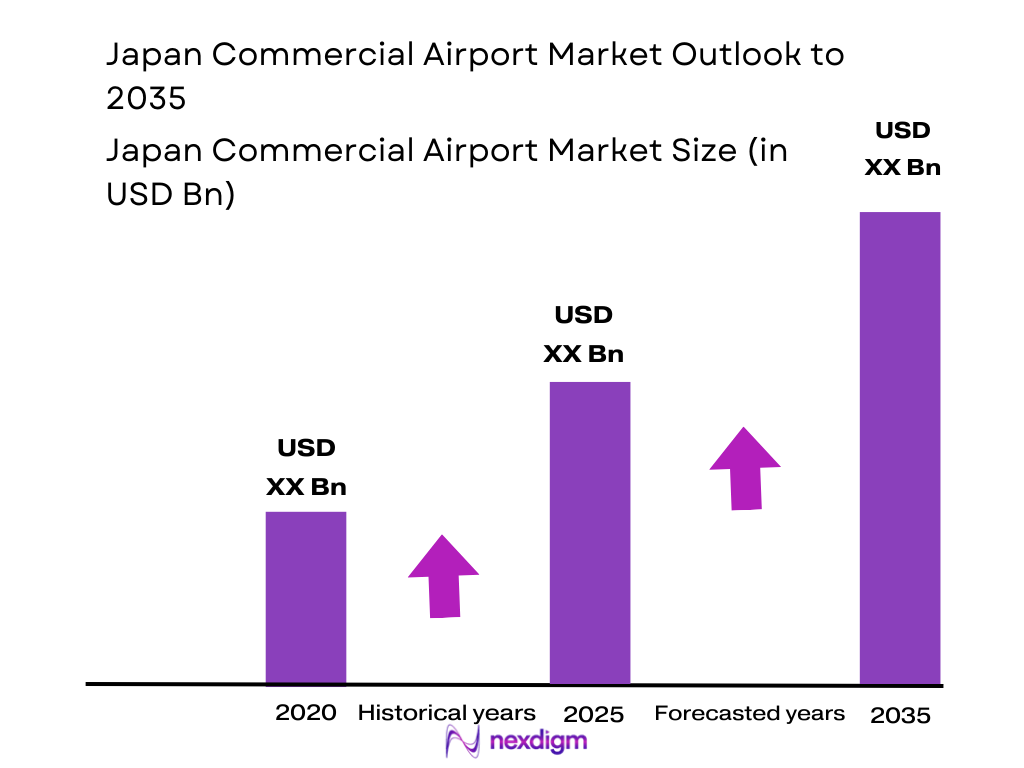
Based on a recent historical assessment, the Japan Commercial Airport Market recorded a total market size of USD ~ billion, reflecting combined capital expenditure, operational spending, and technology investments across commercial airports. This market size is driven by sustained passenger traffic recovery, large-scale terminal redevelopment programs, and airside capacity enhancements led by national aviation authorities. Government-backed infrastructure funding, fleet expansion by domestic carriers, and modernization of baggage handling, security, and digital passenger systems continue to stimulate expenditure. Strong demand for resilient, high-capacity airport infrastructure supporting tourism, trade, and business mobility underpins overall market momentum.
Based on a recent historical assessment, Tokyo remains the dominant city due to the operational scale of Haneda and Narita airports, supported by dense passenger flows, international connectivity, and continuous infrastructure upgrades. Osaka follows, driven by Kansai International Airport’s role as a major western Japan gateway and logistics hub. Nagoya maintains importance due to industrial traffic linked to manufacturing clusters. National dominance is reinforced by Japan’s strong regulatory framework, advanced engineering capabilities, and consistent public investment. Integrated rail connectivity, technology adoption, and disaster-resilient airport design further strengthen Japan’s leadership position.
Market Segmentation
By Product Type
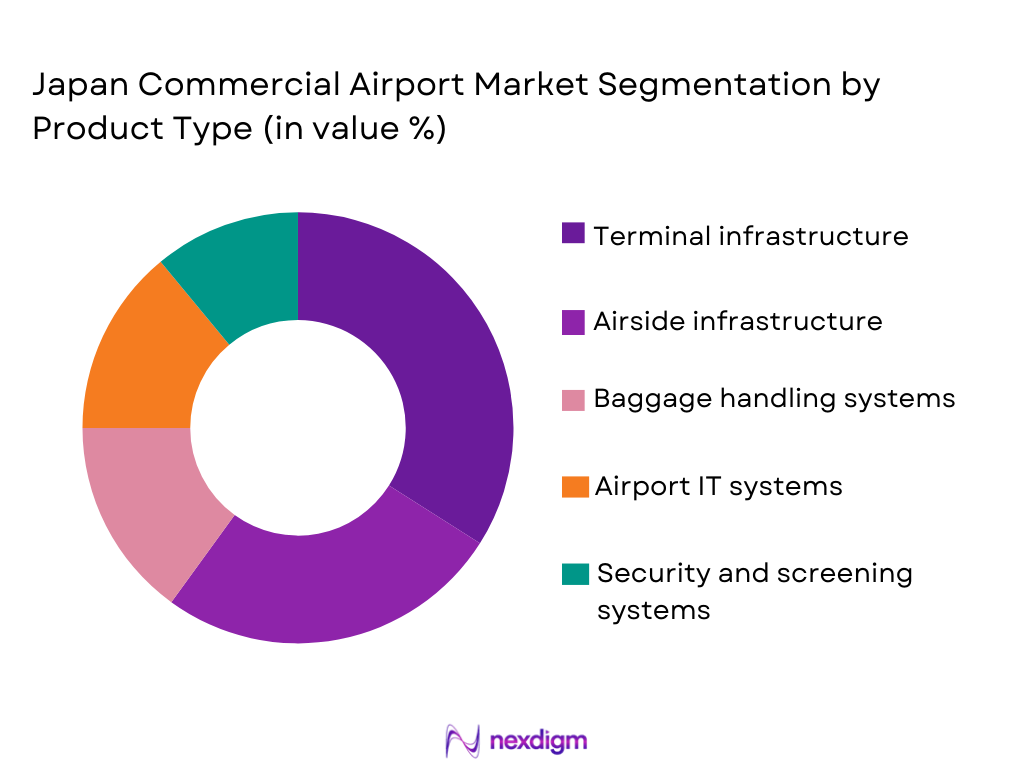
Japan Commercial Airport Market is segmented by product type into terminal infrastructure, airside infrastructure, baggage handling systems, airport IT systems, and security and screening systems. Recently, terminal infrastructure has a dominant market share due to sustained redevelopment of aging terminals, expansion of passenger processing capacity, and integration of commercial and digital services. Large-scale terminal renewal projects at major airports prioritize passenger comfort, retail optimization, and operational efficiency. Terminal assets attract the highest investment because they directly influence passenger throughput and revenue generation. Integration of smart technologies, seismic-resilient construction, and energy-efficient designs further concentrates spending in this segment.
By Platform Type
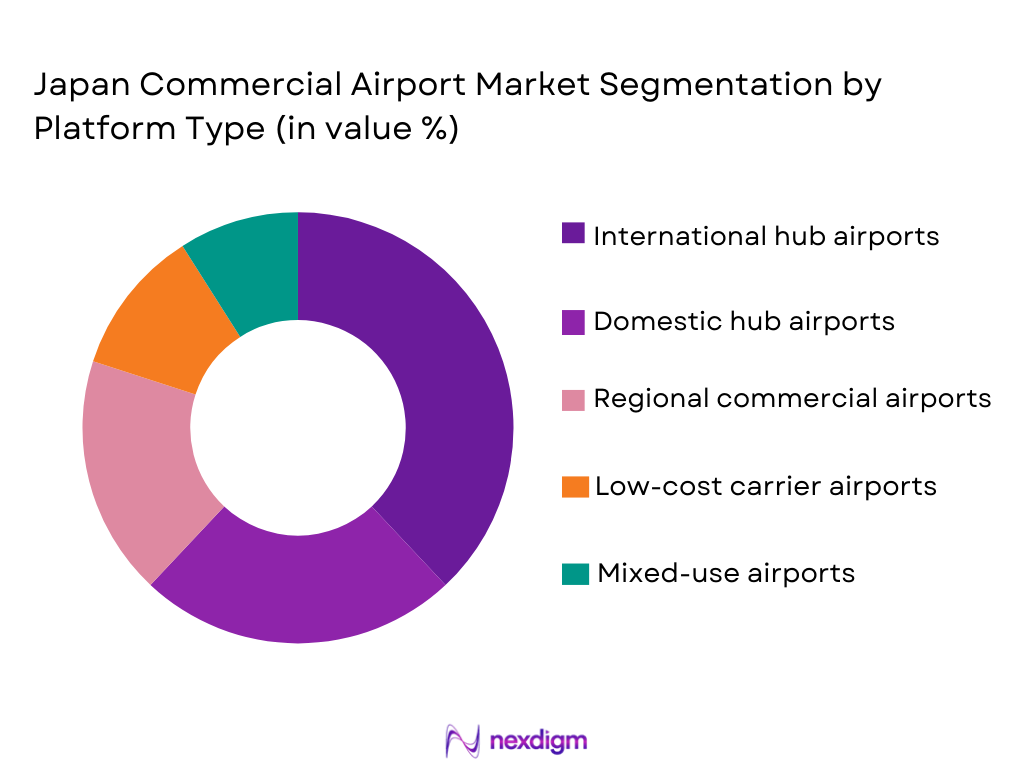
Japan Commercial Airport Market is segmented by platform type into international hub airports, domestic hub airports, regional commercial airports, low-cost carrier airports, and mixed-use airports. Recently, international hub airports dominate the market share due to their scale of operations, higher passenger volumes, and priority allocation of modernization budgets. These airports require continuous investments in runways, terminals, security, and digital platforms to support international standards and connectivity. High commercial revenue potential and strategic national importance reinforce their dominance over other platforms.
Competitive Landscape
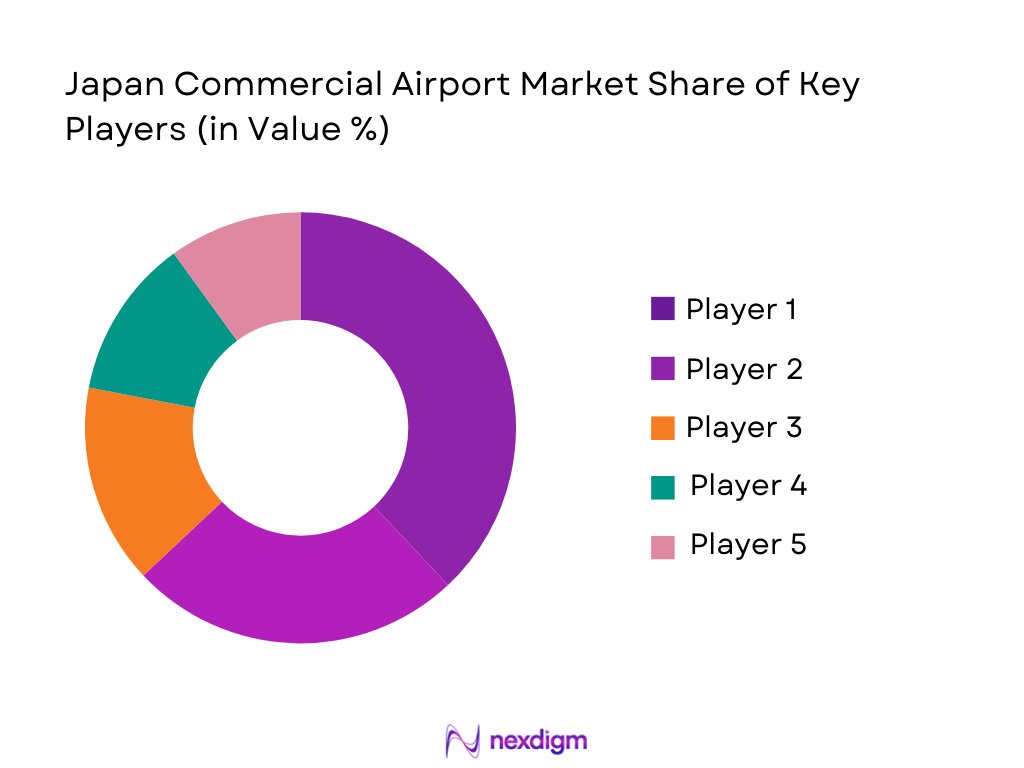
The Japan Commercial Airport Market is moderately consolidated, with major airport operators, construction conglomerates, and technology firms exerting strong influence. Long-term concessions, government ownership, and high capital requirements limit new entrants. Strategic partnerships between airport operators and domestic engineering leaders shape competition.
| Company Name | Establishment Year | Headquarters | Technology Focus | Market Reach | Key Products | Revenue | Core Strength |
| Japan Airport Terminal Co. | 1953 | Tokyo | ~ | ~ | ~ | ~ | ~ |
| Narita International Airport Corp. | 2004 | Narita | ~ | ~ | ~ | ~ | ~ |
| Kansai Airports | 2015 | Osaka | ~ | ~ | ~ | ~ | ~ |
| Taisei Corporation | 1873 | Tokyo | ~ | ~ | ~ | ~ | ~ |
| Obayashi Corporation | 1892 | Tokyo | ~ | ~ | ~ | ~ | ~ |
Japan Commercial Airport Market Analysis
Growth Drivers
Major Airport Infrastructure Modernization Programs:
Major Airport Infrastructure Modernization Programs are a critical growth driver for the Japan Commercial Airport Market because many core airport facilities were constructed decades earlier and now require extensive renewal to meet contemporary operational, safety, and passenger experience standards. Government-led redevelopment initiatives prioritize seismic resilience, energy efficiency, and expanded passenger handling capacity to accommodate growing domestic and international travel demand. Large terminal reconstruction projects stimulate sustained capital flows into construction, materials, systems integration, and project management services across the airport value chain. These programs also drive demand for advanced baggage handling, automated security screening, and digital passenger processing solutions that improve throughput and reduce congestion. Integration of retail, hospitality, and multimodal transport facilities within terminals further increases project scope and investment size. Public funding mechanisms and long-term concession models reduce financial risk and encourage private sector participation. The scale and multi-year nature of modernization programs provide revenue visibility for contractors and technology suppliers. As modernization is phased across multiple airports, it creates a continuous pipeline of projects that structurally supports market growth.
Rising Passenger Traffic and Tourism Recovery:
Rising Passenger Traffic and Tourism Recovery strongly drive the Japan Commercial Airport Market by directly increasing capacity utilization and accelerating the need for infrastructure expansion and operational upgrades. Recovery in inbound tourism, supported by policy measures and improved international connectivity, places pressure on existing airport facilities to handle higher passenger volumes efficiently. Domestic air travel also benefits from business mobility and regional connectivity initiatives, reinforcing utilization across major and secondary airports. Higher traffic levels necessitate investments in terminal extensions, apron expansion, and airside efficiency enhancements to maintain service quality. Airports respond by deploying automation, self-service kiosks, and biometric systems to manage passenger flows without proportional increases in staffing. Increased aircraft movements also require runway maintenance, navigation upgrades, and safety system enhancements. Commercial revenues from retail, parking, and concessions rise alongside traffic, enabling reinvestment into infrastructure. Sustained traffic growth therefore creates a reinforcing cycle of demand and capital expenditure across the market.
Market Challenges
High Capital Intensity and Long Payback Cycles:
High Capital Intensity and Long Payback Cycles represent a significant challenge for the Japan Commercial Airport Market because airport infrastructure projects require substantial upfront investment with extended recovery periods. Large-scale terminal construction, runway expansion, and technology integration involve multibillion-dollar commitments that strain public budgets and financing structures. Revenue realization is spread over long operational horizons, making financial planning sensitive to traffic volatility and external shocks. High capital intensity limits flexibility for rapid project reprioritization and constrains smaller regional airports with limited funding access. Cost overruns due to material price fluctuations, labor shortages, or design modifications further increase financial exposure. Long approval timelines and complex stakeholder coordination delay project execution and defer returns. Private investors may face constrained appetite due to regulated returns and operational risks. These financial dynamics collectively slow decision-making and moderate the pace of market expansion.
Regulatory Complexity and Operational Disruptions:
Regulatory Complexity and Operational Disruptions challenge market efficiency as Japan enforces stringent aviation safety, environmental, and construction standards. Compliance requirements increase project design complexity and extend approval timelines for new developments or upgrades. Airports undergoing modernization must maintain uninterrupted operations, requiring phased construction and temporary capacity adjustments that elevate costs. Noise regulations, land use restrictions, and environmental impact assessments constrain expansion options, particularly in urban areas. Coordination among aviation authorities, local governments, and operators adds administrative burden. Any regulatory change necessitates design revisions and additional approvals. Operational disruptions during construction can affect airline schedules and passenger experience. These factors collectively increase execution risk and complicate project delivery.
Opportunities
Smart Airport Digitalization and Automation Expansion:
Smart Airport Digitalization and Automation Expansion represents a significant opportunity for the Japan Commercial Airport Market as operators increasingly focus on improving efficiency, resilience, and passenger experience through technology adoption. Airports across Japan are deploying biometric identification, self-service check-in, automated boarding gates, and AI-enabled passenger flow management to reduce congestion and optimize terminal utilization. These systems lower long-term operational costs while addressing workforce constraints and rising service expectations. Integration of airport operational databases, predictive maintenance platforms, and real-time analytics enhances decision-making and asset lifecycle management. Japan’s strong domestic electronics and IT ecosystem enables localized development and customization of airport technologies, reducing reliance on imports. Government support for digital infrastructure and smart mobility further accelerates implementation. As digital systems require continuous upgrades, cybersecurity, and software maintenance, long-term service contracts create recurring revenue streams. This opportunity extends beyond major hubs to regional airports seeking cost-effective efficiency gains.
Sustainable and Green Airport Infrastructure Development:
Sustainable and Green Airport Infrastructure Development offers another high-potential opportunity as environmental performance becomes a strategic priority for Japanese aviation infrastructure. Airports are under increasing pressure to reduce carbon emissions, energy consumption, and environmental impact while maintaining operational reliability. Investments in energy-efficient terminal designs, renewable energy installations, electric ground support equipment, and sustainable construction materials are expanding across the airport ecosystem. Japan’s regulatory emphasis on environmental compliance and disaster resilience encourages adoption of advanced building standards and low-emission technologies. Sustainable infrastructure not only supports regulatory alignment but also lowers long-term operating costs through reduced energy consumption and maintenance requirements. Access to green financing instruments and government incentives improves project feasibility and investor appeal. As sustainability increasingly influences airline partnerships and public perception, airports adopting green solutions gain competitive advantages. This shift creates opportunities for construction firms, material suppliers, energy technology providers, and sustainability consultants embedded within airport projects.
Future Outlook
The Japan Commercial Airport Market is expected to evolve steadily over the next five years as infrastructure modernization, passenger traffic normalization, and technology upgrades converge. Airport operators will prioritize terminal expansion, digital passenger processing, and airside efficiency to manage rising volumes. Sustainability initiatives will accelerate investment in energy efficient buildings and low emission ground operations. Regulatory support and public funding will remain critical enablers. Collaboration between airport authorities, construction firms, and technology providers will intensify. Growth will be shaped by tourism recovery, regional connectivity, resilience planning, and the gradual adoption of smart airport ecosystems nationwide across major and secondary locations.
Major Players
- Japan Airport Terminal Co.
- Narita International Airport Corporation
- Kansai Airports
- Central Japan International Airport Company
- Taisei Corporation
- Obayashi Corporation
- Kajima Corporation
- Shimizu Corporation
- Mitsubishi Heavy Industries
- NEC Corporation
- Hitachi Ltd
- Toshiba Infrastructure Systems
- Fujitsu Limited
- ANA Trading
- JAL Engineering
Key Target Audience
- Airport authorities and operators
- Airline companies
- Aviation infrastructure developers
- Engineering and construction companies
- Airport technology and systems providers
- Logistics and cargo operators
- Investments and venture capitalist firms
- Government and regulatory bodies
Research Methodology
Step 1: Identification of Key Variables
Key market variables were identified through analysis of airport infrastructure, operational expenditure, technology adoption, and regulatory frameworks. Data sources included government publications and industry disclosures. Variables were standardized for consistency. Assumptions were validated against sector benchmarks.
Step 2: Market Analysis and Construction
Quantitative and qualitative data were synthesized to construct the market framework. Segmentation logic was applied based on product and platform relevance. Cross-validation ensured data accuracy. Market boundaries were clearly defined.
Step 3: Hypothesis Validation and Expert Consultation
Industry hypotheses were reviewed with aviation infrastructure specialists and analysts. Feedback refined assumptions and segmentation logic. Conflicting inputs were reconciled through secondary validation. Expert insights enhanced robustness.
Step 4: Research Synthesis and Final Output
Findings were consolidated into a structured report format. Analytical insights were aligned with market dynamics. Consistency checks ensured methodological integrity. Final outputs emphasize clarity and usability.

- Executive Summary
- Japan Commercial Airport Market Research Methodology
(Definitions, Scope, Industry Assumptions, Market Sizing Approach, Primary & Secondary Research Framework, Data Collection & Verification Protocol, Analytic Models & Forecast Methodology, Limitations & Research Validity Checks)

- Market Definition and Scope
- Value Chain & Stakeholder Ecosystem
- Regulatory / Certification Landscape
- Sector Dynamics Affecting Demand
- Strategic Initiatives & Infrastructure Growth

- Growth Drivers
Rising domestic and international air passenger traffic
Government investment in airport capacity expansion
Focus on smart airport and digital transformation initiatives
Growth of low cost carriers and regional connectivity
Preparation for major international tourism and business events - Market Challenges
High capital expenditure requirements for airport infrastructure
Land acquisition and space constraints in urban regions
Strict regulatory and safety compliance requirements
Operational disruption during modernization activities
Skilled workforce shortages in advanced airport technologies - Market Opportunities
Expansion of regional and secondary airports
Adoption of green and sustainable airport technologies
Integration of advanced passenger experience solutions - Trends
Increased deployment of biometric passenger processing
Adoption of AI based air traffic and terminal management
Growth of contactless and self service airport systems
Emphasis on carbon neutral and energy efficient airports
Integration of multimodal transport connectivity - Government Regulations & Defense Policy
Civil aviation safety and infrastructure regulations
National transport and tourism development policies
Airport security and emergency preparedness standards - SWOT Analysis
Stakeholder and Ecosystem Analysis
Porter’s Five Forces Analysis
Competition Intensity and Ecosystem Mapping

- By Market Value, 2020-2025
- By Installed Units, 2020-2025
- By Average System Price, 2020-2025
- By System Complexity Tier, 2020-2025

- By System Type (In Value%)
Passenger terminal infrastructure
Airside infrastructure and runways
Baggage handling systems
Airport IT and digital systems
Security screening and surveillance systems - By Platform Type (In Value%)
International hub airports
Domestic hub airports
Regional commercial airports
Low cost carrier focused airports
Mixed civilian aviation airports - By Fitment Type (In Value%)
New airport construction projects
Terminal expansion and modernization
Brownfield airport upgrades
System retrofitting and replacement
Operational efficiency enhancement projects - By EndUser Segment (In Value%)
Airport authorities and operators
Government and aviation regulators
Airline operators
Ground handling service providers
Retail and concession operators - By Procurement Channel (In Value%)
Direct government procurement
Public private partnership contracts
EPC and turnkey project contracts
OEM direct supply agreements
System integrator and consultant led procurement - By Material / Technology (in Value %)
Smart airport and IoT platforms
Advanced construction and composite materials
Biometric and passenger processing technologies
Energy efficient and sustainable systems
AI driven airport operations software

- Market structure and competitive positioning
- Market share snapshot of major players
Cross Comparison Parameters (Infrastructure capability, Technology integration, Project execution expertise, Regulatory compliance strength, Financial stability, Sustainability focus, Digital maturity, Service portfolio breadth, Local partnership network, Cost competitiveness) - SWOT Analysis of Key Players
- Pricing & Procurement Analysis
- Key Players
Japan Airport Terminal Co
Narita International Airport Corporation
Kansai Airports
Central Japan International Airport Company
Taisei Corporation
Obayashi Corporation
Kajima Corporation
Shimizu Corporation
Mitsubishi Heavy Industries
NEC Corporation
Hitachi Ltd
Toshiba Infrastructure Systems
Fujitsu Limited
ANA Trading
JAL Engineering

- Airport operators prioritizing capacity and efficiency optimization
- Airlines seeking reduced turnaround times and operating costs
- Passengers demanding seamless digital and contactless experiences
- Government bodies focusing on safety, sustainability, and resilience

- Forecast Market Value, 2026-2035
- Forecast Installed Units, 2026-2035
- Price Forecast by System Tier, 2026-2035
- Future Demand by Platform, 2026-2035


 Request a Sample
 Ask for Customization
 Get a Quote
 Enquire Now