
 Download PDF
Market Overview
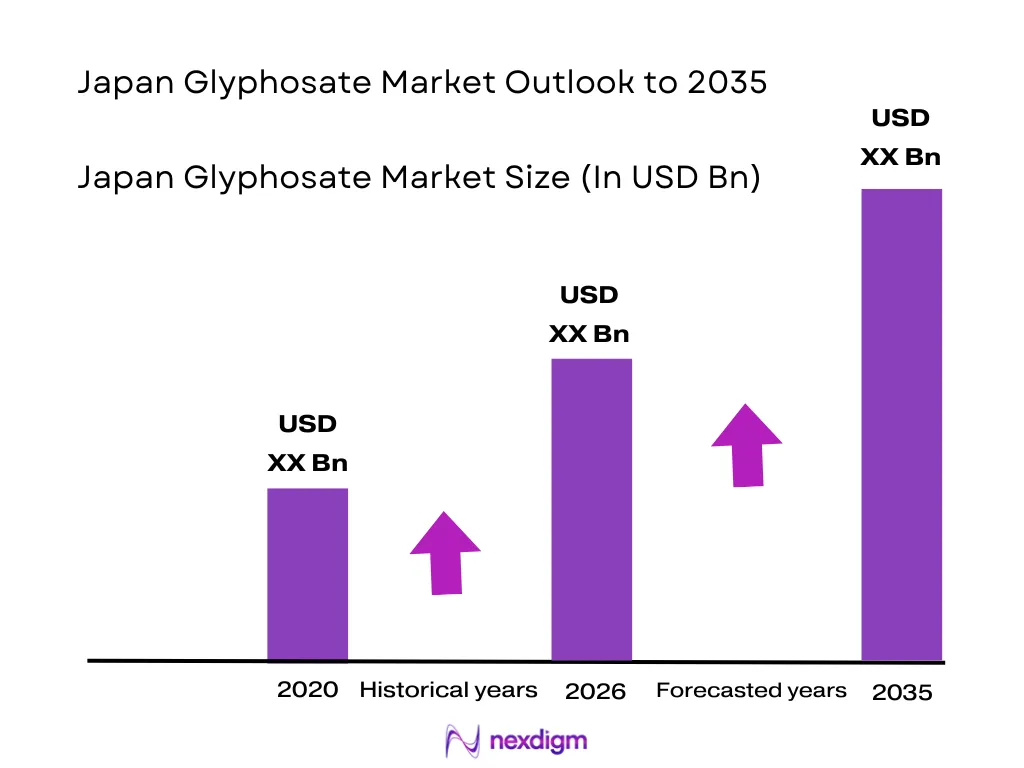
The Japan Glyphosate Market is valued at approximately USD ~ million, supported by increasing herbicide consumption across rice cultivation, soybean farming, horticulture, and non-crop vegetation management activities. Japan continues to depend heavily on imported technical-grade glyphosate for domestic formulation operations due to limited local production capacity. Rising labor shortages in rural agricultural regions and increasing mechanization in farming practices are accelerating glyphosate adoption across commercial agriculture. Demand for broad-spectrum herbicides is also supported by expanding precision agriculture technologies, drone-based spraying systems, and increasing infrastructure vegetation management requirements throughout the country.
Cities and regions such as Tokyo, Osaka, Hokkaido, and Fukuoka dominate the Japan Glyphosate Market due to strong agrochemical distribution networks, advanced agricultural infrastructure, and high concentration of commercial farming activities. Hokkaido remains a major herbicide consumption hub because of extensive soybean, wheat, and feed crop cultivation requiring efficient weed management solutions. Tokyo and Osaka function as commercial centers for agrochemical imports, regulatory administration, and distribution coordination. Fukuoka and Kyushu continue to witness increasing glyphosate demand due to expanding horticulture farming, plantation management, and non-crop vegetation control supported by agricultural cooperatives and infrastructure maintenance agencies.
Market Segmentation
By Formulation Type
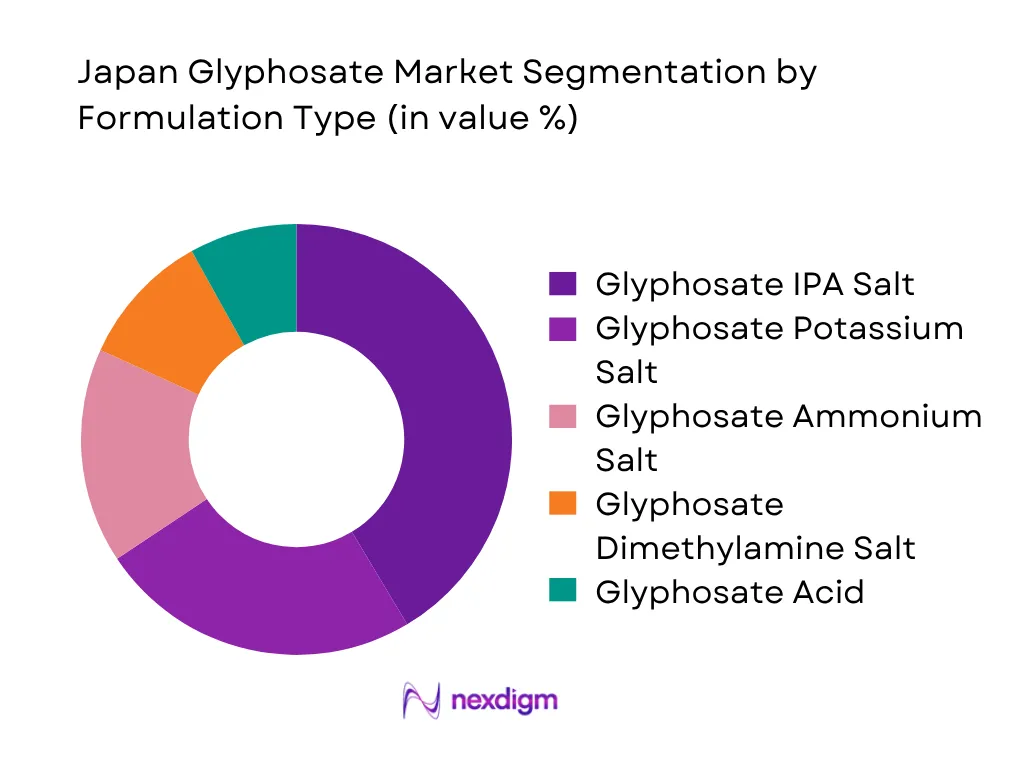
The Japan Glyphosate Market is segmented by formulation type into Glyphosate IPA Salt, Glyphosate Potassium Salt, Glyphosate Ammonium Salt, Glyphosate Dimethylamine Salt, and Glyphosate Acid. Glyphosate IPA Salt dominates the Japan Glyphosate Market because of its broad compatibility with Japanese agricultural spraying systems and superior weed control efficiency across rice, soybean, and horticulture farming. Farmers increasingly prefer IPA salt formulations due to improved rainfastness, stable application characteristics, and lower crop toxicity concerns. The segment also benefits from strong availability of imported technical-grade glyphosate processed into IPA-based formulations by domestic agrochemical manufacturers. Additionally, IPA formulations are widely compatible with drone-based spraying systems and precision agriculture technologies, supporting their increasing penetration across commercial farming operations and agricultural cooperatives throughout Japan.
By Crop Type
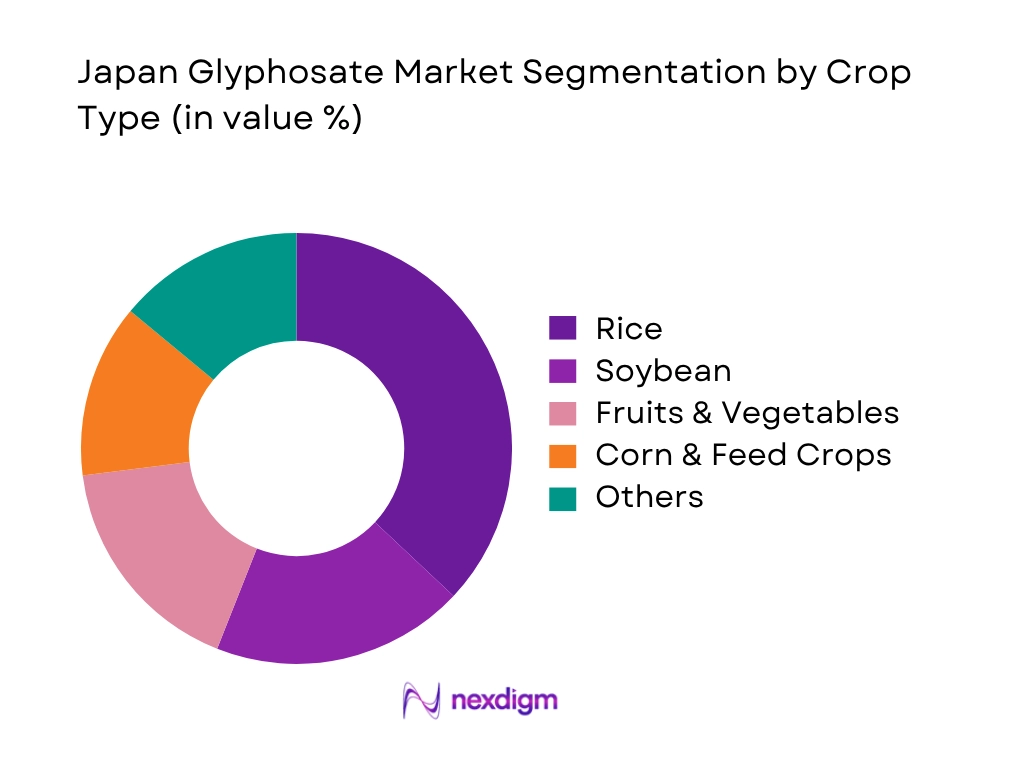
The Japan Glyphosate Market is segmented by crop type into Rice, Soybean, Fruits & Vegetables, Corn & Feed Crops, Tea & Plantation Crops, and Turf & Ornamental Crops. Rice cultivation dominates the Japan Glyphosate Market due to the country’s extensive dependence on paddy farming and increasing adoption of mechanized weed management practices. Japanese farmers utilize glyphosate formulations for pre-planting weed control, irrigation channel maintenance, and vegetation management around field boundaries to reduce labor-intensive farming activities. Hokkaido and Tohoku regions continue to generate strong glyphosate demand because of their large agricultural land areas and commercial-scale rice cultivation operations. Agricultural cooperatives further support herbicide penetration by supplying glyphosate products directly to farmers through organized procurement systems. Cost efficiency and broad-spectrum weed control capabilities continue to strengthen glyphosate usage across rice farming applications in Japan.
Competitive Landscape
The Japan Glyphosate Market is moderately consolidated and characterized by competition between multinational agrochemical manufacturers and domestic crop protection companies. Market participants are focusing on advanced formulation technologies, regulatory compliance, precision agriculture compatibility, and distribution expansion through agricultural cooperatives. The market is also witnessing increasing partnerships between domestic formulators and international technical-grade glyphosate suppliers to strengthen supply chain stability and improve formulation capacity. Companies are investing in environmentally compliant herbicide formulations with improved rainfastness, lower residue levels, and enhanced compatibility with automated spraying systems.
| Company | Establishment Year | Headquarters | Formulation Portfolio | Distribution Strength | Manufacturing Presence | Import Dependency | Crop Focus | Technology Integration |
| Bayer Crop Science | 1863 | Germany | ~ | ~ | ~ | ~ | ~ | ~ |
| Syngenta Japan | 2000 | Switzerland | ~ | ~ | ~ | ~ | ~ | ~ |
| Sumitomo Chemical | 1913 | Japan | ~ | ~ | ~ | ~ | ~ | ~ |
| Nissan Chemical | 1887 | Japan | ~ | ~ | ~ | ~ | ~ | ~ |
| BASF Japan | 1888 | Germany | ~ | ~ | ~ | ~ | ~ | ~ |
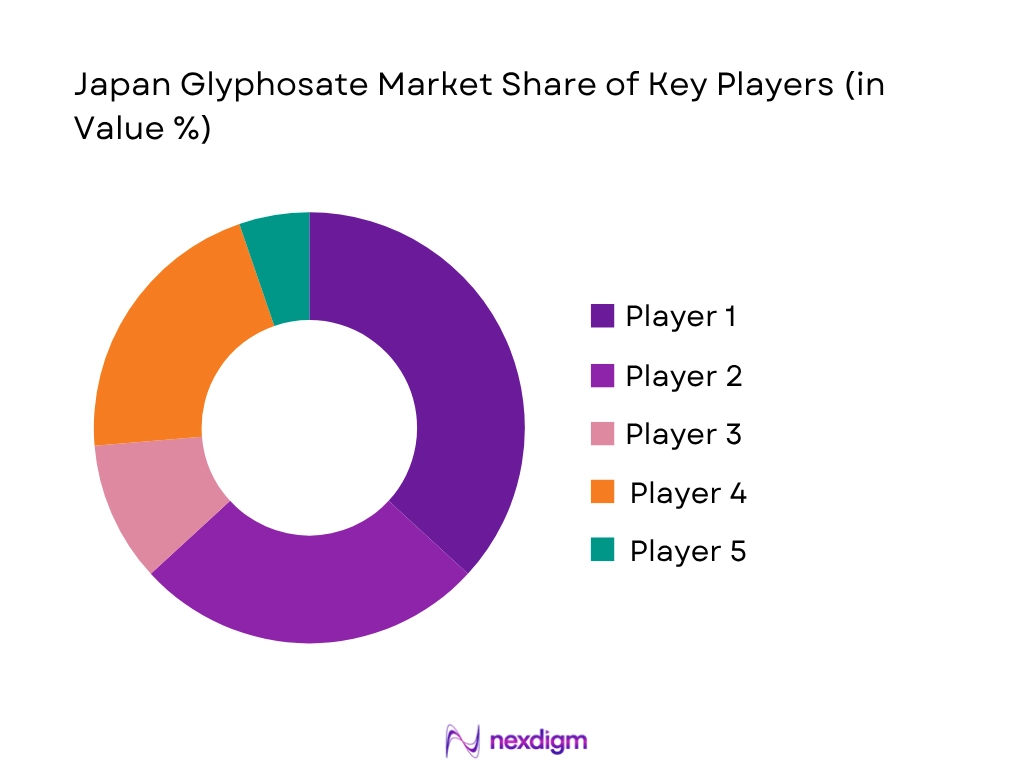
Japan Glyphosate Market Analysis
Growth Drivers
Rising Labor Shortage in Japanese Agriculture
Japan’s aging agricultural workforce is significantly driving glyphosate demand as farmers increasingly rely on herbicides to reduce manual weed control activities. The average age of agricultural workers in Japan exceeded 69 years, while the number of core agricultural workers declined sharply over the past two decades. Commercial farmers are increasingly utilizing glyphosate-based herbicides to improve field management efficiency and reduce labor dependency in rice cultivation, soybean farming, and horticulture operations. Agricultural cooperatives are also promoting mechanized weed management practices to address declining rural labor availability. Rising pressure on domestic agricultural productivity and food self-sufficiency continues to strengthen demand for broad-spectrum herbicides across Japanese farming systems.
Expansion of Precision Agriculture and Smart Farming Technologies
The rapid expansion of smart farming technologies and precision agriculture systems across Japan is accelerating glyphosate consumption due to increasing compatibility with automated spraying technologies. Agricultural drone deployments, AI-based crop monitoring systems, and autonomous spraying equipment are expanding across commercial farming operations. Herbicide formulations compatible with precision application technologies are witnessing growing demand because they improve spray efficiency, reduce operational costs, and optimize weed management across large cultivated areas. Government-supported smart agriculture initiatives and increasing investments in farm automation technologies continue to strengthen adoption of advanced herbicide formulations integrated with digital farming ecosystems.
Market Challenges
Stringent Environmental and Residue Regulations
Japan’s strict environmental and food safety regulations continue to create operational challenges for glyphosate manufacturers and distributors. Regulatory agencies maintain rigorous monitoring frameworks regarding herbicide residues, environmental contamination risks, and food safety compliance standards. Agrochemical companies are increasingly required to invest in low-residue formulations, compliance testing, and environmentally sustainable application practices. Climate-related agricultural risks and rising concerns regarding soil and water quality are also intensifying scrutiny of herbicide usage across farming systems. These stringent regulatory requirements increase operational complexity and compliance costs for herbicide suppliers operating in the Japanese market.
Dependence on Imported Technical-Grade Glyphosate
Japan’s heavy dependence on imported technical-grade glyphosate exposes the market to supply chain disruptions, geopolitical trade risks, and fluctuations in international agrochemical flows. Domestic production capacity for technical-grade glyphosate remains limited, forcing formulators to rely heavily on imports from major global manufacturing hubs. Trade restrictions, freight disruptions, and fluctuations in global chemical supply chains directly impact herbicide availability and operational planning for Japanese agrochemical companies. Import dependency also limits the market’s ability to stabilize supply conditions during periods of global chemical market volatility and increases exposure to international logistics challenges.
Market Opportunities
Expansion of Non-Crop Vegetation Management Applications
The increasing requirement for vegetation control across transportation infrastructure, industrial facilities, forestry zones, and public utility corridors is creating substantial opportunities for glyphosate manufacturers in Japan. Infrastructure maintenance agencies and industrial operators are increasingly utilizing herbicide solutions to reduce labor-intensive vegetation management activities across highways, railways, logistics hubs, and energy facilities. Japan’s extensive forest-covered geography and aging infrastructure maintenance workforce continue to support long-term demand for broad-spectrum vegetation control solutions compatible with mechanized spraying technologies.
Growth in Smart Farming and Automated Spraying Ecosystems
The continued expansion of automated farming technologies and precision spraying ecosystems is creating significant opportunities for advanced glyphosate formulations in Japan. Smart farming systems increasingly require herbicides optimized for drone-based application, variable-rate spraying technologies, and AI-supported field management systems. Investments in agricultural robotics, IoT-enabled farming equipment, and autonomous spraying systems are encouraging agrochemical manufacturers to develop technologically compatible herbicide solutions. The growing integration of automation and digital agriculture within Japanese farming operations is expected to strengthen long-term demand for precision-compatible glyphosate formulations.
Future Outlook
The Japan Glyphosate Market is expected to witness stable growth over the coming years due to increasing agricultural mechanization, rising labor shortages, and expansion of precision farming technologies. Demand for broad-spectrum herbicides is expected to remain strong across rice cultivation, soybean farming, horticulture, and non-crop vegetation management activities. Agrochemical companies are increasingly focusing on advanced formulations with improved spray efficiency, lower residue levels, and compatibility with automated spraying systems. Smart farming technologies, drone-based herbicide application, and AI-supported crop monitoring systems are expected to strengthen operational efficiency across Japanese agriculture. Expansion of infrastructure vegetation management and forestry applications is also anticipated to create additional long-term opportunities for herbicide manufacturers operating in the market.
Major Players
- Bayer Crop Science
- Syngenta Japan
- Sumitomo Chemical Co., Ltd.
- Nissan Chemical Corporation
- Nippon Soda Co., Ltd.
- Kumiai Chemical Industry Co., Ltd.
- BASF Japan Ltd.
- Corteva Agriscience
- UPL Limited
- Nufarm Limited
- ADAMA Agricultural Solutions
- Ihara Chemical Industry Co., Ltd.
- Zhejiang Xinan Chemical Industrial Group
- Rainbow Agro Sciences Co., Ltd.
- Sino-Agri Leading Biosciences Co., Ltd.
Key Target Audience
- Agrochemical Manufacturers and Formulators
- Agricultural Cooperatives and Procurement Associations
- Commercial Farming Enterprises
- Herbicide Importers and Distributors
- Precision Agriculture Technology Providers
- Investments and Venture Capitalist Firms
- Government and Regulatory Bodies
- Forestry and Infrastructure Vegetation Management Agencies
Research Methodology
Step 1: Identification of Key Variables
The initial stage involved identifying critical variables influencing the Japan Glyphosate Market, including herbicide consumption trends, agricultural mechanization, import dependency, formulation technologies, and regulatory compliance standards. Extensive secondary research was conducted using government agrochemical statistics, trade databases, industry journals, and company disclosures to understand the market ecosystem and value chain structure.
Step 2: Market Analysis and Construction
Historical market analysis was conducted using import-export data, formulation production statistics, crop-wise herbicide consumption trends, and regional agricultural activity. Market estimations were derived through bottom-up and top-down methodologies using operational indicators associated with agrochemical demand, commercial farming intensity, and distribution channel activity across Japan.
Step 3: Hypothesis Validation and Expert Consultation
Preliminary market findings were validated through interactions with agrochemical manufacturers, distributors, agricultural cooperatives, and crop protection specialists. These consultations provided operational insights regarding formulation demand, procurement patterns, technological adoption, regulatory challenges, and future herbicide consumption trends within Japanese agriculture.
Step 4: Research Synthesis and Final Output
The final stage involved consolidating quantitative and qualitative findings to produce a comprehensive market assessment. Data triangulation was conducted using trade statistics, operational indicators, government publications, and stakeholder insights to ensure consistency, reliability, and accuracy of market segmentation, competitive positioning, and future growth analysis.

- Executive Summary
- Research Methodology (Market Definitions and Assumptions, Abbreviations, Research Framework, Bottom-Up Market Estimation, Top-Down Validation, Agricultural Consumption Mapping, Trade Flow Assessment, Import Dependency Analysis, Primary Interviews with Agrochemical Manufacturers and Distributors, Forecasting Model, Limitations and Assumptions)

- Definition and Scope
- Evolution of Herbicide Consumption in Japan
- Industry Ecosystem and Stakeholder Mapping
- Supply Chain and Value Chain Analysis
- Technical Grade Glyphosate Procurement Landscape

- Growth Drivers
Rising Labor Shortage in Japanese Agriculture
Expansion of Precision Agriculture and Smart Farming Technologies
Increasing Mechanization in Rice and Soybean Cultivation
Growing Demand for Broad-Spectrum Weed Management Solutions
Expansion of Non-Crop Vegetation Management Activities - Market Challenges
Stringent Environmental and Residue Regulations
Dependence on Imported Technical-Grade Glyphosate
Competition from Bio-Herbicides and Alternative Weed Control Solutions
Climate-Related Agricultural Risks and Crop Sensitivity - Market Opportunities
Expansion of Smart Farming and Automated Spraying Ecosystems
Increasing Demand for Low-Residue Herbicide Formulations
Growth in Infrastructure and Railway Vegetation Management
Expansion of Forestry and Industrial Land Applications - Market Trends
Drone-Based Herbicide Application Expansion
High-Concentration Glyphosate Formulation Development
AI-Based Weed Detection and Smart Spraying Systems
Integration of Precision Agriculture Platforms
Sustainable Packaging Adoption in Agrochemicals - Government Regulations
MAFF Agrochemical Registration Framework
Maximum Residue Limit Compliance Standards
Environmental Safety and Disposal Regulations
Import and Labeling Compliance Requirements - Porter’s Five Forces Analysis
- PESTLE Analysis
- Pricing Analysis
- Competition Ecosystem

- By Value, 2020-2025
- By Volume, 2020-2025
- By Average Selling Price, 2020-2025
- By Import Volume, 2020-2025

- By Formulation Type (in Value %)
Glyphosate IPA Salt
Glyphosate Potassium Salt
Glyphosate Ammonium Salt
Glyphosate Dimethylamine Salt
Glyphosate Acid - By Crop Type (in Value %)
Rice
Soyabean
Fruits and Vegetables
Corn and Feed Crops
Others - By Formulation Format (in Value %)
Mixing Compatibility
Application Efficiency
Storage Stability
Packaging Suitability - By End User (in Value %)
Procurement Volume
Application Frequency
Mechanization Dependency
Operational Scale - By Distribution Channel (in Value %)
Dealer Penetration
Retail Reach
Inventory Turnover
Regional Accessibility - By Application Method (in Value %)
Spray Volume
Precision Agriculture Compatibility
Labor Efficiency
Coverage Efficiency - By Region (in Value %)
Hokkaido
Tohoku
Kanto
Chubu
Kansai
Chugoku
Shikoku
Kyushu & Okinawa

- Market Share Analysis of Major Players on the Basis of Revenue and Volume
- Cross Comparison Parameters (Company Overview, Formulation Portfolio Breadth, Technical Grade Purity, Distribution Reach Across Agricultural Cooperatives, Manufacturing Capacity, Import Dependency, Precision Agriculture Compatibility, Product Registration Portfolio, Sustainability Initiatives, Infrastructure Application Focus, Packaging Strategy, Innovation Pipeline, Regional Penetration, Operational Efficiency, Strategic Collaborations)
- Competitive Benchmarking Matrix
- SWOT Analysis of Major Players
- Pricing Analysis by Formulation Type and SKU
- Detailed Profiles of Major Companies
Bayer Crop Science
Syngenta Japan
Sumitomo Chemical Co., Ltd.
Nissan Chemical Corporation
Nippon Soda Co., Ltd.
Kumiai Chemical Industry Co., Ltd.
BASF Japan Ltd.
Corteva Agriscience
UPL Limited
Nufarm Limited
ADAMA Agricultural Solutions
Ihara Chemical Industry Co., Ltd.
Zhejiang Xinan Chemical Industrial Group
Rainbow Agro Sciences Co., Ltd.
Sino-Agri Leading Biosciences Co., Ltd.

- Agricultural Consumption Frequency Analysis
- Farmer Procurement and Spending Analysis
- Brand Preference and Switching Behavior
- Purchase Decision Parameters
- Mechanization and Smart Farming Adoption Mapping

- By Value, 2026-2035
- By Volume, 2026-2035
- By Average Selling Price, 2026-2035
- By Import Volume, 2026-2035


 Request a Sample
 Ask for Customization
 Get a Quote
 Enquire Now