
 Download PDF
 Download PDF
Market Overview
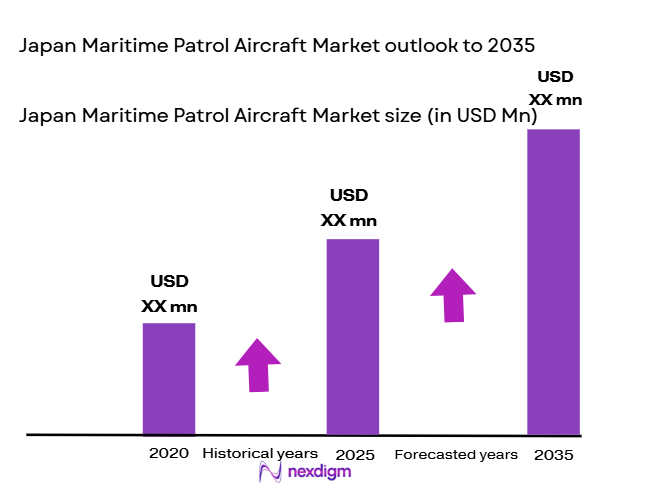
The Japan Maritime Patrol Aircraft market has experienced substantial growth in recent years, attributed to increasing security concerns, advancing technology, and the growing need for maritime surveillance and defense systems. In 2023, the market size was valued at approximately USD ~ billion, driven by the consistent procurement of surveillance aircraft and upgraded defense capabilities. The growing maritime security requirements, coupled with technological advancements in aircraft and surveillance systems, have resulted in a steady market growth trajectory. The demand for more sophisticated patrol aircraft to ensure surveillance of vast maritime areas, especially in the Asia-Pacific region, contributes significantly to the market’s expansion.
Japan, along with key countries like the United States, China, and South Korea, leads the market in maritime patrol aircraft procurement. Japan’s geographical location in the Pacific Ocean, along with its focus on strengthening defense capabilities in the face of increasing regional tensions, underpins the dominance of the country in the market. The country’s defense budgets allocate substantial funds for maritime surveillance and patrol systems, enabling Japan to maintain a strategic edge in naval defense operations. The presence of major manufacturers such as Mitsubishi Heavy Industries further bolsters Japan’s market share in the sector.
Market Segmentation
By System Type
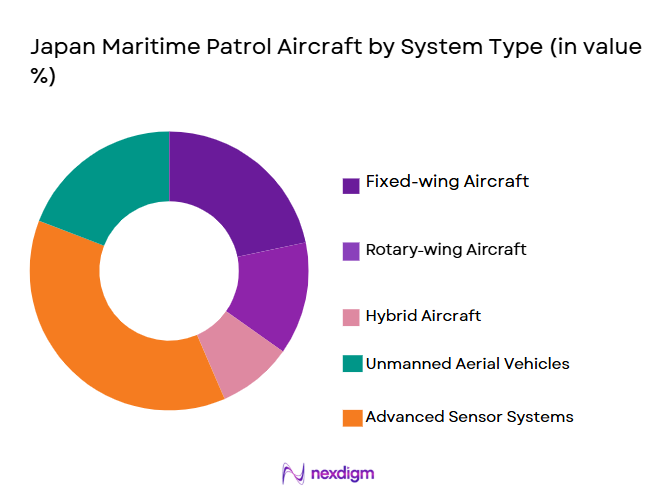
The Japan Maritime Patrol Aircraft market is segmented by system type, comprising fixed-wing aircraft, rotary-wing aircraft, unmanned aerial vehicles (UAVs), hybrid aircraft, and autonomous aircraft. Fixed-wing aircraft hold the dominant market share within this segment. Fixed-wing aircraft, such as the P-1 and Boeing P-8 Poseidon, are widely preferred for their long-range capabilities, higher payload capacity, and proven effectiveness in conducting maritime surveillance. These aircraft are essential for extended missions, providing comprehensive coverage of large maritime areas. Their reliability and ability to carry sophisticated sensor systems make them indispensable for Japan’s maritime security, driving their market dominance.
By Platform Type
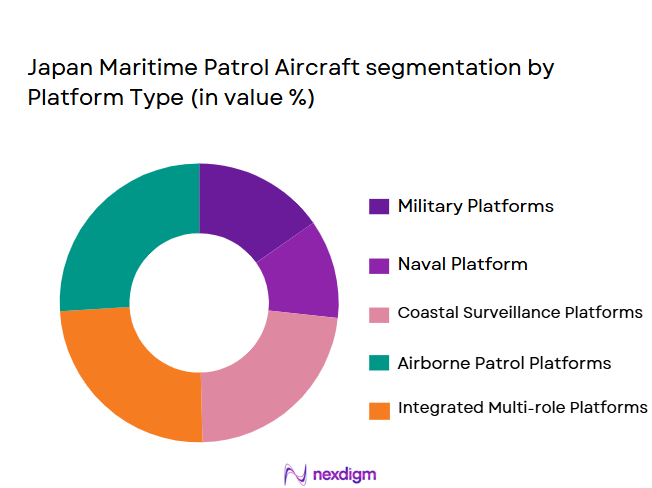
The market is segmented by platform type, including airborne platforms, naval platforms, land-based platforms, coastal surveillance platforms, and integrated multi-platform systems. Airborne platforms dominate this segment. The increasing requirement for long-range surveillance over expansive maritime areas has led to a rise in airborne platforms like maritime patrol aircraft (MPA). These platforms are highly valued for their mobility, ability to perform extended missions, and operational flexibility in both military and surveillance applications. Japan’s strategic emphasis on enhancing its surveillance capabilities has further fueled the demand for airborne platforms, reinforcing their market leadership.
Competitive Landscape
The Japan Maritime Patrol Aircraft market is characterized by the presence of key global players and local manufacturers, including defense contractors like Mitsubishi Heavy Industries, Lockheed Martin, Boeing, Northrop Grumman, and Leonardo. These players compete on technology innovation, cost-effectiveness, and strategic partnerships with national defense agencies. The market consolidation with a few dominant players ensures a stable competitive landscape, with each focusing on high-end technology integration, system reliability, and government contracts for defense procurement.
| Company | Establishment Year | Headquarters | Technology Leadership | System Integration | Government Contracts | Production Capacity | Global Market Reach | R&D Investment | Product Portfolio |
| Mitsubishi Heavy Industries | 1884 | Japan | ~ | ~ | ~ | ~ | ~ | ~ | ~ |
| Lockheed Martin | 1912 | USA | ~ | ~ | ~ | ~ | ~ | ~ | ~ |
| Boeing | 1916 | USA | ~ | ~ | ~ | ~ | ~ | ~ | ~ |
| Northrop Grumman | 1939 | USA | ~ | ~ | ~ | ~ | ~ | ~ | ~ |
| Leonardo | 1948 | Italy | ~ | ~ | ~ | ~ | ~ | ~ | ~ |
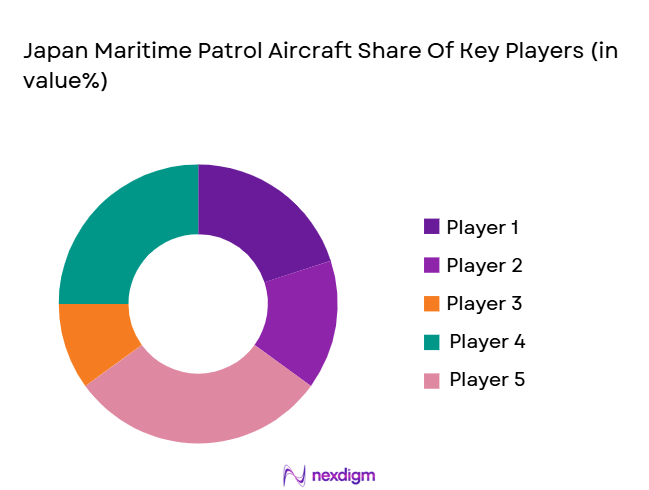
Japan Maritime Patrol Aircraft Market Dynamics
Growth Drivers
Increasing need for coastal security
The growing need for coastal security in Japan is a key growth driver for the maritime patrol aircraft market. With increasing geopolitical tensions and maritime disputes in the Asia-Pacific region, Japan is investing heavily in strengthening its surveillance capabilities to protect its coastal areas. This has led to a rise in demand for maritime patrol aircraft that can provide real-time surveillance, monitor shipping lanes, and detect threats, ensuring national security. The focus on safeguarding Japan’s extensive coastline and its vital maritime resources continues to fuel market growth.
Rising demand for surveillance and reconnaissance capabilities
Rising demand for surveillance and reconnaissance capabilities is a significant driver for the Japan Maritime Patrol Aircraft market. Japan’s strategic emphasis on safeguarding its waters and its reliance on maritime trade necessitate enhanced reconnaissance. The increasing need to monitor vast maritime areas for illicit activities such as smuggling, piracy, and territorial encroachments has driven the adoption of advanced surveillance platforms. These systems allow for continuous monitoring, offering critical intelligence and operational readiness, thus boosting demand for maritime patrol aircraft equipped with cutting-edge reconnaissance systems.
Market Challenges
High initial investment and operational costs
High initial investment and operational costs present a significant challenge for the Japan Maritime Patrol Aircraft market. The acquisition of maritime patrol aircraft involves substantial capital expenditure, particularly for advanced systems with cutting-edge surveillance capabilities. Additionally, maintenance, fuel, and operational costs further strain budgets. Given Japan’s defense priorities, these high costs can limit the pace at which new technologies and aircraft systems are adopted. The significant financial commitment required for acquiring and maintaining these aircraft can be a deterrent for agencies, especially during periods of economic uncertainty.
Complexity in system integration and upgrades
The complexity in system integration and upgrades is another key challenge faced by the Japan Maritime Patrol Aircraft market. Integrating advanced surveillance technologies into existing aircraft systems requires specialized expertise and careful coordination between aircraft manufacturers, technology developers, and military agencies. Furthermore, upgrades to keep pace with evolving threats often require extensive retrofitting, which can be a time-consuming and costly process. These technical challenges hinder the rapid deployment of state-of-the-art systems and limit operational efficiency, as aircraft must undergo multiple phases of integration and testing before they are fully functional.
Market Opportunities
Growth in defense budgets across the Asia-Pacific region
Growth in defense budgets across the Asia-Pacific region presents a promising opportunity for the Japan Maritime Patrol Aircraft market. In response to rising geopolitical tensions and security threats, countries in the region, including Japan, are significantly increasing their defense spending. This trend is expected to continue, as nations prioritize defense and national security. The increased allocation of funds for defense initiatives, including the procurement of advanced surveillance aircraft, provides an opportunity for manufacturers to supply state-of-the-art maritime patrol aircraft to meet the growing demand for enhanced coastal security in the region.
Technological advancements in UAV and autonomous systems
Technological advancements in unmanned aerial vehicles (UAVs) and autonomous systems offer substantial opportunities for the Japan Maritime Patrol Aircraft market. UAVs are gaining traction due to their cost-effectiveness, operational flexibility, and ability to perform extended missions without putting human lives at risk. The integration of autonomous systems in maritime patrol operations can enhance the efficiency and effectiveness of surveillance activities. Japan’s interest in incorporating UAVs and autonomous technologies into its defense strategy provides significant growth opportunities for market players offering cutting-edge solutions in this space.
Future Outlook
Over the next decade, the Japan Maritime Patrol Aircraft market is poised for significant growth, driven by the continuous expansion of maritime security needs, advancements in aircraft technology, and the integration of unmanned systems into surveillance operations. The increasing political and security uncertainties in the Asia-Pacific region, particularly in the South China Sea, will fuel demand for advanced maritime patrol aircraft. Furthermore, the growing focus on autonomous and unmanned aircraft in maritime defense operations is expected to significantly influence the market’s future direction.
Major Players
- Mitsubishi Heavy Industries
- Lockheed Martin
- Boeing
- Northrop Grumman
- Leonardo
- Airbus
- Saab
- Elbit Systems
- General Dynamics
- BAE Systems
- Raytheon Technologies
- Harris Corporation
- L3 Technologies
- Thales
- Bae Systems
Key Target Audience
- Military Agencies (Japan Ministry of Defense, US Department of Defense)
- Coast Guard Agencies (Japan Coast Guard)
- Naval Forces (Japan Maritime Self-Defense Force)
- Private Sector Aircraft Manufacturers
- Investments and Venture Capitalist Firms
- Aerospace and Defense Contractors
- Government and Regulatory Bodies (Japan Defense Procurement Agency)
- National Defense Agencies (Ministry of Defense, Government of Japan)
Research Methodology
Step 1: Identification of Key Variables
In the initial phase, an extensive mapping of key stakeholders within the Japan Maritime Patrol Aircraft market is undertaken. This is done through secondary research, using reliable industry databases, government reports, and market insights. This step is crucial to identifying the primary drivers, technologies, and key players influencing the market.
Step 2: Market Analysis and Construction
This phase focuses on analyzing the historical market trends and revenue generation patterns. A detailed examination of the system types, platforms, and procurement channels helps construct the market framework. The historical data is then analyzed to predict future trends and demand for the market.
Step 3: Hypothesis Validation and Expert Consultation
We validate the developed market hypotheses by conducting computer-assisted telephone interviews (CATIs) with industry experts. These consultations will provide firsthand insights into technological advancements, regulatory hurdles, and operational issues, ensuring that the final market model reflects actual industry practices.
Step 4: Research Synthesis and Final Output
The final research phase involves gathering data from major manufacturers of maritime patrol aircraft. This step will further validate key parameters, refine market size estimates, and ensure that the final report is robust and credible. Insights into the competitive landscape, pricing, and procurement strategies will also be gathered.

- Executive Summary
- Japan Maritime Patrol Aircraft Research Methodology
(Definitions, Scope, Industry Assumptions, Market Sizing Approach, Primary & Secondary Research Framework, Data Collection & Verification Protocol, Analytic Models & Forecast Methodology, Limitations & Research Validity Checks)

- Market Definition and Scope
- Value Chain & Stakeholder Ecosystem
- Regulatory / Certification Landscape
- Sector Dynamics Affecting Demand
- Strategic Initiatives & Infrastructure Growth

- Growth Drivers
Increasing need for coastal security
Rising demand for surveillance and reconnaissance capabilities
Advancements in surveillance technologies - Market Challenges
High initial investment and operational costs
Complexity in system integration and upgrades
Regulatory compliance hurdles - Market Opportunities
Growth in defense budgets across the Asia-Pacific region
Technological advancements in UAV and autonomous systems
Potential partnerships and alliances in the defense sector - Trends
Shift towards hybrid and autonomous patrol aircraft
Increased focus on multi-platform integration
Rising collaboration between private and governmental entities

- By Market Value, 2020-2025
- By Installed Units, 2020-2025
- By Average System Price, 2020-2025
- By System Complexity Tier, 2020-2025

- By System Type (In Value%)
Fixed-wing Aircraft
Rotary-wing Aircraft
Unmanned Aerial Vehicles (UAVs)
Hybrid Aircraft
Autonomous Aircraft - By Platform Type (In Value%)
Airborne Platforms
Naval Platforms
Land-based Platforms
Coastal Surveillance Platforms
Integrated Multi-platform Systems - By Fitment Type (In Value%)
OEM Fitment
Retrofit Fitment
Upgraded Fitment
Custom Fitment
Modular Fitment - By EndUser Segment (In Value%)
Military
Coast Guard
Naval Forces
Private Operators
Government Agencies - By Procurement Channel (In Value%)
Direct Procurement
Tender Bidding
Military Auctions
Third-party Suppliers
Government Contracts

- Market Share Analysis
- Cross Comparison Parameters
(Platform Type, System Type, Procurement Channel, Fitment Type, Regional Demand integration Compatibility with Legacy Platforms, R&D & Technical Innovation Index, Customization & Configuration Flexibility) - SWOT Analysis of Key Competitors
- Pricing & Procurement Analysis
- Key Players
Mitsubishi Heavy Industries
Lockheed Martin
Boeing
Northrop Grumman
Leonardo
Airbus
Saab
Elbit Systems
General Dynamics
BAE Systems
Raytheon Technologies
Harris Corporation
L3 Technologies
Thales
Bae Systems Market Share Analysis

- Demand from defense agencies for advanced surveillance solutions
- Coast Guard agencies expanding their fleet for maritime safety
- Private operators focusing on cost-effective solutions for surveillance
- Government agencies enhancing maritime defense capabilities

- Forecast Market Value, 2026-2035
- Forecast Installed Units, 2026-2035
- Price Forecast by System Tier, 2026-2035
- Future Demand by Platform, 2026-2035


 Request a Sample
 Ask for Customization
 Get a Quote
 Enquire Now