

 Download PDF
Market Overview
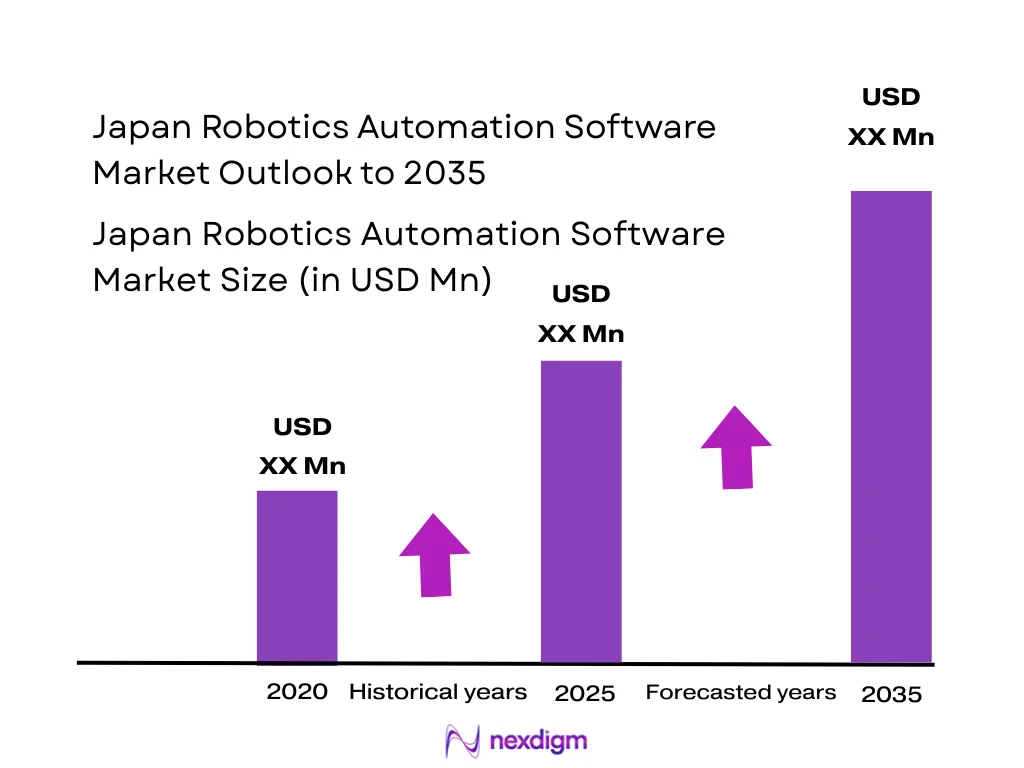
Japan’s robotics automation software market was valued at USD ~ million in 2025, after USD ~ million in 2024, based on public Japan robot software market trackers. The market is being driven by a deep industrial-robot base rather than greenfield adoption alone: Japan had 435,299 industrial robots in operation and 46,106 new installations in factories in 2023, while the installed base rose further to 450,530 units in 2024. That large operational stock directly supports demand for programming, simulation, vision, monitoring, and integration software.
The dominant demand centers are Tokyo–Yokohama, Nagoya/Aichi, and Osaka–Kobe–Kyoto because Japan’s robotics software spending follows its manufacturing, innovation, and systems-integration clusters. Tokyo–Yokohama ranked 2nd, Osaka–Kobe–Kyoto 11th, and Nagoya 28th among global science and technology clusters, while Aichi is described by JETRO and Aichi Prefecture as a robotics-centered manufacturing hub with automotive, aerospace, and precision machinery concentration. Nagoya also anchors Japan’s largest manufacturing agglomeration, which keeps software deployment close to OEMs, plants, and integrators.
Market Segmentation
By Software Type
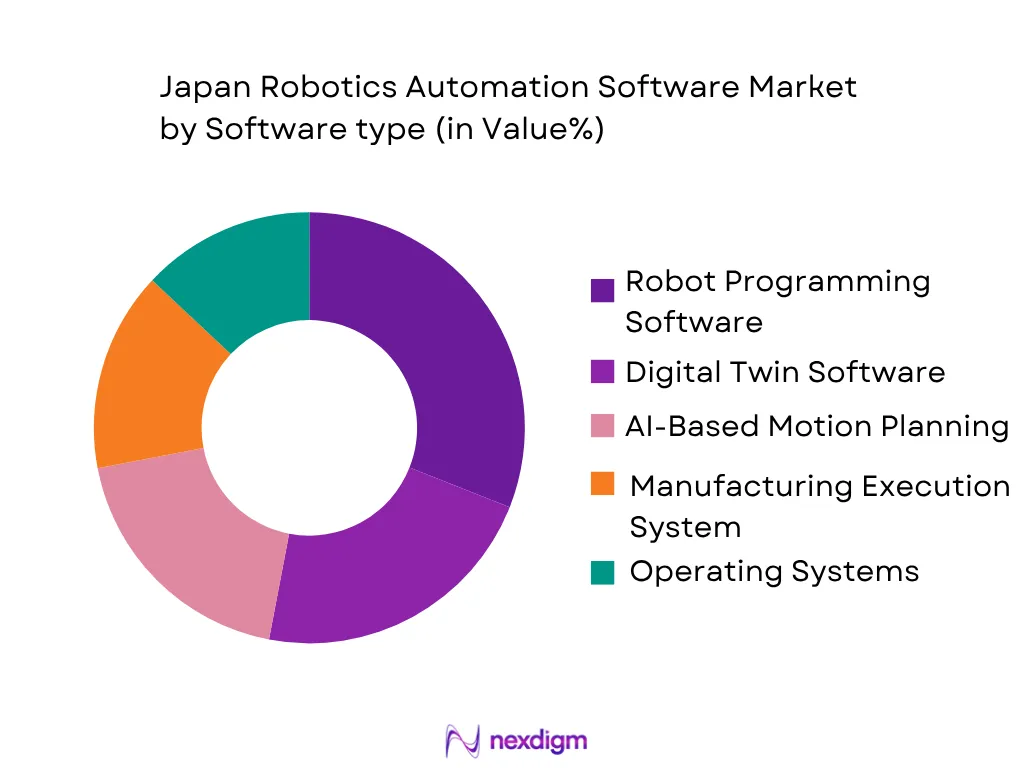
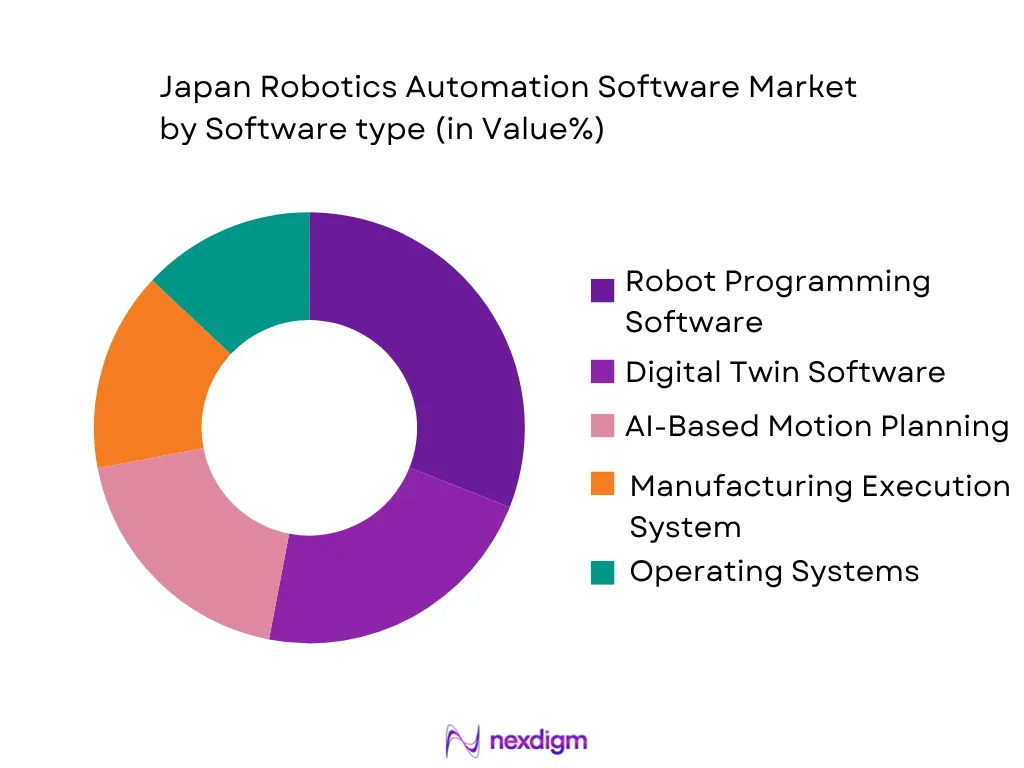
Japan robotics automation software market is segmented by software type into robot programming and offline programming software, simulation and digital twin software, vision AI and motion control software, monitoring and predictive maintenance software, and middleware or integration layers. Robot programming and offline programming software holds the dominant share in Japan because the market is anchored in mature factory automation, where installed robots must be configured, reprogrammed, debugged, and optimized across high-mix production environments. Japan’s software demand is therefore closely tied to the existing robot fleet and to engineering-led use cases in automotive, electronics, welding, handling, and precision assembly. Public product portfolios from FANUC, Yaskawa, Kawasaki, and Mitsubishi Electric also show that simulation, virtual cell design, offline programming, and CAD-linked path creation are core commercial software layers in Japan’s robotics stack, reinforcing the segment’s scale.
By End-User Industry
Japan robotics automation software market is segmented by end-user industry into electrical and electronics, automotive, metal and machinery, logistics and warehousing, and food, pharma and consumer goods. Electrical and electronics is the dominant segment because Japan’s robot usage in this industry is already the largest in installed-base terms and remains structurally software-intensive. IFR reported that the electrical and electronics industry accounted for 14,692 robot installations in Japan in 2023 and represented 143,768 robots in operational stock, equal to 33% of Japan’s total robot stock, ahead of automotive. Electronics manufacturing also requires frequent reconfiguration, high-precision motion, inspection, traceability, and vision-based quality control, all of which carry higher software intensity than simpler fixed automation tasks. That makes the segment the strongest revenue pool for robotics programming, vision, control, and optimization software in Japan.
Competitive Landscape
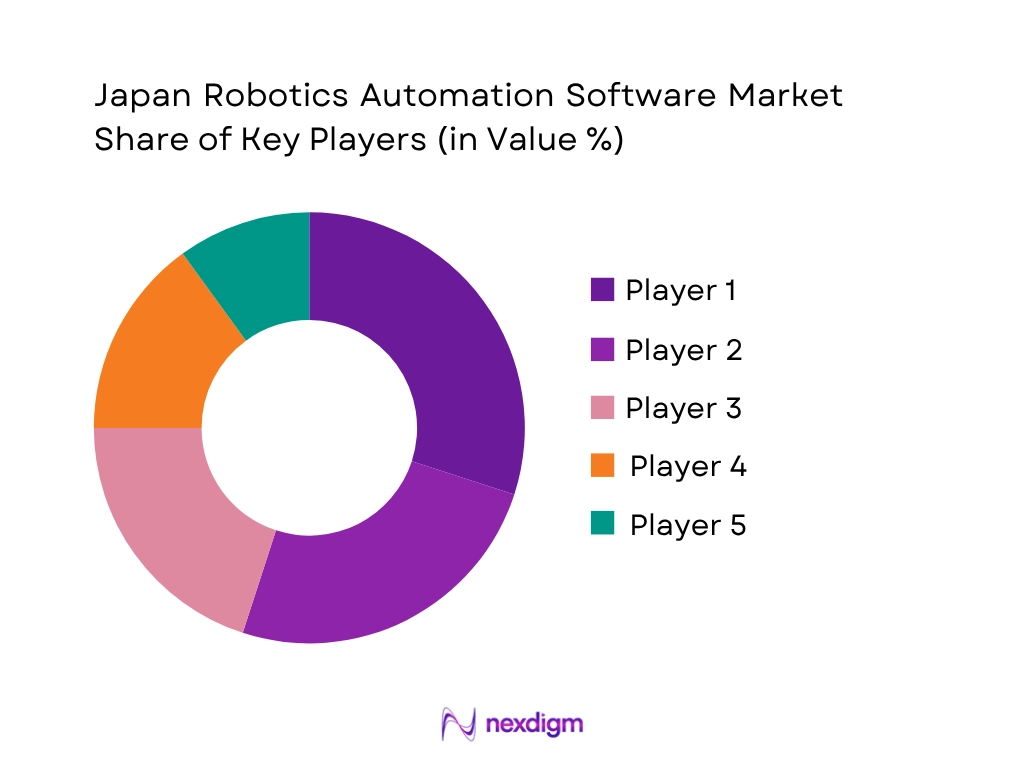
Japan’s robotics automation software market is concentrated around a handful of OEM-led automation groups and industrial software specialists. Domestic leaders such as FANUC, Yaskawa, Mitsubishi Electric, Kawasaki, and OMRON benefit from installed robot bases, controller ecosystems, long-standing SI networks, and deep manufacturing relationships in automotive, electronics, and precision engineering. The market is therefore less fragmented than generic industrial software categories: software adoption in Japan is often pulled through hardware, motion-control, PLC, vision, and cell-integration ecosystems rather than sold as stand-alone software alone.
| Company | Establishment Year | Headquarters | Core Robotics Software Suite | Primary Software Strength | Typical Deployment Emphasis | Key Industry Focus in Japan | Ecosystem / Integration Advantage |
| FANUC | 1972 | Oshino-mura, Yamanashi | – | – | – | – | – |
| Yaskawa Electric | 1915 | Kitakyushu, Fukuoka | – | – | – | – | – |
| Mitsubishi Electric | 1921 | Tokyo | – | – | – | – | – |
| OMRON | 1933 | Kyoto | – | – | – | – | – |
| Kawasaki Robotics / KHI Robot Division | 1969 for robot business | Akashi for Robot Division; KHI head offices in Tokyo/Kobe | – | – | – | – | – |
Market Entry Strategy
Entering the Japan robotics automation software market requires a partner-led, localization-first approach, as the ecosystem is tightly integrated around domestic OEMs and system integrators. New entrants should prioritize alliances with companies such as FANUC Corporation, Yaskawa Electric Corporation, and Mitsubishi Electric Corporation to embed software within existing hardware and controller environments. Given Japan’s 450,530 operational robots in 2024, market entry should focus on retrofitting and optimizing existing installations rather than greenfield deployments. Localization is critical, including Japanese-language interfaces, compliance with METI industrial standards, and adaptation to legacy OT systems. A system integrator-led go-to-market model is preferred, supported by account-based selling to large manufacturers in automotive and electronics clusters. Pricing strategies should balance license-based and subscription models, while offering low-code or AI-assisted tools to address the tight labor market (job ratio 1.25 in 2024). Long-term success depends on building technical support infrastructure, ensuring cybersecurity compliance, and positioning software as a productivity multiplier rather than a standalone tool.
Japan Robotics Automation Software Market Analysis
Growth Drivers
Increasing Industrial Robot Density in Manufacturing
Japan’s robotics automation software demand is being reinforced by the country’s very large industrial robot footprint inside manufacturing. The International Federation of Robotics reported 44,453 new industrial robot installations in Japan in 2024 and 450,530 robots in operation in the same year, keeping Japan among the world’s most automated factory economies. This matters directly for software because every additional robot requires programming, simulation, vision, motion control, diagnostics, and lifecycle optimization layers. The macro backdrop also supports this transition: the IMF indicated Japan’s economy expanded by 0.1 in 2024, is expected to grow by 1.2 in 2025, and 0.7 in 2026, which keeps manufacturers focused on productivity-led output rather than labor-led expansion. In practical terms, robotics software is no longer tied only to new robot purchases; it is increasingly tied to optimizing a large installed base across automotive, electronics, machinery, and precision manufacturing environments.
Severe Labor Shortages Driving Automation Demand
Japan’s labor market remains tight enough to keep automation software strategically relevant across factory operations. Government-backed labor indicators show the active job openings-to-applicants ratio was 1.25 in December 2024, while the regular staff ratio was 1.02, and official labor data showed the unemployment rate at 2.5 in January 2025. At the same time, a widely cited national business survey reported 342 labor-related bankruptcies in 2024, a record level, underlining that labor scarcity is no longer only a wage issue but an operating risk. For robotics automation software vendors, this creates demand for tools that shorten setup time, automate program generation, reduce dependence on veteran technicians, and improve uptime monitoring. The macro context remains relevant: with IMF-linked growth expectations at 1.2 in 2025 and 0.7 in 2026, Japanese manufacturers are under pressure to preserve throughput without assuming abundant labor supply, which favors higher software intensity per robot and per production line.
Market Challenges
Integration Complexity with Legacy Manufacturing Systems
One of the biggest constraints on Japan’s robotics automation software market is that new software must often sit on top of large, heterogeneous factory environments rather than clean-sheet plants. Japan had 450,530 industrial robots in operation in 2024 and still installed 44,453 new units that year, which means software vendors are often integrating across generations of controllers, PLCs, vision systems, MES layers, and customized production logic. METI’s 2024 smart manufacturing guideline itself starts from the need to identify management and operational challenges before digital implementation, reflecting how non-trivial factory transformation remains. This challenge is amplified by Japan’s continued reliance on on-site engineering and precision workflows, where downtime and revalidation costs are high. In a low-growth macro setting where IMF-linked reporting points to 0.1 growth in 2024 and 0.7 in 2026, manufacturers are cautious about disruptive software rollouts, making interoperability, retrofit compatibility, and phased deployment central barriers to scale.
High Initial Software Deployment & Customization Costs
High upfront implementation effort remains a real brake on software penetration, particularly where robotics software must be customized to plant-specific workflows, safety systems, legacy machinery, and operator practices. Japan’s industrial environment still showed mixed momentum in late 2024: METI’s revised December report recorded the production index at 101.6, shipments at 104.6, and inventories at 98.7, while IMF-linked reporting showed national growth at only 0.1 in 2024, with 0.7 expected in 2026. In such a context, manufacturers do not stop digital investment, but they scrutinize payback periods more closely. Robotics automation software often requires cell modeling, digital commissioning, controller mapping, operator training, cybersecurity hardening, and integration with upstream and downstream systems before any value is realized. That makes the business case harder for smaller factories and more complex for large ones, especially when deployments span multiple plants, mixed brands of robots, and high-precision production environments.
Opportunities
Expansion of AI-Powered Robotics Software Platforms
The clearest medium-term opportunity lies in AI-powered robotics software platforms that reduce engineering dependence while improving flexibility, cycle optimization, and real-time decision-making. Evidence of current demand is already visible: a Japan corporate survey in 2024 found 24 companies out of every 100 using AI and 35 planning adoption, while the government has publicly showcased AI software that generates complex machining programs and the Cabinet’s 2025 economic policy direction, cited by OECD, calls for accelerating the use of AI and robots to address labor shortages and productivity needs. Japan also installed 44,453 industrial robots in 2024, giving AI software a large and growing deployment surface. The macro case reinforces the opportunity: with IMF-linked reporting showing 1.2 growth in 2025 and 0.7 in 2026, manufacturers are more likely to favor software that squeezes more output, less downtime, and faster engineering response from existing capital assets rather than relying only on labor expansion or full equipment replacement.
Growth of Digital Twin & Simulation Software Demand
Digital twin and simulation software has a strong runway in Japan because manufacturers are under pressure to preserve precision, shorten commissioning, and transfer expert know-how in an aging labor environment. JETRO notes that digital twin technology is being used in manufacturing to capture the work of experienced workers and support technology transfer, and it also states that partnerships in Japan are progressing for digital twins used in production-line visualization. The opportunity is further reinforced by public industrial investment: METI’s semiconductor revitalization framework includes support of up to 1,699 billion yen, and the government announced up to 60 billion yen for Sony’s Kumamoto image-sensor plant in 2026. Facilities of this kind require simulation-heavy automation environments before full-scale production. With 450,530 industrial robots in operation in 2024, Japan has a large installed base where virtual commissioning, layout modeling, motion validation, and digital replica workflows can deliver immediate operational value without waiting for new greenfield factories.
Future Outlook
Over the long term, Japan robotics automation software market is expected to expand faster than robot hardware because the country already has a very large installed robot base and a growing need to make those assets smarter, easier to program, and more interoperable. Demand should increasingly shift from pure robot programming toward simulation, digital twins, vision AI, remote monitoring, and higher-level integration. Growth will also be reinforced by labor scarcity, smart-manufacturing policy support, and stronger software intensity in electronics, mobility, warehouse automation, and precision production.
Major Players
- FANUC Corporation
- Yaskawa Electric Corporation
- Mitsubishi Electric Corporation
- OMRON Corporation
- Kawasaki Robotics / Kawasaki Heavy Industries
- DENSO WAVE
- Nachi-Fujikoshi
- Epson Robots
- Universal Robots
- ABB
- KUKA
- Siemens
- Rockwell Automation
- Schneider Electric
- Bosch Rexroth
Key Target Audience
- Automotive OEMs and Tier-1 component manufacturers
- Electrical and electronics manufacturers
- Factory automation OEMs and robot system integrators
- Warehouse, intralogistics, and fulfillment operators
- Industrial software vendors and edge/IIoT platform providers
- Investments and venture capitalist firms
- Government and regulatory bodies (METI, NEDO, JETRO, MIC)
- Private equity, corporate strategy, and M&A teams in industrial technology
Research Methodology
Step 1: Identification of Key Variables
The first stage maps the full Japan robotics automation software ecosystem, including robot OEMs, controller suppliers, motion-control vendors, software providers, system integrators, and end-user factories. Secondary research is used to define the most relevant demand variables, such as robot installed base, software attach intensity, end-use concentration, on-premise versus connected deployment models, and smart-manufacturing policy support.
Step 2: Market Analysis and Construction
The market is built using a bottom-up framework that links Japan’s operating stock of industrial robots and annual installations with the software layers typically sold around them. These include programming, simulation, vision, monitoring, and integration tools. Public market-size trackers are then cross-checked against robotics stock data, OEM software portfolios, and industry demand patterns to avoid overstating pure software value.
Step 3: Hypothesis Validation and Expert Consultation
Working assumptions are validated against company disclosures, IFR industry statistics, METI policy materials, and public product evidence from leading OEMs. In a full commercial study, these assumptions would be pressure-tested through CATI or expert interviews with robot OEMs, Japanese system integrators, plant digitalization managers, and software channel partners to verify pricing logic, deployment trends, and segment priority.
Step 4: Research Synthesis and Final Output
The final stage synthesizes all evidence into a market model that reconciles top-down industrial automation trends with bottom-up robot software monetization. Special emphasis is placed on Japan-specific demand factors such as electronics manufacturing intensity, mature robot installed bases, high engineering requirements, and policy-led smart-factory adoption so that the final output reflects market reality rather than generic global robotics assumptions.

- Executive Summary
- Research Methodology (Market Definitions for Robotics Automation Software Stack, Abbreviations for OT/IT/AI Systems, Market Sizing Approach – Bottom-Up (Robot Install Base × Software Attach Rate) & Top-Down (Manufacturing IT Spend Allocation), Primary Interviews with OEMs, System Integrators, MES Vendors, Secondary Research from METI, IFR, JARA, Data Triangulation, Assumptions on Software Penetration per Robot, Limitations and Validation Framework)

- Definition and Scope
- Evolution of Industrial Robotics Software in Japan
- Timeline of Robotics OEM & Software Ecosystem Development
Robotics Software Business Cycle (Design → Simulation → Deployment → Optimization) - Robotics Software Value Chain (OEMs, Middleware Providers, System Integrators, End-Users)

- Growth Drivers
Increasing Industrial Robot Density in Manufacturing
Severe Labor Shortages Driving Automation Demand
Expansion of Smart Factory & Industry 4.0 Initiatives
Rising Demand for AI-Enabled Robotics Software
Government Support via METI & Society 5.0 - Market Challenges
Integration Complexity with Legacy Manufacturing Systems
High Initial Software Deployment & Customization Costs
Cybersecurity Risks in Connected Robotics Systems
Shortage of Skilled Robotics Software Engineers - Opportunities
Expansion of AI-Powered Robotics Software Platforms
Growth of Digital Twin & Simulation Software Demand
Increasing Adoption of Cloud Robotics & Remote Monitoring
SME Automation Opportunity with Low-Code Platforms - Trends
Shift Toward Autonomous & Self-Learning Robots
Integration of Vision AI & Sensor Fusion
Rise of Robotics-as-a-Service (RaaS) Software Models
Standardization via ROS and Open Platforms - Government Regulations
Industrial Safety & Robotics Compliance Standards
Data Localization & Industrial Data Policies
Incentives for Smart Manufacturing Adoption - SWOT Analysis (Automation Ecosystem Strength, Innovation Index, Dependency Risks)
- Stakeholder Ecosystem (OEMs, Integrators, Software Vendors, End-Users)
- Porter’s Five Forces (Supplier Power – OEM Dominance, Buyer Power – Automotive OEMs)
- Competition Ecosystem (OEM Software vs Independent Software Vendors)

- By Value, 2020-2025
- By Installed Base-Linked Software Revenue, 2020-2025
- By Software Attach Rate per Robot, 2020-2025
- By Average Licensing & Subscription Value, 2020-2025

- By Software Type (In Value %)
Robot Programming & Offline Programming Software
Simulation & Digital Twin Software
AI-Based Motion Planning & Vision Software
Manufacturing Execution System (MES) Integration Software
Robotics Middleware & Operating Systems - By Deployment Model (In Value %)
On-Premise Industrial Software
Cloud-Based Robotics Software Platforms
Hybrid Edge-Cloud Architectures - By End-User Industry (In Value %)
Automotive & Auto Components Manufacturing
Electronics & Semiconductor Manufacturing
Logistics & Warehousing Automation
Food & Beverage Processing
Healthcare & Pharma Robotics - By Application (In Value %)
Assembly Line Automation
Material Handling & Warehouse Automation
Inspection & Quality Control (Machine Vision Software)
Welding, Painting & Precision Tasks
Predictive Maintenance & Asset Optimization - By Enterprise Size (In Value %)
Large Enterprises (Tier 1 OEMs)
Mid-Sized Manufacturers
SMEs & Smart Factory Adopters - By Distribution Channel (In Value %)
Direct OEM Software Sales
System Integrators & Automation Solution Providers
Third-Party Industrial Software Vendors - By Region (In Value %)
Kanto Region
Kansai Region
Chubu Region
Kyushu Region
Tohoku Region

- Market Share Analysis (Software Revenue Share, Installed Base Penetration)
- Cross Comparison Parameters (Product Portfolio Breadth, AI Capability Integration, Digital Twin Capability, Edge Computing Support, Cloud Robotics Enablement, Industry Vertical Focus, Integration Ecosystem Strength, Pricing Model & Licensing Flexibility)
- SWOT Analysis of Major Players (Technology Leadership, Ecosystem Reach, R&D Capability)
- Pricing Analysis (License vs Subscription, Per Robot Software Cost, SaaS Models)
- Detailed Profiles of Major Companies
FANUC Corporation
Yaskawa Electric Corporation
Kawasaki Heavy Industries
Mitsubishi Electric Corporation
Omron Corporation
Denso Corporation
Sony Corporation
SoftBank Robotics
Nachi-Fujikoshi Corp
Seiko Epson Corporation
ABB Ltd
KUKA AG
Siemens AG
Rockwell Automation
Universal Robots

- Demand Patterns Across Industries
- Budget Allocation for Automation Software
- IT-OT Convergence Readiness
- Pain Points in Robotics Software Deployment
- Procurement & Vendor Evaluation Process

- By Value, 2026-2035
- By Software Attach Rate Growth, 2026-2035
- By Subscription vs License Revenue Mix, 2026-2035


 Request a Sample
 Ask for Customization
 Get a Quote
 Enquire Now