
 Download PDF
 Download PDF
Market Overview
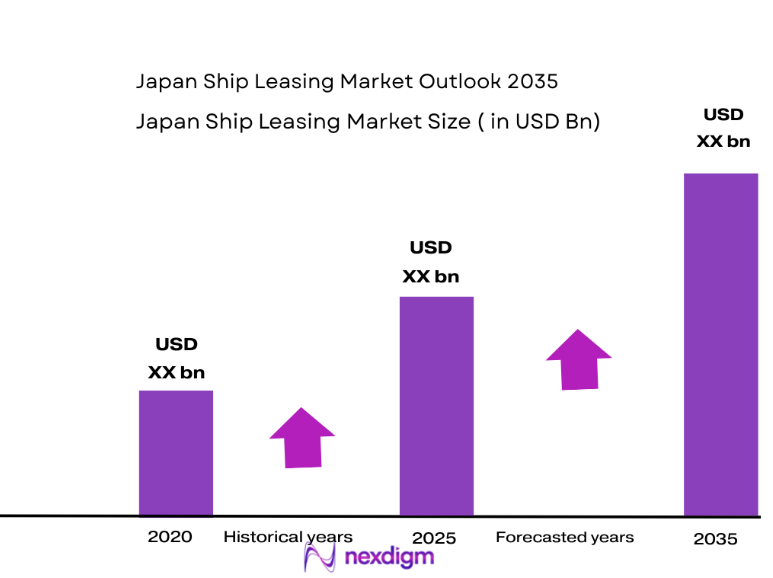
Based on a recent historical assessment, the Japan ship leasing market was valued at approximately USD ~ billion, supported by data from the Japanese Ministry of Land, Infrastructure, Transport and Tourism and disclosures from major domestic leasing houses. The market is driven by Japan’s role as a global maritime financing hub, long-standing relationships with international shipowners, and the preference for operating leases that reduce balance sheet exposure. Stable banking support, competitive yen-denominated financing structures, and strong demand for bulk carriers, LNG carriers, and container vessels continue to sustain leasing activity.
Tokyo and Osaka emerge as dominant centers within the Japan ship leasing market due to their concentration of financial institutions, trading companies, and maritime service providers. Tokyo hosts the headquarters of leading ship leasing firms and major banks, enabling efficient capital deployment and deal structuring. Osaka benefits from its historical shipbuilding and trading ecosystem, supporting close coordination with domestic yards and equipment suppliers. Internationally, strong leasing linkages with shipowners in Greece, Singapore, and Hong Kong reinforce Japan’s influence through cross-border transactions and long-term charter-backed lease arrangements.
Market Segmentation
By Product Type
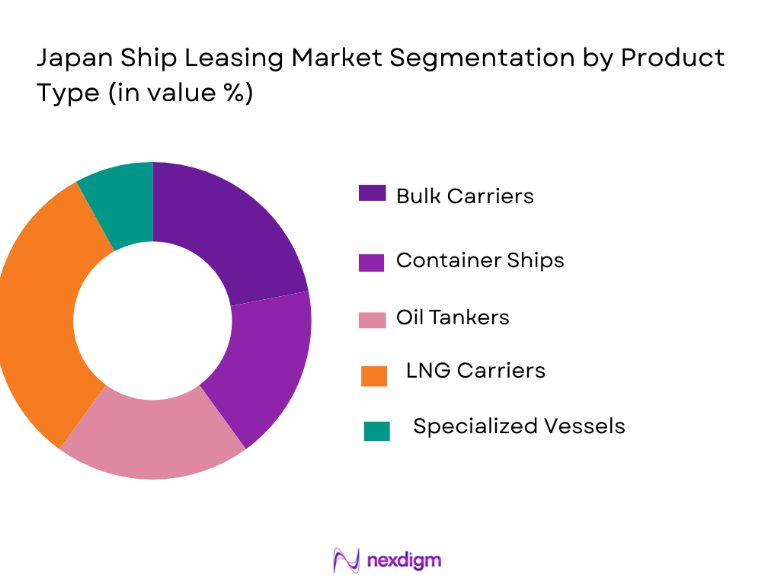
Japan Ship Leasing market is segmented by product type into bulk carriers, container ships, oil tankers, LNG carriers, and specialized vessels. Recently, LNG carriers had a dominant market share due to long-term charter contracts with Japanese utilities, stable cash flow profiles, and strong alignment with national energy security priorities. Japanese lessors prefer LNG assets because they are backed by creditworthy charterers and supported by government-linked financing programs. The complexity and high capital value of LNG carriers favor experienced leasing houses, reinforcing concentration in this sub-segment. Additionally, global LNG trade expansion and Japan’s reliance on imported natural gas sustain consistent demand for leased LNG tonnage.
By Platform Type
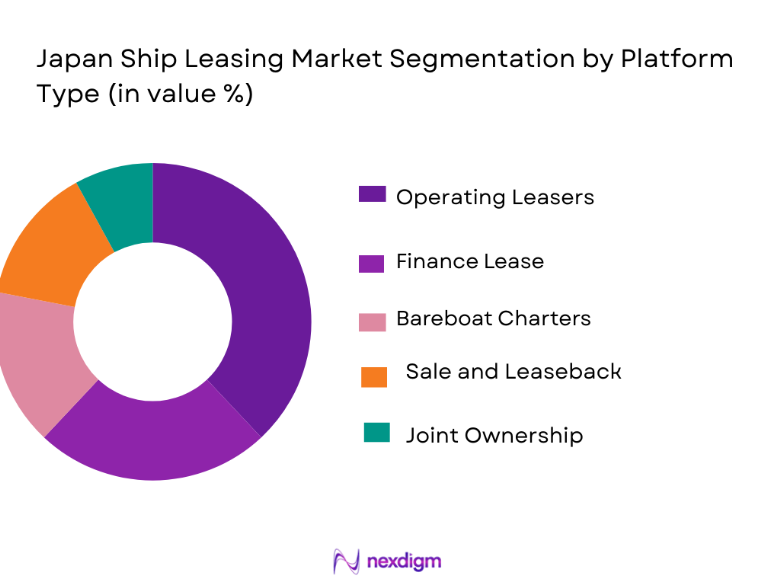
Japan Ship Leasing market is segmented by lease structure into operating leases, finance leases, bareboat charters, sale and leaseback arrangements, and joint ownership structures. Recently, operating leases had a dominant market share due to their flexibility, off-balance-sheet treatment for shipowners, and alignment with Japanese lessors’ risk management practices. Operating leases allow Japanese firms to retain asset ownership while securing long-term charter income, which is attractive under conservative financial strategies. The structure also enables easier redeployment of vessels across global routes, supporting portfolio resilience amid fluctuating freight markets.
Competitive Landscape
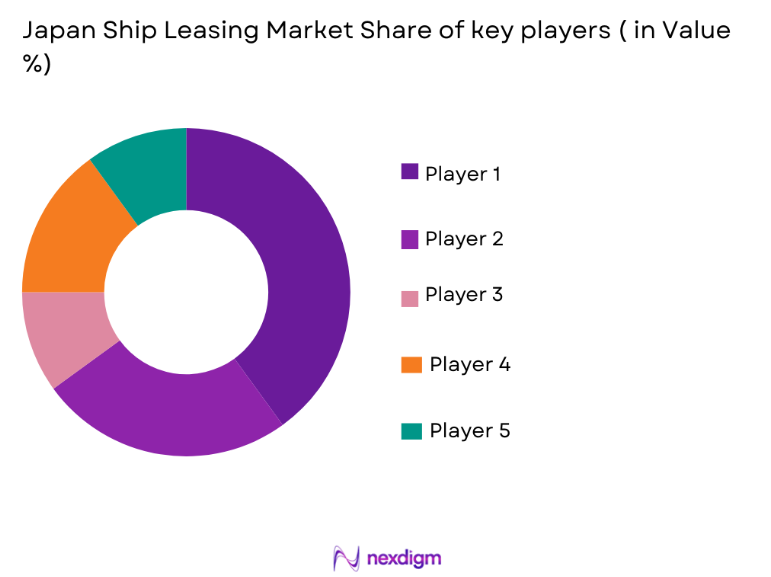
The Japan ship leasing market is moderately consolidated, with a small number of large financial groups and trading houses exerting significant influence over global leasing activity. Major players benefit from strong balance sheets, access to low-cost capital, and deep relationships with shipbuilders and charterers. Competitive intensity is shaped by long-term contracts rather than spot exposure, leading to stable revenue visibility and high barriers to entry for new participants.
| Company Name | Establishment Year | Headquarters | Technology Focus | Market Reach | Key Products | Revenue | Charter Contract Tenure |
| Mitsui OSK Lines Leasing | 1964 | Tokyo, Japan | ~ | ~ | ~ | ~ | ~ |
| NYK Line Leasing | 1885 | Tokyo, Japan | ~ | ~ | ~ | ~ | ~ |
| K Line Leasing | 1919 | Tokyo, Japan | ~ | ~ | ~ | ~ | ~ |
| SMBC Leasing | 1963 | Tokyo, Japan | ~ | ~ | ~ | ~ | ~ |
| Orix Shipping | 1964 | Tokyo, Japan | ~ | ~ | ~ | ~ | ~ |
Japan Ship Leasing Market Analysis
Growth Drivers
Energy Security Driven LNG Fleet Expansion
Energy security considerations play a central role in driving Japan ship leasing market growth, as Japan remains one of the world’s largest importers of liquefied natural gas and relies heavily on maritime transport to secure stable energy supplies. Japanese leasing companies actively finance LNG carriers under long-term charter agreements with domestic utilities and global energy firms, ensuring predictable cash flows and lower credit risk. This structure aligns well with Japan’s conservative financial culture and long investment horizons. Government-backed export credit agencies and policy banks further support LNG vessel financing, reducing capital costs for lessors. The expansion of LNG import terminals and long-term procurement contracts sustains demand for additional vessels. Technological advancements in LNG carrier design, including improved fuel efficiency and boil-off management, increase asset attractiveness. Leasing firms benefit from residual value stability due to limited global supply of advanced LNG carriers. Strong charter coverage insulates lessors from freight market volatility. This driver continues to reinforce Japan’s leadership in high-value ship leasing segments.
Strong Domestic Financial Institutions and Trading
The presence of large, well-capitalized banks and diversified trading houses underpins sustained growth in the Japan ship leasing market by providing reliable access to low-cost funding and integrated maritime services. Japanese megabanks and leasing subsidiaries offer structured finance solutions that combine vessel ownership, insurance, and long-term charter placement. Trading houses leverage global networks to source charters and manage operational risks, enhancing asset utilization. This ecosystem reduces counterparty risk and supports large-scale fleet investments. Conservative credit assessment practices ensure portfolio stability across economic cycles. Long-standing relationships with shipbuilder’s secure favorable construction terms and delivery schedules. The integration of financial, operational, and commercial capabilities creates competitive advantages for Japanese lessors. This institutional strength enables consistent market participation even during global downturns.
Market Challenges
Exposure to Global Shipping Cyclicality and Asset Value Risk
Despite stable charter structures, the Japan ship leasing market faces challenges from global shipping cyclicality that can affect vessel values and redeployment opportunities. Fluctuations in freight demand influence secondary market prices, impacting balance sheets of asset-owning lessors. While long-term contracts mitigate short-term risk, off-hire periods or early charter terminations can expose firms to unfavorable market conditions. Regulatory changes affecting fuel standards may accelerate asset obsolescence. Currency fluctuations between yen-denominated financing and dollar-based charter income add complexity to risk management. Portfolio concentration in specific vessel types can amplify exposure during sector downturns. Conservative accounting practices may require impairment recognition during market stress. These factors necessitate robust risk assessment frameworks. Managing cyclicality remains a persistent operational challenge.
Increasing Regulatory and Environmental Compliance Costs
Environmental regulations impose rising compliance costs on leased fleets, challenging profitability in the Japan ship leasing market. International emissions standards require investments in cleaner propulsion systems and retrofits, increasing capital expenditure. Leasing companies must balance compliance investments with chartered willingness to pay higher lease rates. Uncertainty around future regulatory pathways complicates asset valuation and long-term planning. Older vessels face accelerated depreciation as compliance costs rise. Coordination with charterers on cost-sharing arrangements can be complex. Compliance monitoring increases operational overhead. These pressures affect return expectations across leasing portfolios. Regulatory uncertainty remains a significant constraint.
Opportunities
Green Ship Leasing and Sustainable Finance Structures
The transition toward environmentally sustainable shipping presents a significant opportunity for the Japan ship leasing market through the development of green leasing models and sustainable finance instruments. Japanese lessors can leverage access to green bonds and sustainability-linked loans to finance low-emission vessels. Collaboration with shipyards on next-generation propulsion technologies enhances asset competitiveness. Long-term charters with environmentally conscious charters provide stable returns. Government incentives for decarbonization reduce financing costs. Transparent emissions reporting strengthens investor confidence. Green assets are likely to retain higher residual values. This opportunity aligns with Japan’s broader environmental policy goals. Sustainable leasing can differentiate market leaders.
Expansion of Cross-Border Leasing with Emerging Asian Shipowners
Growing demand from emerging Asian shipowners offers new growth avenues for the Japan ship leasing market. Japanese lessors can deploy capital to fast-growing trade regions while maintaining ownership control. Strong structuring capabilities mitigate credit risk in developing markets. Partnerships with regional operators expand market reach. Diversification across geographies reduces concentration risk. Long-term demand growth in Asia supports fleet utilization. Knowledge transfer enhances operational efficiency. This opportunity supports portfolio expansion beyond traditional markets.
Future Outlook
Over the next five years, the Japan ship leasing market is expected to maintain steady expansion supported by LNG trade growth, sustainable finance adoption, and strong institutional backing. Technological innovation in vessel efficiency and emissions management will shape new leasing structures. Regulatory alignment with global decarbonization goals is likely to encourage green asset deployment. Demand-side stability from long-term charters will continue to underpin predictable revenue streams.
Major Players
- Mitsui OSK Lines Leasing
- NYK Line Leasing
- K Line Leasing
- SMBC Leasing
- Orix Shipping
- Marubeni Leasing
- Sumitomo Mitsui Trust Leasing
- Mitsubishi HC Capital
- Itochu Shipping
- Sojitz Shipping
- Nissho Iwai Leasing
- Shinsei Bank Shipping
- Tokyo Century
- JA Mitsui Leasing
- Resona Leasing
Key Target Audience
- Shipowners
- Shipping operators
- Energy companies
- Port authorities
- Investments and venture capitalist firms
- Government and regulatory bodies
- Maritime insurers
- Shipbuilding companies
Research Methodology
Step 1: Identification of Key Variables
Key variables including vessel types, lease structures, charter tenures, and financing sources were identified through industry reports and regulatory publications to define the analytical scope.
Step 2: Market Analysis and Construction
Quantitative and qualitative data were analyzed to construct market segmentation and competitive positioning, ensuring consistency with verified financial disclosures.
Step 3: Hypothesis Validation and Expert Consultation
Preliminary findings were validated through expert consultation with maritime finance professionals and cross-checked against authoritative industry databases.
Step 4: Research Synthesis and Final Output
Validated insights were synthesized into a structured market outlook ensuring methodological transparency and internal consistency.

- Executive Summary
- Research Methodology (Definitions, Scope, Industry Assumptions, Market Sizing Approach, Primary & Secondary Research Framework, Data Collection & Verification Protocol, Analytic Models & Forecast Methodology, Limitations & Research Validity Checks)

- Market Definition and Scope
- Value Chain & Stakeholder Ecosystem
- Regulatory / Certification Landscape
- Sector Dynamics Affecting Demand
- Strategic Initiatives & Infrastructure Growth

- Growth Drivers
Expansion of LNG import requirements supporting long-term carrier leases
Strong balance sheets of Japanese trading houses enabling asset-heavy leasing
Replacement demand for aging bulk and tanker fleets
Growth in Asia-Pacific trade volumes requiring chartered capacity
Stable access to low-cost capital from domestic financial institutions - Market Challenges
High exposure to global freight rate volatility impacting lease returns
Regulatory pressure on vessel emissions increasing compliance costs
Currency fluctuation risks between yen financing and USD leases
Long asset lifecycles limiting portfolio flexibility
Rising competition from alternative maritime finance hubs - Market Opportunities
Leasing of next-generation low-emission vessels for global operators
Expansion of Japanese leasing participation in offshore wind support fleets
Structured leasing solutions for emerging Asian shipping companies - Trends
Shift toward dual-fuel and LNG-powered vessel lease contracts
Increased use of digital asset monitoring in lease management
Growth of consortium-based leasing to distribute risk
Longer lease tenures for specialized vessels
Closer collaboration between shipyards and lessors - Government Regulations & Defense Policy
Alignment with international maritime emission regulations
Supportive financial regulations for maritime asset financing
Maritime security policies influencing fleet modernization - SWOT Analysis
- Stakeholder and Ecosystem Analysis
- Porter’s Five Forces Analysis
- Competition Intensity and Ecosystem Mapping

- By Market Value, 2020-2025
- By Installed Units, 2020-2025
- By Average System Price, 2020-2025
- By System Complexity Tier, 2020-2025

- By System Type (In Value%)
Operating lease agreements
Finance lease agreements
Bareboat charter structures
Time charter lease structures
Hybrid leasing models - By Platform Type (In Value%)
Bulk carrier leasing
Tanker vessel leasing
Container ship leasing
LNG and LPG carrier leasing
Offshore support vessel leasing - By Fitment Type (In Value%)
Newbuild vessel leasing
Mid-life vessel leasing
Second-hand vessel leasing
Fleet renewal replacement leasing
Charter conversion leasing - By EndUser Segment (In Value%)
Domestic shipping companies
International shipping operators
Energy and commodity traders
Offshore and marine service providers
Logistics and integrated transport firms - By Procurement Channel (In Value%)
Direct leasing from financial institutions
Leasing via trading houses
Shipyard-linked leasing arrangements
Consortium-based leasing structures
Cross-border leasing partnerships - By Material / Technology (in Value %)
Conventional fuel vessel leasing
Dual-fuel vessel leasing
LNG-powered vessel leasing
Energy-efficient eco-ship leasing
Digitally monitored smart vessel leasing

- Market structure and competitive positioning
- Market share snapshot of major players
- Cross Comparison Parameters (Lease tenor, Vessel type coverage, Financing structure, Geographic charter reach, Fuel technology support, Risk sharing mechanisms, Regulatory compliance capability, Asset management services)
- SWOT Analysis of Key Competitors
- Pricing & Procurement Analysis
- Key Players
Mitsui O.S.K. Lines Finance
NYK Group Leasing
Kawasaki Kisen Kaisha Leasing
Mitsubishi HC Capital Marine
Sumitomo Mitsui Finance and Leasing Marine
Mizuho Leasing Marine
Tokio Marine Asset Management Shipping
Orix Maritime Leasing
Itochu Shipping Finance
Marubeni Ship Leasing
Sojitz Marine Leasing
Mitsubishi Corporation Ship Finance
Sumitomo Corporation Marine Assets
Japan Bank for International Cooperation Maritime
Development Bank of Japan Ship Finance

- Shipping companies prioritize predictable charter costs and fleet flexibility
- Energy traders favor long-term LNG carrier leases for supply security
- Logistics firms use leasing to scale capacity without capital strain
- Offshore operators demand specialized vessels under tailored lease terms

- Forecast Market Value, 2026-2035
- Forecast Installed Units, 2026-2035
- Price Forecast by System Tier, 2026-2035
- Future Demand by Platform, 2026-2035


 Request a Sample
 Ask for Customization
 Get a Quote
 Enquire Now