

 Download PDF
Market Overview
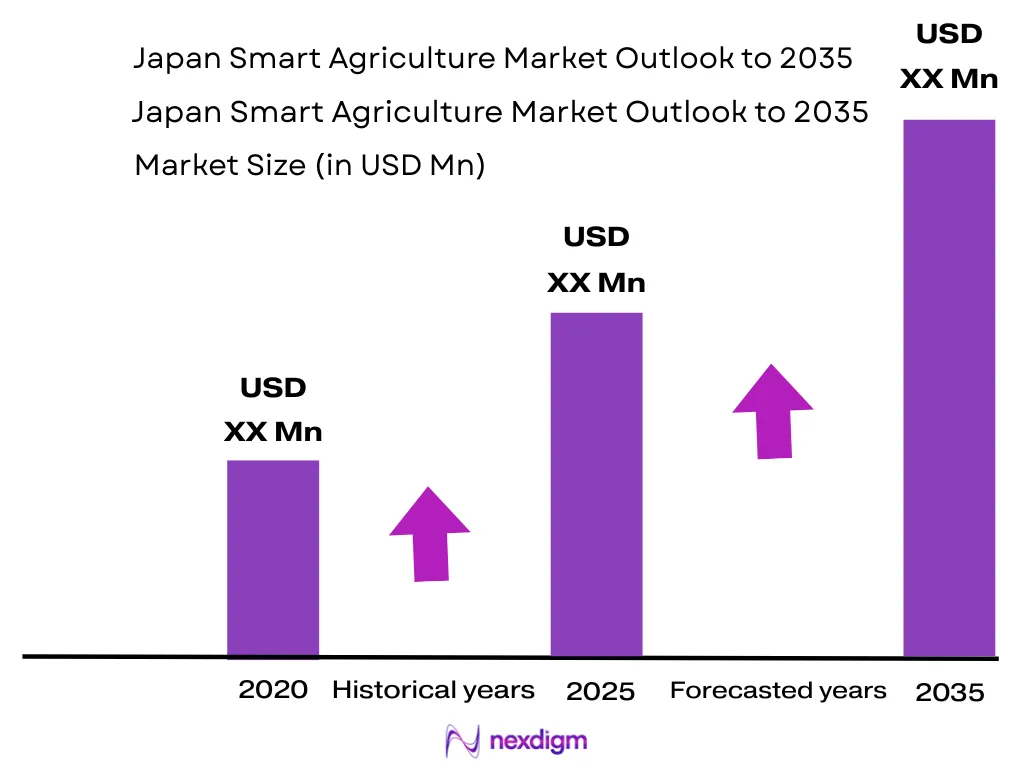
The Japan Smart Agriculture Market is valued at JPY ~ million, based on enterprise sales, with demand driven by smart rice planting, variable fertilization, remote sensing, crop-growth maps, drones, sensors and farm software. The market stood at USD ~ million in the prior base year from another published reference, showing rapid commercialization from pilot use to enterprise sales. The forecasted CAGR for the long-range outlook to 2035 is 5.2%. Hokkaido, Tohoku, Kanto, Chubu and Kyushu-Okinawa dominate Japan Smart Agriculture Market because each region has crop-specific deployment logic. MAFF reports 217 smart agriculture demonstration districts across Japan, covering paddy rice, vegetables, horticulture, tea and livestock, while OECD reported JPY 4,500 million in smart-agriculture technology promotion funding. Hokkaido leads broadacre automation; Tohoku supports paddy water systems; Kanto supports greenhouse IoT; Kyushu-Okinawa supports tea, sugarcane and subtropical crop monitoring.
Market Segmentation
By Technology Type
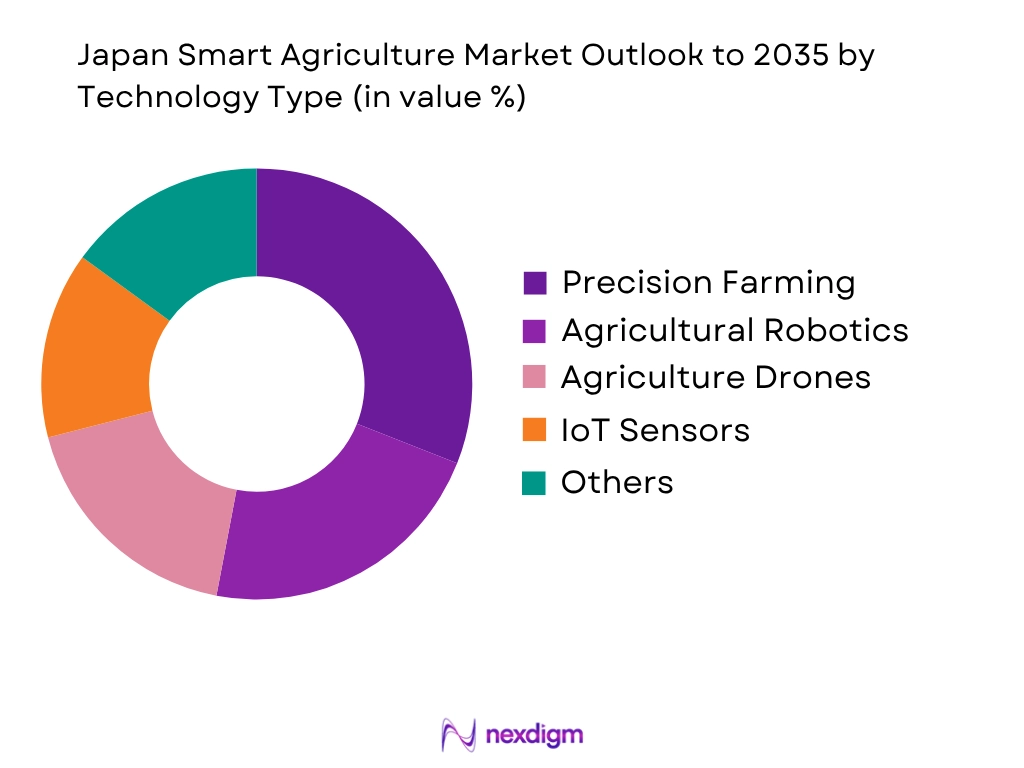
Japan Smart Agriculture Market is segmented by technology type into precision farming and farm management platforms, agricultural robotics, agriculture drones, IoT sensors, smart greenhouse systems and digital traceability platforms. Recently, precision farming and farm management platforms have a dominant market share in Japan under this segmentation because they serve as the operating layer that connects drones, sensors, smart machinery, weather data, fertilizer records, pesticide records, yield maps and compliance documents. Market.us identifies precision farming, software and crop monitoring as dominant segments in Japan smart agriculture, while Grand View Research identifies precision farming as the largest Japan smart agriculture agriculture-type segment. This dominance is also logical in Japan because fragmented farms and aging operators require integrated dashboards rather than isolated equipment.
By Application
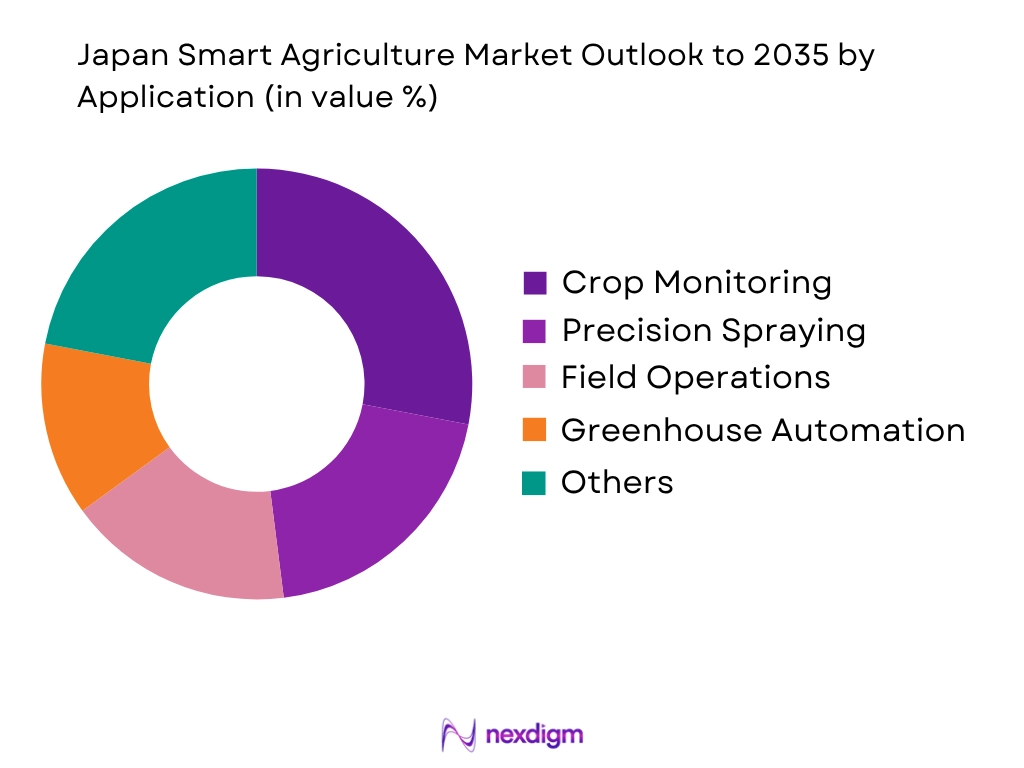
Japan Smart Agriculture Market is segmented by application into crop monitoring and farm operations management, precision spraying, autonomous field operations, greenhouse automation, irrigation and paddy water management, livestock monitoring, and traceability. Recently, crop monitoring and farm operations management have a dominant market share in Japan under the application segmentation because they solve common pain points across rice, vegetables, fruits, tea, greenhouse crops and livestock. MAFF highlights drone-based growth monitoring, farming apps, automatic paddy water management, automated rice transplanters and combines capable of collecting yield and quality data. These solutions reduce field visits, support timely decision-making and standardize work records. Precision spraying and autonomous machinery are expanding, but crop monitoring remains the core digital entry point for many farms.
Competitive Landscape
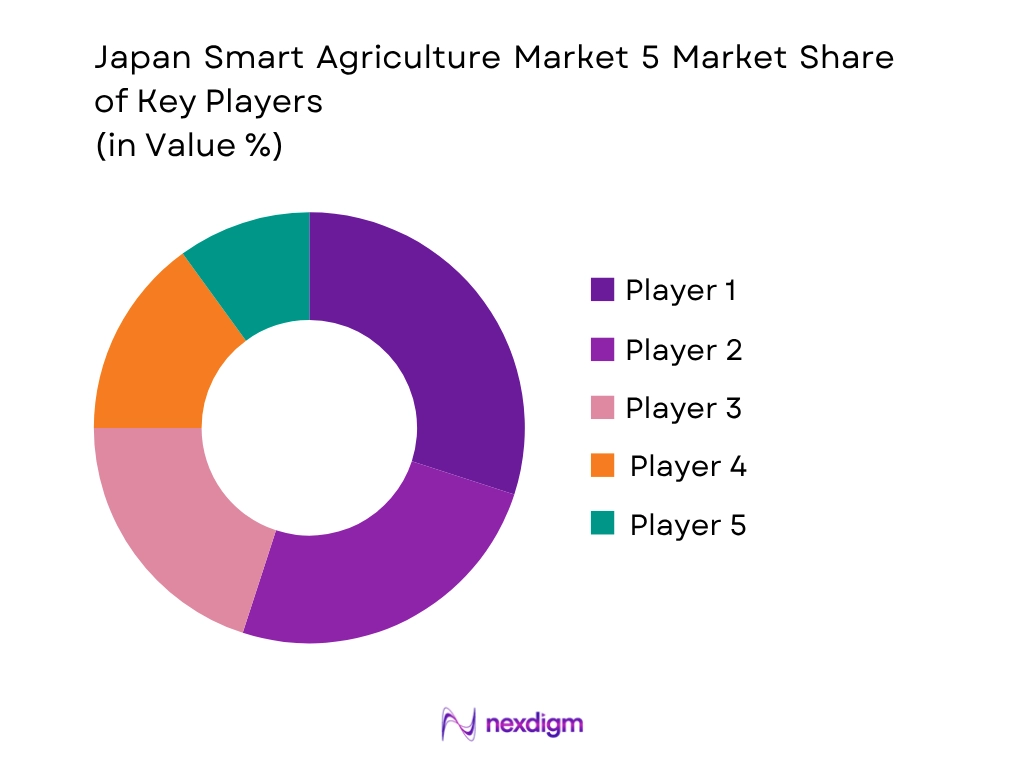
Japan Smart Agriculture Market is led by domestic machinery OEMs, drone firms, AI/IoT platform companies, telecom providers and enterprise technology players. Kubota, Yanmar and Iseki hold strong positions because of their farm-equipment base and dealer relationships; Yamaha, DJI and Nileworks compete in agricultural drones; OPTiM, NTT, Fujitsu, NEC, KDDI, SoftBank, Topcon and Seraku strengthen AI, cloud, IoT, sensing and greenhouse systems. Competition is shifting from standalone hardware toward integrated hardware-software-service ecosystems.
| Company | Establishment Year | Headquarters | Core Smart Agriculture Offering | Key Use Case | Hardware Capability | Software / AI Capability | Channel Strength | Strategic Position |
| Kubota Corporation | 1890 | Osaka, Japan | ~ | ~ | ~ | ~ | ~ | ~ |
| Yanmar Holdings Co., Ltd. | 1912 | Osaka, Japan | ~ | ~ | ~ | ~ | ~ | |
| Yamaha Motor Co., Ltd. | 1955 | Iwata, Japan | ~ | ~ | ~ | ~ | ~ | ~ |
| OPTiM Corporation | 2000 | Tokyo, Japan | ~ | ~ | ~ | ~ | ~ | ~ |
| NTT Group / NTT AgriTechnology | 1985 parent origin | Tokyo, Japan | ~ | ~ | ~ | ~ | ~ | ~ |
Japan Smart Agriculture Market
Growth Drivers
Aging farm workforce is accelerating demand for labour-saving smart agriculture systems
Japan Smart Agriculture Market is being driven by the structural need to maintain farm output with fewer and older operators. MAFF’s 2025 Basic Plan reference records 1.11 million core persons mainly engaged in farming in 2024, with an average age of 69.2 years, while domestic farmland stood at 4.27 million hectares. This creates direct demand for robot tractors, drone spraying, paddy water sensors, autonomous rice transplanters, farm management apps and remote crop-monitoring tools because seasonal farm operations must be completed with reduced labour availability. The market relevance is strongest in rice, greenhouse vegetables, tea, orchards and field crops, where work windows are short and operator experience matters. World Bank data reinforces the demand base, with Japan recording USD 4.03 trillion GDP, USD 32,487.1 GDP per capita and nearly 124 million people in 2024. These macro indicators support technology investment in a high-income food system where domestic production reliability remains economically important.
Government-backed smart agriculture deployment is strengthening commercial adoption
Japan Smart Agriculture Market is supported by policy-led commercialization of robotics, drones, IoT sensors, AI dashboards and precision farming systems. MAFF reports smart agriculture demonstrations across 217 districts from Hokkaido to Okinawa, covering real production sites rather than laboratory-only trials. OECD reported that MAFF allocated JPY 4,500 million in 2024 to promote smart agricultural technologies, including automation systems, precision farming technologies and AI-driven decision-making tools. This directly supports market demand for autonomous tractors, smartphone-operated paddy water systems, drone-based crop-growth monitoring, yield-sensing combines and farm-data platforms. For providers, policy support reduces adoption risk because technologies are demonstrated through crop-specific, region-specific use cases. IMF’s Japan profile lists nominal GDP at USD 4,190 billion, GDP per capita at USD 33,820 and population at 124 million in 2024, showing that Japan has the economic base to fund productivity-led farm digitization. These conditions justify smart agriculture adoption across cooperatives, corporate farms, greenhouse operators and farm-service contractors.
Market Challenges
Fragmented farmland reduces efficiency for robotics, drones and sensor networks
Japan Smart Agriculture Market faces a structural deployment challenge from small, fragmented and terrain-diverse farms. MAFF’s Basic Plan reference records domestic farmland at 4.27 million hectares in 2024, while core persons mainly engaged in farming stood at 1.11 million and averaged 69.2 years of age. This creates a difficult operating environment: farmers need smart tools because labour is scarce, but many fields are not optimized for large robot fleets, standardized drone routes or wide-area sensor networks. Small paddy plots increase setup time for autonomous machinery and spraying drones, while orchards, tea fields and hilly terrain require customized mapping, connectivity and service support. Smart agriculture companies therefore need compact robots, shared drone services, interoperable platforms and region-specific operating models rather than broadacre-only solutions. World Bank macro data shows Japan’s USD 4.03 trillion GDP and USD 32,487.1 GDP per capita in 2024, but farm-level structure can still constrain technology utilization.
Drone and data compliance adds operational burden for smart agriculture providers
Japan Smart Agriculture Market also faces adoption friction from aviation, device and data compliance. MLIT states that unmanned aircraft weighing 100 grams or more must be registered under Japan’s Civil Aeronautics Act, must display a registration ID and must be equipped with remote ID functionality. This directly affects agriculture drones used for pesticide spraying, crop mapping, remote sensing and sensor relay in rice, tea, orchard and vegetable production. Smart agriculture vendors must therefore provide more than hardware; they need operator training, flight-permission support where applicable, safe-use documentation, pesticide-application record compatibility and reliable after-sales service. IoT systems also require stable connectivity, sensor calibration and secure farm-data handling, especially when platforms integrate machinery, weather, input use and crop records. IMF lists Japan’s nominal GDP at USD 4,190 billion, GDP per capita at USD 33,820 and population at 124 million in 2024, showing strong macro capacity, but regulatory complexity can still slow small-farm adoption.
Market Opportunities
Smart agriculture-as-a-service can expand access among small and aging farmers
Japan Smart Agriculture Market has a strong opportunity in smart agriculture-as-a-service, including drone-as-a-service, sensor-as-a-service, robotics-as-a-service, cooperative machine sharing and contractor-operated farm data services. MAFF’s smart agriculture material highlights shared-use approaches, including smart agricultural machines owned by agricultural cooperatives and outsourced operations that reduce direct farmer burden. It also describes shared use of rice-planting machines with straight-drive assist and combine harvesters with taste and yield sensors across 3 locations in Okayama. This model is commercially relevant because many older farmers need labour-saving tools but may not want to operate, maintain or register advanced systems independently. Service models allow JA cooperatives, farm contractors and technology vendors to deploy drones, robots and sensors across multiple small farms, improving utilization and reducing operational complexity for end users. The opportunity is reinforced by Japan’s 1.11 million core farming workers and average farmer age of 69.2 years in 2024. World Bank reported USD 4.03 trillion GDP in 2024, supporting service-based digitization in a high-income economy.
Crop-specific smart platforms can scale across rice, greenhouse, tea and livestock systems
Japan Smart Agriculture Market has future growth potential in crop-specific platforms rather than generic farm digitization tools. MAFF identifies paddy applications such as automatic water management, farming apps, drone-based growth monitoring and yield-quality data collection. It also highlights smart agriculture use cases across vegetables, green tea and sugarcane, using drones, automatic sprinkler systems, environmental sensors, robotic tea-garden management machines and centralized information systems. These current deployments show that market expansion can come from specialized modules for paddy water control, greenhouse climate management, tea canopy monitoring, orchard spraying, dairy sensors and export-grade traceability. Demonstrations across 217 districts provide a base for regional replication, while OECD’s JPY 4,500 million smart agriculture allocation in 2024 supports continued technology integration. World Bank reported Japan’s USD 4.03 trillion GDP and USD 32,487.1 GDP per capita in 2024, while IMF listed USD 4,190 billion nominal GDP. These macro indicators support premium smart-farming adoption where labour savings, quality control and traceability justify deployment.
Future Outlook
Over the next phase, Japan Smart Agriculture Market is expected to expand through autonomous machinery, precision input use, drone spraying, farm data platforms, greenhouse automation, IoT sensors, AI crop diagnosis and traceability systems. The largest demand pools will remain tied to labour-saving technologies for rice, greenhouse vegetables, tea, orchards, field crops and livestock. A key future shift will be the move from product ownership to service-based deployment. Older farmers and small farms may not purchase full robotics or sensor stacks directly, creating demand for drone-as-a-service, sensor-as-a-service, machinery sharing, JA cooperative deployment and contractor-operated field services.
Policy support will remain central. MAFF’s smart agriculture demonstration program has already supported deployments across 217 districts, while the Smart Agriculture Act is intended to accelerate practical use of smart technologies at production sites. These initiatives support broader adoption of robots, drones, AI, IoT and data-driven farm management systems. Precision input optimization will become increasingly important. Yano Research notes that smart rice planting systems with variable fertilization and remote sensing systems that generate crop-growth maps continued to proliferate in FY2024. This supports fertilizer optimization, crop-condition monitoring and yield-quality improvement, particularly in paddy rice and high-value crop systems.
Major Players
- Kubota Corporation
- Yanmar Holdings Co., Ltd.
- Iseki & Co., Ltd.
- Yamaha Motor Co., Ltd.
- DJI Agriculture
- Nileworks Inc.
- OPTiM Corporation
- NTT Group / NTT AgriTechnology
- Fujitsu Limited
- NEC Corporation
- Topcon Corporation
- Sony Semiconductor Solutions Corporation
- KDDI Corporation
- SoftBank Corp.
- Seraku Co., Ltd. / Midori Cloud
Key Target Audience
- Smart agriculture solution providers
- Agricultural machinery manufacturers
- Agriculture drone manufacturers and service operators
- IoT sensor and connectivity providers
- Smart greenhouse and controlled-environment agriculture companies
- Agricultural cooperatives and farm service operators
- Investments and venture capitalist firms
- Government and regulatory bodies, including MAFF, MLIT, MIC, METI, JCAA and Japan Agricultural Cooperatives Group
Research Methodology
Step 1: Identification of Key Variables
The initial phase involves constructing an ecosystem map encompassing all major stakeholders within the Japan Smart Agriculture Market. This includes robotics OEMs, drone companies, IoT sensor providers, farm software firms, telecom operators, cloud providers, JA cooperatives, greenhouse operators, livestock farms and agricultural corporations.
Step 2: Market Analysis and Construction
In this phase, historical data is compiled across robotics, drones, IoT sensors, precision machinery, smart greenhouses, AI analytics and farm management software. The analysis evaluates hardware sales, software subscriptions, service deployment, crop-specific adoption, regional penetration and farm-size-based demand.
Step 3: Hypothesis Validation and Expert Consultation
Market hypotheses are validated through CATI-style interviews with smart agriculture companies, machinery dealers, drone service providers, JA procurement stakeholders, greenhouse operators, livestock farms and agricultural corporations. These consultations verify adoption barriers, channel behavior, training needs, service demand and platform integration requirements.
Step 4: Research Synthesis and Final Output
The final phase integrates secondary research, expert inputs and bottom-up deployment indicators into a validated market model. Segment shares, competitive positioning, growth drivers, challenges and future outlook are cross-checked against smart agriculture policy, regional crop systems, farm demographics and technology commercialization pathways.

- Executive Summary
- Research Methodology (Market Definitions and Assumptions, Abbreviations, Smart Agriculture Scope, Market Sizing Approach, Top-to-Bottom Smart Agriculture Spend Validation, Bottom-to-Top Hardware/Software/Service Revenue Build-Up, Primary Interviews with OEMs/Agri-Tech Firms/JA Cooperatives/Farm Contractors/Greenhouse Operators/Telecom Providers, Secondary Research Validation, Regulatory Mapping, Limitations and Future Conclusions)

- Definition and Scope
- Market Genesis
- Evolution of Japan’s Smart Farming Ecosystem
- Timeline of Major Players
- Business Cycle
- Supply Chain and Value Chain Analysis

- Growth Drivers (Labour-Saving Technology, Smart Agriculture Demonstrations, Farm Consolidation, Export-Quality Traceability, Precision Input Optimization, Greenhouse Automation, Robotics Commercialization)
- Market Challenges (Small Plot Fragmentation, Farmer Digital Skill Gap, High Upfront Investment, Data Interoperability, Rural Connectivity, Regulatory Complexity, Service Network Shortage)
- Opportunities (Smart Agriculture-as-a-Service, Farm Data Platforms, AI Crop Diagnosis, Cooperative Deployment, Greenhouse IoT, Livestock Automation, Digital Traceability, Climate-Smart Farming)
- Trends (Autonomous Flight, RTK Navigation, Edge AI, Farm Data Integration, Digital Traceability, Greenhouse IoT, Agri-Robotics, Remote Sensing, Sustainability Reporting)
- Government Regulation (Smart Agriculture Act, Civil Aeronautics Act, MLIT Drone Rules, Radio Act, Agricultural Chemicals Regulation, Data Governance, Food Traceability, Machinery Safety, Organic JAS)
- SWOT Analysis
- PESTLE Analysis
- Porter’s Five Forces Analysis
- Stakeholder Ecosystem

- By Value (2020-2026)
- By Installed Base (2020-2026)
- By Unit Sales (2020-2026)

- By Technology Type (In Value %)
Agricultural Robotics
Agriculture Drones
IoT Sensors
Farm Management Software - By Application (In Value %)
Crop Monitoring
Precision Spraying and Input Optimization
Autonomous Field Operations
Irrigation and Paddy Water Management
Greenhouse Automation
Livestock Monitoring - By End User (In Value %)
Individual Farmers
Agricultural Corporations
JA Cooperatives
Farm Contractors - By Sales Channel (In Value %)
OEM Direct Sales
Agricultural Machinery Dealers
JA Cooperative Channel
Telecom and Cloud Partners - By Region(In Value %)
Hokkaido Region (Northern Japan)
Kanto Region (East‑Central Japan)
Chubu Region (Central Japan)
Kyushu‑Okinawa Region (Southwest Japan)
Tohoku Region (Northern Honshu)

- Market Share of Major Players on the Basis of Value and Installed Base
- Cross Comparison Parameters (Robotics and Autonomous Equipment Capability, Drone and Remote Sensing Portfolio, IoT Sensor and Connectivity Depth, Farm Data Platform and AI Analytics Strength, Crop-Specific Use Case Coverage, JA/Dealer/Service Network Reach, Regulatory and Training Support Capability, Interoperability with Machinery/Input/Traceability Platforms)
- SWOT Analysis of Major Players
- Pricing Analysis of Major Players(Robot Models, Drone Models, Sensor Kits, Software Subscription, Data Analytics Fees, Maintenance Contracts, Service Packages)
- Detailed Profiles of Major Companies
Kubota Corporation
Yanmar Holdings Co., Ltd.
Iseki & Co., Ltd.
Yamaha Motor Co., Ltd.
DJI Agriculture
Nileworks Inc.
OPTiM Corporation
NTT Group / NTT AgriTechnology
Fujitsu Limited
NEC Corporation
Topcon Corporation
Sony Semiconductor Solutions Corporation
KDDI Corporation
SoftBank Corp.
Seraku Co., Ltd. / Midori Cloud

- Market Demand and Utilization
- Purchasing Power and Budget Allocation
- Regulatory and Compliance Requirements
- Needs, Desires and Pain Point Analysis
- Decision-Making Process

- By Value (2026-2035)
- By Installed Base (2026-2035)
- By Unit Sales (2026-2035)


 Request a Sample
 Ask for Customization
 Get a Quote
 Enquire Now