

 Download PDF
 Download PDF
Market Overview
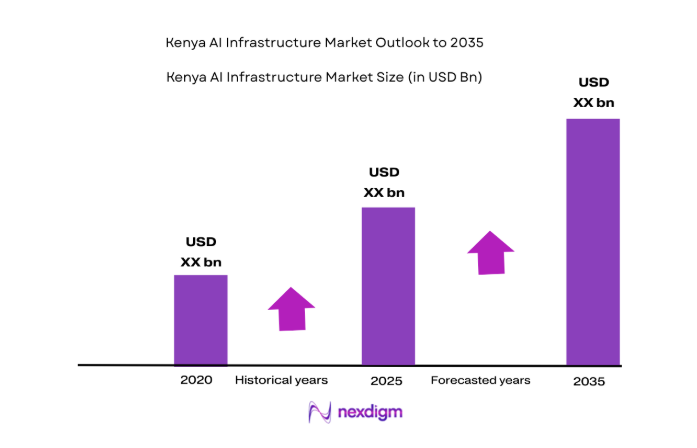
Kenya AI infrastructure market is valued at approximately USD ~ million based on a recent historical assessment, supported by verified disclosures from national ICT investment programs and hyperscale data center expansion filings. Growth is driven by accelerated cloud adoption, AI workload hosting demand, public digitalization programs, and enterprise analytics deployment across finance, telecom, and public services sectors. Infrastructure spending is concentrated in compute clusters, high-density data centers, and GPU-accelerated server deployments aligned with regional digital economy strategies and cross-border data hosting demand.
Nairobi dominates the Kenya AI infrastructure market due to concentration of hyperscale facilities, fiber connectivity hubs, fintech ecosystem density, and government digital services infrastructure deployment. Mombasa emerges as a secondary node because of submarine cable landing stations and logistics corridor data exchange demand supporting regional AI hosting. Neighboring East African markets rely on Kenya’s connectivity backbone and colocation ecosystem, reinforcing cross-border workload hosting and regional AI compute aggregation anchored around Nairobi’s technology cluster and innovation ecosystem.
Market Segmentation
By Product Type
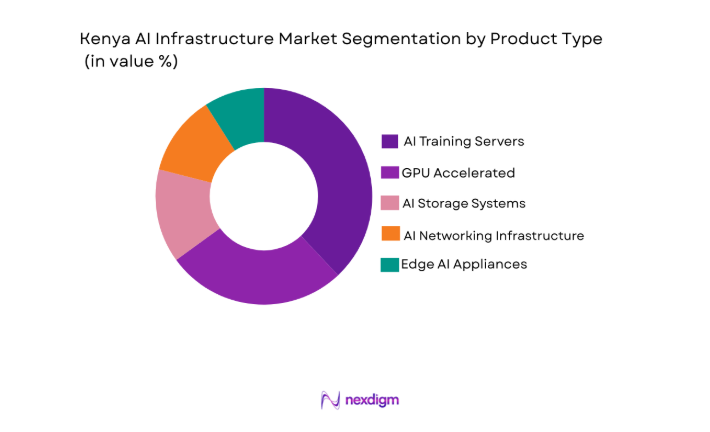
Kenya AI Infrastructure market is segmented by product type into AI servers, GPU accelerators, AI storage systems, AI networking infrastructure, and edge AI appliances. Recently, AI servers has a dominant market share due to factors such as enterprise demand patterns, hyperscale procurement presence, data center infrastructure availability, and institutional preference for centralized compute clusters supporting machine learning workloads and national digital services platforms.
By Platform Type
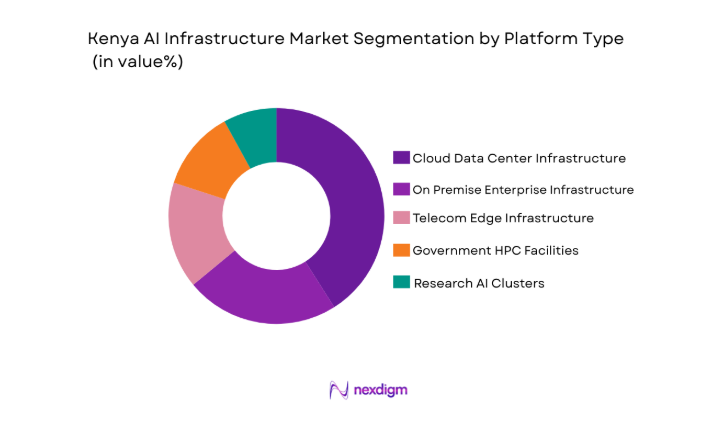
Kenya AI Infrastructure market is segmented by platform type into cloud data centers, enterprise on-premise AI infrastructure, telecom edge infrastructure, government HPC facilities, and research AI clusters. Recently, cloud data centers has a dominant market share due to factors such as hyperscale presence, colocation expansion, connectivity infrastructure, and enterprise migration toward hosted AI platforms enabling scalable compute access across sectors.
Competitive Landscape
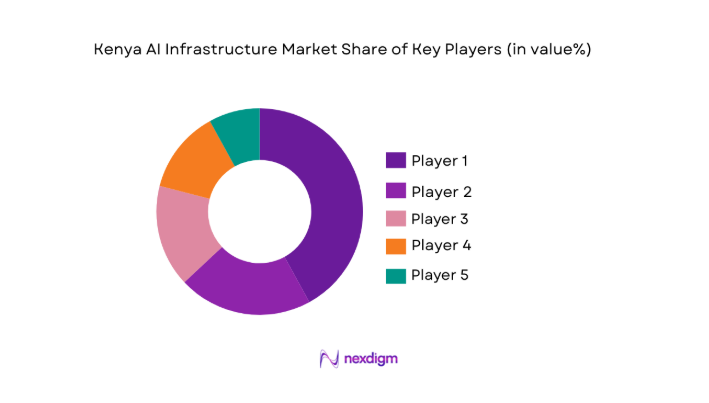
Kenya AI infrastructure market shows moderate consolidation led by global server vendors, hyperscale cloud operators, and regional data center developers collaborating with telecom carriers and system integrators. Market influence is shaped by compute hardware providers supplying GPU-enabled clusters, while local colocation firms control facility deployment and connectivity access. Strategic alliances between global OEMs and Kenyan ICT firms drive deployment scale, while hyperscale tenants anchor long-term capacity commitments across Nairobi and coastal infrastructure nodes.
| Company Name | Establishment Year | Headquarters | Technology Focus | Market Reach | Key Products | Revenue | Kenya Data Center Presence |
| Dell Technologies | 1984 | USA | ~ | ~ | ~ | ~ | ~ |
| Hewlett Packard Enterprise | 2015 | USA | ~ | ~ | ~ | ~ | ~ |
| NVIDIA | 1993 | USA | ~ | ~ | ~ | ~ | ~ |
| Huawei | 1987 | China | ~ | ~ | ~ | ~ | ~ |
| Lenovo | 1984 | China | ~ | ~ | ~ | ~ | ~ |
Kenya AI Infrastructure Market Analysis
Growth Drivers
Expansion of Hyperscale and Colocation Data Center Investments
expansion of hyperscale and colocation data center investments is accelerating Kenya AI infrastructure adoption by creating large-scale compute hosting environments that enable enterprises and governments to deploy AI workloads without owning physical infrastructure, while long-term hyperscale tenancy agreements ensure sustained hardware procurement cycles and facility utilization, and the clustering of GPU-accelerated servers within Nairobi’s data center campuses creates economies of scale that reduce unit compute costs and encourage broader adoption across financial services, telecom analytics, e-government platforms, and regional SaaS providers, thereby stimulating downstream demand for AI servers, storage arrays, and high-speed networking equipment across Kenya’s digital ecosystem and reinforcing infrastructure concentration in established connectivity corridors. This investment wave is further supported by submarine cable expansions and terrestrial fiber upgrades that increase bandwidth availability and reduce latency, making Kenya attractive for regional AI workload hosting and cross-border data services serving East and Central Africa markets. The presence of international cloud providers deploying local zones and edge regions stimulates enterprise migration from legacy IT environments toward AI-ready infrastructure stacks hosted in colocation facilities. Financial institutions and mobile network operators are scaling analytics platforms requiring GPU-dense clusters, directly expanding procurement volumes for AI servers and accelerators installed in Kenyan facilities. Government digital transformation programs involving biometric systems, smart agriculture analytics, and public service automation require centralized compute infrastructure hosted in national data centers. Local technology startups are leveraging cloud-hosted AI compute rather than importing hardware, increasing utilization rates of installed infrastructure capacity. Data sovereignty considerations encourage domestic hosting of sensitive datasets, further driving local infrastructure investment. Real estate developers and energy providers are collaborating with data center operators to expand facility footprints, enabling continuous expansion of AI hardware deployment. These combined structural drivers ensure sustained infrastructure scaling across Kenya’s AI compute ecosystem.
National Digitalization and AI Adoption Across Public and Enterprise Sectors
National digitalization and AI adoption across public and enterprise sectors is driving Kenya AI infrastructure expansion by generating sustained demand for machine learning training, data analytics processing, and automated decision platforms across finance, agriculture, healthcare, telecom, and public administration, while digital public service platforms require scalable compute backends capable of handling biometric identification, transaction processing, and predictive analytics workloads hosted within domestic infrastructure environments to comply with regulatory and data sovereignty frameworks. Government smart economy initiatives promote adoption of AI in agriculture yield prediction, land registry digitization, health surveillance, and urban planning analytics, all of which require centralized GPU-enabled compute clusters installed in national or commercial data centers. Enterprises in banking and mobile payments sectors deploy fraud detection and customer analytics models that demand continuous high-performance processing capacity, directly expanding infrastructure procurement cycles. Telecom operators integrate AI into network optimization and customer experience platforms hosted in cloud or edge environments across Kenya’s connectivity backbone. Retail and logistics companies implement demand forecasting and route optimization analytics requiring scalable compute resources deployed within colocation facilities. Educational and research institutions deploy AI training clusters for language and climate modeling aligned with national development priorities. Public sector procurement policies favor domestic hosting of AI platforms, encouraging local infrastructure deployment rather than offshore cloud reliance. Venture investment into Kenyan AI startups increases consumption of hosted GPU compute resources provided by local cloud and colocation providers. These sector-wide digitalization dynamics collectively sustain long-term expansion of Kenya’s AI infrastructure base.
Market Challenges
High Energy Costs and Power Reliability Constraints for Data Center Operations
High energy costs and power reliability constraints for data center operations limit Kenya AI infrastructure scalability because AI compute clusters require continuous high-density power supply and cooling stability, while fluctuations in grid reliability increase operational risk and infrastructure redundancy costs, forcing data center operators to invest heavily in backup generation, energy storage, and cooling resilience systems that elevate total cost of ownership and slow deployment timelines for new facilities hosting AI servers and GPU accelerators. Electricity tariffs for commercial and industrial users remain relatively elevated compared with some competing regional markets, increasing operating expenditure for AI infrastructure operators and affecting pricing competitiveness of locally hosted compute services. Grid outages or voltage instability events can disrupt AI workloads and damage sensitive hardware, necessitating redundant power architectures that significantly increase capital requirements for facility development. Renewable energy integration for data centers is progressing but requires upfront investment in on-site generation or power purchase agreements, which smaller operators may struggle to secure. Cooling requirements for GPU-dense clusters intensify energy consumption due to high thermal output from AI servers operating at sustained utilization levels. Energy cost volatility introduces uncertainty in long-term infrastructure planning and pricing models for hosted AI services. Limited availability of high-capacity substations near urban technology hubs constrains expansion of large data center campuses required for AI clusters. Infrastructure developers must coordinate with utilities and regulators for capacity upgrades, delaying project execution timelines. These energy-related constraints collectively moderate the pace of Kenya’s AI infrastructure expansion despite strong demand drivers.
Limited Domestic Semiconductor and Advanced Hardware Supply Chain Capabilities
Limited domestic semiconductor and advanced hardware supply chain capabilities constrain Kenya AI infrastructure growth because the country relies entirely on imported GPUs, AI servers, networking silicon, and storage controllers, exposing infrastructure deployment timelines and costs to global semiconductor supply fluctuations, logistics delays, currency volatility, and trade policy changes affecting access to advanced compute hardware required for modern AI workloads. Import dependency increases procurement lead times for hyperscale and enterprise projects seeking GPU-dense clusters, slowing deployment cycles for AI infrastructure installations in Kenyan facilities. Currency exchange volatility raises acquisition costs for imported hardware, increasing capital expenditure for data center operators and enterprises investing in AI infrastructure. Lack of local assembly or integration ecosystems limits opportunities for cost optimization and customization of AI hardware platforms suited to regional operating conditions. Maintenance and replacement of specialized AI components require overseas sourcing and technical support, increasing operational downtime risks. Trade restrictions or export controls affecting advanced semiconductor devices could constrain availability of cutting-edge GPUs needed for large-scale AI training clusters. Domestic workforce skill gaps in specialized hardware engineering and data center operations increase reliance on foreign expertise for deployment and maintenance. Absence of local manufacturing reduces economic spillovers from AI infrastructure expansion within Kenya’s industrial base. Supply chain vulnerability to global disruptions introduces uncertainty in long-term capacity planning for Kenyan AI infrastructure operators. These structural supply chain limitations represent a significant challenge for sustained domestic AI infrastructure scaling.
Opportunities
Regional AI Hosting Hub Development Leveraging East African Connectivity
Regional AI hosting hub development leveraging East African connectivity presents a major opportunity for Kenya AI infrastructure expansion because the country possesses the most advanced fiber backbone, submarine cable access, and colocation ecosystem in East Africa, enabling it to host AI workloads for neighboring markets lacking large-scale compute infrastructure, thereby transforming Kenyan data centers into regional AI processing hubs serving cross-border enterprises, governments, and digital platforms requiring proximity hosting with lower latency than offshore cloud regions. Neighboring countries with emerging digital economies depend on Kenya’s connectivity routes and data exchange infrastructure for international bandwidth access, making Nairobi an efficient aggregation point for regional AI compute services. Regional financial institutions and telecom operators can host analytics platforms in Kenyan facilities while serving multi-country operations across East Africa. Multinational cloud providers can deploy regional AI zones in Kenya to capture demand from underserved neighboring markets, expanding local infrastructure investment. Government cooperation initiatives within East African economic frameworks encourage cross-border data hosting and digital services integration centered on Kenya’s infrastructure base. Logistics and trade corridor digitization programs generate demand for AI analytics hosted in Kenyan data centers supporting regional transport networks. Kenyan operators can export AI infrastructure services without physical hardware relocation, creating new revenue streams. This regional hub positioning enhances utilization rates of installed AI infrastructure capacity and justifies expansion of GPU clusters and data center campuses. Kenya’s geopolitical stability relative to some neighboring markets strengthens its attractiveness as a regional AI hosting destination.
Public Sector AI Infrastructure Programs and Sovereign Data Platform Initiatives
Public sector AI infrastructure programs and sovereign data platform initiatives create significant opportunity for Kenya AI infrastructure growth because governments increasingly require domestically hosted AI systems for public service automation, national security analytics, healthcare data processing, and agricultural intelligence platforms, leading to sustained procurement of national high-performance computing clusters, sovereign cloud environments, and government-controlled data centers equipped with AI-optimized servers and accelerators installed within Kenya’s jurisdictional boundaries. National identification, taxation, land registry, and health surveillance systems generate large datasets requiring secure AI processing infrastructure hosted domestically to comply with sovereignty and privacy frameworks. Smart agriculture programs analyzing climate, soil, and yield data require centralized compute platforms accessible to government agencies and research institutions. Urban planning and transport analytics platforms depend on AI processing capacity hosted in national data centers integrated with municipal systems. Public procurement policies favor local hosting of government data and AI workloads, ensuring infrastructure demand remains within Kenyan facilities. National research networks and universities require HPC clusters for climate modeling and language AI aligned with local needs, expanding infrastructure deployment. Public-private partnerships can finance sovereign AI cloud platforms hosted in Kenyan data centers serving government and regulated industries. Digital economy strategies emphasize domestic data value creation, encouraging infrastructure investment rather than offshore hosting. These sovereign AI infrastructure initiatives provide long-term demand visibility for Kenya’s AI compute ecosystem expansion.
Future Outlook
Kenya AI infrastructure market is expected to expand steadily over the next five years driven by hyperscale data center capacity additions, enterprise AI adoption, and government digitalization programs. Advancements in GPU-dense computing, liquid cooling, and energy-efficient facilities will improve deployment efficiency. Regulatory emphasis on data sovereignty and domestic hosting will reinforce local infrastructure demand. Regional workload hosting from neighboring markets will further strengthen utilization of Kenyan AI compute facilities.
Major Players
- Dell Technologies
- Hewlett Packard Enterprise
- NVIDIA
- Huawei
- Lenovo
- Cisco Systems
- IBM
- Microsoft Azure
- Amazon Web Services
- Google Cloud
- Equinix
- Africa Data Centres
- IXAfrica Data Centres
- Liquid Intelligent Technologies
- Safaricom
Key Target Audience
- Investments and venture capitalist firms
- Government and regulatory bodies
- Hyperscale cloud providers
- Telecom network operators
- Data center developers
- Financial institutions
- Large enterprises adopting AI
- Technology hardware distributors
Research Methodology
Step 1: Identification of Key Variables
Key variables including AI hardware imports, data center capacity, cloud infrastructure investments, and enterprise AI adoption indicators were identified through policy documents, infrastructure filings, and industry disclosures. Supply chain dependencies, energy factors, and regional connectivity variables were mapped to quantify infrastructure deployment drivers.
Step 2: Market Analysis and Construction
Kenya AI infrastructure market structure was constructed by integrating data center capacity data, AI hardware deployment indicators, and sectoral digitalization demand patterns. Segmentation by product and platform type was derived from procurement patterns and facility utilization characteristics across hyperscale, enterprise, and public sector environments.
Step 3: Hypothesis Validation and Expert Consultation
Infrastructure growth assumptions and segmentation weights were validated through consultations with data center operators, ICT policymakers, hardware distributors, and enterprise technology leaders in Kenya. Deployment constraints, energy factors, and regional hosting dynamics were cross-checked against operational insights and investment plans.
Step 4: Research Synthesis and Final Output
Validated datasets and qualitative insights were synthesized into market size estimation, segmentation shares, and competitive landscape mapping. Infrastructure deployment trajectories and opportunity scenarios were modeled to produce a structured outlook for Kenya AI infrastructure market through 2035.

- Executive Summary
- Research Methodology (Definitions, Scope, Industry Assumptions, Market Sizing Approach, Primary & Secondary Research Framework, Data Collection & Verification Protocol, Analytic Models & Forecast Methodology, Limitations & Research Validity Checks)

- Market Definition and Scope
- Value Chain & Stakeholder Ecosystem
- Regulatory / Certification Landscape
- Sector Dynamics Affecting Demand
- Strategic Initiatives & Infrastructure Growth

- Growth Drivers
Expansion of hyperscale and carrier neutral AI data centers
Rising enterprise adoption of AI analytics and automation
Government digital economy and AI strategy initiatives - Market Challenges
High capital cost of GPU clusters and AI facilities
Power reliability and energy cost constraints
Dependence on imported AI semiconductor hardware - Market Opportunities
Regional AI cloud hub serving East Africa
Edge AI infrastructure for smart cities and IoT
Sovereign AI compute for public sector services - Trends
Shift toward GPU dense and liquid cooled AI racks
Hybrid cloud and on prem AI infrastructure adoption
Telecom integrated edge AI compute expansion - Government Regulations & Defense Policy
Data protection and localization requirements for AI workloads
National digital infrastructure and AI policy programs
Telecom and connectivity regulation enabling edge compute - SWOT Analysis
- Stakeholder and Ecosystem Analysis
- Porter’s Five Forces Analysis
- Competition Intensity and Ecosystem Mapping

- By Market Value, 2020-2025
- By Installed Units, 2020-2025
- By Average System Price, 2020-2025
- By System Complexity Tier, 2020-2025

- By System Type (In Value%)
GPU and AI Accelerator Servers
AI Optimized Storage Systems
High Performance AI Networking Fabric
AI Orchestration and Platform Software
Edge AI Compute Nodes - By Platform Type (In Value%)
Hyperscale AI Data Center Infrastructure
Carrier and Telecom Edge AI Platforms
Enterprise Private AI Clusters
Hybrid AI Cloud Platforms
Government Sovereign AI Infrastructure - By Fitment Type (In Value%)
Greenfield AI Data Center Deployments
Brownfield Data Center Upgrades
Modular AI Infrastructure Units
Edge Micro Data Center Installations
Turnkey AI Infrastructure Integration - By End User Segment (In Value%)
Telecommunications and Digital Service Providers
Financial Services and Fintech Firms
Government and Public Sector Agencies
Healthcare and Life Sciences Organizations
Agriculture and Logistics Technology Firms - By Procurement Channel (In Value%)
Direct OEM and Accelerator Procurement
Cloud and Hyperscale Service Contracts
System Integrator and EPC Deployment
Government and Development Funded Programs
Managed AI Infrastructure Services - By Material / Technology (in Value %)
GPU and Heterogeneous AI Accelerators
High Bandwidth Memory and AI Storage Media
Liquid Cooling and Thermal Management Systems
AI Optimized High Speed Interconnects
AI Cloud and Container Orchestration Platforms

- Market structure and competitive positioning
Market share snapshot of major players - Cross Comparison Parameters (Compute Density, GPU Capability, Data Center Scale, Energy Efficiency, Cooling Technology, Connectivity Integration, Edge Deployment, Cloud Integration, Localization Strategy)
- SWOT Analysis of Key Competitors
- Pricing & Procurement Analysis
- Key Players
Amazon Web Services
Microsoft Azure
Google Cloud
Safaricom
Liquid Intelligent Technologies
Africa Data Centres
IXAfrica Data Centre
Huawei Technologies
NVIDIA
Dell Technologies
Hewlett Packard Enterprise
Cisco Systems
Schneider Electric
Vertiv
Seacom

- Telecom operators deploying distributed AI edge nodes
- Financial institutions scaling GPU analytics clusters
- Government agencies adopting sovereign AI platforms
- Startups and research labs using shared AI compute

- Forecast Market Value, 2026-2035
- Forecast Installed Units, 2026-2035
- Price Forecast by System Tier, 2026-2035
- Future Demand by Platform, 2026-2035


 Request a Sample
 Ask for Customization
 Get a Quote
 Enquire Now