

 Download PDF
 Download PDF
Market Overview
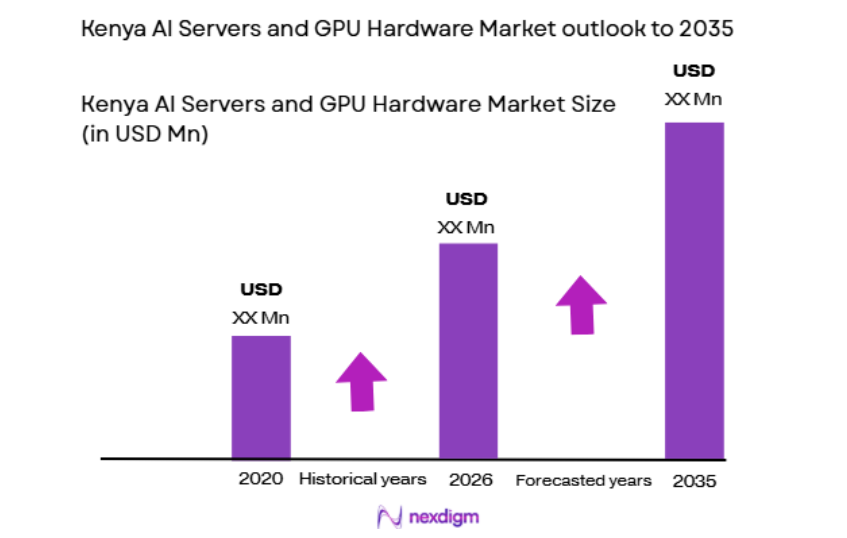
Based on a recent historical assessment, the Kenya AI servers and GPU hardware market operates within a national data center hardware and ICT equipment ecosystem exceeding USD ~ million in annual infrastructure spending, with AI-accelerated servers and GPU clusters forming a rapidly expanding subset driven by cloud, telecom, and enterprise analytics deployments. Hyperscale-grade GPU infrastructure investments tied to regional cloud nodes and enterprise AI adoption account for tens of millions in USD hardware procurement across telecom data centers, financial platforms, and research computing facilities supporting localized AI workloads.
Dominance in the Kenya AI servers and GPU hardware market is concentrated in Nairobi and emerging technology clusters linked to carrier-neutral data centers and cloud interconnection hubs due to proximity to fiber backbones, enterprise headquarters, and digital service platforms. Nairobi hosts most hyperscale cloud regions, telecom core facilities, and financial technology infrastructure requiring AI acceleration hardware, while Konza Technopolis is structured as a national innovation and high-performance computing zone attracting data center operators and AI infrastructure deployments aligned with smart city and research initiatives.
Market Segmentation
By Hardware Type
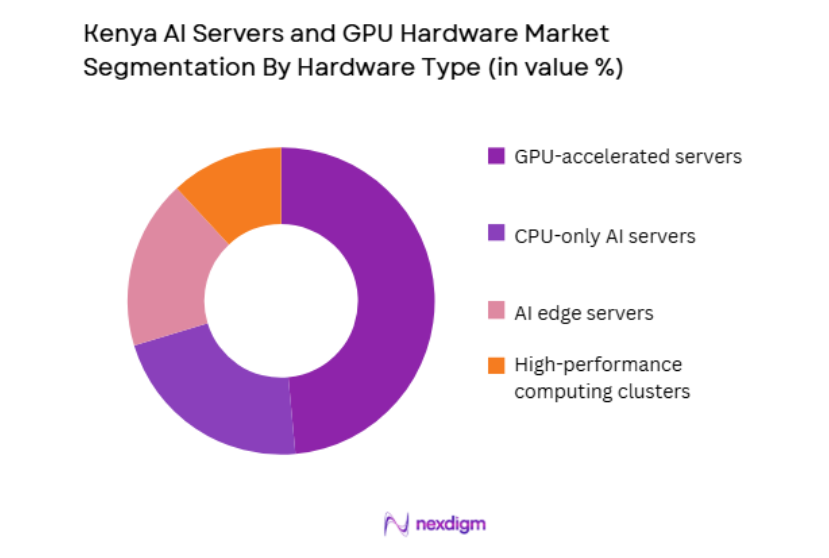
Kenya AI Servers and GPU Hardware market is segmented by product type into GPU-accelerated servers, CPU-only AI servers, AI edge servers, and high-performance computing clusters. Recently, GPU-accelerated servers has a dominant market share due to factors such as demand patterns, brand presence, infrastructure availability, or consumer preference. Enterprise and cloud AI workloads in Kenya increasingly rely on parallel processing for machine learning training, inference acceleration, and analytics pipelines, driving procurement of GPU-integrated rack servers in telecom and cloud data centers.
By End-Use Sector
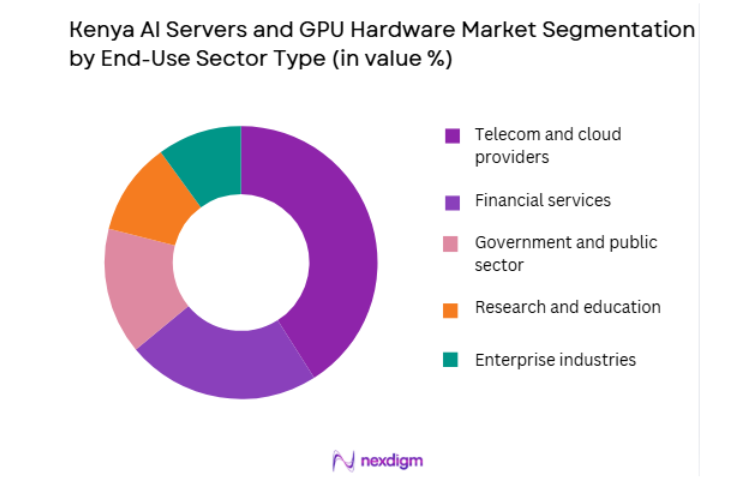
Kenya AI Servers and GPU Hardware market is segmented by product type into telecom and cloud providers, financial services, government and public sector, research and education, and enterprise industries. Recently, telecom and cloud providers has a dominant market share due to factors such as demand patterns, brand presence, infrastructure availability, or consumer preference. AI-enabled services such as content optimization, network analytics, and cloud AI platforms require centralized GPU clusters within carrier and hyperscale data centers, leading telecom and cloud operators to procure the majority of AI server hardware deployed nationally.
Competitive Landscape
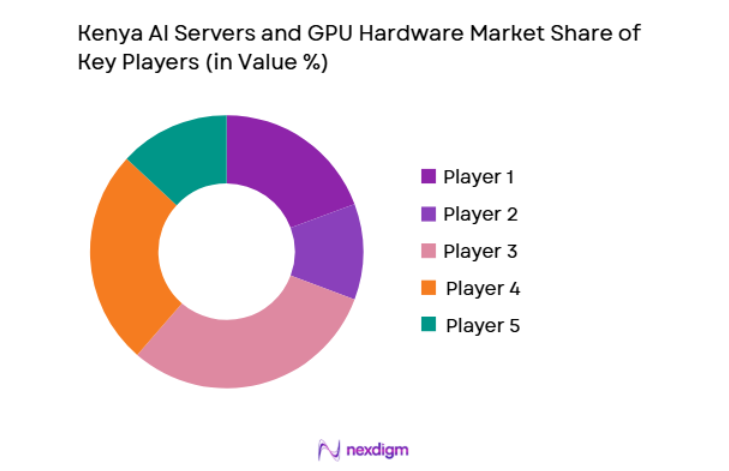
The Kenya AI servers and GPU hardware market is shaped by global semiconductor and server vendors supplying infrastructure to telecom operators, cloud providers, and enterprise data centers, creating a vendor-driven competitive environment with moderate consolidation around GPU technology leaders and enterprise server manufacturers. Partnerships between cloud platforms, telecom infrastructure firms, and hardware vendors influence procurement patterns, with GPU suppliers and integrated AI server OEMs dominating deployments due to technological specialization and supply chain control.
| Company Name | Establishment Year | Headquarters | Technology Focus | Market Reach | Key Products | Revenue | GPU Architecture Focus |
| NVIDIA | 1993 | USA | ~ | ~ | ~ | ~ | ~ |
| AMD | 1969 | USA | ~ | ~ | ~ | ~ | ~ |
| Intel | 1968 | USA | ~ | ~ | ~ | ~ | ~ |
| Dell Technologies | 1984 | USA | ~ | ~ | ~ | ~ | ~ |
| HPE | 1939 | USA | ~ | ~ | ~ | ~ | ~ |
Kenya AI Servers and GPU Hardware Market Analysis
Growth Drivers
Expansion of Cloud AI Infrastructure and Regional Hyperscale Data Center Nodes in East Africa
Kenya’s AI servers and GPU hardware market is significantly driven by the establishment of regional cloud and hyperscale computing infrastructure designed to deliver artificial intelligence services, analytics platforms, and high-performance computing resources across East Africa from centralized data center nodes located in Nairobi and emerging technology zones. Global cloud providers and regional telecom-cloud alliances are deploying GPU-accelerated server clusters to support machine learning platforms, generative AI inference services, and enterprise analytics workloads hosted within national and regional data centers, creating sustained demand for high-density GPU hardware systems. Enterprises across finance, telecommunications, logistics, and digital commerce sectors increasingly rely on cloud-based AI tools for fraud detection, recommendation engines, predictive maintenance, and automation, which require scalable GPU infrastructure delivered through localized cloud regions rather than distant global data centers to ensure latency, compliance, and performance requirements. The localization of AI workloads is reinforced by data sovereignty expectations and enterprise preference for hosting sensitive data within national boundaries, encouraging cloud providers to expand GPU cluster capacity inside Kenyan facilities to serve domestic and regional customers. Telecom operators integrating AI into network optimization, customer analytics, and digital service platforms also deploy GPU-accelerated servers within core data centers, further increasing procurement volumes of AI hardware infrastructure. The growth of AI-as-a-service offerings targeting African enterprises relies on GPU resource pools capable of handling diverse training and inference workloads, strengthening the market position of GPU-centric server architectures within Kenyan infrastructure ecosystems.
Enterprise Adoption of AI Analytics and Automation Across Financial, Telecom, and Industrial Sectors
The increasing integration of artificial intelligence across Kenyan enterprises is driving substantial demand for AI servers and GPU hardware capable of processing large datasets, running machine learning models, and enabling automation across operational and customer-facing functions within finance, telecommunications, manufacturing, and logistics industries. Financial institutions deploy GPU-accelerated computing for fraud detection, credit scoring, algorithmic trading analytics, and customer behavior modeling, requiring high-throughput parallel processing systems installed within secure data center environments to maintain performance and compliance. Telecom operators use AI for network traffic optimization, predictive maintenance of infrastructure, and personalized service delivery, generating continuous analytics workloads that necessitate scalable GPU clusters integrated with core telecom data centers.
Market Challenges
High Capital Cost and Limited Local Supply Chain for Advanced GPU Hardware Deployment
The Kenya AI servers and GPU hardware market faces significant constraints due to the high acquisition cost and limited regional availability of advanced GPU processors and AI server systems, which remain largely imported from global semiconductor and server manufacturers, increasing procurement expenses and deployment lead times for enterprises and infrastructure providers. Advanced GPUs used for AI workloads command premium pricing due to manufacturing complexity, global demand concentration, and supply chain bottlenecks, making large-scale GPU cluster deployment capital-intensive for Kenyan data center operators and enterprises compared to traditional CPU-based infrastructure investments. Import dependence exposes the market to currency fluctuations, logistics delays, and trade restrictions affecting semiconductor supply, complicating procurement planning and increasing total cost of ownership for AI hardware infrastructure. Local system integration and maintenance ecosystems for GPU clusters remain underdeveloped, requiring reliance on international vendors or specialized partners for installation, optimization, and lifecycle management, further raising operational costs. Smaller enterprises and research institutions often lack the financial resources to invest in dedicated GPU infrastructure, limiting adoption to large telecom, cloud, and financial organizations with sufficient capital budgets.
Shortage of Skilled AI Infrastructure Engineers and Optimization Expertise in GPU-Based Systems
The effective deployment and utilization of AI servers and GPU hardware in Kenya is hindered by a limited pool of specialized technical professionals capable of designing, configuring, and optimizing accelerated computing environments, constraining adoption beyond organizations with advanced technical capacity. GPU-based AI infrastructure requires expertise in parallel computing architectures, machine learning frameworks, cluster orchestration, and performance optimization to achieve efficient utilization and return on investment, yet such skills remain scarce in local labor markets. Enterprises investing in GPU hardware often face challenges in integrating systems with existing data platforms, software stacks, and analytics workflows due to insufficient in-house engineering capabilities, leading to underutilization of expensive infrastructure assets. Telecom and cloud providers address this gap through partnerships with global vendors and training programs, but smaller enterprises and public institutions lack similar access to expertise, limiting their ability to deploy and manage AI servers independently. The absence of mature local ecosystems for GPU software optimization, driver management, and AI workload tuning also increases reliance on external consultants or vendor support, raising operational costs and reducing agility in infrastructure management. Research and academic sectors that could contribute to talent development often lack large-scale GPU clusters for training, perpetuating the skills shortage cycle in AI infrastructure engineering. Workforce limitations also affect maintenance and troubleshooting of GPU systems, increasing downtime risk and discouraging adoption by risk-averse organizations.
Opportunities
Development of National AI Research and High-Performance Computing Infrastructure Programs
Kenya’s ambition to become a regional digital innovation hub creates opportunity for establishing national high-performance computing and AI research infrastructure equipped with GPU clusters to support academic research, government analytics, and innovation ecosystems, expanding domestic demand for AI servers and accelerator hardware. National HPC centers and AI research facilities require large-scale GPU installations capable of supporting data science, climate modeling, health analytics, and language processing research tailored to African contexts, generating substantial procurement opportunities for server and semiconductor vendors. Government-supported innovation hubs and technology parks, including Konza Technopolis, provide physical infrastructure and policy support for advanced computing facilities that attract research institutions, startups, and multinational technology firms seeking localized AI experimentation environments. Public investment in sovereign AI infrastructure also enhances data security and independence, encouraging enterprises and public agencies to adopt domestic GPU resources rather than relying exclusively on foreign cloud providers. Collaboration between universities, telecom operators, and global technology vendors can create shared GPU resource pools and training platforms, stimulating ecosystem growth and hardware deployment. Establishing regional AI supercomputing capacity positions Kenya as a destination for African AI research and innovation, attracting international projects and funding that further expand GPU hardware demand.
Growth of AI-Driven Digital Services, Startups, and Industry Automation Requiring Localized GPU Resources
The rapid emergence of AI-enabled digital services, technology startups, and automation initiatives across Kenya’s digital economy creates sustained demand for accessible GPU computing infrastructure that supports product development, model training, and deployment of AI applications tailored to regional markets. Startups in fintech, agritech, healthtech, and logistics sectors rely on machine learning models for predictive analytics, computer vision, and natural language processing solutions, requiring GPU resources for development and scaling that drive procurement of localized AI servers or cloud GPU capacity hosted within Kenyan data centers. Enterprises automating operations through AI-powered analytics, robotics, and decision systems require GPU-accelerated computing environments to process data streams and deploy inference models in production, increasing demand for dedicated or shared GPU clusters across industries. Content creation, media analytics, and generative AI services targeting African languages and markets also depend on GPU infrastructure capable of handling large-scale model training and inference workloads, expanding hardware requirements in creative and digital sectors.
Future Outlook
Kenya’s AI servers and GPU hardware market is expected to expand steadily as cloud regions, telecom AI adoption, and enterprise analytics deployment increase demand for accelerated computing infrastructure. National digitalization and AI innovation initiatives will stimulate GPU cluster investments across public and private sectors. Startup ecosystem growth and industry automation will broaden application diversity.
Major Players
- NVIDIA
- AMD
- Intel
- Dell Technologies
- HPE
- Lenovo
- Supermicro
- Cisco Systems
- Huawei Technologies
- Inspur
- Fujitsu
- Oracle Cloud
- Microsoft Azure
- Amazon Web Services
- Google Cloud
Key Target Audience
- Telecom network operators
- Cloud service providers
- Data center operators
- Investments and venture capitalist firms
- Government and regulatory bodies
- Financial institutions
- Large enterprises deploying AI
- Technology startups
Research Methodology
Step 1: Identification of Key Variables
Key variables including data center capacity, AI adoption intensity, GPU procurement trends, cloud region deployment, and enterprise analytics usage were identified. These variables determine demand for AI servers and accelerator hardware. Infrastructure spending and digital economy indicators were mapped to hardware demand drivers.
Step 2: Market Analysis and Construction
Market sizing integrated ICT hardware expenditure, data center investment, and AI infrastructure deployment patterns across telecom, cloud, and enterprise sectors. Segment shares were derived from end-use demand intensity and hardware architecture adoption. Geographic concentration analysis identified deployment clusters.
Step 3: Hypothesis Validation and Expert Consultation
Assumptions on GPU adoption, hyperscale infrastructure growth, and enterprise AI deployment were validated through vendor reports, infrastructure investment trends, and regional digital economy indicators. Cross-verification ensured consistency with ICT hardware spending and AI adoption trajectories.
Step 4: Research Synthesis and Final Output
Validated data and qualitative drivers were synthesized into segmentation, competitive, and outlook frameworks. Market dynamics were articulated through technology adoption, infrastructure investment, and ecosystem development trends. Final outputs integrated quantitative estimates with structural AI infrastructure analysis.

- Executive Summary
- Research Methodology (Definitions, Scope, Industry Assumptions, Market Sizing Approach, Primary & Secondary Research Framework, Data Collection & Verification Protocol, Analytic Models & Forecast Methodology, Limitations & Research Validity Checks)

- Market Definition and Scope
- Value Chain & Stakeholder Ecosystem
- Regulatory / Certification Landscape
- Sector Dynamics Affecting Demand

- Growth Drivers
Rising AI adoption across fintech, telecom, and public services in Kenya
Expansion of local data center capacity and cloud regions
Demand for accelerated computing for analytics and automation - Market Challenges
High acquisition and import costs for GPU hardware
Limited high-density data center power infrastructure
Shortage of AI infrastructure engineering skills - Market Opportunities
AI infrastructure for mobile money fraud detection and analytics
GPU clusters for academic and research AI development
Localized AI processing for telecom and smart city applications - Trends
Shift toward GPU-accelerated converged AI servers
Adoption of hybrid cloud AI infrastructure architectures - Government Regulations
- SWOT Analysis
- Porter’s Five Forces

- By Market Value, 2020-2025
- By Installed Units, 2020-2025
- By Average System Price, 2020-2025
- By System Complexity Tier, 2020-2025

- By System Type (In Value%)
AI training servers
AI inference servers
GPU accelerator cards
AI storage-optimized servers
Edge AI servers - By Platform Type (In Value%)
Hyperscale cloud data centers
Enterprise private data centers
Telecom network data centers
Research and academic clusters
Government HPC facilities - By Fitment Type (In Value%)
Rack-mounted servers
Blade servers
GPU expansion nodes
Integrated AI appliances - By End User Segment (In Value%)
Cloud service providers
Telecom operators
Financial services institutions

- Market Share Analysis
- Cross Comparison Parameters (GPU performance density, Server scalability, Power and cooling efficiency, AI software stack support, Interconnect bandwidth, Storage throughput, Deployment flexibility, Lifecycle support services, Local integration capability, Total cost of ownership)
- SWOT Analysis of Key Competitors
- Pricing & Procurement Analysis
- Key Players
NVIDIA
AMD
Intel
Supermicro
Dell Technologies
Hewlett Packard Enterprise
Lenovo
Cisco Systems
IBM
Inspur
Huawei Technologies
Fujitsu
ASUS
Gigabyte Technology
Liquid Intelligent Technologies

- Cloud providers scaling GPU capacity for regional AI workloads
- Telecom firms deploying AI servers for network optimization
- Financial institutions investing in AI analytics infrastructure
- Universities building GPU clusters for research and training

- Forecast Market Value, 2026-2035
- Forecast Installed Units, 2026-2035
- Price Forecast by System Tier, 2026-2035
- Future Demand by Platform, 2026-2035


 Request a Sample
 Ask for Customization
 Get a Quote
 Enquire Now