

 Download PDF
 Download PDF
Market Overview
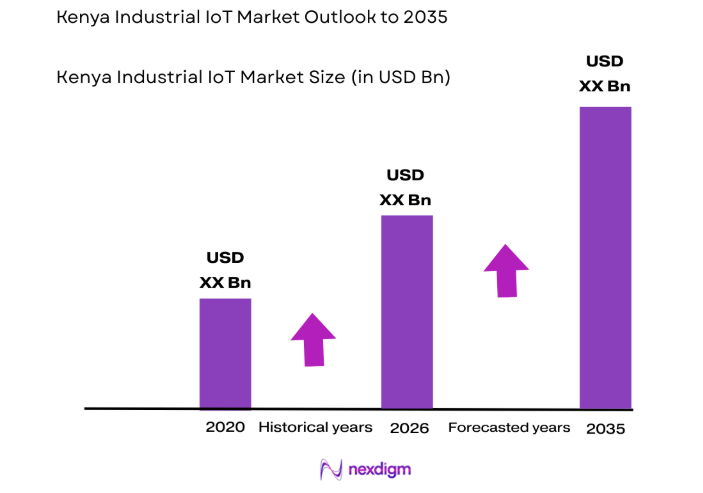
The Kenya Industrial IoT market is valued at approximately USD ~ million based on a recent historical assessment, driven by the increased adoption of connected technologies across manufacturing, energy, agriculture, and transportation. This growth is supported by the need for improved efficiency, real-time monitoring, predictive maintenance, and data-driven decision-making. Additionally, Kenya’s focus on industrialization and the rise of smart manufacturing in the region are further propelling the growth of Industrial IoT solutions.
Key regions driving the Industrial IoT market in Kenya include Nairobi, Mombasa, and Kisumu. Nairobi, as the capital, is a primary hub for technological innovation and industry, contributing to the growing demand for industrial automation solutions. Mombasa, with its port activities and logistics infrastructure, promotes the use of IoT for supply chain management. Kisumu is emerging as a center for agricultural innovation, where IoT solutions are being increasingly adopted for precision farming and resource management.
Market Segmentation
By Product Type
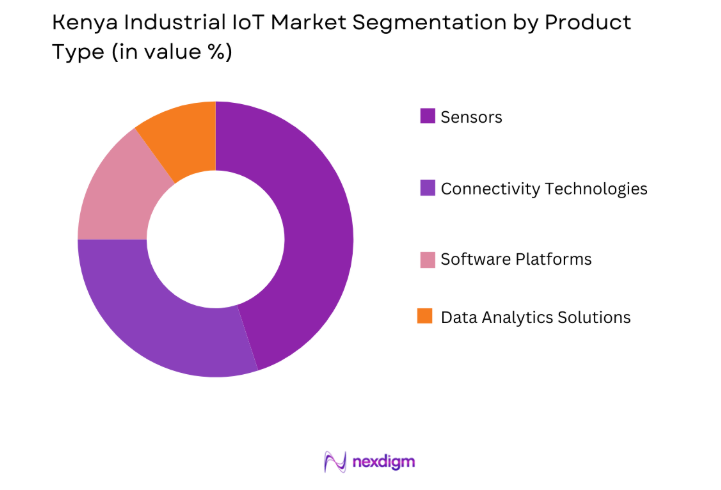
The Kenya Industrial IoT market is segmented by product type into sensors, connectivity technologies, software platforms, and data analytics solutions. Recently, sensors have dominated the market share due to their essential role in gathering real-time data across various industrial applications. These sensors, often integrated with IoT devices, allow for the monitoring of variables such as temperature, pressure, and motion, which are critical for predictive maintenance, inventory management, and process optimization. The increasing demand for smart factories and automation in industries such as manufacturing and agriculture has fueled the need for advanced sensor solutions.
By Application Type
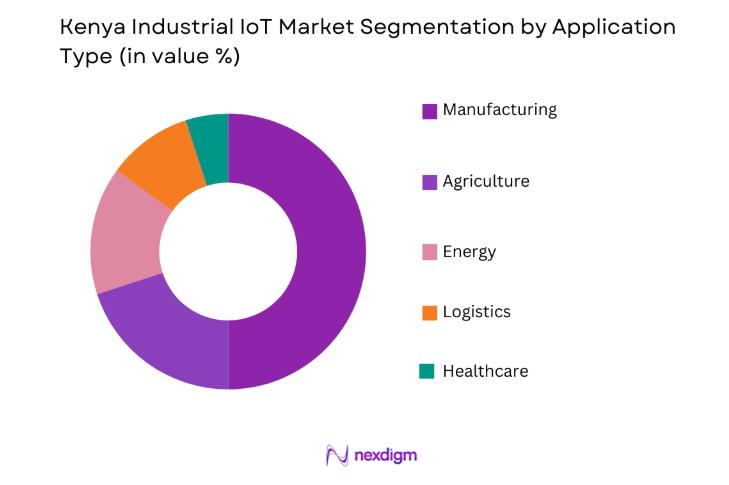
The Kenya Industrial IoT market is also segmented by application type into manufacturing, agriculture, energy, logistics, and healthcare. Manufacturing applications hold the largest market share due to the adoption of IoT solutions aimed at enhancing production processes, improving quality control, and enabling predictive maintenance. The push for smart manufacturing, industry 4.0, and automation in Kenya’s growing industrial sector is propelling the widespread use of Industrial IoT solutions. These solutions help to optimize production lines, reduce downtime, and increase overall operational efficiency, making them integral to modern manufacturing operations.
Competitive Landscape
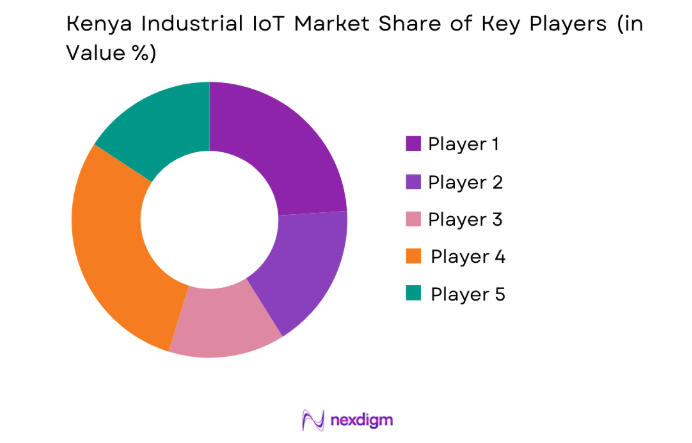
The competitive landscape of the Kenya Industrial IoT market is characterized by the presence of both international technology giants and local startups. Global companies like Siemens, Cisco, and IBM are leading the market by offering advanced IoT solutions across various industries, including manufacturing, agriculture, and energy. However, local companies are also gaining traction by providing tailored IoT solutions that meet the specific needs of Kenyan industries, particularly in agriculture and manufacturing. The increasing demand for automation, along with government support for industrialization, is expected to intensify competition in the coming years.
| Company Name | Establishment Year | Headquarters | Technology Focus | Market Reach | Key Products | Revenue | Industry-Specific Focus |
| Siemens AG | 1847 | Munich, Germany | ~ | ~ | ~ | ~ | ~ |
| Cisco Systems | 1984 | San Jose, USA | ~ | ~ | ~ | ~ | ~ |
| IBM | 1911 | Armonk, USA | ~ | ~ | ~ | ~ | ~ |
| Rockwell Automation | 1903 | Milwaukee, USA | ~ | ~ | ~ | ~ | ~ |
| Huawei Technologies | 1987 | Shenzhen, China | ~ | ~ | ~ | ~ | ~ |
Kenya Industrial IoT Market Analysis
Growth Drivers
Technological Advancements in Connectivity
The Kenya Industrial IoT market is experiencing significant growth due to advancements in connectivity technologies, such as 5G, Wi-Fi 6, and LPWAN (Low Power Wide Area Networks). These technologies provide faster, more reliable, and cost-effective communication for IoT devices across various industries, facilitating real-time data transmission and remote monitoring. The growing demand for smart manufacturing, precision agriculture, and intelligent infrastructure is driving the need for high-performance connectivity solutions. As connectivity technologies continue to improve, industries in Kenya are adopting IoT systems to enhance operational efficiency, reduce downtime, and improve decision-making. Moreover, the deployment of 5G networks is expected to unlock new use cases for Industrial IoT, enabling more devices to connect and communicate at greater speeds and with lower latency, thus further driving the adoption of IoT solutions across sectors.
Government Support for Smart Manufacturing and Industry 4.0
The Kenyan government is a key growth driver for the Industrial IoT market, as it actively promotes smart manufacturing and the digitalization of industries through initiatives such as the “Kenya Vision 2030” development plan. This initiative seeks to transform Kenya into an industrialized, middle-income country by encouraging the adoption of advanced technologies like IoT, robotics, and automation in key sectors such as manufacturing, agriculture, and energy. The government’s push for Industry 4.0, which emphasizes the integration of cyber-physical systems and IoT technologies in manufacturing, is encouraging local industries to invest in automation and IoT solutions. Additionally, policies aimed at improving infrastructure and fostering innovation are supporting the growth of the IoT ecosystem in Kenya, creating a favorable environment for the adoption of Industrial IoT solutions.
Market Challenges
High Initial Capital Investment
One of the primary challenges facing the Kenya Industrial IoT market is the high initial capital investment required for implementing IoT solutions. The cost of setting up IoT infrastructure, including sensors, connectivity systems, and software platforms, can be prohibitive for small and medium-sized enterprises (SMEs) in Kenya. Many businesses, particularly in manufacturing and agriculture, struggle to justify the upfront costs of IoT adoption despite the long-term benefits of improved productivity and reduced operational costs. Additionally, integrating IoT solutions into existing infrastructure often requires further investment in technology upgrades and skilled personnel. This high initial cost remains a significant barrier to widespread IoT adoption across various industries in Kenya.
Lack of Skilled Workforce
The lack of a skilled workforce in areas such as IoT development, data analytics, and automation is another challenge facing the Industrial IoT market in Kenya. The successful implementation of Industrial IoT solutions requires specialized knowledge in areas such as software development, hardware integration, and cybersecurity. However, the current labor market in Kenya does not have a sufficient number of trained professionals in these fields, which limits the adoption of IoT solutions. The shortage of skilled workers also creates difficulties in maintaining and optimizing IoT systems after installation. To overcome this challenge, Kenya needs to invest in education and training programs to develop a skilled workforce capable of supporting the growing demand for Industrial IoT technologies.
Opportunities
Growth of Smart Manufacturing
The expansion of smart manufacturing presents a significant opportunity for the Kenya Industrial IoT market. As industries in Kenya increasingly seek to improve operational efficiency, reduce costs, and enhance product quality, the adoption of IoT technologies is becoming essential. Smart manufacturing uses IoT sensors, machine learning, and data analytics to enable real-time monitoring, predictive maintenance, and automated control of production processes. As Kenya’s manufacturing sector continues to grow, particularly in industries such as textiles, food processing, and automotive, the demand for Industrial IoT solutions will rise. Additionally, the government’s push for digitalization and Industry 4.0 will further accelerate the adoption of smart manufacturing solutions, creating a strong market opportunity for IoT providers.
Adoption of IoT in Agriculture
The agricultural sector in Kenya offers significant growth potential for Industrial IoT solutions. With agriculture being a key contributor to Kenya’s economy, the adoption of IoT technologies in farming is gaining traction. IoT-enabled solutions such as precision farming, smart irrigation systems, and livestock monitoring are helping farmers optimize resource usage, increase crop yields, and reduce costs. The ability to collect real-time data on soil conditions, weather patterns, and crop health is revolutionizing agricultural practices, making them more efficient and sustainable. As the demand for food production rises and the need for more sustainable agricultural practices increases, the opportunity for Industrial IoT in agriculture will continue to expand, benefiting both local farmers and the broader economy.
Future Outlook
Over the next five years, the Kenya Industrial IoT market is expected to grow rapidly, driven by advancements in IoT technologies, increased adoption of automation, and government support for industrial digitalization. Key sectors such as manufacturing, agriculture, and energy will continue to adopt IoT solutions to improve efficiency, productivity, and sustainability. Additionally, the expansion of 5G networks and improvements in connectivity will drive the proliferation of IoT devices across industries. However, challenges such as high initial investment costs and a shortage of skilled labor must be addressed for the market to fully realize its growth potential.
Major Players
- Siemens
- Cisco Systems
- IBM
- Rockwell Automation
- Honeywell
- Schneider Electric
- ABB
- GE Digital
- Microsoft
- SAP
- Oracle
- Huawei Technologies
- PTC
- Bosch
- Mitsubishi Electric
Key Target Audience
- Investments and venture capitalist firms
- Government and regulatory bodies
- Manufacturing companies
- Agriculture firms
- Energy providers
- Telecommunications companies
- IoT solution providers
Research Methodology
Step 1: Identification of Key Variables
The research identifies key drivers, challenges, and trends affecting the Industrial IoT market, focusing on demand patterns, technological advancements, and market conditions across sectors like manufacturing, agriculture, and energy.
Step 2: Market Analysis and Construction
A detailed analysis is conducted to estimate the market size, segment the market, and evaluate growth opportunities based on historical data and current industry trends.
Step 3: Hypothesis Validation and Expert Consultation
Industry experts and stakeholders are consulted to validate hypotheses and ensure the research findings are relevant and accurate for the market.
Step 4: Research Synthesis and Final Output
The final output is a comprehensive market report that consolidates data, insights, and expert opinions to provide actionable market intelligence for stakeholders.

- Executive Summary
- Research Methodology (Definitions, Scope, Industry Assumptions, Market Sizing Approach, Primary & Secondary Research Framework, Data Collection & Verification Protocol, Analytic Models & Forecast Methodology, Limitations & Research Validity Checks)

- Market Definition and Scope
- Value Chain & Stakeholder Ecosystem
- Regulatory / Certification Landscape
- Sector Dynamics Affecting Demand

- Growth Drivers
Increasing automation in manufacturing sectors
Government policies supporting industrial IoT growth
Advancements in connectivity and sensor technologies - Market Challenges
High initial setup and integration costs
Data privacy and cybersecurity concerns
Limited local expertise in IoT solutions - Market Opportunities
Expansion of smart agriculture solutions
Growth in smart city initiatives
Adoption of IoT for energy management in utilities - Trends
Rise of 5G-enabled industrial IoT
Increased use of AI and machine learning for predictive analytics - Government Regulations
Data protection regulations
IoT standards and certifications
Government incentives for smart infrastructure - SWOT Analysis
- Porter’s Five Forces

- By Market Value, 2020-2025
- By Installed Units, 2020-2025
- By Average System Price, 2020-2025
- By System Complexity Tier, 2020-2025

- By System Type (In Value%)
Connected Manufacturing Systems
Predictive Maintenance Systems
Smart Sensors and Actuators
Energy Management Systems
Automation and Control Systems - By Platform Type (In Value%)
Cloud-based Platforms
Edge Computing Platforms
Hybrid Platforms
On-premise Platforms - By Fitment Type (In Value%)
Integrated IoT Systems
Standalone IoT Devices
Modular IoT Solutions
Custom IoT Solutions - By End User Segment (In Value%)
Manufacturing
Energy
Agriculture
Transportation

- Market Share Analysis
- Cross Comparison Parameters (System Type, Platform Type, End User Segment, Fitment Type, Deployment Cost, Technological Adoption, Market Penetration)
- SWOT Analysis of Key Competitors
- Pricing & Procurement Analysis
- Key Players
Cisco Systems
Siemens
Honeywell
GE Digital
Schneider Electric
ABB
Rockwell Automation
PTC
IBM
Microsoft
Bosch
Oracle
Hitachi
SAP
Mitsubishi Electric

- Increased adoption of automation in manufacturing
- Government agencies driving smart city IoT initiatives
- Agriculture sector leveraging IoT for precision farming

- Forecast Market Value, 2026-2035
- Forecast Installed Units, 2026-2035
- Price Forecast by System Tier, 2026-2035
- Future Demand by Platform, 2026-2035


 Request a Sample
 Ask for Customization
 Get a Quote
 Enquire Now