

 Download PDF
 Download PDF
Market Overview
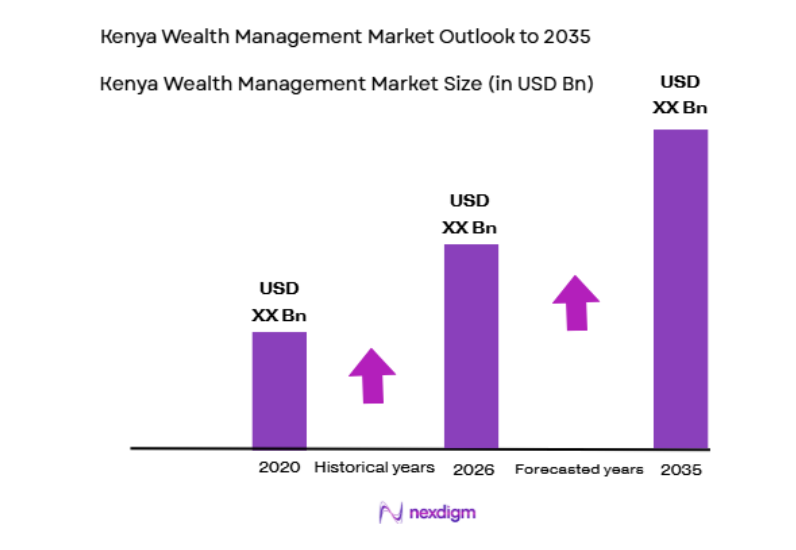
Based on a recent historical assessment, the Kenya wealth management market oversees approximately USD ~ billion in assets under management, according to data from the Capital Markets Authority of Kenya, the Retirement Benefits Authority, and the Central Bank of Kenya, expressed in USD equivalent terms. The market is driven by pension fund accumulation, collective investment schemes, high-net-worth individual portfolios, and growing participation in unit trusts and fund management products distributed through commercial banks and licensed investment advisors.
Nairobi dominates wealth management activity due to its role as Kenya’s financial center, hosting major banks, fund managers, and capital market intermediaries. Mombasa and Kisumu contribute through regional commercial activity and rising entrepreneurial wealth. Kenya benefits from a structured pension framework, a developing capital market anchored by the Nairobi Securities Exchange, and increasing adoption of digital investment platforms that support asset management expansion across urban and emerging middle-income populations.
Market Segmentation
By Client Type
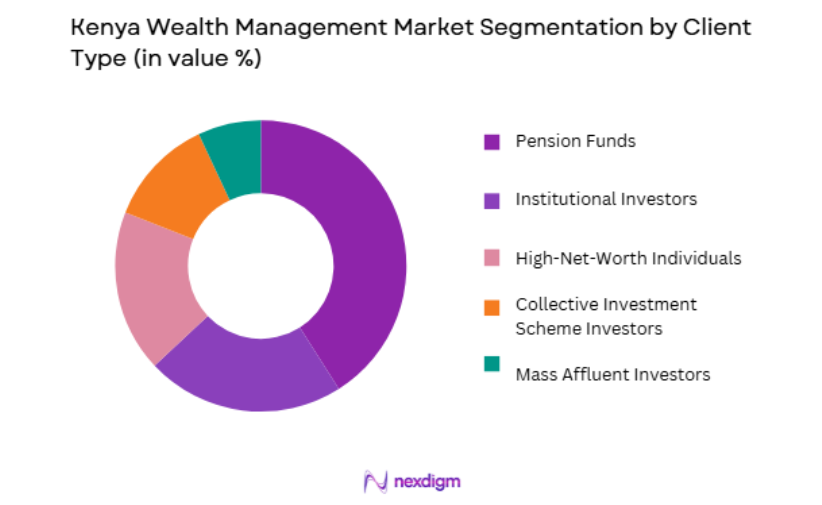
Kenya Wealth Management market is segmented by client type into Institutional Investors, High-Net-Worth Individuals, Mass Affluent Investors, Pension Funds, and Collective Investment Scheme Investors. Recently, Pension Funds has a dominant market share due to mandatory retirement savings contributions and structured long-term asset allocation strategies regulated by the Retirement Benefits Authority. Pension schemes generate consistent inflows that are professionally managed by licensed fund managers across equities, fixed income, and real estate instruments. Automatic payroll deductions ensure recurring asset accumulation, strengthening pension-led asset pools. Regulatory oversight enhances transparency and governance standards. Large occupational schemes and umbrella retirement funds further consolidate managed assets.
By Product Type
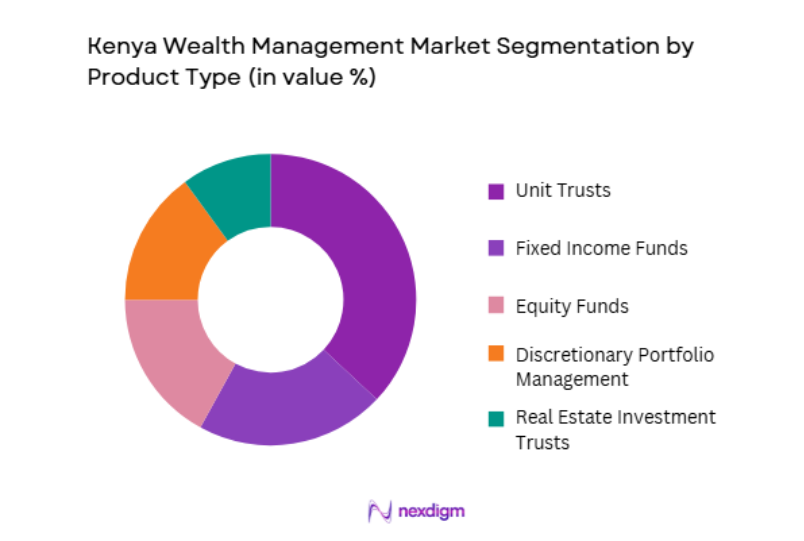
Kenya Wealth Management market is segmented by product type into Unit Trusts, Discretionary Portfolio Management, Fixed Income Funds, Equity Funds, and Real Estate Investment Trusts. Recently, Unit Trusts has a dominant market share due to accessibility, regulatory transparency, and distribution through commercial banks and digital investment platforms. Unit trusts allow retail and institutional investors to participate in diversified portfolios with relatively low entry thresholds. Simplified subscription processes and mobile-enabled transactions increase adoption among emerging middle-class investors. Fund managers promote money market and balanced funds to attract conservative savers seeking liquidity and stability.
Competitive Landscape
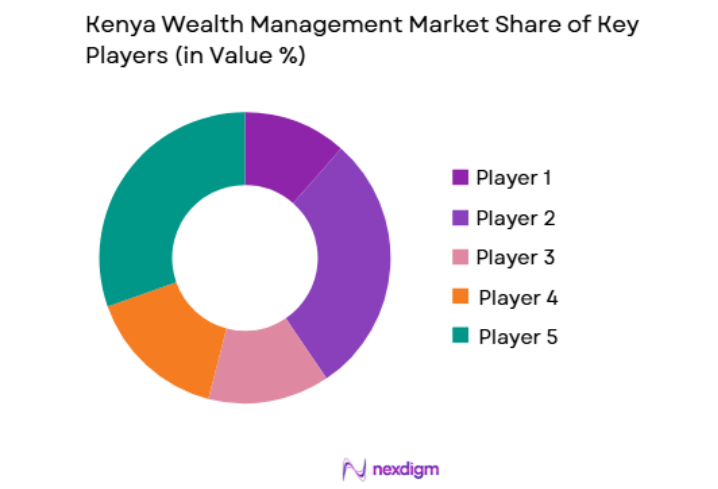
The Kenya wealth management market is moderately concentrated, with bank-affiliated fund managers and insurance-linked investment managers holding significant asset bases. Large commercial banks leverage branch networks and digital channels to distribute unit trusts and pension products. Independent asset managers operate alongside institutional groups but face competitive pressure from integrated financial conglomerates. Regulatory supervision by the Capital Markets Authority reinforces transparency while encouraging consolidation through capital adequacy standards and licensing requirements.
| Company Name | Establishment Year | Headquarters | Technology Focus | Market Reach | Key Products | Revenue | Assets Under Management (USD) |
| CIC Asset Management | 1978 | Nairobi, Kenya | ~ | ~ | ~ | ~ | ~ |
| Britam Asset Managers | 1965 | Nairobi, Kenya | ~ | ~ | ~ | ~ | ~ |
| Old Mutual Investment Group Kenya | 1845 | Nairobi, Kenya | ~ | ~ | ~ | ~ | ~ |
| Sanlam Investments East Africa | 1918 | Nairobi, Kenya | ~ | ~ | ~ | ~ | ~ |
| ICEA Lion Asset Management | 1964 | Nairobi, Kenya | ~ | ~ | ~ | ~ | ~ |
Kenya Wealth Management Market Analysis
Growth Drivers
Expansion of Pension Assets and Structured Retirement Savings
The structured growth of pension assets under mandatory and voluntary retirement schemes represents a fundamental growth driver for the Kenya wealth management market. Automatic payroll contributions into occupational and umbrella retirement schemes ensure recurring capital inflows into professionally managed portfolios. Regulatory oversight by the Retirement Benefits Authority enforces prudent asset allocation frameworks and governance standards, strengthening institutional confidence. Pension funds allocate across government securities, corporate bonds, equities, and real estate, supporting capital market depth. The long-term investment horizon of pension assets enhances stability in fund management revenue streams. Increasing formal employment levels contribute to rising retirement savings participation. Financial literacy initiatives promote voluntary contributions and supplementary retirement products. Institutional fund managers benefit from scale efficiencies and recurring fee-based income. These structural features collectively reinforce pension-led asset growth within Kenya’s evolving wealth management ecosystem.
Rising Middle-Class Participation and Digital Investment Adoption
Growing urbanization and income growth have expanded Kenya’s middle-class segment, increasing demand for accessible wealth management solutions. Digital investment platforms integrated with mobile money services simplify subscription into unit trusts and money market funds. Commercial banks leverage customer data analytics to cross-sell investment products through mobile applications. Enhanced financial awareness campaigns encourage retail participation in regulated collective investment schemes. Low minimum investment thresholds make diversified portfolios attainable for emerging savers. The Nairobi Securities Exchange provides structured capital market access for equity and bond investments. Technology-driven onboarding reduces paperwork and accelerates account opening processes. Growing entrepreneurial wealth further increases demand for discretionary portfolio services. These trends collectively expand the retail asset base within Kenya’s professional wealth management market.
Market Challenges
Limited Capital Market Depth and Liquidity Constraints
The Kenya wealth management market faces structural challenges related to relatively limited capital market depth and liquidity. Concentration of investable instruments in government securities may restrict portfolio diversification. Corporate bond issuance volumes remain moderate, constraining fixed income diversification opportunities. Equity market volatility on the Nairobi Securities Exchange can influence asset valuation stability. Limited alternative investment vehicles reduce allocation flexibility for institutional investors. Foreign investor participation fluctuations may affect market liquidity. Fund managers must balance yield optimization with prudent risk management. Smaller asset managers may face scale limitations affecting cost efficiency. These structural market constraints moderate the pace of diversification within Kenya’s wealth management ecosystem.
Regulatory Compliance and Governance Costs
Wealth management providers in Kenya operate under regulatory oversight by the Capital Markets Authority and the Retirement Benefits Authority, imposing licensing and reporting obligations. Compliance with anti-money laundering frameworks and investor protection standards increases administrative complexity. Smaller asset managers may encounter higher proportional compliance costs. Frequent reporting requirements necessitate investment in digital compliance systems. Governance standards mandate independent trustees and custodians, elevating operational expenses. Regulatory updates require continuous staff training and system upgrades. Cross-border investment restrictions may limit international portfolio exposure. While enhancing systemic integrity, these regulatory frameworks introduce operational cost pressures across the Kenya wealth management market.
Opportunities
Development of Alternative Investment Vehicles and REIT Expansion
Expansion of Real Estate Investment Trusts and alternative asset vehicles presents significant opportunities within the Kenya wealth management market. Urban infrastructure development and commercial real estate growth support asset-backed investment structures. Institutional investors seek diversified exposure beyond traditional equities and bonds. Regulatory encouragement of REIT listings enhances transparency and accessibility. Private equity and infrastructure funds can attract domestic and regional capital flows. Pension schemes increasingly allocate to property-backed instruments for yield diversification. Collaboration between fund managers and property developers broadens product innovation. Structured alternative vehicles provide inflation-hedging potential. These developments create new asset allocation channels within Kenya’s wealth management industry.
Regional Cross-Border Wealth Integration and Digital Advisory Services
Kenya’s role as an East African financial hub creates opportunities for cross-border wealth management expansion. Regional investors seek portfolio diversification through Kenyan fund managers and capital market instruments. Digital advisory platforms facilitate remote account management and reporting. Partnerships with regional banks expand distribution networks. Data analytics enable personalized portfolio allocation aligned with client risk profiles. Increasing expatriate and diaspora engagement strengthens foreign currency investment demand. Regulatory harmonization within East African markets supports regional asset flows. Cloud-based portfolio systems enhance operational scalability. These cross-border and technological opportunities position Kenya’s wealth management sector for broader regional integration and sustained asset growth.
Future Outlook
The Kenya wealth management market is expected to grow steadily over the next five years, supported by pension asset expansion and digital investment adoption. Technological integration in fund management and client onboarding will enhance efficiency. Regulatory supervision will continue strengthening governance and investor confidence. Increasing participation from retail investors and regional capital inflows are anticipated to diversify product offerings and reinforce asset accumulation across the financial ecosystem.
Major Players
- CIC Asset Management
- Britam Asset Managers
- Old Mutual Investment Group Kenya
- Sanlam Investments East Africa
- ICEA Lion Asset Management
- Jubilee Asset Management
- Co-op Trust Investment Services
- Stanbic Investment Management Services
- Absa Asset Management Kenya
- Cytonn Asset Managers
- KCB Asset Management
- Apollo Asset Management
- Genghis Capital
- Madison Asset Management
- Zimele Asset Management
Key Target Audience
- Commercial banks
- Pension fund administrators
- Insurance companies
- High-Net-Worth Individuals
- Collective investment scheme managers
- Regional financial institutions
- Investments and venture capitalist firms
- Government and regulatory bodies
Research Methodology
Step 1: Identification of Key Variables
Key variables including assets under management, pension fund balances, client segmentation, and regulatory frameworks were identified using official publications from financial authorities and industry associations.
Step 2: Market Analysis and Construction
A bottom-up aggregation of pension assets, unit trust balances, and discretionary portfolio values was conducted to construct the Kenya wealth management market framework.
Step 3: Hypothesis Validation and Expert Consultation
Findings were validated through consultations with asset managers, regulatory experts, and institutional investors to ensure alignment with prevailing market practices.
Step 4: Research Synthesis and Final Output
Quantitative and qualitative insights were synthesized into a structured analytical report integrating segmentation, competitive positioning, and forward-looking evaluation.

- Executive Summary
- Research Methodology (Definitions, Scope, Industry Assumptions, Market Sizing Approach, Primary & Secondary Research Framework, Data Collection & Verification Protocol, Analytic Models & Forecast Methodology, Limitations & Research Validity Checks)

- Market Definition and Scope
- Value Chain & Stakeholder Ecosystem
- Regulatory / Certification Landscape
- Sector Dynamics Affecting Demand

- Growth Drivers
Rising High Net Worth Population and Entrepreneurial Wealth
Expansion of Capital Markets and Collective Investment Schemes
Increasing Demand for Retirement and Pension Planning - Market Challenges
Market Volatility and Limited Depth of Domestic Capital Markets
Regulatory Compliance and Investor Protection Requirements
Low Financial Literacy among Retail Investors - Market Opportunities
Growth of Digital and Mobile Based Investment Platforms
Expansion of Sharia Compliant Investment Products
Cross Border Investment Advisory for Diaspora Clients - Trends
Rising Allocation to Fixed Income and Money Market Funds
Growing Adoption of Digital Portfolio Monitoring Tools - Government Regulations
- SWOT Analysis
- Porter’s Five Forces

- By Market Value, 2020-2025
- By Installed Units, 2020-2025
- By Average System Price, 2020-2025
- By System Complexity Tier, 2020-2025

- By System Type (In Value%)
Discretionary Portfolio Management
Financial Planning and Advisory Services
Unit Trust and Collective Investment Schemes
Pension and Retirement Advisory
Alternative Investment Advisory - By Platform Type (In Value%)
Bank Based Wealth Platforms
Independent Asset Managers
Stock Brokerage Firms
Digital Investment Platforms
Hybrid Advisory Models - By Fitment Type (In Value%)
Fee Based Advisory Model
Commission Based Brokerage
Hybrid Fee Commission Structure
Sharia Compliant Advisory Services - By End User Segment (In Value%)
High Net Worth Individuals
Mass Affluent Investors
Corporate Executives and Business Owners

- Market Share Analysis
- Cross Comparison Parameters (Product Diversification Breadth, Sharia Compliance Capability, Offshore Investment Access, Portfolio Customization Depth, Risk Management Framework, Client Reporting Transparency, Custody and Safekeeping Infrastructure, Advisor to Client Ratio, Performance Benchmarking Standards, ESG Integration Level, Diaspora Investment Services Availability)
- SWOT Analysis of Key Competitors
- Pricing & Procurement Analysis
- Key Players
Stanbic Bank Kenya Wealth Management
NCBA Investment Bank
Absa Bank Kenya Wealth
Standard Chartered Wealth Management Kenya
CIC Asset Management
Britam Asset Managers
Old Mutual Investment Group Kenya
ICEA Lion Asset Management
Sanlam Investments East Africa
Apollo Asset Management Kenya
Genghis Capital
Faida Investment Bank
Dry Associates Investment Bank
Dyer and Blair Investment Bank
KCB Investment Bank

- Increasing Preference for Capital Preservation Strategies
- Growing Demand for Diversified Asset Allocation
- Rising Interest in Offshore and Foreign Currency Investments
- Higher Focus on Retirement Income Planning

- Forecast Market Value, 2026-2035
- Forecast Installed Units, 2026-2035
- Price Forecast by System Tier, 2026-2035
- Future Demand by Platform, 2026-2035


 Request a Sample
 Ask for Customization
 Get a Quote
 Enquire Now