
 Download PDF
Market Overview
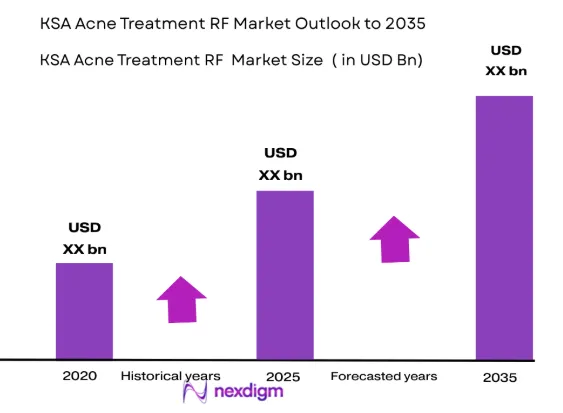
The KSA Acne Treatment RF Devices market is valued at approximately USD ~ billion, driven by increasing demand for non-invasive acne treatment solutions. The market’s growth is supported by technological advancements in radiofrequency (RF) technology, providing patients with efficient and safe alternatives to traditional acne treatments. Factors such as rising awareness of skincare issues, the growing disposable income of consumers, and the increasing number of dermatology clinics are contributing to market expansion. These treatments are gaining traction among individuals looking for quick, effective, and non-invasive procedures. In recent years, RF devices have emerged as a preferred option due to their minimal recovery time and long-lasting results.
Regionally, Saudi Arabia has become a hub for the adoption of advanced cosmetic treatments, including acne RF devices, thanks to the country’s growing healthcare sector and high demand for aesthetic treatments. Major cities such as Riyadh, Jeddah, and Dammam are leading the charge due to their high concentration of dermatology clinics and aesthetic centers. These cities benefit from a well-established healthcare infrastructure, a strong presence of international and local brands, and a high level of disposable income among residents. Additionally, government initiatives aimed at improving healthcare services are further accelerating the adoption of RF devices in these regions.
Market Segmentation
By Product Type
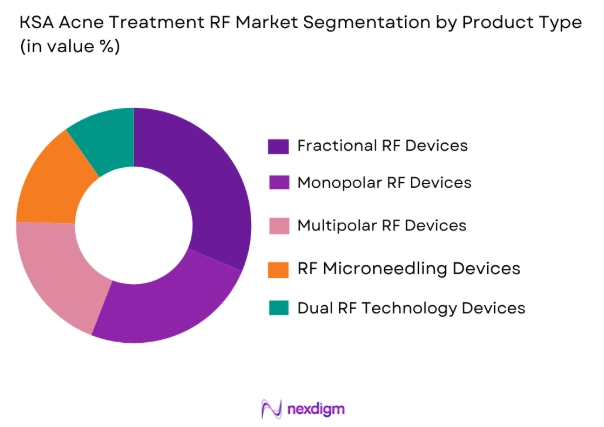
The KSA Acne Treatment RF Devices market is segmented by product type into fractional RF devices, monopolar RF devices, multipolar RF devices, RF microneedling devices, and dual RF technology devices. Recently, fractional RF devices have captured the largest market share due to their efficiency in treating acne scars and other skin conditions. Their ability to target specific layers of the skin, offering more precise treatment with minimal side effects, has made them highly popular in both clinical and at-home use. The growing preference for fractional RF devices is also supported by advancements in technology, which have made these devices more affordable and easier to use.
By Platform Type
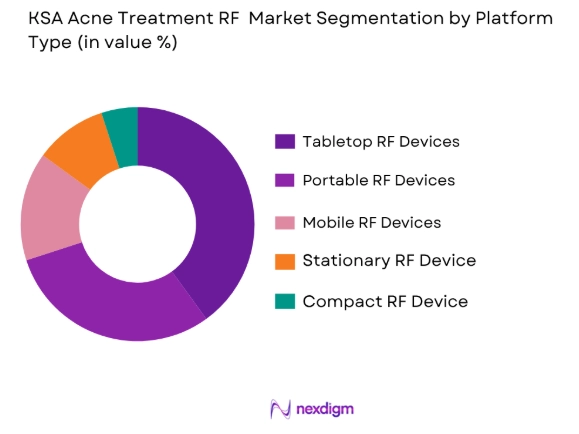
The KSA Acne Treatment RF Devices market is segmented by platform type into tabletop RF devices, portable RF devices, mobile RF devices, stationary RF devices, and compact RF devices. Among these, tabletop RF devices hold the dominant market share, driven by their superior performance and versatility in clinical settings. Tabletop devices are preferred in professional dermatology clinics and aesthetic centers due to their advanced capabilities, reliability, and long-term durability. The trend of shifting toward more effective professional-grade devices is fueling the demand for tabletop RF devices in the market.
Competitive Landscape
The KSA Acne Treatment RF Devices market is witnessing significant consolidation with a few major players leading the market due to their advanced technologies, product offerings, and strong distribution networks. The increasing demand for non-invasive treatments and the rise of aesthetic centers have further intensified the competition. Key players continue to innovate by offering new technologies such as multi-platform RF devices and incorporating artificial intelligence for personalized treatment. The market is characterized by a mix of international companies and regional players, with some focusing on high-end, professional-grade devices, while others cater to the growing demand for affordable consumer devices.
| Company Name | Establishment Year | Headquarters | Technology Focus | Market Reach | Key Products | Revenue (USD) |
| Cynosure | 1991 | Westford, USA | ~ | ~ | ~ | ~ |
| Lumenis | 1993 | Yokneam, Israel | ~ | ~ | ~ | ~ |
| Alma Lasers | 2002 | Caesarea, Israel | ~ | ~ | ~ | ~ |
| Syneron Candela | 2000 | Irvine, USA | ~ | ~ | ~ | ~ |
| Inmode | 2008 | Lake Forest, USA | ~ | ~ | ~ | ~ |
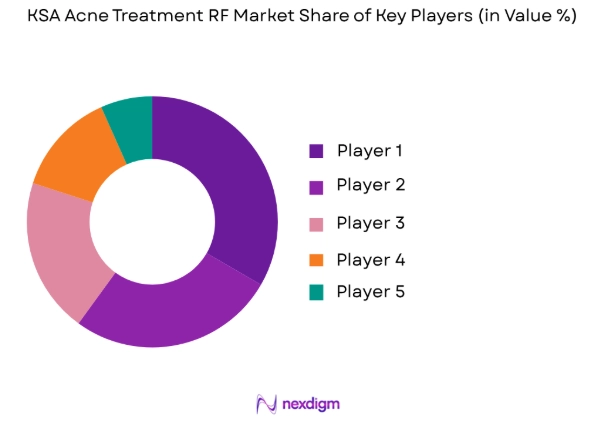
KSA Acne Treatment RF Devices Market Analysis
Growth Drivers
Growing Acne Prevalence & Aesthetic Demand
Acne vulgaris is widely documented among Saudi populations, indicating a sustained base of potential clinical demand for advanced treatment modalities such as RF devices. In a 2024 regional clinical study in the Al‑Baha region of Saudi Arabia, 68.4 percent of surveyed participants exhibited some form of acne, with cases ranging from mild to severe, highlighting clinical treatment needs rather than self‑management alone. The same research showed complications such as scarring in roughly 45.9 percent of cases and post‑inflammatory pigmentation in 45.1 percent of participants, which are conditions often addressed by procedural dermatology devices including RF systems. This high treatment‑seeking potential, grounded in documented prevalence and complication rates from region‑specific clinical data, supports the demand trajectory for technological acne treatments in the Kingdom.
High Disposable Income & Household Consumption Capacity
Household economic data from Saudi Arabia’s official 2023 Household Income and Consumption Expenditure Survey reports that the average monthly household disposable income across the Kingdom is SAR 11,839, equivalent to approximately USD 3,150 per month, with Saudi households averaging SAR 18,056 (about USD 4,810) per month. Per‑capita disposable income was SAR 3,195 (~USD 852) monthly, indicating substantial individual spending capacity when directed toward health and personal care services. Given that discretionary spending is a key determinant of uptake for elective, non‑urgent treatments like aesthetic dermatology, such quantified disposable income figures from government‑published statistics substantiate a financially capable consumer base able to absorb RF treatment costs beyond basic skincare services.
Challenges
High Device Cost & Limited Reimbursement Burden on Patients
Saudi Arabia maintains a high‑income economy status with a nominal GDP per capita of about USD 35,230 according to World Bank and IMF estimations for 2025, signifying strong macroeconomic wealth. However, sophisticated devices such as RF systems remain capital‑intensive. RF platforms often require high upfront investments by clinics operating in private health segments. Without structured reimbursement mechanisms, the cost burden typically passes to patients. In the absence of insurance benchmarks or public funding support for cosmetic dermatological procedures, the up‑front device integration costs combined with patient‑borne fees can constrain adoption. While Saudi macro indicators indicate strong economic capacity overall, the specific lack of reimbursement policy support for non‑medical procedural devices remains a limiting factor for broad market penetration.
Device Logistics Cost and Last‑Mile Delivery Constraints
As Saudi Arabia spans a large geographic area with urban centres (e.g., Riyadh, Jeddah) and remote regions, the logistics expense of acquiring, storing, and servicing advanced medical devices like RF systems can be significant. Saudi trade and import data show machinery and equipment among the primary import categories, necessitating structured supply chains. Industrial imports, which include medical device components, accounted for significant inbound trade volumes in 2023. The complexity of delivering and maintaining advanced RF platforms across dispersed clinic locations introduces logistical cost pressures that are not typically reimbursed and can erode margins for providers investing in these technologies.
Opportunities
Growth of Medical Tourism Infrastructure
Saudi Arabia is actively expanding its tourism and inbound services infrastructure, with initiatives under national strategic plans to attract international visitors beyond religious tourism. Official tourism event statistics show that seasonal and leisure tourism occasions drew more than 20 million participants in 2023 across events such as Riyadh Season, demonstrating the country’s capacity to handle large visitor volumes for non‑traditional tourism. While direct medical tourism statistics specific to cosmetic procedures are limited in official data sets, the successful scaling of general tourism infrastructure provides a quantifiable platform for integrating health‑oriented travel flows, which can be leveraged for elective treatments such as RF acne therapy as part of destination medical services.
Entry of Global RF Device Brands
Saudi Arabia’s broader medical devices market illustrates substantial participation by international manufacturers, making the Kingdom attractive for entry of global RF device brands targeting acne treatment , reflecting established channels for advanced devices to enter and scale. Additionally, Saudi Arabia imports nearly 90 percent of its medical device requirements from foreign manufacturers, with the U.S. and Europe as primary sources, indicating existing demand and reliance on global brands for advanced technologies. This import dependency, combined with the presence of leading multinational med‑tech companies, underscores a competitive environment where new global RF device entrants can integrate into service delivery frameworks and leverage established regulatory clearance pathways for medical devices in the Kingdom.
Future Outlook
The future outlook of the KSA Acne Treatment RF Devices market is optimistic, driven by the expected growth of the healthcare sector, technological advancements, and an increasing consumer shift toward non-invasive acne treatments. Over the next five years, the market is likely to witness significant growth in both clinical and home-use segments. Technological developments, such as the integration of AI for personalized treatments and more affordable RF devices, will further stimulate demand. Regulatory support from the government is expected to continue, facilitating the market’s expansion. As consumer awareness of RF technology grows, the adoption of these devices is set to rise, positioning the market for a promising future.
Major Players
- Cynosure
- Lumenis
- Alma Lasers
- Syneron Candela
- Inmode
- Cutera
- BTL Aesthetics
- Venus Concept
- Solta Medical
- Quanta System
- Dermacare
- Viora
- Lynton Lasers
- Fotona
- Electro Medical Systems
Key Target Audience
- Investments and venture capitalist firms
- Government and regulatory bodies
- Healthcare providers
- Dermatology clinics
- Aesthetic centers
- Beauty salons
- Medical device distributors
- Private clinics
Research Methodology
Step 1: Identification of Key Variables
The first step involves identifying the key variables that influence the market, including technological trends, consumer behavior, and regulatory factors.
Step 2: Market Analysis and Construction
A comprehensive analysis is conducted to understand market dynamics, historical trends, and growth factors, followed by constructing a detailed market model.
Step 3: Hypothesis Validation and Expert Consultation
Market hypotheses are validated through expert consultations, involving discussions with industry professionals, manufacturers, and stakeholders.
Step 4: Research Synthesis and Final Output
Finally, the research findings are synthesized into a structured output, providing key insights, market forecasts, and recommendations.

- Executive Summary
- Research Methodology (Market Definitions, Assumptions & SFDA, Primary and Secondary Research Framework, RF Device Demand Sizing Method, Data Consolidation and Forecast Model, Limitations, Bias Controls, and Future Inference Logic)

- Market Definition & Product Scope
- Public Sector Aesthetic Treatment Programs
- Private Healthcare & RF Treatment Access Landscape
- RF Device Procurement & Import Dependency
- Supply Chain Architecture
- Value Chain and Stakeholder Mapping

- Growth Drivers
Growing Acne Prevalence & Aesthetic Demand
Rising Medical Tourism & Aesthetic Spending
High Disposable Income & Urbanization
Technological Advancement in RF Devices - Market Challenges
High Device Cost & Limited Reimbursement
Device Logistics Cost and Last‑Mile Delivery Constraints
Regulatory Constraints on Non-Invasive Devices - Opportunities
Growth of Medical Tourism Infrastructure
Entry of Global RF Device Brands
Cross‑segment Clinical Innovation - Market Trends
Minimally Invasive RF Treatment Uptake
Digital Health & Teledermatology Growth
Premium RF Device Tier Growth - Government Regulation
SFDA Licensing and Regulatory Landscape
Healthcare Vision 2030 Mandates
Quality Standards & SFDA Certification Incentives - SWOT Analysis
- Ecosystem Interaction
- Porter’s Five Forces
- Competitive Ecosystem Structure

- By Market Value, 2020-2025
- By RF Device Volume, 2020-2025
- By Procurement Channel, 2020-2025
- By Device Logistics Infrastructure Capacity and Utilization, 2020-2025
- By Aesthetic Treatment Coverage Metrics, 2020-2025

- By Product Type (In Value%)
Fractional RF Devices
Monopolar RF Devices
Multipolar RF Devices
RF Microneedling Devices
Dual RF Technology Devices - By Platform Type (In Value%)
Tabletop RF Devices
Portable RF Devices
Mobile RF Devices
Stationary RF Devices
Compact RF Devices - By Technology (In Value %)
Radiofrequency (RF) Only
RF + Ultrasound Combination
Fractional RF + Microneedling
RF + Photobiomodulation - By Distribution Channel (In Value %)
Dermatology & Aesthetic Clinics
Hospitals & Medical Centers
Online Retail & Direct-to-Consumer
Distributors & Medical Supply Companies - By Region (In Value %)
Riyadh
Jeddah
Dammam
Rest of KSA

- Market Share by Value and Volume
Cross Comparison Parameters (Device Portfolio Breadth, Clinic & Hospital Contract Penetration, Distribution Network Reach, After-Sales Service Footprint, Price per Device Tiering and Pricing Strategy, Market Segment, Focus (Dermatology Clinics/Adult/Travel, SFDA Approvals & Local Licensing Status, Innovation & R&D Pipeline Presence) - Company SWOT Profiles
- Pricing Analysis by SKU and Segment
- Detailed Profiles of Major Companies
Syneron-Candela
Lumenis Ltd.
Cutera Inc.
InMode Ltd.
Alma Lasers Pvt. Ltd.
Alma Lasers
Fotona d.o.o.
Cynosure (Palomar)
Jeisys Medical Inc.
Endymed Medical
Venus Concept
Glovax Biotech Corp.
Rohrer Aesthetics
Ilooda Co., Ltd.
Lutronic Inc.

- Clinic & Aesthetic Center Demand Patterns
- Device Procurement & Reimbursement Norms
- Purchasing Behavior
- Unmet Aesthetic Need & Coverage Gaps
- Decision Drivers for Aesthetic Buyers

- By Market Value, 2026-2035
- By RF Device Volume, 2026-2035
- by Procurement Channel, 2026-2035
- by Device Logistics Infrastructure Capacity and Utilization, 2026-2035
- by Aesthetic Treatment Coverage Metrics, 2026-2035


 Request a Sample
 Ask for Customization
 Get a Quote
 Enquire Now