

 Download PDF
Market Overview
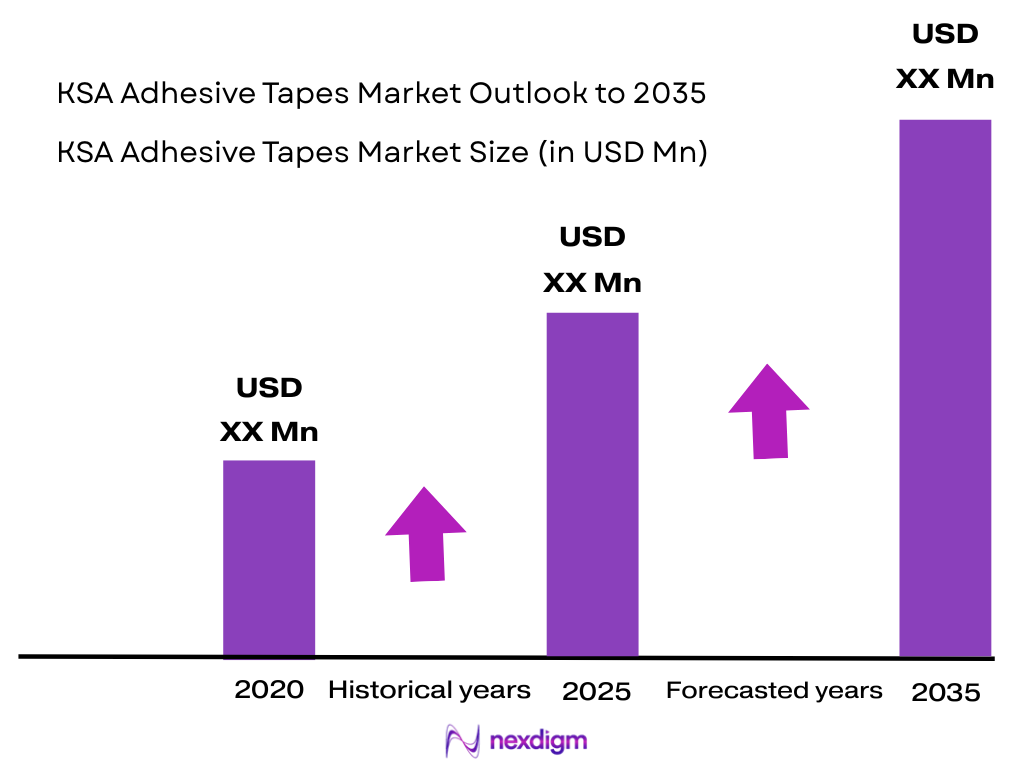
The KSA Adhesive Tapes Market is estimated at ~USD XX million in 2024, with the forecasted 2026–2035 CAGR at ~XX%. Demand is supported by Saudi Arabia’s expanding non-oil economy, manufacturing localization, construction activity, logistics infrastructure and automotive development. GASTAT reported that Saudi Arabia’s nominal GDP reached SAR 4,703 billion in 2024, while real GDP increased by 2.7 under the revised annual national accounts series. Manufacturing, which is a key tape-consuming activity, is becoming increasingly important as industrial diversification expands demand for packaging, mounting, insulation, assembly and surface-protection tapes.
Riyadh, Jeddah, Dammam, Jubail and the wider Eastern Province represent the principal demand centers for adhesive tapes because they combine construction, logistics, manufacturing, petrochemicals, automotive, electronics and commercial activity. Saudi Arabia’s population reached 35.3 million in mid-2024, compared with 33.7 million in mid-2023, increasing the underlying requirement for housing, retail, consumer goods and distribution infrastructure. Dammam and Jeddah are particularly important for imported tape and raw-material flows: GASTAT identifies Dammam’s King Abdulaziz Sea Port and Jeddah Islamic Sea Port among the Kingdom’s major import gateways.
Market Segmentation
By Adhesive Technology
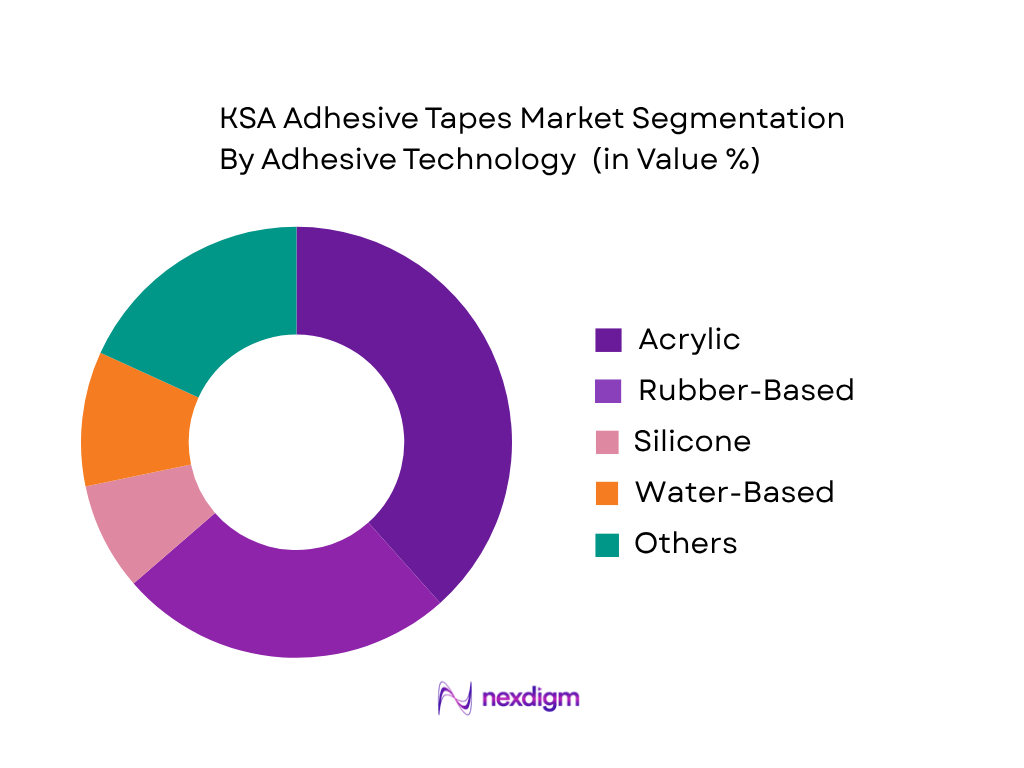
The KSA Adhesive Tapes Market is segmented into acrylic, rubber-based, silicone, water-based, solvent-based and hot-melt adhesive technologies. Acrylic tapes are expected to represent the dominant segment, supported by their broad applicability across packaging, automotive assembly, construction, electronics, mounting and industrial applications. Acrylic systems offer strong adhesion, weathering resistance and comparatively broad substrate compatibility, making them suitable for Saudi Arabia’s demanding operating conditions. The technology is particularly relevant to long-term mounting applications where resistance to temperature fluctuations, UV exposure and aging is important. Saudi Arabia’s industrial base is also expanding beyond hydrocarbons, with manufacturing activity increasingly supporting the need for engineered bonding solutions. GASTAT reported a 6.3 increase in manufacturing activity in December 2024, while chemical manufacturing increased by 4.8, strengthening the industrial ecosystem supporting specialty adhesive consumption.
By End-Use Industry
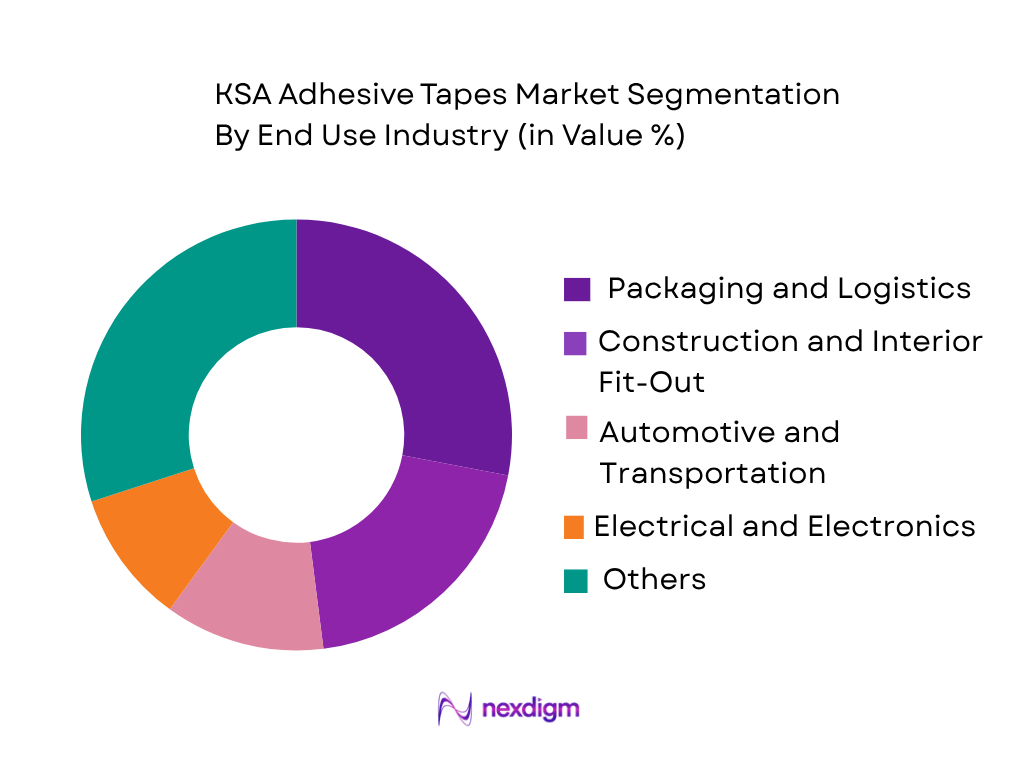
The KSA Adhesive Tapes Market is segmented across packaging and logistics, construction and interior fit-out, automotive and transportation, electrical and electronics, HVAC and MEP, healthcare and pharmaceuticals, industrial manufacturing, aerospace and defense, furniture and interiors, food and beverage, and marine and specialty applications. Packaging and logistics is expected to hold the leading position, reflecting the Kingdom’s expanding trade, warehousing and distribution infrastructure. Adhesive tapes are extensively used for carton sealing, bundling, labeling, palletizing and automated packaging operations. GASTAT reported that imports increased by 15.5 in Q4 2024 compared with Q4 2023, while machinery, electrical equipment and parts represented 26.1 of total imports. Transportation equipment and parts accounted for another 15.1, illustrating the scale of goods movement and industrial supply chains requiring packaging and assembly materials.
Competitive Landscape
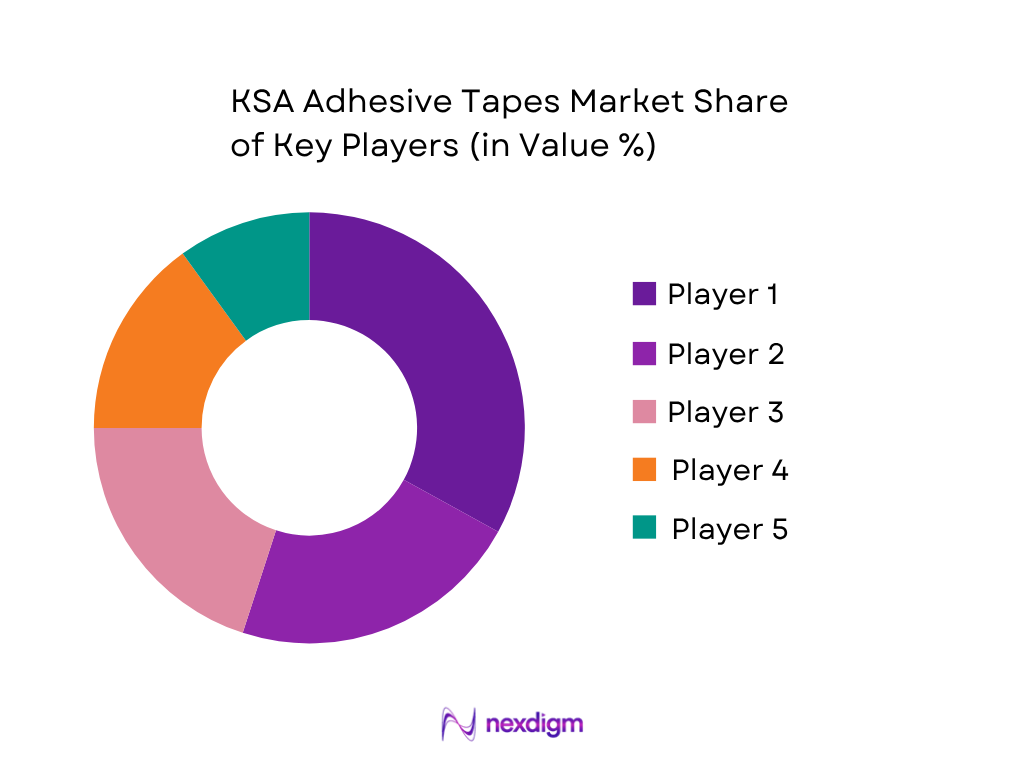
The KSA Adhesive Tapes Market comprises international adhesive and specialty-material manufacturers supplying Saudi customers directly or through regional distributors and converting partners. 3M, Henkel, Avery Dennison, tesa and Nitto have particularly broad technology portfolios covering industrial assembly, packaging, electronics, automotive, construction and specialty applications. Their competitive positioning is reinforced by technical product development, application engineering and established international distribution networks. tesa, for example, operates as an independently managed Beiersdorf subgroup and reported €1,688 million in sales in 2024, including substantial industrial applications.
| Company | Establishment Year | Headquarters | Key Adhesive Technologies | Major Tape Categories | Key UAE Applications | Distribution Strength | Technical Capability | Customization Capability |
| 3M | 1902 | St. Paul, USA | ~ | ~ | ~ | ~ | ~ | ~ |
| Henkel | 1876 | Düsseldorf, Germany | ~ | ~ | ~ | ~ | ~ | ~ |
| Avery Dennison | 1935 | Mentor, USA | ~ | ~ | ~ | ~ | ~ | ~ |
| tesa | 1896 | Norderstedt, Germany | ~ | ~ | ~ | ~ | ~ | ~ |
| Nitto Denko | 1918 | Osaka, Japan | ~ | ~ | ~ | ~ | ~ | ~ |
KSA Adhesive Tapes Market Analysis
Growth Drivers
Packaging and E-Commerce Fulfilment Demand, Vision 2030 Industrial Diversification, and Logistics Expansion
Saudi Arabia’s expansion of non-oil activity is strengthening demand for adhesive tapes used in carton sealing, pallet stabilization, bundling, labeling, splicing, surface protection, and warehouse handling. GASTAT reported that real GDP increased by 1.3% in 2024, while non-oil activities expanded by 4.3% and wholesale and retail trade, restaurants, and hotels grew by 6.4%. Transport, storage, and communication activities also increased by 4.5%, directly supporting logistics-intensive tape applications. Saudi ports handled more than 331 million tons of cargo in 2024, including 222.4 million tons of outbound cargo and approximately 108.9 million tons of inbound cargo, demonstrating the scale of goods movement requiring packaging and logistics consumables. Jeddah Islamic Port has a throughput capacity of 130 million tons and 62 multipurpose berths, while the Kingdom ranked 15th globally for container handling in the 2024 Lloyd’s List ranking. The National Transport and Logistics Strategy has also supported logistics-zone development and supply-chain integration. Together, these indicators create a favorable demand base for pressure-sensitive packaging tapes, carton-sealing tapes, strapping solutions, and industrial bonding products as distribution networks become more sophisticated.
Construction and Infrastructure Development, Automotive Localization, HVAC Installation, Manufacturing Expansion, and Electrical Infrastructure Investment
Saudi Arabia’s industrial diversification agenda is generating multiple tape-consuming applications across construction, automotive, manufacturing, electrical systems, HVAC, and MEP installation. GASTAT recorded 4.2% real growth in construction activity in 2024, while manufacturing excluding petroleum refining increased by 2.6% and electricity, gas, and water activities grew by 4.9%. Manufacturing excluding petroleum refining represented 9.1% of nominal GDP, while construction represented 5.5%, illustrating the scale of industries requiring masking, insulation, mounting, joining, protection, sealing, and surface-finishing tapes. Automotive localization is creating another specialized demand pool: Saudi Arabia’s automotive strategy is targeting 300,000 vehicles annually across three major manufacturers, while Lucid’s Saudi manufacturing facility has an eventual capacity of up to 155,000 vehicles annually. Ceer has also been designed around an annual production target of 170,000 vehicles, alongside a developing domestic supplier ecosystem. The Kingdom’s automotive supplier-development program identified material requirements associated with 565,000 vehicles, covering metals, plastics, rubber, and electronics. These developments increase opportunities for acrylic foam tapes, double-sided mounting tapes, masking tapes, electrical insulation tapes, wire-harness tapes, and assembly solutions used across localized production and infrastructure projects.
Market Challenges
Imported Master-Roll Dependency, Global Polymer and Adhesive Feedstock Exposure, and Limited Advanced Tape Manufacturing
The Saudi adhesive-tapes industry remains exposed to international supply chains for specialty films, adhesive polymers, resins, release liners, master rolls, and other converted-tape inputs. This challenge becomes particularly relevant as domestic industrial production expands faster than the availability of specialized converting and adhesive-coating capabilities. GASTAT reported that Saudi merchandise imports increased by 5.0% in 2024, while the fourth-quarter data showed imports increasing by 15.5% year on year. At the same time, non-oil exports including re-exports increased by 17.3% in the fourth quarter, demonstrating the scale of cross-border goods movement through which industrial inputs enter and leave the Kingdom. The challenge is not simply physical availability: advanced applications require controlled adhesive coat weights, consistent tack and peel performance, temperature resistance, aging stability, liner compatibility, and application-specific qualification. Local manufacturing development is therefore important for reducing lead-time exposure and improving supply resilience. The National Industrial Development and Logistics Program is explicitly focused on developing diversified industrial sectors and strengthening domestic manufacturing capabilities, while the Kingdom’s industrial strategy emphasizes localization and private-sector participation. For adhesive-tape producers, this creates a requirement to develop domestic coating, slitting, laminating, and specialty-converting capabilities rather than relying exclusively on imported master rolls.
Extreme Heat and Humidity, Adhesive Performance Degradation, Industrial Qualification Requirements, Technical Application Knowledge Gaps, and Commodity-Tape Price Competition
Saudi Arabia’s climatic conditions create demanding operating environments for adhesive tapes used in buildings, vehicles, warehouses, electrical systems, HVAC installations, and outdoor infrastructure. High temperatures, intense solar exposure, dust, and humidity in coastal areas can influence adhesive tack, shear resistance, liner stability, aging, and bond durability, increasing the importance of application-specific formulation and testing. The requirement becomes more significant as industrial users move from commodity tapes toward structural mounting, insulation, sealing, and high-temperature bonding applications. Saudi Arabia’s industrial base is simultaneously becoming more technologically demanding: GASTAT reported 2.6% real growth in manufacturing excluding petroleum refining in 2024, while electricity, gas, and water activities increased by 4.9%. The automotive localization ecosystem is also expanding, with more than 130 suppliers and OEMs participating in the KSA Auto Connect Forum and 23 agreements signed around supplier development. These applications require qualification against OEM, electrical, HVAC, construction, and industrial specifications rather than simple price-based purchasing. Consequently, tape suppliers must provide validated temperature ranges, substrate compatibility, adhesion data, aging performance, and application guidance. Commodity tapes remain vulnerable to price competition, but advanced tapes face a different barrier: customers expect documented performance before approving products for production or critical installations.
Market Opportunities
High-Performance Acrylic Foam Tapes, Low-VOC Adhesive Systems, EV and Battery Assembly Tapes, HVAC Foil and Insulation Tapes, and Smart Functional Tapes
Saudi Arabia’s industrial transformation is creating an increasingly suitable environment for higher-performance adhesive technologies that replace mechanical fastening, welding, riveting, or conventional joining methods. Automotive localization provides a particularly relevant application base. PIF states that Ceer is planned for 170,000 vehicles annually, while the Kingdom’s broader automotive localization program is targeting 300,000 vehicles annually across three manufacturers. Ceer has also announced SAR 5.5 billion of agreements with suppliers, with more than 80% of the agreements involving Saudi companies, supporting the emergence of a domestic automotive component ecosystem. This creates opportunities for double-sided acrylic foam tapes, wire-harness tapes, thermal-management tapes, battery-component bonding tapes, protective films, and interior assembly solutions. HVAC and MEP applications provide another avenue because construction activity expanded by 4.2% in 2024, while electricity, gas, and water activities increased by 4.9%. High-performance tapes can address insulation joining, duct sealing, foil lamination, vapor-barrier applications, and equipment mounting. The opportunity extends toward low-VOC and solvent-reduced systems as manufacturers and project developers increasingly emphasize environmental performance and workplace requirements. Advanced functional tapes can therefore move the market away from commodity carton-sealing products toward technically differentiated applications where substrate compatibility, thermal resistance, durability, and clean installation are commercially important.
Sustainable BOPP Packaging Tapes, Bio-Based Adhesive Chemistry, Solar and Renewable-Energy Applications, Premium Yacht and Marine Applications, and Local Specialty-Tape Conversion
Saudi Arabia’s expanding logistics, industrial, renewable-energy, and maritime ecosystems create opportunities for locally converted specialty tapes designed around demanding environmental and application conditions. The Kingdom’s ports handled more than 331 million tons of cargo in 2024, providing a substantial operating environment for packaging, palletizing, container handling, labeling, corrosion-protection, and marine maintenance products. Saudi Arabia is also developing renewable-energy and industrial infrastructure under its economic diversification agenda; the Vision 2030 industrial program highlights a first specialized wind-energy systems plant and continued development of industrial clusters covering automotive, renewable energy, pharmaceuticals, and advanced manufacturing. The domestic opportunity is particularly relevant for specialty-tape conversion because imported master rolls can be transformed locally into application-specific widths, lengths, liners, and adhesive constructions for regional customers. Sustainable BOPP packaging tapes can serve high-volume logistics operations, while bio-based or lower-impact adhesive chemistries can address sustainability requirements without abandoning pressure-sensitive performance. Marine and yacht applications can benefit from UV-resistant, salt-resistant, high-temperature, and surface-protection tapes given the Kingdom’s expanding coastal infrastructure and maritime activity. Local specialty conversion could also shorten lead times and enable smaller minimum-order quantities for industrial customers. The combination of 130 million tons of annual throughput capacity at Jeddah Islamic Port and continued industrial-cluster development supports a broad platform for specialized tape applications.
Future Outlook
The KSA Adhesive Tapes Market is expected to expand through increasing industrial localization, construction and infrastructure development, logistics investment and automotive manufacturing. The development of Saudi Arabia’s domestic automotive ecosystem is particularly relevant to specialty tapes because vehicle assembly creates demand for mounting, wire management, insulation, trim attachment and lightweight bonding solutions. PIF stated that Saudi Arabia is developing its automotive ecosystem around companies including Ceer and Lucid, while Hyundai Motor Manufacturing Middle East has also been established as a Saudi automotive manufacturing joint venture.
The future opportunity is expected to shift progressively from commodity carton-sealing and masking products toward acrylic foam tapes, electronics tapes, EV/battery tapes, HVAC insulation tapes, high-temperature industrial tapes, solar applications and precision die-cut components. Local converting and customization can further reduce dependence on imported finished products while improving availability for Saudi OEMs and contractors.
Major Players
- 3M Company
- Henkel AG & Co. KGaA
- Avery Dennison Corporation
- tesa SE
- Nitto Denko Corporation
- Sika AG
- Saint-Gobain
- H.B. Fuller Company
- Lohmann GmbH & Co. KG
- Arkema / Bostik
- Shurtape Technologies
- Intertape Polymer Group
- ORAFOL Europe GmbH
- Lintec Corporation
- Scapa Group / SWM International
Key Target Audience
- Adhesive Tape Manufacturers and Converters
- Packaging and Logistics Companies
- Construction and Interior Fit-Out Contractors
- Automotive and Transportation Component Manufacturers
- Electrical, Electronics and HVAC/MEP Manufacturers
- Industrial Manufacturing and Assembly Companies
- Investments and Venture Capitalist Firms
- Government and Regulatory Bodies (UAE Ministry of Industry and Advanced Technology, Dubai Municipality, Abu Dhabi Department of Economic Development, Emirates Authority for Standardization and Metrology)
Research Methodology
Step 1: Identification of Key Variables
The research begins by mapping the KSA adhesive-tape ecosystem across manufacturers, master-roll suppliers, converters, distributors, OEMs, contractors and industrial users. Variables include adhesive technology, backing material, tape construction, application, end-use industry, import dependency and local converting capacity.
Step 2: Market Analysis and Construction
Historical market information is compiled across adhesive technologies, tape constructions, end-use industries and application areas. Import activity, domestic conversion, distributor networks and industrial consumption patterns are assessed to reconstruct the supply-demand structure. The analysis also distinguishes commodity packaging tapes from higher-value industrial and specialty products.
Step 3: Hypothesis Validation and Expert Consultation
Market hypotheses are validated through structured discussions with adhesive-tape manufacturers, distributors, converters, packaging companies, automotive suppliers, construction contractors and industrial procurement professionals. Inputs are used to test technology adoption and application-level assumptions.
Step 4: Research Synthesis and Final Output
The final assessment triangulates bottom-up company analysis with end-use demand indicators and supply-chain evidence. Competitive positioning, segmentation shares, financial benchmarks, regional demand and emerging application opportunities are then integrated into the final KSA Adhesive Tapes Market outlook.

- Executive Summary
- Research Methodology (Market Definitions and Scope Boundaries, Adhesive Tape Classification Framework, Value and Volume Estimation, Top-Down Market Sizing, Bottom-Up Market Reconstruction, Import-Export Validation, End-Use Demand Mapping, Distributor and Converter Assessment, Primary Industry Interviews, Secondary Data Validation, Data Triangulation, Forecasting Framework, Sensitivity Analysis, Assumptions and Limitations)

- Definition and Scope
- Market Evolution and Development of the Saudi Adhesive Tapes Industry
- KSA Adhesive Tapes Industry Ecosystem
- Adhesive Tapes Value Chain Analysis
- KSA Adhesive Tapes Supply Chain Analysis

- Growth Drivers (Packaging and E-Commerce Fulfilment Demand, Vision 2030 Industrial Diversification, Construction and Infrastructure Development, Automotive Localization, HVAC Installation, Manufacturing Expansion, Electrical Infrastructure Investment, Lightweight Bonding Adoption)
- Market Challenges (Imported Master-Roll Dependency, Global Polymer and Adhesive Feedstock Exposure, Extreme Heat and Humidity, Adhesive Performance Degradation, Limited Advanced Tape Manufacturing, Industrial Qualification Requirements, Technical Application Knowledge Gaps, Commodity-Tape Price Competition)
- Market Opportunities (High-Performance Acrylic Foam Tapes, Sustainable BOPP Packaging Tapes, Low-VOC Adhesive Systems, Bio-Based Adhesive Chemistry, EV and Battery Assembly Tapes, HVAC Foil and Insulation Tapes, Solar and Renewable-Energy Applications, Smart and Functional Tapes, Premium Yacht and Marine Applications, Local Specialty-Tape Conversion)
- Market Trends (Lightweight Bonding, Replacement of Mechanical Fasteners, Premiumization of Specialty Tapes, Low-VOC Formulations, Sustainable Backings, High-Temperature Adhesives, Electrification-Driven Tape Applications, Local Conversion, Digital Packaging, High-Performance Industrial Tapes)
- Government and Regulatory Framework (Saudi Standards, Metrology and Quality Organization Requirements, Technical Regulation for Glue and Adhesive Materials, Product Conformity Assessment, Arabic and Arabic-English Product Labelling, Chemical Disclosure, Safety Information, Packaging Requirements)
- Porter’s Five Forces Analysis
- PESTLE Analysis
- SWOT Analysis

- By Market Value (2020-2025)
- By Volume Consumption (2020-2025)
- By Average Selling Price (2020-2025)
- By Domestic Production and Imported Supply (2020-2025)
- By Adhesive Tape Consumption Intensity Across Major End-Use Industries (2020-2025)
- By Local Conversion Versus Finished-Product Imports (2020-2025)

- By Adhesive Technology (In Value %)
Acrylic Adhesive Tapes
Rubber-Based Adhesive Tapes
Silicone Adhesive Tapes
Water-Based Adhesive Tapes
Solvent-Based Adhesive Tapes
Hot-Melt Adhesive Tapes
Specialty Reactive and Hybrid Adhesive Systems - By Tape Construction and Product Type (In Value %)
Single-Sided Tapes
Double-Sided Tapes
Transfer Tapes
Foam Tapes
Filament and Reinforced Tapes
Masking Tapes
Packaging and Carton-Sealing Tapes
Electrical Insulation Tapes
Protective Surface Tapes
Specialty High-Performance Tapes - By Backing Material (In Value %)
BOPP Backing
PET Backing
PVC Backing
Paper and Crepe Paper Backing
PE and Polyolefin Backing
Foam Backing
Aluminum Foil Backing
Nonwoven Backing
Fabric and Cloth Backing
Specialty Film Backings - By End-Use Industry (In Value %)
Packaging and Logistics
Construction and Interior Fit-Out
Automotive and Transportation
Electrical and Electronics
HVAC and MEP
Healthcare and Pharmaceuticals
Industrial Manufacturing
Aerospace and Defense
Furniture and Interiors
Food and Beverage
Marine and Specialty Applications - By Application (In Value %)
Carton Sealing and Case Closing
Bundling and Palletizing
Mounting and Assembly
Insulation and Thermal Management
Wire Harnessing and Electrical Insulation
Surface Protection
Masking and Paint Application
Splicing and Web Joining
Lamination and Composite Assembly
Sealing and Joining - By Performance Requirement (In Value %)
High-Temperature Resistance
High Shear Strength
High Peel Adhesion
UV Resistance
Moisture and Humidity Resistance
Chemical Resistance
Flame Retardancy
Electrical Insulation
Low-VOC Performance
Outdoor Durability

- Market Share of Major Players (By Value, Volume, Adhesive Technology, Tape Construction, Backing Material, End-Use Industry, Distribution Channel)
- Cross Comparison Parameters (Adhesive Technology Portfolio Breadth, Tape Construction and Backing Portfolio, Number of Industrial and Specialty Tape Product Families , Saudi Arabia Distribution Network and Geographic Coverage, Local Manufacturing, Slitting, Converting and Die-Cutting Footprint, OEM and Major-Project Qualification Coverage, Technical Support and Application-Engineering Capability, Product Certification and Quality-Compliance Coverage)
- Competitive SWOT Assessment of Major Players
- Detailed Profiles of Major Companies
3M Company
Henkel AG & Co. KGaA
Avery Dennison Corporation
tesa SE
Nitto Denko Corporation
Sika AG
Saint-Gobain S.A.
H.B. Fuller Company
Lohmann GmbH & Co. KG
Arkema / Bostik
Shurtape Technologies, LLC
Intertape Polymer Group Inc.
ORAFOL Europe GmbH
Lintec Corporation
Scapa Group / SWM International

- Packaging and Logistics End-User Analysis
- Construction and Infrastructure End-User Analysis
- Automotive End-User Analysis
- Electrical and Electronics End-User Analysis
- HVAC and MEP End-User Analysis
- Industrial Manufacturing End-User Analysis

- By Market Value (2026-2035)
- By Volume Consumption (2026-2035)
- By Average Selling Price (2026-2035)
- By Domestic Production and Imported Supply (2026-2035)
- By Adhesive Tape Consumption Intensity Across Major End-Use Industries (2026-2035)
- By Local Conversion Versus Finished-Product Imports (2026-2035)


 Request a Sample
 Ask for Customization
 Get a Quote
 Enquire Now