
 Download PDF
Market Overview
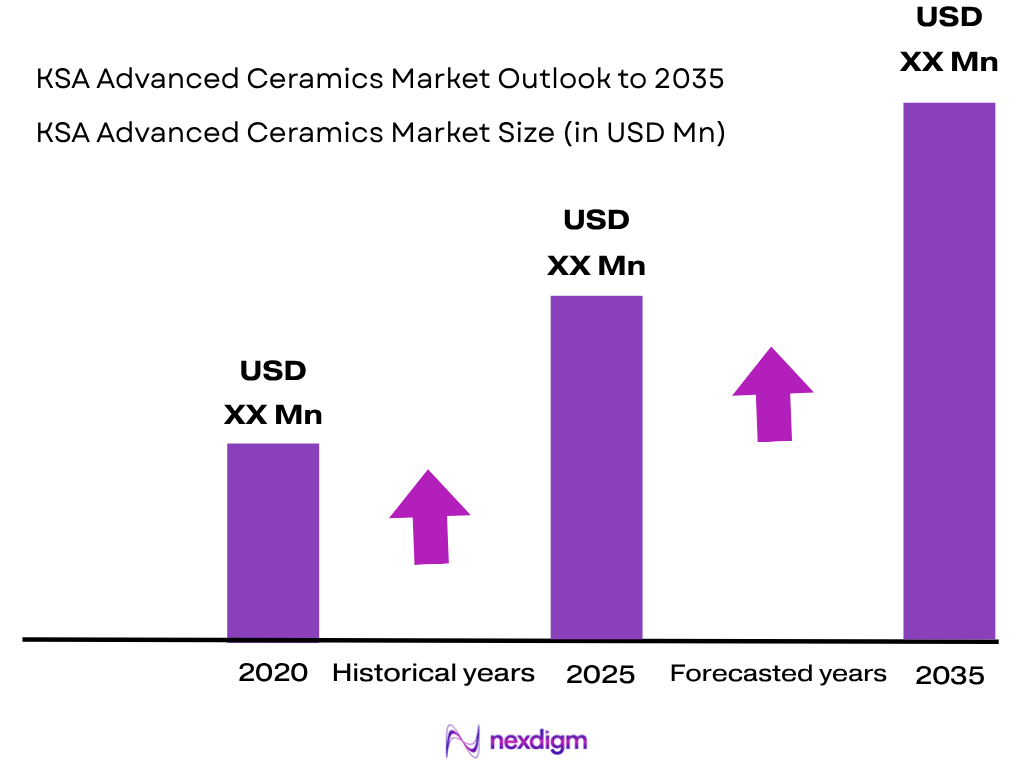
The KSA Advanced Ceramics Market is valued at approximately USD ~[XX] billion, with the 2024 and 2025 market values represented as USD ~[XX] billion and USD ~[XX] billion, respectively, based on validated market-sizing analysis. Demand is supported by the Kingdom’s expanding industrial base, aerospace and defence localization, electronics development, oil and gas processing, healthcare modernization, and investment in high-performance manufacturing. Published industry assessments identify electrical and electronics, medical, transportation, defence and security, and chemical industries as important demand pools for advanced ceramics in Saudi Arabia.
Riyadh, Dammam, Jubail, Yanbu and Jeddah represent the principal demand centers because advanced ceramics are closely linked to Saudi Arabia’s industrial, energy, defence, manufacturing and infrastructure ecosystems. Riyadh benefits from government, defence, advanced manufacturing and technology activity, while the Eastern Province is anchored by oil and gas, petrochemicals and industrial manufacturing. Jubail and Yanbu provide concentrated petrochemical and process-industry demand, while Jeddah supports manufacturing, logistics and healthcare applications. Saudi Arabia had more than 12,000 operating factories across the Kingdom, demonstrating the depth of the industrial customer base.
Market Segmentation
By Material Type
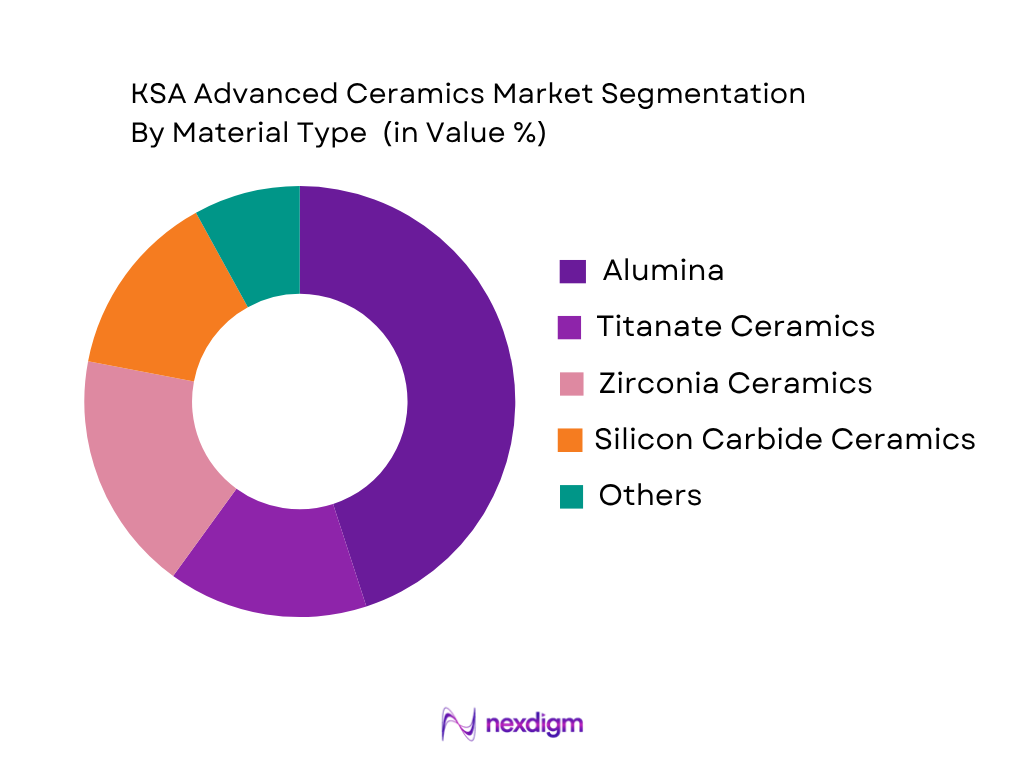
The KSA Advanced Ceramics Market is segmented by material type into Alumina, Zirconia, Silicon Carbide, Titanate, Silicon Nitride, Aluminum Nitride, Ferrite, and Other Advanced Ceramic Materials. Alumina is expected to represent the leading material segment, supported by its combination of high hardness, electrical insulation, chemical resistance, thermal stability and wear resistance. Its broad applicability across electrical and electronic components, industrial machinery, oil and gas equipment, medical applications and wear-resistant components gives it a wider addressable demand base than more specialized materials. Silicon carbide benefits from high-temperature and abrasive applications, particularly in energy and industrial equipment, while zirconia is suited to wear-resistant, structural and medical applications. Silicon nitride and aluminum nitride are positioned toward specialized high-temperature, electronic and thermal-management applications. The Kingdom’s industrial diversification, defence localization and expansion of advanced manufacturing are expected to strengthen demand for engineered ceramic materials with application-specific performance characteristics.
By End Use Industry
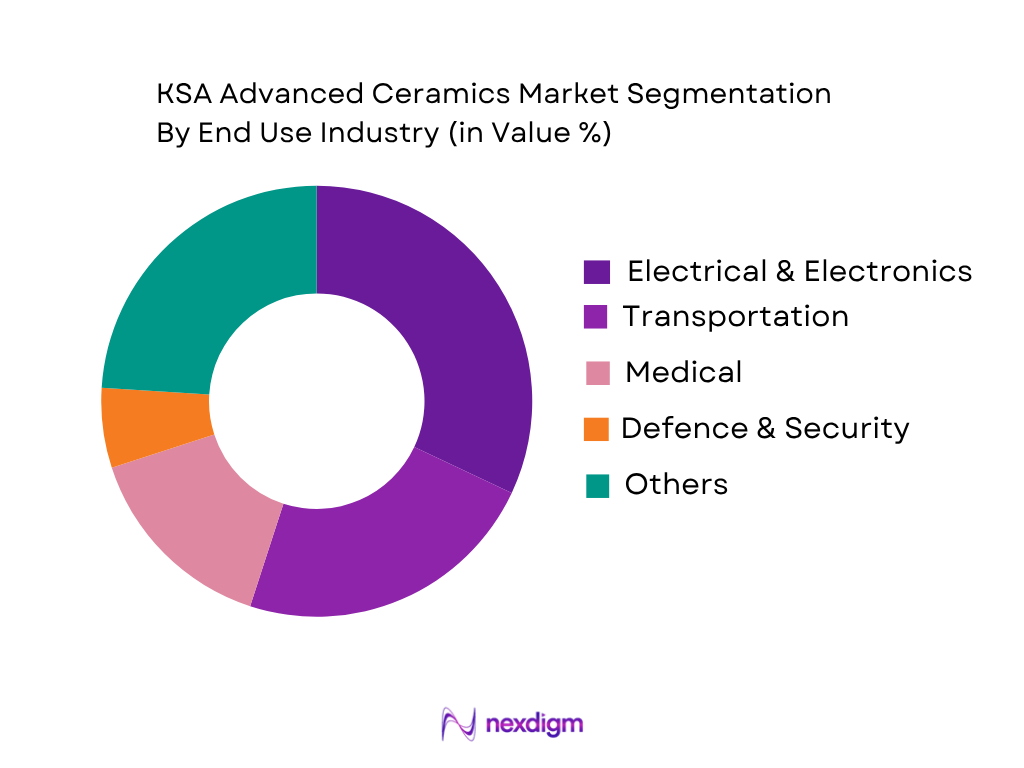
The KSA Advanced Ceramics Market is segmented by end use industry into Oil & Gas, Petrochemicals & Chemicals, Electrical & Electronics, Aerospace & Defense, Healthcare & Medical Devices, Energy & Power, Automotive & Transportation, Industrial Manufacturing, and Other End Use Industries. Oil & Gas is expected to remain the leading end-use industry because Saudi Arabia has a highly developed hydrocarbon, refining and petrochemical ecosystem requiring materials capable of withstanding elevated temperatures, corrosive chemicals, pressure, abrasion and continuous operating conditions. Advanced ceramics can be used in seals, liners, valves, pumps, filters, catalyst-support systems and wear-resistant components. Aerospace and defense represent high-value applications because ceramics offer lightweight, thermal-resistant and high-hardness characteristics. Electrical and electronics demand is supported by applications involving insulation, substrates, packages and thermal management, while healthcare creates requirements for biocompatible ceramic materials. The Kingdom’s industrial diversification and localization programs provide additional opportunities for advanced ceramic adoption across domestic manufacturing and specialized component production.
Competitive Landscape
The KSA Advanced Ceramics Market comprises established international technical-ceramics manufacturers supplying high-performance materials and components alongside regional industrial suppliers and distributors. Competition is shaped less by commodity volume and more by material formulation, precision manufacturing, qualification capability, application engineering and the ability to meet demanding oil and gas, aerospace, defence, electronics and medical specifications. Global companies such as CeramTec, CoorsTek, KYOCERA, Morgan Advanced Materials and Saint-Gobain possess broad technical-ceramics portfolios and international manufacturing networks.
| Company | Establishment | Headquarters | Material Portfolio | Key Product Capability | Core KSA-Relevant Industries | Manufacturing / Technical Footprint | Key Differentiator |
| CeramTec | 1903 | Plochingen, Germany | ~ | ~ | ~ | ~ | ~ |
| CoorsTek | 1910 | Golden, Colorado, USA | ~ | ~ | ~ | ~ | ~ |
| KYOCERA | 1959 | Kyoto, Japan | ~ | ~ | ~ | ~ | ~ |
| Morgan Advanced Materials | 1856 | Windsor, UK | ~ | ~ | ~ | ~ | ~ |
| Saint-Gobain Performance Ceramics & Refractories | 1665 | Courbevoie, France | ~ | ~ | ~ | ~ | ~ |
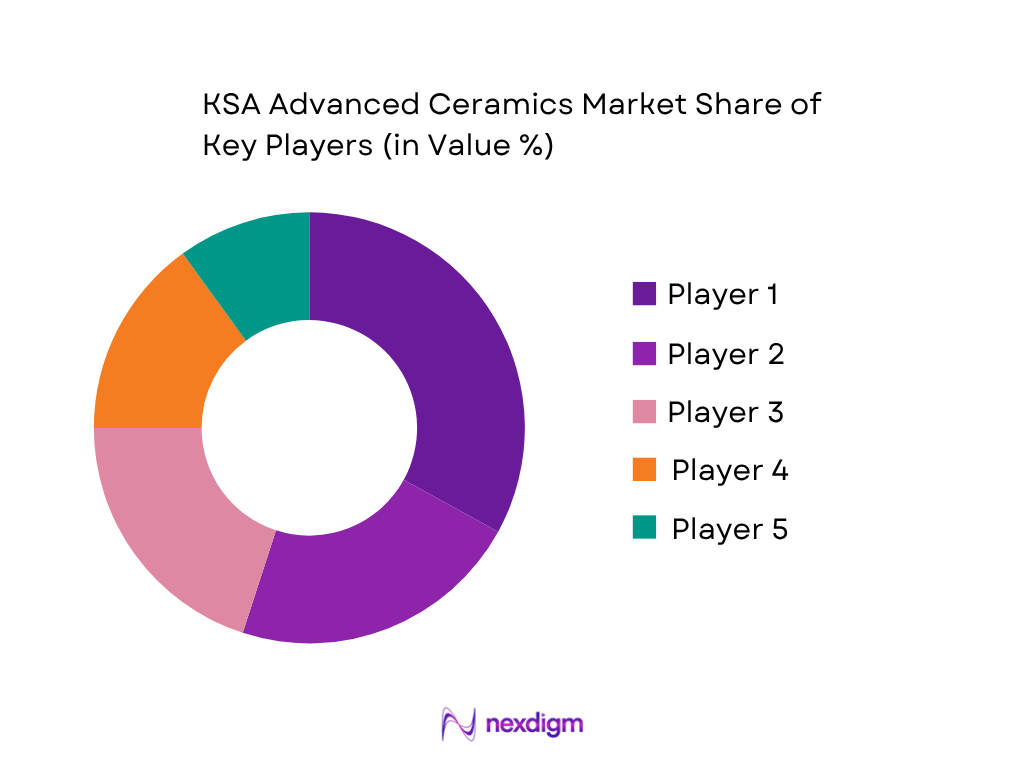
KSA Advanced Ceramics Market Analysis
Growth Drivers
Oil & Gas Equipment Demand, Petrochemical Processing Expansion, Defence Localization, Aerospace Manufacturing
Saudi Arabia’s oil and industrial base provides a strong demand foundation for advanced ceramics used in wear-resistant, corrosion-resistant and high-temperature components. IMF data records crude-oil production at 9.0 million barrels per day and nominal GDP at SAR 4,108 billion in the latest 2024 assessment, while non-oil GDP reached SAR 2,670 billion. This combination supports demand from upstream equipment, refining, gas processing and industrial maintenance, where ceramic components can extend operating life under abrasive and high-temperature conditions. The IMF also reported that non-oil real GDP expanded by 4.5%, with construction among the principal contributors, strengthening the broader industrial ecosystem serving energy projects. Defence localization and aerospace manufacturing further expand the addressable application base because advanced ceramics are relevant to lightweight armour, thermal protection, electrical insulation and high-temperature systems. Saudi Arabia’s economic diversification agenda is also increasing investment outside conventional hydrocarbons, creating additional industrial applications for engineered ceramic materials. Consequently, oilfield equipment, petrochemical processing, defence manufacturing and aerospace supply chains can collectively support greater adoption of alumina, zirconia, silicon-carbide and other advanced ceramic components as domestic industrial capabilities deepen.
Advanced Manufacturing Development, Electronics and Power Infrastructure, Mining Equipment Demand, Healthcare Technology Development
The expansion of Saudi Arabia’s non-oil economy is creating a broader industrial platform for advanced ceramic applications across electronics, power systems, mining equipment and healthcare technologies. The IMF reported 4.5% real non-oil GDP growth and identified construction, retail and hospitality as important contributors, while Saudi Arabia’s nominal non-oil GDP was recorded at SAR 2,670 billion in the 2024 projection. World Bank data also places industry, including construction, at 44.9% of GDP, demonstrating the substantial industrial base supporting demand for high-performance engineering materials. For advanced ceramics, this environment is relevant because electrical insulators, ceramic substrates, wear parts, thermal-management components and medical ceramics depend on sophisticated manufacturing ecosystems. Mining and industrial equipment demand can support silicon-carbide and alumina applications where hardness and abrasion resistance are important. Healthcare expansion creates potential demand for zirconia and other biocompatible ceramics used in dental and medical applications. At the same time, power and electronics infrastructure requires materials capable of electrical isolation and thermal stability. These macroeconomic conditions strengthen the case for advanced ceramics as Saudi Arabia moves from resource-intensive production toward increasingly diversified manufacturing and technology-intensive industrial applications.
Market Challenges
Dependence on Imported Ceramic Powders, Limited Domestic Processing Capacity, High Precision Manufacturing Requirements, Technology and Equipment Dependency
Saudi Arabia’s advanced ceramics ecosystem faces a structural challenge from the relatively specialized nature of ceramic powder preparation, precision forming and sintering technologies. The country’s industrial economy is substantial, with World Bank data indicating that industry, including construction, represented 44.9% of GDP in 2024, but the broader industrial scale does not automatically translate into domestic capability for high-purity ceramic powders or specialized processing equipment. IMF data shows imports of goods equivalent to 19.5% of GDP in its 2024 projection, illustrating the importance of imported industrial inputs within the economy. Advanced ceramics require tightly controlled particle size, purity, additives, firing conditions and dimensional tolerances, making qualification and process development considerably more demanding than conventional ceramics. Dependence on overseas suppliers can therefore expose manufacturers to logistics disruptions, foreign technology requirements and longer qualification cycles. The challenge is particularly significant for zirconia, silicon carbide and specialized electronic ceramics, where material purity and processing consistency directly influence component performance. Building local powder processing, precision machining, sintering and testing capabilities would require sustained industrial investment and specialized technical infrastructure, making localization a gradual process rather than an immediate substitution of imports.
Skilled Workforce Requirements, OEM Qualification Cycles, High Material Purity Requirements, Limited Local Advanced Ceramic Ecosystem
The technical complexity of advanced ceramics creates a capability constraint as Saudi Arabia develops a deeper domestic manufacturing ecosystem. The IMF reported that Saudi Arabia added more than 1 million jobs during 2023, primarily in the private sector, while the unemployment rate for Saudi nationals reached 7.7% in the fourth quarter of that year. However, the availability of workers does not necessarily correspond to the specialized skills required for ceramic powder synthesis, precision machining, additive manufacturing, metallization, sintering, non-destructive testing and qualification of advanced ceramic components. OEM qualification is particularly demanding because components used in oilfield equipment, aerospace, defence, electronics and medical applications must demonstrate consistent performance under defined operating conditions. IMF data also indicates that Saudi Arabia’s imports of goods were equivalent to 19.5% of GDP in its 2024 projection, reinforcing the broader role of international supply chains in industrial inputs. For advanced ceramics, this creates exposure to imported materials, equipment and technical know-how while local suppliers build qualification histories. High-purity materials further increase process sensitivity because contamination can affect electrical, mechanical and thermal properties. The resulting skills, qualification and ecosystem gaps can slow domestic adoption even when end-use industries generate strong underlying demand.
Market Opportunities
Oil & Gas Ceramic Component Localization, Defence Armour Ceramics, Aerospace Ceramic Matrix Composites, Semiconductor Ceramics, Power Electronics Substrates
Saudi Arabia’s ongoing economic diversification creates an opportunity to establish domestic advanced-ceramic capabilities around strategically important industrial sectors. The IMF recorded 9.0 million barrels per day of crude-oil production and SAR 2,670 billion in nominal non-oil GDP in its 2024 assessment, indicating a large industrial base capable of supporting localized component manufacturing. Oil and gas applications provide an immediate industrial pathway for ceramic seals, liners, wear parts and insulating components, while defence localization can create demand for alumina and silicon-carbide armour ceramics. Aerospace and semiconductor-related applications offer a higher-value pathway because they require advanced materials with tightly controlled thermal, electrical and mechanical characteristics. IMF data also shows imports of goods equivalent to 19.5% of GDP, highlighting the scale of industrial inputs that could potentially be progressively localized where technical and economic conditions support domestic production. Power electronics substrates, electrical insulation and thermal-management components can benefit from growing industrial electrification and infrastructure development. The opportunity therefore extends beyond producing finished ceramic parts: Saudi Arabia can develop capabilities in powder preparation, precision forming, sintering, machining, metallization and testing, creating a more integrated advanced-ceramics supply chain around energy, defence, aerospace and electronics applications.
High-Performance Ceramic Coatings, Advanced Bioceramics, Domestic Ceramic Powder Processing, Precision Ceramic Component Manufacturing
Domestic capability development represents a significant opportunity for Saudi Arabia’s advanced ceramics market because it can connect the country’s large industrial base with specialized material technologies. World Bank data shows that industry, including construction, accounted for 44.9% of GDP in 2024, while IMF data recorded 4.5% real non-oil GDP growth, demonstrating continued expansion of the non-hydrocarbon industrial economy. This creates a suitable environment for high-performance ceramic coatings used to improve wear, corrosion and thermal resistance in industrial equipment. Healthcare technology development can simultaneously support zirconia-based dental applications and other bioceramic components requiring biocompatibility and dimensional precision. Domestic ceramic powder processing offers a particularly important opportunity because powder quality determines downstream forming, sintering and final component performance. Establishing local capability could reduce dependence on imported specialized inputs and support shorter supply chains for industrial customers. Precision manufacturing can then extend the value chain into finished components for energy, mining, electronics, defence and medical applications. Saudi Arabia’s goods imports, equivalent to 19.5% of GDP in the IMF’s 2024 projection, further indicate the potential strategic value of developing selected domestic industrial-input capabilities where advanced ceramics can substitute for imported specialized components.
Future Outlook
Over the next decade, the KSA Advanced Ceramics Market is expected to benefit from the Kingdom’s industrial diversification and localization agenda. Demand should increasingly move toward higher-value engineered components rather than basic imported ceramic products. Aerospace and defence localization, semiconductor and electronics development, oil and gas equipment modernization, healthcare investment and advanced manufacturing are expected to create new application requirements. Saudi industrial policy is also emphasizing automation, high-tech manufacturing and domestic production capabilities, creating a stronger ecosystem for advanced materials.
Major Players
- CeramTec
- CoorsTek
- KYOCERA Corporation
- Morgan Advanced Materials
- Saint-Gobain Performance Ceramics & Refractories
- 3M
- Murata Manufacturing
- NGK Insulators
- TOTO
- Ferrotec Holdings
- Rauschert
- Vesuvius
- CUMI – Carborundum Universal
- Materion Corporation
- Ceradyne / 3M
Key Target Audience
- Advanced ceramics manufacturers and component producers
- Oil and gas companies and petrochemical operators
- Aerospace and defence manufacturers and contractors
- Electrical, electronics and semiconductor manufacturers
- Healthcare and medical-device manufacturers
- Investments and venture capitalist firms (Public Investment Fund, Saudi Venture Capital Company, STV)
- Government and regulatory bodies (Ministry of Industry and Mineral Resources, General Authority for Military Industries, Ministry of Energy, Ministry of Investment, Royal Commission for Jubail and Yanbu, MODON)
- Industrial equipment, mining and power-generation companies
Research Methodology
Step 1: Identification of Key Variables
The initial phase involves mapping the complete KSA Advanced Ceramics ecosystem, including raw-material suppliers, powder producers, ceramic manufacturers, component suppliers, distributors and industrial end users. Secondary research is used to identify material categories, manufacturing processes, application areas and demand centers. The assessment also maps Saudi industrial-development programs and localization priorities influencing advanced-material adoption.
Step 2: Market Analysis and Construction
Historical market information is compiled across material types, product classes, applications and end-use industries. The analysis combines demand-side indicators from oil and gas, petrochemicals, defence, aerospace, electronics, healthcare, energy and industrial manufacturing with supply-side assessments of domestic production and imports. Bottom-up estimates are reconciled with top-down industry indicators to construct the market model.
Step 3: Hypothesis Validation and Expert Consultation
Market hypotheses are validated through structured discussions with industry participants involved in advanced ceramics, industrial equipment, oilfield services, aerospace, defence, electronics and medical applications. Interviews focus on procurement specifications, material selection, qualification cycles, application requirements, domestic versus imported supply and technology gaps. Findings are used to refine the market segmentation and competitive assessment.
Step 4: Research Synthesis and Final Output
The final stage triangulates company-level information, industrial indicators, trade information, application demand and expert inputs. The resulting model is tested across material, product, application and end-use dimensions to identify the dominant demand pools and emerging opportunities. Competitive positioning is then assessed according to product breadth, technology capability, manufacturing depth, application coverage and localization potential.

- Executive Summary
- Research Methodology (Market Definition, Scope and Assumptions, Advanced Ceramics Classification, Market Sizing Methodology, Top-Down Analysis, Bottom-Up Analysis, Demand-Side Assessment, Supply-Side Assessment, Import-Export Reconciliation, Primary Research, Expert Validation, Data Triangulation, Forecasting Framework, Scenario Analysis, Research Limitations)

- Definition and Scope
- Advanced Ceramics Industry Evolution in Saudi Arabia
- KSA Advanced Ceramics Industry Development Landscape
- Advanced Ceramics Value Chain Analysis
- Advanced Ceramics Supply Chain Mapping

- Growth Drivers (Oil & Gas Equipment Demand, Petrochemical Processing Expansion, Defence Localization, Aerospace Manufacturing, Advanced Manufacturing Development, Electronics and Power Infrastructure, Mining Equipment Demand, Healthcare Technology Development)
- Market Challenges (Dependence on Imported Ceramic Powders, Limited Domestic Processing Capacity, High Precision Manufacturing Requirements, Technology and Equipment Dependency, Skilled Workforce Requirements, OEM Qualification Cycles, High Material Purity Requirements, Limited Local Advanced Ceramic Ecosystem)
- Market Opportunities (Oil & Gas Ceramic Component Localization, Defence Armour Ceramics, Aerospace Ceramic Matrix Composites, Semiconductor Ceramics, Power Electronics Substrates, High-Performance Ceramic Coatings, Advanced Bioceramics, Domestic Ceramic Powder Processing, Precision Ceramic Component Manufacturing)
- Market Trends (Industrial Localization, Advanced Material Adoption, Ceramic Matrix Composite Development, High-Purity Ceramics, Thermal Management Materials, Smart Manufacturing, Additive Ceramic Manufacturing, Precision Components, Functional Ceramic Coatings)
- Government and Regulatory Landscape (Vision 2030, National Industrial Development and Logistics Program, Local Content, Industrial Investment, Defence Localization, Aerospace Development, Mining Development, R&D and Technology Transfer)
- SWOT Analysis
- Porter’s Five Forces Analysis
- PESTLE Analysis

- By Market Value (2020-2025)
- By Production Volume (2020-2025)
- By Domestic Consumption Volume (2020-2025)
- By Domestic Production (2020-2025)
- By Import Volume (2020-2025)
- By Export Volume (2020-2025)

- By Material Type (In Value %)
Alumina Ceramics
Zirconia Ceramics
Silicon Carbide Ceramics
Silicon Nitride Ceramics
Aluminum Nitride Ceramics
Titanate Ceramics
Ferrite Ceramics
Piezoelectric Ceramics
Hydroxyapatite and Bioceramics - By Product Type (In Value %)
Monolithic Ceramics
Ceramic Coatings
Ceramic Substrates
Ceramic Filters
Ceramic Tubes and Rods
Ceramic Plates and Discs
Ceramic Powders
Ceramic Components
Ceramic Matrix Composites
Precision Ceramic Parts - By Functional Property (In Value %)
High-Temperature Ceramics
Wear-Resistant Ceramics
Corrosion-Resistant Ceramics
Electrical Insulating Ceramics
Dielectric Ceramics
Thermal Conductivity Ceramics
Structural Ceramics
Optical Ceramics
Biocompatible Ceramics - By Manufacturing Process (In Value %)
Dry Pressing
Isostatic Pressing
Injection Molding
Extrusion
Tape Casting
Slip Casting
Hot Pressing
Hot Isostatic Pressing
Pressureless Sintering
Spark Plasma Sintering
Additive Manufacturing - By End-Use Industry (In Value %)
Oil & Gas
Petrochemicals and Chemicals
Aerospace
Defence and Security
Electrical and Electronics
Semiconductors
Healthcare and Medical Devices
Energy and Power
Automotive and Transportation
Industrial Machinery
Mining and Minerals Processing
Water and Environmental Treatment - By Application (In Value %)
Downhole and Oilfield Components
Seals and Valve Components
Wear Liners and Pump Components
Catalyst Supports
Thermal Barrier Coatings
Turbine and Engine Components
Ballistic Protection Components
Radomes and RF Components
Electronic Substrates
Power Electronics Components
Electrical Insulators
Medical and Dental Components

- Market Share Analysis of Major Players (By Material, Product Type, End-Use Industry, Application, Domestic Sales, Imported Supply)
- Cross Comparison Parameters (Material Portfolio Breadth, Ceramic Powder Processing Capability, Powder-to-Component Integration, Precision Machining Capability, High-Purity Ceramic Capability, Oil & Gas Application Coverage, Aerospace & Defence Qualification Capability, R&D and Technology Development Intensity)
- SWOT Analysis of Major Players
- KSA Advanced Ceramics Pricing and Cost Structure Analysis
- Detailed Profiles of Major Companies
CeramTec
CoorsTek
KYOCERA Corporation
Morgan Advanced Materials
Saint-Gobain Performance Ceramics & Refractories
3M
Murata Manufacturing
NGK Insulators
TOTO
Ferrotec Holdings
Rauschert
Vesuvius
CUMI – Carborundum Universal
Materion Corporation
Ceradyne / 3M

- Oil & Gas Procurement Analysis
- Petrochemical Procurement Analysis
- Defence Procurement Analysis
- Aerospace Procurement Analysis
- Electronics and Semiconductor Procurement Analysis
- Healthcare Procurement Analysis
- Energy Procurement Analysis

- By Market Value (2026-2035)
- By Production Volume (2026-2035)
- By Domestic Consumption Volume (2026-2035)
- By Domestic Production (2026-2035)
- By Import Volume (2026-2035)
- By Export Volume (2026-2035)


 Request a Sample
 Ask for Customization
 Get a Quote
 Enquire Now