
 Download PDF
Market Overview
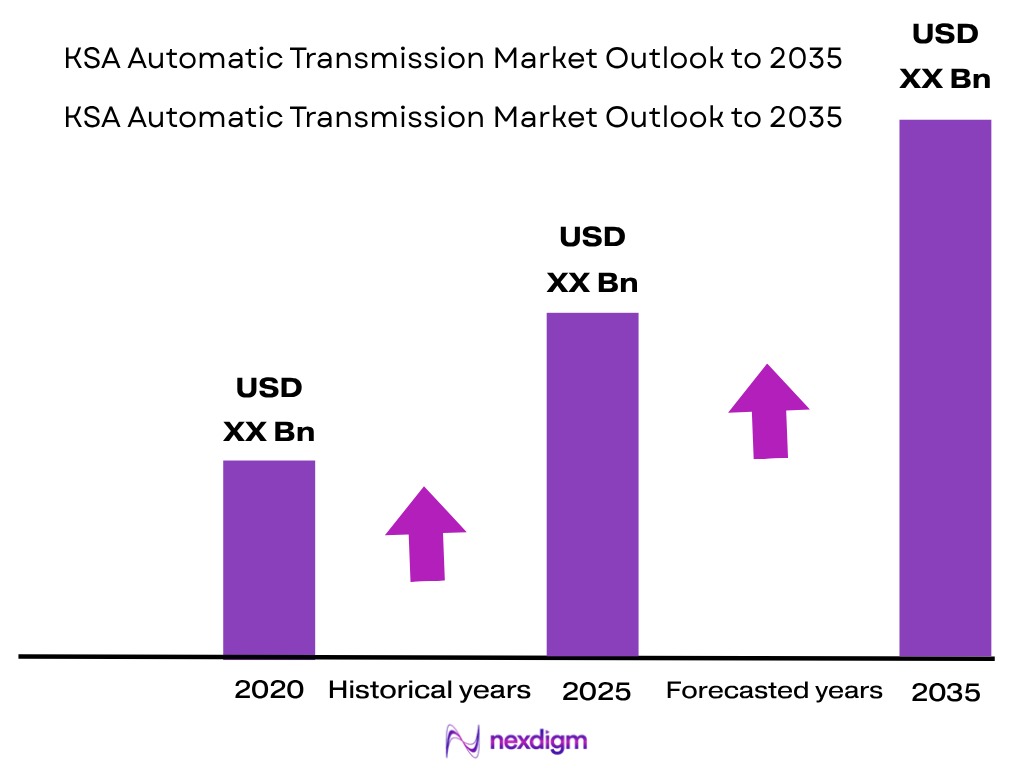
The KSA Automatic Transmission Market is valued at approximately ~USD XX billion, based on the requested placeholder valuation. Demand is supported by the Kingdom’s expanding vehicle base: registered and roadworthy vehicles increased from 14.8 million to more than 15.8 million, while newly registered vehicles increased from 878,100 to 1,025,700 across the two latest annual observations. The large passenger, SUV, pickup, fleet and commercial-vehicle parc supports factory-fit transmissions, replacement assemblies, mechatronics and transmission-service demand.
Riyadh, Jeddah and the wider Makkah Region, together with the Eastern Province, form the principal demand centers for the KSA Automatic Transmission Market because of their large vehicle populations, corporate fleets, dealer infrastructure, logistics activity and concentrations of automotive workshops. Newly issued driving licences increased from 1.191 million to 1.271 million across the two latest annual observations. Riyadh ranked first in new licence issuance, followed by Makkah and the Eastern Region, reinforcing their importance for drivetrain demand and servicing.
Market Segmentation
By Transmission Type
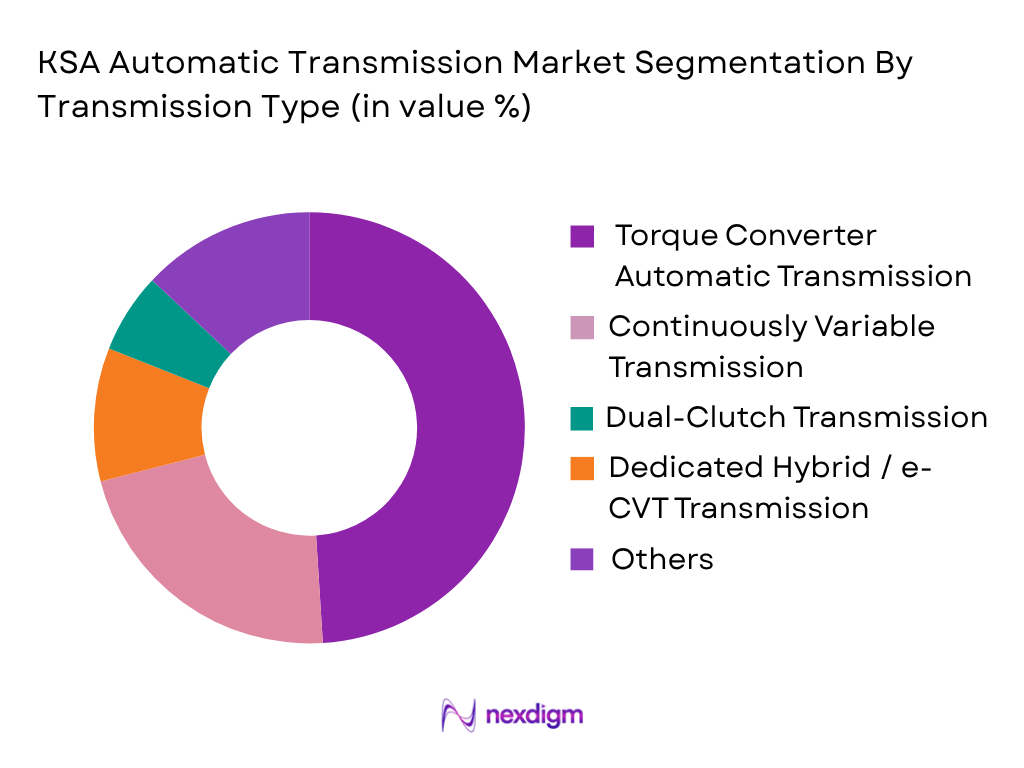
The KSA Automatic Transmission Market is segmented into torque-converter automatic transmissions, continuously variable transmissions, dual-clutch transmissions, dedicated hybrid and e-CVT systems, automated manual transmissions, heavy-duty fully automatic transmissions and electric reduction drives. Torque-converter automatic transmissions hold the dominant modeled market share because Saudi Arabia has a large installed base of SUVs, pickups, luxury vehicles and high-output passenger vehicles where high torque capacity, smooth gear changes, towing capability and durability are important. Six-, eight- and ten-speed torque-converter systems are particularly suited to large-displacement and turbocharged engines as well as four-wheel-drive applications. Saudi driving conditions also favor durable automatic architectures capable of managing sustained highway use, high ambient temperatures and demanding off-road operation. CVTs maintain a strong position in Japanese and Korean passenger cars and compact crossovers, while DCTs are concentrated in selected performance-oriented and European applications. Hybrid e-CVT and dedicated hybrid architectures are emerging as manufacturers broaden electrified line-ups, while BEVs progressively introduce single-speed reduction units into the drivetrain mix.
By Vehicle Type
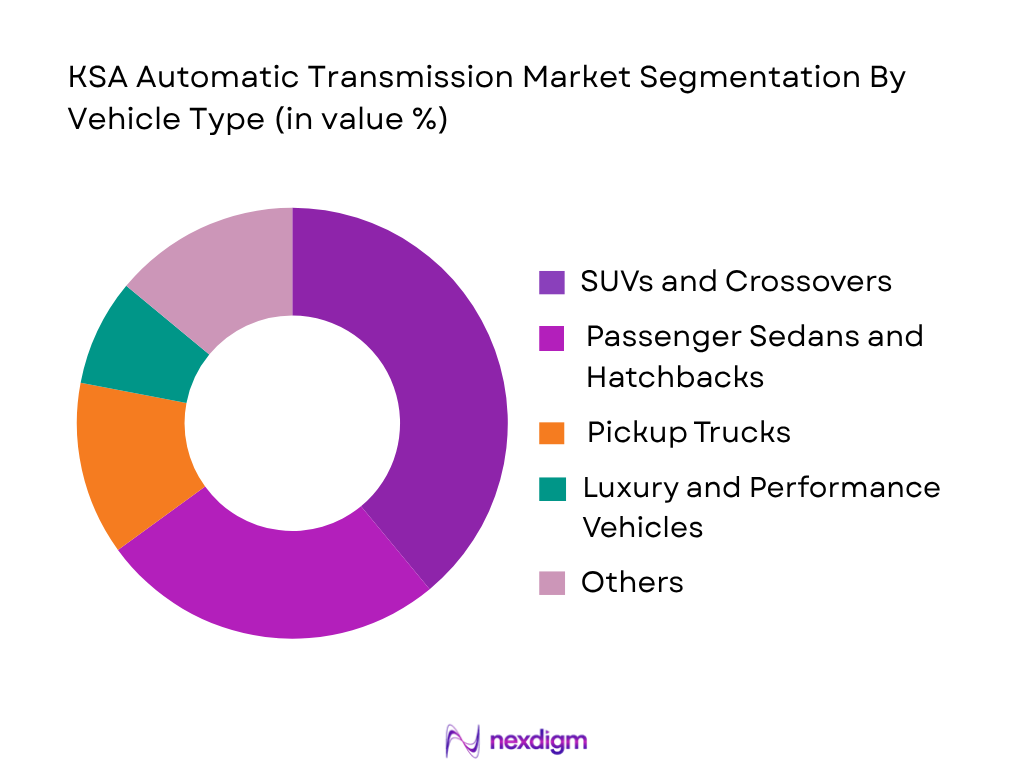
The KSA Automatic Transmission Market is segmented by vehicle type into SUVs and crossovers, passenger sedans, pickup trucks, luxury and performance vehicles, light commercial vehicles, medium and heavy commercial vehicles, buses and coaches, and electric vehicles. SUVs and crossovers hold the dominant modeled market share because Saudi consumers require vehicles suited to long-distance highway travel, family mobility, desert conditions, higher ground clearance and four-wheel-drive operation. The segment uses a wide variety of automatic architectures, particularly six-, eight- and ten-speed torque-converter systems. SUVs also support higher transmission content through transfer cases, all-wheel-drive systems, electronically controlled differentials and enhanced thermal-management systems. The broader addressable vehicle base is substantial: Saudi Arabia had more than 15.8 million registered and roadworthy vehicles and recorded 1,025,700 newly registered vehicles in the latest available annual GASTAT road-transport dataset. Pickup trucks further reinforce high-torque automatic demand, while premium SUVs create opportunities for electronically controlled multi-speed transmissions and integrated driveline systems.
Competitive Landscape
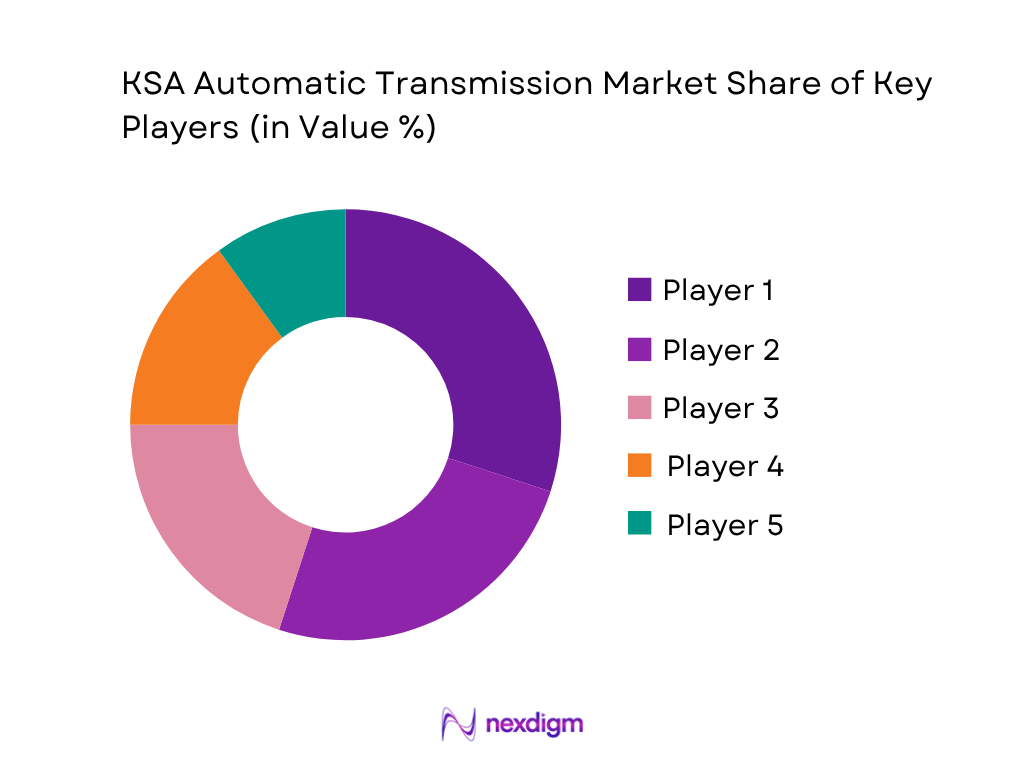
The KSA Automatic Transmission Market is led primarily by global drivetrain suppliers whose technologies enter Saudi Arabia through imported vehicles, authorized OEM distributors and commercial-vehicle fleets. Aisin and JATCO have strong exposure to Japanese vehicle platforms, while Hyundai Transys supports Korean passenger and SUV applications. ZF has a significant technology position in premium, high-torque, commercial and electrified drivetrains, while Allison specializes in heavy-duty fully automatic systems. Competitive differentiation increasingly depends on high-temperature durability, SUV and pickup capability, OEM fitment breadth, hybrid readiness, e-drive technology and aftermarket technical support.
| Company | Establishment Year | Headquarters | Core Transmission Technology | Major KSA Application | Hybrid Capability | Electric Drivetrain Capability | High-Torque / Severe-Duty Capability | Aftermarket / Technical Relevance |
| ZF Friedrichshafen AG | 1915 | Friedrichshafen, Germany | ~ | ~ | ~ | ~ | ~ | ~ |
| Aisin Corporation | 1949 | Kariya, Japan | ~ | ~ | ~ | ~ | ~ | ~ |
| JATCO Ltd. | 1999 | Fuji, Japan | ~ | ~ | ~ | ~ | ~ | ~ |
| Hyundai Transys Inc. | 2019 | Seosan, South Korea | ~ | ~ | ~ | ~ | ~ | ~ |
| Allison Transmission Holdings Inc. | 1915 | Indianapolis, United States | ~ | ~ | ~ | ~ |
KSA Automatic Transmission Market Analysis
Growth Drivers
Expanding Vehicle Parc and New Registrations Strengthen Automatic Transmission Demand
Saudi Arabia’s expanding vehicle parc is a direct growth driver for automatic transmissions because new registrations add factory-fitted transmission demand while the existing fleet creates recurring requirements for replacement units, torque converters, valve bodies, mechatronics, sensors, cooling systems and transmission fluids. GASTAT recorded more than 15.8 million registered and roadworthy vehicles in 2024, compared with 14.8 million in 2023, while vehicles receiving new registrations reached 1,025,700 units in 2024, versus 878,100 units in 2023. Newly issued driving licences also reached 1,271,000 in 2024, while renewed licences totaled 1,204,000, reinforcing the scale of the active driving population. These figures are particularly relevant because Saudi passenger cars, SUVs, pickups and premium vehicles are overwhelmingly suited to automatic architectures such as torque-converter ATs and CVTs, while commercial applications create demand for heavy-duty automatic and automated systems. Road-freight activity adds another transmission-intensive application: 12.2 million tonnes of imports moved through land ports in 2024, alongside 13.4 million tonnes of exports, supporting commercial-vehicle utilization. The macroeconomic base is substantial: the IMF’s latest revised series places Saudi Arabia’s 2024 nominal GDP at SAR 4.703 trillion, equivalent to USD 1.254 trillion, with GDP per capita of USD 35,528. Together, the large vehicle stock, new registrations and commercial transport activity provide a broad OEM and aftermarket demand base for automatic drivetrain technologies.
SUV, Pickup and Severe-Duty Applications Support High-Capacity Automatic Drivetrains
Saudi Arabia’s operating environment favors robust automatic drivetrain technologies because vehicles routinely encounter high ambient temperatures, long-distance highway travel, desert operation, towing and commercial-duty cycles. The opportunity extends beyond passenger vehicles into logistics and freight fleets that require high-torque transmissions, optimized gear ratios and effective thermal management. GASTAT reported 15.8 million registered and roadworthy vehicles in 2024, while 1,025,700 vehicles received new registrations during the year. Road freight through Saudi land ports was also substantial, with 12.2 million tonnes of imported cargo and 13.4 million tonnes of exported cargo in 2024. These freight volumes support continued utilization of trucks and commercial fleets where automatic and automated transmissions can improve drivability, manage high torque loads and reduce driver workload. For passenger applications, Saudi conditions create demand for transmission oil coolers, heat exchangers, durable torque converters, electronically controlled gear selection and four-wheel-drive integration. The economic backdrop reinforces the addressable automotive base: the IMF’s revised data record 2024 nominal GDP of SAR 4.703 trillion, USD 1.254 trillion in dollar terms, and nominal non-oil GDP of SAR 3.545 trillion. The combination of a large vehicle fleet, active freight movement and a substantial non-oil economy supports automatic transmission demand across SUVs, pickups, logistics vehicles, buses and specialist fleets, while increasing the importance of severe-duty calibration, cooling, lubrication and high-torque drivetrain capability.
Market Challenges
Dependence on Imported Drivetrain Technology Limits Domestic Transmission Value Addition
Saudi Arabia’s Automatic Transmission Market remains structurally dependent on foreign drivetrain technologies because the Kingdom’s domestic automotive manufacturing and component ecosystem is still being developed. This means much of the installed transmission base originates within imported vehicles or from internationally engineered powertrain platforms, exposing OEMs and aftermarket participants to external manufacturing, logistics and parts availability. The scale of domestic demand makes this dependence strategically important: GASTAT counted more than 15.8 million registered and roadworthy vehicles in 2024, while 1,025,700 newly registered vehicles entered the system during the year. The Kingdom is addressing this manufacturing gap through localization initiatives. PIF established the King Salman Automotive Cluster in KAEC as a manufacturing center hosting Ceer, Lucid and joint projects with international manufacturers. Hyundai Motor Manufacturing Middle East reached its groundbreaking milestone in 2025, with PIF holding 70 parts out of every 100 of the venture and Hyundai holding 30, illustrating the scale of domestic industrial participation now being created. However, automatic transmissions require precision gears, shafts, clutch systems, torque converters, valve bodies, electronics, software and advanced machining capabilities, making localization considerably more complex than final vehicle assembly. Saudi Arabia’s macroeconomic capacity is substantial—the IMF records 2024 nominal GDP of SAR 4.703 trillion and nominal non-oil GDP of SAR 3.545 trillion—but converting this economic scale into domestic drivetrain value addition requires deeper Tier-1 and Tier-2 capabilities, supplier qualification, technology transfer and precision component manufacturing.
Electric Drivetrains Are Beginning to Substitute Conventional Multi-Speed Transmissions
Electrification presents a structural challenge to conventional automatic transmission suppliers because battery-electric vehicles typically replace complex torque-converter, CVT and DCT architectures with compact reduction gears, differentials and integrated electric-drive systems. Saudi Arabia’s industrial strategy is actively establishing this alternative drivetrain ecosystem. Lucid’s KAEC operation has an initial 5,000-vehicle annual assembly capacity, while its planned full-production configuration is designed around substantially larger localized EV manufacturing. The King Salman Automotive Cluster now brings together Lucid, Ceer and Hyundai-related manufacturing activities, making electrified drivetrain technology an increasingly important part of the domestic automotive supply chain. Hyundai Motor Manufacturing Middle East, whose groundbreaking took place in 2025, is designed to manufacture both internal-combustion and electric vehicles, with an annual production target of 50,000 vehicles. This creates a dual transition for transmission suppliers: they must continue supporting Saudi Arabia’s 15.8 million-plus registered and roadworthy vehicles recorded in 2024, while developing capabilities in reduction gears, e-axles, bearings, shafts, differentials and electric-drive integration. Conventional automatic transmission demand therefore faces technology substitution rather than a simple reduction in mobility demand. The IMF’s revised macroeconomic series places Saudi 2024 nominal GDP at USD 1.254 trillion and nominal non-oil GDP at SAR 3.545 trillion, demonstrating the economic scale supporting industrial diversification. Suppliers concentrated solely on hydraulic multi-speed transmissions consequently face greater strategic risk than companies able to participate simultaneously in conventional, hybrid and fully electric drivetrain architectures.
Market Opportunities
Automotive Localization Creates Opportunities for Transmission and Drivetrain Component Manufacturing
Saudi Arabia’s developing automotive manufacturing ecosystem creates a significant future opportunity for localized transmission components, even though current evidence rather than future market projections provides the foundation for this outlook. In 2025, PIF formally established the King Salman Automotive Cluster at King Abdullah Economic City, bringing together Ceer, Lucid and Hyundai-linked manufacturing operations alongside automotive suppliers. Lucid already operates Saudi Arabia’s first advanced vehicle manufacturing facility, with its initial operation designed for 5,000 vehicles annually. Hyundai Motor Manufacturing Middle East subsequently broke ground at the cluster, with PIF owning 70 parts out of every 100 of the joint venture and Hyundai owning 30. Its manufacturing program covers both combustion-engine and electric vehicles, creating potential procurement requirements spanning conventional drivetrain components and electrified systems. This emerging industrial footprint provides opportunities to localize gears, shafts, bearings, transmission housings, differentials, thermal-management components, electronic controllers and electric reduction-drive parts rather than relying exclusively on imported finished assemblies. Existing domestic vehicle demand provides a substantial foundation: GASTAT recorded 15.8 million registered and roadworthy vehicles and 1,025,700 new registrations in 2024. The IMF’s revised macroeconomic data place 2024 nominal GDP at SAR 4.703 trillion and nominal non-oil GDP at SAR 3.545 trillion, reinforcing the scale of Saudi Arabia’s industrial diversification platform. For drivetrain suppliers, localization therefore creates opportunities across OEM supply, component machining, engineering support, testing, remanufacturing and aftermarket services.
Hybrid and Electric Drive Systems Open a New Drivetrain Technology Opportunity
Saudi Arabia’s shift toward diversified vehicle manufacturing creates an opportunity for automatic-transmission suppliers to expand beyond conventional gearboxes into hybrid systems, electric reduction gears and integrated e-axles. The current industrial base already provides evidence for this transition. Lucid operates an EV assembly facility at KAEC with an initial 5,000-unit annual capacity, establishing local demand for electric-drive integration, reduction gearing, differentials and associated components. In 2025, Hyundai Motor Manufacturing Middle East broke ground inside the King Salman Automotive Cluster; the facility is structured to manufacture both internal-combustion and electric vehicles and has an annual production target of 50,000 vehicles. PIF holds 70 parts out of every 100 of the venture, providing a direct Saudi industrial stake in the emerging drivetrain ecosystem. PIF’s wider automotive platform also includes Ceer, Saudi Arabia’s domestic electric-vehicle brand, meaning component suppliers can potentially serve multiple localized vehicle programs rather than a single assembly operation. The existing vehicle ecosystem remains large enough to sustain conventional and hybrid technologies during this transition: GASTAT reported more than 15.8 million registered and roadworthy vehicles in 2024 and 1,025,700 newly registered vehicles during the year. Macroeconomic capacity further supports industrial investment, with the IMF recording 2024 nominal GDP at USD 1.254 trillion, nominal non-oil GDP at SAR 3.545 trillion and GDP per capita at USD 35,528. These current indicators support future opportunities in e-CVTs, dedicated hybrid transmissions, reduction gears, e-axles, transmission electronics, thermal management and drivetrain software without relying on future demand statistics.
Future Outlook
The KSA Automatic Transmission Market is forecast to expand at approximately ~X.X% CAGR during 2026–2035, using the requested placeholder forecast. Growth will increasingly reflect a transition from conventional automatic gearboxes toward a broader mix of multi-speed automatics, hybrid transmissions, e-CVTs and electric reduction-drive systems. Saudi Arabia is moving from being predominantly a vehicle-import market toward establishing a domestic automotive manufacturing ecosystem. The King Salman Automotive Cluster in King Abdullah Economic City brings together Lucid, Ceer, Hyundai and automotive suppliers, creating a new platform for localized drivetrains, precision components, electric drive systems and aftermarket capabilities.
Local assembly can progressively create demand for gears, shafts, transmission housings, bearings, differentials, oil pumps, electronic control systems and electric reduction units. Hyundai Motor Manufacturing Middle East is targeting 50,000 vehicles of annual production, while Lucid’s Saudi facility began with capacity for 5,000 vehicles annually and has a planned additional full-production capability of 150,000 units annually. These manufacturing programmes can support future localization of drivetrain components and associated supplier networks. Electrification will simultaneously alter the market’s technology mix. Conventional automatic transmissions should remain important because of Saudi Arabia’s large existing vehicle parc, SUV demand, commercial fleets and pickup applications. However, future suppliers will increasingly need capabilities in hybrid e-CVTs, dedicated hybrid transmissions, electric reduction gears, e-axles, thermal management, electronic controls and software-integrated drivetrains.
Major Players
- ZF Friedrichshafen AG – Automatic / Hybrid / Commercial Vehicle Transmissions
- Aisin Corporation – Automatic / CVT / Hybrid and e-Axle Systems
- JATCO Ltd. – CVT / Automatic / Electrified Transmission Systems
- Hyundai Transys Inc. – Automatic / DCT / Hybrid Transmissions
- BorgWarner Inc. – DCT / Hybrid / Electrified Drivetrain Systems
- Magna International – DCT / Hybrid Transmission / E-Drive Systems
- Allison Transmission Holdings Inc. – Fully Automatic Commercial Vehicle Transmissions
- Eaton Corporation – Automated / Heavy-Duty / Electrified Commercial Vehicle Transmissions
- Voith GmbH & Co. KGaA – DIWA Automatic Bus and Commercial Vehicle Transmissions
- Schaeffler AG – Hybrid Transmission / E-Mobility Systems
- Valeo SE – Torque Converter / Clutch / Electrified Transmission Systems
- GKN Automotive – eDrive / Integrated Electric Drivetrain Systems
- Dana Incorporated – Spicer / Commercial and Electrified Drivetrain Systems
- Punch Powertrain N.V. – CVT / DCT / Dedicated Hybrid Transmissions
- Nidec Corporation – Electric Drive Units / E-Axle Systems
Key Target Audience
- Automatic Transmission and Drivetrain Manufacturers
- Passenger Vehicle, SUV and Commercial Vehicle OEMs
- Automotive Tier-1 and Tier-2 Component Manufacturers
- Authorized Automotive Importers, Distributors and Dealer Groups
- Transmission Remanufacturers, Aftermarket Distributors and Service Networks
- Fleet, Rental, Leasing and Commercial Vehicle Operators
- Investments and Venture Capitalist Firms
- Government and Regulatory Bodies (Ministry of Industry and Mineral Resources, Ministry of Investment, Saudi Standards, Metrology and Quality Organization, Zakat, Tax and Customs Authority, Saudi Authority for Industrial Cities and Technology Zones, Local Content and Government Procurement Authority)
Research Methodology
Step 1: Identification of Key Variables
The initial phase involves constructing a comprehensive ecosystem map covering vehicle OEMs, global transmission manufacturers, Saudi automotive assemblers, authorized importers, component suppliers, fleet operators and transmission-service providers. Secondary research is used to identify critical variables including transmission type, vehicle application, powertrain, gear configuration, OEM fitment, vehicle parc, import dependence, local assembly and electrified drivetrain penetration.
Step 2: Market Analysis and Construction
Historical market construction combines top-down and bottom-up approaches. The top-down analysis evaluates registered vehicles, new vehicle registrations, vehicle categories, local automotive manufacturing and drivetrain technology trends. Bottom-up analysis maps vehicle models to their installed transmission architectures, OEM supplier relationships, passenger and commercial applications, replacement cycles, remanufacturing activity and aftermarket component requirements to derive segment-level estimates.
Step 3: Hypothesis Validation and Expert Consultation
Market hypotheses are validated through computer-assisted telephone interviews and structured discussions with vehicle distributors, transmission suppliers, automotive component manufacturers, workshop operators, fleet managers and industry specialists. These interactions assess OEM fitment patterns, high-temperature performance requirements, replacement behavior, spare-parts availability, hybrid and EV adoption, transmission-service complexity and potential opportunities for drivetrain component localization.
Step 4: Research Synthesis and Final Output
The final phase integrates vehicle-registration indicators, OEM platform mapping, transmission fitment, fleet characteristics, Saudi manufacturing initiatives, hybridization, electrification and aftermarket dynamics. Bottom-up transmission volumes are reconciled against top-down automotive indicators to improve consistency. The resulting analysis covers conventional automatic, CVT, DCT, heavy-duty automatic, hybrid and electric reduction-drive technologies across OEM and replacement channels in the KSA Automatic Transmission Market.

- Executive Summary
- Research Methodology (Market Definition and Scope, KSA Automatic Transmission Taxonomy, Transmission Architecture Classification, Vehicle Powertrain Mapping, OEM Platform and Transmission Fitment Mapping, Passenger and Commercial Vehicle Application Assessment, SUV and Pickup Transmission Assessment, Hybrid and Electric Drivetrain Mapping, Transmission Component and Sub-System Assessment, Local Assembly and Import Dependency Assessment, Aftermarket and Remanufacturing Assessment, Market Sizing Framework)

- Definition and Scope
- KSA Automatic Transmission Industry Evolution and Technology Development
- Automatic Transmission Manufacturing and Assembly Process
- Automatic Transmission Value Chain Analysis
- KSA Automatic Transmission Supply Chain Analysis
- Transmission Component, Mechatronics and Drivetrain Ecosystem Analysis
- KSA Automatic Transmission Import Dependency and Localization Assessment
- OEM Transmission Fitment Architecture and Aftermarket Service Framework

- Growth Drivers (High Automatic Transmission Penetration, Large SUV and Crossover Fleet, Strong Pickup and 4×4 Demand, Expansion of New Vehicle Registrations, Growth of Rental and Corporate Fleets, Increasing Hybrid Vehicle Availability, Premium Vehicle Demand, Local Automotive Manufacturing Development)
- Market Challenges (Dependence on Imported Transmission Assemblies, Limited Domestic Precision Drivetrain Manufacturing, High-Temperature Operating Conditions, Severe-Duty Desert Applications, Advanced Transmission Electronics Complexity, Hybrid and EV Substitution of Conventional Multi-Speed Transmissions, Specialized Technician Requirements, Imported Spare Parts Dependency)
- Market Opportunities (Localized Transmission Component Manufacturing, Hybrid e-CVT and Dedicated Hybrid Systems, Electric Reduction Gear Units, Integrated E-Axles, Heavy-Duty Automatic Transmissions, Fleet Transmission Remanufacturing, High-Temperature Thermal Management Solutions, Transmission Electronics and Diagnostics)
- Market Trends (8-Speed and 10-Speed Automatic Adoption, CVT Usage in Passenger Vehicles, Hybrid e-CVT Expansion, Shift-by-Wire Systems, Integrated Transmission Mechatronics, Electric Reduction Drive Adoption, Predictive Transmission Control, Severe-Duty Transmission Cooling Technology)
- Regulatory and Standards Landscape (Saudi Standards Metrology and Quality Organization Vehicle Requirements, Saudi Fuel Economy Standard, Vehicle Energy Efficiency Labeling, ZATCA Vehicle Import Requirements, Vehicle Age and Import Controls, GCC Conformity Requirements, Vehicle Type Approval Requirements, Electric Vehicle Technical Regulations)
- SWOT Analysis
- Porter’s Five Forces Analysis
- PESTLE Analysis
- Stakeholder Ecosystem
- Competition Ecosystem

- By Market Value (2020-2025)
- By Automatic Transmission Installation Volume (2020-2025)
- By New Vehicle Automatic Transmission Fitment Volume (2020-2025)
- By Passenger Vehicle Transmission Volume (2020-2025)
- By SUV and Pickup Transmission Volume (2020-2025)
- By Commercial Vehicle Transmission Volume (2020-2025)
- By Import Volume (2020-2025)
- By Average Selling Price (2020-2025)
- By Hybrid Transmission Volume (2020-2025)
- By Electric Reduction Gear and E-Drive Volume (2020-2025)

- By Transmission Type (In Value %)
Torque Converter Automatic Transmission
Continuously Variable Transmission
Dual-Clutch Transmission
Automated Manual Transmission
Dedicated Hybrid Transmission
Electronic Continuously Variable Transmission
Hybrid Dual-Clutch Transmission
Planetary Power-Split Hybrid Transmission
Heavy-Duty Fully Automatic Transmission
Electric Single-Speed Reduction Gear
Multi-Speed Electric Vehicle Transmission
Other Automatic Drivetrain Architectures - By Vehicle Type (In Value %)
Passenger Sedans
SUVs and Crossovers
Luxury and Performance Vehicles
Pickup Trucks
Light Commercial Vehicles
Medium Commercial Vehicles
Heavy Commercial Vehicles
Buses and Coaches
Fleet and Rental Vehicles
Government and Municipal Vehicles
Off-Road and Desert-Use Vehicles
Electric Passenger Vehicles
Electric Commercial Vehicles - By Propulsion Type (In Value %)
Petrol Internal Combustion Vehicles
Diesel Internal Combustion Vehicles
Mild Hybrid Vehicles
Full Hybrid Vehicles
Plug-in Hybrid Vehicles
Battery Electric Vehicles
Range-Extended Electric Vehicles
Alternative-Fuel Commercial Vehicles - By Gear Configuration (In Value %)
Single-Speed Electric Reduction Gear
4-Speed Automatic Transmission
5-Speed Automatic Transmission
6-Speed Automatic Transmission
7-Speed Automatic Transmission
8-Speed Automatic Transmission
9-Speed Automatic Transmission
10-Speed Automatic Transmission
Variable-Ratio CVT
Power-Split e-CVT
Multi-Speed Electrified Transmission - By Sales Channel (In Value %)
OEM Factory-Fitted Transmission
Tier-1 Direct Supply
Authorized OEM Replacement Channel
Automotive Distributor and Dealer Networks
Transmission Specialist Workshops
Independent Automotive Aftermarket
Remanufactured Transmission Suppliers
Independent Repair Garages
Online Automotive Parts Platforms
Fleet Maintenance and Service Contracts - By Region (In Value %)
Riyadh Region
Makkah Region
Jeddah Automotive Market
Eastern Province
Dammam-Khobar-Dhahran Cluster
Madinah Region
Qassim Region
Asir Region
Tabuk Region
King Abdullah Economic City
Other KSA

- Market Share of Major Players (By Revenue, Installation Volume, Transmission Type, Vehicle Type, Propulsion Type, OEM Fitment, Aftermarket Presence, Local Supply Capability)
- Cross Comparison Parameters (KSA OEM Fitment and Authorized Distributor Coverage, Automatic Transmission Architecture Breadth, SUV Pickup and High-Torque Application Capability, High-Temperature and Severe-Duty Transmission Capability, Hybrid e-CVT and Dedicated Hybrid Transmission Capability, Electric Reduction Gear and E-Axle Capability, Saudi Localization and GCC Supply Footprint, Aftermarket Remanufacturing Diagnostics and Technical Support Network)
- SWOT Analysis of Major Players
- Competitive Positioning Matrix
- Product and Technology Portfolio Benchmarking
- Pricing and Distribution Network Benchmarking
- Market Entry Strategy Assessment
- Detailed Profiles of Major Companies
ZF Friedrichshafen AG – Automatic / Hybrid / Commercial Vehicle Transmissions
Aisin Corporation – Automatic / CVT / Hybrid and e-Axle Systems
JATCO Ltd. – CVT / Automatic / Electrified Transmission Systems
Hyundai Transys Inc. – Automatic / DCT / Hybrid Transmissions
BorgWarner Inc. – DCT / Hybrid / Electrified Drivetrain Systems
Magna International – DCT / Hybrid Transmission / E-Drive Systems
Allison Transmission Holdings Inc. – Fully Automatic Commercial Vehicle Transmissions
Eaton Corporation – Automated / Heavy-Duty / Electrified Commercial Vehicle Transmissions
Voith GmbH & Co. KGaA – DIWA Automatic Bus and Commercial Vehicle Transmissions
Schaeffler AG – Hybrid Transmission / E-Mobility Systems
Valeo SE – Torque Converter / Clutch / Electrified Transmission Systems
GKN Automotive – eDrive / Integrated Electric Drivetrain Systems
Dana Incorporated – Spicer / Commercial and Electrified Drivetrain Systems
Punch Powertrain N.V. – CVT / DCT / Dedicated Hybrid Transmissions
Nidec Corporation – Electric Drive Units / E-Axle Systems

- Buyer Segmentation
- OEM Procurement Behaviour
- Supplier Selection Criteria
- Buyer Pain Points
- Technology Adoption Assessment
- Replacement and Repurchase Behaviour

- By Market Value (2026-2035)
- By Automatic Transmission Installation Volume (2026-2035)
- By New Vehicle Automatic Transmission Fitment Volume (2026-2035)
- By Passenger Vehicle Transmission Volume (2026-2035)
- By SUV and Pickup Transmission Volume (2026-2035)
- By Commercial Vehicle Transmission Volume (2026-2035)
- By Import Volume (2026-2035)
- By Average Selling Price (2026-2035)
- By Hybrid Transmission Volume (2026-2035)
- By Electric Reduction Gear and E-Drive Volume (2026-2035)


 Request a Sample
 Ask for Customization
 Get a Quote
 Enquire Now