

 Download PDF
Market Overview
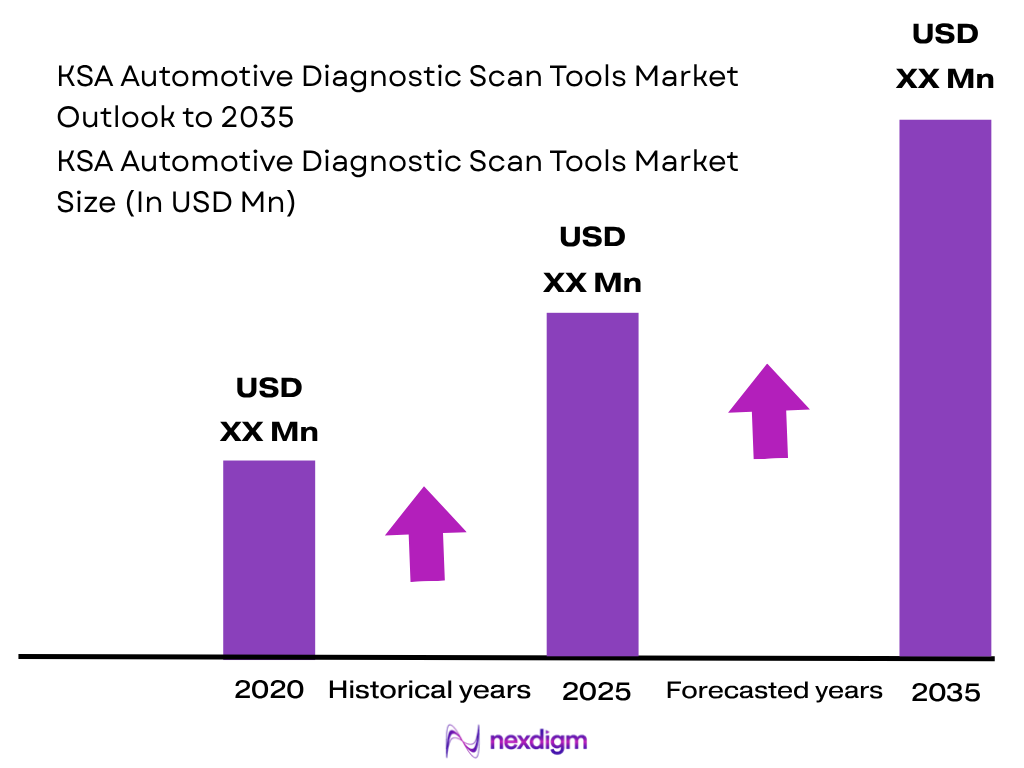
The KSA Automotive Diagnostic Scan Tools Market is valued at USD ~ billion, based on the historical market assessment, with demand supported by the Kingdom’s expanding vehicle base, increasing electronic-system complexity and recurring workshop requirements for fault identification and vehicle programming. GASTAT reported more than 15.8 million registered vehicles in operation at the end of 2024, while newly registered vehicles exceeded 1 million, creating a substantial installed base requiring periodic diagnostics, maintenance and electronic troubleshooting.
Riyadh, Jeddah and Dammam represent the principal automotive service and diagnostic-equipment centers because of their concentration of vehicle owners, dealerships, independent workshops, commercial fleets and automotive-equipment distributors. GASTAT reported more than 15.8 million vehicles in operation nationally, while the Transport General Authority recorded more than 1 million registered transport vehicles through its operating-card system, indicating substantial requirements for commercial-vehicle inspection and maintenance. Bosch’s Saudi distributor network, for example, has established distributor locations in Riyadh, Jeddah and Dammam.
Market Segmentation
By Diagnostic Tool Type
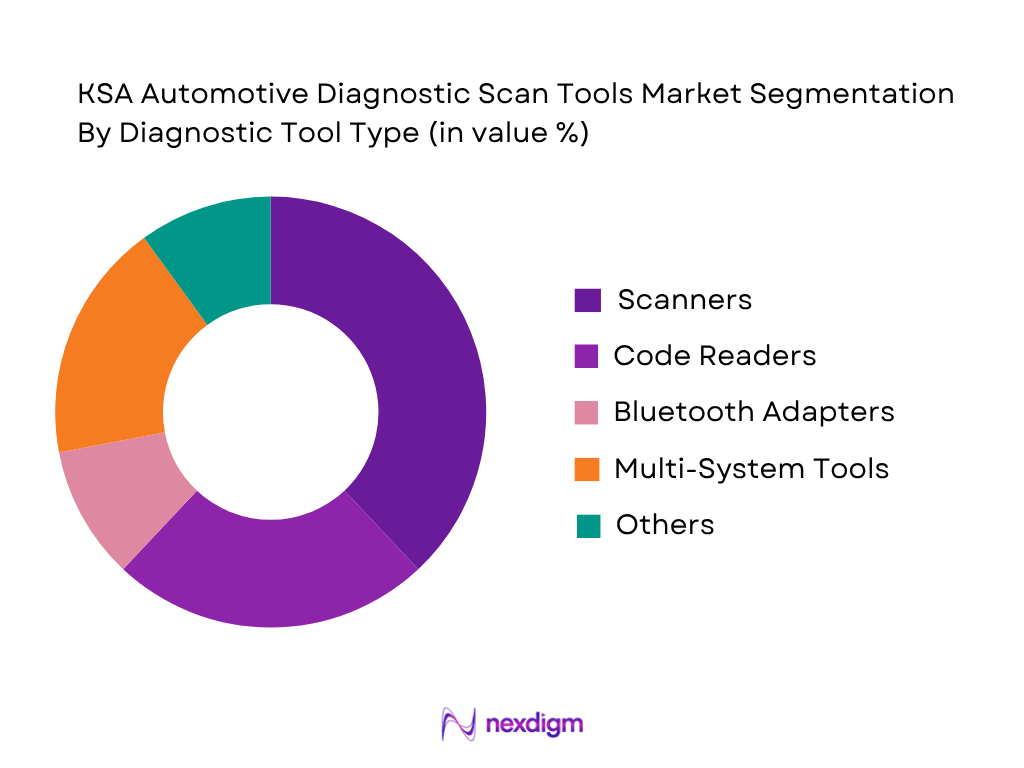
The KSA Automotive Diagnostic Scan Tools Market is segmented by diagnostic tool type into professional multi-brand diagnostic scanners, OEM-specific diagnostic systems, OBD-II code readers, ECU coding and programming tools, heavy-duty diagnostic scanners, TPMS diagnostic tools, battery and electrical-system testers, ADAS diagnostic systems, and key-programming/immobilizer diagnostic tools. Professional multi-brand diagnostic scanners are expected to represent the dominant segment, supported by the structure of Saudi Arabia’s independent workshop ecosystem and the need to service multiple vehicle brands through a single diagnostic platform. These systems increasingly combine full-system scanning, live data, bi-directional controls, service resets, ECU coding and programming, topology mapping and advanced communication protocols. Their relevance is particularly strong where workshops handle Japanese, Korean, American, European and Chinese vehicle brands simultaneously. The emergence of EVs and vehicles equipped with ADAS is further shifting demand toward scanners capable of battery-management, high-voltage, charging, radar, camera and electronic-control-module diagnostics. Saudi distributors already market equipment spanning professional diagnostics, ECU programming, truck diagnostics, TPMS and ADAS solutions, reinforcing the breadth of functionality required by professional users.
By End User
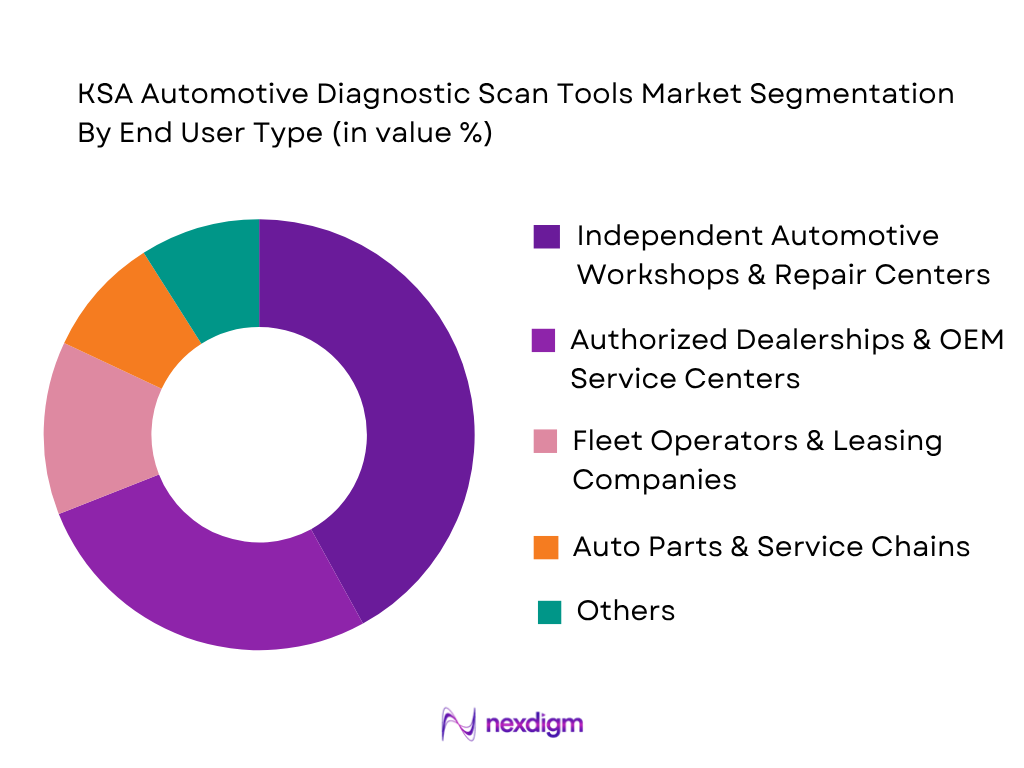
The KSA Automotive Diagnostic Scan Tools Market is segmented by end user into independent automotive workshops, authorized dealership service centers, premium and luxury vehicle workshops, automotive repair chains, commercial fleet maintenance facilities, vehicle rental and leasing companies, mobile diagnostic service providers, and vehicle inspection facilities. Independent automotive workshops are expected to maintain the leading position because they service a broad mix of vehicle brands and rely heavily on multi-brand diagnostic equipment to reduce dependence on manufacturer-specific service infrastructure. Their requirements increasingly extend beyond basic OBD fault-code reading toward ABS, SRS, transmission, body-control, immobilizer, ADAS and ECU functions. Dealerships remain strategically important because OEM-level systems provide deeper access to proprietary diagnostic functions and programming capabilities. Commercial fleets create another specialized demand pool, particularly for heavy-duty diagnostics, preventive maintenance and uptime management. Vehicle inspection facilities also represent a structurally important user group because Saudi Arabia operates a regulated periodic technical inspection framework, with SASO providing licensing and equipment requirements for inspection facilities. More than 30 periodic motor-vehicle inspection centers had received Saudi accreditation according to SAAC’s 2024 announcement.
Competitive Landscape
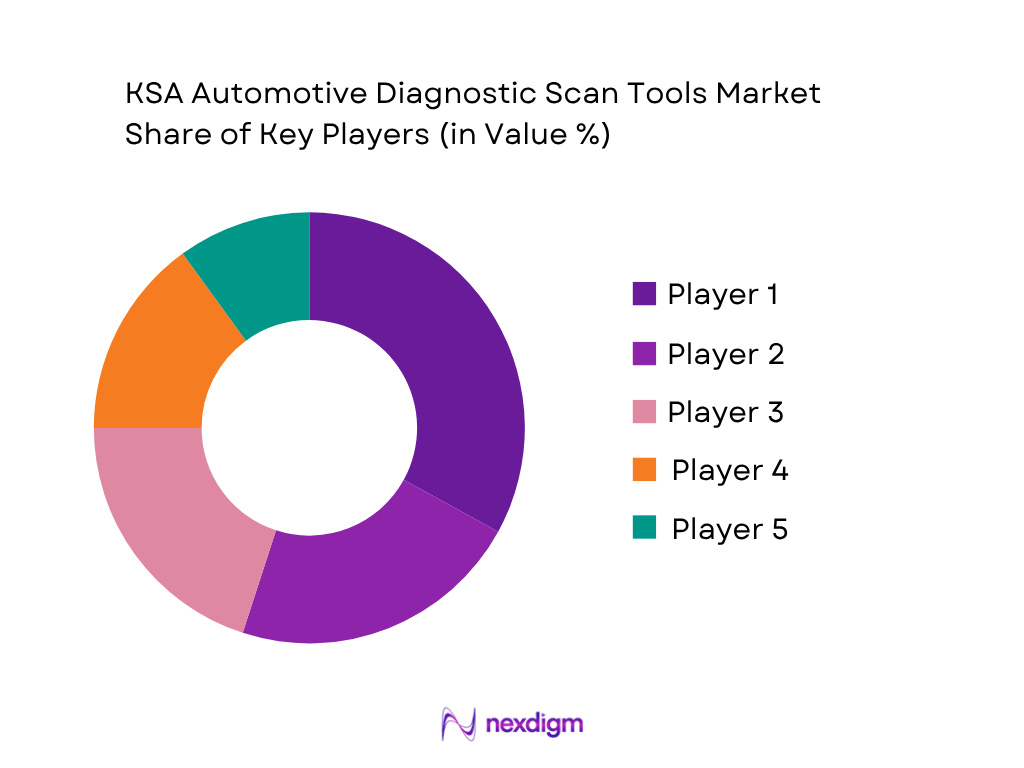
The KSA Automotive Diagnostic Scan Tools Market features a combination of global diagnostic-equipment manufacturers and specialized technology suppliers competing through vehicle coverage, diagnostic depth, ECU programming, EV capability, ADAS functionality, software updates and local technical support. Bosch, Snap-on, Autel, LAUNCH and TEXA represent important competitive benchmarks across professional workshop diagnostics. Local distribution capability is particularly significant because Saudi workshops require product availability, software support, training and after-sales service. Autel’s Saudi distribution infrastructure, for instance, provides professional diagnostic equipment, programming systems, ADAS solutions, training and technical support, while Bosch lists authorized distribution locations in Riyadh, Jeddah and Dammam.
| Company | Establishment Year | Headquarters | Core Diagnostic Focus | Key Product / Platform | Vehicle Coverage | EV / Hybrid Diagnostics | ADAS Capability |
| Robert Bosch GmbH | 1886 | Gerlingen, Germany | ~ | ~ | ~ | ~ | ~ |
| Snap-on Incorporated | 1920 | Kenosha, Wisconsin, USA | ~ | ~ | ~ | ~ | ~ |
| Autel Intelligent Technology Corp. | 2004 | Shenzhen, China | ~ | ~ | ~ | ~ | ~ |
| Launch Tech Co., Ltd. | 1992 | Shenzhen, China | ~ | ~ | ~ | ~ | ~ |
| Continental AG | 1871 | Hanover, Germany | ~ | ~ | ~ | ~ | ~ |
KSA Automotive Diagnostic Scan Tools Market Analysis
Growth Drivers
Rising Vehicle Parc
The expansion of Saudi Arabia’s vehicle parc is strengthening the recurring requirement for automotive diagnostic scan tools across independent workshops, dealership service centers, fleet operators and inspection facilities. The General Authority for Statistics reported more than 15.8 million registered and roadworthy vehicles in operation at the end of 2024, compared with 14.8 million in 2023, while newly issued vehicle registrations exceeded 1.0 million units in 2024 compared with 878,100 units in 2023. This expanding installed base creates a larger pool of vehicles requiring periodic electronic diagnostics, fault-code retrieval, ECU testing, ABS and airbag checks, battery analysis and preventive maintenance. The supporting economic environment also remained resilient: World Bank data records Saudi Arabia’s 2024 GDP at USD 1.24 trillion, while GDP per capita reached USD 35,121.7. IMF data indicates that non-oil real GDP expanded 4.2% in 2024, supported by private consumption and investment. These conditions support continued vehicle utilization and workshop activity, increasing the addressable installed base for diagnostic equipment. The growth of the vehicle parc therefore provides a structural demand foundation for scanners, code readers, bidirectional diagnostic systems and advanced programming platforms.
Increasing Electronic Content per Vehicle
Increasing electronic complexity is raising the diagnostic intensity of vehicles operating in Saudi Arabia, moving workshop requirements beyond basic fault-code reading toward multi-system scanning, live-data analysis, bidirectional testing, ECU coding and electronic-system verification. The Kingdom had more than 15.8 million vehicles in operation in 2024, creating a substantial installed base for electronically controlled powertrain, braking, safety, body-control and driver-assistance systems. Saudi Arabia’s digital environment also supports the transition toward software-enabled diagnostic workflows. The Communications, Space and Technology Commission reported 99% internet penetration and 99.4% mobile internet usage in 2024, while average mobile data consumption reached 48 GB per person per month. These figures indicate a highly connected operating environment suitable for cloud-connected diagnostic platforms, remote software updates and tablet-based workshop systems. The macroeconomic backdrop reinforces investment capacity: World Bank data places 2024 GDP at USD 1.24 trillion, while IMF data reports 4.2% non-oil real GDP growth. As vehicle electronics become more interconnected, workshops require diagnostic equipment capable of communicating with multiple ECUs and supporting increasingly sophisticated repair workflows. Consequently, the installed vehicle base and digital infrastructure jointly support greater adoption of advanced diagnostic technologies.
Market Challenges
High Cost of Advanced Diagnostic Systems
The high acquisition burden associated with advanced diagnostic systems can constrain adoption among smaller Saudi workshops, particularly where equipment must support multi-brand diagnostics, bidirectional controls, ECU programming, secure gateway access, ADAS functions and EV systems. The challenge is relevant because the Saudi aftermarket includes a large installed vehicle base requiring increasingly sophisticated equipment: GASTAT recorded 15.8 million registered and roadworthy vehicles in operation at the end of 2024 and more than 1.0 million newly issued vehicle registrations during the year. Advanced scanners therefore need to cover a broad and continuously changing vehicle population. The investment environment remains active, but capital allocation competes with workshop requirements for lifts, alignment equipment, air-conditioning equipment, spare parts and technician training. World Bank data shows Saudi Arabia generated USD 1.24 trillion of GDP in 2024, while IMF data records 4.2% non-oil real GDP growth, demonstrating overall economic capacity but not eliminating equipment-level investment constraints for individual workshops. Inflation remained relatively contained at 1.7% according to World Bank data, yet sophisticated diagnostic platforms still require expenditure on hardware, subscriptions, software updates and brand-specific access. The result is a market in which premium systems can deliver greater functionality but may face slower penetration among price-sensitive independent repair operators.
Technician Skill Requirements
The increasing sophistication of Saudi vehicle electronics creates a skills constraint because modern diagnostic equipment requires technicians capable of interpreting live parameters, conducting bidirectional tests, distinguishing communication faults from component faults and executing ECU programming safely. The scale of the vehicle base intensifies this requirement: GASTAT recorded 17,231 serious traffic accidents in 2024 and 24,077 injuries, while more than 15.8 million registered and roadworthy vehicles were operating across the Kingdom. This creates continuous demand for accurate troubleshooting and repair rather than simple mechanical replacement. Digitalization further changes technician workflows. CST reported 99% internet penetration in Saudi Arabia in 2024 and average mobile data consumption of 48 GB per person per month, creating an environment where connected diagnostic platforms and cloud-based technical information can be integrated into workshop operations. However, connectivity does not automatically translate into diagnostic competence. Technicians need knowledge of vehicle communication protocols, sensor interpretation, electrical testing, high-voltage safety and manufacturer-specific procedures. IMF data shows 4.2% non-oil real GDP growth in 2024, supporting broader economic activity and investment, but workshops still face the operational challenge of converting sophisticated equipment into accurate repairs. The resulting skills gap can slow adoption of advanced scan tools and increase dependence on experienced diagnostic specialists.
Market Opportunities
AI-Assisted Diagnostics
AI-assisted diagnostics present an opportunity to improve the efficiency and accuracy of vehicle troubleshooting by combining diagnostic trouble codes, live sensor data, historical repair information and guided diagnostic workflows. Saudi Arabia provides a strong digital foundation for such systems. The Communications, Space and Technology Commission reported 99% internet penetration in 2024, 99.4% mobile internet usage, and 48 GB of average monthly mobile data consumption per person, supporting connected diagnostic applications and cloud-based processing. CST also reported that 21.5% of internet users used different types of AI tools, demonstrating existing exposure to AI-enabled digital services. These conditions can support scan tools that automatically interpret fault combinations, prioritize probable causes, generate guided testing sequences and provide technicians with contextual repair information. The opportunity is particularly relevant to the Kingdom’s 15.8 million registered and roadworthy vehicles, because broader vehicle coverage increases the potential volume of diagnostic events that can generate useful data for algorithmic analysis. World Bank data records Saudi Arabia’s USD 1.24 trillion GDP in 2024, while IMF data reports 4.2% non-oil real GDP growth, indicating an economy with substantial digital-investment capacity. AI therefore offers a pathway for diagnostic suppliers to differentiate products through software intelligence rather than hardware alone, particularly across multi-brand independent workshops and increasingly connected dealership service operations.
EV Battery Diagnostics
EV battery diagnostics represent a strategic opportunity as Saudi Arabia’s automotive ecosystem progressively incorporates electrified vehicles and requires specialized equipment for battery health assessment, cell-level fault identification, thermal-system monitoring, isolation testing and high-voltage system diagnostics. The opportunity is supported by the Kingdom’s broader economic diversification and digital infrastructure. IMF data reports 4.2% growth in non-oil real GDP in 2024, while World Bank data records GDP of USD 1.24 trillion and GDP per capita of USD 35,121.7. Saudi Arabia also had more than 15.8 million registered and roadworthy vehicles in operation at the end of 2024, establishing a large automotive service ecosystem into which EV diagnostic capabilities can progressively be integrated. Digital connectivity provides an additional enabler: CST recorded 99% internet penetration, 99.4% mobile internet usage, and 48 GB monthly mobile data consumption per person in 2024. These conditions favor diagnostic platforms that combine vehicle communication with cloud-based battery databases, software updates and remote technical support. EV battery diagnostics can therefore become an important extension of conventional scan-tool functionality, allowing suppliers and workshops to move from basic fault-code retrieval toward battery state-of-health analysis, thermal management diagnostics and high-voltage maintenance. This creates opportunities for specialized EV modules, battery analyzers and software-enabled diagnostic subscriptions within the Saudi aftermarket.
Future Outlook
The KSA Automotive Diagnostic Scan Tools Market is expected to evolve from conventional OBD-based fault identification toward comprehensive electronic vehicle diagnostics. Growth will be supported by increasing ECU complexity, expansion of connected vehicles, rising adoption of EVs and hybrids, greater ADAS penetration and the increasing need for software-enabled repair functions.
Professional workshops are likely to prioritize scanners with ECU programming, secure-gateway access, topology mapping, bi-directional controls and cloud-based software updates. EV adoption should create additional demand for battery-management-system diagnostics, high-voltage safety functions, charging-system diagnostics and state-of-health assessment. ADAS calibration is expected to become increasingly integrated with diagnostic workflows, particularly as workshops service vehicles equipped with cameras, radar and electronic driver-assistance systems. Meanwhile, commercial fleets should drive demand for heavy-duty diagnostic platforms linked with preventive maintenance and uptime management.
Major Players
- Robert Bosch GmbH
- Snap-on Incorporated
- Autel Intelligent Technology Corp.
- LAUNCH Tech Co., Ltd.
- TEXA S.p.A.
- HELLA GUTMANN SOLUTIONS
- PHINIA Inc.
- ACTIA Group
- TOPDON
- THINKCAR Tech
- OBDSTAR Technology Co., Ltd.
- FCAR Technology
- XTOOL
- ANCEL
- Innova Electronics Corporation
Key Target Audience
- Automotive OEMs and Authorized Dealership Networks
- Independent Automotive Workshop Chains and Service Centers
- Commercial Fleet Operators and Fleet Maintenance Companies
- Automotive Diagnostic Equipment Distributors and Dealers
- Automotive Equipment Importers and Aftermarket Parts Distributors
- Investments and Venture Capitalist Firms (Automotive Technology, Mobility and Aftermarket Investments)
- Government and Regulatory Bodies (Saudi Standards, Metrology and Quality Organization, Transport General Authority, Saudi Accreditation Center)
- Vehicle Inspection and Testing Facility Operators
Research Methodology
Step 1: Identification of Key Variables
The initial phase involves mapping the KSA Automotive Diagnostic Scan Tools ecosystem across diagnostic-equipment manufacturers, distributors, dealerships, independent workshops, fleet operators and inspection facilities. The assessment identifies variables including vehicle parc, diagnostic-equipment penetration, vehicle electronics complexity, ECU programming requirements, EV adoption, ADAS penetration and workshop digitalization.
Step 2: Market Analysis and Construction
Historical market information is consolidated using vehicle-registration statistics, automotive aftermarket indicators, workshop infrastructure, equipment-distribution channels and manufacturer-level product information. The bottom-up model evaluates diagnostic-equipment deployment across workshops, dealerships, fleet facilities and inspection centers, while the top-down model benchmarks the market against the broader automotive aftermarket and vehicle-service ecosystem.
Step 3: Hypothesis Validation and Expert Consultation
Market hypotheses are tested through interviews with automotive workshop operators, diagnostic-equipment distributors, dealership service managers, fleet-maintenance professionals and vehicle-inspection stakeholders. Discussions focus on diagnostic-tool adoption, vehicle-brand coverage, software subscriptions, ECU programming, ADAS calibration, EV diagnostics, replacement cycles and purchasing criteria.
Step 4: Research Synthesis and Final Output
The final stage triangulates equipment-level demand with vehicle-parc dynamics, workshop requirements, distributor intelligence and technology adoption. Market estimates are reconciled across diagnostic tool types and end-user categories, followed by competitive benchmarking of product capabilities, vehicle coverage, software ecosystems, local support and distribution strength.

- Executive Summary
- Research Methodology (Market Definition and Scope, Diagnostic Scan Tool Ecosystem Mapping, Top-Down Market Sizing, Bottom-Up Market Construction, Vehicle-Parc Analysis, Workshop-Level Assessment, Import and Distribution Analysis, Demand-Side Assessment, Supply-Side Assessment, Primary Industry Interviews, Distributor Validation, Workshop Interviews, Data Triangulation, Forecasting Framework, Assumptions and Limitations)

- Definition and Scope
- KSA Automotive Diagnostic Ecosystem
- Evolution of Automotive Diagnostics in Saudi Arabia
- Automotive Diagnostic Value Chain
- Automotive Aftermarket Structure

- Growth Drivers (Rising Vehicle Parc, Increasing Electronic Content per Vehicle, Luxury Vehicle Penetration, Workshop Digitalization, Commercial Fleet Expansion, EV and Hybrid Diagnostics)
- Market Challenges (High Cost of Advanced Diagnostic Systems, Technician Skill Requirements, Software Subscription Dependency, Grey-Market Equipment, Multi-Brand Compatibility Constraints, Secure Gateway Restrictions)
- Market Opportunities (AI-Assisted Diagnostics, EV Battery Diagnostics, ADAS Calibration, Cloud-Based Diagnostics, ECU Programming, Fleet Diagnostics, Remote Vehicle Diagnostics)
- Market Trends (Wireless Scanning, Cloud-Connected Diagnostics, AI Fault Detection, Remote Diagnostics, Secure Gateway Diagnostics, EV Battery Health Testing, Integrated ADAS Calibration)
- Regulatory and Standards Environment (SASO Requirements, Periodic Technical Inspection Regulations, Vehicle Safety Requirements, Roadworthiness Standards, Emissions Testing, Equipment Compliance)
- Porter’s Five Forces Analysis
- PESTLE Analysis
- SWOT Analysis

- By Market Value (2020-2025)
- By Unit Volume (2020-2025)
- By Installed Diagnostic Equipment Base (2020-2025)
- By Professional Diagnostic Equipment (2020-2025)
- By Consumer Diagnostic Equipment (2020-2025)
- By Replacement and Upgrade Demand (2020-2025)
- By New Workshop Equipment Demand (2020-2025)

- By Diagnostic Tool Type (In Value %)
Professional Multi-Brand Diagnostic Scanners
OEM-Specific Diagnostic Systems
OBD-II Code Readers
ECU Coding and Programming Tools
Heavy-Duty Vehicle Diagnostic Scanners
TPMS Diagnostic and Programming Tools
Battery and Electrical System Testers
ADAS Diagnostic and Calibration Systems
Key Programming and Immobilizer Diagnostic Tools - By Vehicle Type (In Value %)
Passenger Cars
Luxury and Premium Cars
Light Commercial Vehicles
Heavy Commercial Vehicles
Buses and Coaches
Hybrid Electric Vehicles
Battery Electric Vehicles - By Diagnostic Function (In Value %)
Engine and Powertrain Diagnostics
Transmission Diagnostics
ABS and Brake Diagnostics
Airbag and SRS Diagnostics
Body Control Module Diagnostics
ECU Coding and Programming
Battery and Charging-System Diagnostics
ADAS Diagnostics and Calibration
TPMS Diagnostics
CAN-Bus and Vehicle Network Diagnostics - By Connectivity Technology (In Value %)
Wired Diagnostic Interfaces
Bluetooth Diagnostic Interfaces
Wi-Fi Diagnostic Interfaces
USB Diagnostic Interfaces
Cloud-Connected Diagnostic Systems
Pass-Thru Diagnostic Interfaces - By End User (In Value %)
Independent Automotive Workshops
Authorized Dealership Service Centers
Premium and Luxury Vehicle Workshops
Automotive Repair Chains
Commercial Fleet Maintenance Facilities
Vehicle Rental and Leasing Companies
Mobile Diagnostic Service Providers
Vehicle Inspection and Testing Facilities - By Sales Channel (In Value %)
Authorized Distributors
Automotive Equipment Dealers
Specialized Diagnostic Equipment Retailers
Online Automotive Equipment Platforms
Direct Manufacturer Sales
OEM and Dealer Procurement

- Market Share Analysis of Major Players (By Value, Unit Volume, Diagnostic Tool Type, Vehicle Type, Diagnostic Function, End User, Sales Channel)
- Cross Comparison Parameters (Multi-Brand Vehicle Coverage, ECU Coding and Programming Capability, EV and Hybrid Diagnostic Capability, ADAS Calibration Support, Heavy-Duty Vehicle Coverage, Secure Gateway and OEM-Level Access, Cloud and Wireless Connectivity, KSA Distribution and Technical Support Network)
- Competitive Pricing Positioning (Entry-Level Scanners, Professional Systems, OEM-Level Platforms, ECU Programming Systems, ADAS Equipment)
- SWOT Analysis of Major Players
- Detailed Profiles of Major Companies
Robert Bosch GmbH
Snap-on Incorporated
Autel Intelligent Technology Corp.
LAUNCH Tech Co., Ltd.
TOPDON
THINKCAR Tech
OBDSTAR Technology Co., Ltd.
TEXA S.p.A.
HELLA GUTMANN SOLUTIONS
PHINIA Inc.
ACTIA Group
FCAR Technology
XTOOL
ANCEL
Innova Electronics Corporation

- Independent Workshop Diagnostic Requirements
- Authorized Dealership Diagnostic Requirements
- Luxury Vehicle Workshop Requirements
- Fleet Operator Diagnostic Requirements
- EV Workshop Requirements
- Vehicle Inspection Facility Requirements
- Technician Capability Assessment
- Diagnostic Equipment Purchasing Criteria
- Diagnostic Equipment Replacement Cycle

- By Market Value (2026-2035)
- By Unit Volume (2026-2035)
- By Installed Diagnostic Equipment Base (2026-2035)
- By Professional Diagnostic Equipment (2026-2035)
- By Consumer Diagnostic Equipment (2026-2035)
- By Replacement and Upgrade Demand (2026-2035)
- By New Workshop Equipment Demand (2026-2035)


 Request a Sample
 Ask for Customization
 Get a Quote
 Enquire Now