

 Download PDF
Market Overview
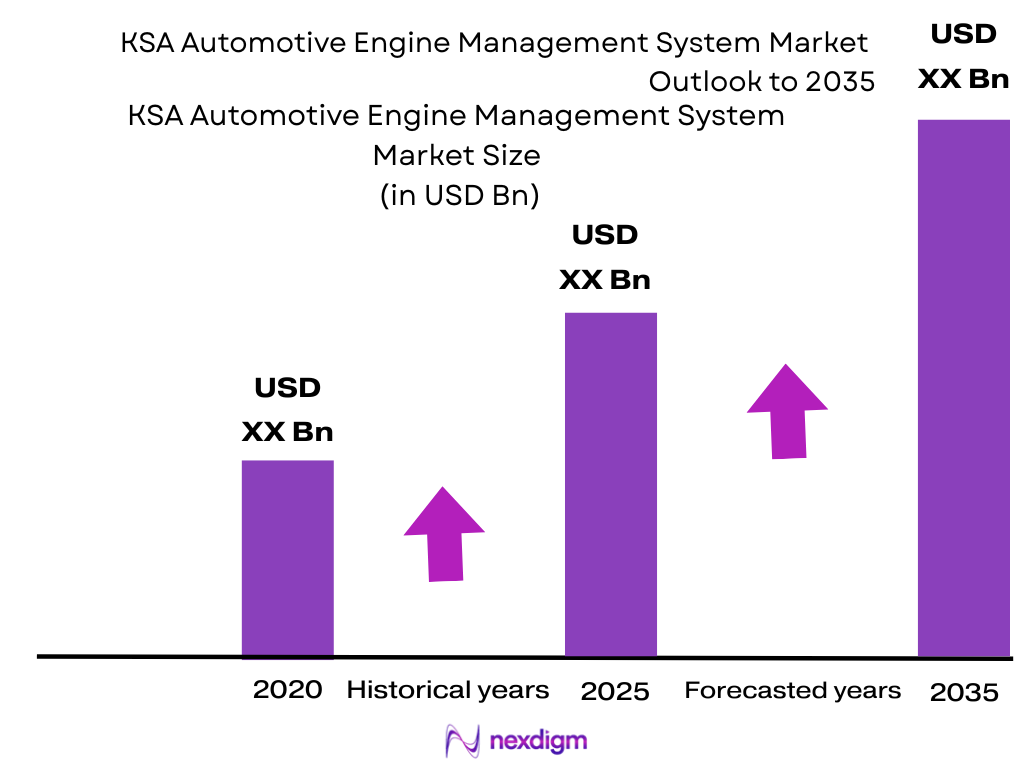
The KSA Automotive Engine Management System Market is valued at ~ billion under the requested placeholder framework. Demand is supported by a large installed vehicle base, extensive intercity road mobility, SUVs, pickups and commercial fleets. Saudi Arabia had approximately 35.3 million residents in the latest relevant population base, while updated nominal GDP for the preceding annual reading reached approximately SAR 4.5 trillion, providing substantial capacity for vehicle ownership and aftermarket expenditure. Riyadh, Jeddah-Makkah, Dammam-Khobar and King Abdullah Economic City dominate KSA Automotive Engine Management System activity because they concentrate passenger vehicles, corporate fleets, logistics operations, industrial transport, workshops and automotive distribution. Riyadh and Jeddah host extensive aftermarket service networks, while Dammam serves industrial and diesel fleets. KAEC is emerging as the manufacturing nucleus through the King Salman Automotive Cluster incorporating Lucid, Ceer and Hyundai-linked activities.
Market Segmentation
By Component Type
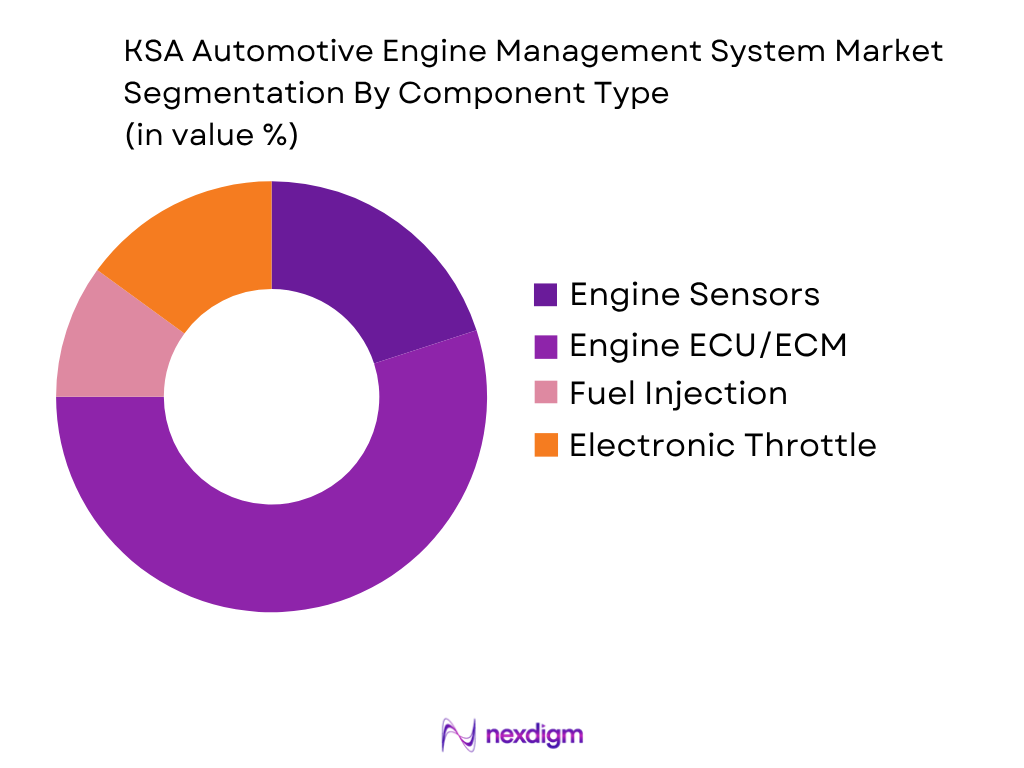
The KSA Automotive Engine Management System Market is segmented into engine control units and powertrain control modules, engine and exhaust sensors, fuel-injection components, ignition-management components, and electronic throttle and other actuators. Engine control units and powertrain control modules represent the dominant value segment because they provide the central computing architecture linking injection timing, ignition, throttle control, turbocharger boost, emissions functions and onboard diagnostics. Saudi Arabia’s high concentration of SUVs, pickups, turbo-petrol vehicles and electronically controlled diesel commercial vehicles further raises ECU complexity. Sensors constitute the next major pool because modern combustion systems rely on oxygen, MAP, MAF, fuel-pressure, crankshaft, camshaft, knock and temperature measurements. Saudi CAFE requirements also reinforce the importance of accurate air-fuel and combustion control because incoming light-duty vehicles must comply with fuel-economy performance requirements.
By Powertrain Type
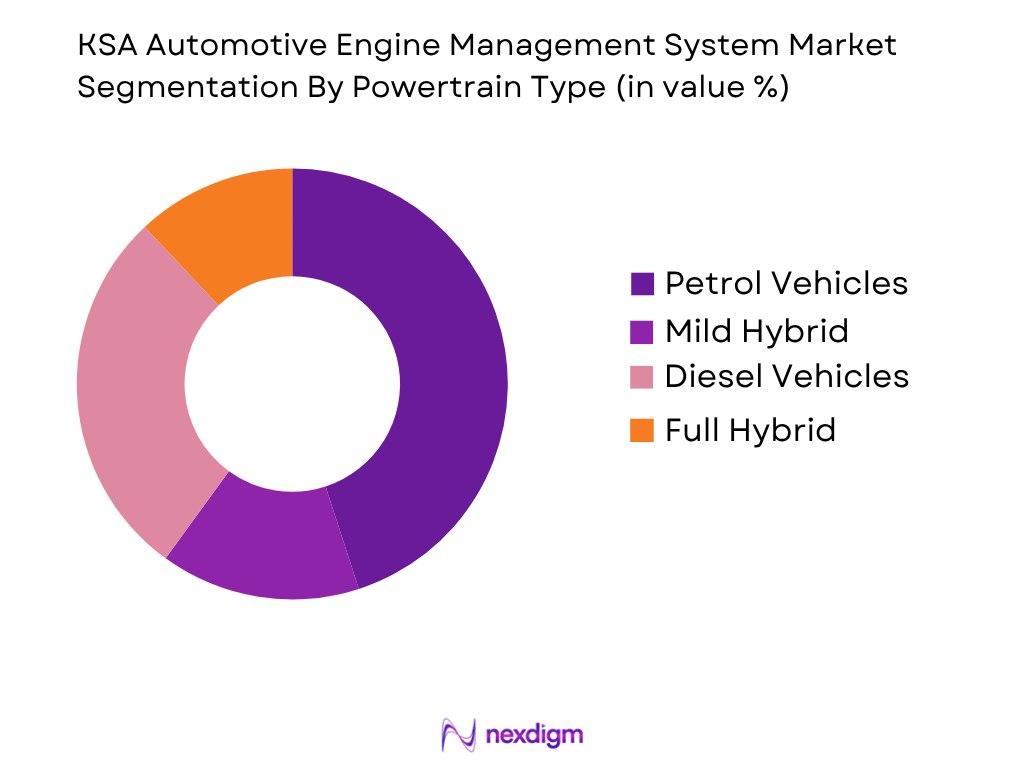
The KSA Automotive Engine Management System Market is segmented into conventional petrol, conventional diesel, mild hybrid, full hybrid, plug-in hybrid and other combustion-assisted architectures. Conventional petrol dominates current EMS demand, reflecting widespread use of gasoline-powered sedans, SUVs, crossovers and large utility vehicles. These platforms require ignition control, electronic throttle management, oxygen sensing, knock detection, variable valve timing and increasingly high-pressure direct-injection control. Diesel has a smaller passenger-vehicle presence but remains strategically important across trucks, buses, pickups, construction fleets and industrial applications, where common-rail injection, EGR, DPF and SCR management raise electronic content. Hybrid systems remain smaller but are becoming more important because they preserve most combustion-engine electronics while adding engine-motor coordination, start-stop logic, torque arbitration and additional thermal-management software.
Competitive Landscape
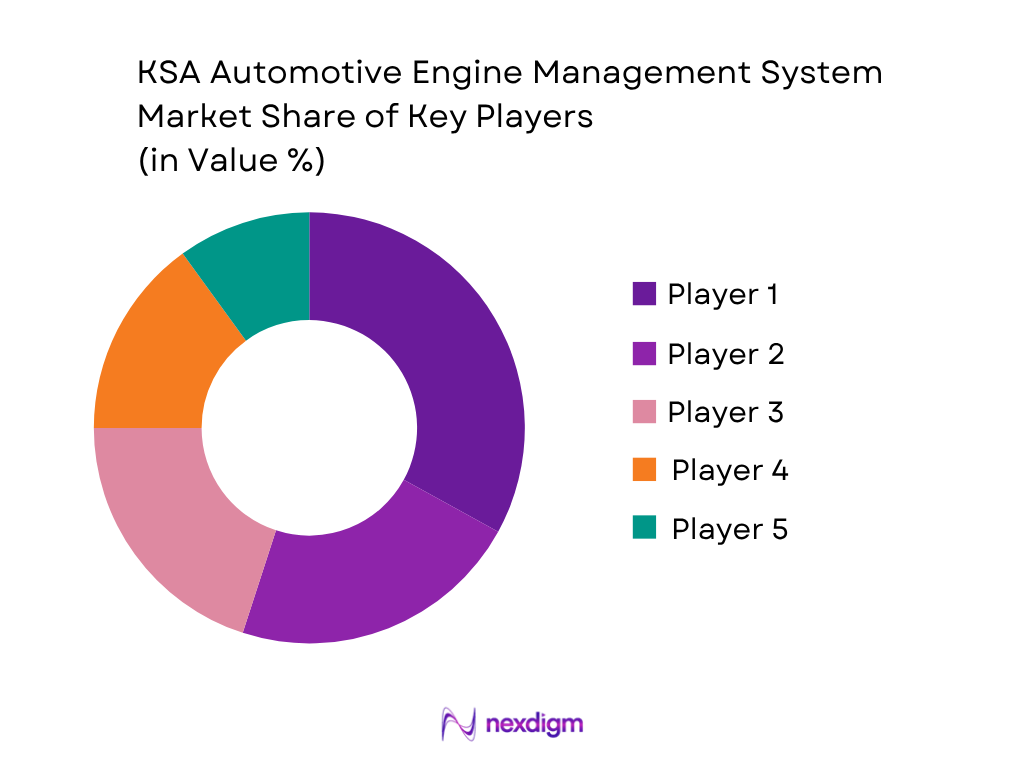
The KSA Automotive Engine Management System Market is led by international Tier-1 automotive technology companies supplying Saudi vehicles through OEM fitment, authorized distributors, dealership networks and independent aftermarket channels. Bosch and DENSO have particularly broad capabilities spanning gasoline and diesel control, sensors, injection and diagnostics. DENSO officially identifies gasoline and diesel engine-management systems, exhaust-gas sensors and powertrain ECUs among its core products, while Bosch operates an established Saudi diesel workshop ecosystem covering Riyadh, Jeddah, Dammam and other cities.
| Major Player | Establishment Year | Headquarters | ECU / Controller Capability | Engine Sensor Portfolio | Fuel-Injection Capability | Diesel EMS Capability | Hybrid / Electrified Powertrain Capability | KSA Market Relevance |
| Robert Bosch GmbH | 1886 | Germany | ~ | ~ | ~ | ~ | ~ | ~ |
| DENSO Corporation | 1949 | Kariya, Japan | ~ | ~ | ~ | ~ | ~ | ~ |
| BorgWarner Inc. | 1928 | USA | ~ | ~ | ~ | ~ | ~ | ~ |
| Valeo | 1923 | France | ~ | ~ | ~ | ~ | ~ | ~ |
| PHINIA / Delphi | 2023 as PHINIA | Auburn Hills, USA | ~ | ~ | ~ | ~ | ~ | ~ |
KSA Automotive Engine Management System Market Analysis
Growth Drivers
Large Installed Vehicle Parc and Rising New Registrations
Saudi Arabia’s large road-vehicle base creates a substantial recurring requirement for engine control units, fuel-injection electronics, ignition modules, oxygen sensors, crankshaft and camshaft sensors, throttle bodies and diesel-management components. GASTAT reported more than 15.8 million registered vehicles in operation at the end of 2024, while more than 1 million vehicles received new registrations during 2024. These figures directly enlarge both OEM-linked and replacement demand for engine-management systems because every new petrol, diesel or hybrid combustion platform requires electronic engine control, while the installed parc generates ongoing sensor, injector and ECU servicing requirements. Saudi Arabia also had 35.3 million residents in 2024, according to the IMF, creating a sizeable consumer and commercial mobility base. Large SUVs, pickups and commercial vehicles are particularly important because these applications generally use more demanding cooling, ignition, injection and torque-management strategies than entry-level passenger cars. High annual road utilization additionally increases operating hours for oxygen sensors, ignition coils, rail-pressure sensors and electronic throttle components. The Saudi aftermarket therefore benefits not only from additions to the fleet but also from the maintenance requirements of millions of existing combustion vehicles. As turbocharging, direct injection and electronically controlled diesel systems become more common, replacement demand increasingly moves from basic mechanical parts toward electronically coded components requiring scan tools and software-assisted diagnosis. This provides a durable demand foundation for global Tier-1 suppliers, authorized distributors, independent workshops and diesel specialists.
Fuel-Economy Compliance and Increasing Electronic Powertrain Sophistication
Saudi fuel-economy requirements are strengthening the technical importance of accurate electronic engine management. SASO maintains fuel-economy labeling and compliance procedures for imported and locally supplied vehicles and publishes annual manufacturer performance reports, including reports covering 2024 and 2025, while its current compliance system also lists manufacturer supply-plan requirements through 2026. These requirements matter directly to the KSA Automotive Engine Management System Market because achieving better fuel use requires precise control of injection quantity, ignition timing, electronic throttle position, variable valve timing, turbocharger boost and air-fuel ratio. The macroeconomic environment provides a substantial base for adoption of electronically sophisticated vehicles: the IMF recorded 35.3 million residents in 2024, while Saudi Arabia’s monetary authorities held approximately USD 423.7 billion in net foreign assets in April 2024, supporting economic and import capacity. Increasingly sophisticated gasoline engines require wideband lambda sensors, knock sensors, pressure sensors and high-speed ECUs; diesel applications add common-rail pressure regulation, EGR management, DPF regeneration and SCR coordination. Saudi operating conditions further increase electronic-control requirements because high ambient temperatures affect intake-air density, knock probability, coolant temperature and fuel-vapor behavior. Engine-control software must continually compensate for these conditions while maintaining drivability and emissions compliance. Consequently, regulation does not simply create a paperwork requirement for OEMs. It raises the value of calibration software, engine sensing and electronically actuated subsystems. Suppliers with integrated ECU, sensor, fuel-system and diagnostic portfolios are therefore better positioned than companies limited to standalone mechanical engine parts.
Market Challenges
Dependence on Imported High-Value Electronics and Multi-Brand Vehicle Platforms
A major challenge for the KSA Automotive Engine Management System Market is its dependence on imported vehicle platforms and advanced powertrain electronics. Saudi Arabia had more than 15.8 million registered vehicles operating at the end of 2024, and more than 1 million newly registered vehicles were added during the same annual period, creating enormous application diversity across Japanese, Korean, American, European and Chinese brands. This diversity raises inventory and technical complexity because each vehicle family may use different ECU hardware, oxygen-sensor characteristics, fuel-pressure ranges, injector specifications, immobilizer protocols and diagnostic software. Saudi Arabia’s macroeconomic scale allows substantial automotive imports, with the IMF reporting a population of 35.3 million in 2024 and the Saudi Central Bank holding USD 423.7 billion in net foreign assets in April 2024. However, strong import capacity does not eliminate supply-chain exposure. Engine ECUs depend on automotive-grade microcontrollers, power semiconductors, memory devices and highly calibrated sensors that cannot always be substituted between platforms. An incorrect crankshaft, MAP or lambda sensor can generate faulty engine behavior even if mechanically compatible, while replacement ECUs may require coding, immobilizer matching and software flashing. The challenge extends to independent workshops, which need increasingly expensive multi-brand diagnostic capability and technicians trained in electrical troubleshooting rather than purely mechanical repair. Parallel-import vehicles can further complicate parts identification where GCC-specification vehicles differ from overseas variants. Consequently, Saudi aftermarket competitiveness increasingly depends on VIN-level parts identification, ECU programming support, technical databases and reliable distributor inventories rather than simple access to generic replacement parts.
Harsh Climate and High Thermal Stress on Engine Electronics
Saudi Arabia’s operating environment places unusually demanding thermal and durability requirements on engine-management hardware. The challenge is particularly relevant across SUVs, pickups, commercial fleets, construction vehicles and long-distance transport applications because prolonged high engine-bay temperatures accelerate stress on ECUs, ignition coils, electronic throttle bodies, oxygen sensors, fuel-pressure sensors and wiring interfaces. GASTAT reported a national installed base exceeding 15.8 million operating vehicles in 2024, meaning even relatively low component-failure rates can translate into a large replacement requirement. The broader economy also supports intensive commercial mobility: the IMF recorded 35.3 million residents in 2024, while non-oil activity remained a central economic engine through 2025 and 2026 as the Kingdom continued diversification. High ambient temperatures affect intake-air density, coolant temperature, oil temperature, battery voltage, fuel vaporization and knock behavior, forcing ECUs to continuously adapt fuel and ignition strategies. Turbocharged engines face additional stress because compressed intake air and exhaust-driven turbochargers create higher thermal loads, while diesel aftertreatment introduces extremely hot exhaust components near temperature-sensitive electronics. Dust exposure adds another reliability issue for connectors, air-flow measurement and sensor housings. These conditions raise product-validation requirements for EMS suppliers because components designed for mild climates may experience shorter service life under Saudi duty cycles. Fleet operators also face greater downtime risk when electronically controlled components fail, particularly on trucks and commercial vehicles operating far from major service centers. The result is a market in which thermal durability, sealing, connector quality and diagnostic accuracy become competitive differentiators. Suppliers that can demonstrate GCC-specific validation, high-temperature sensor performance and reliable replacement availability have a stronger position than low-cost generic component vendors.
Market Opportunities
Localization of Engine Electronics within the Saudi Automotive Manufacturing Ecosystem
Saudi Arabia’s emerging automotive manufacturing ecosystem creates a forward opportunity to localize selected engine-management components, embedded software and electronic assembly capabilities. In 2025, PIF formally announced the King Salman Automotive Cluster at King Abdullah Economic City, bringing together automotive manufacturing and supply-chain activity involving Ceer, Lucid and Hyundai. The Hyundai-PIF joint venture broke ground on its Saudi manufacturing facility in May 2025, with the project structured to manufacture both internal-combustion and electric vehicles, directly creating a potential local customer base for automotive electronics, sensors, control modules and validation services. Current macroeconomic fundamentals support such industrial development: the IMF recorded 35.3 million residents in 2024, while its 2025 Article IV assessment highlighted continued expansion of non-oil activity. For the KSA Automotive Engine Management System Market, localization does not initially require domestic production of every ECU semiconductor. Practical entry points include PCB assembly, engine wiring interfaces, oxygen and temperature sensor packaging, ECU housings, electronic throttle subassemblies, software calibration and diagnostic engineering. Local testing laboratories can also validate components against Saudi temperature, dust and vibration conditions. Over time, localized embedded software and calibration may become particularly valuable because these activities require engineering knowledge rather than large semiconductor fabrication facilities. Saudi manufacturing can also create demand for local Tier-1 technical support, quality inspection, traceability and end-of-line ECU programming. The opportunity therefore extends beyond replacing imports. A localized supplier ecosystem can shorten lead times, improve application engineering and potentially support regional GCC exports. For investors and component manufacturers, the strongest opportunities lie where Saudi industrial policy intersects with high-value electronic content: smart sensors, ECU assembly, validation, calibration software and diagnostics.
Hybrid Powertrain Controls, Advanced Diagnostics and Software-Led EMS Services
Hybridization and software-intensive servicing offer another important growth avenue for the KSA Automotive Engine Management System Market. Hybrid vehicles preserve most combustion-engine electronics—engine ECUs, injectors, ignition systems, oxygen sensors, crankshaft and camshaft sensors and electronic throttle control—while adding supervisory logic for motor-engine torque coordination, rapid engine restart, thermal management and battery interaction. This makes hybrid powertrains particularly attractive to traditional EMS suppliers because they increase control complexity without eliminating engine-management content. Saudi Arabia already had more than 15.8 million operating vehicles at the end of 2024, including a very large legacy combustion fleet that will continue requiring diagnostics and replacement parts alongside newer hybrid platforms. The IMF recorded a population of 35.3 million in 2024, while Saudi economic diversification continued to support mobility, logistics and industrial activity through 2025 and 2026. Software creates a second opportunity because modern engine faults increasingly require electronic diagnosis, coding and reprogramming rather than mechanical inspection alone. Replacement ECUs may require immobilizer synchronization; throttle bodies can require relearning; injectors may require coding; and adaptive fuel strategies can depend on ECU resets or software updates. Hybrid systems add further complexity because technicians must interpret interactions among engine, transmission, battery and motor controllers. The large Saudi parc therefore supports demand for advanced scan tools, ECU repair and remanufacturing, programming equipment and technical training. Over time, predictive diagnostics can use engine fault codes, sensor deviations and operating histories to identify failures before they immobilize fleet vehicles. Suppliers combining hardware with software, calibration databases and workshop training can capture more value than component-only vendors.
Future Outlook
The KSA Automotive Engine Management System Market is projected to register a ~ CAGR during 2026–2035 under the requested placeholder framework. Future expansion will increasingly depend on higher electronics content per combustion or hybrid vehicle rather than conventional vehicle volumes alone. Turbocharged petrol engines, gasoline direct injection, stricter fuel-economy control, smart sensors, commercial diesel systems and hybrid supervisory controls should increase system sophistication. Saudi Arabia’s broader economic and industrial transformation supports this evolution. GASTAT reported updated GDP of approximately SAR 4.5 trillion for the revised national-account base, while the IMF recorded a population of 35.3 million in its relevant economic assessment. Non-oil activity has also remained a central driver of economic diversification, strengthening transport, logistics, manufacturing and automotive-service demand. Localization will increasingly differentiate Saudi Arabia from purely import-led automotive markets. The King Salman Automotive Cluster has been positioned by PIF as a manufacturing and R&D ecosystem hosting or supporting companies including Ceer, Lucid and Hyundai. This creates a potential pathway for local ECU assembly, sensor production, wiring electronics, calibration engineering, testing services and Tier-1 supplier localization.
Major Players
- Robert Bosch GmbH / Bosch Saudi Arabia
- DENSO Corporation
- AUMOVIO
- BorgWarner Inc.
- Valeo
- PHINIA Inc. / Delphi
- FORVIA HELLA
- Marelli
- Astemo Ltd.
- Schaeffler Group
- Mitsubishi Electric Automotive
- AISIN Corporation
- Hyundai Mobis
- Niterra Co., Ltd.
- Standard Motor Products / Intermotor
Key Target Audience
- Automotive OEMs and Local Vehicle Assemblers
- Engine ECU, Sensor and Fuel-Injection Component Manufacturers
- Automotive Tier-1 and Tier-2 Component Suppliers
- Automotive Parts Importers, Distributors and Aftermarket Networks
- Commercial Fleet, Logistics and Vehicle Maintenance Operators
- Investments and Venture Capitalist Firms
- Automotive Semiconductor, Embedded Software and Diagnostic Technology Companies
- Government and Regulatory Bodies (Saudi Standards, Metrology and Quality Organization; Ministry of Industry and Mineral Resources; Ministry of Transport and Logistic Services; Saudi Energy Efficiency Center)
Research Methodology
Step 1: Identification of Key Variables
The initial phase establishes the ecosystem of the KSA Automotive Engine Management System Market across vehicle OEMs, assemblers, Tier-1 suppliers, parts distributors, workshops, diesel specialists and fleet operators. Key variables include registered vehicle parc, petrol-diesel-hybrid composition, ECU content, engine-sensor count, fuel-injection architecture, turbocharger penetration, vehicle age and local manufacturing activity. Saudi-specific variables such as extreme ambient temperature, large-SUV penetration, pickup demand, commercial-fleet utilization and emerging automotive localization are included because they materially influence component specifications and replacement behavior.
Step 2: Market Analysis and Construction
The top-down model begins with the Saudi vehicle population, annual vehicle additions and applicable combustion or hybrid powertrain mix. Vehicle classes are mapped against typical ECU, sensor, injection, throttle, ignition and aftertreatment content to estimate system demand. The bottom-up model separately builds EMS value through engine controllers, oxygen sensors, MAP/MAF sensors, crankshaft and camshaft sensors, fuel injectors, high-pressure pumps, ignition modules and diesel common-rail components. OEM and replacement channels are analyzed independently.
Step 3: Hypothesis Validation and Expert Consultation
Market hypotheses are validated using CATIs with OEM representatives, authorized automotive distributors, Tier-1 suppliers, independent workshops, diesel injection specialists, spare-parts wholesalers and fleet-maintenance operators. The interviews test component replacement frequency, ECU failure patterns, fuel-system servicing, diagnostic complexity and platform-specific demand. Particular attention is given to Riyadh, Jeddah, Dammam and KAEC to capture differences between private vehicle demand, commercial fleets, heavy-duty diesel applications and emerging local manufacturing.
Step 4: Research Synthesis and Final Output
The final stage triangulates government vehicle statistics, SASO requirements, company information, distributor intelligence and primary interviews. Both top-down and bottom-up results are reconciled to derive the final market structure and validate component-level assumptions. Forecast scenarios incorporate Saudi automotive localization, fuel-economy regulation, hybrid adoption, turbocharged and direct-injection engines, fleet replacement cycles, aftermarket expansion, BEV substitution and rising ECU software complexity.

- Executive Summary
- Research Methodology (Market Definitions and Assumptions, Abbreviations, EMS Market Boundary, Vehicle Parc Mapping, New Vehicle Sales Mapping, Powertrain Mapping, ECU Content-per-Vehicle Assessment, Engine Sensor Content Assessment, Fuel-Injection System Mapping, OEM Fitment Assessment, Aftermarket Replacement Cycle, Vehicle Age Assessment, Top-Down Market Sizing, Bottom-Up Component Build-Up, Demand-Side Assessment, Supply-Side Assessment, OEM-Tier-1-Distributor-Workshop Interviews, Data Triangulation, Scenario Forecasting, Limitations and Future Conclusions)

- Definition and Scope
- Evolution of Electronic Engine Management in Saudi Arabia
- Transition from Mechanical Fuel Systems to Electronic Fuel Injection
- Evolution of Petrol Engine Electronic Control
- Development of Diesel Common-Rail Engine Management

- Growth Drivers (High Vehicle Utilization, SUV and Pickup Demand, Commercial Fleet Expansion, Turbocharged Engine Penetration, Advanced Fuel Injection, Vehicle Localization, Sensor Content Growth, Hybridization)
- Market Challenges (Imported ECU Dependence, Semiconductor Dependence, Extreme Heat, Platform Fragmentation, Diagnostic Complexity, Counterfeit Electronics, BEV Substitution)
- Market Opportunities (EMS Localization, Hybrid Controllers, Smart Sensors, GDI Electronics, Diesel Diagnostics, ECU Remanufacturing, Automotive Software, Regional Exports)
- Market Trends (GDI Expansion, Turbo-Petrol Control, Connected Diagnostics, Predictive Maintenance, Hybridization, Domain Controllers, ECU Reprogramming, High-Temperature Electronics)
- SWOT Analysis
- Porter’s Five Forces Analysis
- PESTLE Analysis

- By Market Value (2020-2025)
- By Engine Management System Unit Volume (2020-2025)
- By Engine ECU/ECM Unit Volume (2020-2025)

- By Component Type (In Value %)
Engine Control Unit / Engine Control Module
Powertrain Control Module
Fuel Injectors
High-Pressure Fuel Pumps
Oxygen / Lambda Sensors - By Vehicle Type (In Value %)
Passenger Sedans
SUVs and Crossovers
Large SUVs
Pickup Trucks
Light Commercial Vehicles - By Powertrain Type (In Value %)
Conventional Petrol
Conventional Diesel
Mild Hybrid
Full Hybrid
Plug-in Hybrid - By Application (In Value %)
Fuel Injection Management
Ignition Timing Management
Electronic Throttle Control
Air-Fuel Ratio Management
Variable Valve Timing - By Region (In Value %)
Central Region
Western Region
Eastern Region
Northern Region
Southern Region

- Market Share of Major Players by Value
- Cross Comparison Parameters (Engine ECU and Powertrain Controller Portfolio Breadth, Petrol-Diesel-Hybrid Engine Management Capability, Engine Sensor and Fuel-Injection Portfolio Depth, SUV-Pickup-Commercial Vehicle Platform Coverage, High-Temperature and Harsh-Environment Product Capability, Saudi OEM/Aftermarket Distribution and Workshop Reach, ECU Software-Diagnostics-Calibration Capability, KSA Localization and King Salman Automotive Cluster Readiness)
- SWOT Analysis of Major Players
- Detailed Profiles of Major Companies
Robert Bosch GmbH / Robert Bosch Saudi Arabia
DENSO Corporation
AUMOVIO
BorgWarner Inc.
Valeo
PHINIA Inc. / Delphi
FORVIA HELLA
Marelli
Astemo Ltd.
Schaeffler Group
Mitsubishi Electric Automotive
AISIN Corporation
Hyundai Mobis
Niterra Co., Ltd.
Standard Motor Products / Intermotor

- Private Passenger Vehicle EMS Demand
- SUV and Off-Road Vehicle EMS Demand
- Pickup Truck User Demand
- Government Fleet EMS Demand
- Taxi and Ride-Hailing Fleet Demand

- By Market Value (2026-2035)
- By Engine Management System Unit Volume (2026-2035)
- By Engine ECU/ECM Unit Volume (2026-2035)


 Request a Sample
 Ask for Customization
 Get a Quote
 Enquire Now