

 Download PDF
Market Overview
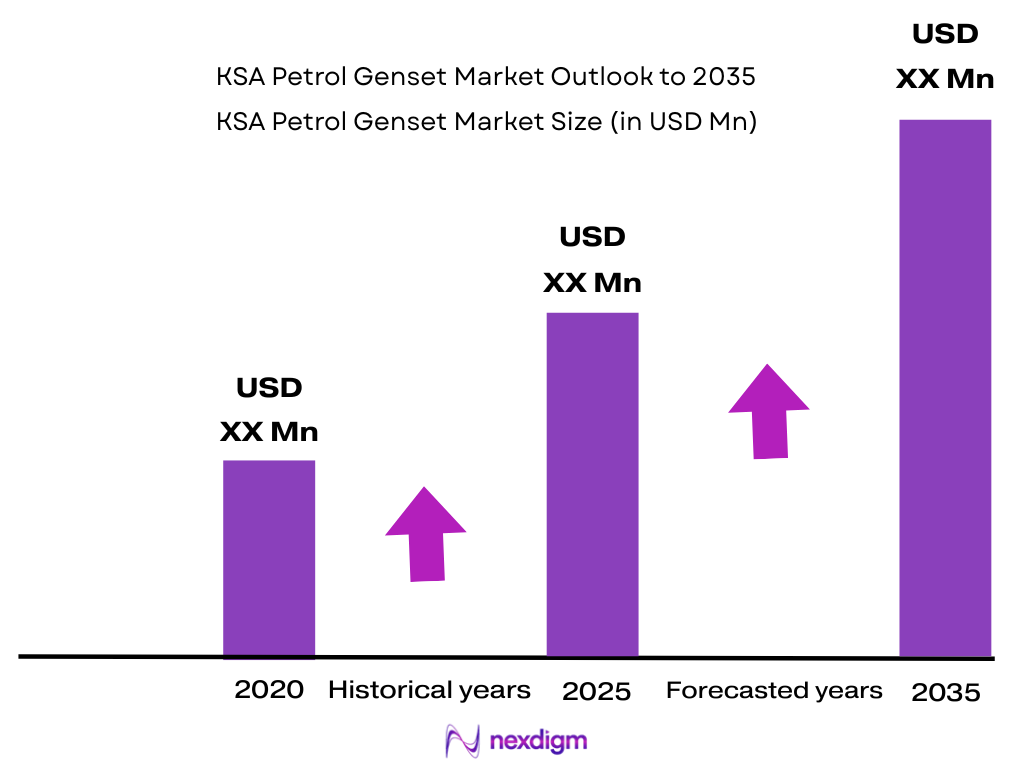
The KSA Petrol Genset Market is valued at approximately ~ million, supported by electricity consumption increasing from roughly 315 TWh to 324 TWh and grid peak load reaching 74.8 GW. Demand is concentrated in portable backup and temporary-power applications across automotive workshops, construction locations, small businesses, outdoor events and remote worksites. Saudi Electricity Company also connected more than 341,000 new subscribers, expanding the country’s underlying electrical-load ecosystem. Riyadh, Jeddah, Dammam and the wider Eastern Province constitute the principal demand centres because they combine population concentration, construction activity, industrial estates, automotive workshops, infrastructure projects and commercial facilities. Saudi Arabia’s population increased from approximately 33.7 million to 35.3 million people, adding about 1.6 million residents. Riyadh additionally benefits from extensive development activity, while Jeddah and Dammam support logistics, industrial and construction operations requiring portable electricity away from permanent connections.
Market Segmentation
By Power Rating
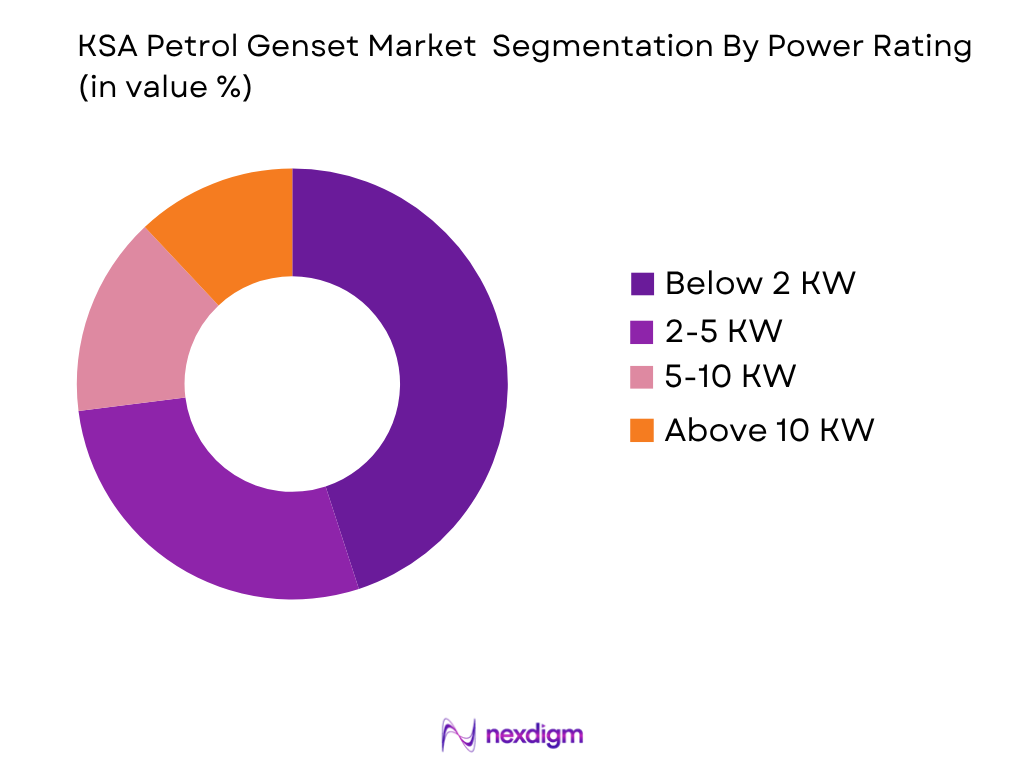
The KSA Petrol Genset Market is segmented into below 2 kW, 2–5 kW, 5–10 kW, 10–15 kW and above 15 kW systems. The 2–5 kW category holds the dominant market share because it provides a practical balance between portability, output and fuel storage requirements for workshops, mobile mechanics, construction crews, households and small commercial users. Equipment within this band can support lighting, hand tools, compressors, battery chargers, refrigerators, small pumps and essential backup circuits without requiring the footprint of larger industrial generating sets. Petrol engines are also particularly competitive in this low-to-medium output band because users frequently require intermittent rather than continuous generation. Honda’s Saudi power-products portfolio includes portable and inverter generators, while Hyundai Power Products operates a Saudi-facing petrol-generator offering, demonstrating the commercial relevance of compact gasoline-powered equipment.
By End-Use Application
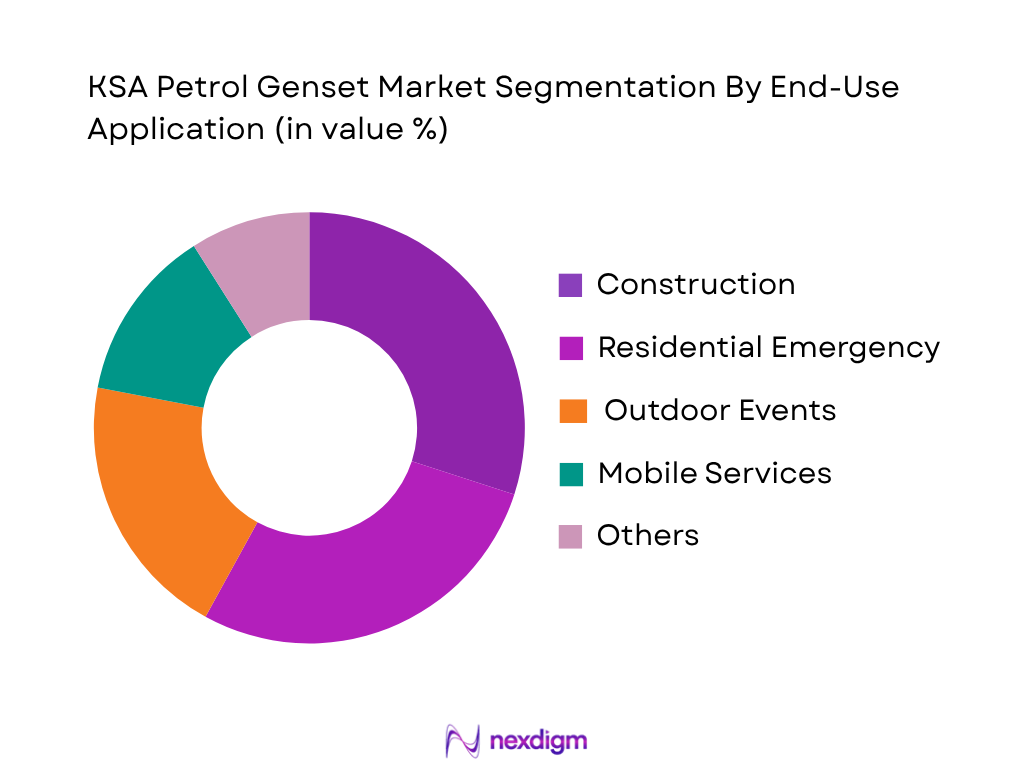
The KSA Petrol Genset Market is segmented into construction and infrastructure, automotive workshops and mobile service, residential backup, small commercial establishments, outdoor events and recreation, and other temporary-power applications. Construction and infrastructure applications represent the dominant segment because portable petrol gensets are suitable for temporary locations where permanent grid connections may not yet be operational or where individual tools and work areas require localized electricity. Saudi Arabia’s continuing development programme generates demand for portable lighting, cutting equipment, drills, pumps, inspection systems and maintenance tools across dispersed worksites. Petrol units are particularly useful where mobility, quick starting and relatively compact equipment are prioritized over long-duration base-load operation. Automotive workshops and roadside/mobile servicing form another significant category because generators can operate chargers, diagnostic equipment, lighting, compressors and electric tools where fixed utility power is unavailable.
Competitive Landscape
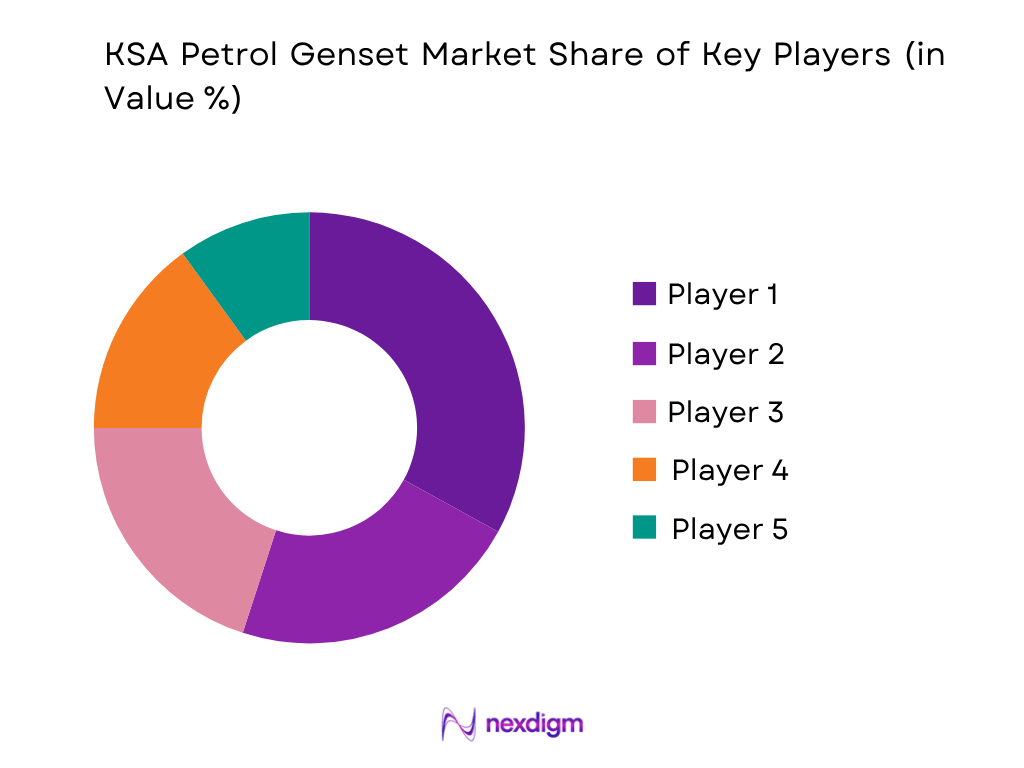
The KSA Petrol Genset Market consists of international power-equipment manufacturers supported by Saudi distributors, equipment retailers, construction-equipment suppliers and digital sales channels. Honda maintains a particularly established position through Abdullah Hashim Company, its sole Saudi distributor covering Honda generators and other power products. Hyundai Power Products maintains a dedicated Saudi petrol-generator offering, while Generac equipment is represented through Saudi power-equipment channels such as Middle East Development Company. Competition increasingly centres on inverter technology, portability, engine reliability, electric starting, runtime and local after-sales support.
| Major Player | Establishment Year | Headquarters | Petrol Genset Portfolio | Inverter Capability | Typical Output Focus | Portability | Starting System | Saudi Market Channel |
| Honda Motor Co. | 1948 | Tokyo, Japan | ~ | ~ | ~ | ~ | ~ | ~ |
| Hyundai Power Products | 2009 | UK / Global Brand Network | ~ | ~ | ~ | ~ | ~ | ~ |
| Generac Holdings | 1959 | Wisconsin, USA | ~ | ~ | ~ | ~ | ~ | ~ |
| Briggs & Stratton | 1908 | Wisconsin, USA | ~ | ~ | ~ | ~ | ~ | ~ |
| Yamaha Motor | 1955 | Iwata, Japan | ~ | ~ | ~ | ~ | ~ | ~ |
KSA Petrol Genset Market Analysis
Growth Drivers
Construction, Infrastructure and Temporary Power Requirement
Saudi Arabia’s petrol genset market is supported by the scale of construction, infrastructure development and temporary-site activity associated with the Kingdom’s non-oil transformation. Petrol gensets are particularly suitable for mobile workshops, construction crews, road-maintenance teams, temporary offices, inspection equipment, lighting towers, small tools and site-support vehicles where connecting every work location to permanent electricity is impractical. The World Bank recorded Saudi Arabia’s nominal GDP at approximately USD 1.254 trillion in 2024, while the IMF recorded a population of 35.3 million people, providing a substantial economic and demographic base for infrastructure, residential and commercial development. Electricity demand also illustrates the intensity of development activity. Saudi Electricity Company reported that grid peak load reached 74.8 GW in 2024, electricity consumption reached 324 TWh, and more than 341,000 new subscribers were added during the year. During the first half of 2025, peak load had reached 75.1 GW, while transmitted electricity reached 193.6 TWh. These figures indicate sustained expansion in buildings, industrial loads, infrastructure and population centres, all of which create temporary-power requirements during development and commissioning phases. The construction pipeline remained active into 2025–2026. General Authority for Statistics data recorded 7,584 building permits in May 2025, while 6,803 permits were issued in April 2026 and 5,056 permits in May 2026. Although permanent grid connections ultimately serve completed properties, portable petrol generators have a different role: they provide power before utility energisation, during maintenance, at dispersed work fronts and for low-to-medium electrical loads that do not justify larger diesel sets. Petrol units are also easier to transport in light commercial vehicles and pickups because compact units can serve drills, grinders, pumps, diagnostic tools and small welding equipment. Saudi Arabia’s extremely dispersed project geography reinforces this requirement. Large projects, tourism developments, road corridors and utility works can extend beyond mature city electricity networks, meaning contractors often need independent power at several temporary points simultaneously. The macroeconomic setting remains supportive. The World Bank recorded Saudi GDP above USD 1.2 trillion in both 2024 and 2025, while IMF analysis continued to identify construction, hospitality, private consumption and government-led projects among important sources of non-oil activity. For petrol-genset suppliers, the addressable demand is therefore concentrated less in large permanent standby installations and more in portable 1–10 kW units, inverter generators and wheeled open-frame generators that can accompany service vehicles and construction teams. Features such as electric start, multiple AC outlets, wheel kits, fuel gauges, automatic voltage regulation and inverter electronics become important differentiators for contractors seeking transportability and dependable output. The combination of 74.8 GW grid peak demand, 324 TWh electricity consumption, 341,000 new electricity subscribers and thousands of monthly building permits provides a measurable foundation for continuing temporary-power requirements. Principal supporting sources are the World Bank, International Monetary Fund, Saudi Electricity Company and General Authority for Statistics.
Tourism, Events and Mobile Commercial Power Demand
Expansion in tourism, entertainment and event activity represents another important demand driver for petrol gensets because temporary venues and outdoor operations require compact, rapidly deployable electrical power. Saudi Arabia welcomed approximately 116 million domestic and international tourists in 2024, according to official tourism authorities, and the total increased to around 123 million tourists in 2025. The Vision 2030 annual reporting framework also recorded 5,937 licensed tourism facilities in 2025, demonstrating the growing physical infrastructure serving visitors throughout the Kingdom. This expansion creates petrol-generator applications beyond conventional residential emergency backup. Outdoor festivals, temporary food outlets, camping facilities, desert excursions, mobile retail units, temporary ticketing systems, maintenance vehicles, recreational activities and small event installations commonly require portable power for lighting, refrigeration, communication equipment, point-of-sale systems and audiovisual equipment. Petrol gensets are particularly relevant where electrical requirements are modest and mobility is more valuable than prolonged heavy-load operation. Saudi Arabia’s tourism geography further strengthens this application because visitor activity is distributed across Riyadh, Jeddah, AlUla, the Red Sea coast, religious destinations and increasingly remote leisure locations. A compact generator can support operations where installing fixed grid infrastructure solely for intermittent use would be operationally inefficient. Riyadh’s major entertainment calendar illustrates the scale of temporary power ecosystems: official Vision 2030 reporting stated that Riyadh Season attracted more than 19 million visitors during the relevant reporting cycle. At a national level, electricity demand reached 324 TWh in 2024, while SEC added more than 341,000 electricity subscribers, demonstrating that tourism and event growth is occurring alongside wider commercial and residential load expansion. The World Bank recorded Saudi Arabia’s economy at approximately USD 1.254 trillion in 2024, and IMF data recorded 35.3 million residents, providing substantial domestic purchasing power and labour demand around hospitality, recreation and event services. Petrol genset vendors can therefore address several distinct user categories: small hospitality operators, tour companies, event contractors, rental fleets, maintenance crews and mobile food-service businesses. Product specifications are likely to differ from construction use. Tourism and entertainment users place greater emphasis on low noise, compact dimensions, clean electrical output and easy starting, supporting inverter gensets and enclosed petrol models rather than only conventional open-frame equipment. Stable power quality is increasingly important because temporary venues operate sensitive electronics, LED systems, communications equipment and digital payment infrastructure. Fuel efficiency is also relevant where equipment operates for several hours at partial load. The opportunity for suppliers extends through equipment-rental networks because many tourism and event operators require generators only for specific periods. Rental companies can deploy fleets across large festivals, exhibitions, sporting events and seasonal tourism peaks without requiring end users to maintain permanent generator inventories. The continuing expansion of formal tourism infrastructure also enlarges the service and maintenance base for small generators. With 116 million tourists in 2024, 123 million in 2025, 5,937 licensed tourism facilities and more than 19 million Riyadh Season visitors, the Kingdom has a large, measurable temporary-power ecosystem capable of supporting petrol genset utilisation. Principal supporting sources are the Saudi Ministry of Tourism, Saudi Vision 2030, World Bank, IMF and Saudi Electricity Company.
Market Challenges
Expanding Grid Capacity Reducing Permanent Petrol Backup Requirement
One of the principal challenges for Saudi Arabia’s petrol genset market is the continuing expansion and strengthening of the national electricity system, which reduces the need for small petrol generators as permanent backup solutions in established urban locations. Saudi Electricity Company reported that more than 341,000 new subscribers were connected during 2024 as grid peak load reached 74.8 GW and total electricity consumption reached 324 TWh. During the first half of 2025, grid peak load reached 75.1 GW and transmitted energy reached 193.6 TWh, showing that utility infrastructure is continuing to absorb additional residential, commercial and industrial demand. This is significant because petrol generators perform best as portable, intermittent power sources rather than primary electricity systems. As construction sites, tourism developments and peripheral communities gain formal electricity connections, some applications that previously required independent generators migrate to utility supply. Saudi Arabia also has a very high level of established electricity connectivity across the population, which means the petrol-genset market cannot rely on widespread unelectrified households as a structural demand pool. The World Bank recorded Saudi Arabia’s population at approximately 35 million-plus residents and its economy above USD 1.2 trillion, while the electricity system supports rapidly rising peak demand across major metropolitan regions. Consequently, genset suppliers must compete for narrower use cases such as temporary construction, camping, mobile services, outdoor events and emergency resilience rather than treating petrol generators as a mainstream substitute for grid electricity. Grid expansion also affects rental utilisation. Contractors can reduce generator operating hours once permanent site connections are completed, making equipment demand dependent on construction sequencing rather than continuous consumption. The same dynamic applies to hotels, restaurants and commercial facilities where fixed backup systems are often based on larger diesel or gas-fired generators rather than portable petrol models. This limits petrol gensets mainly to smaller loads. Saudi electricity-sector expansion is also increasingly associated with renewable integration and new generating assets. By the end of the first quarter of 2025, SEC reported approximately 6.7 GW of connected renewable capacity, demonstrating that electricity supply diversification is moving forward alongside transmission-system expansion. For users concerned about emissions, noise or fuel storage, battery power stations and solar-plus-storage equipment can compete with petrol generators for light-duty applications such as camping, communications, electronics charging and small mobile operations. This creates a further competitive challenge, particularly for low-kW petrol units whose traditional advantage was portability. Petrol genset manufacturers therefore need to reposition products around applications that batteries and fixed grids cannot yet satisfy economically, including longer-duration field power, high starting loads, construction tools and situations where rapid gasoline refuelling offers operational advantages. Advanced inverter technology, parallel operation, automatic idle control and hybrid compatibility can help maintain relevance. The scale of Saudi electricity infrastructure means the market is not driven by chronic lack of grid access. Instead, it is driven by mobility, temporary power and resilience. Suppliers unable to distinguish these applications risk overestimating demand. The combination of 74.8 GW peak load, 324 TWh annual consumption, 341,000 new connections and 6.7 GW of connected renewable capacity shows how quickly utility coverage and alternative power options are evolving. Principal supporting sources are the Saudi Electricity Company, World Bank and Saudi Electricity Regulatory Authority.
Machinery Safety, Emissions Compliance and Petrol-Engine Operating Constraints
Petrol genset suppliers in Saudi Arabia face increasing compliance requirements surrounding machinery safety, product conformity and environmental performance. The Saudi Standards, Metrology and Quality Organization published its Technical Regulation for General Requirements for Machinery Safety on 29 March 2024, while Saudi Arabia’s Standards and Quality System was formally issued on 4 August 2024 and published on 16 August 2024. These measures strengthen the national framework governing products placed on the Saudi market and create additional responsibilities for manufacturers, importers and distributors of engine-driven generating equipment. Petrol gensets combine several hazards within one product: rotating machinery, electrical generation, hot exhaust surfaces, gasoline storage, ignition sources, noise and combustion emissions. Compliance therefore extends beyond basic generator output and requires attention to guarding, electrical protection, operating instructions, conformity documentation and product traceability. Environmental controls create a second layer of challenge. Saudi Arabia’s air-quality regulation empowers the National Center for Environmental Compliance to regulate and inspect emission-producing activities, issue environmental requirements and address exceedances from stationary sources. Petrol generators used continuously at construction compounds, commercial facilities or events can generate carbon monoxide, nitrogen oxides and volatile organic compounds, making inefficient or poorly maintained engines less attractive as environmental oversight increases. The challenge is amplified by Saudi operating conditions. Electricity demand reached 324 TWh in 2024 and peak load reached 74.8 GW, partly reflecting the Kingdom’s high cooling requirement. Petrol gensets operating outdoors during the same high-temperature periods face thermal stress, reduced cooling margins and greater fuel-management requirements. Dust also affects air filters and cooling passages, increasing maintenance intensity for construction and desert applications. Unlike diesel, petrol is highly volatile, which requires disciplined storage and handling around hot worksites and transport vehicles. Smaller fuel tanks can also limit continuous operating duration relative to larger diesel gensets, making petrol less attractive for sustained prime-power applications. These characteristics structurally confine petrol generators to intermittent and portable use even where total temporary-power demand is strong. Saudi Arabia’s macroeconomic scale magnifies the importance of compliance because the Kingdom imported and deployed large quantities of machinery and equipment to support an economy valued by the World Bank at approximately USD 1.254 trillion in 2024. As project owners adopt more formal procurement standards, low-cost generators without documented safety and conformity features can face growing barriers to institutional sales. Corporate contractors increasingly require established product certifications, after-sales service, spare-parts availability and safe-use documentation before approving equipment for worksites. For vendors, this raises the importance of authorized distribution and technical support. Suppliers need to differentiate products through overload protection, low-oil shutdown, circuit breakers, spark arrestors, automatic voltage regulation and, where relevant, carbon-monoxide detection or shutoff technologies. Environmental and safety compliance may also shift demand toward modern electronically controlled and inverter-based engines that can reduce unnecessary engine speed under partial loads. The challenge is therefore not merely regulatory paperwork; it changes product specifications and the economics of low-end market participation. Principal supporting sources are the Saudi Standards, Metrology and Quality Organization, Ministry of Environment, Water and Agriculture, National Center for Environmental Compliance, World Bank and Saudi Electricity Company.
Market Opportunities
Inverter, Smart-Control and Hybrid Portable Genset Development
The strongest product-development opportunity in Saudi Arabia lies in moving the petrol genset category away from conventional fixed-speed open-frame equipment toward inverter-based, electronically managed and hybrid-compatible portable generators. The opportunity is supported by current electricity and digitalisation indicators rather than speculative future demand. Saudi Electricity Company recorded 74.8 GW of peak load and 324 TWh of electricity consumption in 2024, demonstrating the scale of electrical equipment use throughout households, businesses and project sites. The company also connected more than 341,000 new subscribers during the same period. Meanwhile, GASTAT reported that Saudi information and communications technology activities generated SAR 249.8 billion in operating revenue in 2024, with telecommunications activities accounting for SAR 133.9 billion. Saudi ICT goods imports reached SAR 67.9 billion, compared with SAR 54.9 billion in the preceding period. This rapid digital-equipment penetration changes what customers expect from portable power. Traditional generators designed primarily for resistive tools and lighting must increasingly supply laptops, telecommunications equipment, digital payment systems, electronic controls, cameras and entertainment equipment. Inverter petrol generators provide a commercially attractive solution because electronically regulated output can better support sensitive devices while allowing engine speed to adjust to electrical load. Reduced engine speed at partial load can also improve runtime, decrease noise and lower unnecessary fuel consumption, characteristics particularly valuable for tourism, recreational, residential and event users. Saudi Arabia’s tourism ecosystem provides a large current application base: official authorities recorded approximately 116 million tourists in 2024 and around 123 million in 2025, while 5,937 licensed tourism facilities were operating in 2025. Quiet portable gensets can support camping, desert tourism, temporary hospitality, mobile kiosks and outdoor events where conventional open-frame units create unacceptable noise. Hybridisation provides another opportunity. Suppliers can pair petrol generators with batteries or portable energy-storage systems so the engine operates only when battery charge falls or loads exceed battery capability. This reduces engine hours while retaining the ability to refuel quickly during extended operation. The model is especially relevant for remote telecommunications, field maintenance, recreation and mobile commercial operations. Digital control features can further differentiate products. Bluetooth or Wi-Fi interfaces, remote start, runtime tracking, maintenance alerts, fuel-level monitoring and overload notifications allow equipment owners and rental companies to manage dispersed generator fleets. Saudi digital adoption creates a favourable backdrop for such functionality. The opportunity also aligns with stricter safety expectations following the 2024 machinery-safety technical regulation and Saudi product-quality framework. Manufacturers can integrate low-oil shutdown, overload protection, electronic fuel management and carbon-monoxide safety systems as standard features, raising product quality while differentiating authorised models from basic imports. Rather than relying exclusively on unit growth, suppliers can therefore expand through technological premiumisation of the existing portable-power category. Principal supporting sources are the Saudi Electricity Company, General Authority for Statistics, Saudi Ministry of Tourism, Saudi Vision 2030 and Saudi Standards, Metrology and Quality Organization.
Remote Project, Tourism and Equipment-Rental Power Solutions
Saudi Arabia’s dispersed infrastructure, construction and tourism activity creates a future growth opportunity for petrol gensets supplied through equipment-rental, service-vehicle and mobile-power business models. This opportunity is supported by current project and visitor activity rather than future project projections. GASTAT recorded 7,584 building permits in May 2025, 6,803 permits in April 2026 and 5,056 permits in May 2026, indicating that thousands of building projects continue to enter the construction pipeline each month. At the same time, official tourism data recorded around 116 million tourists in 2024, increasing to approximately 123 million tourists in 2025, with 5,937 licensed tourism facilities serving the sector. Each of these ecosystems creates dispersed, short-duration electrical demand that differs from permanent backup generation. Construction contractors need mobile power for tools, temporary offices, inspections and maintenance before final grid energisation. Tourism operators require generators for outdoor experiences, remote lodges, mobile catering, temporary attractions and desert operations. Event companies require additional units during setup, live operation and dismantling. Because utilisation is intermittent, many of these customers can obtain better operational economics through renting generators instead of owning large equipment fleets. This supports specialised rental companies and distributors that can maintain standardised inventories of compact petrol gensets across Riyadh, Jeddah, the Eastern Province and emerging tourism corridors. Saudi Arabia’s macroeconomic capacity supports such service models. The World Bank recorded nominal GDP at approximately USD 1.254 trillion in 2024, while the IMF reported a population of 35.3 million people, providing a broad corporate and consumer customer base. Electricity-sector expansion also creates demand for mobile maintenance power. SEC’s network carried 324 TWh of electricity in 2024, operated against a 74.8 GW peak load, and added more than 341,000 subscribers, creating ongoing requirements for utility construction, inspection, repair and field-service activity. Petrol gensets are well suited to service vehicles because compact models can be transported directly with tools and spare parts. Rental fleets can further segment offerings according to 1–3 kW inverter units for electronics and recreation, 3–7 kW portable models for trade tools and temporary facilities, and larger wheeled petrol generators for site equipment. Suppliers can add value through preventative maintenance, rapid replacement, spare units and on-site fuel management. The service model also creates opportunities to improve regulatory compliance because professional rental providers can maintain equipment according to Saudi machinery-safety requirements and replace poorly maintained legacy products. Remote monitoring can improve fleet utilisation by tracking operating hours, service intervals and load conditions. As tourism and construction activity increasingly extends beyond traditional metropolitan locations, dependable logistics becomes a competitive advantage. Companies able to establish regional service centres, mobile technicians and parts inventories can capture customers that require equipment immediately rather than waiting for imported replacements. The opportunity therefore extends beyond selling generators; it includes rental, fleet management, mobile maintenance, hybrid power packages and project-site power services. The existing combination of thousands of monthly building permits, more than one hundred million annual tourists and a national electricity system carrying hundreds of terawatt-hours demonstrates a substantial current base of mobile-power applications. Principal supporting sources are the General Authority for Statistics, Ministry of Tourism, Saudi Vision 2030, World Bank, International Monetary Fund and Saudi Electricity Company.
Future Outlook
The KSA Petrol Genset Market is expected to expand at approximately ~ CAGR during 2026–2035, with demand gradually shifting toward compact, efficient and electronically controlled portable generators. Construction, infrastructure maintenance, automotive servicing and temporary commercial power will remain important consumption areas even as Saudi Arabia continues expanding and strengthening its national electricity system. Higher grid reliability does not eliminate the requirement for mobile electricity at locations without permanent connections. Inverter generators are expected to gain importance because they provide cleaner electrical output for electronic diagnostic systems, chargers and sensitive tools while allowing manufacturers to differentiate on noise, fuel consumption and compactness. At the same time, battery power stations and hybrid energy systems will increasingly compete with small petrol units. Petrol genset manufacturers will therefore need to emphasize rapid refuelling, high continuous output, rugged construction and extended operating capability to retain their role in professional applications.
Major Players
- Honda Motor Co.
- Hyundai Power Products
- Generac Holdings
- Briggs & Stratton
- Yamaha Motor Co.
- Pramac
- Champion Power Equipment
- Westinghouse Outdoor Power Equipment
- FIRMAN Power Equipment
- DuroMax Power Equipment
- WEN Products
- Pulsar Products
- A-iPower
- Loncin Motor
- Kipor Power Equipment
Key Target Audience
- Petrol genset manufacturers and assemblers
- Power-equipment distributors and importers
- Automotive workshop and garage equipment suppliers
- Construction and infrastructure contractors
- Equipment rental and temporary-power companies
- Automotive roadside-assistance and mobile-service operators
- Investments and venture capitalist firms
- Government and regulatory bodies (Saudi Standards, Metrology and Quality Organization, Ministry of Energy, Ministry of Municipalities and Housing, Saudi Civil Defense)
Research Methodology
Step 1: Identification of Key Variables
The initial phase develops a complete ecosystem map of the KSA Petrol Genset Market covering manufacturers, importers, distributors, construction contractors, automotive workshops, rental companies, households and temporary-power users. Critical variables include rated and maximum output, engine displacement, fuel-tank capacity, runtime, inverter configuration, starting mechanism, portability, noise performance and application requirements.
Step 2: Market Analysis and Construction
Historical market demand is assessed using a bottom-up model combining product shipments, distributor throughput, power-equipment channel activity and demand across construction, automotive service, residential and commercial applications. Top-down validation considers Saudi electricity demand, infrastructure investment, population expansion, construction activity and gasoline availability. Saudi Electricity Company reported grid peak demand of 74.8 GW and electricity consumption of approximately 324 TWh, providing an important macro-demand benchmark.
Step 3: Hypothesis Validation and Expert Consultation
Market hypotheses are validated through structured discussions and CATIs with generator distributors, power-equipment retailers, construction companies, rental businesses, workshop operators and service technicians. Consultations focus on preferred output bands, gasoline versus diesel selection, inverter adoption, runtime requirements, servicing intervals, generator portability, spare-parts availability and purchasing channels.
Step 4: Research Synthesis and Final Output
Primary insights are reconciled with manufacturer portfolios, Saudi distributor networks and government infrastructure indicators. Honda’s authorized Saudi generator distribution, Hyundai’s dedicated Saudi petrol-generator portfolio and other regional equipment channels are used to validate competitive availability. Demand-side and supply-side findings are then triangulated to create the final historical model, segmentation structure and long-term market outlook.

- Executive Summary
- Research Methodology (Market Definition and Scope, Petrol/Gasoline Genset Classification, Top-Down Market Sizing, Bottom-Up Unit Assessment, Import and Distributor Mapping, Power-Rating Analysis, Dealer Interviews, Contractor Interviews, End-User Validation, Product-Level Benchmarking, Data Triangulation, Forecasting Framework, Assumptions and Limitations)

- Definition and Scope
- Market Evolution and Industry Genesis
- Development of Portable Petrol Generator Ecosystem
- Petrol Genset Business Cycle
- Portable Generator Demand Ecosystem

- Growth Drivers (Portable Power Requirement, Construction and Infrastructure Activity, Residential Backup Demand, Automotive Workshop Expansion, Outdoor and Tourism Activity)
- Market Challenges (Runtime Limitations, Fuel Storage, Noise, Emissions, Thermal Performance, Alternative Power Technologies)
- Market Opportunities (Inverter Technology, Compact Power Systems, Smart Controls, Multi-Fuel Designs, Low-Noise Products)
- Market Trends (Inverter Electronics, Fuel Optimisation, Digital Monitoring, Lightweight Design, Safety Automation)
- Government Regulations (Product Conformity, Electrical Safety, Engine Emissions, Noise, Fuel Handling, Import Compliance)
- SWOT Analysis
- Porter’s Five Forces Analysis
- PESTLE Analysis

- By Market Value (2020-2025)
- By Unit Sales Volume (2020-2025)
- By Installed Petrol Genset Base (2020-2025)

- By Power Rating (In Value %)
Below 2 kW
2–3 kW
3–5 kW
5–7.5 kW
7.5–10 kW - By Generator Architecture (In Value %)
Conventional Open-Frame Petrol Generators
Silent Petrol Generators
Petrol Inverter Generators
Digital Inverter Generators
Petrol Generator-Welder Units
Multi-Fuel Generators with Petrol Capability - By End User (In Value %)
Households and Villas
Construction Contractors
Automotive Workshops
Small Retail Businesses
Facility Management Companies - By Region (In Value %)
Central Region
Western Region
Eastern Region
Southern Region
Northern Region

- Market Positioning of Major Players
- Cross Comparison Parameters (Petrol Genset Power Range, Inverter Generator Portfolio, Rated-to-Surge Output Ratio, Fuel-Tank Capacity and Runtime, Noise-Control Technology, Starting-System Options, Carbon Monoxide/Safety Features, Saudi Dealer and After-Sales Service Coverage)
- SWOT Analysis of Major Players
- Detailed Profiles of Major Companies
Honda Motor Co.
Yamaha Motor Co.
Generac Holdings
Pramac
FIRMAN Power Equipment
Briggs & Stratton
Champion Power Equipment
Westinghouse Outdoor Power Equipment
Hyundai Power Products
ELEMAX
SENCI Power
Loncin Motor
Kipor Power
A-iPower
Atlas Copco

- Residential User Demand Analysis
- Construction Contractor Demand Analysis
- Automotive Workshop Demand Analysis
- Retail and Small Business Demand Analysis
- Event and Temporary Facility Demand Analysis

- By Future Market Value (2026-2035)
- By Future Unit Sales Volume (2026-2035)
- By Future Installed Petrol Genset Base (2026-2035)


 Request a Sample
 Ask for Customization
 Get a Quote
 Enquire Now