

 Download PDF
Market Overview
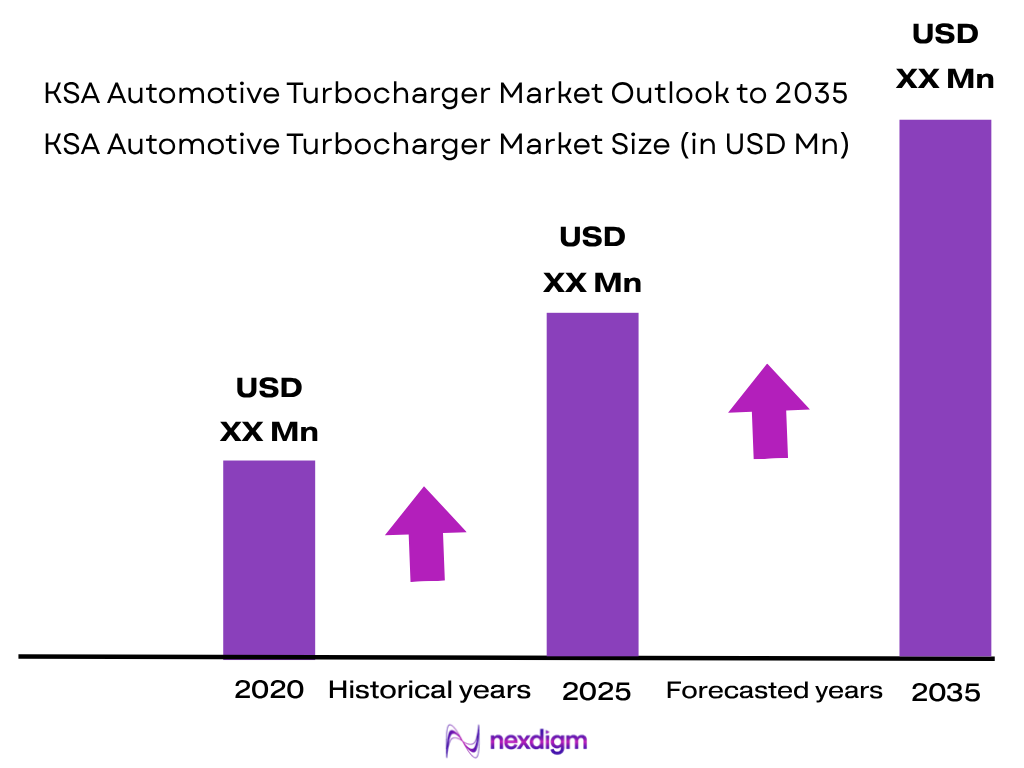
The KSA Automotive Turbocharger Market is valued at ~USD XX million, supported by a large in-use vehicle base, replacement demand and continued turbocharged-engine adoption. Saudi Arabia recorded 15.8 million registered and roadworthy vehicles, up from 14.8 million, while newly issued vehicle registrations reached 1.03 million, compared with 878,100 previously. Road-freight imports through land ports also increased from 11.4 million tonnes to 12.2 million tonnes, reinforcing commercial-vehicle utilization and the need for engine-performance components.
Riyadh, Jeddah and Dammam/Eastern Province are the principal demand centers because they combine vehicle density, commercial activity, logistics infrastructure and concentrated automotive service networks. Riyadh benefits from its position as the national business and fleet-management center; Jeddah combines passenger-vehicle demand with port-linked logistics; and Dammam, Dhahran and Jubail benefit from industrial, petrochemical and freight activity. Saudi Arabia also had 23 activated logistics centers covering 34.6 million square meters, while Makkah Region alone accounted for 20.4 million square meters.
Market Segmentation
By Technology Type
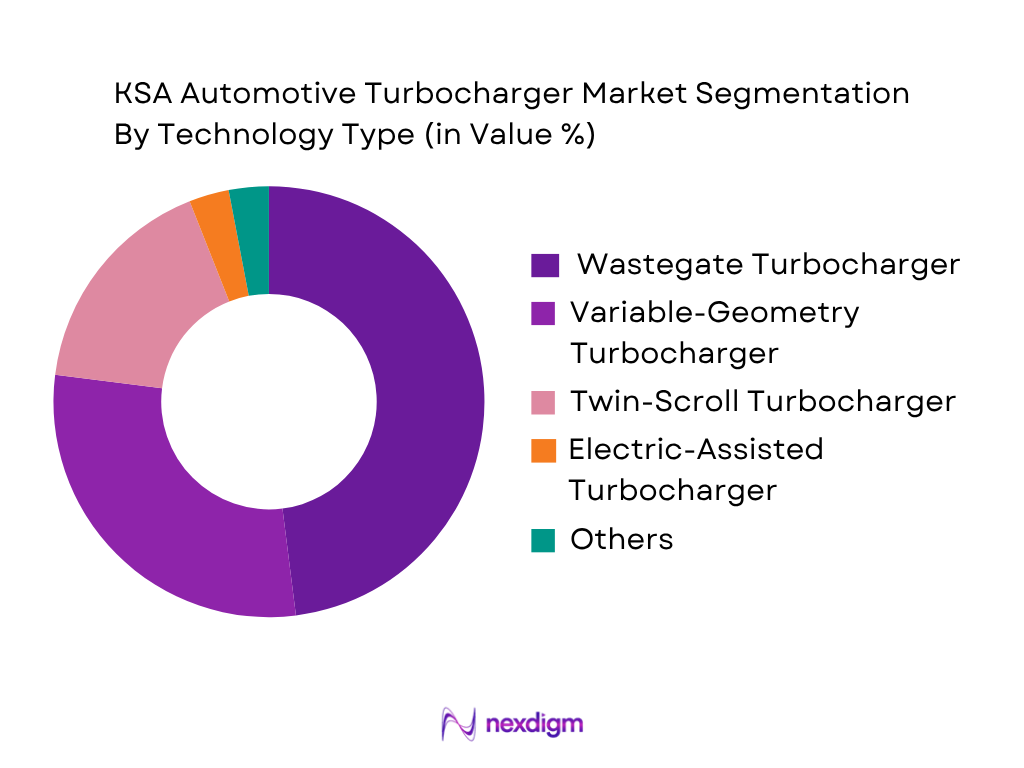
The KSA Automotive Turbocharger Market is segmented by technology type into wastegate turbochargers, variable-geometry turbochargers, twin-scroll turbochargers, electric-assisted turbochargers and other turbocharger technologies. Wastegate systems remain important because of their broad application across gasoline and diesel engines, comparatively straightforward architecture and established aftermarket availability. Variable-geometry systems are particularly relevant to diesel-powered SUVs, pickups and commercial vehicles because they improve boost control across different engine speeds and load conditions. The technology mix is increasingly influenced by engine downsizing, fuel-efficiency requirements and emissions management. IHI identifies wastegate and variable-geometry systems as the two principal turbocharger concepts and offers electric-motor-assisted systems for 48V mild-hybrid applications. Mitsubishi Heavy Industries similarly supplies variable-geometry and twin-scroll turbochargers.
By Vehicle Type
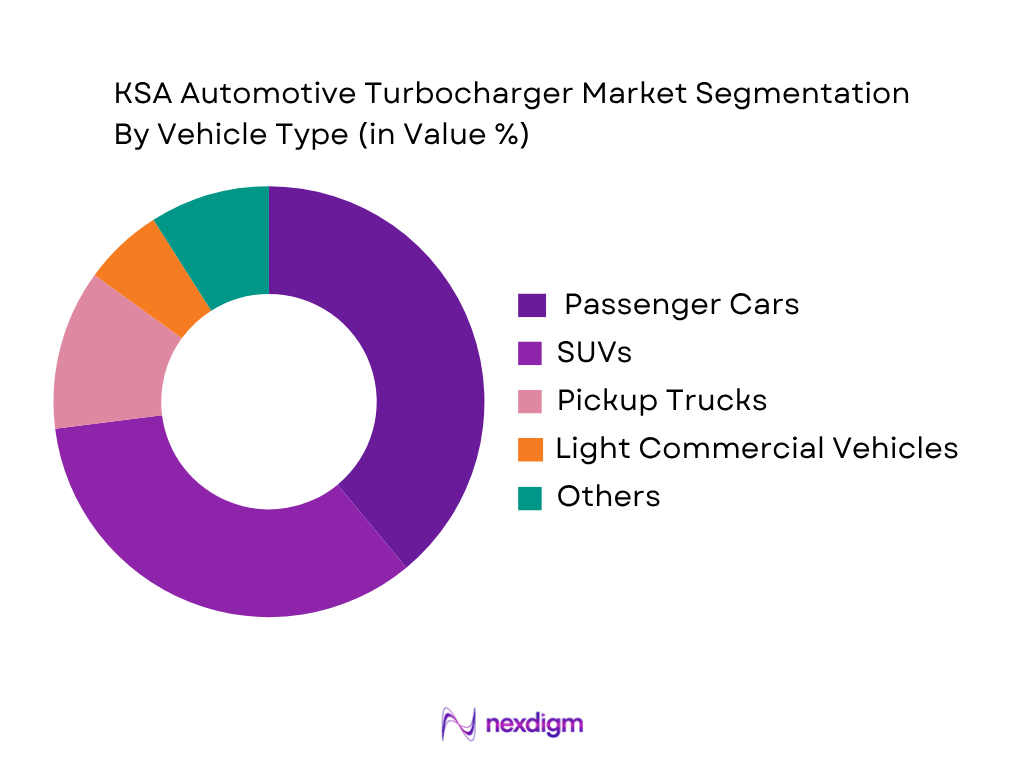
The KSA Automotive Turbocharger Market is segmented by vehicle type into passenger cars, SUVs, pickup trucks, light commercial vehicles, heavy commercial vehicles and buses. Passenger cars and SUVs constitute the largest addressable base because of Saudi Arabia’s extensive passenger-vehicle parc and continued availability of turbocharged gasoline and diesel powertrains. SUVs and pickups are particularly relevant because turbocharging provides higher torque and power from relatively compact engines, supporting operation under high temperatures, long-distance driving and demanding road conditions. Commercial vehicles represent an additional high-value application because turbochargers operate under sustained engine loads and therefore create replacement opportunities when vehicles accumulate high mileage. Saudi road-transport statistics recorded 15.8 million roadworthy vehicles and more than 1.0 million newly issued registrations, creating a broad installed base for both OE and aftermarket turbocharger demand.
Competitive Landscape
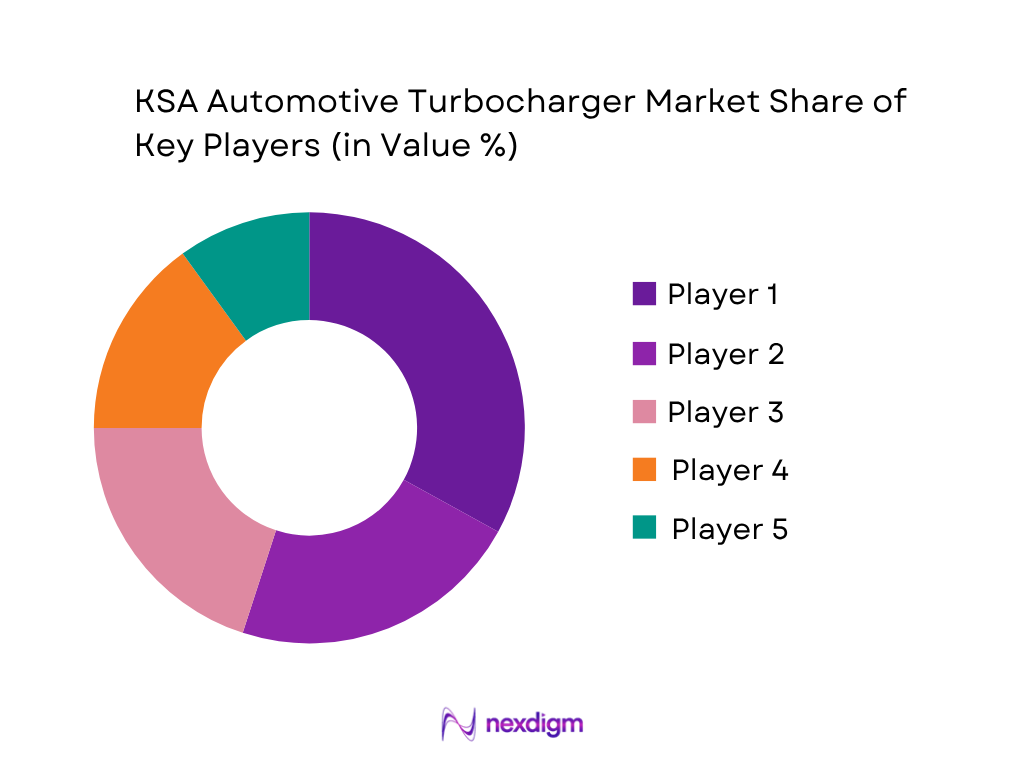
The KSA Automotive Turbocharger Market is characterized by global turbocharger manufacturers serving OEM applications alongside specialist aftermarket suppliers, distributors and remanufacturers. Competition is shaped by OE fitment coverage, technology capability, product reliability, local availability and technical support. Garrett Motion, BorgWarner, Cummins Turbo Technologies, Mitsubishi Heavy Industries and IHI represent important global technology suppliers, while specialist aftermarket companies compete through replacement cartridges, complete turbochargers, remanufacturing and broad vehicle coverage. The increasing technical sophistication of turbocharging is also shifting competition toward electronic actuation, variable geometry, thermal management and hybrid-compatible boosting systems. IHI, for example, reports more than 100 million vehicular turbochargers produced globally and maintains production and development bases across multiple regions.
| Major Player | Establishment | Headquarters | Core Turbo Technologies | Primary Vehicle Focus | KSA Relevance | Sales Model | Aftermarket Capability | Technology Focus |
| Garrett Motion | 2018 | Rolle, Switzerland | ~ | ~ | ~ | ~ | ~ | ~ |
| BorgWarner | 1928 | Auburn Hills, USA | ~ | ~ | ~ | ~ | ~ | ~ |
| Cummins Turbo Technologies | 1919 | Columbus, USA | ~ | ~ | ~ | ~ | ~ | ~ |
| Mitsubishi Heavy Industries | 1884 | Tokyo, Japan | ~ | ~ | ~ | ~ | ~ | ~ |
| IHI Corporation | 1853 | Tokyo, Japan | ~ | ~ | ~ | ~ | ~ | ~ |
KSA Automotive Turbocharger Market Analysis
Growth Drivers
Fleet Expansion and Turbocharged Engines
Vehicle fleet expansion and increasing turbocharged-engine penetration are strengthening the addressable base for automotive turbochargers in Saudi Arabia. The General Authority for Statistics (GASTAT) recorded more than 15.8 million registered and roadworthy vehicles in 2024, compared with 14.8 million in 2023, while newly issued vehicle registrations increased from 878,100 to 1.026 million units. This expanding vehicle base directly enlarges the installed population of engines requiring turbocharger maintenance and replacement. The International Monetary Fund (IMF) reported that Saudi Arabia’s non-oil real GDP grew 4.2 in 2024, supported principally by private consumption and non-oil private investment, with retail, hospitality and construction among the leading activities. The World Bank recorded Saudi Arabia’s GDP at US$1.24 trillion and GDP per capita at US$35,121.7 in 2024, illustrating the scale of economic activity supporting vehicle ownership and mobility. Turbocharging is also increasingly relevant to manufacturers seeking greater output from smaller-displacement engines while maintaining fuel-efficiency objectives. The effect is particularly relevant in SUVs, pickups and commercial vehicles, where higher torque is valuable under heavy loads and demanding operating conditions. GASTAT also recorded 1.271 million newly issued driving licences in 2024, compared with 1.191 million in 2023, indicating continued expansion of the active mobility ecosystem. For turbocharger suppliers, this combination of a growing vehicle parc, new registrations, economic activity and continued demand for efficient powertrains creates a broader OE and aftermarket opportunity. The expanding installed base is particularly important because turbochargers are high-utilization engine components, making vehicle age, mileage, operating conditions and maintenance practices important determinants of replacement demand.
Commercial Fleets and Logistics Activity
Commercial fleet utilization, construction activity and logistics growth provide an additional demand foundation for turbocharged engines and associated replacement components in Saudi Arabia. GASTAT’s Road Transport Statistics recorded 12.2 million tonnes of road-freight imports through Saudi land ports in 2024, compared with 11.4 million tonnes in 2023, while road-freight exports reached 13.4 million tonnes. The same GASTAT dataset recorded more than 15.8 million registered and roadworthy vehicles, creating a substantial operating population across passenger and commercial applications. Saudi Arabia’s logistics infrastructure also expanded: GASTAT reported 23 activated logistics centers covering 34.6 million square meters in 2024, compared with 22 centers in 2023. The country had 12,234 licensed commercial warehouses with a combined area exceeding 22 million square meters, while construction warehouses numbered 1,189, covering 7.5 million square meters. Delivery activity exceeded 290 million fulfilled orders, demonstrating the scale of vehicle-intensive distribution activity. These conditions support demand for diesel and gasoline engines operating under frequent acceleration, high payloads, long operating cycles and elevated thermal loads, all of which increase the importance of effective turbocharger performance. The IMF reported that non-oil economic activity remained robust in 2024, with construction among the sectors supporting growth, while the World Bank recorded real GDP growth of 2.0 and inflation of 1.7. Construction, logistics, warehousing, industrial distribution and intercity freight therefore create multiple applications for turbocharged pickups, light commercial vehicles, heavy trucks and buses. Higher utilization also creates opportunities for preventive inspection, turbocharger diagnostics, replacement cartridges and remanufactured units. Consequently, commercial fleet growth does not merely expand vehicle numbers; it increases operating hours and mileage per vehicle, which can accelerate component wear and strengthen aftermarket demand for turbocharger assemblies and related components.
Market Challenges
Imports and Harsh Operating Conditions
Imported-component dependency and Saudi Arabia’s harsh operating environment create structural challenges for turbocharger suppliers, distributors and workshops. Turbocharger systems incorporate precision components such as compressor wheels, turbine wheels, bearings, shafts, seals, actuators and electronic controls, and many replacement components are sourced through international automotive supply chains. GASTAT recorded 12.2 million tonnes of road-freight imports through land ports in 2024, up from 11.4 million tonnes in 2023, demonstrating the country’s extensive dependence on cross-border freight flows. At the macroeconomic level, the IMF reported US$405.2 billion in SAMA net foreign assets in 2024 and estimated imports of goods and services at a level supported by substantial investment-related demand, illustrating both the scale of international trade and the importance of imported industrial inputs. The operating environment adds further technical stress. High ambient temperatures increase thermal loading on turbine housings, bearings, engine oil and charge-air systems, while desert dust can place additional pressure on air filtration and compressor-side components when filtration or maintenance is inadequate. GASTAT reported 17,231 serious traffic accidents in 2024, including 10,388 intracity accidents, highlighting the demanding nature of road usage and stop-start driving environments. The same dataset recorded 24,077 traffic injuries, compared with 24,002 in 2023. For turbocharger manufacturers, these conditions increase the importance of heat-resistant materials, robust sealing, filtration compatibility and correct lubrication. For distributors, maintaining adequate inventories of genuine components becomes important because long international lead times can affect vehicle uptime. The challenge is therefore not simply import dependence; it involves managing global sourcing, technical quality, inventory availability and component durability simultaneously in a demanding climate.
Qualification and Aftermarket Quality
OEM qualification requirements, counterfeit replacement components and shortages of specialized repair capabilities can constrain the development of Saudi Arabia’s turbocharger aftermarket. Modern turbochargers increasingly integrate variable-geometry mechanisms, electronic actuators, advanced bearing systems and sophisticated engine-control interfaces, meaning that replacement is not always a simple mechanical substitution. GASTAT recorded 15.8 million registered and roadworthy vehicles in 2024, while more than 1.026 million vehicles received new registrations during the year. This creates a large installed base requiring standardized parts as well as vehicle-specific turbocharger assemblies. The challenge becomes more pronounced for commercial fleets because failures can result in significant downtime when the required turbocharger or component is unavailable. Saudi logistics statistics recorded 290 million-plus fulfilled delivery orders and 140,000 active Saudi drivers alongside 302,000 non-Saudi drivers in the logistics sector, demonstrating the intensity of vehicle-dependent operations. GASTAT also reported 12,234 licensed commercial warehouses, indicating a broad commercial distribution ecosystem in which parts availability and inventory management are critical. At the macroeconomic level, the IMF reported 4.2 non-oil real GDP growth in 2024, supported by private consumption and investment, while private-sector activity continued to expand. This economic activity increases demand for vehicle utilization but simultaneously raises expectations for uptime and service responsiveness. Counterfeit or poorly manufactured turbocharger components can create premature failures, oil leakage, inadequate boost pressure and engine damage, making brand authentication and technical diagnosis increasingly important. Workshops must also correctly identify actuator faults, boost-control issues, lubrication failures and air-intake restrictions before replacing an entire turbocharger. Consequently, suppliers face a dual challenge: meeting stringent technical requirements for OE and high-quality aftermarket applications while building reliable distribution, authentication, diagnostic and technician-support systems.
Market Opportunities
Variable-Geometry and Electric Turbocharging
Variable-geometry turbochargers and electrically assisted turbocharging provide significant opportunities as Saudi Arabia’s vehicle ecosystem moves toward higher engine efficiency and more sophisticated powertrain control. GASTAT recorded 15.8 million registered and roadworthy vehicles in 2024 and 1.026 million newly issued vehicle registrations, providing a substantial installed and replacement base for advanced turbocharger technologies. The opportunity is particularly relevant to diesel SUVs, pickups, commercial vehicles and heavy-duty applications where variable turbine geometry can improve boost response across different engine speeds and operating loads. Saudi logistics activity provides a practical operating environment: GASTAT reported 12.2 million tonnes of road-freight imports through land ports and 13.4 million tonnes of road-freight exports in 2024. These freight flows support high-utilization vehicles where responsive boosting and efficient combustion are important for sustained operation. At the broader economic level, the IMF reported 4.2 non-oil real GDP growth in 2024, with investment and domestic demand supporting sectors including construction and transportation-related activities. The World Bank recorded GDP of US$1.24 trillion, providing an economic base for continued investment in advanced mobility technologies. Electric-assisted turbochargers are particularly relevant to hybrid architectures because an electric motor can provide boost assistance independently of exhaust-energy availability, improving transient response and enabling closer integration between engine and electrical systems. International suppliers including Garrett Motion, BorgWarner, IHI and Mitsubishi Heavy Industries are already developing electrically assisted or electronically controlled boosting technologies, establishing technical pathways that can be adapted to regional applications. For Saudi Arabia, the opportunity extends beyond new-vehicle fitment: advanced turbocharger diagnostics, actuator calibration, specialist repair, replacement cartridges and fleet-maintenance services can develop alongside the installed base. This creates a higher-value opportunity centered on performance, efficiency and technical support rather than basic component replacement.
Heavy-Duty, Remanufacturing and Hybrid Systems
Heavy-duty diesel turbochargers, remanufacturing and hybrid-compatible boosting systems offer attractive avenues for future market development because Saudi Arabia combines extensive road freight, logistics infrastructure, construction activity and a large commercial-vehicle operating environment. GASTAT recorded 23 activated logistics centers with a combined area of 34.6 million square meters in 2024, compared with 22 centers in 2023. Commercial warehousing was also substantial, with 12,234 licensed warehouses covering more than 22 million square meters. Road freight through land ports reached 25.6 million tonnes when imports and exports are combined, consisting of 12.2 million tonnes of imports and 13.4 million tonnes of exports. These operating conditions support sustained demand for heavy trucks, tractor units, buses, construction vehicles and other diesel-powered assets in which turbochargers are critical to torque delivery and engine efficiency. Remanufacturing offers an additional opportunity because commercial fleets can require cost-effective replacement solutions while maintaining reliability and uptime. A professionally remanufactured turbocharger can provide an alternative to complete new-unit replacement when the core assembly remains suitable for rebuilding, creating opportunities for specialist workshops with balancing, calibration and actuator-testing capabilities. Hybrid turbocharging represents another technical pathway as manufacturers seek greater efficiency from combustion engines while integrating electrified systems. The IMF reported 4.2 non-oil real GDP growth in 2024 and identified private consumption and non-oil private investment as important contributors, while GASTAT reported more than 290 million fulfilled delivery orders. These indicators support continued vehicle-intensive economic activity and create a strong environment for technologies that improve uptime and operating efficiency. Suppliers capable of combining heavy-duty turbocharger engineering with local inventory, remanufacturing, diagnostics, actuator calibration and fleet-service agreements can therefore address both conventional diesel demand and the gradual transition toward more advanced hybrid powertrains.
Future Outlook
The KSA Automotive Turbocharger Market is expected to expand through greater replacement demand, continued turbocharged-engine penetration and increasing technical sophistication of boosting systems. Vehicle utilization across logistics, commercial transportation and private mobility will sustain the installed base requiring maintenance and replacement components. Saudi Arabia’s logistics infrastructure provides an important demand foundation. The country recorded 290 million-plus fulfilled delivery orders and 23 activated logistics centers, while road-freight imports through land ports reached 12.2 million tonnes. These conditions support continued utilization of commercial vehicles and associated engine components.
The market is also moving toward variable-geometry, electronically actuated and electrically assisted turbochargers. This transition is particularly important as manufacturers seek greater engine efficiency while maintaining power and torque. MHI has been developing turbocharging solutions for hybrid and new-energy vehicle architectures, while IHI offers electric motor-assisted turbochargers for 48V mild-hybrid systems.
Major Players
- Garrett Motion
- BorgWarner
- Cummins Turbo Technologies
- Mitsubishi Heavy Industries
- IHI Corporation
- BMTS Technology
- Marelli
- Bosch Mahle Turbo Systems
- Continental
- Turbo Technics
- Melett
- Nissens Automotive
- Rotomaster
- Turbo Energy
- Holset
Key Target Audience
- Automotive OEMs and Vehicle Assembly Companies
- Commercial Vehicle and Fleet Operators
- Automotive Spare-Parts Distributors and Importers
- Turbocharger Specialists and Independent Repair Workshops
- Automotive Component Manufacturers and Remanufacturers
- Investments and Venture Capitalist Firms
- Government and Regulatory Bodies (Ministry of Industry and Mineral Resources, Ministry of Transport and Logistics Services, Saudi Standards, Metrology and Quality Organization, Saudi Energy Efficiency Center)
- Automotive Dealership and Authorized Service Networks
Research Methodology
Step 1: Identification of Key Variables
The research begins by mapping the Saudi turbocharger ecosystem across vehicle manufacturers, turbocharger suppliers, distributors, workshops, fleets and aftermarket channels. Variables include turbocharger technology, vehicle parc, engine type, replacement cycles, OE fitment, aftermarket penetration and commercial-vehicle utilization. Government road-transport and vehicle-registration datasets are incorporated to establish the underlying demand environment.
Step 2: Market Analysis and Construction
Historical market information is structured through a bottom-up assessment of turbocharger units, vehicle applications, technology mix and replacement requirements. The model differentiates OE-installed turbochargers from aftermarket replacement units and considers passenger, SUV, pickup, light-commercial and heavy-commercial applications. Road-freight and logistics indicators are used to validate commercial-vehicle utilization assumptions.
Step 3: Hypothesis Validation and Expert Consultation
Market hypotheses are validated through consultations with turbocharger manufacturers, automotive distributors, fleet operators, service centers and component specialists. Interviews focus on replacement intervals, preferred brands, technology adoption, failure modes, inventory availability, workshop practices and demand differences between OEM and independent aftermarket channels.
Step 4: Research Synthesis and Final Output
The final market model triangulates vehicle registrations, installed-vehicle demand, turbocharger technology penetration, replacement activity and supplier-level intelligence. Company information and product portfolios are cross-checked against manufacturers’ published technical information, including turbocharger architecture, engine compatibility and advanced boosting technologies. IHI and MHI product documentation is used to validate technology classifications.

- Executive Summary
- Research Methodology (Market Definition, Turbocharger Classification, Market Boundary, Revenue and Unit-Volume Methodology, Top-Down Sizing, Bottom-Up Sizing, Vehicle Production Analysis, Engine-Fitment Analysis, OEM Procurement Assessment, Aftermarket Reconstruction, Import and Distribution Analysis, Primary Interviews, Secondary Research, Data Triangulation, Forecasting Framework, Scenario Analysis, Assumptions and Limitations)

- Definition and Scope
- Evolution of Turbocharging in the Saudi Automotive Industry
- Saudi Automotive and Powertrain Ecosystem
- Automotive Turbocharger Value Chain
- Automotive Turbocharger Supply Chain
- Turbocharger Operating Architecture
- Turbocharger Technology Landscape

- Growth Drivers (Vehicle Fleet Expansion, Turbocharged Engine Penetration, Engine Downsizing, Commercial Fleet Demand, Fuel-Efficiency Requirements, Construction and Logistics Activity)
- Market Challenges (Imported Component Dependency, Extreme Heat, Dust Ingress, Turbocharger Wear, OEM Qualification Requirements, Aftermarket Counterfeiting, Skilled Repair Requirements)
- Market Opportunities (Variable Geometry Turbochargers, Electrically Assisted Turbochargers, Heavy-Duty Diesel Turbochargers, Turbocharger Remanufacturing, Advanced Gasoline Turbochargers, Hybrid Turbocharging)
- Technology Trends (Variable Geometry, Electronic Actuation, Electric Boost Assistance, Higher Boost Pressure, Lightweight Rotating Components, Advanced Bearing Systems)
- Government and Regulatory Environment (SASO Vehicle Requirements, Fuel-Economy Standards, Vehicle Import Requirements, Emissions Compliance, Saudi Automotive Localization Policies)
- Porter’s Five Forces Analysis
- PESTLE Analysis
- SWOT Analysis

- By Market Value (2020-2025)
- By Turbocharger Unit Volume (2020-2025)
- By Average Turbocharger Value (2020-2025)
- By Original Equipment Demand (2020-2025)
- By Aftermarket Demand (2020-2025)
- By Vehicle Production (2020-2025)
- By Vehicle Sales (2020-2025)

- By Turbocharger Technology (in value %)
Wastegate Turbochargers
Variable Geometry Turbochargers
Twin-Turbochargers
Two-Stage Turbochargers
Electrically Assisted Turbochargers
Electrically Driven Turbochargers - By Vehicle Type (in value %)
Passenger Cars
SUVs and Crossovers
Pickup Trucks
Light Commercial Vehicles
Medium-Duty Trucks
Heavy-Duty Trucks
Buses - By Engine Type (in value %)
Gasoline Engines
Diesel Engines
Hybrid Engines
Mild-Hybrid Engines
Plug-in Hybrid Engines
Natural Gas Engines - By Engine Displacement (in value %)
Below 1.0 Liter
1.0–1.5 Liters
1.5–2.0 Liters
2.0–3.0 Liters
3.0–4.0 Liters
Above 4.0 Liters - By Application ( in value %)
Passenger Vehicle Powertrain
Pickup and SUV Powertrain
Light Commercial Vehicle Powertrain
Heavy Truck Powertrain
Bus Powertrain
Performance Automotive Applications - By Turbocharger Configuration (in value %)
Single Turbo
Twin Turbo
Parallel Twin Turbo
Sequential Twin Turbo
Two-Stage Turbo
Variable Geometry Turbo

- Market Share of Major Players (By Revenue, Unit Volume, OEM, Aftermarket, Vehicle Type, Engine Type, Turbocharger Technology, Distribution Channel)
- Cross Comparison Parameters (Turbocharger Product Portfolio Breadth, OEM Platform Coverage, Variable Geometry Turbo Capability, Heavy-Duty Diesel Turbocharger Coverage, Gasoline Turbocharger Coverage, E-Turbo Technology Capability, KSA Distributor Network Reach, Aftermarket and Remanufacturing Capability)
- SWOT Analysis of Major Players
- Detailed Profiles of Major Companies
Garrett Motion
BorgWarner Inc.
Cummins Inc. / Holset
Mitsubishi Heavy Industries
IHI Corporation
MAHLE GmbH
BMTS Technology
Continental AG
Robert Bosch GmbH
Marelli Holdings Co., Ltd.
Turbo Energy Limited
Ningbo Shuangqiu Machinery Co., Ltd.
Weifang Fuyuan Turbochargers Co., Ltd.
Rotomaster
Melett

- Consumer and Vehicle-Owner Profile
- Turbocharged Vehicle Usage Patterns
- Turbocharger Replacement Behavior
- Turbocharger Purchase Decision Factors
- OEM versus Aftermarket Purchase Behavior
- Consumer Brand Preference Analysis

- By Market Value (2026-2035)
- By Turbocharger Unit Volume (2026-2035)
- By Average Turbocharger Value (2026-2035)
- By Original Equipment Demand (2026-2035)
- By Aftermarket Demand (2026-2035)
- By Vehicle Production (2026-2035)
- By Vehicle Sales (2026-2035)


 Request a Sample
 Ask for Customization
 Get a Quote
 Enquire Now