
 Download PDF
Market Overview
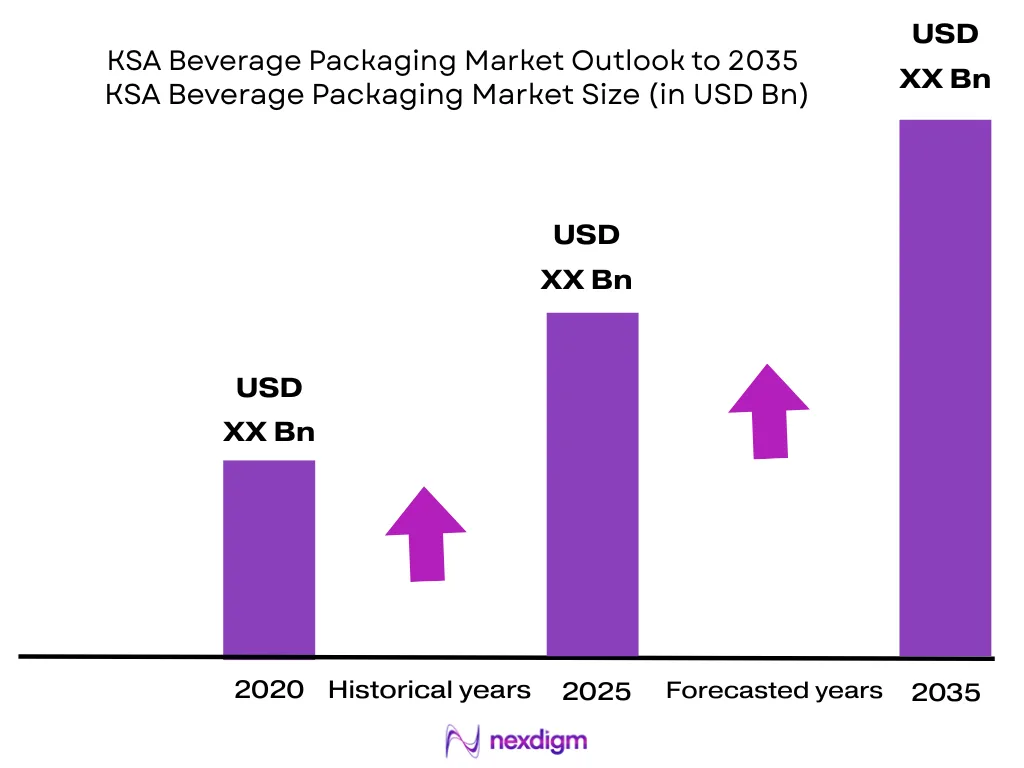
The KSA Beverage Packaging Market is valued at approximately USD ~ billion and is forecast to expand at a CAGR of % during 2026–2035. Saudi nominal GDP reached approximately USD 1.24 trillion, compared with about USD 1.07 trillion in the preceding annual period, while the population reached 35.30 million people. Demand is driven by packaged water, dairy, laban, juices, soft drinks, energy drinks, malt beverages, hospitality, foodservice and pilgrimage-related consumption. Riyadh, Jeddah, Dammam, Al Kharj, Makkah and Madinah dominate the KSA Beverage Packaging Market. Riyadh combines population, national retail headquarters, beverage bottling, packaging conversion and central distribution. Jeddah serves western-region consumers, port logistics, hospitality and pilgrimage supply chains. Dammam and Jubail benefit from petrochemical materials and eastern industrial infrastructure, while Al Kharj has substantial dairy and beverage processing. Makkah and Madinah generate high-volume seasonal demand for water and portion-controlled beverages.
Market Segmentation
By Packaging Material
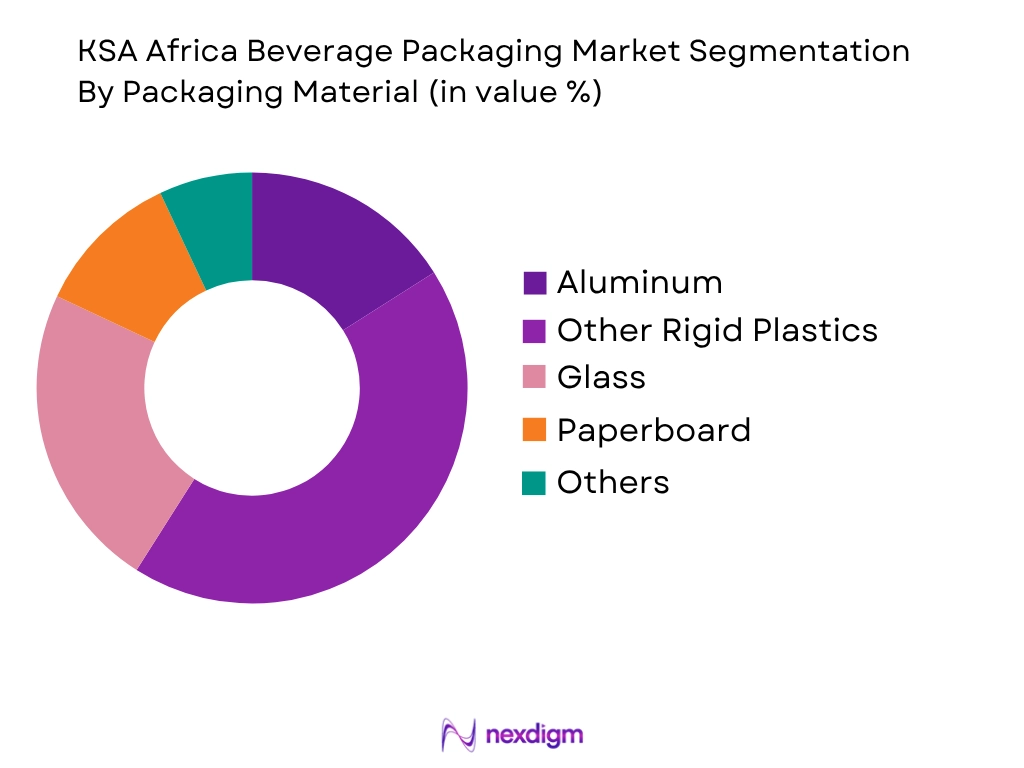
The KSA Beverage Packaging Market is segmented into PET and other rigid plastics, aluminium and steel, paperboard and aseptic cartons, glass, and flexible or composite packaging. PET and other rigid plastics hold the dominant indicative position because packaged drinking water, carbonated soft drinks, juice, dairy products and family-size beverages depend extensively on bottles, preforms, caps and labels. PET provides low transport weight, transparency, reclosure and compatibility with high-speed filling. Aluminium cans are prominent in energy drinks, carbonated beverages, malt drinks and ready-to-drink coffee. Aseptic cartons hold an established role in milk, laban, juice, camel-milk beverages and shelf-stable nutritional products. Glass remains relevant for premium water, juice, malt beverages and hospitality applications. Flexible structures serve concentrates, pouches, powdered beverages and bag-in-box systems.
By Beverage Category
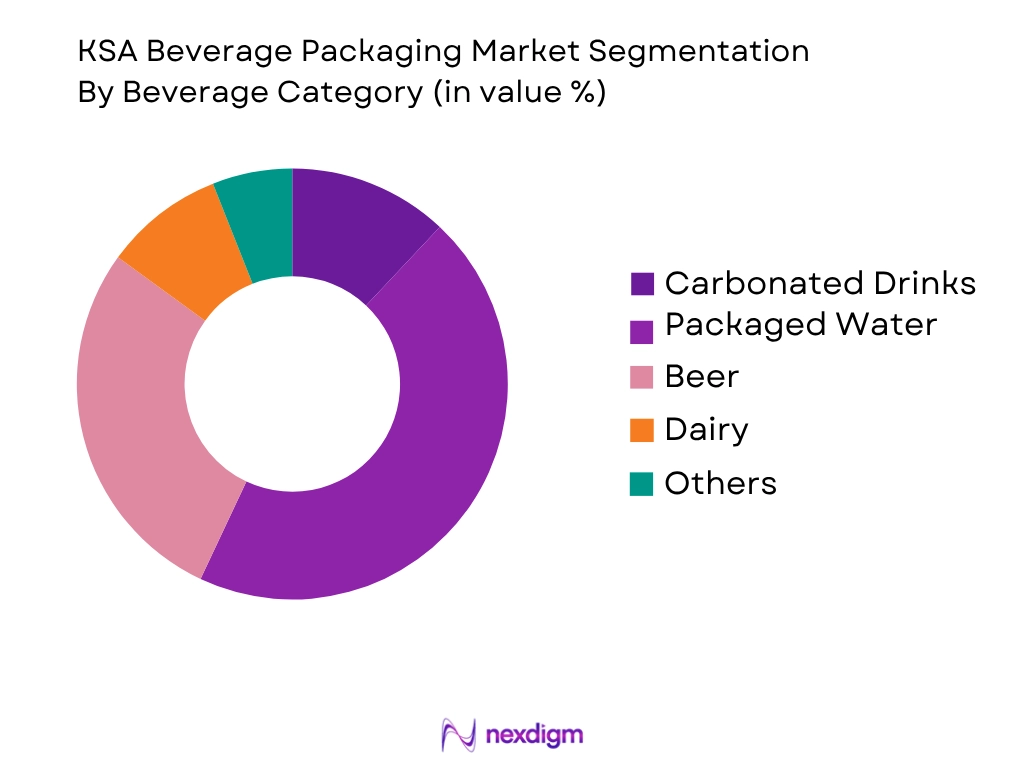
The KSA Beverage Packaging Market is segmented into packaged drinking water, dairy and laban beverages, carbonated soft drinks, juices and nectars, energy and sports drinks, ready-to-drink tea and coffee, malt beverages, plant-based beverages, and functional products. Packaged drinking water holds the dominant indicative share because high temperatures, household hydration, workplaces, schools, hospitality, outdoor activity, Hajj and Umrah travel, and institutional distribution create continuous requirements for single-serve PET bottles, multi-serve bottles, five-gallon jars, caps, labels, shrink films and cases. Dairy and laban support HDPE, PET, gable-top and aseptic cartons. Carbonated drinks and energy beverages sustain can and pressure-resistant PET demand. Juice producers require hot-fill PET, glass and aseptic cartons, while hotels and premium restaurants generate demand for decorative glass and aluminium formats.
Competitive Landscape
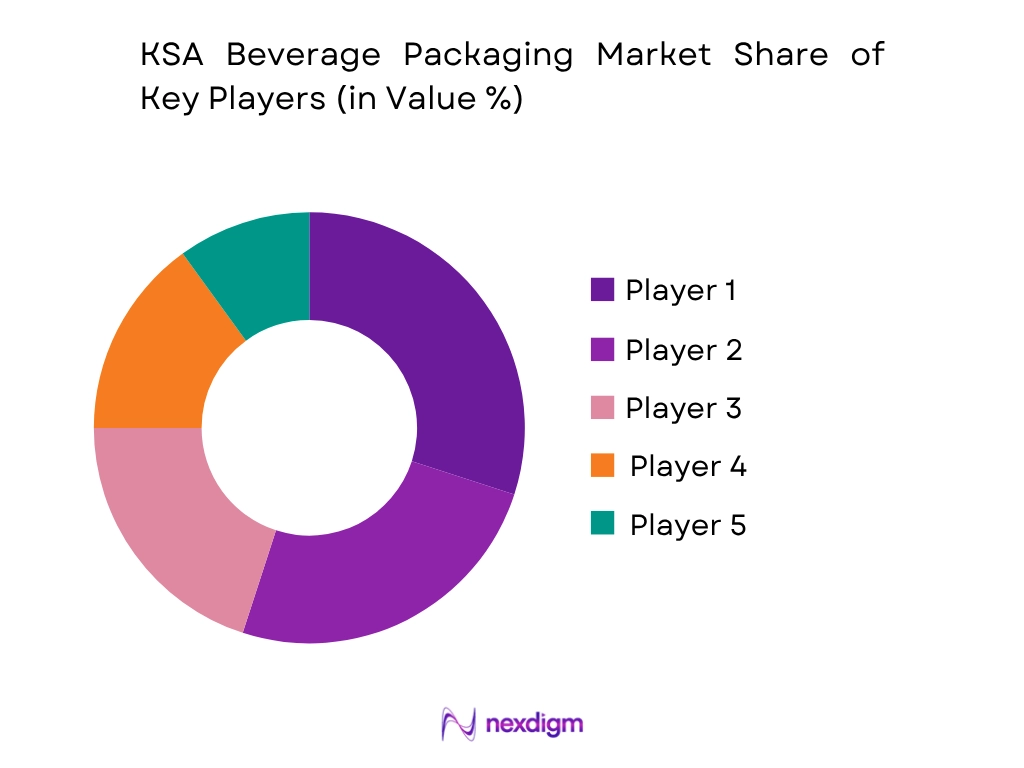
The KSA Beverage Packaging Market combines domestic plastic, metal, glass, paper and flexible-packaging companies with multinational carton and closure suppliers. Competition is influenced by local manufacturing capacity, access to petrochemical feedstock, proximity to beverage fillers, high-temperature package performance, food-contact compliance, Arabic-language documentation and the ability to supply large pilgrimage, retail and hospitality volumes. Napco National, Takween Advanced Industries, Saudi Arabian Packaging Industry, Tetra Pak Arabia and SIG Combibloc Obeikan represent major positions across flexible packaging, rigid plastics, metal containers and aseptic-carton systems.
| Company | Establishment Year | Headquarters | Core Beverage Portfolio | Material Capability | Principal Applications | KSA Footprint | Circularity Capability | Strategic Differentiation |
| Napco National | 1956 | Dammam, Saudi Arabia | ~ | ~ | ~ | ~ | ~ | ~ |
| Takween Advanced Industries | 1993 | Al Khobar, Saudi Arabia | ~ | ~ | ~ | ~ | ~ | ~ |
| Saudi Arabian Packaging Industry | 1976 | Riyadh, Saudi Arabia | ~ | ~ | ~ | ~ | ~ | ~ |
| Tetra Pak Arabia | 1951 group heritage | Pully, Switzerland | ~ | ~ | ~ | ~ | ~ | ~ |
| SIG Combibloc Obeikan | 2001 joint-venture heritage | Riyadh, Saudi Arabia | ~ | ~ | ~ | ~ | ~ | ~ |
KSA Beverage Packaging Market Analysis
Growth Drivers
Packaged-Water Demand, Pilgrimage Traffic, and Urban Beverage Consumption
Saudi Arabia’s beverage-packaging demand is supported by a resident population of 35,300,280 people, extensive packaged-water consumption, large metropolitan markets, religious tourism, hospitality, foodservice, schools, workplaces, healthcare facilities, and outdoor activity. Saudi GDP at current prices reached SAR 4,070 billion in 2024, providing a broad consumption and manufacturing base for PET bottles, aluminium cans, glass containers, aseptic cartons, closures, labels, shrink films, corrugated cases, reusable water jars, and filling equipment. Riyadh combines national retail headquarters, beverage filling, packaging conversion, warehousing, and central distribution. Jeddah serves western-region consumers, port logistics, hotels, foodservice, Makkah, and Madinah. Dammam and Jubail benefit from access to petrochemical materials, industrial infrastructure, and Gulf distribution, while Al Kharj has substantial dairy and beverage-processing activity. Religious tourism creates an additional market-specific demand layer. The official Hajj count reached 1,833,164 pilgrims in 2024, including 1,611,310 international pilgrims and 221,854 domestic pilgrims. In 2025, the Hajj system served 1,673,230 pilgrims using 420,070 public- and private-sector workers, demonstrating the scale of temporary water, juice, dairy-drink, foodservice, transport, and institutional distribution required around Makkah and Madinah. Saudi Arabia also recorded 3,348,512 foreign Umrah performers during the third quarter of 2024, generating demand beyond the concentrated Hajj period. Packaged water uses small PET bottles, multi-serve containers, five-gallon jars, caps, labels, shrink-wrapped multipacks, and paperboard cases. Dairy, laban, flavoured milk, juice, and camel-milk products sustain PET, HDPE, gable-top, and aseptic-carton demand. Carbonated soft drinks, energy beverages, malt drinks, and ready-to-drink coffee support aluminium cans and pressure-resistant PET. High-volume pilgrimage distribution requires compact containers, tamper evidence, heat resistance, pallet efficiency, rapid manual handling, and organised waste collection. The interaction of 35.3 million residents, more than 1.8 million Hajj pilgrims, millions of Umrah visitors, and SAR 4,070 billion in economic activity makes beverage packaging a structural component of Saudi food manufacturing, retail, hospitality, and logistics.
Non-Oil Industrial Expansion and Local Packaging Manufacturing
Saudi Arabia’s industrial-diversification strategy is expanding the domestic ecosystem for beverage bottles, preforms, closures, cans, cartons, labels, films, corrugated cases, filling lines, and recycling services. GASTAT recorded GDP at current prices of SAR 4,070 billion in 2024, with manufacturing excluding petroleum refining accounting for approximately SAR 370 billion when the official sector contribution is applied to total output. Wholesale and retail trade, restaurants, and hotels accounted for approximately SAR 419 billion, creating a sizeable downstream market for packaged beverages and foodservice formats. The country’s updated national accounts placed the preceding annual GDP level at SAR 4.5 trillion under the revised statistical framework, including an additional SAR 566 billion identified through improved measurement of economic activity. Although the historical series is subject to revision, the update demonstrates the scale of small, medium, and diversified enterprises participating in the Saudi economy. Local beverage-packaging production benefits from access to petrochemical feedstock, industrial cities, national logistics infrastructure, and proximity to large bottlers. Riyadh supports metal, plastic, paper, and label conversion. Jeddah connects packaging plants with western-region beverage producers, ports, pilgrimage markets, and foodservice operators. Dammam, Jubail, and Al Khobar provide access to polymer and chemical supply chains, while Al Kharj combines major dairy and beverage filling operations. Domestic production reduces the cost and operational risk of transporting empty bottles, cans, cartons, and closures over long distances. It also allows converters to work directly with beverage plants on bottle weight, preform neck design, closure torque, can seams, carton sterility, label adhesion, and pallet configuration. Industrial activity continued expanding into 2025 and 2026. GASTAT reported real GDP of SAR 4,789 billion in 2025, while the first quarter of 2026 recorded growth across oil, non-oil, and government activities. In April 2025, Saudi oil production reached 9.01 million barrels per day, while manufacturing activity increased materially compared with the preceding annual period, indicating stronger utilisation of industrial facilities and downstream chemical capacity. For beverage packaging, the main implication is a broader local supplier base capable of serving water, dairy, juice, carbonated soft drinks, energy drinks, and hospitality customers. Opportunities also extend to contract filling, digital printing, small-run can decoration, aseptic-line servicing, food-contact testing, and package-design engineering. The combination of industrial localisation, petrochemical availability, beverage-filling investment, and national logistics supports a transition from import-dependent container procurement toward integrated Saudi production and technical support.
Market Challenges
High-Temperature Distribution and Food-Contact Performance
Saudi Arabia’s climate places demanding technical requirements on PET bottles, aluminium cans, glass containers, cartons, closures, labels, flexible laminates, corrugated cases, and pallet systems. Packaged beverages may move from controlled filling plants into outdoor loading areas, ambient warehouses, long-distance trucks, petrol stations, temporary pilgrimage facilities, construction sites, or vehicles exposed to substantial heat. PET bottles can experience panel deformation, loss of top-load strength, base instability, cap leakage, or altered carbonation pressure when preform design, resin quality, wall distribution, and storage conditions are unsuitable. Aluminium cans require consistent seam geometry, internal coatings, pressure resistance, and end performance. Glass bottles must withstand thermal transitions, impact, and pallet vibration. Aseptic cartons and flexible pouches must preserve barrier and seal integrity, while labels and adhesives need to resist heat, humidity, condensation, and surface distortion. Saudi Arabia’s SAR 4,070 billion economy and population of 35,300,280 people support large beverage-filling and distribution systems, making technical failures operationally significant. A defect affecting a high-speed filling line can produce thousands of rejected containers before detection. SFDA enforcement illustrates the importance of package and product compliance. Saudi bottled-water regulation sets the maximum bromate concentration at 10 parts per billion, and SFDA issued a product warning in 2025 after laboratory testing identified a bottled-water product that exceeded the permitted limit. Approved requirements also specify a drinking-water pH range from 6.5 to 8.5 and require specific labelling for drinking and natural mineral water. These rules relate primarily to beverage quality, but packaging systems must protect compliant water from contamination, migration, seal failure, and improper storage throughout its shelf life. Food-contact risk extends to polymer additives, recycled resin, can coatings, printing inks, adhesives, cap liners, and carton barrier layers. Producers importing or manufacturing filled beverages must maintain technical records, product registration, traceability, and compliance with applicable Saudi and Gulf requirements. Lightweighting adds another engineering constraint. Reducing plastic, metal, glass, or board can lower material consumption, but excessive reduction can increase deformation, breakage, or beverage loss. Smaller regional producers may lack in-house polymer, seaming, migration, or aseptic-filling expertise and therefore depend on packaging suppliers and external laboratories. The central challenge is not simply producing a recyclable container; it is creating packaging that survives extreme distribution conditions, protects the beverage, runs efficiently on high-speed lines, and satisfies food-contact and product-integrity requirements.
Fragmented Recovery and Limited Beverage-Grade Recycled Feedstock
Saudi Arabia’s waste-management framework is developing rapidly, but beverage-container collection remains fragmented across municipalities, commercial waste contractors, hotels, retailers, pilgrimage sites, airports, workplaces, residential compounds, and informal material channels. PET bottles, aluminium cans, glass containers, cartons, shrink films, caps, and labels require different collection and processing routes. Mixed municipal waste can contaminate beverage packaging with food residue, liquids, sand, oils, paper, and unrelated plastics. PET intended for new food-contact bottles must be sorted by colour and polymer, washed, decontaminated, filtered, pelletised, and tested. Aluminium cans need separation from steel, foil, aerosols, and other scrap. Glass must be separated from ceramics, stones, heat-resistant glass, and mixed colours. Used beverage cartons require specialised hydrapulping, while multilayer pouches and barrier films are difficult to recycle through conventional mechanical processes. The challenge is particularly important because Saudi Arabia has a population of 35,300,280 people, recorded 1,833,164 Hajj pilgrims in 2024, and hosted millions of Umrah visitors, producing concentrated packaging flows in cities, transport hubs, hotels, and religious sites. MWAN’s strategic plan aims to divert waste from landfill and develop integrated recycling systems, but the target requires extensive sorting, collection, treatment, licensing, and market development across material categories. MWAN currently maintains licensing pathways for activities including recyclable-waste sorting and processing, collection and transportation, recycling-facility establishment, waste technologies, and final disposal. This structure improves formal oversight, but beverage producers still need sufficient volumes of clean, traceable material located within practical transport distance of recyclers. PET bottles are bulky unless compacted or baled, making long-distance transport inefficient. Glass has a high weight-to-value ratio, while cartons and flexible films may not generate sufficient returns unless aggregated at scale. The pilgrimage system creates both a challenge and an opportunity: large quantities of similar water bottles can be collected over a defined period, but temporary sites need containers, trained staff, balers, transport schedules, and recycler contracts. Saudi GDP at current prices reached SAR 4,070 billion in 2024, indicating sufficient economic capacity to fund collection and recycling infrastructure, yet investment must be coordinated across cities and material streams. Without dependable domestic feedstock, packaging manufacturers may remain more reliant on virgin resin, primary metal, imported cullet, or non-food recycled materials. The market challenge is therefore converting dispersed beverage waste into specification-grade secondary raw material with documented origin, stable composition, and food-contact eligibility.
Market Opportunities
Food-Grade rPET, Smart Collection, and Closed-Loop Water Bottles
Saudi Arabia has a substantial opportunity to build closed-loop PET systems around packaged-water consumption, pilgrimage traffic, urban retail, hotels, workplaces, schools, airports, and institutional sites. The current demand base includes 35,300,280 residents, 1,833,164 Hajj pilgrims in 2024, 1,673,230 Hajj pilgrims in 2025, and 1,707,301 pilgrims in 2026. These exact visitor flows create concentrated, predictable streams of small PET water bottles around Makkah, Madinah, airports, rail stations, accommodation sites, catering facilities, and transport corridors. In 2026, 1,546,655 Hajj pilgrims arrived from outside Saudi Arabia and 160,646 were domestic pilgrims, demonstrating the importance of transport-linked and temporary-site beverage distribution. A closed-loop system could begin with clear PET bottles, limited pigments, smaller labels, wash-off adhesives, compatible caps, and consistent bottle geometries. Reverse-vending machines and smart bins can identify accepted containers through barcodes, shape recognition, or material detection and then compact them for transport. Pilgrimage operators, retailers, hotels, airports, universities, hospitals, and government offices can provide relatively clean collection streams compared with mixed municipal waste. Digital systems can record the collection point, container type, weight, collection contractor, recycling batch, pellet output, preform manufacturer, and final beverage use. This traceability is important for food-grade rPET and producer environmental reporting. Saudi Arabia’s SAR 4,070 billion GDP provides the industrial and financial base for optical sorting, hot washing, decontamination reactors, melt filtration, pelletising, preform moulding, laboratory testing, and material-certification services. MWAN’s waste-sector framework already licenses recyclable-waste sorting, recycling-facility establishment, transport, and waste-management technologies, enabling investors to structure formal operations rather than relying on unregulated collection. Additional opportunities include mobile balers for seasonal pilgrimage sites, retail reward applications, bottle-deposit trials, commercial collection contracts, and long-term resin offtake agreements with packaged-water companies. Five-gallon refillable water jars offer a parallel circular system. QR codes or RFID tags can record washing cycles, cap replacement, route movement, and asset loss. Closed-loop development would reduce reliance on virgin PET only when clean collection, approved recycling technology, food-contact verification, and beverage-brand procurement are developed together. Current population, pilgrimage volumes, official waste-management licensing, and concentrated water consumption provide a measurable foundation for future food-grade rPET capacity without requiring speculative market-size forecasts.
Aluminium Cans, Aseptic Cartons, and Pilgrimage-Specific Packaging Systems
Saudi Arabia’s beverage mix creates opportunities for aluminium cans, aseptic cartons, fibre-based secondary packaging, and purpose-designed high-volume pilgrimage formats. Aluminium cans are suited to energy drinks, carbonated soft drinks, malt beverages, sparkling water, ready-to-drink coffee, and functional drinks because they provide complete light protection, pressure resistance, rapid chilling, efficient pallet density, and a large printable surface. Standard, sleek, slim, and mini formats allow beverage companies to target convenience stores, petrol stations, hotels, airports, entertainment venues, and younger consumers. Digital printing and sleeving can support small production runs for seasonal beverages, regional brands, sporting events, Ramadan products, and promotional campaigns. Aseptic cartons provide a separate opportunity in milk, laban, flavoured dairy, juice, nectar, camel-milk beverages, plant-based drinks, and nutritional products. They support ambient distribution before opening, reducing dependence on continuous refrigeration across long national delivery routes. Saudi Arabia’s dairy and juice-processing clusters in Al Kharj, Riyadh, Jeddah, Qassim, and the Eastern Region provide a customer base for cartons, closures, processing systems, and filling-line services. Pilgrimage creates an additional format opportunity. The 1,833,164 pilgrims recorded in 2024, 1,673,230 in 2025, and 1,707,301 in 2026 require high-volume water, juice, dairy-drink, and catering distribution. Packaging for these operations must combine low weight, tamper evidence, heat resistance, efficient stacking, fast handout, and straightforward collection. Paperboard cases, clip-style can carriers, moulded-fibre trays, compact water multipacks, and bulk beverage dispensers can reduce secondary material while maintaining handling performance. The 420,070 workers serving Hajj pilgrims in 2025 illustrate the size of the operational network that could implement segregated collection and return logistics. Aluminium recovery can be strengthened through collection cages, event-site compactors, retail take-back, and agreements with licensed scrap processors. Used aseptic cartons require dedicated hydrapulping and fibre-recovery systems, creating opportunities for specialised recycling plants and retailer collection. Saudi GDP reached SAR 4,070 billion in 2024, while the IMF lists a population of 36.726 million for 2026, indicating continued expansion of the underlying beverage-consumption and manufacturing base. The strongest opportunity is not in selling isolated containers but in providing integrated systems covering container design, filling compatibility, closures, multipacks, collection, and recycling support.
Future Outlook
The KSA Beverage Packaging Market is expected to expand through 2035 as packaged-water consumption, dairy processing, juice manufacturing, hospitality, modern retail and pilgrimage services sustain container demand. PET bottles, aluminium cans, aseptic cartons, refillable water jars and heat-resistant secondary packaging will remain central to future development. Industrial localisation under Saudi economic-diversification policy will support new converting, filling and recycling capacity. GASTAT reported that non-oil activities grew by 4.3% in 2024 and 4.9% in 2025, while real GDP growth strengthened to 4.5% in 2025. These figures support continued investment in food manufacturing, logistics, retail, hotels and packaging production. Packaged water will remain the largest beverage-packaging application. Saudi regulations cover bottled drinking water labelling, product composition, hygiene and container integrity. SFDA has also confirmed that bottled water must comply with the Saudi-Gulf technical regulation governing product quality, including a maximum bromate level of 10 parts per billion.
Major Players
- Saudi Arabian Packaging Industry
- Napco National
- Zamil Plastic Industries
- Takween Advanced Industries
- Saudi Plastic Factory Company
- Al Sharq Plastic Industries
- Arabian Can Industry
- Saudi Can Manufacturing Company
- Mahmood Saeed Beverage Cans and Ends Industry
- National Metal Manufacturing and Casting Company
- Obeikan Investment Group
- Tetra Pak Arabia
- SIG Combibloc Obeikan
- Saudi Glass Company
- Bericap Saudi Arabia
Key Target Audience
- Beverage-container and packaging-material manufacturers
- Packaged-water, soft-drink, dairy, juice and energy-beverage producers
- Contract beverage fillers and co-packaging companies
- Hotels, foodservice operators, retailers and pilgrimage caterers
- Waste collectors, recyclers and material-recovery operators
- Investments and venture capitalist firms
- Private-equity and strategic packaging investors
- Government and regulatory bodies
Research Methodology
Step 1: Identification of Key Variables
The initial phase constructs an ecosystem map covering resin suppliers, bottle and preform manufacturers, can companies, carton suppliers, closures, beverage fillers, retailers, hospitality operators, waste contractors and recyclers. Critical variables include container units, package weight, beverage volume, filling technology, heat resistance, recycled content, local capacity and regulatory exposure.
Step 2: Market Analysis and Construction
Historical data is compiled by material, container format, beverage category, pack size, distribution channel and region. Bottom-up analysis evaluates packaging plants, filling capacity, container shipments, material tonnage and company revenues. Top-down analysis reviews GDP, population, non-oil activity, beverage manufacturing, retail, hospitality, imports and waste flows.
Step 3: Hypothesis Validation and Expert Consultation
Market hypotheses are validated through computer-assisted telephone interviews with packaging converters, beverage companies, dairy processors, packaged-water producers, contract fillers, retailers, hotels, waste operators and regulatory specialists. Consultations assess plant utilisation, heat performance, package qualification, local sourcing, compliance and procurement behaviour.
Step 4: Research Synthesis and Final Output
Supply-side and demand-side findings are triangulated to reconcile domestic production, imports, beverage filling and recovered-material availability. Segment shares and forecasts are tested against package weights, plant footprints, filling capacity, SFDA requirements, MWAN licensing, company disclosures and primary-industry feedback.

- Executive Summary
- Research Methodology (Market Definitions and Assumptions, Beverage Packaging Inclusion and Exclusion Criteria, Abbreviations, Market Sizing Approach, Top-Down Analysis, Bottom-Up Analysis, Beverage Filling Volume Model, Container Unit Conversion Model, Material Tonnage Assessment, Domestic Production Analysis, Import and Export Assessment, Demand-Side Interviews, Supply-Side Interviews, Data Triangulation, Regional Scenario Modelling, Forecasting Framework, Limitations and Future Conclusions)

- Definition and Scope
- Market Evolution and Industry Genesis
- Evolution of Beverage Packaging Materials
- Development of PET Bottled-Water Packaging
- Expansion of Aluminium Beverage Cans
- Development of Returnable and One-Way Glass Bottles

- Growth Drivers (Packaged-Water Consumption, Population Expansion, Religious Tourism, Hospitality, Dairy Processing, Juice Production, Modern Retail, Foodservice and Industrial Localisation)
- Market Challenges (High-Temperature Distribution, Recycled Feedstock Availability, Import Dependence, Glass Freight Intensity, Collection Fragmentation, Multilayer Recovery and Food-Contact Compliance)
- Market Opportunities (Food-Grade rPET, Aluminium Can Expansion, Water Refill Systems, Aseptic Cartons, Fibre-Based Multipacks, Smart Collection, Premium Glass and Regional Co-Packing)
- Market Trends (PET Lightweighting, Can Premiumisation, Recycled Content, Refillable Water Jars, Digital Printing, Aseptic Packaging, Smart Labels and Packaging Carbon Disclosure)
- SWOT Analysis
- Porter’s Five Forces Analysis
- PESTLE Analysis

- By Market Value (2020-2025)
- By Beverage Container Units (2020-2025)
- By Packaged Beverage Volume (2020-2025)

- By Packaging Material (In Value %)
PET
HDPE
Polypropylene
Polyethylene Films
Aluminium
Steel and Tinplate
Glass - By Beverage Category (In Value %)
Packaged Drinking Water
Natural Mineral Water
Flavoured and Enhanced Water
Carbonated Soft Drinks
Energy Drinks
Sports and Isotonic Drinks
Fruit Juices - By Distribution Channel (In Value %)
Supermarkets and Hypermarkets
Convenience Stores
Petrol-Station Stores
Traditional Grocery Stores
Wholesale Markets
Beverage Distributors
Online Grocery
Quick-Commerce Platforms - By Region (In Value %)
Central Region
Western Region
Eastern Region
Northern Region
Southern Region

- Market Share of Major Players
- Cross Comparison Parameters (Beverage Container Material and Format Breadth, Annual Beverage Container and Closure Manufacturing Capacity, KSA Plant Footprint and Proximity to Filling and Pilgrimage Clusters, Food-Grade rPET and Closed-Loop Material Capability, High-Temperature Performance and Filling-Line Technical Support, Beverage Category and Pack-Size Coverage, SFDA SASO and Waste-Management Compliance Support, Lightweighting and New-Format Commercialisation Capability)
- SWOT Analysis of Major Players
- Detailed Profiles of Major Companies
Saudi Arabian Packaging Industry
Napco National
Zamil Plastic Industries
Takween Advanced Industries
Saudi Plastic Factory Company
Al Sharq Plastic Industries
Arabian Can Industry
Saudi Can Manufacturing Company
Mahmood Saeed Beverage Cans and Ends Industry
National Metal Manufacturing and Casting Company
Obeikan Investment Group
Tetra Pak Arabia
SIG Combibloc Obeikan
Saudi Glass Company
Bericap Saudi Arabia

- Packaged-Water Producer Analysis
- Carbonated Soft Drink Producer Analysis
- Energy and Sports Drink Producer Analysis
- Juice and Nectar Producer Analysis
- Dairy, Laban and Camel-Milk Producer Analysis

- By Market Value (2026-2035)
- By Beverage Container Units (2026-2035)
- By Packaged Beverage Volume (2026-2035)


 Request a Sample
 Ask for Customization
 Get a Quote
 Enquire Now