

 Download PDF
Market Overview
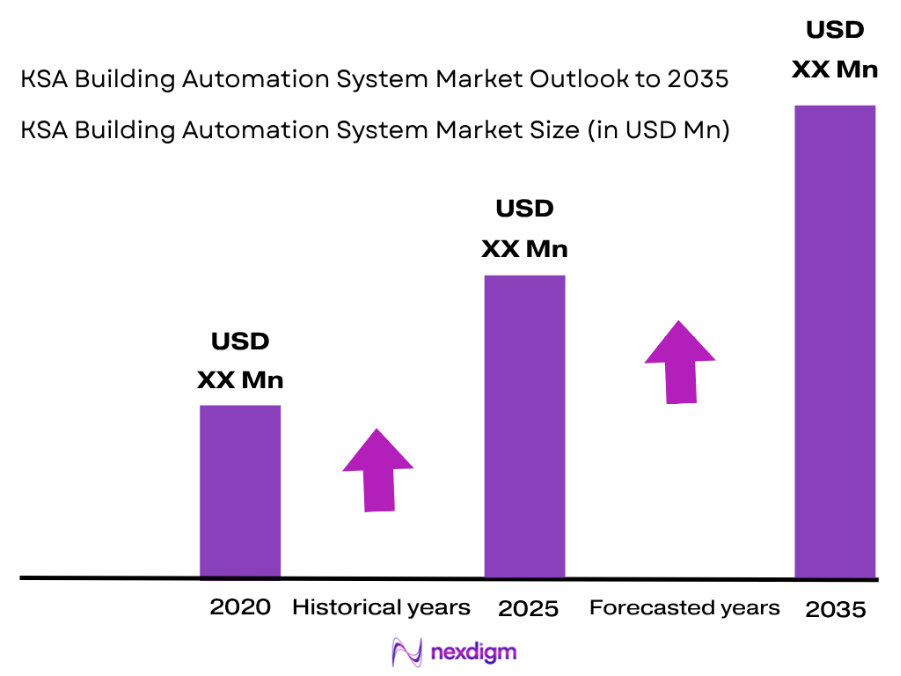
The KSA Building Automation System Market is valued at ~USD XX billion, supported by the expansion of commercial, residential, hospitality, healthcare and infrastructure assets across the Kingdom. Saudi Arabia recorded SAR 4,070 billion in GDP at current prices, while construction contributed 5.5 to GDP and expanded by 4.2 in real terms. Real-estate activities represented 6.5 of GDP, demonstrating the importance of the built environment. Vision 2030 is simultaneously accelerating technology adoption, infrastructure development and economic diversification, strengthening demand for HVAC controls, energy management, IoT sensors and integrated building-management platforms.
Riyadh, Jeddah, Dammam and the emerging giga-project locations represent the principal demand centres for the KSA Building Automation System Market because they combine dense building activity, commercial development and large-scale infrastructure programs. Riyadh is particularly important because of major financial, residential and mixed-use developments, while Jeddah benefits from tourism, hospitality and urban regeneration projects. The Kingdom’s Vision 2030 framework identifies large projects and urban transformation as strategic development priorities, while its Housing Program targets a 70 home ownership rate by 2030. NEOM, Qiddiya, Red Sea and other developments further create requirements for digitally integrated buildings.
Market Segmentation
By System Type
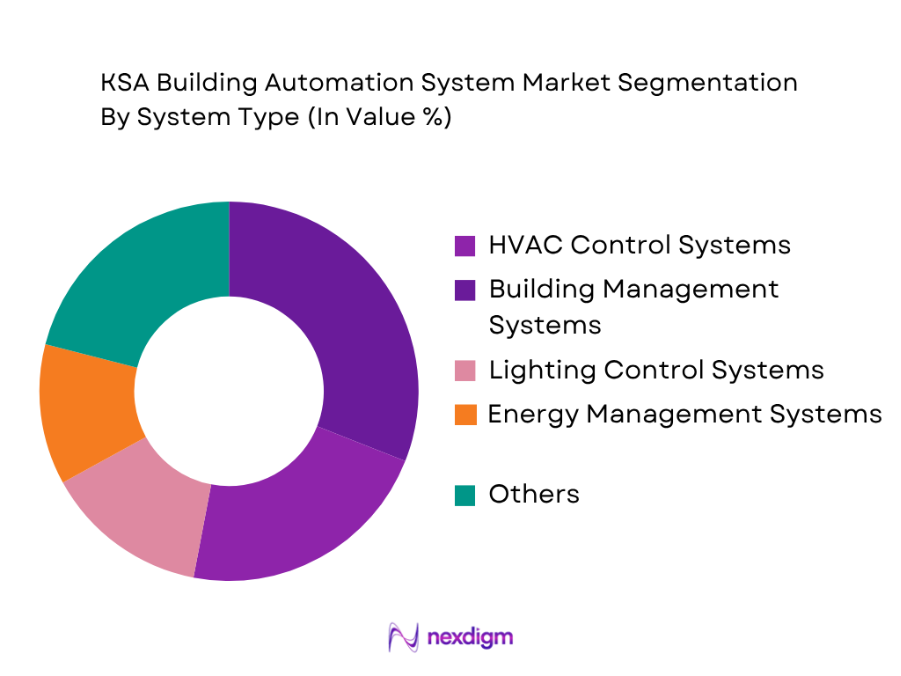
The KSA Building Automation System Market is segmented by system type into building management systems, HVAC control systems, energy management systems, lighting control systems, security and access-control systems, fire and life-safety integration, smart metering systems and integrated automation platforms. Building Management Systems are expected to maintain the leading position because they provide the centralized architecture required to monitor and coordinate HVAC, lighting, energy, alarms and other building services. Their relevance is particularly high in large commercial buildings, hotels, hospitals, mixed-use developments and giga-project facilities where multiple subsystems must operate through a unified supervisory platform. HVAC control systems represent another substantial component because cooling is a critical building function in Saudi Arabia. Integration of chillers, air-handling units, pumps, fans and variable-air-volume systems allows operators to automate schedules and operating conditions. The increasing emphasis on energy efficiency also strengthens demand for energy-management modules and smart meters. Cloud connectivity, IoT gateways and analytics further expand the functionality of conventional BMS platforms, moving the market toward integrated, data-driven building operations.
By Building Type
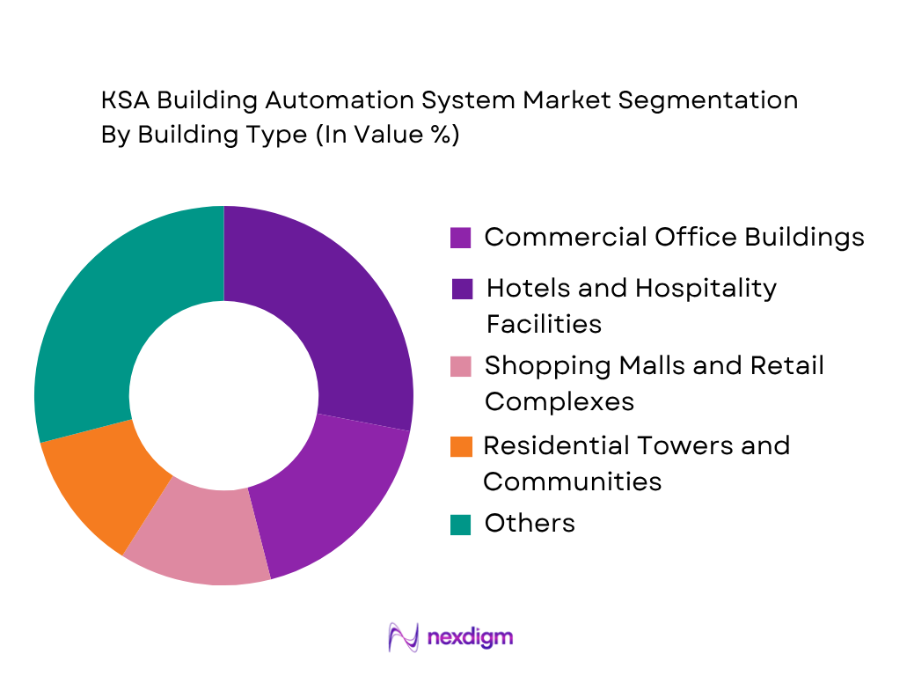
The KSA Building Automation System Market is segmented by building type into commercial office buildings, hotels and hospitality facilities, shopping malls and retail complexes, residential towers and communities, mixed-use developments, healthcare facilities, educational buildings, government buildings, financial and banking facilities, industrial and manufacturing facilities, warehouses and logistics facilities, data centres, airports and transportation facilities, and sports and entertainment facilities. Commercial office buildings are expected to represent a leading application because they require continuous HVAC management, centralized facility monitoring, lighting control, access integration and energy optimization across large occupied spaces. Riyadh’s expanding business districts and commercial developments reinforce this demand, while Jeddah adds requirements from retail, hospitality and mixed-use projects. Hotels and hospitality facilities are also strategically important because Saudi Arabia is developing tourism and entertainment infrastructure under Vision 2030. Data centres constitute a technically demanding application because uninterrupted cooling, environmental monitoring, power management and alarm handling are critical. Healthcare facilities similarly require sophisticated HVAC zoning, indoor-air-quality monitoring and equipment integration. The increasing development of mixed-use communities creates additional opportunities because residential, retail, hospitality and commercial functions can be integrated under centralized building-management architectures.
Competitive Landscape
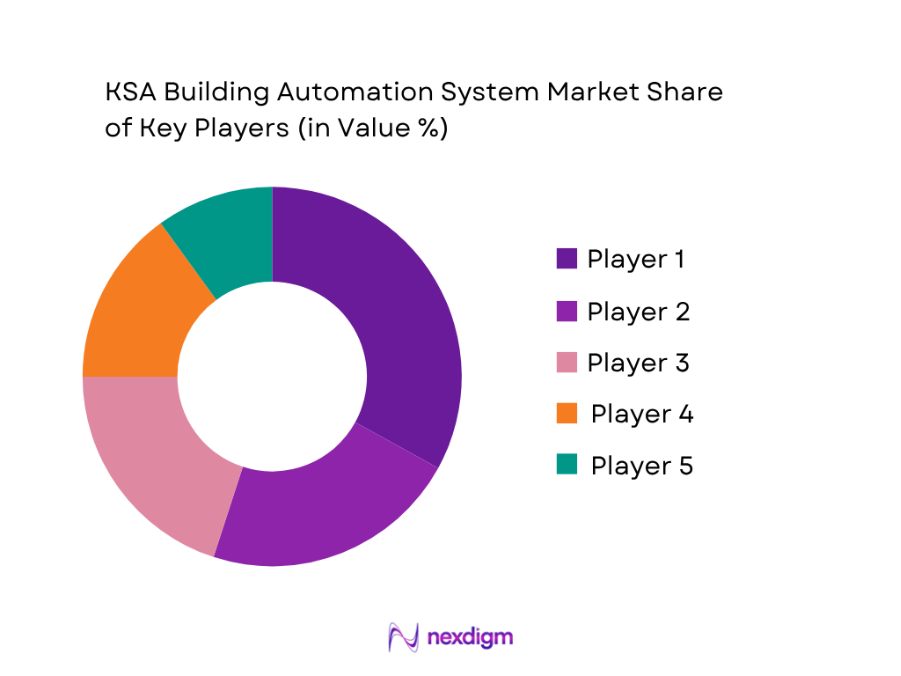
The KSA Building Automation System Market is characterized by international building-technology companies, controls specialists and engineering-system providers competing through HVAC automation, BMS platforms, energy-management capabilities, IoT connectivity and system integration. Siemens, Honeywell, Schneider Electric, Johnson Controls and ABB have strong positions through broad automation portfolios and the ability to integrate multiple building subsystems. Competition is increasingly influenced by cloud connectivity, AI-enabled analytics, cybersecurity, open-protocol compatibility and local engineering and commissioning capabilities. Large developments associated with Vision 2030 also favour suppliers capable of delivering complex, multi-building automation architectures and long-term lifecycle services.
| Parameter | Siemens | Honeywell | Schneider Electric | Johnson Controls | ABB |
| Establishment Year | 1847 | 1885 | 1836 | 1885 | 1883 |
| Headquarters | Munich, Germany | Charlotte, USA | Rueil-Malmaison, France | Cork, Ireland | Zurich, Switzerland |
| Core BAS Capability | ~ | ~ | ~ | ~ | ~ |
| HVAC Controls | ~ | ~ | ~ | ~ | ~ |
| Energy Management | ~ | ~ | ~ | ~ | ~ |
KSA Building Automation System Market Analysis
Growth Drivers
Commercial Real Estate & Smart Infrastructure
Commercial real estate and large-scale urban development are creating a broad installation base for the KSA Building Automation System Market. According to the General Authority for Statistics (GASTAT), Saudi Arabia’s GDP reached SAR 4,789 billion in 2025, while construction activities contributed 8.0 to GDP. The economy recorded real GDP growth of 4.5 in 2025, with non-oil activities expanding 4.9, indicating continued diversification-led activity. The construction ecosystem is directly relevant to BAS demand because new offices, hotels, residential communities, retail destinations and mixed-use developments require integrated HVAC, lighting, energy and security controls. Vision 2030-linked developments are also increasing the technical complexity of new buildings, particularly in Riyadh, Jeddah and giga-project locations. Riyadh is becoming a major concentration point for commercial, financial and digital infrastructure, while Jeddah is supported by tourism, hospitality and urban-regeneration development. Large developments require centralized building-management platforms capable of coordinating multiple facilities and equipment types. The combination of construction expansion, smart-city implementation and increasingly sophisticated building specifications therefore creates a sustained project pipeline for BAS controllers, sensors, supervisory software, HVAC automation, energy-management platforms and integrated facility-management systems across the Kingdom.
HVAC & Energy Optimization
High cooling requirements and increasing emphasis on energy efficiency are important structural drivers for the KSA Building Automation System Market. GASTAT’s Energy Efficiency Statistics 2024 recorded building-sector energy consumption intensity at 118 barrels of oil equivalent per million SAR, compared with 172 for industry and 80 for transportation. The same publication reported building-sector electricity consumption of 23 megawatt-hours per consumer, compared with 23 megawatt-hours in the preceding period, while government-sector electricity consumption reached 129.3 megawatt-hours per consumer. Primary energy savings from energy-efficiency initiatives reached 662 thousand barrels of oil equivalent per day, including 484 thousand barrels of oil equivalent per day from residential, governmental and commercial buildings. These figures directly reinforce the operational rationale for automated HVAC scheduling, chiller sequencing, variable-speed controls, temperature management, occupancy-based control and continuous energy monitoring. District cooling systems also benefit from centralized automation because chilled-water production, pumping and distribution require coordinated control across multiple operating points. Building electrification further increases the number of electrical loads that can be managed through a unified platform. BAS systems can connect meters, chillers, pumps, air-handling units, lighting and other equipment, enabling facility operators to identify abnormal consumption and optimize operating schedules.
Market Challenges
Legacy Systems & Interoperability
Legacy building infrastructure creates a significant technical challenge for the KSA Building Automation System Market because many properties contain equipment installed at different stages of their operational lifecycle. Existing chillers, air-handling units, pumps, meters, lighting systems and security equipment may use different controllers, communication protocols and software architectures. Consequently, a BAS modernization project may require gateways, protocol converters, controller replacement and additional engineering instead of a simple software upgrade. GASTAT reported 4.5 real GDP growth in 2025, with construction contributing 8.0 of current-price GDP, demonstrating the continuing expansion of the built environment alongside a large installed base requiring modernization. Retrofit complexity is particularly relevant to older commercial buildings, hotels, hospitals and government properties where installation must occur without disrupting occupied operations. Proprietary control platforms can also create vendor dependency and make it difficult to combine equipment from different manufacturers. Multi-vendor integration requires detailed point mapping, communication testing, commissioning and cybersecurity validation. HVAC integration presents another challenge because BAS modifications must preserve equipment safety, operating limits and manufacturer requirements. These conditions can increase engineering requirements and project duration while creating additional technical risks. As a result, suppliers with open-protocol support, migration capabilities and strong commissioning expertise can be better positioned to address the Kingdom’s retrofit environment.
Skills, Cybersecurity & Data Complexity
The increasing sophistication of connected buildings is creating skills, cybersecurity and data-management challenges for the KSA Building Automation System Market. Modern BAS deployments require expertise spanning HVAC controls, electrical systems, networking, IoT devices, software integration and cybersecurity rather than conventional equipment installation alone. GASTAT reported that Saudi Arabia’s real GDP increased by 4.5 in 2025, while non-oil activities expanded 4.9, indicating continued development of digitally intensive economic activities that require increasingly connected facilities. Saudi Arabia’s data-centre infrastructure also provides an indication of the digital complexity emerging around critical buildings. The Ministry of Communications and Information Technology reported approximately 148 MW of data-centre capacity in March 2024, with Riyadh accounting for 45 of national supply, Dammam 24 and Jeddah 16. Connected BAS infrastructure in such facilities must protect operational technology while maintaining continuous equipment monitoring and control. Cybersecurity becomes more important as controllers, sensors and supervisory platforms communicate through enterprise networks and cloud environments. Large facilities can also generate substantial quantities of temperature, occupancy, equipment-status and energy data, creating requirements for structured data governance and secure storage. Facility managers consequently need training to interpret alarms, analytics and automated recommendations. These technical requirements can constrain adoption when building owners lack specialized personnel or when system integrators are required to coordinate numerous technology vendors.
Market Opportunities
Data Centres, AI & Smart BAS
Data centres, advanced commercial facilities and giga-projects represent significant opportunities for higher-value BAS solutions in the KSA Building Automation System Market. The Ministry of Communications and Information Technology reported Saudi Arabia’s data-centre capacity at approximately 148 MW in March 2024, with Riyadh representing 45 of national capacity, Dammam 24 and Jeddah 16. These facilities require continuous environmental monitoring, cooling optimization, power monitoring, equipment alarms and highly reliable control architectures. This creates opportunities for BAS platforms that combine conventional automation with cloud analytics, predictive maintenance and AI-based optimization. Commercial-building retrofits provide another addressable opportunity because existing HVAC and electrical systems can be upgraded with sensors, smart meters, connected controllers and supervisory software without completely rebuilding the property. GASTAT’s Energy Efficiency Statistics recorded 484 thousand barrels of oil equivalent per day of primary energy savings from residential, governmental and commercial buildings, demonstrating the operational importance of building energy efficiency. AI-enabled BAS platforms can build on this environment by analyzing equipment performance and identifying abnormal chiller, pump, fan or air-handling-unit behaviour. Predictive maintenance can reduce dependence on fixed maintenance schedules by using operating data to identify emerging faults. Giga-projects provide an additional opportunity because large developments require centralized digital infrastructure capable of managing multiple buildings and interconnected mechanical and electrical systems.
Digital Twins & Integrated Energy Systems
The increasing integration of buildings with digital infrastructure and electrical systems creates opportunities for advanced BAS solutions across the KSA Building Automation System Market. Saudi Arabia’s electricity and energy-efficiency environment provides a strong technical foundation for integrated energy management. GASTAT reported building-sector electricity consumption of 23 megawatt-hours per consumer in its 2024 Energy Efficiency Statistics, while primary energy savings generated through energy-efficiency initiatives reached 662 thousand barrels of oil equivalent per day. These conditions create opportunities to connect building automation with smart meters, solar generation, EV charging, electrical storage and controllable HVAC loads. Digital twins can provide building operators with continuously updated representations of mechanical and electrical systems, supporting asset monitoring, commissioning and fault detection. Multi-site facility management is particularly relevant to organizations operating portfolios of offices, hotels, retail properties, healthcare facilities and government buildings because cloud-connected BAS platforms can consolidate operational information within centralized control environments. Saudi Arabia’s data-centre ecosystem further demonstrates the growth of digitally intensive infrastructure, with approximately 148 MW of capacity reported by MCIT in March 2024. BAS vendors can therefore expand beyond traditional temperature and equipment controls toward integrated energy and asset-management platforms. The opportunity is particularly relevant where building owners seek coordinated control of HVAC, lighting, renewable generation, EV charging and other electrical loads through a single operational architecture.
Future Outlook
The KSA Building Automation System Market is expected to experience sustained expansion through the forecast period as Saudi Arabia advances Vision 2030, smart-city programs, giga-projects and real-estate development. Demand is likely to shift from conventional HVAC controls toward integrated platforms connecting energy, lighting, security, occupancy and facility-management systems. Data centres, hospitality developments, healthcare facilities and mixed-use communities are expected to create particularly sophisticated BAS requirements. Cloud platforms, AI-enabled optimization, digital twins and predictive maintenance are likely to become increasingly important in new-build and retrofit projects. Vision 2030 explicitly identifies technology, investment and major projects as instruments of economic transformation.
Major Players
- Siemens
- Honeywell
- Schneider Electric
- Johnson Controls
- ABB
- Carrier
- Trane Technologies
- Delta Controls
- Distech Controls
- Automated Logic
- Belimo
- KMC Controls
- Azbil Corporation
- Legrand
- SAS Technology
Key Target Audience
- Commercial real estate developers and property owners
- Facility management companies and building operators
- HVAC and MEP contractors
- Data centre developers and operators
- Hospitality and tourism asset owners
- Industrial facility owners and manufacturing companies
- Investments and venture capitalist firms
- Government and regulatory bodies (Saudi Energy Efficiency Center, Ministry of Municipalities and Housing, Ministry of Energy, Saudi Building Code National Committee)
Research Methodology
Step 1: Identification of Key Variables
The initial phase involves mapping the KSA Building Automation System ecosystem across developers, building owners, facility managers, BAS manufacturers, HVAC contractors, MEP companies and system integrators. The assessment identifies the principal variables affecting BAS deployment, including building construction, HVAC intensity, energy-management requirements, retrofit activity, smart-city development and digital infrastructure.
Step 2: Market Analysis and Construction
Historical market information is compiled using a combination of supply-side and demand-side analysis. The assessment considers BAS installations, building-system integration, controller deployment, HVAC automation, energy-management systems, IoT connectivity and project-level adoption across commercial, residential, hospitality, healthcare, industrial and infrastructure facilities.
Step 3: Hypothesis Validation and Expert Consultation
Market hypotheses are validated through discussions with BAS manufacturers, system integrators, HVAC contractors, MEP specialists, facility managers and building developers. These consultations are used to validate deployment patterns, procurement structures, technology preferences, retrofit requirements and competitive positioning across major Saudi cities and development projects.
Step 4: Research Synthesis and Final Output
The final analysis triangulates company-level information, construction indicators, government development programs and project-level BAS requirements. Bottom-up estimates are reconciled with top-down market calculations to establish a consistent market framework covering system type, building type, deployment model, regional demand and future technology adoption.

- Executive Summary
- Research Methodology (Market Definitions and Assumptions, KSA BAS Market Classification, Building Automation System Scope, BAS and BMS Terminology Mapping, System Architecture Assessment, Controls and Automation Component Mapping, HVAC Controls Assessment, Chiller Plant Controls Assessment, Lighting Automation Assessment, Energy Management Assessment, Security and Access Integration Assessment, Fire and Life-Safety Integration Assessment, IoT and Sensor Ecosystem Mapping, BACnet and Modbus Integration Assessment, Cloud BAS Assessment, AI-Based Building Optimization Assessment, New-Build and Retrofit Market Mapping, Giga-Project Pipeline Assessment, Top-Down Market Sizing, Bottom-Up Market Sizing, Demand-Side Assessment, Supply-Side Assessment, Primary Industry Interviews, Project-Level Validation, Data Triangulation, Forecasting Framework)

- Definition and Scope
- Building Automation System Ecosystem in Saudi Arabia
- Evolution of Building Controls and BMS Infrastructure
- Saudi Smart Building Transformation and Vision 2030 Alignment
- Building Automation Value Chain Analysis
- BAS Supply Chain Analysis
- Building Automation System Architecture and Control Hierarchy
- HVAC, Lighting, Energy, Security and Life-Safety Integration Framework
- New-Build Versus Retrofit BAS Deployment Landscape
- Riyadh, Jeddah, Dammam and Major Urban Development Ecosystem

- Growth Drivers (Commercial Real Estate Development, Vision 2030 Smart Infrastructure Investment, Giga-Project Development, Riyadh Urban Expansion, Jeddah Urban Development, HVAC Energy Optimization, District Cooling Integration, Data Centre Expansion, Hospitality and Tourism Development, Green Building Requirements, Energy Efficiency Programs, Smart City Development, Digital Facility Management, IoT Sensor Deployment, Chiller Optimization, Building Electrification, Integrated Energy Management)
- Market Challenges (Legacy BAS Infrastructure, Proprietary Control Platforms, Interoperability Constraints, Protocol Compatibility Issues, Retrofit Installation Complexity, Skilled BAS Engineer Requirements, Cybersecurity Vulnerabilities, Fragmented System Integration Ecosystem, Existing HVAC Integration Constraints, Long Equipment Replacement Cycles, Building Data Management Complexity, High System Customization Requirements, Multi-Vendor Integration Constraints, Facility Manager Training Requirements)
- Market Opportunities (Data Centre BAS, Cloud-Based Building Automation, AI-Enabled Energy Optimization, Predictive HVAC Maintenance, Smart Chiller Controls, Commercial Building Retrofits, Giga-Project BAS Deployment, Green Building Modernization, Industrial Facility Automation, Indoor Air Quality Monitoring, Occupancy Analytics, Digital Twin-Based Building Management, Multi-Site Facility Management, Building Electrification Controls, EV Charging and Building Energy Management, Solar and BMS Integration)
- Market Trends (AI-Enabled Building Optimization, Cloud-Based BMS, IoT-Connected Buildings, Digital Twin Adoption, Predictive HVAC Maintenance, Smart Chiller Controls, Occupancy-Based Automation, Edge Computing in BAS, Integrated Energy Management, Remote Facility Operations, Automated Fault Detection, Building Cybersecurity, Open-Protocol Integration, Smart Meter Integration, Demand-Responsive Building Controls)
- Government Regulations and Standards (Saudi Building Code, Saudi Energy Efficiency Center Requirements, Saudi Green Building Framework, SBC Energy Efficiency Requirements, Civil Defense Requirements, Electrical Installation Standards, HVAC Design Requirements, Fire and Life-Safety Requirements, Building Energy Performance Requirements, Data and Cybersecurity Regulations, Smart City Standards, NEOM Sustainability Requirements, Estidama-Related Sustainability Frameworks, Municipal Building Requirements)
- SWOT Analysis
- Porter’s Five Forces Analysis
- PESTLE Analysis
- Stakeholder Ecosystem

- By Market Value (2020-2025)
- By Installed BAS Systems (2020-2025)
- By Building Automation Controllers Deployed (2020-2025)
- By Connected Sensors and Field Devices (2020-2025)
- By HVAC Control Points (2020-2025)
- By Building Area Under BAS Management (2020-2025)
- By New-Build BAS Deployment (2020-2025)

- By System Component (In Value %)
Controllers and Direct Digital Controllers
Sensors and Field Devices
Actuators and Control Valves
Operator Workstations and HMIs
BAS Servers and Supervisory Controllers
Communication Gateways and Protocol Converters
BAS Software Platforms
Energy Management Software
Analytics and Optimization Software
IoT Gateways and Edge Controllers - By Building System Integration (In Value %)
HVAC Automation
Chiller Plant Automation
Air Handling Unit Controls
Fan Coil Unit Controls
Variable Air Volume Controls
Lighting Automation
Energy and Power Monitoring
Indoor Air Quality Monitoring
Access Control Integration
Fire and Life-Safety Integration
Elevator and Vertical Transportation Integration
Water and Pumping System Integration
Renewable Energy and Solar Integration
EV Charging Integration - By Deployment Model (In Value %)
New Construction BAS
BAS Retrofit and Modernization
Brownfield BAS Upgrades
Greenfield BAS Deployment
Centralized Building Management
Distributed Building Automation
Cloud-Connected BAS
Edge-Based Building Automation
Hybrid Cloud-Edge BAS - By Building Type (In Value %)
Commercial Office Buildings
Hotels and Hospitality Facilities
Shopping Malls and Retail Complexes
Residential Towers and Communities
Mixed-Use Developments
Healthcare Facilities
Educational Institutions
Government Buildings
Financial and Banking Facilities
Industrial and Manufacturing Facilities
Warehouses and Logistics Facilities
Data Centres
Airports and Transportation Facilities
Sports and Entertainment Facilities - By Region and Major Urban Market (In Value %)
Riyadh
Jeddah
Dammam and Al Khobar
Makkah
Madinah
NEOM and Tabuk Region
Abha and Asir Region
Other Saudi Arabian Markets

- Market Share of Major Players (By Revenue, Installed BAS Systems, Building Area Managed, Controller Deployment, HVAC Control Capability, Energy Management Capability, Integrated Building Systems, Data Centre BAS Capability, Giga-Project Participation, Geographic Coverage)
- Cross Comparison Parameters (BAS Platform Breadth, HVAC and Chiller Control Capability, Installed Building Footprint, IoT and Sensor Integration Capability, Open-Protocol Support, Cloud and Edge BAS Capability, AI and Analytics Capability, Local Engineering and Commissioning Network)
- SWOT Analysis of Major Players
- Detailed Profiles of Major Companies
Siemens
Honeywell
Schneider Electric
Johnson Controls
ABB
Carrier
Trane Technologies
Delta Controls
Distech Controls
Automated Logic
Belimo
KMC Controls
Azbil Corporation
Legrand
SAS Technology

- Commercial Real Estate Developer BAS Requirements
- Facility Management Company BAS Requirements
- General Contractor BAS Procurement Assessment
- MEP Contractor BAS Requirement Analysis
- Data Centre BAS Requirement Assessment
- Hospitality BAS Requirement Assessment

- By Market Value (2026-2035)
- By Installed BAS Systems (2026-2035)
- By Building Automation Controllers Deployed (2026-2035)
- By Connected Sensors and Field Devices (2026-2035)
- By HVAC Control Points (2026-2035)
- By Building Area Under BAS Management (2026-2035)
- By New-Build BAS Deployment (2026-2035)


 Request a Sample
 Ask for Customization
 Get a Quote
 Enquire Now
