

 Download PDF
Market Overview
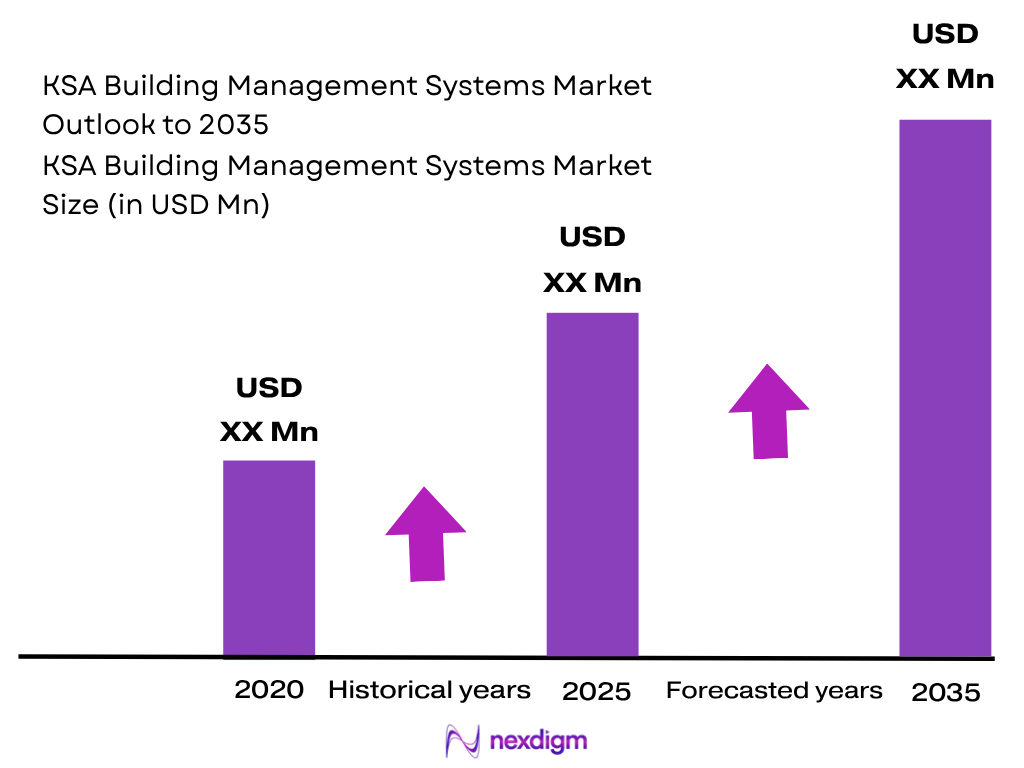
The KSA Building Management Systems Market is valued at approximately ~USD XX million, supported by expanding commercial, hospitality, healthcare, data-centre and giga-project infrastructure. Electricity consumption increased from 327,001 GWh to 340,430 GWh, while electricity supplied to the national network rose from 380,878 GWh to 402,628 GWh across the two latest comparable annual observations. This growing building-energy requirement strengthens demand for HVAC automation, smart metering, centralized monitoring, load management and energy-optimization systems.
Riyadh, Jeddah and the north-western giga-project corridor dominate KSA Building Management Systems demand because they concentrate large integrated developments requiring sophisticated automation. Riyadh’s New Murabba is planned with more than 25 million m² of floor area, including 104,000 residential units, 9,000 hotel rooms and 1.4 million m² of offices. In Jeddah, four construction contracts worth SAR 12 billion cover major landmarks and infrastructure, reinforcing demand for integrated HVAC, lighting, security and energy-management platforms.
Market Segmentation
By System Function
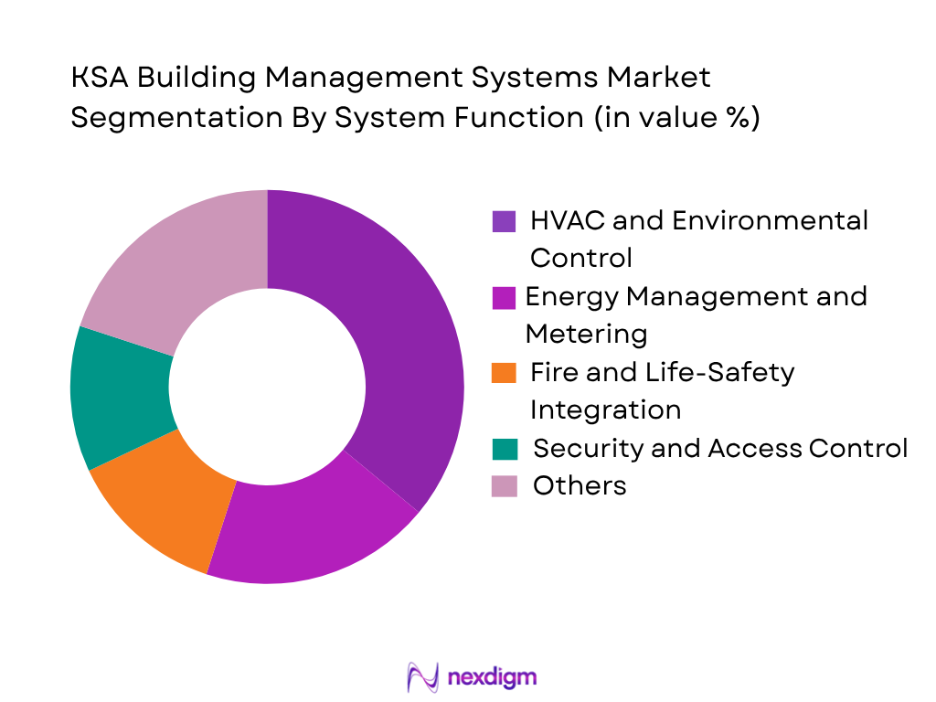
The KSA Building Management Systems Market is segmented into HVAC and environmental control, energy management and metering, fire and life-safety integration, security and access control, lighting and shading control, smart-room management, and other integrated functions. HVAC and environmental control holds the dominant market share because cooling represents a mission-critical building function under Saudi climatic conditions. BMS platforms continuously supervise chillers, cooling towers, pumps, air-handling units, fan-coil units, variable-air-volume systems, temperature, humidity and ventilation. Saudi energy statistics show building electricity consumption at 23.0 MWh per consumer, including 34.0 MWh for commercial consumers and 129.3 MWh for government consumers, highlighting the importance of active building-energy management. Modern HVAC-focused BMS platforms also provide scheduling, setpoint optimization, alarm handling, occupancy-based control and fault detection. Their ability to improve environmental conditions while managing one of a building’s largest controllable loads supports HVAC automation’s leadership within the KSA Building Management Systems Market.
By Building Type
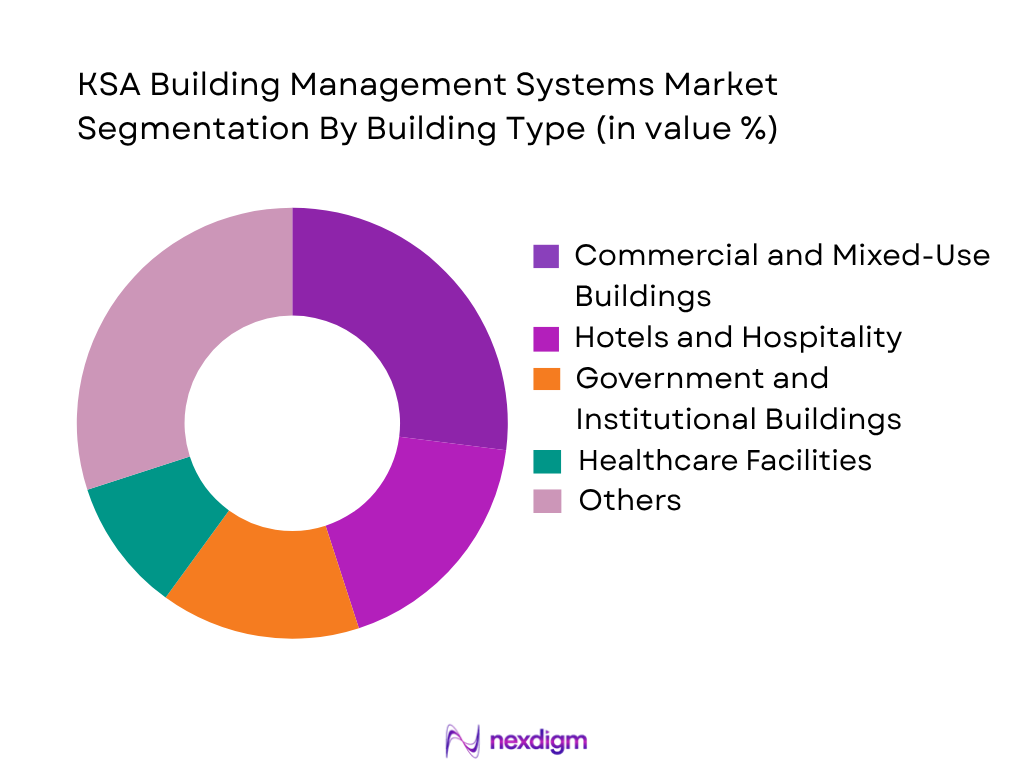
The KSA Building Management Systems Market is segmented by building type into commercial buildings, hotels and resorts, government and institutional buildings, healthcare facilities, data centres, retail and mixed-use developments, industrial facilities and premium residential properties. Commercial and mixed-use buildings represent the leading demand cluster because Riyadh and other major cities are receiving large integrated developments combining offices, retail, hospitality, entertainment and residential assets. New Murabba alone is planned with 1.4 million m² of office space, more than 980,000 m² of retail space and 620,000 m² of leisure assets, creating a highly automation-intensive built environment. KAFD has also been recognized as a digitally advanced smart district, supporting broader adoption of connected building technologies. These projects require integrated HVAC control, metering, access systems, lighting automation, digital facility-management platforms and centralized command infrastructure rather than standalone controls.
Competitive Landscape
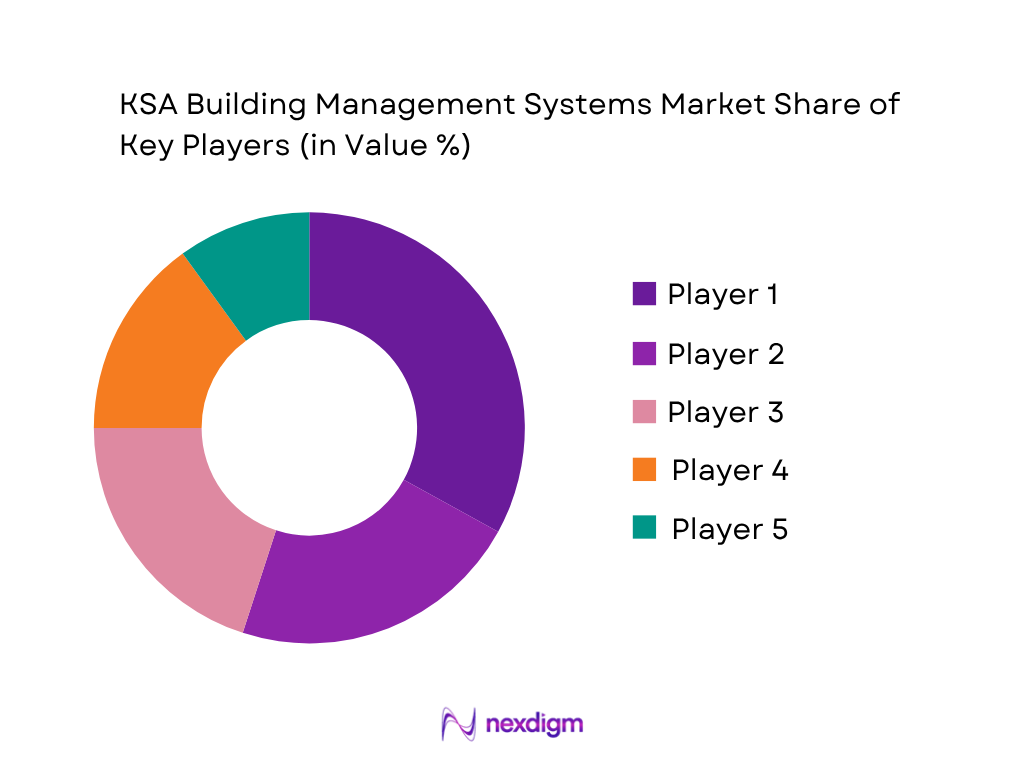
The KSA Building Management Systems Market is led by multinational automation providers with local Saudi operations, engineering teams, system-integrator relationships and established building-control platforms. Honeywell, Siemens, Schneider Electric, Johnson Controls and ABB compete beyond conventional controllers by integrating HVAC, power, lighting, security, analytics and cloud-based building operations. Competitive advantage increasingly depends on open-protocol integration, lifecycle service, cybersecurity, energy optimization and capability to execute large giga-project, airport, hospitality and data-centre installations. Honeywell maintains locations in Riyadh and Al-Khobar, while Johnson Controls Arabia operates directly in KSA and Schneider Electric maintains a dedicated Saudi building-management portfolio.
| Company | Establishment Year | Headquarters | Saudi Presence | Core BMS Platform | Protocol / Integration Capability | HVAC Integration | Cloud / Analytics Capability | Lifecycle Services |
| Honeywell | 1906 | Charlotte, USA | ~ | ~ | ~ | ~ | ~ | ~ |
| Siemens | 1847 | Munich / Berlin, Germany | ~ | ~ | ~ | ~ | ~ | ~ |
| Schneider Electric | 1836 | Rueil-Malmaison, France | ~ | ~ | ~ | ~ | ~ | ~ |
| Johnson Controls | 1885 | Cork, Ireland | ~ | ~ | ~ | ~ | ~ | ~ |
| ABB | 1988 | Zurich, Switzerland | ~ | ~ | ~ | ~ | ~ | ~ |
KSA Building Management Systems Market Analysis
Growth Drivers
Large-Scale Construction and Smart-Building Development
Saudi Arabia’s accelerated construction pipeline is expanding the installed base of buildings that require centralized HVAC, lighting, power, water, access-control and life-safety management. More than 276,000 building permits were issued during 2024, alongside approximately 100,000 building compliance certificates. Residential development is also substantial, with more than 117,000 Saudi families benefiting from housing solutions during the same period and more than 21,000 families obtaining homes through developmental housing programs. Large master-planned communities increase the number of chillers, pumps, meters, ventilation systems and common-area assets that can be connected to BMS platforms. Saudi Arabia’s GDP stood at approximately USD 1.2398 trillion in 2024, while GDP per capita reached USD 35,121.7. For BMS suppliers and system integrators, this combination of national economic scale and high building-permit activity supports demand for DDC controllers, sensors, gateways, central supervisory software, energy dashboards and lifecycle automation services across Riyadh, Jeddah and other urban development centres.
High Electricity Consumption and Need for Building Energy Optimization
Saudi Arabia’s electricity-intensive built environment is strengthening the case for Building Management Systems focused on HVAC efficiency, load monitoring, chiller sequencing and equipment scheduling. National electricity consumption reached approximately 340,430 GWh in 2024, while electricity supplied to the national grid reached about 402,628 GWh. Licensed electricity-generation capacity was approximately 92.5 GW, illustrating the scale of the power infrastructure supporting residential, commercial and institutional facilities. Cooling represents a critical operational requirement across offices, hotels, hospitals, retail centres and mixed-use developments because of the Kingdom’s climatic conditions, making temperature control, variable-frequency drives, differential-pressure management and optimized chilled-water operation central BMS applications. Saudi Arabia’s GDP of USD 1.2398 trillion and GDP per capita of USD 35,121.7 in 2024 further support capital spending on energy-management technologies. BMS platforms allow owners to connect electrical meters, HVAC plant, occupancy controls and alarms into one operating environment, making building automation increasingly relevant as power demand, building density and operational complexity expand simultaneously.
Market Challenges
Complex Integration Across Large Multi-System Buildings
The increasing scale of Saudi construction creates a technical challenge because modern projects contain thousands of assets from multiple mechanical, electrical, security and life-safety vendors. More than 276,000 building permits were recorded in 2024, while around 100,000 building compliance certificates were issued nationally, demonstrating the volume of facilities entering or moving through the built-environment ecosystem. ROSHN manages a development footprint exceeding 200 million square metres, while its SEDRA community in Riyadh covers 20 million square metres, includes 30,000 homes and incorporates 400 integrated amenities. Integrating chillers, AHUs, pumps, energy meters, lighting controls, fire systems, access control and IoT sensors across developments of this scale requires extensive protocol management, testing, graphics engineering and network commissioning. Saudi Arabia’s USD 1.2398 trillion GDP in 2024 indicates substantial economic capacity, but the sophistication of new infrastructure raises the technical execution burden. BMS vendors therefore face challenges around BACnet and Modbus interoperability, point validation, cybersecurity, subsystem handover and consistent commissioning across multiple contractors.
Commissioning and Lifecycle Management Across Expanding Building Portfolios
Saudi BMS projects increasingly extend beyond single buildings into large portfolios, creating challenges in commissioning, software standardization, maintenance and long-term system performance. ROSHN operates across a real-estate portfolio of approximately 200 million square metres, including more than 2 million square metres of leasable retail space and another 2 million square metres of commercial opportunities. Its development activity included the addition of more than 6,500 homes across 4.2 million square metres, while the fourth phase of SEDRA added nearly 5,000 homes. Large portfolios create thousands of controllers, sensors and connected equipment points that must remain calibrated, documented and accessible after construction teams exit the project. Saudi Arabia generated approximately USD 1.2398 trillion of GDP in 2024, with GDP per capita at USD 35,121.7. As more high-value buildings enter operation, maintaining consistent sequences of operation, alarm priorities, cybersecurity controls, software versions and service documentation becomes critical. Weak handover or inconsistent commissioning can limit the operational value of sophisticated BMS installations even when advanced hardware has been deployed.
Market Opportunities
Hospitality and Tourism Building Automation
Saudi Arabia’s expanding hospitality infrastructure creates a strong forward opportunity for Building Management Systems because hotels and resorts require intensive control of air-conditioning, guest rooms, lighting, hot water, ventilation, utility metering and central plant equipment. Saudi Arabia recorded 17.5 million international tourists in 2024 and more than 966,500 tourism jobs, demonstrating the operating scale already supporting new hospitality assets. Licensed tourism room inventory subsequently exceeded 596,900 rooms, giving BMS vendors a substantial installed environment for controls, modernization and energy management. Large destinations add further system complexity, with the Red Sea destination covering approximately 28,000 square kilometres and its first phase comprising 16 resorts. Saudi Arabia’s USD 1.2398 trillion GDP in 2024 and GDP per capita of USD 35,121.7 support continued investment in high-specification tourism infrastructure. Current hospitality capacity therefore provides a foundation for future adoption of guest-room automation, chiller optimization, centralized operations platforms, occupancy-linked controls, remote monitoring and predictive maintenance across luxury hotels, resorts and mixed-use tourism developments.
Integrated Smart Districts and Portfolio-Level Building Management
Saudi Arabia’s current pipeline of master-planned urban developments creates an opportunity for BMS suppliers to move beyond individual-building controls toward district-wide monitoring, cloud platforms and portfolio analytics. ROSHN’s development program encompasses more than 400,000 homes across over 200 million square metres in Riyadh, Jeddah, Al Ahsa and other locations. SEDRA alone comprises 20 million square metres, 30,000 homes and 400 integrated amenities, giving developers a large base of HVAC, electrical, water, lighting and common-area assets that can be coordinated through centralized platforms. New Murabba adds another major smart-building environment, with over 25 million square metres of planned floor area, more than 104,000 residential units, 9,000 hotel rooms, approximately 1.4 million square metres of office space and more than 980,000 square metres of retail space. Saudi Arabia’s economy stood at approximately USD 1.2398 trillion in 2024, providing a strong macroeconomic foundation for complex urban infrastructure. These project dimensions support future demand for cloud BMS, digital twins, multi-site command centres, fault diagnostics and unified energy-management architectures.
Future Outlook
The KSA Building Management Systems Market is projected to expand at approximately ~XX.X% CAGR during 2026–2035, supported by Saudi Vision 2030 infrastructure, tourism development, data centres, smart districts, commercial assets and large-scale urban projects. Market development will increasingly move from conventional HVAC supervisory control toward integrated digital platforms combining building automation, power monitoring, asset analytics, cybersecurity and cloud-based portfolio management.
Riyadh will remain a central opportunity because major urban projects are creating large digitally managed districts. New Murabba is planned with over 25 million m² of floor area, while King Salman International Airport is designed around six parallel runways and sustainability-focused infrastructure. These developments can generate requirements for millions of BMS data points across HVAC plants, electrical networks, terminal assets, retail environments and centralized control rooms.
Major Players
- Honeywell Saudi Arabia
- Siemens Saudi Arabia
- Schneider Electric Saudi Arabia
- Johnson Controls Arabia
- ABB Saudi Arabia
- Trane Saudi Arabia
- Carrier Saudi Arabia
- Delta Electronics Saudi Arabia
- Legrand Saudi Arabia
- Lutron Electronics
- Crestron Electronics
- Emerson Saudi Arabia
- Mitsubishi Electric Saudi Arabia
- Distech Controls
- Azbil Saudi Arabia
Key Target Audience
- Building Management System OEMs and Building Automation Technology Providers
- BMS System Integrators and Control Panel Manufacturers
- Giga-Project Developers and Real Estate Developers
- Data Centre, Hospitality and Commercial Property Operators
- HVAC, MEP and EPC Contractors
- Facility Management and Energy Service Companies
- Investments and Venture Capitalist Firms
- Government and Regulatory Bodies (Saudi Building Code National Committee, Ministry of Energy, Saudi Standards Metrology and Quality Organization, Ministry of Municipalities and Housing, Communications Space and Technology Commission)
Research Methodology
Step 1: Identification of Key Variables
The initial phase involves constructing an ecosystem map of the KSA Building Management Systems Market covering OEMs, controllers, sensors, actuators, HVAC suppliers, system integrators, giga-project developers and facility-management companies. Key variables include installed BMS points, project type, building area, HVAC architecture, controller density, protocol mix, energy consumption and lifecycle-service requirements.
Step 2: Market Analysis and Construction
Historical market development is analysed through top-down and bottom-up approaches. The top-down model evaluates commercial construction, hospitality developments, giga-projects, airports, healthcare infrastructure and data-centre activity, while the bottom-up framework assesses controllers, field devices, BMS points, software platforms, system integration and service revenues associated with individual building categories.
Step 3: Hypothesis Validation and Expert Consultation
Market hypotheses are validated through structured interviews with BMS manufacturers, authorized system integrators, MEP engineers, facility managers, developers, EPC contractors and building owners. Interviews are used to validate procurement practices, controller architecture, protocol preferences, integration complexity, project sizing, commissioning requirements, cloud adoption and competitive positioning in Saudi Arabia.
Step 4: Research Synthesis and Final Output
The final stage triangulates primary findings with Saudi Building Code requirements, government infrastructure data, energy statistics, developer project pipelines and company product portfolios. Bottom-up BMS installation models are reconciled with top-down construction demand indicators to create validated segmentation, competitive benchmarking, forecast scenarios and strategic recommendations for the KSA Building Management Systems Market.

- Executive Summary
- Research Methodology (Market Definitions and Assumptions, KSA Building Management Systems Market Classification, Building Automation Scope, Integrated Building Management System Mapping, HVAC Automation Assessment, Lighting Control Assessment, Building Energy Management Assessment, Fire and Life-Safety Integration Assessment, Access Control Integration Assessment, Electrical and Power Monitoring Assessment, Water and Utility Monitoring Assessment, Indoor Air Quality Monitoring Assessment, Direct Digital Controller Assessment, PLC-Based Building Control Assessment, Sensors and Actuators Assessment, Supervisory Controller Assessment, BMS Head-End Software Assessment, Cloud BMS Assessment, Edge Controller Assessment, BACnet Assessment, Modbus Assessment, KNX Assessment, Wired and Wireless Building Control Network Assessment, Greenfield Project Assessment, Retrofit and Modernization Assessment, Saudi Building Code Compliance Assessment, Energy-Efficiency Compliance Assessment, Smart City and Giga-Project Assessment, Data Centre Automation Assessment, Hospitality Building Automation Assessment, Supply-Side Assessment, Demand-Side Assessment, Top-Down Market Sizing, Bottom-Up Market Sizing, Primary Industry Interviews, Construction and Giga-Project Pipeline Assessment, Data Triangulation, Forecasting Framework)

- Definition and Scope
- KSA Building Automation Industry Evolution and Development of Conventional Building Management Systems, Direct Digital Control Systems, Integrated Building Management Systems, HVAC Automation, Building Energy Management Systems, Lighting Automation, Fire and Life-Safety Integration, Access Control Integration, Electrical Monitoring, Smart Metering, IoT-Enabled Building Automation, Cloud-Based BMS, AI-Enabled Building Optimization, Digital Twin Platforms, Wireless Building Automation, Predictive Maintenance Platforms, Smart Building Command Centres, District Cooling Integration, Giga-Project Building Automation, Portfolio-Level Building Management Platforms
- Building Management Systems Value Chain Analysis
- Building Management Systems Supply Chain Analysis
- Sensor Manufacturers, Thermostat and Environmental Sensor Suppliers, DDC Controller Manufacturers, PLC Suppliers, Supervisory Controller Providers, Valves and Damper Actuator Suppliers, Variable Frequency Drive Suppliers, Smart Meter Providers, Gateways and Protocol Converter Suppliers, BMS Software Developers, Cloud Platform Providers, Building Analytics Providers, HVAC OEMs, Electrical Automation Providers, Security System Providers, Fire Detection System Providers, System Integrators, Control Panel Builders, MEP Consultants, EPC Contractors, Facility Management Companies, Real Estate Developers, Giga-Project Developers, Data Centre Operators, Hospitality Developers, Commercial Property Owners, Smart City Operators, BMS Service and Maintenance Providers

- Growth Drivers (Saudi Vision 2030 Infrastructure Development, Giga-Project Construction, Riyadh Commercial Development, Data Centre Capacity Expansion, Hospitality and Tourism Infrastructure, Airport Expansion, Healthcare Development, Smart City Investment, Energy-Efficiency Requirements, Saudi Building Code Compliance, District Cooling Expansion, High Cooling Load Management)
- Market Challenges (High Initial BMS Installation Cost, Legacy Proprietary Systems, Multi-Vendor Integration Complexity, Shortage of Specialized BMS Engineers, Cybersecurity Risks, Extreme Climate Operating Conditions, Large-Scale Project Commissioning Complexity, Price-Based Tendering, Sensor Calibration Requirements, Interoperability Challenges, Dependence on Imported Automation Components, Localization Requirements, Maintenance Capability Gaps, Protocol Compatibility Issues)
- Market Opportunities (Giga-Project Building Automation, NEOM Smart Building Platforms, Riyadh Mega-Developments, Data Centre BMS, Luxury Hospitality Automation, District Cooling Optimization, Cloud-Based BMS, AI-Driven HVAC Optimization, Chiller Plant Optimization, Portfolio-Level Remote Operations, Wireless Retrofit Controls, Open-Protocol BACnet Migration, Digital Twin Integration)
- Market Trends (BACnet/IP Adoption, Cloud BMS Migration, Edge Computing, Wireless Sensors, AI and Machine Learning Optimization, Digital Twin-Based Building Operations, Fault Detection and Diagnostics, Continuous Commissioning, Occupancy-Based HVAC Control, Demand-Controlled Ventilation, Integrated Energy Dashboards, Smart Meter Integration, Cybersecure Building Networks, Vendor-Agnostic Platforms, API-Based Integration, Arabic-English Operator Interfaces, Mobile Facility Management)
- Government Regulations and Standards (Saudi Building Code Requirements, Saudi Energy Conservation Code Requirements, Saudi Green Building Requirements, Saudi Standards Metrology and Quality Organization Requirements, Civil Defense Fire and Life-Safety Requirements, HVAC Energy-Efficiency Requirements, Building Electrical Requirements, Smart Metering Requirements, Data Centre Regulatory Requirements)
- SWOT Analysis
- Porter’s Five Forces Analysis
- PESTLE Analysis
- Stakeholder Ecosystem
- Giga-Project and Building Automation Project Ecosystem

- By Market Value (2020-2025)
- By Hardware Market Value (2020-2025)
- By Software Market Value (2020-2025)
- By Services Market Value (2020-2025)
- By BMS Controllers Installed (2020-2025)
- By Sensors and Field Devices Installed (2020-2025)
- By BMS Monitoring and Control Points (2020-2025)
- By Buildings Connected to BMS Platforms (2020-2025)
- By Integrated BMS Project Value (2020-2025)
- By Greenfield BMS Project Value (2020-2025)

- By Offering Type (In Value %)
BMS Control Hardware
Building Management Software
Engineering and Design Services
Installation and Commissioning Services
Annual Maintenance Services
Managed Building Services
Cloud and Software Subscription Services
System Upgrade and Modernization Services - By Hardware Component (In Value %)
Direct Digital Controllers
Supervisory Controllers
Application-Specific Controllers
Programmable Logic Controllers
I/O Modules
Temperature Sensors
Humidity Sensors
CO2 and Indoor Air Quality Sensors
Occupancy and Motion Sensors
Pressure and Differential Pressure Sensors
Flow Sensors and Flow Meters
Smart Energy Meters
Valves and Valve Actuators
Damper Actuators
Variable Frequency Drives
Gateways and Protocol Converters
Operator Workstations and HMIs
BMS Control Panels - By Building System Managed (In Value %)
HVAC and Chiller Plant Controls
District Cooling Interface and Monitoring
Lighting Control Systems
Electrical and Power Monitoring
Building Energy Management
Fire and Life-Safety Monitoring
Access Control Systems
Security and CCTV Integration
Elevator and Escalator Monitoring
Water Supply and Pump Monitoring
Sewage and Utility Monitoring
Indoor Air Quality Monitoring
Parking Management Integration
Renewable Energy and Solar Integration
EV Charging and Building Load Integration - By Project Type (In Value %)
Greenfield Building Automation
Brownfield BMS Retrofit
Legacy BMS Modernization
BMS Controller Replacement
BMS Software Upgrade
Open-Protocol Migration
Energy-Efficiency Retrofit
Multi-Building BMS Integration
Smart Building Transformation
Giga-Project Integrated Automation - By System Function (In Value %)
HVAC and Environmental Control
Energy Management and Metering
Lighting and Shading Control
Fire and Life-Safety Integration
Access Control Integration
Video Surveillance Integration
Elevator and Vertical Transportation Integration
Room Automation
Indoor Air Quality Monitoring
Water and Pumping System Monitoring
Electrical Power Monitoring
Utility Monitoring
Occupancy and Space Management
Fault Detection and Diagnostics
Predictive Maintenance - By Building Type (In Value %)
Grade-A Office Buildings
Commercial Towers
Retail and Shopping Centres
Hotels and Hospitality Properties
Luxury Resorts
Hospitals and Healthcare Facilities
Data Centres
Airports and Transportation Facilities
Educational Campuses
Government and Institutional Buildings
Industrial and Manufacturing Facilities
Warehouses and Logistics Facilities
Mixed-Use Developments
Premium Residential and High-Rise Buildings
Entertainment and Leisure Facilities
Religious and Pilgrimage Infrastructure - By Region (In Value %)
Central Region
Western Region
Eastern Region
Northern Region
Southern Region
Riyadh
Jeddah
Makkah
Madinah
Dammam
Al Khobar
NEOM and Tabuk
Red Sea Development Region
Rest of Saudi Arabia

- Market Share of Major Players (By KSA BMS Revenue, Hardware Revenue, Software Revenue, Services Revenue, Installed BMS Base, Controller Installations, Monitored and Controlled Points, HVAC Automation Capability, Energy Management Capability, Integrated BMS Capability, Cloud BMS Capability, Giga-Project Portfolio, Data Centre Project Portfolio, Hospitality Project Portfolio, System Integrator Network, Geographic Coverage, Annual Maintenance Base)
- Cross Comparison Parameters (BMS Hardware and Controller Portfolio Breadth, Open-Protocol BACnet Modbus and KNX Integration Capability, Installed BMS Control Point and Building Base in KSA, HVAC Chiller Plant and District Cooling Optimization Capability, Cloud AI Analytics and Digital Twin Capability, Saudi System Integrator and Lifecycle Service Network Reach, Giga-Project Data Centre and Mission-Critical BMS Execution Capability, BMS Modernization Cybersecurity and Local Support Capability)
- SWOT Analysis of Major Players
- Competitive Positioning Matrix
- Major Companies
Honeywell Saudi Arabia
Siemens Saudi Arabia
Schneider Electric Saudi Arabia
Johnson Controls Arabia
ABB Saudi Arabia
Trane Saudi Arabia
Carrier Saudi Arabia
Delta Electronics Saudi Arabia
Legrand Saudi Arabia
Lutron Electronics
Crestron Electronics
Emerson Saudi Arabia
Mitsubishi Electric Saudi Arabia
Distech Controls
Azbil Saudi Arabia

- Real Estate Developer BMS Requirement Assessment
- Giga-Project Developer Automation Requirement Assessment
- Commercial Building Owner BMS Requirement Assessment
- Facility Manager Requirement Assessment
- MEP Consultant Specification Assessment
- System Integrator Requirement Assessment
- Data Centre BMS Requirement Assessment
- Hotel and Resort BMS Requirement Assessment
- Hospital BMS Requirement Assessment
- Retail and Mixed-Use BMS Requirement Assessment
- Airport and Transportation BMS Requirement Assessment
- Government Building BMS Requirement Assessment
- Premium Residential BMS Requirement Assessment
- Entertainment and Leisure Facility BMS Requirement Assessment

- By Market Value (2026-2035)
- By Hardware Market Value (2026-2035)
- By Software Market Value (2026-2035)
- By Services Market Value (2026-2035)
- By BMS Controllers Installed (2026-2035)
- By Sensors and Field Devices Installed (2026-2035)
- By BMS Monitoring and Control Points (2026-2035)
- By Buildings Connected to BMS Platforms (2026-2035)
- By Integrated BMS Project Value (2026-2035)
- By Greenfield BMS Project Value (2026-2035)


 Request a Sample
 Ask for Customization
 Get a Quote
 Enquire Now
