
 Download PDF
Market Overview
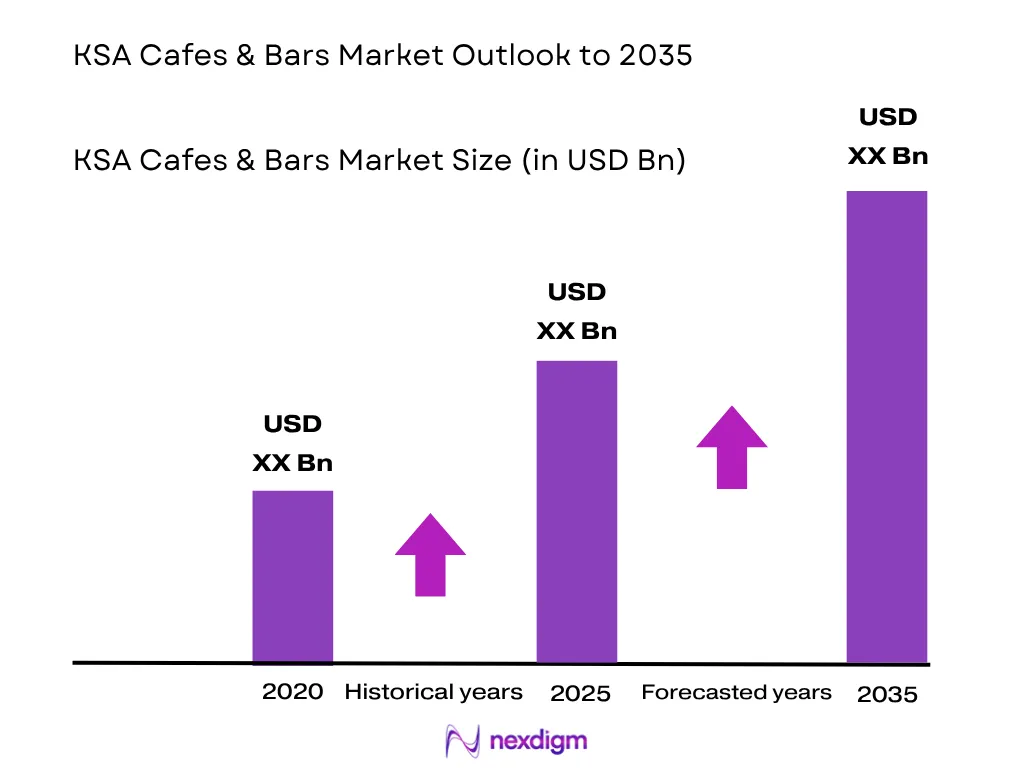
The KSA Cafes & Bars Market is valued at USD ~ billion, based on published cafe-market sizing, while a comparable cafe-and-coffee-chain benchmark reported USD ~ billion in the prior base period. Growth is driven by specialty coffee adoption, modern social dining, mall-based retail expansion, and branded store rollouts. The market is supported by a young consumer base, premium beverage preferences, and the use of cafes as work, study, and social venues.
Riyadh, Jeddah, and the Eastern Province dominate KSA Cafes & Bars Market demand due to their concentration of urban consumers, commercial districts, premium malls, corporate offices, tourism activity, and branded cafe outlets. Riyadh leads because of purchasing power and business footfall; Jeddah benefits from coastal lifestyle and tourism; Eastern Province is supported by affluent urban clusters, office demand, and expatriate consumption. Saudi Arabia also reached 5,130 branded coffee-shop outlets in a recent regional benchmark.
Market Segmentation
By Outlet Type
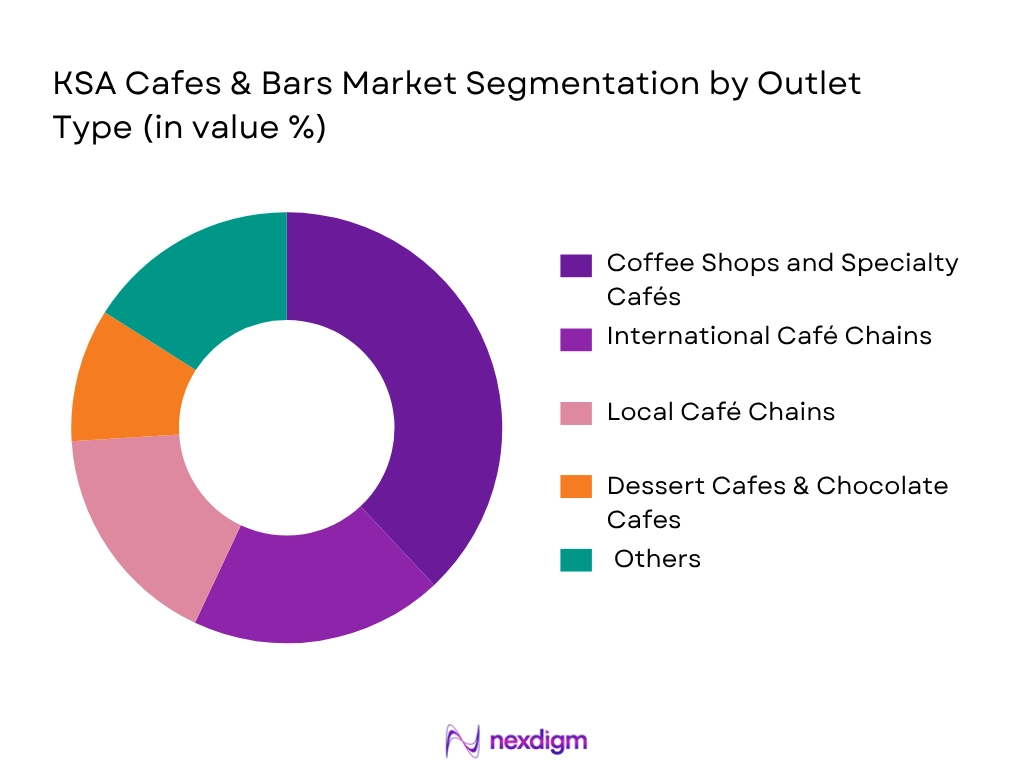
KSA Cafes & Bars Market is segmented by outlet format into coffee shops and specialty cafes, international café chains, local café chains, dessert cafes, juice and mocktail bars, traditional Arabic cafes, and kiosk-led formats. Coffee shops and specialty cafes dominate the market due to the rapid shift from basic coffee consumption to premium, experience-led coffee occasions. Consumers increasingly seek espresso-based beverages, Spanish latte, cold brew, single-origin coffee, Saudi coffee reinterpretations, and barista-led experiences. Riyadh and Jeddah have become major specialty cafe clusters, where store design, menu novelty, social-media visibility, and premium seating influence footfall. Local and international brands both benefit from the cultural role of coffee as a social beverage, while specialty operators capture higher average tickets through premium beans, desserts, and seasonal drinks.
By Service Model
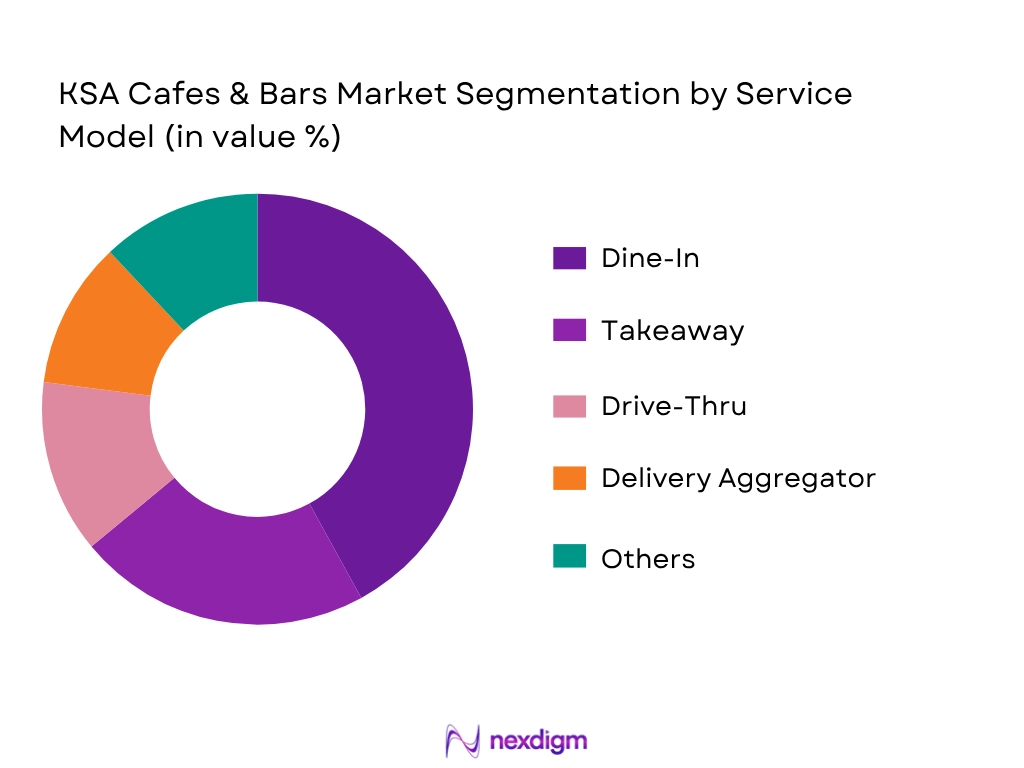
KSA Cafes & Bars Market is segmented by service model into dine-in, takeaway, drive-thru, delivery aggregator, own app ordering, kiosk and event-led service models. Dine-in dominates the market because cafes in Saudi Arabia operate as “third places” for socializing, meetings, studying, leisure, and family gatherings. Premium mall cafes, high-street specialty cafes, hotel cafes, and lifestyle-led coffee concepts depend on seating comfort, ambience, privacy, Wi-Fi availability, and social-media-friendly interiors. While delivery and takeaway are expanding, the cafe occasion remains highly experiential, especially in Riyadh, Jeddah, and Eastern Province. Operators also prioritize dine-in because it supports higher attachment rates through desserts, bakery, breakfast, chocolate, and premium add-on beverages.
Competitive Landscape
The KSA Cafes & Bars Market is competitive, with international brands, domestic cafe chains, specialty roasters, dessert cafe operators, and premium lifestyle cafes competing for prime real estate and repeat beverage occasions. Starbucks, Barn’s, Dunkin’, Tim Hortons, and dr.CAFE COFFEE hold strong visibility, while local specialty players compete through Saudi identity, roastery control, menu localization, store design, and social-media-led brand discovery.
| Company | Establishment Year | Headquarters | KSA Positioning | Core Format | Key Beverage Strength | Expansion Model | Digital / Loyalty Presence | Market-Specific Differentiator |
| Starbucks
|
1971
|
Seattle, USA
|
~ | ~ | ~ | ~ | ~ | ~ |
| Barn’s | 1992 | Jeddah, Saudi Arabia | ~ | ~ | ~ | ~ | ~ | ~ |
| Dunkin’ | 1950 | Canton, USA | ~ | ~ | ~ | ~ | ~ | ~ |
| Tim Hortons | 1964 | Toronto, Canada | ~ | ~ | ~ | ~ | ~ | ~ |
| dr.CAFE COFFEE | 1999 | Riyadh, Saudi Arabia | ~ | ~ | ~ | ~ | ~ | ~ |
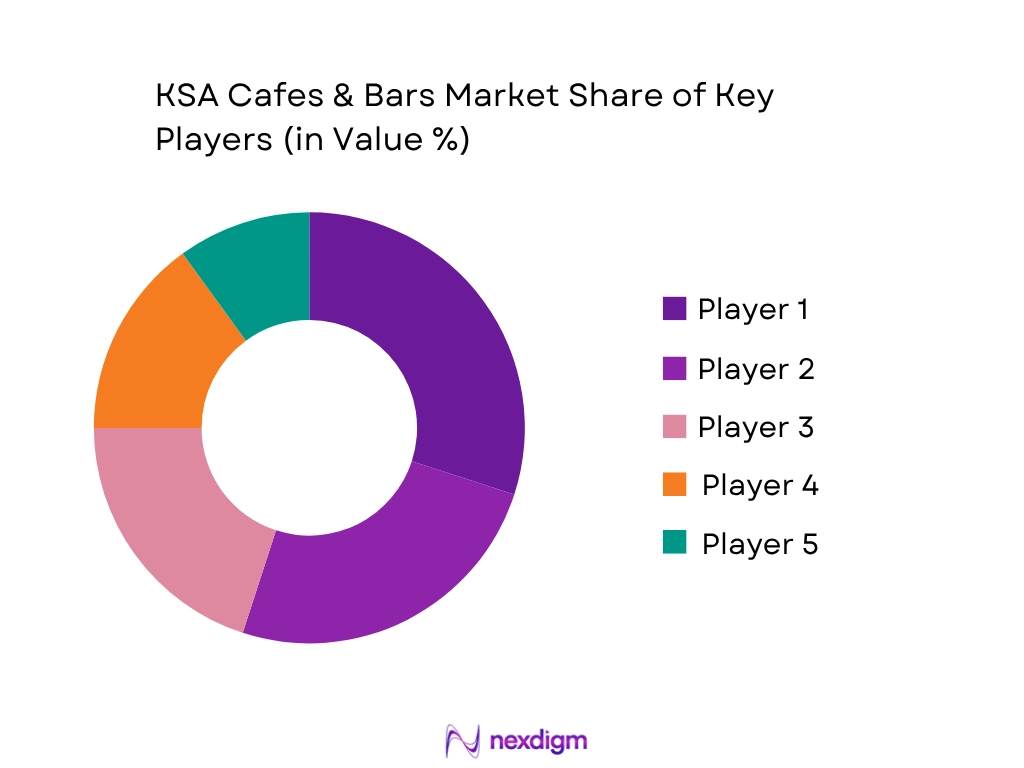
KSA Cafes & Bars Market Analysis
Growth Drivers
Youth Demographics
Saudi Arabia’s young consumer base is a direct demand driver for the KSA Cafes & Bars Market because cafes function as social, study, work, and leisure venues rather than only beverage outlets. The country’s total population reached 35,300,280 people in 2024, while Saudi citizens exceeded 19.6 million, up from 19.3 million in 2023, creating a larger domestic base for repeat out-of-home beverage occasions. GASTAT also reported that Saudis under the age of 35 accounted for 69.4% of the Saudi population in 2024, while the 15–34 age group represented 35.9% of the total population. This supports cafe demand because younger cohorts are more exposed to specialty coffee, cold beverages, digital ordering, branded chains, social-media-led discovery, and evening social consumption. World Bank data further shows Saudi Arabia’s GDP per capita at USD 35,121.7 in 2024, which supports discretionary spending in urban lifestyle formats such as specialty cafes, dessert cafes, and premium beverage lounges.
Coffee Culture
Coffee culture is a structural growth driver for the KSA Cafes & Bars Market because coffee is embedded in Saudi hospitality while modern operators are expanding it into specialty coffee, Saudi coffee concepts, cold beverages, premium desserts, and roastery-led experiences. Saudi Arabia recorded 116 million tourists in 2024, including 86.2 million domestic tourists and 29.7 million inbound tourists, creating strong footfall for cafes in airports, hotels, malls, religious corridors, entertainment districts, and high-street locations. Domestic tourism alone generated 538.62 million overnight stays and an average stay of 6.25 nights, increasing demand for coffee shops, dessert cafes, and non-alcoholic beverage bars near leisure and hospitality assets. On the supply side, Saudi Arabia imported coffee mainly from Ethiopia at USD 303 million, Brazil at USD 50.8 million, Colombia at USD 46.9 million, the United States at USD 36.4 million, and India at USD 25.4 million in 2024, indicating a broad sourcing base for specialty menus and differentiated origins.
Market Challenges
High Rentals
High rentals remain a market-specific challenge for the KSA Cafes & Bars Market because cafes depend on premium visibility, parking, frontage, mall positioning, and dense urban catchments. GASTAT’s CPI release shows that Saudi Arabia’s housing, water, electricity, gas, and other fuels division increased by 6.9% in March 2025, mainly driven by an 8.2% rise in rents paid for housing and an 11.9% rise in apartment rental prices; the same division carried a CPI basket weight of 25.5%. While this is a residential-rent indicator, it reflects the same urban pressure in Riyadh, Jeddah, and other dense commercial zones where cafe operators compete for high-footfall real estate. In November 2024, GASTAT-linked data reported housing rents up 10.8%, apartment rentals up 12.5%, and restaurants and hotels prices up 1.5%, showing that occupancy-linked inflation pressures were visible in consumer-facing service categories. For cafes, this affects outlet feasibility, store payback, rent-to-sales discipline, and expansion sequencing.
Staff Turnover
Staff turnover is a key challenge for the KSA Cafes & Bars Market because beverage quality depends on trained baristas, service consistency, shift coverage, upselling ability, and speed during peak dayparts. The labor pool is expanding, but competition for hospitality workers is intense. GASTAT reported that total employees in tourism activities reached 983,253 in Q1 2025, including 243,369 Saudi employees and 739,884 non-Saudi employees. The same publication shows tourism employees represented 5.4% of the total workforce and 8.1% of private-sector employment, indicating that cafes compete within a large hospitality labor ecosystem rather than a narrow beverage-service pool. GASTAT also reported an overall unemployment rate of 2.8% and labor force participation of 68.2% in Q1 2025, while total accommodation and food service employment increased from 681,367 in Q1 2024 to 714,084 in Q1 2025. For cafe operators, this creates pressure to retain trained staff, reduce onboarding repetition, and standardize beverage preparation.
Opportunities
Boutique Roasting
Boutique roasting offers future growth potential in the KSA Cafes & Bars Market because the country has an expanding coffee-consuming base, imported-origin diversity, and growing demand for differentiated cup profiles. Saudi Arabia’s 2024 coffee imports show a strong origin mix, including Ethiopia at USD 303 million, Brazil at USD 50.8 million, Colombia at USD 46.9 million, the United States at USD 36.4 million, and India at USD 25.4 million. This creates an opportunity for specialty roasters to build menus around Ethiopian naturals, Brazilian espresso blends, Colombian filter coffee, and localized Saudi coffee offerings. The domestic demand base is reinforced by Saudi Arabia’s 35,300,280 population in 2024 and GDP per capita of USD 35,121.7, which support premium beverage experimentation in Riyadh, Jeddah, Khobar, Dammam, and emerging lifestyle districts. Boutique roasters can capture value through roasted-bean retail, subscription packs, café supply contracts, barista training, and limited-edition seasonal offerings without relying only on dine-in store expansion.
Saudi Coffee Concepts
Saudi coffee concepts offer a strong future opportunity because they combine national identity, local agriculture, tourism, and premium cafe positioning. Jazan Province has about 1,985 coffee farms, around 340,000 coffee trees, and average annual production of 2,040 tons, while a Saudi Press Agency report citing the Ministry of Environment, Water and Agriculture stated that the region has over 2,000 coffee farms producing more than 1,000 tons annually. This gives operators a local-origin narrative for Saudi coffee flights, Khawlani coffee, date pairings, Arabic dessert pairings, gifting packs, and tourism-led cafe concepts. Demand-side support is also visible in tourism: Saudi Arabia recorded 116 million tourists in 2024, including 29.7 million inbound tourists and 86.2 million domestic tourists, creating occasions for culturally differentiated cafes in airports, hotels, heritage sites, malls, and religious-tourism corridors. Saudi coffee concepts can therefore become a premium identity-led format rather than only a traditional beverage item.
Future Outlook
The KSA Cafes & Bars Market is expected to maintain steady growth, supported by coffee culture, premium beverage innovation, young consumers, urban retail development, and tourism-led hospitality demand. The forecasted long-range CAGR benchmark for Saudi coffee retail chains is 5.70% for the 2026–2035 period. Growth will be strongest in specialty coffee, drive-thru formats, premium mocktails, cold beverages, dessert-led cafes, and branded local chains. Future growth will also be shaped by Vision-linked tourism, entertainment districts, airport and hotel cafe expansion, religious tourism corridors, and the rise of Saudi coffee as a differentiated product identity. Operators will focus on higher store productivity, outlet clustering, digital loyalty, delivery economics, and menu engineering. Stronger competition will raise the importance of real estate access, barista training, procurement efficiency, and brand-led customer retention.
Major Players
- Starbucks
- Barn’s
- Dunkin’
- Tim Hortons
- Costa Coffee
- Half Million
- dr.CAFE COFFEE
- Café Bateel
- Molten Chocolate Café
- Brew92
- Overdose Coffee
- Dose Café
- Caffeine Lab
- Camel Step Coffee Roasters
- EL&N London
Key Target Audience
- Café chain operators and franchise owners
- Specialty coffee roasters and green coffee importers
- Foodservice and HoReCa operators
- Mall developers and commercial real estate owners
- Hospitality groups, hotel operators, and tourism destination developers
- Investments and venture capitalist firms
- Beverage ingredient, dairy, syrup, packaging, and POS solution providers
- Government and regulatory bodies (Saudi Food and Drug Authority, Ministry of Municipalities and Housing, Ministry of Tourism, Ministry of Investment, Zakat, Tax and Customs Authority, Saudi Franchise Center)
Research Methodology
Step 1: Identification of Key Variables
The initial phase involves constructing an ecosystem map of cafe chains, specialty cafes, roasters, dessert cafes, juice bars, mocktail bars, delivery platforms, mall operators, suppliers, and regulators. This step uses desk research, company store locators, menu benchmarking, public filings, foodservice databases, and trade sources to identify variables influencing demand, supply, pricing, and outlet productivity.
Step 2: Market Analysis and Construction
The second phase compiles historical and current market indicators including outlet count, average ticket size, store format mix, delivery penetration, beverage category mix, and city-level expansion. Market sizing is constructed using top-to-bottom foodservice benchmarks and bottom-to-top outlet revenue modeling. Revenue estimates are cross-checked with transaction volume, store productivity, and average beverage pricing.
Step 3: Hypothesis Validation and Expert Consultation
Market hypotheses are validated through structured discussions with cafe operators, franchise managers, roasters, distributors, mall leasing teams, POS vendors, and delivery aggregators. These consultations help test assumptions around revenue per store, customer frequency, procurement cost, rental burden, delivery commissions, menu margins, and city-level growth potential.
Step 4: Research Synthesis and Final Output
The final stage synthesizes desk research, market modeling, expert inputs, and competitive benchmarking into a validated market assessment. Findings are refined through triangulation of published market sizes, operator-level expansion data, menu pricing, outlet-format economics, and consumer-demand patterns to produce a practical business-facing analysis of the KSA Cafes & Bars Market.

- Executive Summary
- Research Methodology (Market Definitions and Scope, Abbreviations and Terminologies, Market Sizing Approach, Top-to-Bottom Consumption Mapping, Bottom-to-Top Outlet Build-Up, Demand-Side Research Approach, Supply-Side Research Approach, Primary Research Framework, Secondary Research Framework, Limitations and Future Conclusions)

- Definition and Scope
- Market Genesis and Evolution
- Timeline of Major Players
- Business Cycle
- Supply Chain and Value Chain Analysis
- Café and Bar Format Ecosystem
- Revenue Pool Mapping
- Demand Occasion Mapping
- Regulatory and Cultural Context
- Investment and Franchise Landscape

- Growth Drivers (Youth Demographics, Coffee Culture, Tourism Growth, Mall Expansion, Drive-Thru Adoption, Premiumization, Social Dining, Female Workforce Participation)
- Market Challenges (High Rentals, Staff Turnover, Bean Price Volatility, Franchise Fees, Store Saturation, Delivery Commission, Menu Replication, Quality Consistency)
- Opportunities (Boutique Roasting, Saudi Coffee Concepts, Zero-Proof Beverage Menus, Premium Desserts, Drive-Thru Expansion, Loyalty Apps, Airport Cafes, Hospitality Partnerships)
- Trends (Specialty Brewing, Cold Coffee, Premium Mocktails, Low-Sugar Beverages, Instagrammable Interiors, Local Identity, Drive-Thru, AI-Enabled Loyalty)
- Government Regulation (Food Safety, Municipal Licensing, Saudization, VAT, Excise Tax on Sweetened Beverages, Franchise Law, Halal Compliance, Advertising Controls)
- SWOT Analysis (Brand Equity, Store Density, Menu Innovation, Real Estate Access, Supply Chain Control, Franchise Scalability, Customer Loyalty)
- Porter’s Five Forces Analysis (Supplier Power, Buyer Power, Threat of New Entrants, Threat of Substitutes, Competitive Rivalry)
- PESTLE Analysis (Vision-Led Tourism, Urban Lifestyle, Digital Payments, Food Safety Law, Sustainability, Disposable Packaging)
- Stakeholder Ecosystem (Café Chains, Roasters, Bean Importers, Syrup Suppliers, Dairy Suppliers, Mall Operators, Delivery Platforms, POS Vendors, Regulators)
- Unit Economics Analysis (Revenue Per Store, Rent-to-Sales Ratio, Labor Cost, COGS, Gross Margin, EBITDA Margin, Payback Period)
- Store Productivity Benchmarking (Sales Per Sqm, Cups Per Day, Transactions Per Day, Average Ticket, Seat Turnover, Delivery Mix)
- Supply Chain Analysis (Green Beans, Roasting, Dairy, Alternative Milk, Syrups, Cups, Packaging, Cold Chain, Last-Mile Delivery)

- By Value (2020-2025)
- By Transaction Volume (2020-2025)
- By Outlet Count (2020-2025)
- By Average Ticket Size (2020-2025)
- By Beverage Cups Served (2020-2025)
- By Store-Level Revenue Productivity (2020-2025)
- By Delivery and Takeaway GMV (2020-2025)

- By Outlet Format (In Value%)
Specialty Coffee Cafes
International Café Chains
Local Café Chains
Independent Boutique Cafes
Dessert Cafes
Juice & Smoothie Bars
Mocktail & Zero-Proof Beverage Bars
Tea & Karak Lounges
Chocolate Cafes
Roastery-Led Cafes - By Beverage Category (In Value%)
Espresso-Based Coffee
Brewed & Filter Coffee
Saudi Coffee
Cold Coffee
Tea & Karak
Fresh Juices
Smoothies
Mocktails
Functional Beverages
Hot Chocolate
Dessert Beverages - By Food and Add-On Category (In Value%)
Bakery
Pastries
Chocolates
Dates
Sandwiches
Breakfast Items
Desserts
Ice Cream
Protein Snacks
Retail Coffee Beans
Merchandise - By Price Positioning (In Value%)
Economy
Mass Premium
Premium
Luxury
Boutique Artisanal - By Service Model (In Value%)
Dine-In
Takeaway
Drive-Thru
Delivery Aggregator
Own App Ordering
Kiosk
Cloud Beverage Kitchen
Catering & Events - By Location Type (In Value%)
High-Street
Shopping Mall
Office District
University Campus
Airport
Hotel
Petrol Station
Tourist Destination
Residential Community
Religious Tourism Corridor - By Region (In Value%)
Central Region
Western Region
Eastern Region
Southern Region
Northern Region - By Consumer Cohort (In Value%)
Saudi Nationals
Expatriates
Gen Z
Millennials
Families
Female Consumers
Office Workers
Students
Tourists
Pilgrims - By Ordering Channel (In Value %)
In-Store POS
Mobile App
Delivery Aggregator
QR Table Ordering
Loyalty Platform
Corporate Bulk Order
Event Order - By Ownership Model (In Value%)
Company-Owned Stores
Franchise Stores
Master Franchise
Licensed Outlets
Independent Owner-Operated Cafes
Joint Venture Cafes

- Market Share of Major Players (Revenue Share, Outlet Share, Transaction Share, City-Level Share, Beverage Category Share)
- Market Share by Outlet Format (Specialty Coffee, Chain Cafes, Dessert Cafes, Juice Bars, Mocktail Bars, Roastery Cafes)
- Competitive Positioning Matrix (Premiumization, Store Density, Menu Breadth, Digital Maturity, Brand Recall, Expansion Pipeline)
- Cross Comparison Parameters (Outlet Count, Average Ticket Size, Store Format Mix, Drive-Thru Presence, Delivery Share, Beverage Category Mix, Roastery/Bean Sourcing Capability, Loyalty App Strength)
- Additional Company Comparison Parameters (Company Overview, Brand Positioning, Target Customer, Business Strategy, Recent Developments, Franchise Model, Revenues, Revenue by Format, City Presence, Number of Touchpoints, Menu Breadth, Pricing Band, Gross Margin Indicators, Store Productivity, Supply Chain Strength, Unique Value Offering)
- SWOT Analysis of Major Players (Brand Strength, Expansion Capability, Cost Structure, Menu Differentiation, Customer Loyalty, Real Estate Access)
- Pricing Analysis by Major SKUs (Espresso, Americano, Latte, Cappuccino, Spanish Latte, Cold Brew, Saudi Coffee, Karak, Fresh Juice, Mocktail, Dessert Combo)
- Menu Benchmarking of Major Players (Hot Coffee, Cold Coffee, Saudi Coffee, Tea, Juice, Smoothies, Mocktails, Desserts, Breakfast, Retail Beans)
- Store Format Benchmarking (Flagship Café, Mall Café, High-Street Café, Drive-Thru, Kiosk, Petrol Station Café, Airport Café)
- Digital Benchmarking (Mobile App, Loyalty Program, Delivery Aggregator Presence, Online Ordering, CRM, Subscription, Digital Offers)
- Detailed Profiles of Major Companies
Starbucks
Barn’s
Dunkin’
Tim Hortons
Costa Coffee
Half Million
dr.CAFE COFFEE
Café Bateel
Molten Chocolate Café
Brew92
Overdose Coffee
Dose Café
Caffeine Lab
Camel Step Coffee Roasters
EL&N London

- Consumer Demand and Utilization (Visit Frequency, Beverage Occasion, Spend Per Visit, Dine-In Duration, Delivery Frequency, Group Size)
- Purchasing Power and Budget Allocation (Disposable Income, Premium Café Spend, Student Spend, Office Worker Spend, Tourist Spend, Family Spend)
- Needs, Desires, and Pain Point Analysis (Taste Consistency, Seating Comfort, Wi-Fi, Parking, Speed of Service, Price, Menu Novelty, Privacy)
- Decision-Making Journey (Discovery, Menu Evaluation, Location Convenience, Social Media Influence, Loyalty Offers, Payment, Repeat Visit)
- Consumer Occasion Mapping (Morning Coffee, Work Meetings, Study Sessions, Family Outings, Social Gatherings, Dessert Visits, Late-Night Beverages)
- Customer Cohort Analysis (Gen Z, Millennials, Families, Female Professionals, Students, Tourists, Pilgrims, Expatriates)
- Brand Switching Analysis (Price Sensitivity, Menu Similarity, Service Quality, Convenience, Delivery Experience, Loyalty Benefits)
- Customer Satisfaction and NPS Analysis (Taste, Ambience, Speed, Staff Behavior, Seating, Cleanliness, Delivery Packaging, Value for Money)

- By Value (2026-2035)
- By Transaction Volume (2026-2035)
- By Outlet Count (2026-2035)
- By Average Ticket Size (2026-2035)
- By Beverage Cups Served (2026-2035)
- By Store-Level Revenue Productivity (2026-2035)
- By Delivery and Takeaway GMV (2026-2035)


 Request a Sample
 Ask for Customization
 Get a Quote
 Enquire Now