

 Download PDF
Market Overview
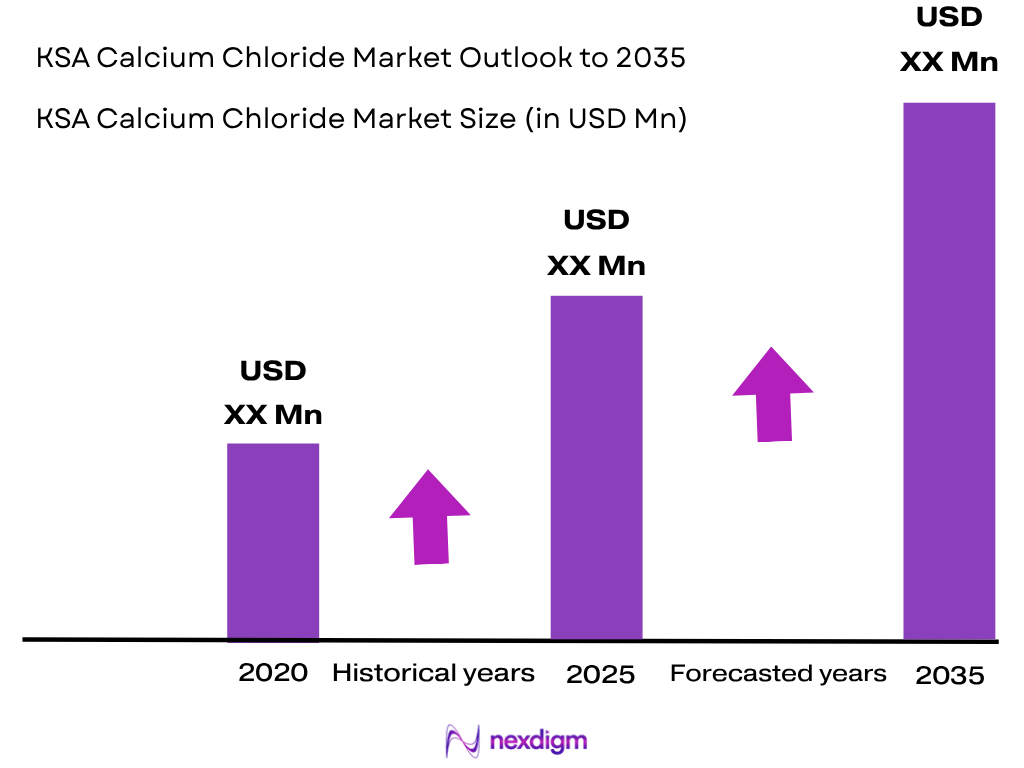
The KSA Calcium Chloride Market is estimated at ~USD XX million in 2024, compared with ~USD XX million in 2023, with demand supported by oilfield drilling and completion, petrochemical processing, industrial water treatment, construction, mining, dust suppression and chemical manufacturing. Saudi Arabia’s economy generated SAR 4.07 trillion in GDP at current prices, while manufacturing excluding petroleum refining contributed 9.1 of GDP. Construction recorded real growth of 4.2, supporting calcium chloride consumption across industrial and infrastructure applications.
Dominant Cities and Industrial Hubs: Jubail, Ras Al-Khair, Dammam, Riyadh and Yanbu form the principal demand centers for the KSA Calcium Chloride Market because they combine petrochemical production, oilfield services, industrial manufacturing, logistics and infrastructure development. Jubail is particularly important because of its integrated chemical and petrochemical ecosystem, while Ras Al-Khair hosts InoChem’s calcium chloride complex. InoChem operates an 800,000-square-meter industrial complex with reported annual calcium chloride capacity of 348,000 MT, providing a substantial domestic production base.
Market Segmentation
By Product Form
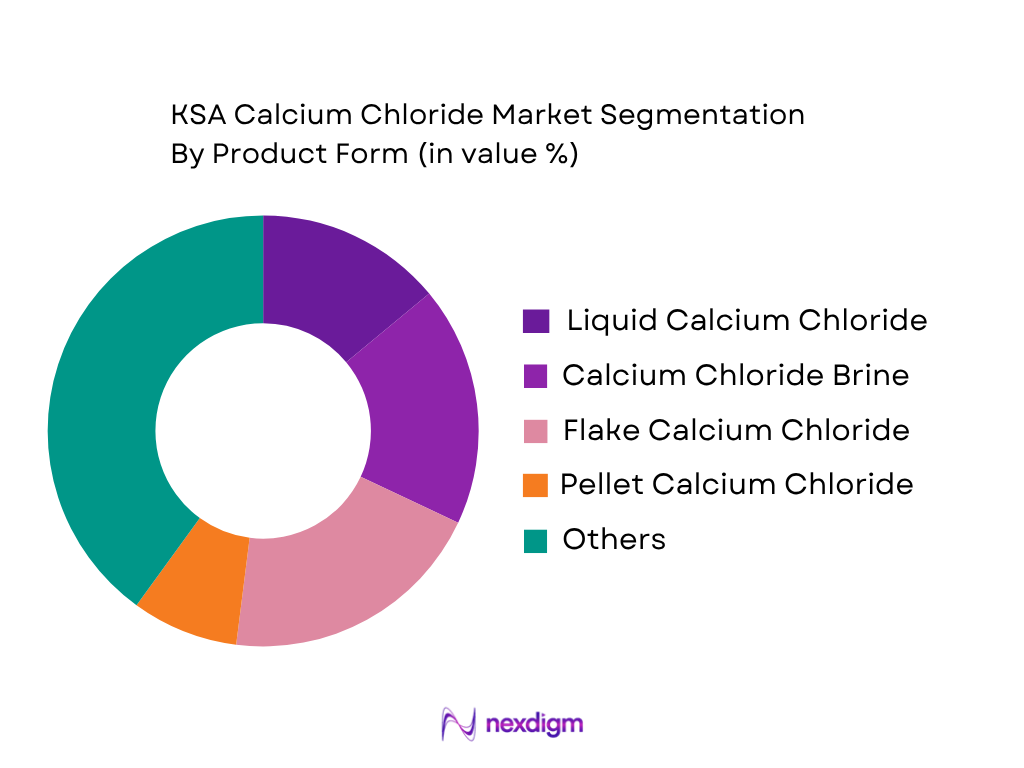
The KSA Calcium Chloride Market is segmented by product form into liquid calcium chloride, calcium chloride brine, flake calcium chloride, pellet calcium chloride, granulated calcium chloride, briquette calcium chloride, anhydrous calcium chloride and powdered calcium chloride. Granulated calcium chloride is expected to account for a dominant share because it provides concentrated calcium chloride in a convenient solid format for oilfield, concrete, dust-control and industrial applications. InoChem specifically produces 94% calcium chloride granules and 77% calcium chloride flakes, with the granules manufactured by removing water from calcium chloride brine through evaporation. The company’s product documentation identifies drilling mud, oil-well completion fluids, cementing, concrete acceleration and dust control as major applications. Domestic production of multiple physical forms therefore supports customer requirements across oilfield and industrial applications while reducing reliance on imported finished products.
By Application
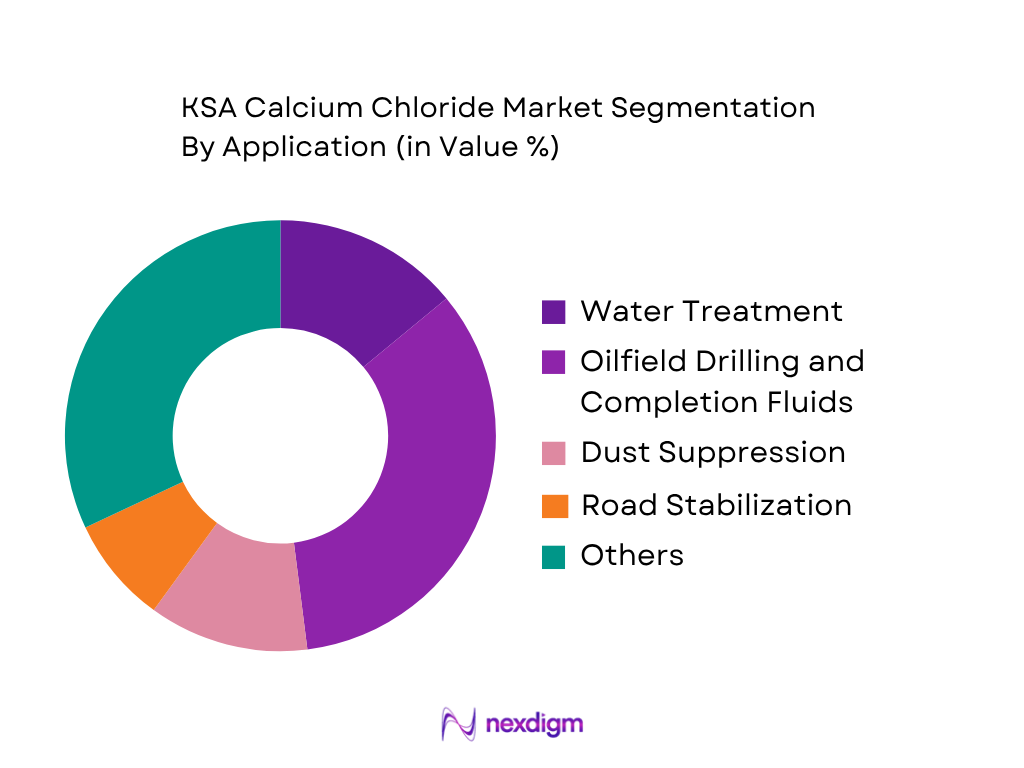
The KSA Calcium Chloride Market is segmented by application into oilfield drilling and completion fluids, water treatment, dust suppression, road stabilization, concrete acceleration, food processing, refrigeration brine, chemical processing, mining and mineral processing and other industrial applications. Oilfield drilling and completion fluids represent a key application because calcium chloride is used in drilling mud additives, completion fluids, oil-well cementing and petroleum-related drying applications. Saudi Arabia’s upstream ecosystem provides a substantial industrial base for these applications. Aramco reported average total hydrocarbon production of 12.4 million barrels of oil equivalent per day and maintained maximum sustainable capacity of 12 million barrels per day during the period covered by its 2024 annual reporting. The combination of upstream production, well intervention and oilfield services creates recurring requirements for specialized calcium chloride brines and solid grades.
Competitive Landscape
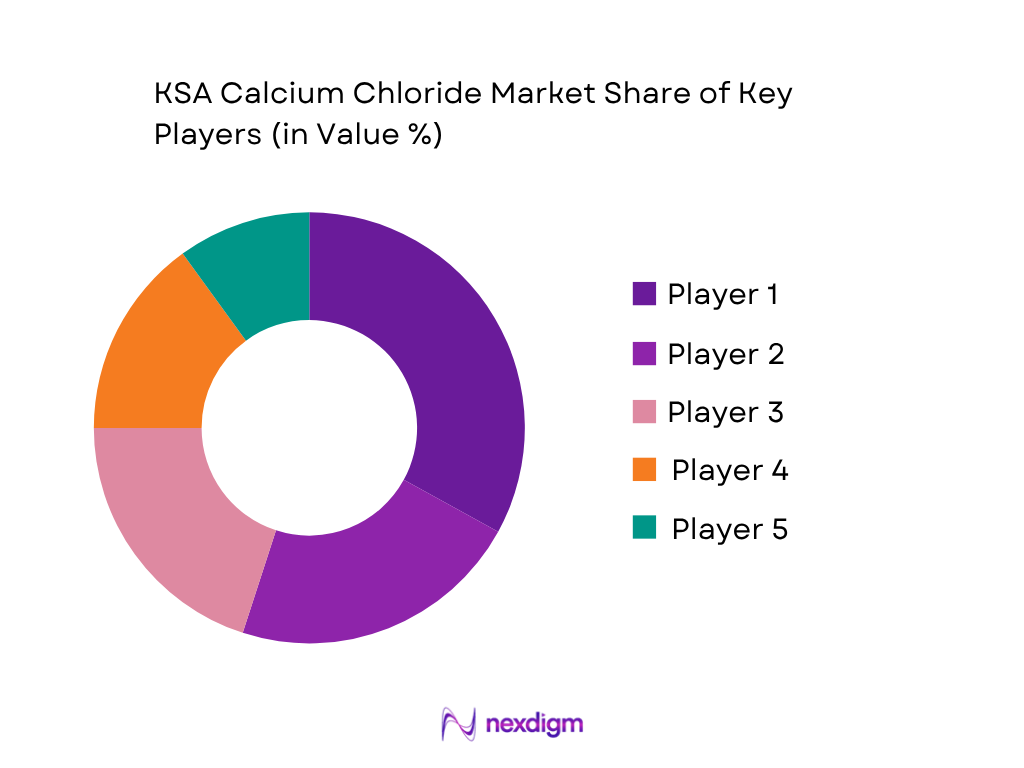
The KSA Calcium Chloride Market includes domestic chemical manufacturers, integrated chlor-alkali producers, industrial chemical distributors and international calcium chloride suppliers. InoChem represents a major domestic manufacturing platform, operating its calcium chloride complex at Ras Al-Khair. NAMA Chemicals also manufactures and markets calcium chloride from its Saudi chemical operations in Jubail. International suppliers participate through specialized grades, oilfield brines, food-grade products and industrial distribution. This combination creates a market structure comprising domestic production, integrated chemical manufacturing and imported specialty supply.
| Company | Establishment Year | Headquarters | Calcium Chloride Portfolio | Oilfield Applications | Product Grades | Domestic Manufacturing | Industrial Applications |
| InoChem | 2016 | Al Khobar / Ras Al-Khair, Saudi Arabia | ~ | ~ | ~ | ~ | ~ |
| NAMA Chemicals | 1992 | Jubail, Saudi Arabia | ~ | ~ | ~ | ~ | ~ |
| Sheidco | — | Al Khafji, Saudi Arabia | ~ | ~ | ~ | ~ | ~ |
| TETRA Technologies | 1981 | The Woodlands, USA | ~ | ~ | ~ | ~ | ~ |
| Nedmag | — | Veendam, Netherlands | ~ | ~ | ~ | ~ | ~ |
KSA Calcium Chloride Market Analysis
Growth Drivers
Oil and Gas Drilling and Completion Activity
Saudi Arabia’s large hydrocarbon industry remains a direct demand base for calcium chloride used in completion brines, drilling fluids, dehydration and related oilfield operations. The U.S. Energy Information Administration reports that Saudi Arabia produced 9.0 million barrels per day of crude oil in 2024, while petroleum and other liquids production reached 22.374 quadrillion Btu of primary-energy output. The country also consumed 3.695 million barrels per day of petroleum and other liquids in 2024, indicating substantial domestic hydrocarbon-processing activity. (U.S. Energy Information Administration) Saudi Arabia’s industrial structure further reinforces chemical demand: GASTAT reported that manufacturing activities generated SAR 2,901 billion in combined operating revenues across the broader industrial-activity base in 2024, while coke and refined petroleum products represented 41.1% of manufacturing operating revenues and chemicals and chemical products represented 23.4%. (Saudi Statistics Authority) These operating conditions support continued requirements for calcium chloride in oilfield brines where controlled-density fluids and water-management properties are required. Expansion and maintenance of drilling, completion and production infrastructure can therefore sustain industrial consumption, while the concentration of petroleum, refining and chemical activities creates a connected demand ecosystem for calcium chloride suppliers serving oilfield-service companies and industrial chemical users.
Expansion of Oilfield Services
The development of Saudi Arabia’s oilfield-services ecosystem provides another market-specific demand channel for calcium chloride because drilling contractors, completion-service providers and production-support operations require formulated brines and treatment chemicals. Saudi Arabia produced 9.0 million barrels per day of crude oil in 2024, according to the U.S. Energy Information Administration, while total primary petroleum and other liquids production was 22.374 quadrillion Btu. (U.S. Energy Information Administration) The scale of hydrocarbon activity is complemented by substantial downstream industrial activity. GASTAT reported that manufacturing activities accounted for 41.1% of manufacturing operating revenues from coke and refined petroleum products and 23.4% from chemicals and chemical products during 2024. (Saudi Statistics Authority) These figures indicate a large operating base in which oilfield chemicals, industrial chemicals and process materials are consumed across interconnected activities. Calcium chloride is relevant to this ecosystem because its high-density brine properties allow it to serve completion and workover-fluid applications, while its hygroscopic and moisture-control characteristics support additional industrial uses. Continued activity across drilling, well intervention, completion and production-support services can therefore broaden requirements for dependable domestic supply, particularly where operators need consistent technical grades and reliable bulk availability close to major petroleum-producing and processing regions.
Market Challenges
Imported Specialty Grade Dependence
Availability of calcium chloride in Saudi Arabia is influenced by the distinction between standard industrial grades and specialized products requiring controlled purity, concentration and physical characteristics. This creates a supply-management challenge because oilfield completion fluids, food processing, water treatment and chemical applications can require different specifications rather than a single standardized product. Saudi Arabia’s industrial base is substantial: GASTAT reported SAR 2,901 billion in operating revenues across mining, manufacturing, electricity, gas, steam, water supply, sewerage, waste-management and remediation activities in 2024. Within manufacturing, chemicals and chemical products accounted for 23.4% of operating revenues, while food products represented 8.4%. (Saudi Statistics Authority) This breadth of industrial activity creates demand for differentiated chemical inputs and increases the importance of consistent grade availability. The challenge is particularly relevant for calcium chloride because liquid brines, flakes, granules and high-purity grades have different handling and application requirements. Dependence on external sources for selected grades can expose users to shipping schedules, customs procedures, specification mismatches and longer replenishment cycles. Domestic producers can reduce these risks for standardized products, but specialized grades may still require carefully managed sourcing arrangements, quality certification and inventory buffers to ensure uninterrupted supply for technically sensitive applications.
Hydrochloric Acid Feedstock Availability
Calcium chloride production can be integrated with hydrochloric-acid-based chemical processes, making reliable availability of appropriate feedstock an important consideration for producers and downstream users. Saudi Arabia possesses a large chemicals and industrial-processing base, with GASTAT reporting that chemicals and chemical products generated 23.4% of manufacturing operating revenues in 2024. (Saudi Statistics Authority) The same statistics show that coke and refined petroleum products represented 41.1% of manufacturing operating revenues, demonstrating the scale of adjacent chemical and hydrocarbon processing operations. (Saudi Statistics Authority) At the broader industrial level, operating revenues reached SAR 2,901 billion in 2024. (Saudi Statistics Authority) Despite this industrial depth, calcium chloride producers must manage feedstock availability, concentration, purity and transportation because interruptions in upstream chemical supply can affect production continuity. Hydrochloric acid also requires controlled handling and storage, adding operational requirements for facilities producing calcium chloride from acid-based routes. Regional concentration of chemical manufacturing can further increase logistics exposure when feedstock or finished calcium chloride must move between production clusters and oilfield, industrial, construction or water-treatment customers. Consequently, reliable feedstock contracts, integrated chemical operations and appropriate storage infrastructure remain important factors in maintaining stable calcium chloride availability across Saudi Arabia.
Market Opportunities
Domestic Calcium Chloride Capacity Expansion
Saudi Arabia’s established industrial and chemical infrastructure creates conditions for further development of domestic calcium chloride production, particularly where local manufacturing can serve oilfield, industrial-water, construction and chemical-processing customers. GASTAT reported SAR 2,901 billion in operating revenues across the Kingdom’s broad industrial activities in 2024, while manufacturing alone recorded strong participation from chemicals and chemical products, which represented 23.4% of manufacturing operating revenues. (Saudi Statistics Authority) Petroleum and refined-product manufacturing represented another 41.1%, creating an industrial ecosystem closely connected to chemical production and oilfield demand. (Saudi Statistics Authority) The opportunity for calcium chloride suppliers is therefore not limited to replacing imports; domestic capacity can also support shorter delivery cycles, greater control over product specifications and more reliable supply for customers requiring regular bulk volumes. Domestic production can be structured around liquid calcium chloride, flakes, granules and application-specific grades, allowing suppliers to address oilfield brines alongside water treatment, construction chemicals and industrial processing. Integration with existing chemical manufacturing infrastructure could also improve feedstock utilization and logistics efficiency. As Saudi Arabia continues developing non-oil industrial activities, locally available calcium chloride can support a wider customer base while reducing exposure to international freight disruptions and external supply constraints.
High-Purity Grade Manufacturing
Development of high-purity calcium chloride provides an opportunity to serve applications where ordinary industrial-grade material may not satisfy technical or regulatory requirements. Saudi Arabia’s manufacturing structure provides a relevant industrial base: GASTAT reported that chemical and chemical-product manufacturing accounted for 23.4% of manufacturing operating revenues in 2024, while food-product manufacturing contributed 8.4%. (Saudi Statistics Authority) The broader industrial sector generated SAR 2,901 billion in operating revenues during the same period. (Saudi Statistics Authority) These figures indicate a sizeable ecosystem of chemical, food and process industries in which controlled-quality inputs can have commercial relevance. High-purity calcium chloride can be positioned for food-grade processing, specialized water treatment, pharmaceutical-related applications and technically controlled industrial processes where impurity limits and consistent concentration are important. Domestic production of such grades could also reduce the need for specialized external sourcing and allow suppliers to offer application-specific documentation, controlled packaging and technical support. The opportunity is strengthened by the coexistence of large chemical and food-processing industries, since producers capable of meeting differentiated specifications can address multiple demand channels rather than relying exclusively on commodity calcium chloride sales. This supports movement toward higher-value, specification-driven product portfolios within Saudi Arabia’s industrial chemical ecosystem.
Future Outlook
Over the forecast period, the KSA Calcium Chloride Market is expected to benefit from continued oilfield activity, industrial diversification, chemical manufacturing, water treatment, infrastructure development and mining expansion. Saudi Arabia’s non-oil activities grew 4.3 in 2024, while construction grew 4.2 and electricity, gas and water activities grew 4.9. These developments create multiple demand channels for calcium chloride beyond petroleum applications. Domestic manufacturing is expected to remain strategically important. InoChem reports annual calcium chloride capacity of 348,000 MT across various grades, densities, shapes and sizes, while its manufacturing complex covers 800,000 square meters in Ras Al-Khair. NAMA also maintains calcium chloride within its Saudi chemical portfolio. The market opportunity is therefore linked not only to volume growth but also to greater availability of application-specific grades, oilfield brines, high-purity products, food-grade calcium chloride and specialized industrial formulations.
Major Players
- InoChem
- NAMA Chemicals Company
- Sheidco Trading and Contracting Company
- TETRA Technologies
- Nedmag
- Brenntag Saudi Arabia
- Univar Solutions
- OxyChem
- Occidental Petroleum
- Gulf Chemicals and Industrial Oils
- Reda Chemicals
- Arabian Industrial Fiberglass Company
- Al-Kawther Chemicals
- Saudi Industrial Resins
- Gulf Chlorine
Key Target Audience
- Oil and Gas Exploration and Production Companies
- Oilfield Drilling and Completion Service Providers
- Petrochemical and Chemical Manufacturing Companies
- Industrial Water and Wastewater Treatment Operators
- Construction Chemical and Concrete Producers
- Mining and Mineral Processing Companies
- Investments and Venture Capitalist Firms (Industrial Chemicals, Oilfield Services and Mining)
- Government and Regulatory Bodies (Ministry of Energy, Ministry of Industry and Mineral Resources, Saudi Food and Drug Authority, Royal Commission for Jubail and Yanbu)
Research Methodology
Step 1: Identification of Key Variables
The initial phase involves constructing an ecosystem map covering calcium chloride manufacturers, integrated chemical producers, importers, distributors and major consuming industries across Saudi Arabia. The assessment identifies product forms, grades, production capacity, import dependency, end-use applications and regional demand centers.
Step 2: Market Analysis and Construction
Historical information is compiled across calcium chloride production, imports, exports and consumption. Demand is mapped against oilfield activity, chemical manufacturing, water treatment, construction, mining, food processing and refrigeration. Product-form and application-level demand are subsequently reconciled to establish the market structure.
Step 3: Hypothesis Validation and Expert Consultation
Market hypotheses concerning product-form adoption, oilfield demand, domestic manufacturing and imported specialty grades are developed and validated through industry consultations. Inputs from chemical manufacturers, oilfield service companies, distributors, water-treatment operators and industrial purchasers are used to verify application-specific demand.
Step 4: Research Synthesis and Final Output
The final stage integrates supply-side and demand-side findings into a consolidated KSA Calcium Chloride Market assessment. Manufacturer capabilities, product specifications, distribution networks and end-use requirements are cross-checked to improve consistency. The analysis supports segmentation, competitive benchmarking, market forecasting and strategic assessment.

- Executive Summary
- Research Methodology (Market Definition and Scope, KSA Calcium Chloride Market Classification, Top-Down Market Sizing, Bottom-Up Market Sizing, Demand-Side Assessment, Supply-Side Assessment, Oilfield Chemical Demand Mapping, Industrial Application Assessment, Import-Export Analysis, Primary Industry Interviews, Data Triangulation, Forecasting Framework, Limitations and Future Conclusions)

- Definition and Scope
- KSA Calcium Chloride Industry Evolution
- Calcium Chloride Value Chain Analysis
- KSA Calcium Chloride Supply Chain Analysis

- Growth Drivers (Oil and Gas Drilling and Completion Activity, Expansion of Oilfield Services, Chlor-Alkali Chemical Manufacturing, Industrial Water Treatment Demand, Construction and Infrastructure Development, Mining Expansion, Food Processing Activity, Refrigeration and Cold Chain Infrastructure)
- Market Challenges (Imported Specialty Grade Dependence, Hydrochloric Acid Feedstock Availability, Product Grade Differentiation, Chloride Discharge Management, Moisture-Sensitive Storage, Bulk Transportation Requirements, Product Quality Consistency, Competition from Sodium Chloride and Magnesium Chloride)
- Market Opportunities (Domestic Calcium Chloride Capacity Expansion, High-Purity Grade Manufacturing, Oilfield Completion Brine Production, Industrial Water Treatment Applications, Food Grade Calcium Chloride, Mining and Mineral Processing, Construction Chemical Applications, Refrigeration and Thermal Management)
- Market Trends (Domestic Chemical Localization, Oilfield Brine Optimization, High-Purity Calcium Chloride Adoption, Industrial Water Treatment Integration, Dust Suppression Applications, Advanced Packaging, Bulk Chemical Logistics, Specialty Grade Development)
- Government Regulations and Standards (Saudi Food and Drug Authority Requirements, Ministry of Environment Water and Agriculture Requirements, Ministry of Energy Regulations, Saudi Aramco Material Specifications, Royal Commission for Jubail and Yanbu Requirements, Environmental Discharge Standards, Industrial Chemical Handling Requirements, Saudi Standards Metrology and Quality Organization Requirements)
- SWOT Analysis
- Porter’s Five Forces Analysis
- PESTLE Analysis
- Stakeholder Ecosystem
- Competition Ecosystem

- By Market Value (2020-2025)
- By Calcium Chloride Consumption Volume (2020-2025)
- By Domestic Production Volume (2020-2025)
- By Import Volume (2020-2025)
- By Export Volume (2020-2025)

- By Product Form (In Value %)
Liquid Calcium Chloride
Calcium Chloride Brine
Flake Calcium Chloride
Pellet Calcium Chloride
Granulated Calcium Chloride
Briquette Calcium Chloride
Anhydrous Calcium Chloride
Powdered Calcium Chloride - By Application (In Value %)
Oilfield Drilling and Completion Fluids
Water Treatment
Dust Suppression
Road Stabilization
Concrete Acceleration
Food Processing
Refrigeration Brine
Chemical Processing
Mining and Mineral Processing
Paper Manufacturing
Desiccant and Dehydration
Other Industrial Applications - By Grade (In Value %)
Industrial Grade
Food Grade
Oilfield Grade
High-Purity Grade
Technical Grade - By Raw Material (In Value %)
Hydrochloric Acid and Limestone
Solvay Process By-Product
Natural Brine
Synthetic Chemical Route
Other Calcium Chloride Feedstocks - By End-Use Industry (In Value %)
Oil and Gas
Petrochemicals
Chemical Manufacturing
Water and Wastewater Treatment
Construction and Infrastructure
Mining and Mineral Processing
Food and Beverage Processing
Refrigeration and Cold Chain
Paper and Pulp
Agriculture
Industrial Manufacturing

- Market Share of Major Players (By Revenue, Consumption Volume, Product Form, Grade, Application, Domestic Production, Import Supply and End-Use Industry)
- Cross Comparison Parameters (Calcium Chloride Product Portfolio Breadth, Domestic Production Capacity, Oilfield Grade Capability, High-Purity Grade Capability, Product Form Coverage, Industrial Customer Reach, Saudi Manufacturing and Blending Footprint, Technical Service and Distribution Network)
- SWOT Analysis of Major Players
- Detailed Profiles of Major Companies
InoChem
Al Ghaith Industries
Saudi Arabian Mining Company (Ma’aden)
Saudi Basic Industries Corporation (SABIC)
Saudi Industrial Resins Limited
Arabian Industrial Fiberglass Company
National Chlorine Industries
Gulf Chlorine
Al Jubail Industrial Gases
Brenntag Saudi Arabia
Univar Solutions
Nouryon
TETRA Technologies
OxyChem
Nedmag

- Oil and Gas Operator Procurement Assessment
- Oilfield Services Procurement Assessment
- Petrochemical Plant Demand Assessment
- Industrial Water Treatment Procurement Assessment
- Construction Chemical Demand Assessment

- By Market Value (2026-2035)
- By Calcium Chloride Consumption Volume (2026-2035)
- By Domestic Production Volume (2026-2035)
- By Import Volume (2026-2035)
- By Export Volume (2026-2035)


 Request a Sample
 Ask for Customization
 Get a Quote
 Enquire Now