
 Download PDF
Market Overview
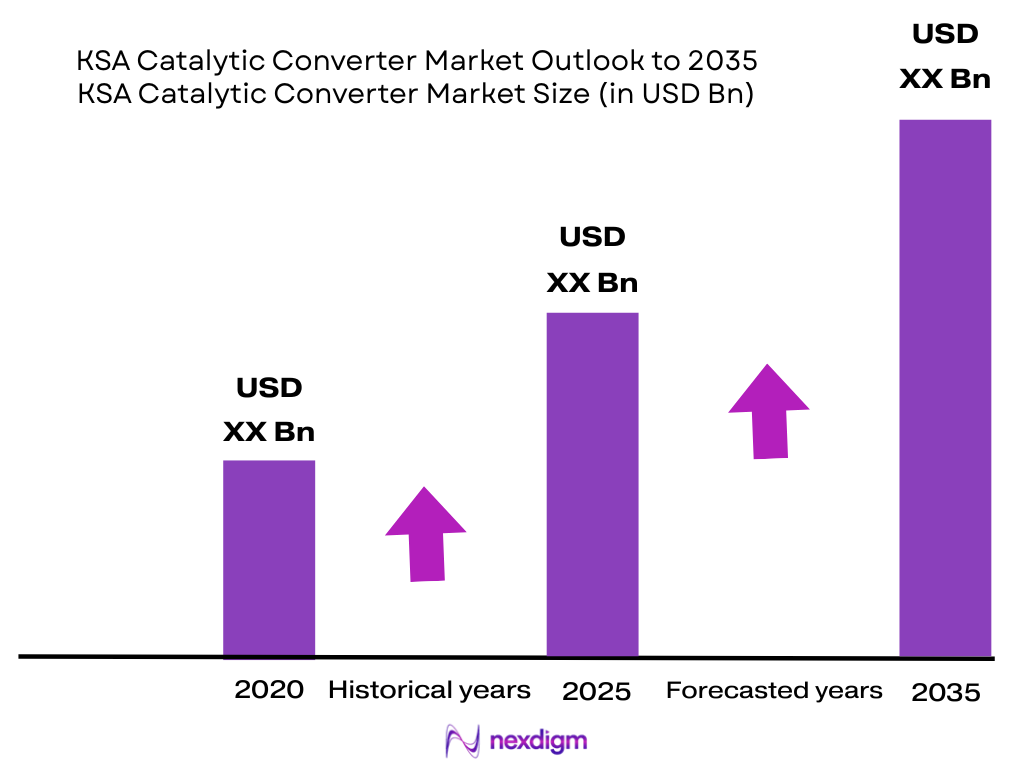
Market Size and Demand Foundation: The KSA Catalytic Converter Market is valued at USD ~ billion, supported by Saudi Arabia’s large petrol-dominated vehicle parc, SUVs, pickups, passenger cars and commercial fleets. Across the latest two vehicle-parc observations, roadworthy registered vehicles increased from roughly 14.8 million to more than 15.8 million units, while private vehicles alone reached 11,262,279 units. The installed combustion fleet therefore provides substantial OEM, inspection-linked and aftermarket catalyst demand. Dominant Geographic Markets: Riyadh, Jeddah, Dammam-Al Khobar, Makkah and the broader Eastern Province dominate KSA catalytic-converter activity because they combine dense private-vehicle ownership, logistics fleets, dealerships, workshops and spare-parts distribution. Saudi Arabia also expanded from 22 to 23 activated logistics centres, covering 34.6 million square metres, while Makkah Region alone contained six centres spanning 20.4 million square metres, reinforcing commercial-vehicle and high-mileage aftertreatment demand around major logistics corridors.
Market Segmentation
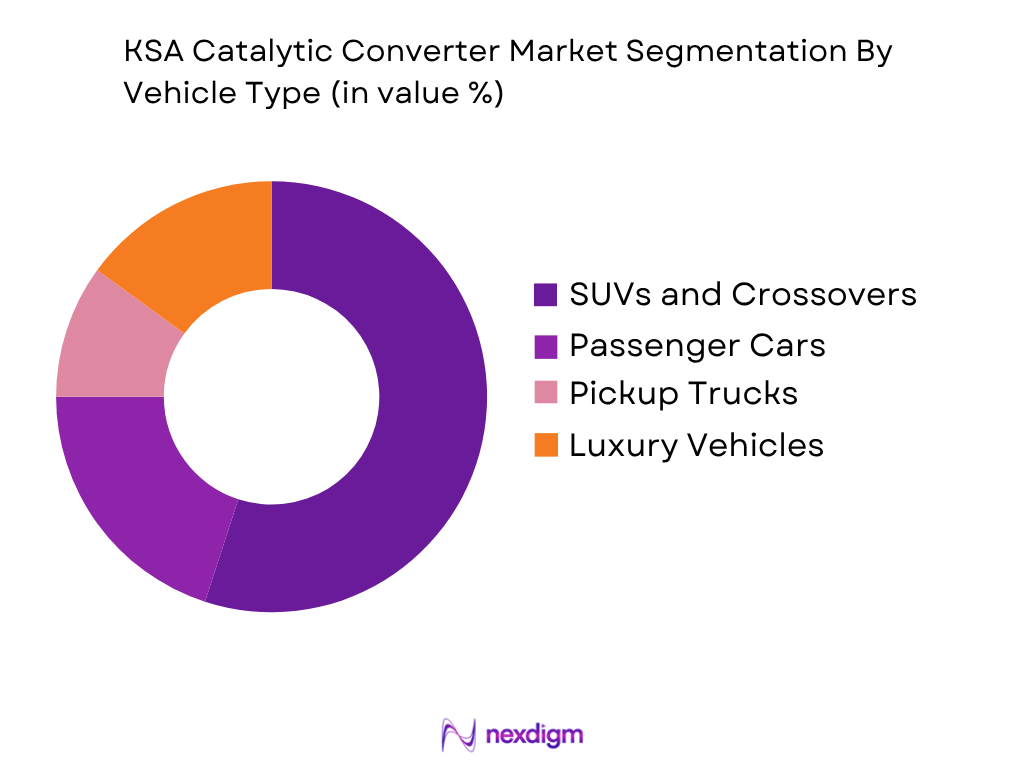
By Vehicle Type
The KSA Catalytic Converter Market is segmented into passenger cars, SUVs and crossovers, pickup trucks, premium vehicles, light commercial vehicles and medium/heavy commercial vehicles. SUVs and crossovers dominate the market by value under the report model because Saudi consumers maintain strong demand for large petrol-powered vehicles capable of long-distance highway and desert operation. V6, V8 and turbocharged SUV architectures frequently use twin exhaust banks, close-coupled converters and multiple catalyst bricks, increasing catalyst substrate and PGM content relative to compact cars. The addressable fleet is substantial: Saudi Arabia recorded more than 15.8 million registered roadworthy vehicles, including 11,262,279 private vehicles at the end of the latest official period. This supports large direct-fit replacement catalogues covering Toyota, Lexus, Nissan, Hyundai, Kia, Ford, Chevrolet/GMC and premium European applications.
By Powertrain Type
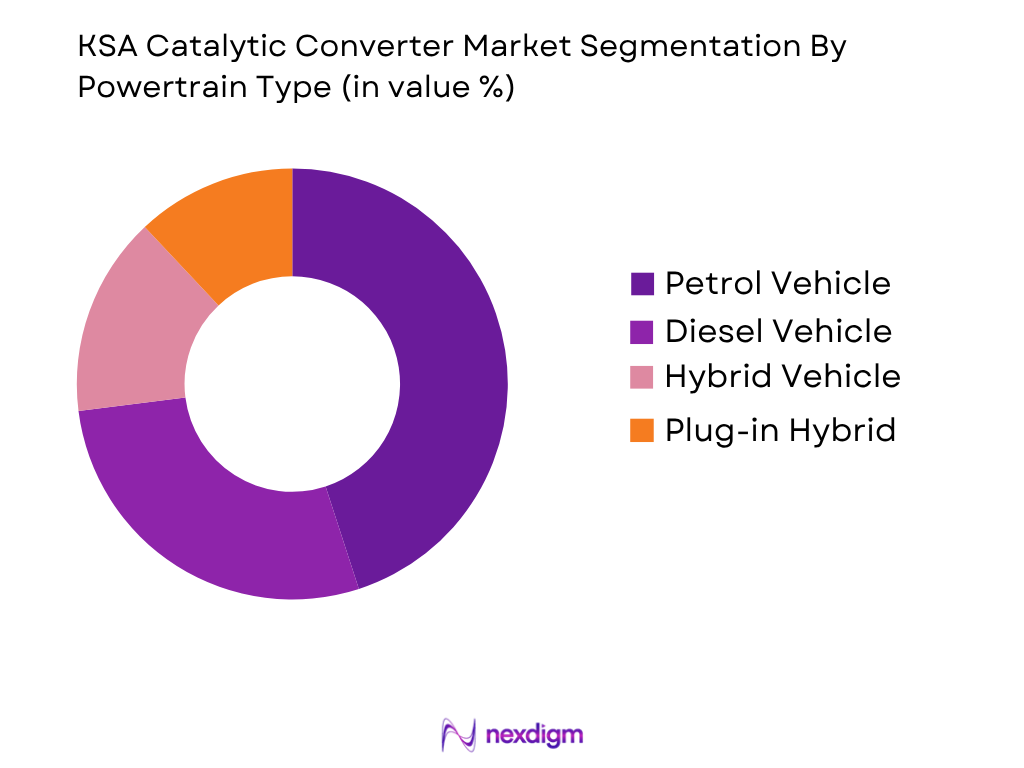
The KSA Catalytic Converter Market is segmented into conventional petrol vehicles, petrol hybrids, plug-in hybrids, diesel vehicles and other combustion powertrains. Conventional petrol vehicles dominate current catalytic-converter demand because the installed Saudi fleet contains a very large base of gasoline-powered cars, SUVs and pickups using three-way catalytic converters. Petrol systems commonly rely on palladium-rhodium formulations to oxidize carbon monoxide and hydrocarbons while reducing nitrogen oxides. Hybrid vehicles are increasingly relevant because they preserve catalytic converters while introducing more complex thermal-management requirements during repeated engine shutdown and restart cycles. In contrast, battery-electric vehicles completely eliminate exhaust aftertreatment. Saudi Arabia’s expanding domestic EV ecosystem—anchored by Lucid and Ceer—therefore makes hybrid applications strategically important as a transition segment between conventional ICE and fully electric platforms.
Competitive Landscape
The KSA Catalytic Converter Market is supplied predominantly through international emissions-control technology companies, exhaust-system Tier-1 suppliers and aftermarket manufacturers rather than a mature domestic catalyst-coating industry. Tenneco/Walker, FORVIA Clean Mobility, Purem by Eberspächer, BASF Environmental Catalyst and Metal Solutions, and Johnson Matthey represent important competitive benchmarks. Competition centres on GCC vehicle coverage, large-engine catalyst architecture, high-temperature durability, PGM formulation, OEM integration, OBD compatibility, Gulf inventory availability and access to Saudi dealership and workshop networks.
| Major Player | Establishment | Headquarters | Core Offering | Vehicle Coverage | Catalyst/PGM Capability | Thermal Capability | OEM/Aftermarket Position | KSA Relevance |
| Tenneco / Walker | 1940-era corporate roots | Northville, USA | ~ | ~ | ~ | ~ | ~ | ~ |
| FORVIA Clean Mobility | 2022 | Nanterre, France | ~ | ~ | ~ | ~ | ~ | ~ |
| Purem by Eberspächer | 1865 | Esslingen, Germany | ~ | ~ | ~ | ~ | ~ | ~ |
| BASF ECMS | 1865 group roots | USA/Germany network | ~ | ~ | ~ | ~ | ~ | ~ |
| Johnson Matthey | 1817 | London, UK | ~ | ~ | ~ | ~ | ~ | ~ |
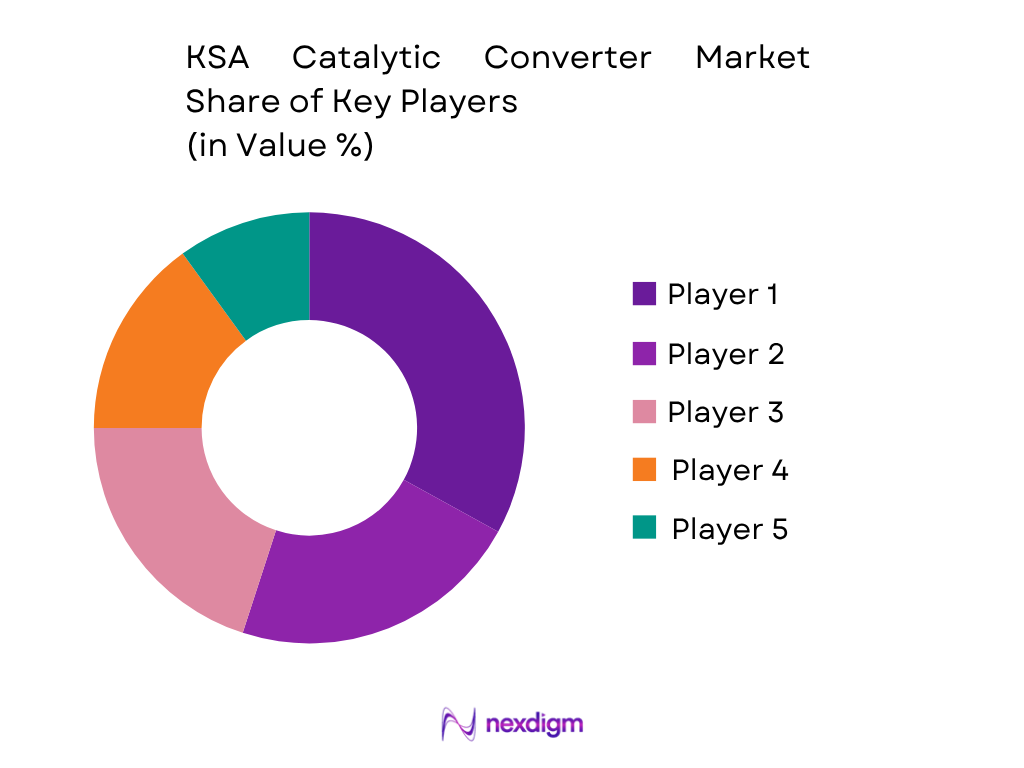
KSA Catalytic Converter Market Analysis
Growth Drivers
Large ICE Vehicle Parc and Expanding Road-Logistics Activity
Saudi Arabia’s large combustion-powered vehicle population remains one of the strongest demand drivers for catalytic converters because passenger cars, SUVs, pickups, vans, buses and commercial vehicles require functioning exhaust-aftertreatment systems throughout their operating lives. GASTAT’s Road Transport Statistics show that the Kingdom had more than 15.8 million registered roadworthy vehicles in 2024, including 11,262,279 private vehicles, creating a substantial installed base for three-way catalysts, diesel oxidation catalysts and replacement exhaust assemblies. The commercial-vehicle side is also being reinforced by logistics expansion. GASTAT reported 23 activated logistics centres covering 34.6 million square metres in 2024, compared with 22 centres previously; Makkah Region alone contained 6 centres occupying 20.4 million square metres. This expanding warehousing and freight ecosystem increases truck, van and delivery-vehicle utilisation, exposing catalytic and diesel-aftertreatment systems to high mileage, continuous thermal cycling and greater service requirements. The broader logistics master plan calls for 59 centres exceeding 100 million square metres, underscoring how freight mobility is becoming more structurally important to the Saudi economy. The macroeconomic environment supports this road-transport intensity. The IMF reported that Saudi Arabia’s non-oil economy generated strong activity in 2024, with nominal economic output supported by retail, hospitality, construction and investment, while the World Bank subsequently recorded national GDP at USD 1.277 trillion in 2025 and GDP per capita at USD 34,536.7. For catalytic-converter manufacturers and distributors, the importance of this installed vehicle base extends beyond first fitment. Catalysts deteriorate through substrate cracking, thermal ageing, oil contamination, ignition misfires, rich combustion and repeated high-load operation. Saudi Arabia’s long inter-city road distances, widespread SUV use and commercial freight activity make these deterioration mechanisms particularly relevant. Large petrol vehicles can use multiple catalyst bricks or twin-bank systems, so replacement content per vehicle can exceed that of a basic compact car. High-mileage diesel fleets additionally require oxidation catalysts integrated with DPF and SCR systems. These conditions create recurring demand for direct-fit converters, oxygen-sensor-compatible assemblies, commercial aftertreatment and diagnostic services. The scale of Saudi road mobility, therefore, provides catalytic-converter demand even before accounting for new automotive manufacturing initiatives.
Vision 2030 Automotive Localization Expanding the Saudi Emissions-Control Supply Ecosystem
Saudi Arabia’s industrialization strategy is creating a second growth driver by establishing a domestic automotive supply chain that can progressively support exhaust-system fabrication, converter canning, thermal-management components and vehicle-specific emissions-control integration. PIF’s automotive investments are already building a sizeable manufacturing ecosystem. Ceer, Saudi Arabia’s first national electric-vehicle brand, is expected to attract more than USD 150 million of foreign direct investment, create up to 30,000 direct and indirect jobs, and contribute around USD 8 billion directly to Saudi GDP over its development horizon. Its planned manufacturing complex at King Abdullah Economic City covers more than 1 million square metres, creating a large platform for automotive supplier localization. Lucid provides another manufacturing anchor: its Saudi AMP-2 facility began with capacity for 5,000 vehicles per year, while the complete site is designed for eventual capacity of up to 155,000 vehicles annually. Although both projects are strongly EV-oriented, their importance to the catalytic-converter ecosystem comes from the wider supplier infrastructure they generate. Automotive clusters require stainless-steel fabrication, thermal shielding, sensors, precision welding, metal forming, electronics, testing, logistics and Tier-1 engineering—the same industrial capabilities needed to localize portions of conventional and hybrid exhaust-aftertreatment systems. Saudi Arabia’s existing combustion fleet of more than 15.8 million roadworthy vehicles means domestic component suppliers can serve both new automotive manufacturing and a very large aftermarket rather than depending on future EV production alone. Hybrid vehicles are particularly relevant because they combine electrification with internal-combustion engines and therefore still require catalytic converters. Supplier localization can enable Saudi manufacturers to assemble close-coupled catalyst shells, manifolds, exhaust tubing and heat shields locally while sourcing coated substrates or PGM formulations from specialist international companies. The macroeconomic foundation supports this industrial transition. The IMF reported that Saudi non-oil activity expanded strongly in 2024, driven by sectors including construction, retail and hospitality, and its 2026 mission reported that GDP reached stronger momentum in 2025 as domestic demand remained robust. World Bank data place total Saudi economic output at USD 1.277 trillion in 2025, illustrating the scale of capital available to support automotive industrialization. For catalytic-converter companies, the opportunity is therefore broader than simply selling imported replacement converters. Global suppliers can establish relationships with Saudi OEMs and Tier-1 companies, localize hot-end exhaust integration, develop Gulf-specific high-temperature components and supply hybrid vehicles that retain three-way catalysts. As Saudi Arabia’s automotive sector moves from an import-dominated model toward domestic assembly and supplier localization, catalytic-converter technologies can increasingly become part of a broader locally integrated automotive component chain.
Market Challenges
Accelerating EV Manufacturing and Charging Infrastructure Removing Future Converter Content
The rapid development of Saudi Arabia’s electric-vehicle ecosystem poses the most significant structural challenge to the Catalytic Converter Market because a battery-electric vehicle contains no combustion engine, exhaust manifold or catalytic converter. Saudi Arabia is developing both vehicle manufacturing and charging infrastructure at the same time, creating conditions for progressively greater substitution of catalyst-equipped petrol vehicles. Ceer is dedicated specifically to battery-electric vehicles and is developing sedans and SUVs using technology licensed from BMW through its collaboration with Foxconn. PIF states that the company’s industrial program is expected to generate 30,000 direct and indirect jobs and attract more than USD 150 million in foreign investment, demonstrating that EV manufacturing is being treated as a major domestic industrial sector rather than a niche import category. Lucid’s AMP-2 plant provides additional manufacturing capability, beginning with 5,000 vehicles of annual assembly capacity and designed for eventual output of up to 155,000 vehicles annually. Charging infrastructure is expanding alongside vehicle production. In 2024, PIF-owned ROSHN and EVIQ began deploying high-speed charging infrastructure across Saudi developments and launched the Kingdom’s first public fast-charging site at ROSHN Front in Riyadh, a destination receiving more than 800,000 visitors each month. By 2026, EVIQ partnerships had expanded into major developments such as New Murabba, where AC and DC charging systems are being integrated directly into new urban assets. Every battery-electric SUV or passenger car entering service removes an original catalytic converter and also eliminates future replacement, oxygen-sensor, emissions-diagnostic and PGM-recovery revenue associated with that vehicle. This is particularly important in Saudi Arabia because the current market benefits strongly from large petrol SUVs and pickups that can use multiple catalyst bricks; electrifying these platforms removes relatively high catalyst content per vehicle. The macroeconomic environment makes the transition commercially feasible. World Bank data show Saudi Arabia operating a USD 1.277 trillion economy in 2025, while the IMF reported strong domestic demand and continued economic diversification through 2024–2026. Saudi consumers and government-backed fleets therefore have financial and infrastructure support to adopt newer vehicle technologies. The immediate effect will still be moderated by the existing roadworthy fleet of more than 15.8 million vehicles, most of which remain combustion-powered. However, the long-term direction is clear: new-fitment catalyst opportunities will increasingly concentrate in hybrids and surviving ICE segments rather than broad vehicle-market expansion. Catalytic-converter suppliers must consequently diversify toward hybrid systems, high-age replacement demand, commercial diesel aftertreatment and recovered PGM rather than relying indefinitely on conventional petrol OEM fitment.
PGM Import Dependence and Harsh Thermal Operating Conditions
Saudi Arabia’s catalytic-converter industry also faces material challenges from imported platinum-group-metal dependence and severe thermal operating conditions. Three-way catalysts require precious metals such as palladium and rhodium, while diesel oxidation catalysts use platinum-containing formulations; Saudi Arabia does not operate a primary domestic PGM supply chain capable of supporting its large road-vehicle population, making catalyst technology dependent on international mining, refining and specialist coating networks. This exposure is significant because the Kingdom already has more than 15.8 million roadworthy vehicles, including over 11.26 million private vehicles, meaning even a modest replacement requirement translates into substantial demand for PGM-containing components. Saudi Arabia’s physical operating environment creates another technical constraint. The country covers approximately 2.24 million square kilometres, with extensive desert terrain and long-distance inter-city road networks, while logistics infrastructure continues expanding through 23 operational logistics centres covering 34.6 million square metres. Catalytic converters already operate at very high internal temperatures; extended highway use, heavy commercial loads, air-conditioning demand and large petrol engines can add thermal stress to ceramic substrates, washcoats and converter shells. Failure of ignition, cooling or fuel systems can push catalyst temperatures even higher, creating substrate melting or cracking. This environment makes low-specification universal converters particularly vulnerable if they lack adequate PGM loading, thermal durability or correct canning. Application diversity further raises complexity. The Saudi fleet includes large numbers of Japanese SUVs, Korean cars, American pickups, European luxury vehicles, Chinese models and commercial trucks. Each engine family can use different catalyst volumes, sensor locations, manifold geometry and emissions calibrations. Replacement suppliers therefore need extensive inventories rather than a small number of generic SKUs. Saudi automotive localization may eventually reduce some supply exposure, but current domestic industrial development is focused heavily on new EV manufacturing. Lucid’s Saudi plant begins from 5,000 vehicles annual capacity, while Ceer is creating a manufacturing ecosystem covering more than 1 million square metres; neither development immediately substitutes for specialist domestic PGM refining or catalyst coating. The macroeconomic scale of the issue is substantial. World Bank data place Saudi GDP at USD 1.277 trillion in 2025, and the IMF states that the economy entered 2026 with strong domestic momentum. A large automotive service economy consequently depends on stable international catalyst supply. Suppliers able to manage this challenge need secure PGM procurement, high-temperature formulations, application-specific catalogue depth and accurate OBD compatibility. Over time, secondary PGM recovery from spent Saudi converters could reduce reliance on primary imported material, but until formal collection and refining become more integrated, precious-metal supply and thermal durability will remain major operating constraints.
Market Opportunities
Hybrid SUVs and High-Mileage Fleet Aftertreatment
Hybrid SUVs, passenger vehicles and high-mileage commercial fleets create a strong growth opportunity because these applications preserve exhaust-aftertreatment demand while aligning more closely with Saudi Arabia’s gradual transition toward lower-emission mobility. Unlike battery-electric vehicles, full hybrids and plug-in hybrids retain internal-combustion engines and therefore require three-way catalytic converters to control carbon monoxide, hydrocarbons and nitrogen oxides. Hybrid operating patterns can actually increase the technical complexity of catalytic systems because the engine repeatedly shuts down during electric propulsion, allowing exhaust temperature to fall before restarting. This creates demand for low-light-off catalyst formulations, reduced thermal-mass substrates, close-coupled converter architecture and high oxygen-storage capacity. Saudi Arabia’s existing road base makes this technically attractive segment commercially meaningful. The Kingdom has more than 15.8 million registered roadworthy vehicles, including 11,262,279 private vehicles, providing manufacturers with a very large population of motorists who can transition gradually from conventional petrol SUVs toward hybrid versions without moving directly to battery-electric vehicles. Commercial fleets add a separate opportunity. GASTAT reports 23 active logistics centres covering 34.6 million square metres, while the national logistics master plan provides for 59 centres exceeding 100 million square metres. These logistics investments support trucks, vans and delivery fleets accumulating high annual mileage, which increases thermal cycling and eventual replacement requirements for diesel oxidation catalysts and integrated DOC-DPF-SCR systems. The expanding non-oil economy strengthens the demand case: the IMF identified retail, hospitality and construction as important drivers of Saudi economic activity in 2024 and subsequently reported strong domestic momentum entering 2026. World Bank data show national GDP of USD 1.277 trillion in 2025 and GDP per capita of USD 34,536.7, supporting continued household vehicle expenditure and fleet modernization. For catalyst suppliers, this creates room to shift from commodity replacement products toward technically differentiated applications. Hybrid versions of popular SUVs require catalysts designed for rapid thermal recovery; large petrol engines may use multiple converter bricks; logistics fleets require durable diesel aftertreatment; and high-mileage passenger or ride-hailing vehicles eventually generate direct-fit replacement demand. Companies with vehicle-specific engineering for Toyota, Lexus, Hyundai, Kia and other hybrid platforms can participate in electrification without surrendering their catalyst business. Commercial-system suppliers can similarly focus on higher-durability DOC and integrated aftertreatment for trucks and buses. The key opportunity is therefore not unrestricted growth of conventional ICE catalysts but migration toward segments where combustion engines remain operationally necessary and catalyst technology becomes more sophisticated.
Automotive Localization and Closed-Loop PGM Recovery
Saudi Arabia’s developing automotive manufacturing base creates an opportunity to localize parts of the catalytic-converter value chain while simultaneously building a more organized system for recovering precious metals from end-of-life converters. The industrial foundation is expanding rapidly. Ceer’s planned automotive operation is expected to attract more than USD 150 million of foreign direct investment, create up to 30,000 direct and indirect jobs, and operate from a manufacturing complex exceeding 1 million square metres at King Abdullah Economic City. Lucid’s AMP-2 facility has an initial annual capacity of 5,000 vehicles, with the site designed to eventually reach 155,000 units annually, and the company explicitly links its Saudi presence to development of a domestic automotive supply chain. These factories themselves are EV-focused and therefore do not create catalytic-converter demand, but the surrounding industrial capabilities—precision metal forming, thermal management, welding, sensors, automotive-grade stainless steel, quality testing, logistics and Tier-1 supplier development—are directly transferable to hybrid and combustion exhaust systems. Saudi suppliers could therefore localize converter shells, manifolds, heat shields and complete exhaust assemblies while importing advanced coated substrates from global catalyst companies. Such localization becomes commercially viable because the Kingdom already maintains more than 15.8 million roadworthy vehicles, creating a sizeable aftermarket in parallel with new domestic vehicle manufacturing. The same installed fleet represents a future source of secondary PGM material. Failed or scrapped converters contain recoverable platinum, palladium and rhodium embedded in ceramic or metallic substrates. A formal collection system could link workshops, dismantlers and authorized recyclers, classify converters by application, decan or process monoliths and consolidate material for specialist refining. Saudi Arabia’s logistics infrastructure provides a strong base for such operations, with 23 active logistics centres covering 34.6 million square metres and plans for 59 centres exceeding 100 million square metres. This allows spent converters to be aggregated efficiently from Riyadh, Jeddah, the Eastern Province and other major automotive markets. The macroeconomic environment is supportive of investment in higher-value automotive circularity. The World Bank records Saudi GDP of USD 1.277 trillion in 2025, while the IMF reports that the economy entered 2026 with strong momentum from domestic activity and continued diversification. A closed-loop model could therefore combine new parts distribution with core returns: workshops receive approved direct-fit replacement converters while surrendering spent units for traceable PGM recovery. This would reduce material leakage, provide additional value to garages and recyclers, and lower the industry’s exposure to entirely primary PGM imports. Automotive localization and PGM circularity together provide one of the strongest longer-term opportunities because they allow the catalytic-converter sector to capture domestic value even as the Saudi vehicle industry becomes progressively more electrified.
Future Outlook
The KSA Catalytic Converter Market is forecast to expand at ~ CAGR during 2026–2035 under the placeholder scenario. Near- to medium-term growth should remain supported by Saudi Arabia’s very large combustion-vehicle parc, SUV and pickup ownership, commercial fleets, periodic vehicle inspection, aftermarket replacement and increasing automotive localization. Over the longer term, domestic electric-vehicle manufacturing and charging infrastructure will progressively reduce conventional new-fitment catalyst demand. The installed fleet provides an extensive replacement base. Saudi road transport statistics show more than 15.8 million registered roadworthy vehicles, representing an increase of more than one million vehicles versus the preceding base implied by official annual comparison. Catalyst replacement becomes relevant as vehicles accumulate mileage and experience substrate deterioration, misfire damage, oil contamination, heat ageing or oxygen-sensor-related efficiency faults.
Saudi Arabia’s automotive-industrial strategy creates an additional opportunity. Lucid has established an automotive manufacturing presence in the Kingdom, while Ceer is developing Saudi Arabia’s first domestic EV brand and is building a new vehicle manufacturing ecosystem. PIF states that Ceer is expected to attract more than USD 150 million in foreign direct investment and create up to 30,000 direct and indirect jobs, illustrating the scale of the emerging supplier base. Although these projects focus heavily on EVs, the wider supplier localization they create can also support metal fabrication, exhaust components, heat shields, sensors and other technologies useful to combustion and hybrid aftertreatment. Hybridization represents an important defensive opportunity. Saudi consumers have historically favoured SUVs and larger vehicles, and hybrid versions of these platforms preserve three-way catalyst demand while lowering fuel consumption. Hybrid catalysts require rapid light-off and strong thermal retention because the combustion engine can remain switched off during portions of a journey. This increases the importance of advanced washcoats, close-coupled configurations and high oxygen-storage capacity. Commercial vehicles should provide another resilient segment. Saudi Arabia’s logistics network expanded to 23 logistics centres occupying 34.6 million square metres, compared with 22 centres previously. Heavy logistics, delivery vehicles, buses and fleets accumulate higher mileage than private vehicles, sustaining demand for diesel oxidation catalysts and integrated aftertreatment systems even where passenger-car electrification progresses faster.
However, EV substitution is becoming structurally important. Lucid’s Saudi facility and Ceer’s manufacturing plans directly expand the domestic supply of converter-free battery-electric vehicles. Ceer states that it is building EVs specifically engineered for Saudi and GCC conditions, while PIF positions the company as a central component of Saudi automotive transformation. Saudi Arabia’s macroeconomic environment provides a strong demand backdrop. The IMF recorded 2.0 real GDP growth and 4.5 non-oil GDP growth in 2024, with population at 35.3 million and average CPI inflation at 1.7. World Bank data put 2024 GDP per capita at approximately USD 38,590.6. This combination of high income, non-oil diversification and infrastructure investment supports continued vehicle purchases and automotive aftermarket expenditure.
Major Players
- Tenneco / Walker Emissions Control
- FORVIA Clean Mobility
- Purem by Eberspächer
- BOSAL
- MagnaFlow
- BASF Environmental Catalyst and Metal Solutions
- Umicore
- Johnson Matthey
- Corning Incorporated
- DENSO Corporation
- Cataler Corporation
- NGK Insulators
- IBIDEN
- Futaba Industrial
- Sango Co., Ltd.
Key Target Audience
- Catalytic Converter and Automotive Exhaust-System Manufacturers
- Passenger Vehicle, SUV and Commercial Vehicle OEMs
- Automotive Importers, Distributors and Spare-Parts Companies
- Authorized Dealers, Service Centres and Multi-Brand Workshops
- Fleet, Logistics, Rental and Commercial Transport Operators
- Platinum-Group-Metal Suppliers, Refiners and Automotive Recyclers
- Investments and Venture Capitalist Firms
- Government and Regulatory Bodies (Saudi Standards, Metrology and Quality Organization; Ministry of Industry and Mineral Resources; Ministry of Transport and Logistic Services; Saudi Transport General Authority)
Research Methodology
Step 1: Identification of Key Variables
The initial phase constructs an ecosystem map covering vehicle OEMs, importers, catalyst manufacturers, exhaust suppliers, substrate manufacturers, PGM suppliers, distributors, workshops, fleet operators and recyclers. Primary variables include the Saudi vehicle parc, SUV and pickup penetration, engine size, converters per vehicle, powertrain, catalyst chemistry, vehicle age, replacement lifecycle and regional distribution.
Official GASTAT road-transport data are used to establish the vehicle base, while government and corporate sources support automotive localization and EV-transition assumptions. Vehicle applications are separated by Japanese, Korean, American, European and Chinese origin because catalyst configurations vary significantly across engine families.
Step 2: Market Analysis and Construction
The top-down approach begins with more than 15.8 million registered roadworthy vehicles and allocates the combustion-powered population by vehicle type, fuel and expected catalyst content. SUVs, pickups and V-engine vehicles are modeled separately because twin-bank exhaust systems can materially increase converter content.
The bottom-up approach evaluates dealer replacements, direct-fit converter portfolios, universal converters, independent-workshop activity, fleet repair demand and imported component availability. OEM fitment and aftermarket replacement are separated to prevent double counting.
Step 3: Hypothesis Validation and Expert Consultation
Market hypotheses are validated through CATIs with catalytic-converter suppliers, automotive distributors, dealer service teams, exhaust workshops, fleet operators and scrap/recycling companies. Interviews examine converter replacement frequency, large-engine applications, P0420/P0430 diagnostics, extreme-heat exposure, PGM loading and availability of direct-fit parts.
Additional validation focuses on hybrid vehicles, commercial diesel aftertreatment, SUV replacement behaviour and the developing domestic automotive supplier ecosystem. Inputs inconsistent with official transport statistics or primary OEM information are reassessed.
Step 4: Research Synthesis and Final Output
The final stage triangulates vehicle-parc statistics, automotive localization, catalyst engineering, primary interviews and competitive mapping. Demand is segmented by converter type, vehicle type, powertrain, fitment, emission compliance, substrate, catalyst composition, vehicle origin, channel and region.
Forecast scenarios incorporate vehicle ageing, SUV retention, hybrid penetration, EV substitution, local vehicle manufacturing, commercial-fleet expansion, PGM availability and catalyst recycling. Base-case, accelerated-EV, high-hybrid and high-aftermarket scenarios are used to test market resilience.

- Executive Summary
- Research Methodology (Market Definitions and Assumptions, Abbreviations, Catalytic Converter Market Boundary, Vehicle-Parc Mapping, Converter-per-Vehicle Assessment, Petrol-Diesel-Hybrid Powertrain Mapping, OEM Fitment Assessment, Replacement Cycle Analysis, Vehicle Inspection Assessment, PGM Loading Analysis, Import and Distribution Mapping, Automotive Localization Assessment, Market Sizing Approach, Top-Down Analysis, Bottom-Up Analysis, Demand-Side Assessment, Supply-Side Assessment, OEM and Tier-1 Interviews, Distributor and Workshop Interviews, Recycler Interviews, Data Triangulation, Forecasting Framework, Scenario Analysis, Limitations and Future Conclusions)

- Definition and Scope
- Evolution of Automotive Catalytic Emission Control in Saudi Arabia
- Development of Petrol Three-Way Catalyst Technology
- Evolution of Saudi/GCC Vehicle Emission Compliance
- Catalytic Converter Role in Petrol, Hybrid and Diesel Powertrains

- Growth Drivers (Large Petrol Vehicle Parc, High SUV and Pickup Penetration, Periodic Vehicle Inspection, Premium Vehicle Catalyst Content, Commercial Fleet Growth, Automotive Localization, Hybrid Vehicle Adoption, Vehicle Aftermarket Expansion)
- Market Challenges (Battery-Electric Vehicle Adoption, PGM Import Dependence, High Ambient Temperature Exposure, Limited Domestic Catalyst-Coating Capability, Counterfeit Replacement Parts, Vehicle Application Complexity, Imported Converter Dependence, Catalyst Modification and Removal)
- Market Opportunities (Hybrid Catalyst Systems, SUV and Pickup Replacement, Local Converter Canning, Saudi Automotive Cluster Localization, Inspection-Driven Replacement, High-Temperature Catalyst Technology, PGM Recycling, Digital VIN-Based Application Matching)
- Market Trends (Close-Coupled Catalysts, High-Temperature Wash coats, PGM Thrifting, Multi-Brick Large-Engine Systems, Hybrid Thermal Management, Localized Exhaust Assembly, Digital Parts Catalogues, Recycled-PGM Usage)
- SWOT Analysis
- Porter’s Five Forces Analysis
- PESTLE Analysis

- By Market Value (2020-2025)
- By Catalytic Converter Unit Volume (2020-2025)
- By OEM-Fitted Converter Volume (2020-2025)

- By Converter Type (In Value %)
Three-Way Catalytic Converters
Close-Coupled Catalytic Converters
Manifold-Integrated Catalytic Converters
Underfloor Catalytic Converters
Diesel Oxidation Catalysts - By Vehicle Type (In Value %)
Passenger Cars
Sport Utility Vehicles
Crossovers
Pickup Trucks
Premium and Luxury Vehicles - By Powertrain Type (In Value %)
Conventional Petrol Vehicles
Petrol Hybrid Vehicles
Plug-in Hybrid Vehicles
Diesel Vehicles
Alternative-Fuel Internal Combustion Vehicles - By Region (In Value %)
Riyadh Region
Makkah Region
Eastern Province
Madinah Region
Qassim Region

- Market Share of Major Players by Value
- Cross Comparison Parameters (KSA/GCC Vehicle Application Coverage, SUV-Pickup-Passenger Vehicle Converter Portfolio Breadth, Platinum-Palladium-Rhodium Catalyst Formulation Capability, High-Temperature Substrate and Wash coat Durability, SASO/GSO-OBD and Vehicle-Specific Compatibility, KSA/GCC Distribution and Inventory Footprint, OEM-Dealer-Workshop-Fleet Channel Reach, PGM Recycling and Closed-Loop Material Capability)
- SWOT Analysis of Major Players
- Detailed Profiles of Major Companies
Tenneco / Walker Emissions Control
FORVIA Clean Mobility
Purem by Eberspächer
BOSAL
MagnaFlow
BASF Environmental Catalyst and Metal Solutions
Umicore
Johnson Matthey
Corning Incorporated
DENSO Corporation
Cataler Corporation
NGK Insulators
IBIDEN
Futaba Industrial
Sango Co., Ltd.

- Automotive OEM Procurement
- Vehicle Importer Procurement
- OEM Dealer Replacement Demand
- Independent Spare-Parts Distributor Demand
- Authorized Service Centre Demand

- By Market Value (2026-2035)
- By Catalytic Converter Unit Volume (2026-2035)
- By OEM-Fitted Converter Volume (2026-2035)


 Request a Sample
 Ask for Customization
 Get a Quote
 Enquire Now