
 Download PDF
Market Overview
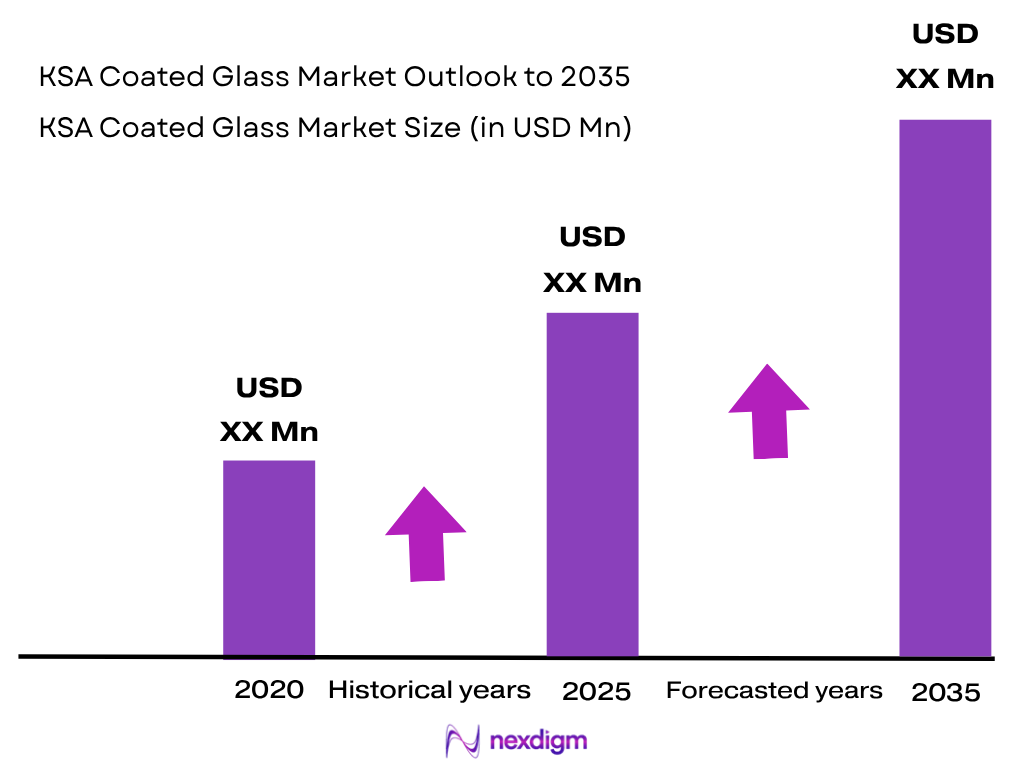
The KSA coated glass market is valued at approximately USD ~651.72 million in 2024, supported by increasing demand for energy-efficient architectural glazing solutions across commercial, residential, hospitality, and infrastructure projects. The market expansion is driven by Saudi Arabia’s construction pipeline, Vision 2030 infrastructure investments, rising adoption of solar control glass in high-temperature environments, and increasing requirements for sustainable building materials. The broader Saudi construction ecosystem continues to support demand for advanced glass solutions due to large-scale urban development activities.
The coated glass market in Saudi Arabia is primarily concentrated around Riyadh, Jeddah, Dammam, and the NEOM region due to their high construction activity and infrastructure investments. Riyadh dominates demand due to government-led urban transformation, commercial developments, and large real estate projects. Jeddah contributes significantly through hospitality, tourism, and coastal infrastructure projects. The Eastern Province benefits from industrial construction and commercial developments, while NEOM creates demand for advanced façade systems, energy-efficient glazing, and premium architectural glass solutions.
Market Segmentation
By Product Type
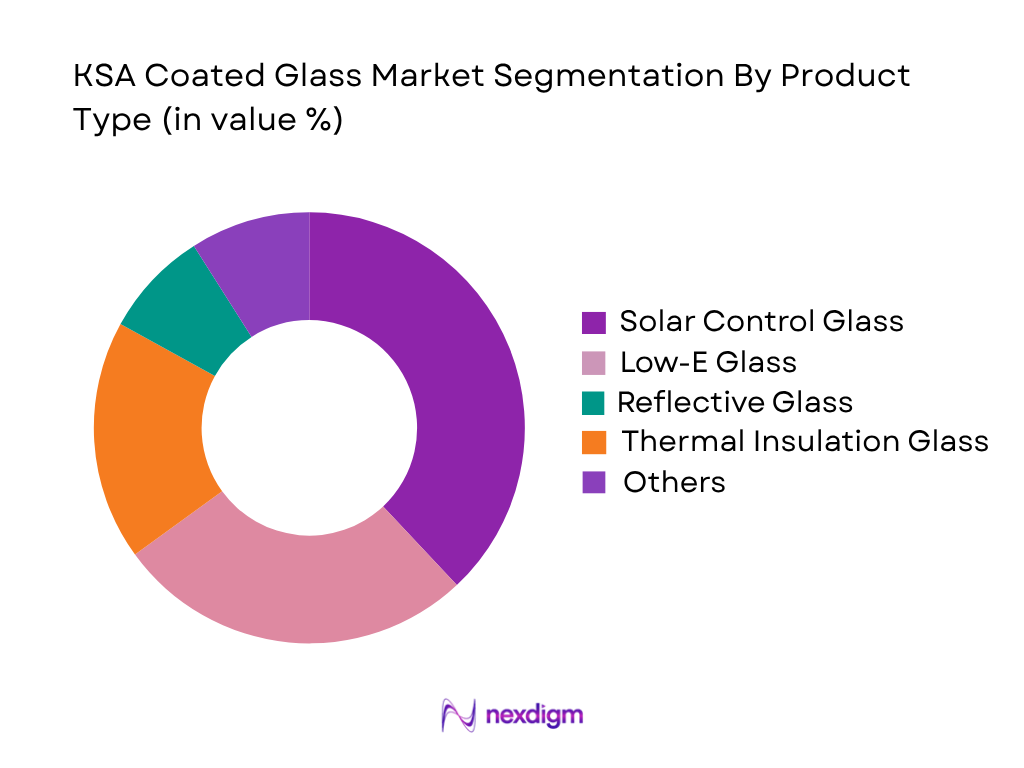
The KSA coated glass market is segmented by product type into Low-E Glass, Solar Control Glass, Reflective Glass, Anti-Reflective Glass, Self-Cleaning Glass, Decorative Coated Glass, and Thermal Insulation Glass. Among these, Solar Control Glass holds the dominant position due to Saudi Arabia’s extreme climatic conditions, high solar radiation levels, and the requirement to reduce cooling loads in buildings. Commercial towers, hospitality developments, and large infrastructure projects increasingly use solar control coated glass to improve indoor thermal comfort and reduce energy consumption. Low-E glass is also gaining adoption due to green building standards and increasing demand for high-performance glazing systems.
By Application
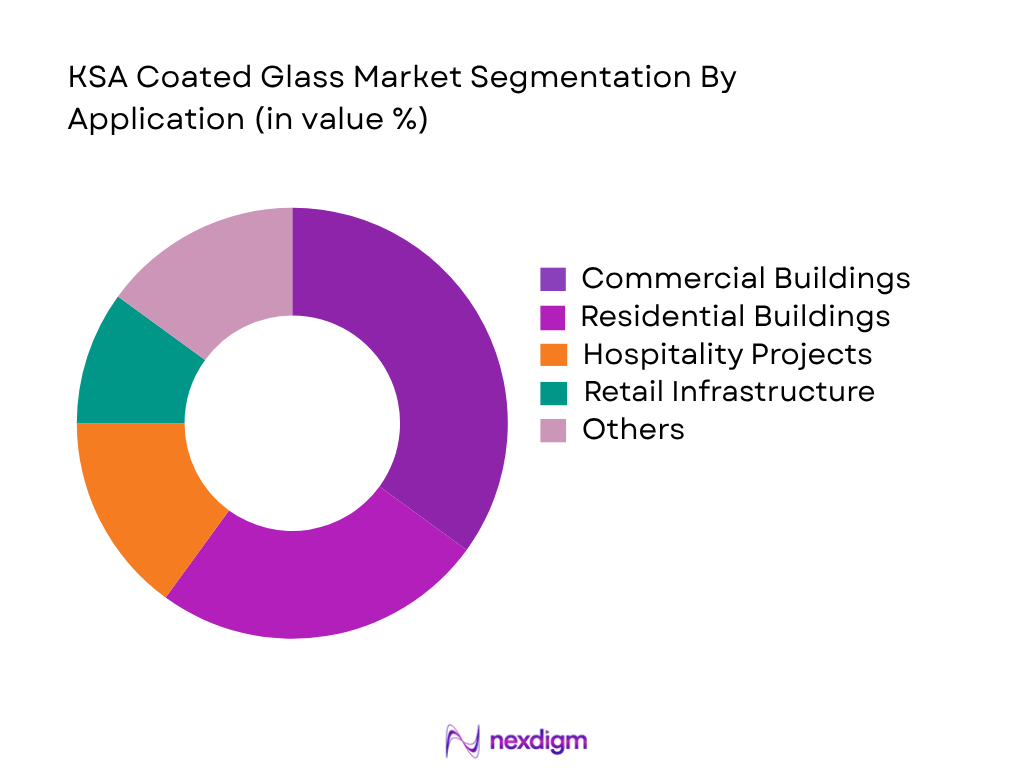
The KSA coated glass market is segmented by application into Commercial Buildings, Residential Buildings, Hospitality Projects, Retail Infrastructure, Healthcare Facilities, Industrial Buildings, Transportation Infrastructure, and Solar Energy Projects. Commercial buildings represent the largest application segment due to extensive development of office towers, mixed-use developments, financial districts, and government infrastructure. Riyadh’s urban expansion, Jeddah’s tourism development, and large-scale real estate projects require advanced façade glazing systems that provide thermal insulation, aesthetic appeal, and energy efficiency.
Competitive Landscape
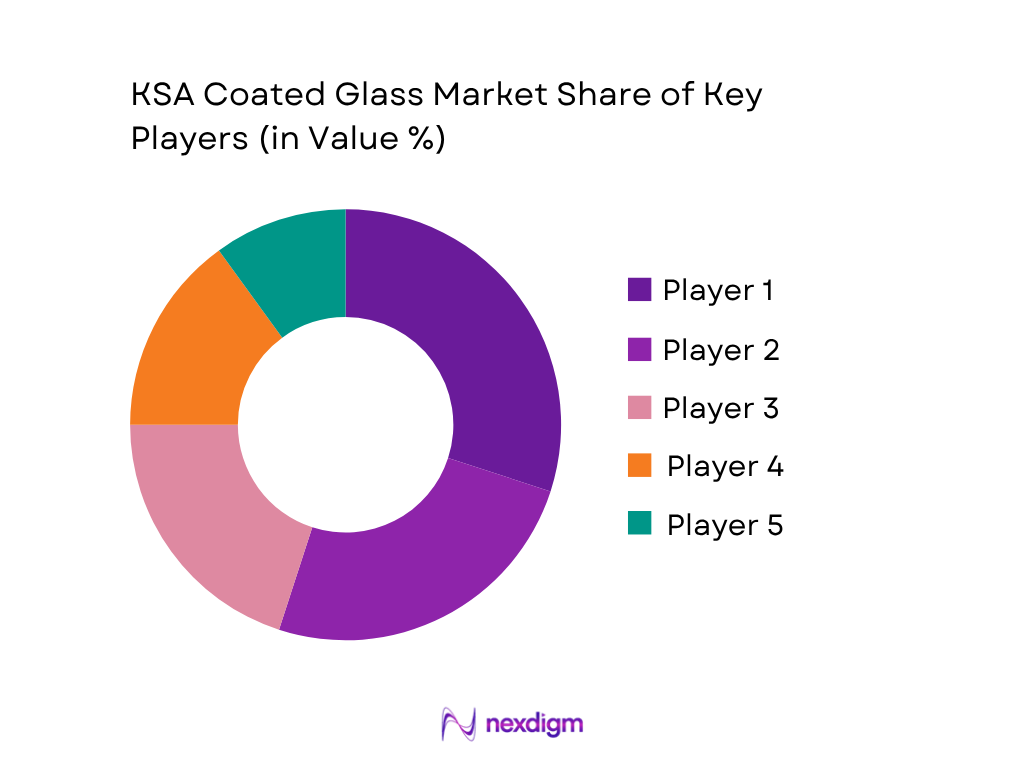
The KSA coated glass market is moderately consolidated with the presence of global glass manufacturers, regional processors, and architectural glass suppliers. Major players compete through advanced coating technologies, Low-E and solar control glass portfolios, project supply capabilities, fabrication networks, and relationships with construction companies and façade contractors. International manufacturers such as Saint-Gobain, AGC Glass, Guardian Glass, and NSG Group maintain strong positions through technology leadership, while regional companies participate through processing and distribution capabilities.
| Company | Establishment Year | Headquarters | Product Portfolio | Coating Technology | KSA Market Presence | Major Applications | Processing Capability | Distribution Network |
| Saint-Gobain | 1665 | France | ~ | ~ | ~ | ~ | ~ | ~ |
| AGC Glass | 1907 | Japan | ~ | ~ | ~ | ~ | ~ | ~ |
| Guardian Glass | 1932 | USA | ~ | ~ | ~ | ~ | ~ | ~ |
| NSG Group (Pilkington) | 1918 | Japan | ~ | ~ | ~ | ~ | ~ | ~ |
| Şişecam | 1935 | Türkiye | ~ | ~ | ~ | ~ | ~ | ~ |
KSA Coated Glass Market Analysis
Growth Drivers
Vision 2030 Infrastructure Development and Construction Expansion
Saudi Arabia’s large-scale infrastructure transformation under Vision 2030 is creating sustained demand for coated glass solutions used in energy-efficient façades, commercial buildings, hospitality assets, and mega development projects. The country’s real GDP was valued at approximately USD 1.24 trillion in 2024, reflecting the economic scale supporting construction and infrastructure investments. The World Bank reported that industry, including construction, contributed approximately 44.84% of Saudi Arabia’s GDP in 2024, highlighting the importance of industrial and construction activities in the economy. The non-oil economy expanded by 4.3% in 2024, supported by sectors including construction, tourism, transportation, and private investment, according to Saudi government data. This economic diversification is accelerating demand for advanced glazing systems such as solar control glass and Low-E glass, particularly in Riyadh, Jeddah, and emerging development zones. The expansion of urban infrastructure, commercial districts, residential developments, and tourism-related assets increases the requirement for architectural glass products that improve thermal performance and reduce cooling requirements in Saudi Arabia’s hot climate conditions.
Energy Efficiency Regulations and Increasing Adoption of Sustainable Building Materials
The increasing focus on energy conservation and sustainable construction standards is supporting adoption of coated glass technologies across Saudi Arabia’s building sector. The country’s extreme climatic conditions, with high cooling demand in commercial and residential buildings, are encouraging developers to use advanced glazing solutions that improve insulation and solar heat management. Saudi Arabia’s non-oil sectors recorded strong activity, with the IMF highlighting continued private consumption and investment-driven expansion in non-oil economic activities. The World Bank reported that industry-related activities, including construction and manufacturing, remained a significant contributor to economic output, accounting for 44.84% of GDP in 2024. The implementation of building efficiency requirements through Saudi Building Code provisions and sustainability programs is increasing the relevance of Low-E glass, solar control coatings, and insulated glazing systems. Growth in commercial towers, healthcare facilities, hospitality projects, and government buildings is creating greater demand for coated glass products that support energy performance objectives while maintaining architectural aesthetics.
Market Challenges
Dependence on Imported Coated Glass and Limited Domestic Advanced Coating Capacity
The Saudi coated glass market continues to face challenges due to reliance on imported advanced coated glass products and limited domestic production capabilities for specialized coating technologies. High-performance products such as triple silver Low-E glass, advanced solar control coatings, and specialty architectural glass often require sophisticated coating lines and technology expertise. Saudi Arabia’s industrial sector, although representing 44.84% of GDP in 2024 according to World Bank data, still has a developing ecosystem for specialized glass manufacturing compared with established global glass-producing countries. The country imported significant volumes of construction materials to support infrastructure development, reflecting the requirement for international supply networks. The dependence on overseas suppliers creates exposure to global logistics conditions, shipping timelines, and supply chain disruptions. Additionally, establishing domestic coated glass manufacturing requires significant industrial investment, advanced coating equipment, skilled technical manpower, and consistent demand from large construction projects. These factors can limit rapid localization of coated glass production despite increasing domestic demand from infrastructure and real estate developments.
Project-Based Demand Cycles and Technical Adoption Barriers
The coated glass market in Saudi Arabia is influenced by the timing and execution of large construction projects, creating fluctuations in procurement patterns and demand visibility. While infrastructure investment remains strong, project delays, specification changes, and approval cycles can affect purchasing decisions for advanced glazing products. Saudi Arabia’s overall GDP growth was 1.3% in 2024, with non-oil activities expanding by 4.3%, showing that economic activity is increasingly diversified but still influenced by investment cycles. The adoption of premium coated glass also requires technical coordination among architects, façade consultants, contractors, and developers to ensure correct product specification, installation, and performance. Smaller construction projects may continue using conventional glass solutions due to lower technical requirements and limited awareness of lifecycle energy benefits. Furthermore, advanced coated glass products require specialized handling, storage, and installation practices, increasing operational complexity across the supply chain. These factors create challenges for broader penetration of high-performance glazing technologies beyond major commercial and infrastructure developments.
Market Opportunities
Expansion of Green Buildings and High-Performance Façade Systems
Saudi Arabia’s transition toward sustainable urban development is creating opportunities for coated glass manufacturers and suppliers focused on energy-efficient façade solutions. The country’s economic diversification agenda has increased investment into commercial districts, tourism infrastructure, and smart city developments requiring advanced building materials. Saudi Arabia’s non-oil economy expanded by 4.3% in 2024, supported by private-sector activities and infrastructure-related development. The World Bank reported that industry, including construction-related activities, represented 44.84% of GDP in 2024, demonstrating the continued importance of construction-driven economic activity. These conditions create opportunities for Low-E glass, solar control glass, and insulated glazing systems that support energy reduction objectives in buildings. Increasing development of premium commercial towers, hospitality facilities, and mixed-use projects creates demand for architectural glass with enhanced thermal performance. Developers increasingly require materials aligned with sustainability objectives, creating opportunities for suppliers offering advanced coating technologies, customized façade solutions, and performance-based glazing systems.
Domestic Glass Manufacturing Development and Renewable Energy Infrastructure Growth
Saudi Arabia’s industrial diversification strategy is creating opportunities for localization of glass processing and advanced manufacturing capabilities. The Kingdom’s industrial sector remains a major contributor to economic activity, with World Bank data indicating that industry including construction accounted for approximately 44.84% of GDP in 2024. Government-backed infrastructure programs and renewable energy expansion are increasing demand for specialized glass applications across buildings and energy projects. Saudi Arabia has been expanding renewable energy development as part of its broader energy transition strategy, creating potential demand for specialized solar-related glass products and supporting industrial ecosystem development. The continued growth of manufacturing activities and investment initiatives creates opportunities for establishing domestic coated glass processing facilities, improving supply chain efficiency, and reducing dependence on imports. Local production capabilities can support faster delivery for large construction projects while enabling customization for regional climatic conditions. The development of domestic expertise in glass processing, coating technologies, and architectural applications can strengthen Saudi Arabia’s position within the regional advanced glass market.
Future Outlook
The KSA coated glass market is expected to witness significant growth during the forecast period, driven by Vision 2030 construction initiatives, increasing adoption of sustainable building materials, expansion of premium real estate developments, and rising demand for energy-efficient façades. The market is expected to grow at a CAGR of approximately ~8% during 2026-2035, supported by mega projects, smart city development, and increasing penetration of advanced glazing technologies. Growth opportunities will emerge from domestic manufacturing investments, triple silver Low-E glass adoption, smart glass solutions, and renewable energy-related glass applications.
Major Players
- Saint-Gobain
- AGC Glass
- Guardian Glass
- NSG Group (Pilkington)
- Şişecam
- Vitro Architectural Glass
- SCHOTT
- Xinyi Glass
- Kibing Group
- Jindal India
- Saudi Arabian Glass Company
- Emirates Glass
- Al Abbar Group
- Gulf Glass Industries
- National Glass Industries
Key Target Audience
- Architectural Glass Manufacturers and Fabricators
- Construction Companies and Façade Contractors
- Real Estate Developers and Project Owners
- Investments and Venture Capitalist Firms (Public Investment Fund, Saudi Venture Capital Company, Jada Fund of Funds)
- Government and Regulatory Bodies (Ministry of Municipalities and Housing, Saudi Standards Metrology and Quality Organization, Saudi Energy Efficiency Center)
- Renewable Energy Developers and Solar Project Companies
- Building Material Distributors and Trading Companies
- Glass Processing Equipment Manufacturers and Technology Providers
Research Methodology
Step 1: Identification of Key Variables
The initial phase involves developing a comprehensive ecosystem map covering all stakeholders operating within the KSA coated glass market. This includes manufacturers, glass processors, construction companies, façade contractors, developers, regulatory bodies, and end-user industries. Extensive secondary research is conducted through industry databases, company publications, construction project databases, and market intelligence sources to identify key demand and supply variables.
Step 2: Market Analysis and Construction
This phase involves collecting and analyzing historical market information related to coated glass consumption, application trends, import dependency, pricing patterns, and project-based demand. Bottom-up analysis is performed by evaluating manufacturer revenues, product volumes, processing capacities, and application-level consumption. Supply chain assessment is conducted to understand market structure and competitive dynamics.
Step 3: Hypothesis Validation and Expert Consultation
Market assumptions are validated through primary interviews with industry participants including glass manufacturers, processors, façade contractors, construction companies, and project developers. Expert consultations provide insights into product preferences, procurement patterns, technology adoption, pricing trends, and future investment opportunities within the Saudi coated glass ecosystem.
Step 4: Research Synthesis and Final Output
The final stage involves integrating primary and secondary research findings to develop a comprehensive market assessment. Data triangulation is performed by comparing supplier-side information, demand-side analysis, project pipeline evaluation, and industry feedback. The final report provides validated market sizing, competitive analysis, segmentation assessment, and strategic recommendations.

- Executive Summary
- Research Methodology (Market Definition and Scope, KSA Coated Glass Market Classification, Architectural Glass Demand Assessment, Solar Control Glass Consumption Mapping, Low-E Glass Adoption Assessment, Building Envelope Energy Efficiency Analysis, Saudi Construction Sector Glass Requirement Assessment, Vision 2030 Infrastructure Development Assessment, NEOM and Giga Project Glass Demand Mapping, Commercial Real Estate Glass Consumption Analysis, Hospitality and Tourism Infrastructure Glass Demand Assessment, Solar Energy Glass Requirement Analysis, Domestic Glass Processing Capacity Assessment, Coated Glass Import Dependency Analysis, Magnetron Sputtering and Pyrolytic Coating Technology Assessment)

- Definition and Scope
- KSA Coated Glass Industry Evolution and Development of Energy Efficient Architectural Glass, Solar Control Glass, Low-E Glass, Reflective Glass, Insulated Glass Units, Façade Glazing Systems and Specialty Coated Glass Ecosystem
- KSA Coated Glass Value Chain Analysis
- KSA Coated Glass Supply Chain Analysis
- Raw Material Supplier, Float Glass Manufacturer, Coating Technology Provider, Glass Processor, Glass Fabricator, Façade Contractor, Architectural Consultant, Real Estate Developer, Construction Company, Project Owner, End-User Industry

- Growth Drivers (Saudi Vision 2030 Infrastructure Development, NEOM and Giga Project Construction Pipeline, Riyadh Urban Transformation Projects, Rising Demand for Energy Efficient Building Envelope Solutions, Extreme Heat Conditions Driving Solar Control Glass Adoption, Commercial Real Estate Expansion, Luxury Hospitality and Tourism Infrastructure Growth, High-Rise Building Development, Green Building Certification Adoption, Renewable Energy Project Expansion)
- Market Challenges (High Dependence on Imported Coated Glass Products, Limited Domestic Coating Line Capacity, High Capital Requirement for Coated Glass Manufacturing Facilities, Complex Technical Specification Requirements, Fluctuation in Float Glass and Raw Material Prices, Construction Project Dependency, Limited Awareness of Advanced Glazing Technologies, Logistics and Storage Challenges for Specialty Glass Products)
- Market Opportunities (Domestic Coated Glass Manufacturing Expansion, NEOM and Giga Project Architectural Glass Demand, Riyadh Commercial Infrastructure Growth, Triple Silver Low-E Glass Adoption, Green Building Material Demand, Sustainable Construction Initiatives, Solar Energy Glass Manufacturing Opportunity, Smart Glass and Advanced Glazing System Adoption)
- Market Trends (Low-E Glass Market Penetration, Solar Heat Gain Reduction Solutions, Premium Architectural Façade Development, High Performance Glazing Systems, Smart Glass Integration, Large Format Glass Usage, Sustainable Building Materials, Automated Glass Processing, Energy Efficient Building Compliance, Premium Residential and Hospitality Glazing)
- Regulatory and Standards Landscape (Saudi Building Code Requirements, Saudi Green Building Standards, Energy Efficiency Regulations, Saudi Standards Metrology and Quality Organization Requirements, Construction Material Compliance Standards, Glass Safety Regulations, Fire Rated Glass Requirements, Environmental Sustainability Regulations)
- SWOT Analysis
- Porter’s Five Forces Analysis
- PESTLE Analysis
- Stakeholder Ecosystem
- Competition Ecosystem

- By Market Value (2020-2025)
- By Coated Glass Consumption Volume (2020-2025)
- By Coated Glass Consumption Area (Million Sq. Meters) (2020-2025)
- By Architectural Coated Glass Consumption Volume (2020-2025)
- By Solar Control Glass Consumption Volume (2020-2025)
- By Low-E Glass Consumption Volume (2020-2025)
- By Reflective Glass Consumption Volume (2020-2025)

- By Coating Technology (In Value %)
Magnetron Sputtered Vacuum Coated Glass
Soft-Coated Low-E Glass
Hard-Coated Pyrolytic Glass
Online Coated Glass
Offline Coated Glass
Single Silver Low-E Coated Glass
Double Silver Low-E Coated Glass
Triple Silver Low-E Coated Glass
Solar Control Coating Technology
Reflective Coating Technology - By Product Type (In Value %)
Low-E Glass
Solar Control Glass
Reflective Glass
Anti-Reflective Glass
Self-Cleaning Glass
Thermal Insulation Glass
Decorative Coated Glass
Tinted Coated Glass
Safety Coated Glass
High Performance Architectural Glass - By Glass Configuration (In Value %)
Single Glazed Coated Glass
Double Glazed Insulated Glass Units
Triple Glazed Insulated Glass Units
Laminated Coated Glass
Tempered Coated Glass
Heat Strengthened Coated Glass
Curved Coated Glass
Large Format Coated Glass - By Application (In Value %)
Commercial Buildings
Residential Buildings
Hospitality and Tourism Projects
Retail and Shopping Centers
Healthcare Facilities
Educational Institutions
Government Buildings
Industrial Facilities
Airports and Transportation Infrastructure
Solar Energy Projects
Automotive Glass Applications - By End-Use Industry (In Value %)
Construction and Real Estate
Commercial Infrastructure
Residential Construction
Hospitality Sector
Retail Infrastructure
Healthcare Infrastructure
Industrial Buildings
Renewable Energy Sector
Automotive Industry
Transportation Infrastructure - By Distribution Channel (In Value %)
Direct Project Supply
Glass Fabricators and Processors
Façade Contractors
Architectural Glass Suppliers
Construction Material Distributors
OEM Supply Channels
Specialized Glass Trading Companies - By Region (In Value %)
Central Region
Western Region
Eastern Region
Northern Region
Southern Region

- Market Share of Major Players (By KSA Revenue, Coated Glass Sales Volume, Architectural Glass Sales Volume, Low-E Glass Sales Volume, Solar Control Glass Sales Volume, Import Supply Volume, Domestic Processing Capacity, Project Portfolio, End-Use Industry Coverage, Distribution Network Reach)
- Cross Comparison Parameters (KSA Coated Glass Revenue, Low-E and Solar Control Glass Portfolio Breadth, NEOM and Giga Project Supply Capability, Local Glass Processing and Fabrication Capacity, Triple Silver Low-E Technology Capability, Solar Heat Gain Reduction Performance Portfolio, Architectural Façade Project Exposure, Technical Support and Specification Development Capability)
- SWOT Analysis of Major Players
- Competitive Positioning Matrix
- Detailed Profiles of Major Companies
Saint-Gobain
AGC Glass
Guardian Glass
NSG Group (Pilkington)
Şişecam
Vitro Architectural Glass
SCHOTT
Kibing Group
Xinyi Glass
Jindal India
Saudi Arabian Glass Company
National Glass Industries
Al Abbar Group
Gulf Glass Industries
United Glass Industries

- Commercial Real Estate Developer Coated Glass Procurement Assessment
- Riyadh High-Rise Building Façade Glass Requirement Analysis
NEOM and Giga Project Architectural Glazing Demand Assessment
- Saudi Hospitality Sector Premium Glass Consumption Analysis
- Retail and Shopping Mall Glass Procurement Assessment
Government Infrastructure Coated Glass Requirement Analysis - Residential Development Energy Efficient Glass Adoption Assessment
- Façade Contractor Coated Glass Specification Analysis
- Solar Project Coated Glass Requirement Assessment
- Industrial Facility Thermal Insulation Glass Demand Assessment

- By Market Value (2026-2035)
- By Coated Glass Consumption Volume (2026-2035)
- By Coated Glass Consumption Area (Million Sq. Meters) (2026-2035)
- By Architectural Coated Glass Consumption Volume (2026-2035)
- By Solar Control Glass Consumption Volume (2026-2035)
- By Low-E Glass Consumption Volume (2026-2035)
- By Reflective Glass Consumption Volume (2026-2035)


 Request a Sample
 Ask for Customization
 Get a Quote
 Enquire Now