
 Download PDF
Market Overview
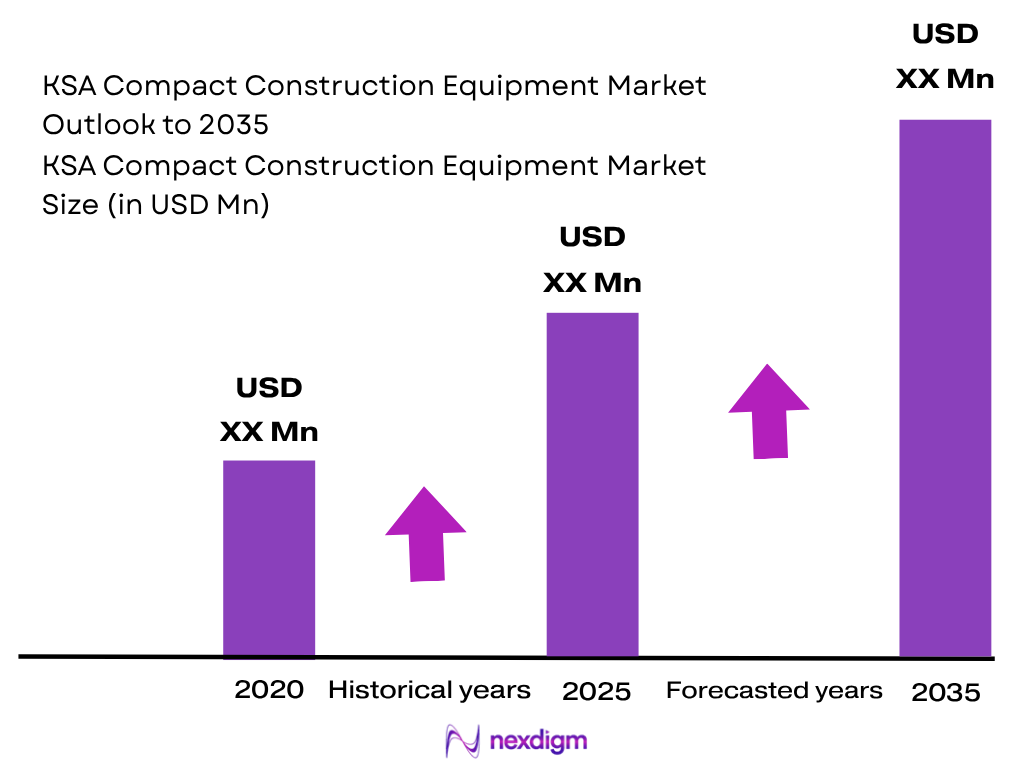
Market Size and Growth Drivers: The KSA Compact Construction Equipment Market is valued at approximately USD ~XX million in 2024, compared with USD ~XX million in 2023, with the exact compact-equipment value retained as a placeholder because no authoritative public source isolates this submarket. For context, Saudi Arabia’s broader construction-equipment market reached 37,272 units in 2024, while non-oil economic activity expanded alongside major housing, infrastructure and urban-development programs. Demand is concentrated around mini excavators, skid-steer loaders, compact loaders and related earthmoving machinery.
Dominant Cities and Construction Hubs: Riyadh, Jeddah and the Eastern Province represent the principal demand centers for KSA compact construction equipment. Riyadh benefits from government, residential and commercial development, with 33,380 cumulative housing products recorded under Housing Program regional data. Makkah recorded 24,792, while the Eastern Region recorded 14,088. These construction pipelines support demand for maneuverable excavation, loading, grading, landscaping and utility equipment suited to congested urban sites and distributed residential developments.
Market Segmentation
By Equipment Type
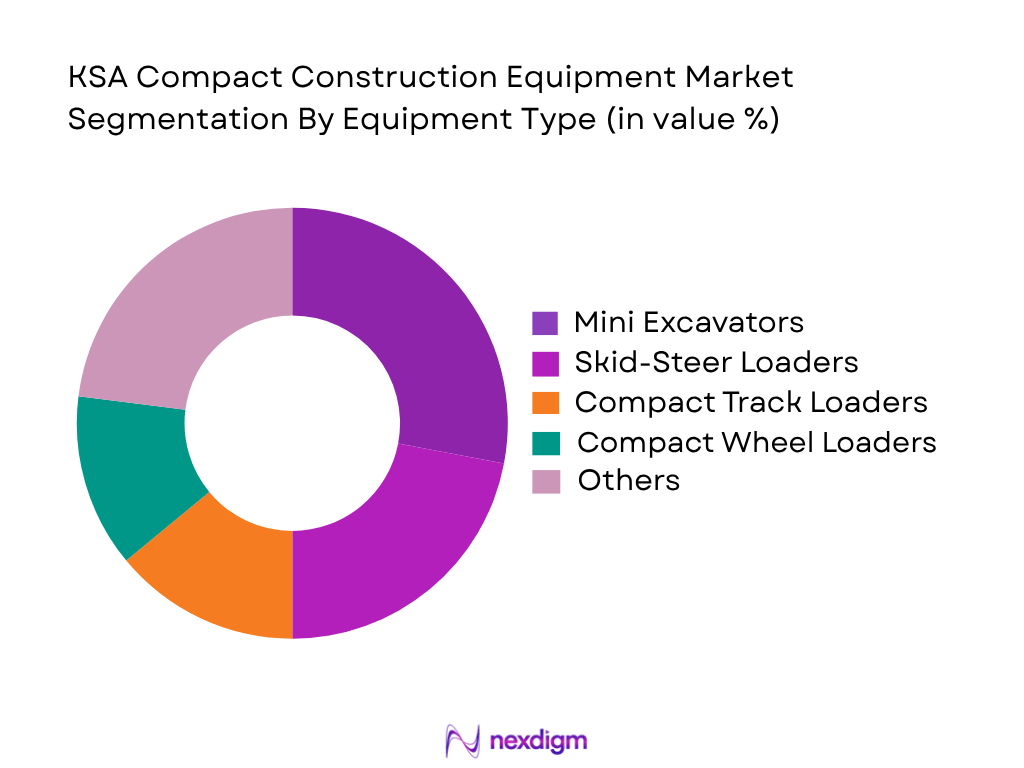
The KSA Compact Construction Equipment Market is segmented by equipment type into mini excavators, skid-steer loaders, compact track loaders, compact wheel loaders, backhoe loaders, compact telehandlers and compact compaction equipment. Mini excavators hold a leading position within the segmentation due to their suitability for urban excavation, utility installation, landscaping, residential development and confined-site construction. Their smaller footprint enables contractors to operate around buildings and infrastructure where full-size excavators face access limitations. Skid-steer and compact track loaders also constitute an important category because attachment interchangeability allows contractors to perform loading, grading, trenching and material-handling operations with one machine. The dominance of earthmoving-oriented compact equipment is consistent with the wider Saudi construction-equipment market, where earthmoving equipment represented the largest equipment category and excavators were the largest earthmoving product group in 2024.
By Application
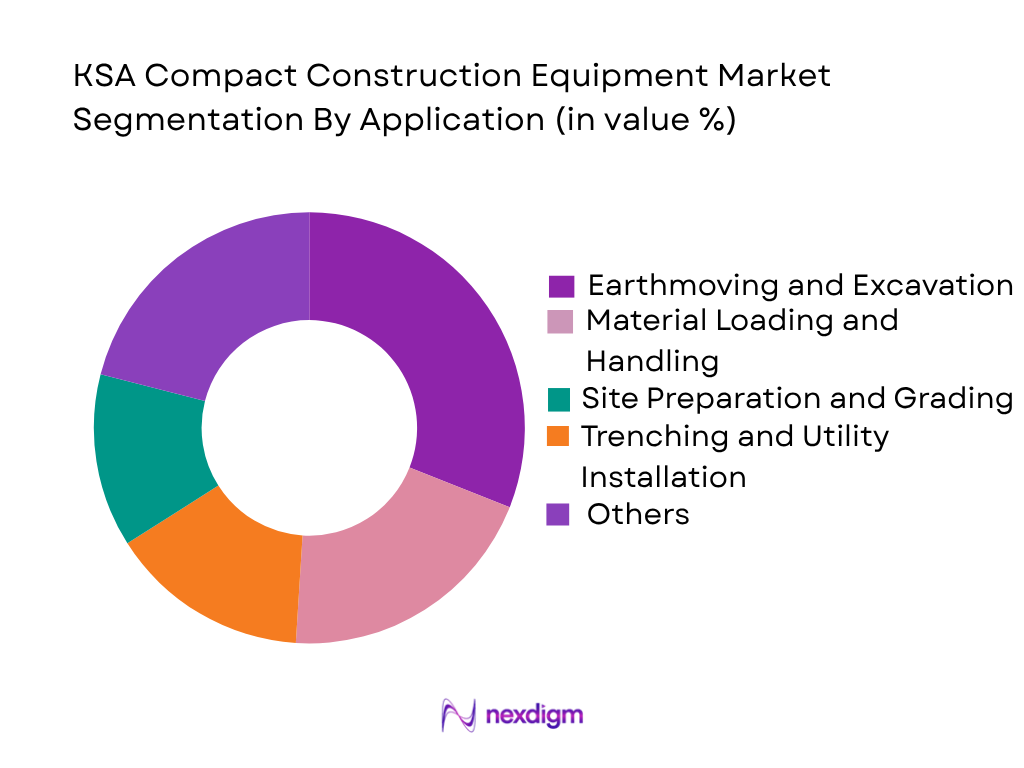
The KSA Compact Construction Equipment Market is segmented by application into earthmoving and excavation, material loading and handling, site preparation and grading, trenching and utility installation, landscaping and urban development, demolition and renovation, and road and pavement construction. Earthmoving and excavation represent the dominant application, supported by Saudi Arabia’s extensive residential, tourism, infrastructure and urban-development pipeline. Compact excavators and loaders provide operational advantages on smaller plots and projects requiring repeated equipment repositioning. Utility trenching is also important as expanding communities require water, electricity, telecommunications and municipal infrastructure. Saudi Vision 2030 reported 850,485 residential product contracts, including 414,406 readymade units, 254,623 self-construction products, and 105,112 off-plan sales, illustrating the scale of the underlying construction ecosystem capable of generating equipment utilization.
Competitive Landscape
The KSA Compact Construction Equipment Market features international OEMs supported by Saudi distributors, service networks and rental channels. Competition centers on mini-excavator and compact-loader breadth, hydraulic performance, attachment versatility, machine durability under high-temperature and dusty conditions, spare-parts availability, telematics and field-service response. Caterpillar, for example, identifies Zahid Tractor as its Saudi dealer, illustrating the importance of local dealer infrastructure for equipment uptime and aftermarket support.
| Company | Established | Headquarters | Key Compact Equipment | Core Technology | Attachment Capability | Saudi Market Route | After-Sales Focus | Key Application Strength |
| Caterpillar | 1925 | Irving, Texas, USA | ~ | ~ | ~ | ~ | ~ | ~ |
| Bobcat Company | 1958 | West Fargo, USA | ~ | ~ | ~ | ~ | ~ | ~ |
| JCB | 1945 | Rocester, UK | ~ | ~ | ~ | ~ | ~ | ~ |
| Komatsu | 1921 | Tokyo, Japan | ~ | ~ | ~ | ~ | ~ | ~ |
| Volvo Construction Equipment | 1832* | Gothenburg, Sweden | ~ | ~ | ~ | ~ | ~ | ~ |
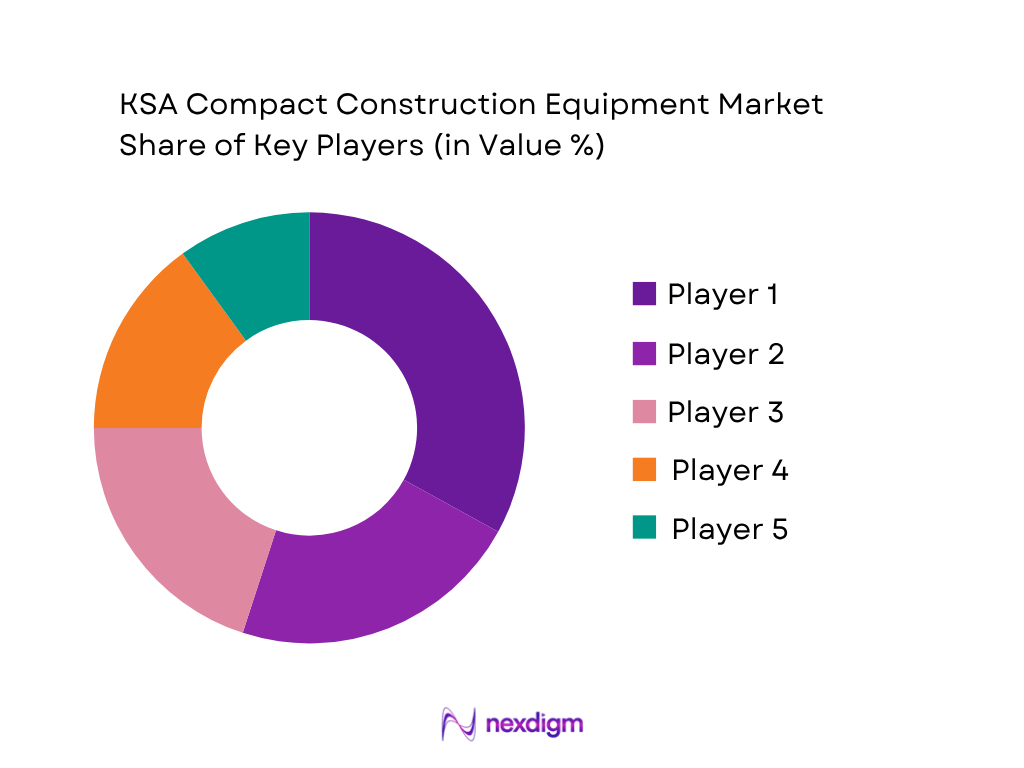
KSA Compact Construction Equipment Market Analysis
Growth Drivers
Large-Scale Infrastructure and Capital Project Execution
Saudi Arabia’s continuing infrastructure build-out is directly supporting utilization of compact excavators, skid-steer loaders, compact wheel loaders, trenching machinery and site-preparation equipment. The country recorded SAR 191 billion of actual capital expenditure in 2024, with spending supporting giga projects including the Red Sea development, King Salman Park, Green Riyadh, Sports Boulevard, the Grand Mosque expansion and domestic airports. The 2024 budget separately allocated SAR 38 billion to infrastructure and transportation and SAR 81 billion to municipal services. These programs generate equipment-intensive activities such as utility trenching, earthmoving, grading, landscaping, pavement preparation and material movement, where compact machines offer greater maneuverability than conventional heavy equipment. The underlying economy also provides a substantial investment base, with Saudi nominal GDP reaching SAR 4,108 billion in 2024, including approximately SAR 2,670 billion of nominal non-oil GDP. Continued capital deployment across urban infrastructure and non-oil development therefore creates a broad pipeline of jobsites suitable for mini excavators, skid-steer loaders and compact wheel loaders.
Housing Construction and Urban Development Pipeline
Residential development is another major demand driver because compact equipment is extensively deployed for foundation excavation, trenching, grading, landscaping, material handling and preparation of smaller urban sites. Saudi Arabia recorded 850,485 residential product contracts in 2024, compared with only 22,187 in 2018, demonstrating the scale reached by the housing ecosystem. The 2024 portfolio included 414,406 readymade units, 254,623 self-construction products, 105,112 off-plan sales and 76,344 land-ownership contracts. These numbers matter for compact construction machinery because residential and mixed-use developments typically require repeated excavation and loading operations within restricted working areas where maneuverability is critical. Government expenditure reached SAR 1,375 billion in 2024, while actual capital expenditure stood at SAR 191 billion. This combination of housing delivery, urban development and public investment expands the addressable operating base for mini excavators, skid-steer loaders, compact track loaders and compact wheel loaders across Riyadh and other Saudi urban centers.
Market Challenges
High Dependence on Imported Construction Machinery
Import dependence remains a structural challenge because Saudi contractors, rental companies and distributors rely extensively on international manufacturers for excavators, loaders and associated equipment. Saudi Arabia imported 9,985 units of 360-degree revolving excavators in 2024, including 6,582 units from China, 1,685 from South Korea, 662 from India, 296 from Japan and 282 from Austria. Front-end loader imports added another 4,962 units, including 2,062 from China, 1,291 from India, 373 from the Czech Republic, 315 from Japan and 307 from South Korea. Another 990 units entered under the self-propelled excavating-machinery category. Although these customs classifications extend beyond compact machinery alone, they demonstrate the import-intensive supply environment within which compact equipment operates. Dependence on overseas manufacturing creates exposure to shipping schedules, distributor inventories, spare-parts availability and international supply-chain disruptions, making local stocking, maintenance capacity and service-network coverage increasingly important requirements for compact construction equipment suppliers operating in Saudi Arabia.
After-Sales Support and Equipment Uptime Requirements
Saudi Arabia’s imported equipment base creates substantial requirements for maintenance capacity, spare-parts inventories and trained service technicians. The country recorded 9,985 imported 360-degree excavators, 4,962 front-end loaders and 990 units of other self-propelled excavating machinery in 2024. This means at least 15,937 units entered across these three broader machinery classifications during a single year, before considering road rollers, graders, skid-steer-specific classifications and the existing installed equipment fleet. The equipment originated from numerous manufacturing locations, with the excavator category alone including 6,582 Chinese, 1,685 South Korean, 662 Indian, 296 Japanese, 282 Austrian, 165 German and 112 French units. Such supplier diversity can increase the complexity of maintaining spare-parts inventories, diagnostic systems and technical expertise across different brands and platforms. For compact-equipment distributors and rental fleets, machine availability is particularly important because intensive utilization places recurring demands on hydraulic systems, filters, undercarriages, engines, attachments and preventive-maintenance schedules.
Market Opportunities
Expansion of Compact Earthmoving and Loading Equipment Deployment
Current machinery inflows demonstrate a large equipment ecosystem capable of supporting greater penetration of compact models. Saudi Arabia imported 9,985 units of 360-degree revolving excavators in 2024, while front-end shovel-loader imports reached 4,962 units and other self-propelled excavating machinery totaled 990 units. The combined 15,937 units across these categories demonstrate substantial contractor and fleet requirements for excavation and loading functions. Compact-equipment manufacturers can address portions of this requirement with mini excavators, skid-steer loaders and compact wheel loaders suited to utility installation, landscaping, residential development and confined urban jobsites. The opportunity is reinforced by 850,485 residential product contracts, including 414,406 readymade units, 254,623 self-construction products, 105,112 off-plan sales and 76,344 land-ownership contracts. These activities require repeated small-scale excavation, grading and material-handling operations rather than exclusively large earthmoving machines. Suppliers offering multiple attachments, compact dimensions, telematics capabilities and strong Saudi aftermarket support therefore have opportunities to increase equipment utilization across fragmented urban construction activities.
Rental Fleet and Multi-Purpose Compact Equipment Expansion
Saudi Arabia’s construction pipeline creates an opportunity for rental companies to expand fleets of compact machines that contractors can deploy across short-duration excavation, landscaping, municipal and utility projects. Actual government capital expenditure reached SAR 191 billion in 2024, while the national budget allocated SAR 38 billion to infrastructure and transportation and SAR 81 billion to municipal services. These expenditure categories support roads, airports, municipal development and infrastructure projects that generate distributed equipment requirements across numerous construction sites. At the same time, Saudi Arabia imported 4,962 front-end loaders and 9,985 revolving excavators in 2024, indicating an established machinery procurement ecosystem that rental operators can leverage when expanding specialized compact fleets. Rental deployment is particularly relevant for mini excavators, skid-steer loaders and compact track loaders because interchangeable buckets, breakers, augers, trenchers, forks and grading attachments allow one machine to perform several operations. This versatility creates opportunities to serve contractors requiring specialized machinery for limited project durations without maintaining large permanent equipment fleets.
Future Outlook
The KSA Compact Construction Equipment Market is expected to expand at a placeholder CAGR of ~XX% during 2026-2035. Demand will increasingly be influenced by urban construction, housing delivery, tourism destinations, municipal infrastructure, utilities and equipment-rental penetration. Compact machines should benefit from contractors seeking maneuverability, attachment flexibility and higher machine utilization across smaller jobsites.
Riyadh’s continued development provides a particularly relevant demand base. Vision 2030 housing data show Riyadh with 17,999 ready-built units and 10,094 off-plan units within the cited regional housing-solutions dataset. Saudi Vision 2030 Compact equipment can address excavation, trenching, grading, landscaping and material-handling requirements across these developments.
Major Players
- Caterpillar
- Bobcat Company
- JCB
- Komatsu
- Volvo Construction Equipment
- CASE Construction Equipment
- Kubota
- Takeuchi
- Yanmar
- SANY
- XCMG
- LiuGong
- Hyundai Construction Equipment
- DEVELON
- Wacker Neuson
Key Target Audience
- Compact Construction Equipment Manufacturers
- Construction Equipment Importers and Authorized Distributors
- Construction and Infrastructure Contractors
- Equipment Rental and Fleet Management Companies
- Real Estate and Infrastructure Developers
- Spare Parts, Attachments and Aftermarket Service Providers
- Investments and Venture Capitalist Firms
- Government and Regulatory Bodies (Saudi Standards, Metrology and Quality Organization [SASO], Heavy Equipment Regulatory Center, Ministry of Municipalities and Housing, Ministry of Investment)
Research Methodology
Step 1: Identification of Key Variables
The initial stage develops an ecosystem map of the KSA Compact Construction Equipment Market, covering OEMs, distributors, rental fleets, contractors, developers, attachment suppliers and aftermarket participants. Secondary research identifies variables including unit sales, installed fleet, operating weight, equipment category, rental penetration, utilization, replacement cycles, import dependency and application demand.
Step 2: Market Analysis and Construction
Historical equipment demand is assessed through top-down and bottom-up approaches. The framework examines Saudi construction activity, equipment imports, dealer sales, fleet additions, replacement demand, rental deployment and equipment utilization. Wider construction-equipment statistics are reconciled with compact-equipment categories to avoid counting cranes, large excavators and other machinery outside the defined scope.
Step 3: Hypothesis Validation and Expert Consultation
Market hypotheses are validated through structured interviews with OEM representatives, equipment distributors, rental operators, contractors, fleet managers and aftermarket specialists. Discussions focus on mini-excavator and compact-loader demand, preferred operating weights, attachment utilization, replacement cycles, rental behavior, machine uptime and purchasing criteria.
Step 4: Research Synthesis and Final Output
Primary findings are triangulated with trade statistics, regulatory information, construction indicators and company-level evidence. Bottom-up estimates are cross-checked against the broader construction-equipment universe and adjusted for product scope. The final framework develops historical demand, segmentation, competitive positioning and forecasts for the KSA Compact Construction Equipment Market.

- Executive Summary
- Research Methodology (Market Definition and Scope, Compact Equipment Classification Framework, Operating Weight Threshold Assessment, Equipment Population Mapping, New Equipment Sales Assessment, Used Equipment Assessment, Rental Fleet Assessment, Dealer Inventory Mapping, Equipment Import Assessment, OEM and Distributor Mapping, Attachment Ecosystem Assessment, Fleet Utilization Analysis, Contractor Procurement Assessment, Infrastructure Project Mapping, Megaproject Equipment Deployment Assessment, Equipment Replacement Cycle Analysis, Aftermarket Assessment, Supply-Side Assessment, Demand-Side Assessment, Top-Down Market Sizing, Bottom-Up Market Sizing, Primary Industry Interviews, Data Triangulation, Forecasting Framework)

- Definition and Scope
- KSA Compact Construction Equipment Industry Evolution and Development of Mini Excavators, Skid-Steer Loaders, Compact Track Loaders, Compact Wheel Loaders, Backhoe Loaders, Mini Loaders, Compact Telehandlers, Light Compaction Equipment, Electric Compact Equipment and Attachment-Based Multi-Purpose Machines
- Compact Construction Equipment Value Chain Analysis
- Compact Construction Equipment Supply Chain Analysis
- Component Suppliers, Engine and Powertrain Suppliers, Hydraulic System Suppliers, Tire and Rubber Track Suppliers, Attachment Manufacturers, Global Equipment OEMs, Saudi Distributors, Equipment Importers, Rental Fleet Operators, Used Equipment Dealers, Spare Parts Distributors, Maintenance Workshops, Construction Contractors, Infrastructure Developers, Municipal Contractors, Industrial Contractors and Equipment End Users

- Growth Drivers (Vision 2030 Infrastructure Development, Riyadh Urban Expansion, Transport Infrastructure Construction, Housing Development, Tourism and Hospitality Projects, Utility Network Expansion, Contractor Mechanization, Demand for Equipment Suitable for Confined Construction Sites)
- Market Challenges (Dependence on Imported Equipment and Components, Harsh Desert Operating Conditions, Hydraulic System Maintenance Requirements, Skilled Equipment Operator Availability, Spare Parts Lead Times, Competition from Used Machinery, Fleet Downtime Risk, Dealer Service Coverage Requirements)
- Market Opportunities (NEOM and Northwestern Development Projects, Red Sea Tourism Construction, Riyadh Urban Infrastructure, Utility and Trenching Applications, Compact Equipment Rental Fleet Expansion, Electric Mini Equipment Adoption, Attachment-Based Equipment Utilization, Local Equipment Service and Remanufacturing)
- Market Trends (Telematics-Enabled Fleet Management, GPS Equipment Tracking, Multi-Attachment Compact Machines, Rental-Based Procurement, Low-Emission Machinery, Electric Mini Excavators, Operator-Assistance Systems, Predictive Maintenance, Used Equipment Digitization, Fleet Standardization)
- Government Regulations and Standards (Saudi Standards, Metrology and Quality Organization Requirements, SASO Heavy Equipment Regulatory Center Requirements, Machinery Safety Technical Regulations, Mobile Machinery and Heavy-Duty Equipment Conformity Requirements, SABER Product Conformity Procedures, Occupational Safety Requirements, Equipment Inspection Requirements, Import Conformity Requirements)
- SWOT Analysis
- Porter’s Five Forces Analysis
- PESTLE Analysis
- Stakeholder Ecosystem
- Competition Ecosystem

- By Market Value (2020-2025)
- By New Equipment Sales Volume (2020-2025)
- By Installed Equipment Fleet (2020-2025)
- By Rental Fleet Units (2020-2025)
- By Mini Excavator Sales Volume (2020-2025)
- By Skid-Steer and Compact Track Loader Sales Volume (2020-2025)
- By Compact Wheel Loader Sales Volume (2020-2025)
- By Backhoe Loader Sales Volume (2020-2025)
- By Compact Telehandler Sales Volume (2020-2025)
- By Light Compaction Equipment Sales Volume (2020-2025)
- By Average Equipment Selling Price (2020-2025)
- By Equipment Replacement Demand (2020-2025)
- By Imported Compact Equipment Units (2020-2025)

- By Equipment Type (In Value %)
Mini Excavators
Skid-Steer Loaders
Compact Track Loaders
Compact Wheel Loaders
Backhoe Loaders
Compact Telehandlers
Mini Loaders
Compact Compaction Equipment
Trench Rollers and Rammers - By Operating Weight Class (In Value %)
Below 2 Tons
2–4 Tons
4–6 Tons
6–8 Tons
8–10 Tons
Above 10 Tons within Compact Equipment Classification - By Propulsion Type (In Value %)
Diesel-Powered Compact Equipment
Electric Compact Equipment
Battery-Electric Mini Excavators
Battery-Electric Compact Loaders
Hybrid Compact Equipment
Alternative-Fuel Compact Equipment - By Ownership Model (In Value %)
Direct Equipment Purchase
Long-Term Equipment Rental
Short-Term Equipment Rental
Operating Lease
Used Equipment Purchase
Fleet Management Contracts - By Application (In Value %)
Earthmoving and Excavation
Trenching and Utility Installation
Material Loading and Handling
Site Preparation and Grading
Road and Pavement Construction
Landscaping and Urban Development
Demolition and Renovation
Compaction Operations
Industrial Site Maintenance
Mining Support Operations - By End-Use Industry (In Value %)
Residential Construction
Commercial Construction
Transport Infrastructure
Utilities and Municipal Infrastructure
Industrial Construction
Oil and Gas Infrastructure
Mining and Quarrying
Tourism and Hospitality Development
Warehousing and Logistics Infrastructure
Renewable Energy Construction - By Attachment Type (In Value %)
General-Purpose Buckets
Trenching Buckets
Hydraulic Breakers
Augers
Grapples
Pallet Forks
Trenchers
Sweepers
Compaction Attachments
Grading and Leveling Attachments - By Sales Channel (In Value %)
Authorized OEM Dealers
Independent Equipment Distributors
Direct OEM Sales
Rental Companies
Used Equipment Dealers
Equipment Auctions and Digital Resale Platforms - By Region (In Value %)
Central Region
Western Region
Eastern Region
Northern Region
Southern Region
Riyadh
Makkah
Madinah
Eastern Province
Tabuk
Rest of KSA

- Market Share of Major Players (By KSA Equipment Revenue, Unit Sales, Installed Fleet, Mini Excavator Presence, Skid-Steer Loader Presence, Compact Loader Presence, Dealer Network, Rental Fleet Presence, Spare Parts Availability, After-Sales Service Coverage, Attachment Portfolio, Contractor Customer Base)
- Cross Comparison Parameters (Compact Equipment Product Breadth, Mini Excavator Operating Weight Range, Skid-Steer Rated Operating Capacity, Engine Power and Hydraulic Performance, Attachment Compatibility, Telematics and Fleet Management Capability, Saudi Dealer and Service Network Coverage, Spare Parts and Aftermarket Support)
- SWOT Analysis of Major Players
- Competitive Positioning Matrix
- Equipment Specification Benchmarking
- Compact Equipment Total Cost of Ownership Assessment
- Dealer and Aftermarket Capability Assessment
- Rental Fleet Competitive Benchmarking
- Major Companies
Caterpillar
Bobcat Company
JCB
Komatsu
Volvo Construction Equipment
CASE Construction Equipment
Kubota
Takeuchi
Yanmar Construction Equipment
SANY
XCMG
LiuGong
Hyundai Construction Equipment
DEVELON
Wacker Neuson

- Construction Contractor Equipment Requirement Assessment
- Infrastructure Contractor Fleet Requirement Assessment
- Residential Developer Equipment Demand Assessment
- Utility and Trenching Contractor Requirement Assessment
- Municipal Contractor Equipment Assessment
- Industrial Construction Equipment Requirement Assessment
- Mining and Quarry Support Equipment Assessment
- Rental Fleet Operator Procurement Assessment
- Megaproject Contractor Equipment Deployment Assessment
- Equipment Purchase Decision Assessment (Operating Weight, Digging Depth, Rated Operating Capacity, Engine Power, Hydraulic Flow, Fuel Efficiency, Maneuverability, Attachment Compatibility, Service Availability, Resale Value)

- By Market Value (2026-2035)
- By New Equipment Sales Volume (2026-2035)
- By Installed Equipment Fleet (2026-2035)
- By Rental Fleet Units (2026-2035)
- By Mini Excavator Sales Volume (2026-2035)
- By Skid-Steer and Compact Track Loader Sales Volume (2026-2035)
- By Compact Wheel Loader Sales Volume (2026-2035)
- By Backhoe Loader Sales Volume (2026-2035)
- By Electric Compact Equipment Sales Volume (2026-2035)
- By Equipment Replacement Demand (2026-2035)
- By Aftermarket Revenue Potential (2026-2035)
- By Attachment Demand (2026-2035)


 Request a Sample
 Ask for Customization
 Get a Quote
 Enquire Now