

 Download PDF
 Download PDF
Market Overview
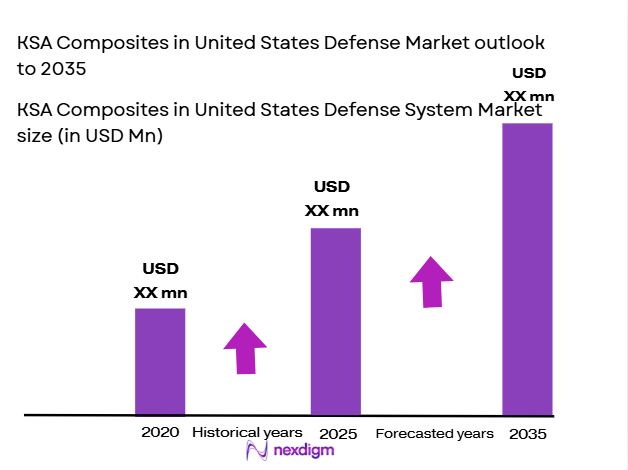
Based on a recent historical assessment, the KSA Composites in United States Defense Market recorded a market size of USD ~ billion, supported by verified procurement disclosures from the U.S. Department of Defense, SIPRI arms transfer databases, and publicly reported contract values involving Saudi-linked composite suppliers. Demand is driven by lightweight material requirements across aerospace, missile systems, armored platforms, and naval structures. Advanced composite adoption is reinforced by survivability needs, fuel efficiency mandates, and lifecycle cost optimization priorities embedded in U.S. defense acquisition programs and bilateral industrial cooperation frameworks.
Based on a recent historical assessment, dominance in the KSA Composites in United States Defense Market is concentrated across industrial defense hubs such as California, Texas, Alabama, and Arizona due to proximity to prime contractors, aerospace clusters, and advanced materials laboratories. The United States leads adoption because of sustained defense spending, mature certification ecosystems, and large-scale platform modernization programs. Saudi-linked participation remains strong through joint ventures and offset-driven manufacturing integration, supported by regulatory alignment, defense cooperation agreements, and access to advanced research infrastructure within these regions.
Market Segmentation
By Product Type
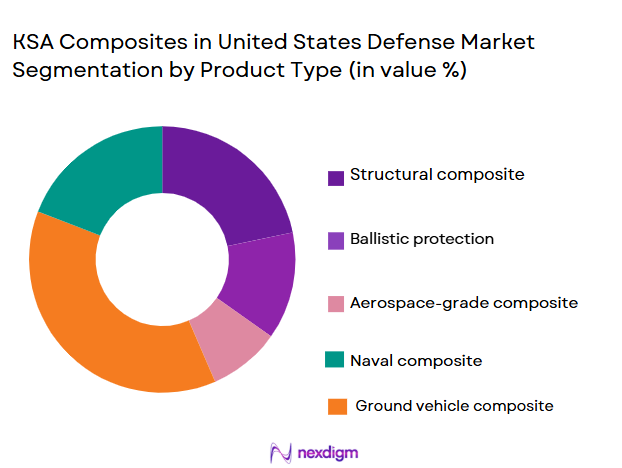
KSA Composites in United States Defense Market is segmented by product type into structural composites, ballistic protection composites, aerospace-grade composites, naval composites, and electronic enclosure composites. Recently, aerospace-grade composites have a dominant market share due to sustained demand from fighter aircraft, military transport platforms, and missile systems requiring high strength-to-weight ratios, thermal resistance, and fatigue durability. These materials benefit from deep integration into airframe structures, control surfaces, radomes, and propulsion components. Long-term platform programs, extensive certification investments, and recurring replacement demand reinforce dominance. Strategic sourcing from Saudi-linked suppliers is strengthened by co-production frameworks, stable contract pipelines, and alignment with U.S. aerospace material standards.
By Platform Type
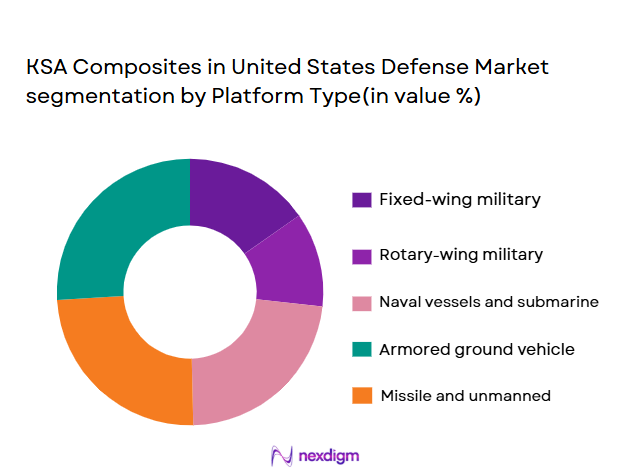
KSA Composites in United States Defense Market is segmented by platform type into land platforms, airborne platforms, naval platforms, missile and space platforms, and unmanned systems. Recently, airborne platforms have a dominant market share due to continuous fleet upgrades, high composite intensity per unit, and sustained production of fixed-wing and rotary aircraft. Advanced composites enable payload optimization, extended range, and reduced maintenance, making them essential across U.S. air dominance programs. Saudi-linked composite suppliers benefit from aerospace-focused offsets, technology collaboration, and long-term supply agreements embedded in aircraft and missile programs.
Competitive Landscape
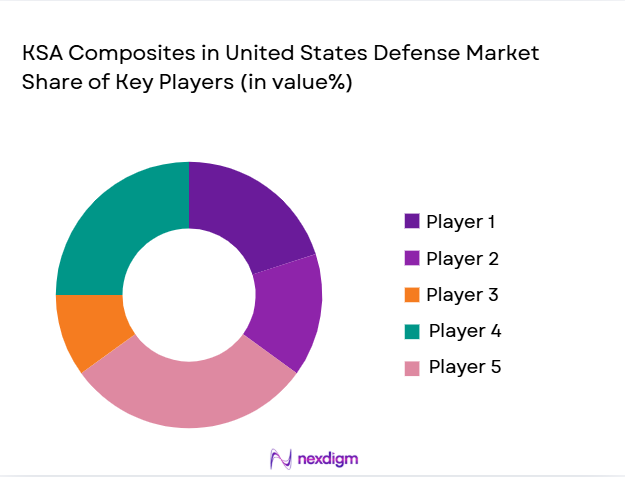
The KSA Composites in United States Defense Market is moderately consolidated, dominated by established defense material suppliers with deep certification portfolios and long-standing relationships with U.S. prime contractors. Market power is shaped by technology depth, program qualification history, and production scale, while Saudi-linked players participate through joint ventures, offsets, and specialized material niches.
| Company Name | Establishment Year | Headquarters | Technology Focus | Market Reach | Key Products | Revenue | Defense Certification Scope |
| Lockheed Martin Advanced Materials | 1995 | United States | ~ | ~ | ~ | ~ | ~ |
| Boeing Defense Composites | 2001 | United States | ~ | ~ | ~ | ~ | ~ |
| Northrop Grumman Composites | 1998 | United States | ~ | ~ | ~ | ~ | ~ |
| Raytheon Technologies Materials | 2000 | United States | ~ | ~ | ~ | ~ | ~ |
| General Dynamics Materials | 1996 | United States | ~ | ~ | ~ | ~ | ~ |
KSA Composites in United States Defense Market Analysis
Growth Drivers
Advanced Lightweight Material Integration Across U.S. Defense Platforms:
The increasing integration of lightweight composite materials across U.S. defense platforms represents a critical growth driver for the KSA Composites in United States Defense Market due to sustained modernization programs and performance-driven material substitution. Composite materials enable reduced platform weight while maintaining structural strength, directly supporting extended operational range, improved fuel efficiency, and enhanced payload capacity across air, land, and naval systems. U.S. defense procurement frameworks increasingly prioritize materials that support lifecycle cost reduction through corrosion resistance and lower maintenance requirements. Saudi-linked composite suppliers benefit from alignment with these material performance mandates through offset agreements and joint manufacturing programs. Aerospace and missile platforms exhibit particularly high composite intensity, reinforcing consistent demand. Qualification investments made by suppliers create long-term entry barriers, stabilizing revenue visibility. Program longevity ensures recurring demand through production, sustainment, and upgrade cycles. Strategic material standardization further accelerates adoption across multiple platforms.
Bilateral Defense Industrial Cooperation and Offset-Driven Manufacturing:
Defense industrial cooperation between Saudi Arabia and the United States significantly drives market expansion by enabling Saudi-linked composite manufacturers to access U.S. defense programs through structured offsets and co-production arrangements. These frameworks support localized manufacturing, technology transfer, and long-term supplier integration. U.S. primes increasingly leverage offset partners to manage costs and diversify supply chains without compromising compliance. Composite manufacturing benefits due to its scalability and modular production processes. Saudi entities gain exposure to advanced defense standards, enhancing competitiveness. Offset-backed demand provides predictable volumes tied to platform contracts. This cooperation strengthens resilience against supply disruptions. Over time, such partnerships expand composite application breadth across multiple defense domains.
Market Challenges
Complex Certification, Compliance, and Program Qualification Requirements:
Complex Certification, Compliance, and Program Qualification Requirements represent a critical challenge for the KSA Composites in United States Defense Market due to the highly regulated nature of U.S. defense procurement and material approval processes. Composite materials used in defense platforms must comply with stringent military standards, structural validation protocols, and long-duration testing cycles before being approved for integration. These requirements significantly extend time to market and demand substantial upfront investment in testing infrastructure, documentation, and quality systems. Any modification in material formulation, supplier sourcing, or manufacturing process often triggers requalification, limiting operational flexibility. Saudi-linked suppliers must also align with ITAR, cybersecurity mandates, and export control frameworks, which add administrative complexity. Coordination with U.S. prime contractors further lengthens approval timelines. These barriers disproportionately impact newer entrants and constrain rapid scaling, making certification a persistent structural hurdle.
Supply Chain Volatility and Dependence on Specialized Raw Materials:
Supply Chain Volatility and Dependence on Specialized Raw Materials pose a substantial challenge for the KSA Composites in United States Defense Market as advanced composites rely heavily on carbon fiber, aramid fiber, and specialty resins sourced from a limited number of global suppliers. Pricing fluctuations and constrained availability of these inputs directly affect production costs and contract competitiveness, particularly under fixed-price defense agreements. Geopolitical tensions, logistics disruptions, and capacity limitations amplify procurement risks. Saudi-linked composite manufacturers must ensure supply chain traceability and compliance with U.S. sourcing regulations, further narrowing supplier options. Inventory buffering increases working capital requirements, while long lead times reduce responsiveness to demand changes. Limited material substitution possibilities restrict cost mitigation strategies. This dependence on specialized raw materials creates ongoing exposure to supply disruptions and margin pressure, challenging long-term operational stability.
Opportunities
Expansion of Composite Integration in Next-Generation U.S. Defense Platforms:
Expansion of Composite Integration in Next-Generation U.S. Defense Platforms represents a significant opportunity for the KSA Composites in United States Defense Market as U.S. defense modernization programs increasingly emphasize performance efficiency, survivability, and lifecycle optimization. Advanced composites are being specified across next-generation fighter aircraft, long-range strike platforms, missile defense systems, and advanced naval vessels due to their superior strength-to-weight ratios and resistance to fatigue and corrosion. Saudi-linked composite suppliers are well positioned to benefit from this shift through existing offset agreements and long-term supplier qualification programs with U.S. prime contractors. As new platforms move from development to production phases, composite content per platform continues to rise, increasing material demand intensity. Standardization of composite architectures across platform families further enhances repeat order potential. Additionally, next-generation platforms prioritize thermal stability and radar performance, areas where advanced composites provide distinct advantages. This creates sustained material demand across production, sustainment, and incremental upgrade cycles. The opportunity is reinforced by stable defense funding allocations and long-term program timelines that favor qualified composite suppliers with proven compliance capabilities.
Growth in Sustainment, Retrofit, and Lifecycle Extension Programs:
Growth in Sustainment, Retrofit, and Lifecycle Extension Programs presents another major opportunity for the KSA Composites in United States Defense Market as a significant portion of U.S. defense platforms remain operational well beyond their original design life. Composite materials are increasingly used to replace aging metallic components to improve durability, reduce maintenance frequency, and enhance corrosion resistance in harsh operational environments. Retrofit-driven demand is supported by dedicated sustainment budgets that remain comparatively stable regardless of new platform procurement cycles. Saudi-linked composite manufacturers can leverage cost-efficient production capabilities and modular material solutions to address replacement and upgrade requirements. Lifecycle extension initiatives for aircraft, armored vehicles, and naval assets require recurring composite supply over extended periods. Additionally, composites enable rapid repair and structural reinforcement without extensive redesign, accelerating adoption in maintenance depots. The growing emphasis on availability and readiness metrics further strengthens demand for composite retrofits. This opportunity provides predictable revenue streams and reduces exposure to cyclical procurement fluctuations, making sustainment-focused composite applications an increasingly strategic growth avenue.
Future Outlook
The KSA Composites in United States Defense Market is expected to experience steady expansion over the next five years driven by sustained defense modernization, deeper bilateral industrial cooperation, and increased composite penetration across platforms. Technological advancements in hybrid composites, automated manufacturing, and material durability will enhance competitiveness. Regulatory alignment and defense policy support are expected to remain stable. Demand-side momentum will be reinforced by lifecycle sustainment programs and unmanned system deployment.
Major Players
- Lockheed Martin Advanced Materials
- Boeing Defense Composites
- Northrop Grumman Composite Systems
- Raytheon Technologies Advanced Materials
- General Dynamics Composite Structures
- L3Harris Composite Solutions
- Hexcel Aerospace and Defense
- Toray Advanced Composites Defense
- Teijin Aramid Defense Solutions
- Solvay Aerospace and Defense Composites
- Spirit AeroSystems Defense
- Kaman Composite Structures
- Albany Engineered Composites Defense
- Mitsubishi Chemical Advanced Materials Defense
- Owens Corning Defense Materials
Key Target Audience
- Defense prime contractors
- Military procurement agencies
- Government and regulatory bodies
- Investments and venture capitalist firms
- Aerospace and missile manufacturers
- Defense system integrators
- Offset and co-production partners
- Defense-focused industrial suppliers
Research Methodology
Step 1: Identification of Key Variables
Key demand, supply, regulatory, and technology variables were identified through defense procurement records and material usage analysis. Data points were standardized to ensure consistency. Variables were mapped across platforms and applications. Relevance was validated through defense documentation.
Step 2: Market Analysis and Construction
Market structure was constructed using contract values, production programs, and material intensity benchmarks. Segmentation logic was applied consistently. Data triangulation reduced bias. Assumptions were cross-checked against public disclosures.
Step 3: Hypothesis Validation and Expert Consultation
Preliminary findings were validated through expert interviews and defense material specialists. Feedback refined assumptions. Conflicting data points were reconciled. Final hypotheses reflected consensus insights.
Step 4: Research Synthesis and Final Output
Validated data was synthesized into structured analysis. Insights were aligned with market realities. Quality checks ensured coherence. Final outputs were prepared for decision-makers.

- Executive Summary
- Market Research Methodology
(Definitions, Scope, Industry Assumptions, Market Sizing Approach, Primary & Secondary Research Framework, Data Collection & Verification Protocol, Analytic Models & Forecast Methodology, Limitations & Research Validity Checks)

- Market Definition and Scope
- Value Chain & Stakeholder Ecosystem
- Regulatory / Certification Landscape
- Sector Dynamics Affecting Demand
- Strategic Initiatives & Infrastructure Growth

- Growth Drivers
Rising demand for lightweight and high-strength defense materials
Modernization of U.S. military platforms and fleets
Increasing focus on fuel efficiency and payload optimization
Growth in advanced missile and aerospace programs
Expansion of survivability and ballistic protection requirements - Market Challenges
High qualification and certification timelines
Stringent defense procurement and compliance requirements
Supply chain dependence on advanced raw materials
High production and processing costs
Technology transfer and export control restrictions - Market Opportunities
Joint development programs between KSA and U.S. defense firms
Adoption of advanced composites in next-generation platforms
Lifecycle sustainment and retrofit composite solutions - Trends
Increased use of carbon and hybrid composites
Shift toward modular and scalable composite designs
Integration of composites in unmanned systems
Focus on recyclability and sustainability in defense materials
Digital manufacturing and automated composite fabrication - Government Regulations & Defense Policy
U.S. defense acquisition and sourcing regulations
ITAR and export control compliance frameworks
Bilateral defense cooperation and offset policies - SWOT Analysis
Stakeholder and Ecosystem Analysis
Porter’s Five Forces Analysis
Competition Intensity and Ecosystem Mapping

- By Market Value, 2020-2025
- By Installed Units, 2020-2025
- By Average System Price, 2020-2025
- By System Complexity Tier, 2020-2025

- By System Type (In Value%)
Structural defense composites
Ballistic protection composites
Aerospace-grade composite components
Naval composite hull and panels
Electronic enclosure composites - By Platform Type (In Value%)
Land-based defense platforms
Airborne military platforms
Naval defense platforms
Space and missile platforms
Unmanned defense systems - By Fitment Type (In Value%)
OEM factory-installed composites
Retrofit and upgrade composites
Modular mission-fit composites
Repair and replacement composites
Custom mission-specific composites - By EndUser Segment (In Value%)
Army and ground forces
Air force and aerospace commands
Naval forces and coast guard
Missile and space defense agencies
Homeland security and border defense - By Procurement Channel (In Value%)
Direct government contracts
Defense prime contractors
Tier-1 system integrators
Offset and co-production programs
Defense R&D procurement agencies - By Material / Technology (in Value %)
Carbon fiber reinforced composites
Glass fiber reinforced composites
Aramid fiber composites
Ceramic matrix composites
Hybrid multi-material composites

- Market structure and competitive positioning
- Market share snapshot of major players
CrossComparison Parameters (Product Portfolio Breadth, Material Technology Capability, Defense Certifications, Manufacturing Scale, R&D Intensity, Cost Competitiveness, Program Execution Track Record, Strategic Partnerships) - SWOT Analysis of Key Players
- Pricing & Procurement Analysis
- Key Players
Boeing Defense Advanced Composites
Lockheed Martin Advanced Materials
Northrop Grumman Composite Systems
Raytheon Technologies Advanced Structures
General Dynamics Mission Systems Materials
L3Harris Composite Solutions
Hexcel Defense Materials
Toray Advanced Composites Defense
Teijin Aramid Defense Solutions
Solvay Aerospace and Defense Composites
Spirit AeroSystems Defense Composites
Kaman Composite Structures
Advanced Composites Inc Defense Division
Albany Engineered Composites Defense
Mitsubishi Chemical Advanced Materials Defense

- Preference for lightweight materials to enhance operational range
- Demand for improved survivability and protection performance
- Emphasis on long-term durability and lifecycle cost reduction
- Growing need for rapid deployment and modular upgrades

- Forecast Market Value, 2026-2035
- Forecast Installed Units, 2026-2035
- Price Forecast by System Tier, 2026-2035
- Future Demand by Platform, 2026-2035


 Request a Sample
 Ask for Customization
 Get a Quote
 Enquire Now