

 Download PDF
Market Overview
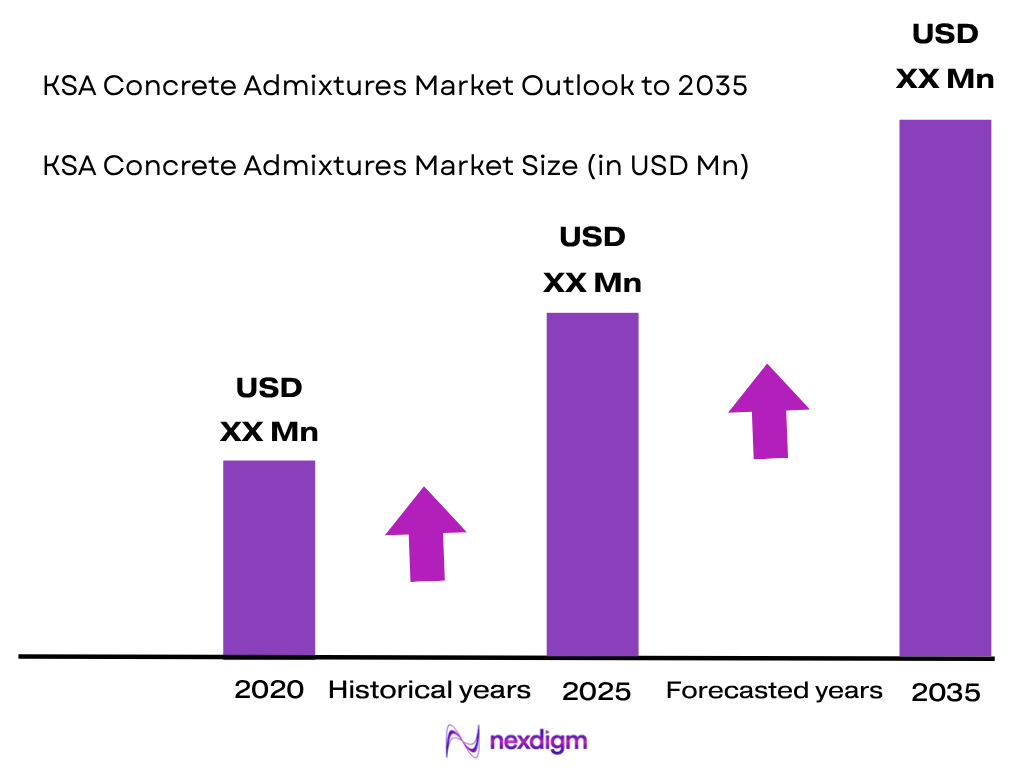
The KSA Concrete Admixtures Market is valued at approximately ~USD XX million, supported by large-scale construction, infrastructure and non-oil investment. Across the latest two annual observations, IMF nominal GDP moved from SAR 4,003 billion to SAR 4,108 billion, while Saudi construction and real-estate operating revenues reached SAR 467.3 billion and construction subsequently attracted SAR 18 billion of foreign direct investment. This expanding construction base supports superplasticizer, retarder, waterproofing and durability-admixture consumption.
Riyadh, Tabuk/NEOM, the Red Sea coast, Jeddah and the Eastern Province dominate KSA Concrete Admixtures Market demand because the largest urban, tourism, industrial and infrastructure projects are concentrated in these corridors. Qiddiya had SAR 10 billion of awarded construction contracts in the first observation, while the subsequent period integrated SAR 50 billion across 21 projects in 14 cities; New Murabba also completed 13.1 million cubic metres of excavation, highlighting Riyadh’s extraordinary concrete-intensive development pipeline.
Market Segmentation
By Admixture Type
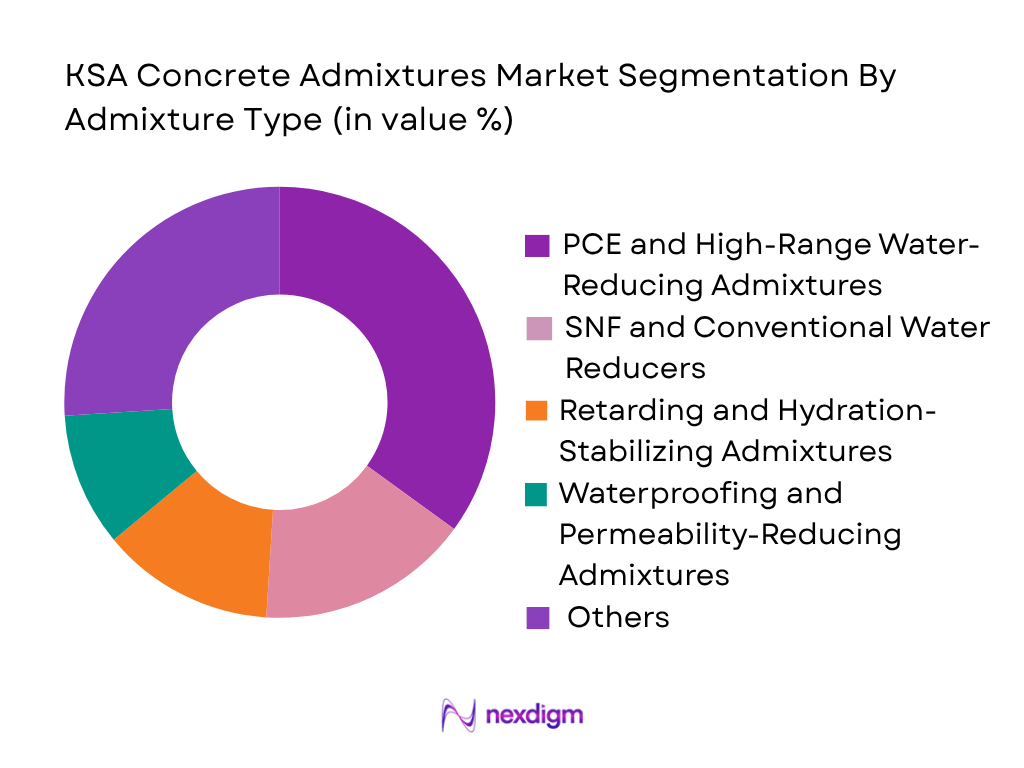
The KSA Concrete Admixtures Market is segmented into water reducers, high-range water reducers, PCE superplasticizers, SNF superplasticizers, retarders, accelerators, hydration stabilizers, viscosity modifiers, waterproofing admixtures, corrosion inhibitors, shrinkage reducers and specialty shotcrete systems. High-range water reducers and PCE-based superplasticizers hold the dominant modeled market share because Saudi concrete is frequently placed under severe ambient temperatures, transported over long project distances and pumped vertically or horizontally across large developments. PCE chemistry allows high water reduction while maintaining flowability, enabling lower water-cement ratios and improved strength and durability. Long-slump-retention grades are particularly relevant for Riyadh, NEOM and Red Sea construction where centralized or project batching plants must deliver concrete reliably despite climatic stress. Large raft foundations and high-rise structures also require high-pumpability concrete and controlled rheology. Saudi standards specifically recognize chemical admixtures through SASO-GSO-ASTM C494, reinforcing the use of performance-classified admixture systems in structural concrete.
By Application
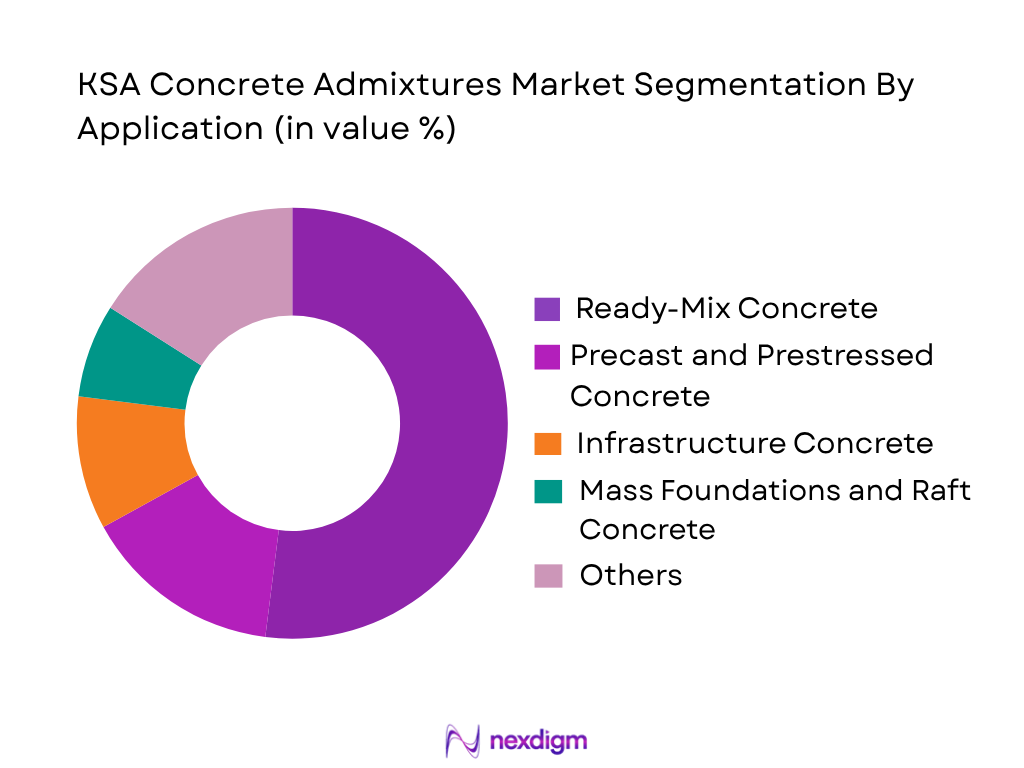
The KSA Concrete Admixtures Market is segmented into ready-mix concrete, precast and prestressed concrete, site-batched concrete, pumped high-rise concrete, mass foundations, shotcrete, marine concrete and infrastructure concrete. Ready-mix concrete represents the dominant modeled application because Saudi giga-projects and urban developments require industrial-scale batching with repeatable workability, strength and durability specifications. Ready-mix plants rely on PCE superplasticizers, retarders and hydration-control admixtures to manage hot-weather delivery, pumpability and variable placement schedules. The scale of active development supports this dominance: Qiddiya spans 360 square kilometres, while Red Sea Global previously identified approximately 700,000 cubic metres of concrete for initial construction at its destination. Saudi Arabia also applies ready-mixed concrete requirements aligned with ASTM C94/C94M through SASO standardization, emphasizing purchaser-defined quality and delivery performance. These characteristics favor professionally produced ready-mix systems rather than uncontrolled site batching for large structural and infrastructure works.
Competitive Landscape
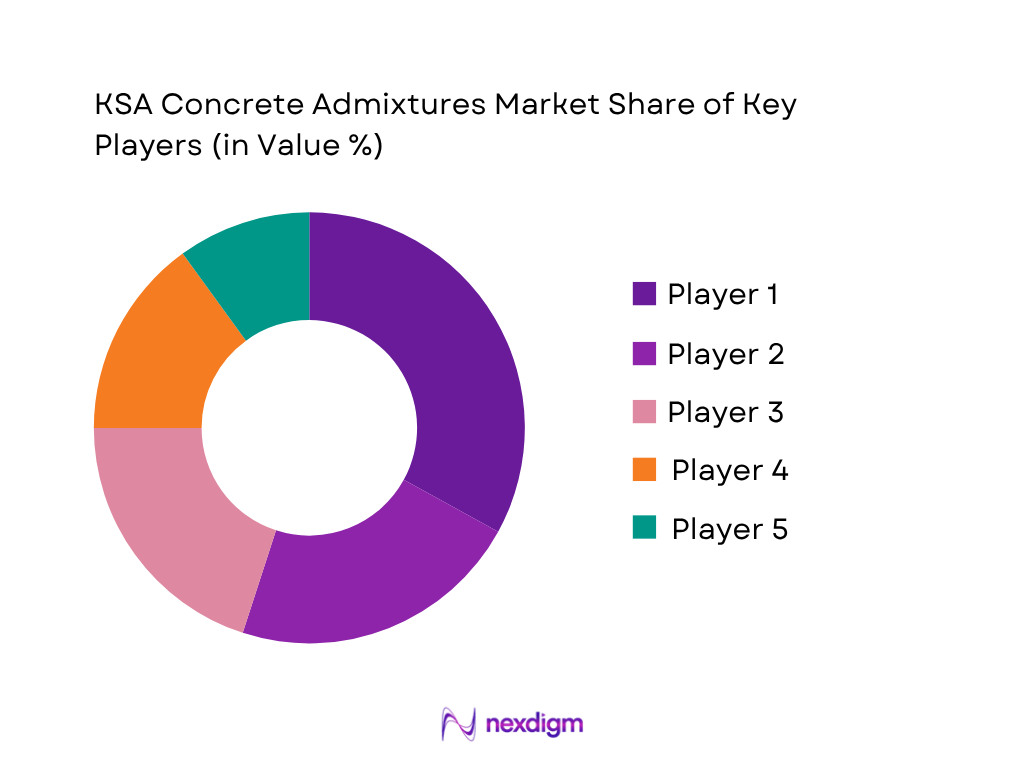
The KSA Concrete Admixtures Market combines multinational construction-chemical manufacturers with established Saudi producers possessing localized manufacturing, bulk-distribution and field-service capability. Sika, Fosroc, MAPEI, Arkaz and DCP compete through PCE technology, long-slump-retention formulations, cement compatibility, waterproofing systems, technical laboratories and project approval credentials. Local production is particularly important because Saudi mega-projects require continuous bulk supply and rapid technical response, while concrete formulations often need adjustment for local cement, SCMs and extreme climatic conditions.
| Major Player | Establishment Year | Headquarters | Core Admixture Capability | Hot-Weather / Slump Retention | Local Manufacturing | Ready-Mix / Precast Coverage | Durability / Waterproofing Capability | Technical Support |
| Sika | 1910 | Baar, Switzerland | ~ | ~ | ~ | ~ | ~ | ~ |
| Fosroc | 1972 | Dubai, UAE | ~ | ~ | ~ | ~ | ~ | ~ |
| MAPEI | 1937 | Milan, Italy | ~ | ~ | ~ | ~ | ~ | ~ |
| Arkaz | 2008 | Al Khobar, Saudi Arabia | ~ | ~ | ~ | ~ | ~ | ~ |
| DCP | 1927 | Haverhill, United Kingdom | ~ | ~ | ~ | ~ | ~ | ~ |
KSA Concrete Admixtures Market Analysis
Growth Drivers
Giga-Project Construction and Urban Development Intensifying Concrete Admixture Demand
Saudi Arabia’s giga-project and urban-development program is directly increasing demand for high-range water reducers, PCE superplasticizers, retarders, waterproofing admixtures and durability-enhancing concrete chemistry. PIF’s 2024 reporting shows Qiddiya covering 360 square kilometres, while its integration with SEVEN brought SAR 50 billion of investment across 21 projects in 14 cities. In Riyadh, New Murabba completed 13.1 million cubic metres of excavation, indicating the enormous foundation, basement, infrastructure and structural-concrete requirements emerging from the development. Large-volume pours and high-rise structures require low water-cement ratios, prolonged workability and controlled hydration, making chemical admixtures essential for pumpability and placement consistency. Saudi Arabia’s 2024 gross fixed capital formation reached SAR 1.441 trillion, according to GASTAT, demonstrating the broader capital-investment base supporting construction-intensive projects. The IMF recorded nominal Saudi GDP at SAR 4.108 trillion in 2024 and nominal non-oil GDP at SAR 2.670 trillion, while World Bank data place GDP at approximately USD 1.240 trillion. These macroeconomic figures support sustained construction activity and reinforce demand for concrete admixtures capable of meeting increasingly complex structural specifications.
Expanding Cement and Ready-Mix Production Base Supporting Admixture Consumption
Saudi Arabia’s large cement-production and ready-mix ecosystem provides a substantial underlying consumption base for water reducers, superplasticizers, retarders, accelerators and waterproofing systems. Yamama Cement inaugurated a new Saudi plant in 2024 with clinker production capacity of 20,000 tons per day, materially expanding raw material availability for concrete production around Riyadh and other central-region projects. Another Saudi cement producer reported 1,474,415 tons of cement production and 1,750,630 tons of total sales during 2024, illustrating the physical scale of cement moving through the domestic construction supply chain. Ready-mixed concrete is also subject to formal Saudi conformity requirements: SASO identifies ready-mixed concrete among products required to obtain the Saudi Quality Mark, reinforcing industrialized batching, documented quality control and standardized concrete performance. These conditions support consistent use of chemical admixtures rather than uncontrolled onsite formulation. At the national level, GASTAT recorded SAR 1.441 trillion of gross fixed capital formation in 2024, while World Bank data record Saudi GDP of approximately USD 1.240 trillion. The IMF separately placed nominal GDP at SAR 4.108 trillion, providing the economic scale supporting cement consumption, batch-plant investment and technically optimized ready-mix production.
Market Challenges
Project-Pipeline Volatility Can Create Uneven Concrete Admixture Demand
The KSA Concrete Admixtures Market faces demand-planning challenges because project execution and building-permit activity can fluctuate substantially even when the broader construction pipeline remains large. GASTAT reported 5,056 building permits in May 2026 compared with 7,584 permits in May 2025 and 6,803 permits in April 2026. This variation affects ready-mix plant utilization, bulk admixture inventory, tanker scheduling and regional requirements for PCE superplasticizers, retarders and waterproofing systems. Admixture producers supporting multiple cities must therefore maintain flexible production and warehouse networks rather than assume uniform concrete demand throughout the year. The challenge is particularly relevant where giga-project procurement operates independently of conventional municipal building activity, creating different demand cycles between Riyadh, Tabuk, Jeddah and the Eastern Province. Suppliers may consequently face simultaneous high-volume project requirements in one region and softer conventional construction activity elsewhere. The broader macroeconomic base remains substantial: World Bank data record Saudi GDP of approximately USD 1.240 trillion in 2024, while IMF data record nominal GDP of SAR 4.108 trillion and non-oil GDP of SAR 2.670 trillion. GASTAT also measured gross fixed capital formation at SAR 1.441 trillion, showing that the principal challenge is timing and allocation of construction demand rather than insufficient national investment capacity.
Strict Concrete Quality and Compliance Requirements Raise Technical Qualification Burden
Saudi concrete admixture suppliers must operate within increasingly formalized concrete-quality and product-conformity requirements, creating technical and qualification challenges for manufacturers introducing new PCE, retarding, accelerating or specialty durability formulations. SASO lists ready-mixed concrete among products required to obtain the Saudi Quality Mark and reported 1,323 establishments, 351,794 products and 1,528 active licenses across the broader Quality Mark system. Its mechanical and construction products laboratory assigns 10 working days to testing ready-mixed concrete under SASO ASTM C94 and 30 working days for compressive-strength testing of cylindrical concrete specimens under SASO ASTM C39. In 2026, SASO also initiated an updated ready-mixed-concrete specification aligned with ASTM C94/C94M-25, underscoring continuing modernization of technical requirements. For admixture suppliers, this means concrete performance must be repeatedly validated against local cement, aggregate and project specifications before wide deployment, particularly on giga-project and infrastructure sites. The wider economy can support these higher compliance standards: IMF data place 2024 nominal GDP at SAR 4.108 trillion, and World Bank data record approximately USD 1.240 trillion of GDP. GASTAT’s SAR 1.441 trillion gross fixed capital formation further illustrates the scale of assets where quality failures could carry substantial operational consequences.
Market Opportunities
Low-Carbon and SCM-Compatible Admixtures Can Gain from Large Saudi Construction Programs
Low-carbon concrete creates a significant future opportunity for KSA admixture suppliers because large projects are beginning to incorporate alternative cementitious materials and lower-emission concrete technologies while construction volumes remain substantial. NEOM states that its design and construction program is testing solutions involving GGBFS, seawater concrete, captured carbon dioxide and reuse of excavation waste as construction material. These approaches increase the need for specialized PCE superplasticizers, hydration modifiers and strength-development admixtures because replacing conventional clinker changes water demand, rheology, adsorption and early-age performance. Current construction scale provides a strong platform for future adoption: New Murabba reported 13.1 million cubic metres of excavation completed, while Qiddiya spans 360 square kilometres and incorporated 21 projects across 14 cities through its SEVEN integration. Suppliers able to optimize high-SCM mixes for pumpability, slump retention and early strength can therefore target large urban and infrastructure applications rather than isolated sustainability pilots. Saudi macroeconomic capacity supports this transition, with GASTAT recording SAR 1.441 trillion in gross fixed capital formation in 2024. World Bank data record GDP of approximately USD 1.240 trillion, while IMF data place nominal non-oil GDP at SAR 2.670 trillion, demonstrating the scale of investment available for advanced construction materials and sustainable concrete technology.
Local PCE Formulation and Admixture Manufacturing Offer Supply-Chain Expansion Potential
Saudi Arabia’s expanding domestic cement and concrete-production base creates a future opportunity to localize PCE formulation, admixture blending, bulk storage and concrete-technology laboratories. Yamama Cement’s new facility provides 20,000 tons of clinker production capacity per day, while another Saudi cement producer recorded 1,474,415 tons of cement output and 1,750,630 tons of sales during 2024. These physical volumes illustrate the scale of locally available binder demand that can support domestically formulated superplasticizers, retarders, hydration stabilizers and waterproofing systems. Localization can also reduce dependence on imported finished admixtures while allowing formulations to be tuned to Saudi cement chemistry, high-temperature placement conditions and individual giga-project specifications. SASO’s mandatory quality framework for ready-mixed concrete further favors suppliers able to maintain local laboratories and rapid compatibility-testing capability. National capital formation provides additional support: GASTAT recorded SAR 1.441 trillion of gross fixed capital formation in 2024, including extensive investment in buildings, machinery and infrastructure. World Bank data put Saudi GDP at approximately USD 1.240 trillion, and IMF data record nominal GDP of SAR 4.108 trillion. Together, these current indicators provide a substantial base for additional Saudi admixture production capacity, technical-service centers and regional bulk-distribution infrastructure serving Riyadh, Jeddah, Tabuk and the Eastern Province.
Future Outlook
The KSA Concrete Admixtures Market is forecast to expand at approximately ~X.X% CAGR during 2026–2035, supported by sustained urban development, tourism infrastructure, stadium construction, transport investment and industrial localization. The market is expected to move toward higher-value PCE formulations, durability systems, shotcrete accelerators and low-carbon concrete optimization rather than relying primarily on conventional plasticizers.
Riyadh will remain a major center of demand. PIF reported that New Murabba had completed 13.1 million cubic metres of excavation, while Qiddiya spans approximately 360 square kilometres and incorporates residential, commercial, entertainment and infrastructure assets. The Vision 2030 annual report also reported Aquarabia at 81% completion and Six Flags Qiddiya at 87% completion, demonstrating the construction intensity supporting ready-mix, precast and mass-foundation admixture requirements.
Major Players
- Sika Saudi Arabia Limited
- Fosroc Saudi Arabia / Saint-Gobain
- MAPEI Saudia
- Arkaz
- DCP Saudi Co.
- Jazea for Construction Chemicals
- Saveto Group / Saudi Vetonit
- CHRYSO / Saint-Gobain Construction Chemicals
- GCP Applied Technologies / Saint-Gobain
- Normet
- PAC Technologies / Kerakoll Group
- Penetron GCC
- Xypex Chemical Corporation
- MC-Bauchemie
- CIC Construction Chemicals
Key Target Audience
- Concrete Admixture and Construction Chemical Manufacturers
- Ready-Mix Concrete Producers
- Precast and Prestressed Concrete Manufacturers
- Giga-Project Developers and Main Contractors
- Infrastructure and Civil Engineering Contractors
- Cement and Supplementary Cementitious Material Producers
- Investments and Venture Capitalist Firms
- Government and Regulatory Bodies (Saudi Standards, Metrology and Quality Organization, Saudi Building Code National Committee, Ministry of Municipalities and Housing, Ministry of Industry and Mineral Resources, Royal Commission for Riyadh City)
Research Methodology
Step 1: Identification of Key Variables
The initial phase involves constructing an ecosystem map encompassing admixture manufacturers, PCE raw-material suppliers, cement producers, ready-mix plants, precast manufacturers, giga-project developers and infrastructure contractors. Desk research identifies key variables including concrete production, admixture dosage, cement chemistry, climatic conditions, project type, SCM loading, pumping requirements, local manufacturing and SASO compliance.
Step 2: Market Analysis and Construction
Historical market demand is assessed using top-down and bottom-up methodologies. Top-down analysis evaluates construction activity, giga-project pipelines, infrastructure development and concrete-consuming end uses, while bottom-up analysis calculates admixture requirements using concrete volumes, dosage ranges, product combinations, ready-mix penetration, precast production and specialty-admixture applications.
Step 3: Hypothesis Validation and Expert Consultation
Market hypotheses are validated through computer-assisted telephone interviews with admixture manufacturers, ready-mix producers, cement suppliers, concrete technologists, contractors and project procurement teams. These consultations validate PCE adoption, slump-retention requirements, local cement compatibility, bulk supply practices, approval processes, durability requirements and competitive positioning across Saudi construction applications.
Step 4: Research Synthesis and Final Output
The final phase triangulates GASTAT construction indicators, project disclosures, regulatory standards, supplier portfolios and primary interviews. Bottom-up admixture-consumption estimates are reconciled against top-down construction and concrete-demand indicators. The final model assesses admixture type, application mix, regional demand, competitive positioning, local manufacturing and future opportunities associated with giga-projects, infrastructure and sustainable concrete.

- Executive Summary
- Research Methodology (Market Definitions and Assumptions, KSA Concrete Admixtures Market Classification, Chemical Admixture Scope, Ready-Mix Concrete Assessment, Precast and Prestressed Concrete Assessment, Site-Batched Concrete Assessment, Water-Reducing Admixture Assessment, High-Range Water Reducer Assessment, PCE-Based Admixture Assessment, SNF-Based Admixture Assessment, Retarding Admixture Assessment, Accelerating Admixture Assessment, Hydration-Stabilizing Admixture Assessment, Waterproofing Admixture Assessment, Corrosion-Inhibiting Admixture Assessment, Shrinkage-Reducing Admixture Assessment, Viscosity-Modifying Admixture Assessment, Shotcrete Accelerator Assessment, High-Performance Concrete Assessment, Self-Compacting Concrete Assessment, Hot-Weather Concreting Assessment, Long-Slump-Retention Assessment, Mass-Pour Concrete Assessment, Marine Concrete Assessment, Low-Carbon Concrete Assessment, Fly Ash Compatibility Assessment, GGBS Compatibility Assessment, Silica Fume Compatibility Assessment, Ready-Mix Plant Mapping, Precast Plant Mapping, Supply-Side Assessment

- Definition and Scope
- KSA Concrete Admixtures Industry Evolution and Development of Conventional Water Reducers, Lignosulfonate-Based Plasticizers, Sulfonated Naphthalene Formaldehyde Superplasticizers, Polycarboxylate Ether Superplasticizers, Extended Slump-Retention Admixtures, Retarding Admixtures, Accelerating Admixtures, Hydration Stabilizers, Viscosity-Modifying Admixtures, Integral Waterproofing Admixtures, Corrosion-Inhibiting Admixtures, Shrinkage-Reducing Admixtures, Shotcrete Accelerators, High-Performance Concrete Technologies, Self-Compacting Concrete Technologies, Hot-Weather Concrete Solutions, High-Pumpability Concrete, Mass-Pour Concrete, Marine Concrete Durability Solutions, Low-Carbon Concrete Admixtures, Giga-Project Concrete Technologies
- Concrete Admixtures Value Chain Analysis
- Concrete Admixtures Supply Chain Analysis
- PCE Macromonomer Suppliers, Acrylic Raw Material Suppliers, Naphthalene Sulphonate Suppliers, Lignosulfonate Suppliers, Surfactant Manufacturers, Specialty Polymer Producers, Concrete Admixture Manufacturers, Local Polymer Blending Facilities, Ready-Mix Concrete Producers, Precast and Prestressed Concrete Manufacturers, Cement Producers, Supplementary Cementitious Material Suppliers, Construction Chemical Distributors

- Growth Drivers (Vision 2030 Construction Pipeline, Riyadh Urban Expansion, NEOM Construction Activity, Red Sea Tourism Development, Qiddiya Development, Expo 2030 Infrastructure, FIFA World Cup Infrastructure, Ready-Mix Concrete Demand, Precast and Modular Construction, Data Centre Development, Transport Infrastructure, Local Manufacturing Expansion)
- Market Challenges (Extreme Ambient Temperatures, Rapid Slump Loss, Cement Chemistry Variability, Aggregate Quality Variability, High Chloride and Sulfate Exposure, Long Concrete Delivery Distances, Imported Raw Material Dependence, Polymer Feedstock Volatility, PCE-Cement Compatibility, Technical Qualification Requirements, Project-Specific Approval Requirements, Concrete Supply Reliability)
- Market Opportunities (Long-Slump-Retention PCE Systems, Giga-Project Concrete, NEOM Concrete Supply, Riyadh High-Rise and Infrastructure Concrete, Red Sea Marine Concrete, Stadium Construction, Shotcrete and Tunnelling Admixtures, Mass-Pour Concrete Solutions, Low-Carbon Concrete Admixtures, GGBS and Fly Ash Optimization, Integral Waterproofing, Local PCE Manufacturing, Digital Concrete Dosing and Monitoring)
- Market Trends (PCE-Based Water Reducers, Long Slump-Retention Admixtures, High-Pumpability Concrete, High-SCM Mixes, Self-Compacting Concrete, Precast Industrialization, Low-Permeability Concrete, Integral Waterproofing, Alkali-Free Shotcrete Accelerators, Local Admixture Production, Sustainable Concrete Chemistry, Performance-Based Specifications, Automated Dosing, Customized Mix-Specific Admixtures)
- Government Regulations and Standards (Saudi Building Code Concrete Requirements, SASO-GSO-ASTM C494 Chemical Admixture Requirements, SASO-ASTM C260 Air-Entraining Admixture Requirements, SASO-GSO-ASTM C1017 Flowing Concrete Requirements, SASO-ASTM C94 Ready-Mixed Concrete Requirements, SASO Quality Mark Requirements, Building Materials Technical Regulation Part 3, Concrete Aggregate Standards, Ready-Mix Plant Quality Requirements, Royal Commission and Giga-Project Concrete Specifications)
- SWOT Analysis
- Porter’s Five Forces Analysis
- PESTLE Analysis
- Stakeholder Ecosystem
- Concrete Admixtures Manufacturing and Giga-Project Ecosystem

- By Market Value (2020-2025)
- By Admixture Consumption Volume (2020-2025)
- By High-Range Water-Reducing Admixture Consumption (2020-2025)
- By PCE-Based Superplasticizer Consumption (2020-2025)
- By SNF-Based Superplasticizer Consumption (2020-2025)
- By Retarding Admixture Consumption (2020-2025)
- By Accelerating Admixture Consumption (2020-2025)
- By Hydration-Stabilizing Admixture Consumption (2020-2025)
- By Waterproofing Admixture Consumption (2020-2025)
- By Corrosion-Inhibiting Admixture Consumption (2020-2025)
- By Ready-Mix Concrete Admixture Consumption (2020-2025)

- By Admixture Type (In Value %)
Water-Reducing Admixtures
High-Range Water-Reducing Admixtures
PCE-Based Superplasticizers
SNF-Based Superplasticizers
Set Retarding Admixtures
Set Accelerating Admixtures
Hydration-Stabilizing Admixtures
Air-Entraining Admixtures
Viscosity-Modifying Admixtures
Shrinkage-Reducing Admixtures
Corrosion-Inhibiting Admixtures
Integral Waterproofing Admixtures
Permeability-Reducing Admixtures
Anti-Washout Admixtures
Shotcrete Accelerators
Specialty Sustainable Concrete Admixtures - By Chemical Technology (In Value %)
Polycarboxylate Ether-Based Admixtures
Sulfonated Naphthalene Formaldehyde-Based Admixtures
Sulfonated Melamine Formaldehyde-Based Admixtures
Lignosulfonate-Based Admixtures
Acrylic Polymer-Based Admixtures
Polymer-Modified Hybrid Admixtures
Calcium Nitrate-Based Systems
Calcium Nitrite-Based Systems
Non-Chloride Accelerator Chemistries
Amine-Based Corrosion-Inhibiting Chemistry
Crystalline Reactive Chemicals
Hydrophobic Pore-Blocking Admixtures
Alkali-Free Shotcrete Accelerator Chemistry
Other Specialty Chemistries - By Application (In Value %)
Ready-Mix Concrete
Precast Concrete
Prestressed Concrete
Site-Batched Concrete
Shotcrete and Sprayed Concrete
Piling Concrete
Raft Foundation Concrete
Mass Foundation Concrete
Pumped High-Rise Concrete
Tunnel and Underground Concrete
Marine and Coastal Concrete
Water-Retaining Structures
Industrial Flooring Concrete
Road and Pavement Concrete
Giga-Project Concrete - By Performance Requirement (In Value %)
Extended Slump Retention
High Water Reduction
High Early Strength
Delayed Setting
Rapid Setting
Improved Pumpability
Self-Compacting Performance
Segregation Control
Reduced Permeability
Chloride Resistance
Sulfate Resistance
Corrosion Protection
Crack and Shrinkage Control
High-Temperature Concrete Performance
Mass-Pour Thermal Control
Low-Carbon Mix Optimization - By Region (In Value %)
Riyadh
Jeddah
Makkah
Madinah
Eastern Province
Dammam
Al Khobar
Jubail
Tabuk
NEOM Region
Red Sea Coast
Qiddiya and Greater Riyadh
Yanbu
Jazan
Other Saudi Arabia

- Market Share of Major Players (By KSA Revenue, Admixture Consumption Volume, PCE-Based Admixture Portfolio, SNF-Based Admixture Portfolio, Ready-Mix Concrete Exposure, Precast and Prestressed Concrete Exposure, Giga-Project Exposure, Infrastructure Project Exposure, Shotcrete and Tunnelling Portfolio, Marine Concrete Portfolio, Local Manufacturing Capacity, Polymer Blending Capability, Technical Laboratory Capability, Bulk Delivery Network, Regional Distribution Coverage, Low-Carbon Concrete Capability)
- Cross Comparison Parameters (PCE Superplasticizer Portfolio Breadth, Hot-Weather Long-Slump-Retention and High-Pumpability Capability, Ready-Mix Precast and Giga-Project Customer Coverage, In-Kingdom Manufacturing and Blending Capability, Cement GGBS Fly-Ash and Silica-Fume Compatibility, Marine Shotcrete and Durability Admixture Capability, Technical Laboratory and Mix-Design Support, Bulk Delivery Regional Supply and Field-Service Network)
- SWOT Analysis of Major Players
- Competitive Positioning Matrix
- Major Companies
Sika Saudi Arabia Limited
Fosroc Saudi Arabia / Saint-Gobain
MAPEI Saudia
Arkaz
DCP Saudi Co.
Jazea for Construction Chemicals
Saveto Group / Saudi Vetonit
CHRYSO / Saint-Gobain Construction Chemicals
GCP Applied Technologies / Saint-Gobain
Normet
PAC Technologies / Kerakoll Group
Penetron GCC
Xypex Chemical Corporation
MC-Bauchemie
CIC Construction Chemicals

- Ready-Mix Concrete Producer Requirement Assessment
- Precast and Prestressed Concrete Manufacturer Requirement Assessment
- Giga-Project Contractor Procurement Assessment
- High-Rise Building Concrete Requirement Assessment
- Infrastructure Contractor Requirement Assessment
- Marine and Coastal Concrete Requirement Assessment
- Property Developer Concrete Specification Assessment
- Shotcrete and Tunnelling Contractor Requirement Assessment
- Low-Carbon Concrete Requirement Assessment
- Hot-Weather Concrete Performance Requirement Assessment
- PCE-Cement Compatibility Assessment
- Technical Laboratory and Field Service Requirement Assessment
- Bulk Supply Reliability Assessment
- SASO and Project Approval Requirement Assessment

- By Market Value (2026-2035)
- By Admixture Consumption Volume (2026-2035)
- By High-Range Water-Reducing Admixture Consumption (2026-2035)
- By PCE-Based Superplasticizer Consumption (2026-2035)
- By SNF-Based Superplasticizer Consumption (2026-2035)
- By Retarding Admixture Consumption (2026-2035)
- By Accelerating Admixture Consumption (2026-2035)
- By Hydration-Stabilizing Admixture Consumption (2026-2035)
- By Waterproofing Admixture Consumption (2026-2035)
- By Corrosion-Inhibiting Admixture Consumption (2026-2035)
- By Ready-Mix Concrete Admixture Consumption (2026-2035)


 Request a Sample
 Ask for Customization
 Get a Quote
 Enquire Now
