
 Download PDF
Market Overview
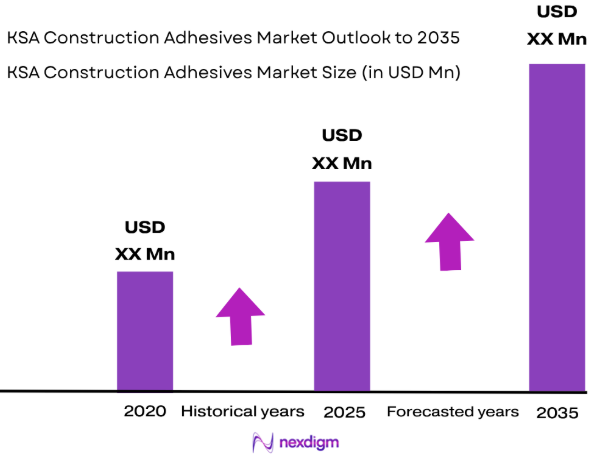
The KSA Construction Adhesives Market is valued at approximately ~USD XX million, supported by residential construction, giga-projects, hospitality development and high-specification interior finishing. In the preceding reporting period, more than 66,000 Saudi families received homes and over 24,000 residential units were released, while the latest period recorded 850,485 residential product contracts cumulatively. Large-format tiles, stone finishes, flooring systems and structural bonding requirements are increasing demand for cementitious, epoxy, polyurethane and hybrid adhesives.
Riyadh, Makkah, Jeddah, the Eastern Province and Tabuk are the principal construction-adhesive demand centres because they combine housing, hospitality, mixed-use and giga-project development. Riyadh recorded 33,380 housing products in the latest reporting period, followed by Makkah with 24,792 and the Eastern Province with 14,088. In the preceding period Riyadh also secured Expo hosting rights, strengthening its long-term development pipeline across commercial, hospitality, public-realm and fit-out construction.
Market Segmentation
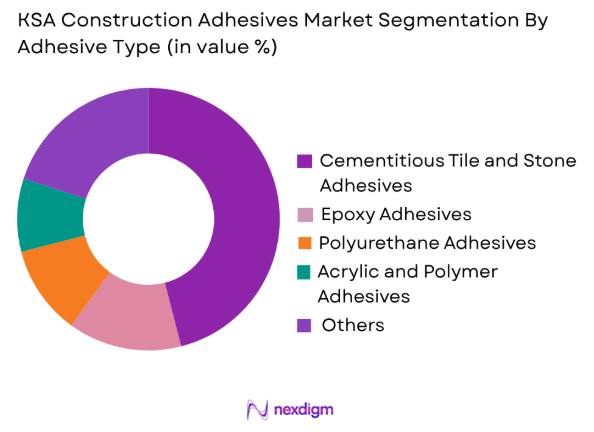
By Adhesive Type
The KSA Construction Adhesives Market is segmented into cementitious tile adhesives, epoxy adhesives, polyurethane adhesives, acrylic adhesives, SBR and latex bonding agents, hybrid polymer adhesives and specialty structural adhesives. Cementitious tile adhesives represent the dominant subsegment because Saudi construction uses large volumes of ceramic, porcelain, marble and natural stone across residential, commercial, hospitality and religious developments. Factory-produced polymer-modified adhesives provide more consistent bond strength, slip resistance and open time than conventional site-mixed mortars, which is especially important under high ambient temperatures. Large-format porcelain and stone installation is further increasing demand for flexible and deformable products. Local suppliers already offer specialized products for submerged areas, marble, glass mosaics and large-format slabs, indicating broad application depth. Epoxy and polyurethane systems remain smaller by volume but are strategically important for structural bonding, heavy-duty flooring, industrial kitchens, wet areas and high-performance applications where cementitious products are unsuitable.
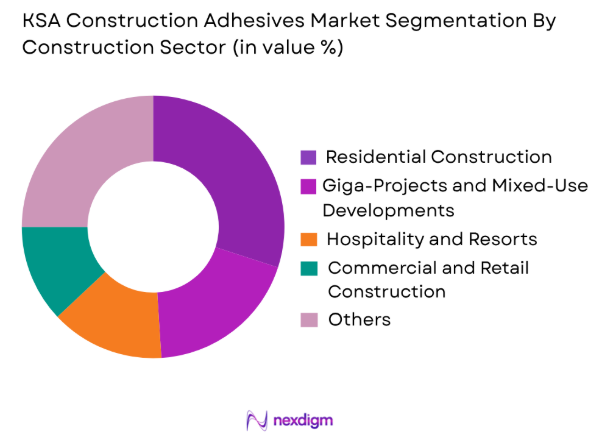
By Construction Sector
The KSA Construction Adhesives Market is segmented into residential, commercial and mixed-use, hospitality, retail, infrastructure, industrial, healthcare, education and giga-project applications. Residential construction represents the dominant subsegment because Saudi housing programs and integrated community developments require extensive tile, stone, flooring, interior-panel and wet-area installation. The Housing Program recorded substantial contract activity across Riyadh, Makkah and the Eastern Province, while ROSHN is developing large integrated communities across major Saudi regions. Hospitality is another high-intensity segment because hotels and resorts specify natural stone, porcelain slabs, pools, spas and decorative finishes requiring premium adhesives. The Ministry of Tourism reported 4,425 licensed hospitality facilities and 475,970 licensed rooms in the latest period, while private hospitality facility licences increased from 1,929 in the preceding period to 8,357. These applications favor high-performance cementitious adhesives, polyurethane systems, epoxy products and rapid-setting solutions.
Competitive Landscape
The KSA Construction Adhesives Market combines multinational construction-chemical companies with locally established dry-mix manufacturers and regional suppliers. Competition is driven by cementitious adhesive breadth, large-format tile capability, structural epoxy expertise, hot-weather performance, local manufacturing, distributor access and consultant specification. Companies with Saudi production or warehousing have an advantage because large projects require rapid replenishment, technical support and consistent batch quality. Sika operates in Jeddah, Riyadh and Dammam, while MAPEI has a Saudi manufacturing plant in Tabuk and a Riyadh branch.
| Major Player | Establishment Year | Headquarters | Tile & Stone Adhesives | Structural Bonding | Hot-Climate Capability | Local KSA Presence | Flooring / Interior Adhesives | Technical Support |
| Sika | 1910 | Baar, Switzerland | ~ | ~ | ~ | ~ | ~ | ~ |
| Fosroc | 1972 | Dubai, UAE | ~ | ~ | ~ | ~ | ~ | ~ |
| MAPEI | 1937 | Milan, Italy | ~ | ~ | ~ | ~ | ~ | ~ |
| Saint-Gobain / Weber | 1665 group roots | Courbevoie, France | ~ | ~ | ~ | ~ | ~ | ~ |
| H.B. Fuller | 1887 | St. Paul, USA | ~ | ~ | ~ | ~ | ~ | ~ |
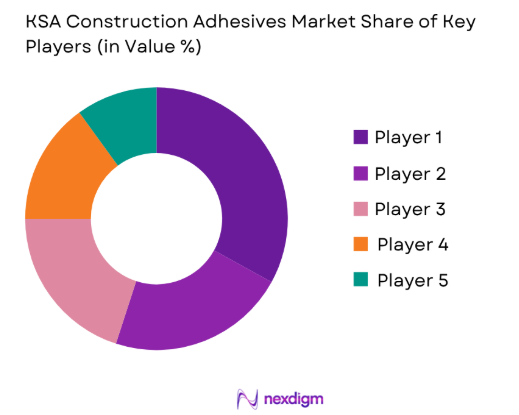
KSA Construction Adhesives Market Analysis
Growth Drivers
Residential Development and Urban Expansion Are Increasing Adhesive Consumption
Saudi Arabia’s construction adhesives demand is being strengthened by the scale of residential development and integrated community construction, particularly in Riyadh, Jeddah and the Eastern Province. The Housing Program reported a homeownership level of 65.4 in 2024, while ROSHN’s active development platform covers more than 400,000 homes across over 200 million square metres of master-planned communities. SEDRA in Riyadh alone spans 20 million square metres, includes 30,000 homes, 400 integrated amenities and 8 development phases. These projects require extensive ceramic, porcelain, stone, flooring, façade and wet-area installation, directly supporting cementitious, epoxy, polyurethane and hybrid construction adhesives. The broader macroeconomic environment also provides a strong base for sustained building activity. World Bank data place Saudi Arabia’s nominal GDP at USD1,239.8 billion in 2024 and GDP per capita at USD35,121.7. Large-format tile and stone finishes used in new housing communities increasingly require factory-produced adhesives with controlled bond strength, slip resistance and open time. This shifts demand away from conventional site-mixed mortar toward polymer-modified systems better suited to modern Saudi construction.
Hospitality and Tourism Construction Is Expanding High-Performance Adhesive Demand
Saudi Arabia’s hospitality expansion is creating a major demand channel for premium construction adhesives used in hotel rooms, lobbies, pools, spas, façades, kitchens and luxury fit-out applications. The Ministry of Tourism recorded 4,425 licensed hospitality facilities in 2024, supporting 475,970 licensed rooms across the Kingdom. Private hospitality facility licences reached 8,357, compared with 1,929 in the preceding reporting period, significantly widening the base of properties requiring stone, porcelain, mosaic and resilient-flooring installation. These applications typically require high-bond cementitious adhesives, epoxy systems, polyurethane products and flexible formulations capable of resisting moisture, heat and substrate movement. Tourism-linked construction is especially relevant in Riyadh, Jeddah, Makkah, Madinah and Red Sea destinations where premium finish intensity is high. Saudi Arabia’s macroeconomic scale reinforces this demand environment, with World Bank data showing nominal GDP of USD1,239.8 billion in 2024 and GDP per capita of USD35,121.7. The combination of a large hospitality asset base and strong national investment capacity supports recurring demand for technically advanced adhesives rather than basic masonry bonding materials.
Market Challenges
Imported Polymer and Resin Dependence Creates Supply-Side Exposure
The KSA Construction Adhesives Market remains exposed to imported raw materials because high-performance adhesives depend on redispersible polymer powders, epoxy resins, polyurethane intermediates, acrylic emulsions, cellulose ethers and specialty additives that are not fully available from domestic sources. This dependence is particularly important for flexible tile adhesives, large-format porcelain systems, structural epoxies and hybrid polymer products where raw-material substitution can materially change bond strength, open time and deformability. Saudi construction volumes amplify the need for reliable supply. ROSHN’s development platform exceeds 400,000 homes, while SEDRA alone covers 20 million square metres and 30,000 homes, requiring sustained availability of finishing materials across long project cycles. The macroeconomic backdrop is robust, with World Bank data recording Saudi nominal GDP of USD1,239.8 billion in 2024 and GDP per capita of USD35,121.7, but this does not remove exposure to international chemical supply chains. Suppliers therefore need regional warehousing, multiple feedstock sources and larger inventories. Delays in imported polymer or resin availability can affect batch consistency, project approvals and replenishment for tile, flooring and structural bonding products used on fast-track Saudi construction sites.
Extreme Heat and Application Conditions Increase Installation Risk
Saudi Arabia’s construction adhesives market faces a technically important challenge from high ambient and substrate temperatures, which can shorten open time, accelerate surface skinning and reduce adhesive transfer if products are not formulated or applied correctly. These risks are especially significant for exterior porcelain tiles, stone façades, roof-level finishes and large-format installations exposed to intense solar heating. The scale of current construction magnifies the issue. ROSHN’s SEDRA development includes 30,000 homes across 8 phases, while Saudi Arabia had 4,425 licensed hospitality facilities and 475,970 licensed rooms in 2024, creating thousands of active and future application environments where consistent installation quality is essential. Premium materials such as porcelain slabs and natural stone also place greater demands on substrate preparation, adhesive coverage and deformation capability. Saudi Arabia’s 2024 nominal GDP stood at USD1,239.8 billion, with GDP per capita of USD35,121.7, reflecting the economic scale supporting sophisticated construction but also raising expectations for quality and durability. Manufacturers must therefore invest in hot-climate formulations, contractor training and field technical support to reduce delamination, hollow spots and premature bond failure.
Market Opportunities
Local Dry-Mix Manufacturing and Regional Warehousing Can Expand Further
Saudi Arabia has a strong future opportunity to increase local production of cementitious construction adhesives and improve domestic blending, packaging and regional warehousing for epoxy, polyurethane and hybrid products. Current housing and project activity provides a substantial demand base for localization. ROSHN is developing more than 400,000 homes across over 200 million square metres, while 71 of every 100 contracts awarded by ROSHN in 2024 went to local suppliers. SEDRA alone contains 30,000 residential units and 400 amenities, creating recurring demand for tile, stone, flooring and interior installation materials. Local manufacturing can reduce dependence on imported finished products, shorten replenishment times and allow formulations to be adapted for Saudi temperature and substrate conditions. The macroeconomic platform supports industrial localization, with World Bank data recording nominal GDP of USD1,239.8 billion in 2024 and GDP per capita of USD35,121.7. Future growth can therefore come from Saudi-based dry-mix plants, resin-blending facilities, contractor training centres and regional warehouses near Riyadh, Jeddah and Dammam. Suppliers combining local production with technical specification support can capture a larger role in residential, hospitality and giga-project procurement.
Premium Tile, Stone and Hospitality Fit-Out Create Scope for Specialized Adhesives
Saudi Arabia’s expanding premium construction pipeline creates a future opportunity for higher-value adhesives designed for large-format porcelain, natural stone, mosaics, wet areas and façade applications. Current hospitality infrastructure provides a substantial installed and developing base: the Kingdom had 4,425 licensed hospitality facilities and 475,970 licensed rooms in 2024, while private hospitality facility licences reached 8,357. These assets require repeated installation of marble, porcelain, stone, pool finishes, resilient flooring and decorative surfaces where conventional mortar is often insufficient. Large-format materials create greater requirements for deformability, non-slip performance, extended open time and complete adhesive coverage, particularly under Saudi climatic conditions. Residential development reinforces this opportunity, with ROSHN planning more than 400,000 homes across major regions and SEDRA alone providing 30,000 homes in Riyadh. World Bank data show Saudi Arabia’s nominal GDP at USD1,239.8 billion in 2024 and GDP per capita at USD35,121.7, supporting continued investment in premium buildings and finishes. Future growth is therefore likely to favor high-performance cementitious C2-type systems, epoxy stone adhesives, flexible polyurethane products and hybrid polymer solutions tailored to demanding Saudi applications.
Future Outlook
The KSA Construction Adhesives Market is expected to expand at approximately ~X.X% CAGR during 2026-2035, supported by continued urban development, housing construction, hospitality investment, giga-project execution and premium interior finishing. Future growth will increasingly favor factory-produced, polymer-modified adhesives rather than conventional site-mixed mortars.
Large-format porcelain slabs, natural stone façades and luxury finishes will require flexible, deformable and extended-open-time products suited to high ambient temperatures. Structural epoxy and hybrid polymer systems will gain relevance in infrastructure, prefabrication and repair applications. Hospitality development will remain particularly important. Saudi Arabia recorded 475,970 licensed hospitality rooms in the latest reporting period, creating a large installed and developing base for wet-area, stone, flooring and fit-out adhesive applications. Local manufacturing will also influence competitive positioning. Suppliers with Saudi dry-mix plants, resin-blending capability and regional warehouses can reduce lead times and improve responsiveness to giga-project contractors and tile installers.
Major Players
- Sika Saudi Arabia
- Fosroc Saudi Arabia
- Mapei Saudi Arabia
- Saint-Gobain Weber Saudi Arabia
- Bostik Middle East / Arkema
- DCP Saudi Co.
- Saveto / Saudi Vetonit
- LATICRETE Middle East
- Henkel / Ceresit
- H.B. Fuller
- Terraco Saudi Arabia
- CONMIX
- MC-Bauchemie Middle East
- Soudal Middle East
- Dow Construction Solutions
Key Target Audience
- Construction Adhesive and Construction Chemical Manufacturers
- Tile, Stone and Flooring Material Manufacturers and Distributors
- Main Contractors and Specialist Fit-Out Contractors
- Real Estate, Giga-Project and Hospitality Developers
- Building Material Importers, Distributors and Dry-Mix Producers
- Investments and Venture Capitalist Firms
- Government and Regulatory Bodies (Ministry of Municipalities and Housing, Saudi Standards Metrology and Quality Organization, Saudi Building Code National Committee, Public Investment Fund, Ministry of Tourism)
- Structural, Precast and Building-Envelope Solution Providers
Research Methodology
Step 1: Identification of Key Variables
The initial phase involves constructing an ecosystem map covering construction adhesive manufacturers, raw-material suppliers, dry-mix producers, distributors, tile contractors, flooring contractors, developers and major project owners. Secondary and proprietary databases are used to identify chemistry types, application areas, local manufacturing and regional demand concentrations. Key variables include adhesive consumption, project type, tile format, substrate, application environment and local supply capability.
Step 2: Market Analysis and Construction
Historical demand is analyzed across residential, commercial, hospitality, infrastructure, fit-out and giga-project applications. The top-down approach evaluates Saudi construction activity, housing development and hospitality project pipelines, while the bottom-up approach assesses manufacturer sales, distributor throughput, local production and project consumption. These datasets are reconciled across cementitious, epoxy, polyurethane, acrylic and hybrid adhesive categories.
Step 3: Hypothesis Validation and Expert Consultation
Market hypotheses are validated through computer-assisted telephone interviews and structured consultations with construction chemical manufacturers, distributors, contractors, tile installers, flooring specialists and project procurement teams. Discussions evaluate product selection, open-time requirements, substrate compatibility, large-format tile usage, local sourcing and qualification procedures. These consultations help distinguish commodity dry-mix products from higher-performance structural and specialty adhesive systems.
Step 4: Research Synthesis and Final Output
The final phase triangulates supplier information with Vision 2030 project data, housing activity, tourism development, local manufacturing disclosures and primary interviews. Demand is cross-checked by application, chemistry, project type and region. Forecasting incorporates giga-project execution, residential development, hospitality construction, large-format tile adoption, local manufacturing expansion and premium specification trends to produce the final KSA Construction Adhesives Market outlook.

- Executive Summary
- Research Methodology (Market Definitions and Assumptions, KSA Construction Adhesives Market Classification, Construction Adhesive Scope, Cementitious Adhesive Assessment, Epoxy Adhesive Assessment, Polyurethane Adhesive Assessment, Acrylic Adhesive Assessment, SBR and Latex Bonding Adhesive Assessment, Hybrid Polymer Adhesive Assessment, Tile and Stone Adhesive Assessment, Flooring Adhesive Assessment, Structural Bonding Adhesive Assessment, Façade Adhesive Assessment, Insulation Adhesive Assessment, Precast Bonding Assessment, Repair and Rehabilitation Adhesive Assessment, Hot-Climate Performance Assessment, Open-Time Assessment, Slip Resistance Assessment, Tensile Adhesion Strength Assessment, Deformability Assessment, Water Resistance Assessment, Heat Resistance Assessment, Chemical Resistance Assessment, VOC and Indoor Air Quality Assessment, New-Build Demand Assessment, Renovation Demand Assessment, Giga-Project Mapping, Local Manufacturing Assessment, Import Assessment, Supply-Side Assessment, Demand-Side Assessment, Top-Down Market Sizing, Bottom-Up Market Sizing, Primary Industry Interviews, Construction Project Pipeline Assessment, Distributor Mapping, Contractor Mapping, Data Triangulation, Forecasting Framework)

- Definition and Scope
- KSA Construction Adhesives Industry Evolution and Development of Conventional Site-Mixed Mortars, Polymer-Modified Cementitious Tile Adhesives, Epoxy Structural Adhesives, Polyurethane Bonding Systems, Acrylic Adhesives, SBR and Latex Bonding Agents, Hybrid Polymer Adhesives, Large-Format Tile Adhesives, Natural Stone Adhesives, Flooring Adhesives, Façade Bonding Systems, Insulation Adhesives, Precast Bonding Systems, High-Temperature Adhesives, Low-VOC Adhesives, Giga-Project Construction Adhesive Solutions
- Construction Adhesives Value Chain Analysis
- Construction Adhesives Supply Chain Analysis
- Polymer Resin Suppliers, Redispersible Polymer Powder Suppliers, Cement and Mineral Filler Suppliers, Epoxy Resin Suppliers, Polyurethane Raw Material Suppliers, Acrylic Emulsion Suppliers, SBR Latex Suppliers, Specialty Additive Suppliers, Construction Adhesive Manufacturers, Dry-Mix Mortar Producers, Local Blending Facilities, Importers, Construction Chemical Distributors, Building Material Dealers, Tile and Stone Distributors, Flooring Contractors, Tiling Contractors, Main Contractors, Fit-Out Contractors, Giga-Project Contractors, Real Estate Developers, Consultants, Testing Laboratories, Government Authorities

- Growth Drivers (Vision 2030 Giga-Projects, Riyadh Urban Expansion, ROSHN Residential Development, Hospitality Construction, Expo Riyadh Development, Transport Infrastructure, Airport Development, Large-Format Tile Adoption, Premium Natural Stone Usage, Retail and Commercial Fit-Out, Construction Renovation, Local Building Materials Manufacturing)
- Market Challenges (Extreme Ambient Temperature, Rapid Open-Time Reduction, Imported Polymer and Resin Dependence, Adhesive-Substrate Compatibility, Skilled Applicator Availability, Product Specification Complexity, Site Mixing Quality, Conventional Mortar Competition, Contractor Price Sensitivity, Product Qualification Requirements, Raw Material Supply Risk, Project Rescheduling)
- Market Opportunities (High-Performance Cementitious Adhesives, Large-Format Tile Adhesives, High-Deformability Adhesives, Structural Epoxy Adhesives, Hybrid Polymer Adhesives, Low-VOC Flooring Adhesives, Hospitality Fit-Out Solutions, Façade Adhesives, Prefabrication and Modular Construction Adhesives, Local Dry-Mix Manufacturing, Sustainable Adhesive Formulations, Premium Giga-Project Specifications)
- Market Trends (Polymer-Modified Cementitious Adhesives, Large-Format Porcelain Slabs, Extended Open-Time Adhesives, Flexible Tile Adhesives, Rapid-Setting Products, Low-VOC Systems, Hybrid Polymer Adhesives, Factory-Produced Dry-Mix Mortars, Premixed Adhesive Systems, Lightweight Adhesives, Sustainable Polymer Technology, System-Based Tile Installation)
- Government Regulations and Standards (Saudi Building Code Requirements, Saudi Standards Metrology and Quality Organization Requirements, SASO Product Conformity Requirements, SABER Conformity Procedures, GCC Construction Product Requirements, Ceramic Tile Installation Requirements, Fire and Life-Safety Requirements, VOC and Chemical Safety Requirements, Occupational Safety Requirements, Mostadam Sustainability Requirements)
- SWOT Analysis
- Porter’s Five Forces Analysis
- PESTLE Analysis
- Stakeholder Ecosystem
- Construction Adhesives Manufacturing and Construction Project Ecosystem

- By Market Value (2020-2025)
- By Consumption Volume (2020-2025)
- By Cementitious Adhesive Consumption (2020-2025)
- By Epoxy Adhesive Consumption (2020-2025)
- By Polyurethane Adhesive Consumption (2020-2025)
- By Acrylic and Polymer Adhesive Consumption (2020-2025)
- By Tile and Stone Adhesive Consumption (2020-2025)
- By Flooring Adhesive Consumption (2020-2025)
- By Structural Bonding Adhesive Consumption (2020-2025)
- By Façade Adhesive Consumption (2020-2025)
- By Insulation Adhesive Consumption (2020-2025)
- By Residential Construction Adhesive Demand (2020-2025)
- By Commercial and Hospitality Adhesive Demand (2020-2025)
- By Infrastructure Adhesive Demand (2020-2025)
- By Giga-Project Adhesive Demand (2020-2025)
- By Locally Manufactured Adhesive Consumption (2020-2025)
- By Imported Adhesive Consumption (2020-2025)

- Market Share of Major Players (By KSA Revenue, Adhesive Consumption Volume, Cementitious Adhesive Sales, Tile Adhesive Sales, Epoxy Adhesive Sales, Flooring Adhesive Sales, Structural Bonding Exposure, Residential Project Exposure, Hospitality Project Exposure, Giga-Project References, Local Manufacturing Capacity, Regional Warehouse Coverage, Distributor Network, Contractor Technical Support, Specification Presence)
- Cross Comparison Parameters (Construction Adhesive Chemistry Portfolio Breadth, Cementitious Tile and Large-Format Adhesive Capability, Structural Epoxy and High-Strength Bonding Capability, Hot-Climate Open-Time and Deformability Performance, KSA Manufacturing Warehousing and Distribution Network, Residential Hospitality and Giga-Project Reference Base, Technical Training Specification and Contractor Support, Low-VOC Sustainable and High-Performance Product Capability)
- SWOT Analysis of Major Players
- Competitive Positioning Matrix
- Major Companies
Sika Saudi Arabia
Fosroc Saudi Arabia
Mapei Saudi Arabia
Saint-Gobain Weber Saudi Arabia
Bostik Middle East / Arkema
DCP Saudi Co.
Saveto / Saudi Vetonit
LATICRETE Middle East
Henkel / Ceresit
H.B. Fuller
Terraco Saudi Arabia
CONMIX
MC-Bauchemie Middle East
Soudal Middle East
Dow Construction Solutions

- Main Contractor Requirement Assessment
- Tile Contractor Requirement Assessment
- Flooring Contractor Requirement Assessment
- Fit-Out Contractor Requirement Assessment
- Façade Contractor Requirement Assessment
- Structural Repair Contractor Requirement Assessment
- Real Estate Developer Requirement Assessment
- Giga-Project Developer Requirement Assessment
- Architect and Consultant Specification Assessment
- Hospitality Developer Requirement Assessment
- Building Material Distributor Requirement Assessment
- Large-Format Tile Installer Requirement Assessment
- Technical Support Requirement Assessment
- Warranty and System Approval Requirement Assessment

- By Market Value (2026-2035)
- By Consumption Volume (2026-2035)
- By Cementitious Adhesive Consumption (2026-2035)
- By Epoxy Adhesive Consumption (2026-2035)
- By Polyurethane Adhesive Consumption (2026-2035)
- By Acrylic and Polymer Adhesive Consumption (2026-2035)
- By Tile and Stone Adhesive Consumption (2026-2035)
- By Flooring Adhesive Consumption (2026-2035)
- By Structural Bonding Adhesive Consumption (2026-2035)
- By Façade Adhesive Consumption (2026-2035)
- By Insulation Adhesive Consumption (2026-2035)
- By Residential Construction Adhesive Demand (2026-2035)
- By Commercial and Hospitality Adhesive Demand (2026-2035)
- By Infrastructure Adhesive Demand (2026-2035)
- By Giga-Project Adhesive Demand (2026-2035)
- By Locally Manufactured Adhesive Consumption (2026-2035)
- By Imported Adhesive Consumption (2026-2035)


 Request a Sample
 Ask for Customization
 Get a Quote
 Enquire Now