
 Download PDF
Market Overview
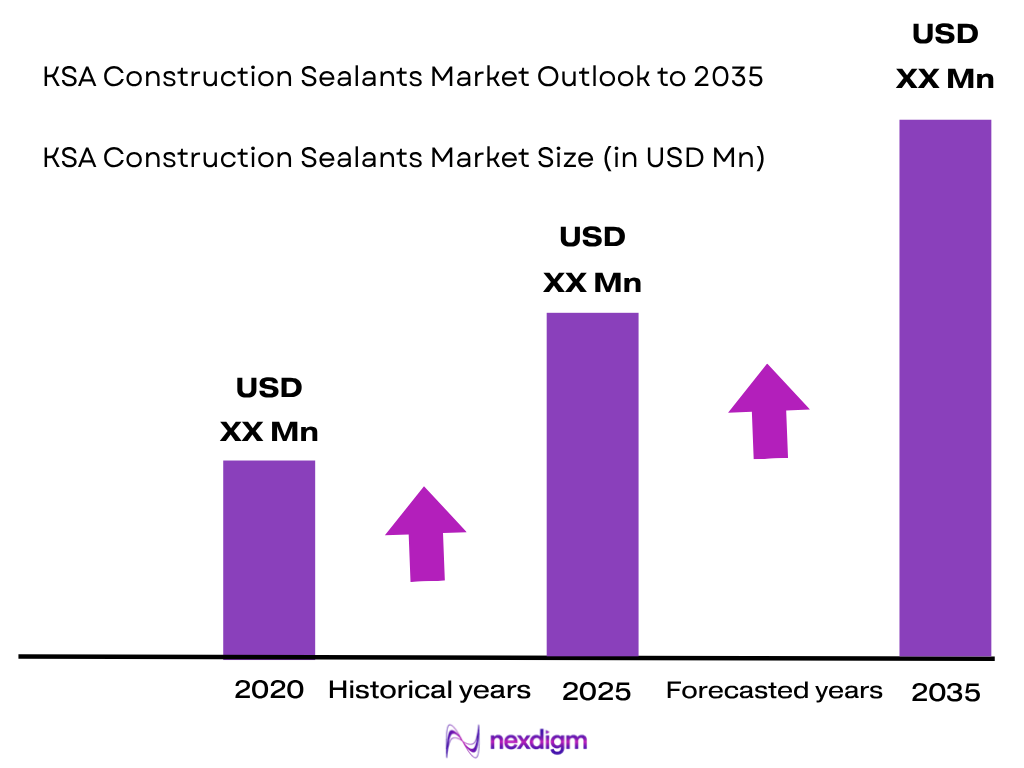
The KSA Construction Sealants Market is valued at approximately USD ~XX million, supported by a construction sector whose operating revenues advanced from approximately SAR429.3 billion in the preceding annual observation to SAR470.6 billion in the latest period. Operating expenses reached SAR183.0 billion, while the sector contained 273,874 active enterprises. This construction ecosystem generates significant requirements for façade silicone, polyurethane expansion-joint sealants, polysulfide systems, glazing sealants and concrete-joint technologies.
Riyadh, Tabuk, Jeddah-Makkah and the Red Sea development corridor dominate KSA sealant demand because major residential, hospitality, commercial and giga-project construction is concentrated in these locations. Riyadh Municipality approved 19 residential plans covering 13,522,478 square metres, providing more than 17,000 housing units, and issued 18,248 building permits. Separately, Saudi Arabia’s five PIF giga-project platforms include NEOM, Red Sea Global, Qiddiya, ROSHN and Diriyah, concentrating high-performance façade and infrastructure applications.
Market Segmentation
By Sealant Chemistry
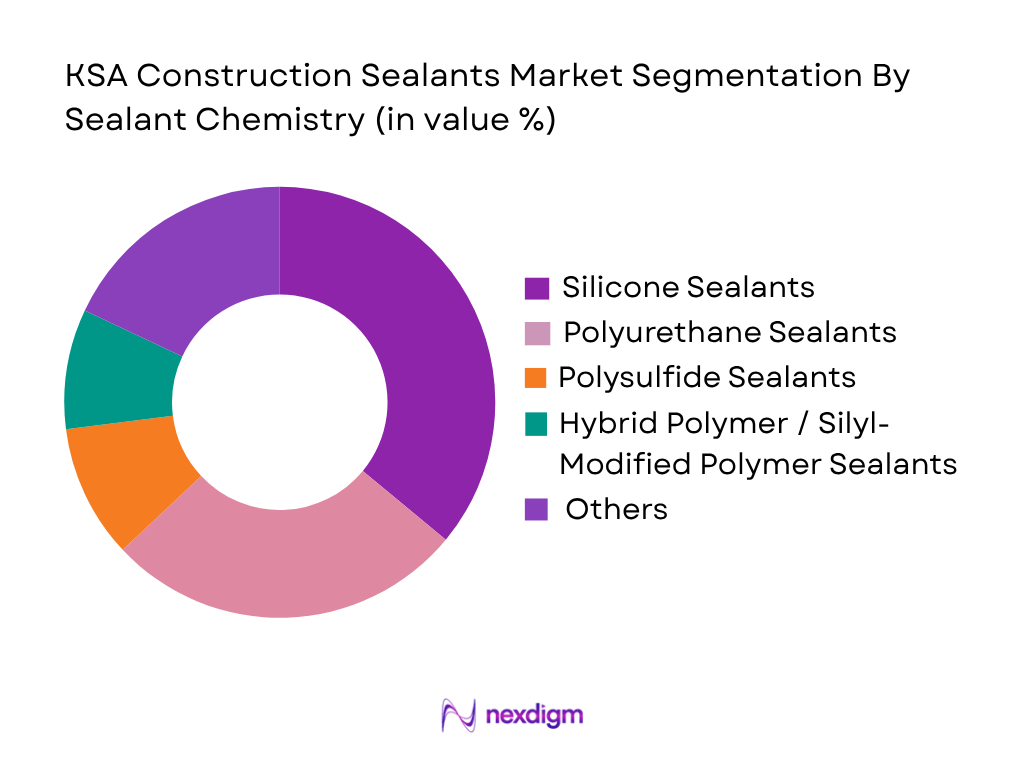
The KSA Construction Sealants Market is segmented into silicone sealants, polyurethane sealants, polysulfide sealants, hybrid polymer and silyl-modified polymer sealants, acrylic sealants, butyl sealants and other specialty products. Silicone sealants hold the dominant market share because Saudi Arabia’s commercial towers, hotels, malls, airports and large mixed-use developments require long-term resistance to intense solar radiation, thermal cycling and exterior weathering. Neutral-cure architectural silicones are particularly important for glass curtain walls, aluminum façades, window perimeters and natural-stone interfaces where movement capability and UV stability are critical. Structural glazing further supports silicone consumption in high-rise construction. Polyurethane products remain widely used for concrete expansion joints, parking structures and floor joints because of their adhesion and traffic resistance, while polysulfides retain relevance in fuel-exposed and infrastructure applications. Hybrid polymer technologies are developing as contractors seek paintability, lower VOC content and multi-substrate adhesion.
By Application
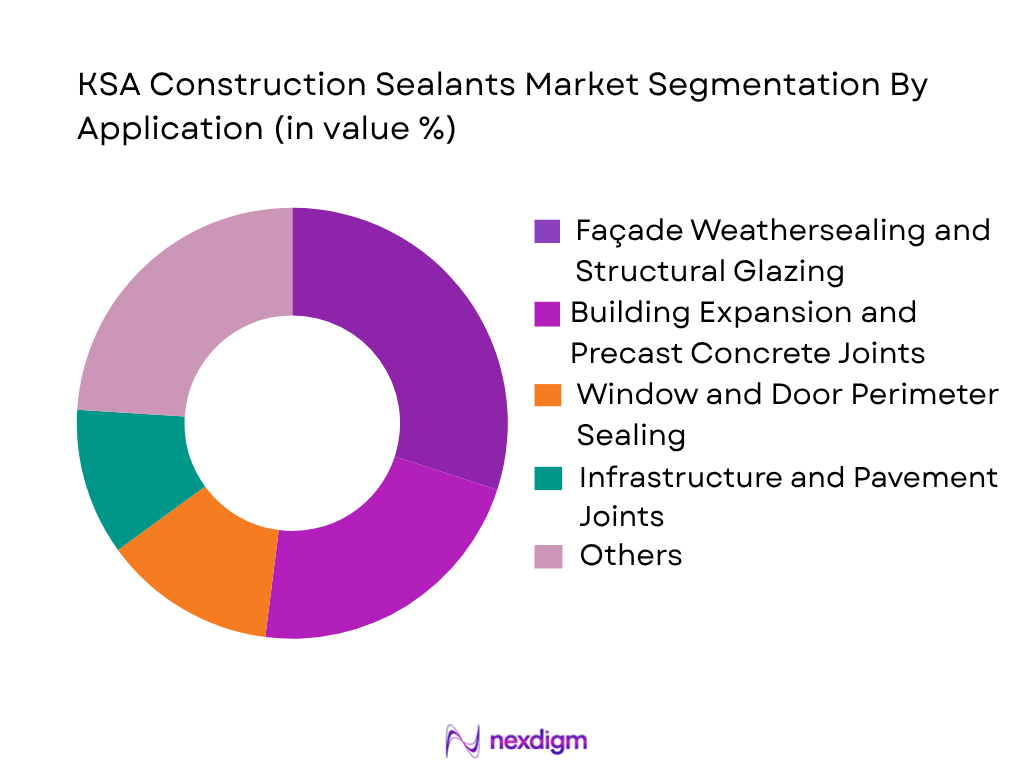
The KSA Construction Sealants Market is segmented into façade and structural glazing, building expansion and precast joints, window and door perimeter sealing, infrastructure and pavement joints, roofing, firestop and acoustic sealing, sanitary applications and other uses. Façade and structural glazing applications hold the dominant market share because modern Saudi developments increasingly use glass, aluminum, stone and mixed-material building envelopes exposed to intense heat and large daily temperature variations. Riyadh’s high-rise expansion, hospitality development along the Red Sea, and landmark commercial projects create extensive linear joint requirements. Silicone weatherseals accommodate differential movement between glass and metal while maintaining air and water resistance. Precast concrete construction also supports substantial polyurethane and polysulfide usage at panel and expansion joints. Airports, bridges, roads and parking structures form another important application cluster because joint systems in these environments must tolerate traffic, water exposure, movement and demanding service conditions.
Competitive Landscape
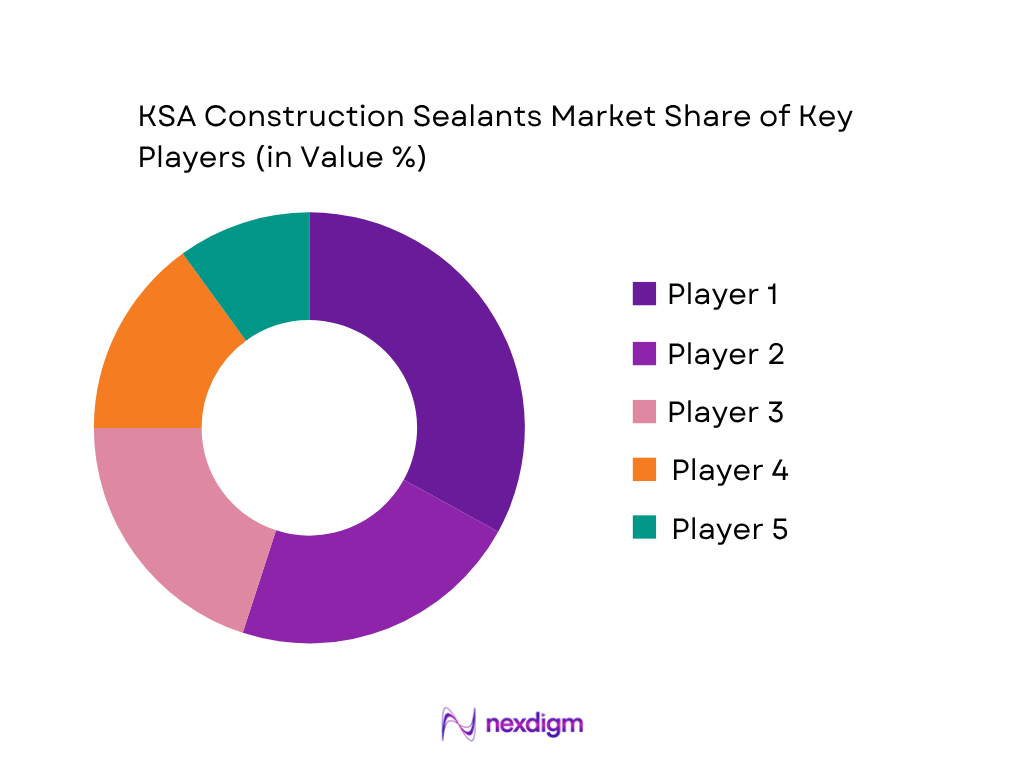
The KSA Construction Sealants Market combines multinational construction-chemical companies, specialist silicone technology providers and regional manufacturers. Sika and Fosroc have broad construction-chemical portfolios spanning joint sealing, waterproofing and infrastructure applications, while Dow is particularly strong in structural silicone glazing and architectural weathersealing. MAPEI participates across building and civil-construction chemicals, while Bostik contributes polyurethane, hybrid and general construction-sealing technologies. Competition is increasingly determined by high-temperature performance, façade approvals, ASTM-compliant movement capability, local project support, contractor training and ability to secure giga-project specifications.
| Major Player | Establishment Year | Headquarters | Silicone / Weatherseal Capability | Polyurethane / Joint Capability | Structural Glazing Capability | High-Temperature & UV Performance | Infrastructure Applications | Technical & Specification Support |
| Sika | 1910 | Baar, Switzerland | ~ | ~ | ~ | ~ | ~ | ~ |
| Fosroc | 1972 | Dubai, UAE regional base | ~ | ~ | ~ | ~ | ~ | ~ |
| MAPEI | 1937 | Milan, Italy | ~ | ~ | ~ | ~ | ~ | ~ |
| Dow / DOWSIL | 1897 | Midland, Michigan, US | ~ | ~ | ~ | ~ | ~ | ~ |
| Bostik | 1889 | France | ~ | ~ | ~ | ~ | ~ | ~ |
KSA Construction Sealants Market Analysis
Growth Drivers
Large Construction Activity Expanding Façade, Joint and Weathersealing Demand
Saudi Arabia’s large construction base is directly supporting demand for silicone, polyurethane, polysulfide and hybrid construction sealants across façades, glazing systems, precast panels, expansion joints and roofing interfaces. General Authority for Statistics data show construction-sector operating revenues of SAR470.6 billion in 2024, operating expenses of SAR183.0 billion, and an operating surplus of SAR207.7 billion. The sector also included 273,874 active construction enterprises, indicating extensive contractor and project activity across the Kingdom. Riyadh alone approved 19 residential plans covering 13,522,478 square metres, supporting more than 17,000 housing units, including 14,897 villas and 2,460 apartments, while issuing 18,248 building permits. These projects require perimeter sealing, concrete-joint systems, sanitary sealants and exterior façade products capable of handling thermal movement. The macroeconomic environment provides substantial support, with World Bank data showing Saudi Arabia’s GDP at US$1,239.8 billion in 2024 and GDP per capita at US$35,121.7. This combination of urban construction, contractor depth and national economic capacity supports recurring sealant consumption across residential, commercial and infrastructure developments.
Giga-Project Construction Increasing High-Performance Sealant Requirements
Saudi Arabia’s giga-project development is strengthening demand for high-performance construction sealants because large hospitality, residential, entertainment and infrastructure projects require extensive façade weathersealing, structural glazing, concrete-joint sealing and fire-rated systems. PIF reported that NEOM had more than 100 active development sites at the end of 2024, with 200 kilometres of water pipelines, 500 kilometres of fiber, 20 million cubic metres of earth excavation and 2.4 million cubic metres of concrete used in construction. NEOM’s total development footprint covers approximately 26,500 square kilometres, involving more than 115,000 company employees and contractors. These construction volumes translate into large quantities of concrete joints, glazing interfaces, façade transitions and penetrations requiring durable elastomeric sealing. The broader PIF portfolio also includes Red Sea Global, Qiddiya, ROSHN and Diriyah, creating additional demand for project-approved products. Saudi Arabia’s 2024 macroeconomic scale further supports this pipeline, with the World Bank reporting US$1,239.8 billion of GDP and US$35,121.7 GDP per capita. High-specification projects therefore provide a strong platform for silicone, polyurethane, polysulfide and firestop sealant technologies.
Market Challenges
Extreme Project Scale Increasing Installation and Quality-Control Complexity
Saudi Arabia’s construction sealant market faces significant execution challenges because large developments require thousands of individual façade, glazing, precast and concrete joints to be installed consistently across extensive project footprints. NEOM alone reported more than 100 active development sites, 2.4 million cubic metres of concrete consumption, 200 kilometres of installed water pipelines and 20 million cubic metres of earth excavation in 2024. This scale creates a substantial requirement for correct joint width-to-depth ratios, substrate cleaning, primer selection, backer-rod placement and sealant tooling. Any inconsistency can reduce adhesion or movement performance, particularly on external façades exposed to thermal cycling, dust and high solar loading. Riyadh’s additional 18,248 building permits, including 15,346 residential permits, further increase the number of active construction sites requiring trained applicators and reliable technical supervision. The market operates within a large macroeconomic system, with World Bank data showing Saudi Arabia’s 2024 GDP at US$1,239.8 billion and GDP per capita at US$35,121.7. The combination of massive project scale and widespread construction activity makes installation quality, specification control and field technical support a material challenge for sealant suppliers.
Fragmented Contractor Base Increasing Distribution and Technical-Service Requirements
The KSA Construction Sealants Market faces distribution and technical-service complexity because construction activity is supported by a very large number of contractors and establishments operating across 13 administrative regions. General Authority for Statistics data record 273,874 active construction enterprises in 2024, while total construction operating revenues reached SAR470.6 billion and operating expenses reached SAR183.0 billion. This broad contractor base increases the need for local warehouses, distributors, field engineers and applicator training because sealant performance depends heavily on correct product selection and installation. Large projects may require structural glazing silicone, high-movement façade sealants or trafficable polyurethane systems, while smaller contractors may use acrylic or general-purpose products for windows, internal joints and residential applications. GASTAT’s Construction Cost Index framework also covers all 13 administrative regions, highlighting the national geographic spread of construction activity. Saudi Arabia’s macroeconomic base remains substantial, with World Bank data showing US$1,239.8 billion of GDP in 2024 and US$35,121.7 GDP per capita. Suppliers therefore face the challenge of maintaining technical consistency, inventory availability and specification support across a highly dispersed construction ecosystem.
Market Opportunities
Hospitality Expansion Creating Future Demand for Façade and Wet-Area Sealants
Saudi Arabia’s expanding hospitality infrastructure creates a strong future opportunity for construction sealants because hotels and resorts require extensive façade, glazing, bathroom, roofing, firestop and movement-joint systems. The Ministry of Tourism reported 4,425 licensed tourism hospitality facilities in 2024 with 475,970 licensed rooms. By the first half of 2025, the Kingdom had 2,527 licensed hotels containing 450,074 room keys alongside 2,799 licensed apartments and other facilities with 94,805 room keys. Makkah alone accounted for 326,066 hotel room keys, while Riyadh contained 25,840 hotel room keys. Red Sea Global further reported multiple resort openings during 2024, including the 90-key St. Regis Red Sea Resort, 63-key Nujuma Ritz-Carlton Reserve, 73-key Shebara Resort and 64-key Desert Rock. These assets generate future replacement and new-installation demand for sanitary silicone, façade weatherseals, glazing sealants and fire-rated systems. World Bank data show Saudi Arabia’s GDP at US$1,239.8 billion in 2024 and GDP per capita at US$35,121.7, supporting continued hospitality investment and associated construction-material demand.
Aviation Infrastructure Supporting High-Specification Joint and Glazing Systems
Saudi Arabia’s expanding aviation ecosystem presents a future growth opportunity for construction sealant suppliers because airports require extensive glazing, façade sealing, pavement-joint sealing, roofing interfaces and fire-rated penetration systems. The General Authority of Civil Aviation reported more than 128 million passengers through Saudi airports in 2024, supported by more than 905,000 flights and air-cargo volumes exceeding 1.2 million tonnes. Another official update recorded connectivity to 172 destinations, demonstrating the scale of airport operations and the pressure for continued terminal, runway, logistics and support-facility development. Airport construction and rehabilitation are sealant-intensive because runways and aprons require durable joint systems, while terminals depend on structural silicone glazing, weatherseal systems and firestop products at façade and service penetrations. The current aviation base therefore creates a sizeable platform for future specification-driven sealant demand without relying on forecast passenger figures. Saudi Arabia’s broader economic capacity also supports capital-intensive aviation projects, with World Bank data showing US$1,239.8 billion of GDP in 2024 and US$35,121.7 GDP per capita. Suppliers with airport-grade polysulfide, polyurethane and structural silicone systems are positioned to benefit from this infrastructure cycle.
Future Outlook
The KSA Construction Sealants Market is expected to expand at approximately ~XX% CAGR during 2026-2035, supported by urban development, hospitality construction, transport infrastructure and large-scale building-envelope requirements. High-movement silicone products should remain central to glass and metal façades, while polyurethane and polysulfide products will continue supporting concrete and infrastructure joints. Giga-project activity will create demand for increasingly specification-driven products. PIF currently identifies NEOM, Qiddiya, Red Sea Global, ROSHN and Diriyah among its major giga-project platforms, spanning urban communities, tourism, entertainment and infrastructure.
High solar radiation and temperature cycling will continue pushing project specifications toward UV-resistant, low-modulus and high-movement sealants. Suppliers capable of demonstrating long-term adhesion to aluminum, glass, concrete, stone and coated substrates will gain an advantage. Localization should also become strategically important as developers seek shorter supply chains, local inventories, faster technical support and greater domestic manufacturing participation.
Major Players
- Sika Saudi Arabia
- Fosroc Saudi Arabia
- MAPEI Saudi Arabia
- Bostik Saudi Arabia
- Dow / DOWSIL
- DCP Saudi Co.
- Saveto Group / Vetonit
- Bitumat Company Limited
- Henkel Saudi Arabia
- H.B. Fuller
- Soudal
- Tremco Construction Products Group
- Terraco Arabia Company Ltd.
- Master Builders Solutions
- Al Muqarram Industry
Key Target Audience
- Construction Sealant and Construction Chemical Manufacturers
- Façade, Glazing and Building Envelope Contractors
- General Contractors and Infrastructure Contractors
- Property Developers and Giga-Project Developers
- Construction Material Distributors and Building Product Suppliers
- Silicone, Polyurethane and Specialty Polymer Suppliers
- Investments and Venture Capitalist Firms
- Government and Regulatory Bodies (Saudi Standards, Metrology and Quality Organization, Ministry of Municipalities and Housing, Saudi Building Code National Committee, Saudi Civil Defense, Royal Commission for Riyadh City)
Research Methodology
Step 1: Identification of Key Variables
The initial phase involves constructing an ecosystem map covering sealant manufacturers, polymer suppliers, local blenders, importers, distributors, façade contractors, glazing contractors, infrastructure contractors and giga-project developers. Critical variables include construction activity, façade joint density, sealant chemistry, movement requirements, climatic exposure, project approvals, imported-versus-local supply and regional demand concentration.
Step 2: Market Analysis and Construction
Historical information for the KSA Construction Sealants Market is compiled using construction-sector activity, residential development, infrastructure expenditure and project pipelines. Bottom-up analysis estimates sealant consumption through application-specific joint lengths, product yields and chemistry usage, while top-down analysis evaluates construction expenditure and construction-chemical intensity to establish the overall market framework.
Step 3: Hypothesis Validation and Expert Consultation
Market hypotheses are subsequently validated through computer-assisted telephone interviews with manufacturers, distributors, façade contractors, sealant applicators, project procurement managers and specification professionals. These consultations evaluate silicone versus polyurethane consumption, polysulfide applications, giga-project approvals, high-temperature performance, packaging requirements, contractor preferences and technical-service expectations.
Step 4: Research Synthesis and Final Output
Primary findings are triangulated with government construction statistics, municipal building information, giga-project disclosures, building standards and manufacturer technical literature. Top-down and bottom-up estimates are reconciled to establish market size and segmentation, while forecasting incorporates urban construction, hospitality investment, infrastructure activity, façade complexity, sealant replacement cycles and increasing localization of construction-material supply.

- Executive Summary
- Research Methodology (Market Definitions and Assumptions, KSA Construction Sealants Market Classification, Silicone Sealant Scope, Polyurethane Sealant Assessment, Polysulfide Sealant Assessment, Hybrid Polymer Sealant Assessment, Acrylic Sealant Assessment, Structural Glazing Sealant Assessment, Façade Weatherseal Assessment, Precast Joint Sealant Assessment, Concrete Expansion Joint Sealant Assessment, Traffic-Grade Sealant Assessment, Fire-Rated Sealant Assessment, Acoustic Sealant Assessment, Roofing Sealant Assessment, Window and Door Sealant Assessment, Hot-Climate Performance Assessment, UV Resistance Assessment, Sand and Dust Exposure Assessment, ASTM C920 Assessment, ASTM C719 Movement Capability Assessment, ISO 11600 Assessment, EN 15651 Assessment, Joint Movement Assessment, Substrate Compatibility Assessment)

- Definition and Scope
- KSA Construction Sealants Industry Evolution and Development of Bituminous Joint Sealants, Acrylic Caulks, Polysulfide Joint Sealants, One-Component Polyurethane Sealants, Two-Component Polyurethane Sealants, Acetoxy Silicone Sealants, Neutral-Cure Silicone Sealants, Structural Silicone Glazing Systems, Low-Modulus Weatherseal Silicones, Hybrid Polymer Sealants, Silyl-Modified Polymer Sealants, Firestop Sealants, Acoustic Sealants, Traffic-Grade Joint Sealants, Airport Pavement Sealants, Precast Concrete Joint Sealants, Window and Door Sealants, Roofing Sealants, Sanitary Sealants, Low-VOC Sealants and High-Movement Façade Sealant Systems
- Construction Sealants Value Chain Analysis
- Construction Sealants Supply Chain Analysis
- Silicone Polymer Suppliers, Polyurethane Prepolymer Suppliers, Polysulfide Polymer Suppliers, Acrylic Polymer Suppliers, Silane-Modified Polymer Suppliers, Plasticizer Suppliers, Mineral Filler Suppliers, Catalyst Suppliers, Pigment Suppliers, Packaging Suppliers, Construction Sealant Manufacturers, Local Blenders, Importers, Distributors, Façade and Glazing Contractors

- Growth Drivers (Vision-Led Construction, Riyadh Urban Expansion, Giga-Project Development, NEOM Construction, Qiddiya Development, Diriyah Development, Red Sea Hospitality Construction, Airport Development, Residential Expansion, High-Rise Construction, Precast Concrete Usage, Infrastructure Rehabilitation, High-Performance Building Envelope Requirements)
- Market Challenges (Extreme Ambient Temperature, High UV Exposure, Sand and Dust Contamination, High Substrate Surface Temperature, Joint Preparation Quality, Natural Stone Staining Risk, Polyurethane Weathering Limitations, Sealant-Substrate Compatibility, Skilled Applicator Availability, Imported Polymer Dependence, Specification Complexity, Product Storage Conditions)
- Market Opportunities (High-Movement Silicone Systems, Hybrid Polymer Sealants, Giga-Project Façade Sealants, Structural Glazing Silicones, Non-Staining Stone Sealants, Airport Pavement Sealants, Bridge Joint Sealants, Firestop Sealants, Low-VOC Products, Primerless Sealants, High-Temperature Sealants, Preformed Joint Systems, Local Manufacturing)
- Market Trends (Neutral-Cure Silicone Adoption, High-Movement Weatherseal Systems, Low-Modulus Façade Sealants, Hybrid SMP Technology, UV-Resistant Formulations, Fast-Cure Polyurethane Sealants, Low-Monomer PU Technology, Non-Staining Natural Stone Sealants, Trafficable Polysulfide Systems, Sausage Packaging, Low-VOC Formulations, Building Envelope System Integration, Digital Joint Calculators, Project-Specific Color Matching)
- Government Regulations and Standards (Saudi Building Code Requirements, Saudi Standards Metrology and Quality Organization Requirements, ASTM C920 Elastomeric Joint Sealants, ASTM C719 Cyclic Movement Testing, ISO 11600 Joint Sealant Classification, EN 15651 Façade Sealant Requirements, Civil Defense Firestop Requirements, Ministry of Municipalities and Housing Requirements)
- SWOT Analysis
- Porter’s Five Forces Analysis
- PESTLE Analysis
- Stakeholder Ecosystem
- Construction Sealants Manufacturing and Project Ecosystem

- By Market Value (2020-2025)
- By Sealant Consumption Volume (2020-2025)
- By Silicone Sealant Consumption (2020-2025)
- By Polyurethane Sealant Consumption (2020-2025)
- By Polysulfide Sealant Consumption (2020-2025)
- By Hybrid Polymer Sealant Consumption (2020-2025)
- By Acrylic Sealant Consumption (2020-2025)
- By Façade and Glazing Sealant Consumption (2020-2025)
- By Concrete and Precast Joint Sealant Consumption (2020-2025)
- By Infrastructure and Trafficable Sealant Consumption (2020-2025)
- By Fire-Rated and Acoustic Sealant Consumption (2020-2025)
- By Roofing Sealant Consumption (2020-2025)
- By Residential Construction Sealant Consumption (2020-2025)
- By Commercial and Hospitality Sealant Consumption (2020-2025)

- By Sealant Chemistry (In Value %)
Silicone Sealants
Polyurethane Sealants
Polysulfide Sealants
Hybrid Polymer and Silyl-Modified Polymer Sealants
Acrylic Sealants
Siliconized Acrylic Sealants
Butyl Sealants
Epoxy Hybrid Sealants
Other Specialty Construction Sealants - By Product Type (In Value %)
One-Component Sealants
Two-Component Sealants
Non-Sag Gun-Grade Sealants
Self-Leveling Sealants
Trafficable Joint Sealants
Structural Glazing Sealants
Façade Weatherseal Sealants
Precast Concrete Joint Sealants
Window and Door Sealants
Roofing Sealants
Fire-Rated Sealants
Acoustic Sealants
Sanitary Sealants
Preformed Joint Sealing Systems
Joint Fillers and Backer Rod Systems - By Application (In Value %)
Curtain Wall Weathersealing
Structural Silicone Glazing
Precast Concrete Panel Joints
Building Expansion Joints
Concrete Control Joints
Window and Door Perimeter Sealing
Stone and Metal Façade Joints
Roofing and Flashing Sealing
Parking Structure Joints
Industrial Floor Joints
Road and Highway Joints
Bridge Joints
Airport Pavement Joints
Firestopping
Acoustic Sealing
Sanitary and Wet-Area Sealing - By Performance Requirement (In Value %)
High-Movement Sealants
Medium-Movement Sealants
Low-Movement Sealants
Low-Modulus Façade Sealants
High-Modulus Structural Sealants
High-Temperature-Resistant Sealants
UV-Resistant Sealants
Non-Staining Stone Sealants
Traffic-Grade Sealants
Fuel-Resistant Sealants
Immersion-Grade Sealants
Fire-Rated Sealants
Acoustic Sealants
Low-VOC Sealants
Primerless Adhesion Sealants - By Region (In Value %)
Riyadh Region
Makkah Region
Eastern Province
Madinah Region
Tabuk Region
Asir Region
Qassim Region
Jazan Region
Northern Borders Region
Al Jouf Region
Hail Region
Najran Region
Al Baha Region

- Market Share of Major Players (By KSA Revenue, Sealant Consumption Volume, Silicone Sealant Portfolio, Polyurethane Sealant Portfolio, Polysulfide Sealant Portfolio, Hybrid Polymer Portfolio, Façade Project Exposure, Structural Glazing Exposure, Infrastructure Project Exposure, Giga-Project Exposure, Local Manufacturing Capacity, Local Blending Capability, Technical Laboratory Capability, Distributor Network, Specification Support)
- Cross Comparison Parameters (High-Movement Silicone and Façade Weatherseal Portfolio Breadth, Polyurethane and Polysulfide Joint Sealant Capability, Structural Glazing and Curtain Wall Sealant Capability, High-Temperature and UV-Resistance Performance, KSA Manufacturing and Local Blending Capability, Giga-Project and Infrastructure Specification Exposure, Distributor and Project-Supply Network Reach, Technical Laboratory and On-Site Application Support)
- SWOT Analysis of Major Players
- Competitive Positioning Matrix
- Major Companies
Sika Saudi Arabia
Fosroc Saudi Arabia
MAPEI Saudi Arabia
Bostik Saudi Arabia
Dow / DOWSIL
DCP Saudi Co.
Saveto Group / Vetonit
Bitumat Company Limited
Henkel Saudi Arabia
H.B. Fuller
Soudal
Tremco Construction Products Group
Terraco Arabia Company Ltd.
Master Builders Solutions
Al Muqarram Industry

- Façade Contractor Requirement Assessment
- Glazing Contractor Requirement Assessment
- Waterproofing Contractor Requirement Assessment
- General Contractor Procurement Assessment
- Precast Contractor Requirement Assessment
- Infrastructure Contractor Requirement Assessment
- Airport Contractor Requirement Assessment
- Giga-Project Developer Specification Assessment
- Architect and Engineering Consultant Requirement Assessment
- Hospitality Developer Requirement Assessment
- Building Owner and Facility Manager Requirement Assessment
- Technical Service and Field Support Requirement Assessment

- By Market Value (2026-2035)
- By Sealant Consumption Volume (2026-2035)
- By Silicone Sealant Consumption (2026-2035)
- By Polyurethane Sealant Consumption (2026-2035)
- By Polysulfide Sealant Consumption (2026-2035)
- By Hybrid Polymer Sealant Consumption (2026-2035)
- By Acrylic Sealant Consumption (2026-2035)
- By Façade and Glazing Sealant Consumption (2026-2035)
- By Concrete and Precast Joint Sealant Consumption (2026-2035)
- By Infrastructure and Trafficable Sealant Consumption (2026-2035)
- By Fire-Rated and Acoustic Sealant Consumption (2026-2035)
- By Roofing Sealant Consumption (2026-2035)
- By Residential Construction Sealant Consumption (2026-2035)
- By Commercial and Hospitality Sealant Consumption (2026-2035)


 Request a Sample
 Ask for Customization
 Get a Quote
 Enquire Now
