
 Download PDF
Market Overview
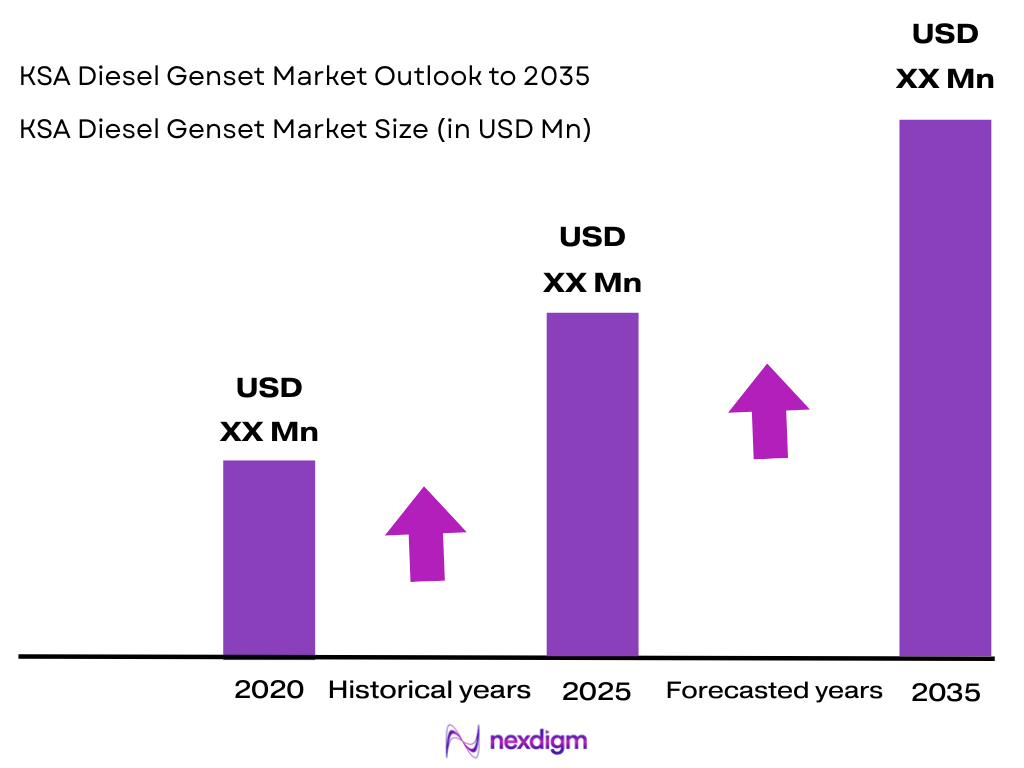
The KSA Diesel Genset Market is valued at approximately USD ~ million, compared with USD ~ million in the preceding annual benchmark. Saudi new motor-vehicle sales increased from 758,791 units to 805,034 units across the two latest annual benchmarks, while Lucid’s local assembly operation added 5,000 vehicles of annual initial capacity. These developments expand workshops, manufacturing utilities, warehouses, logistics compounds and production facilities requiring resilient standby electricity. King Abdullah Economic City, Jeddah and Riyadh dominate KSA Diesel Genset Market opportunities, supported by emerging manufacturing and established distribution infrastructure. Across the two latest annual benchmarks, Lucid inaugurated AMP-2 with 5,000 units of initial annual capacity, while Ceer awarded a SAR 5 billion construction contract for its KAEC complex covering approximately 530,000 square metres. These industrial investments concentrate manufacturing, supplier, logistics and utility requirements capable of supporting larger diesel standby installations.
Market Segmentation
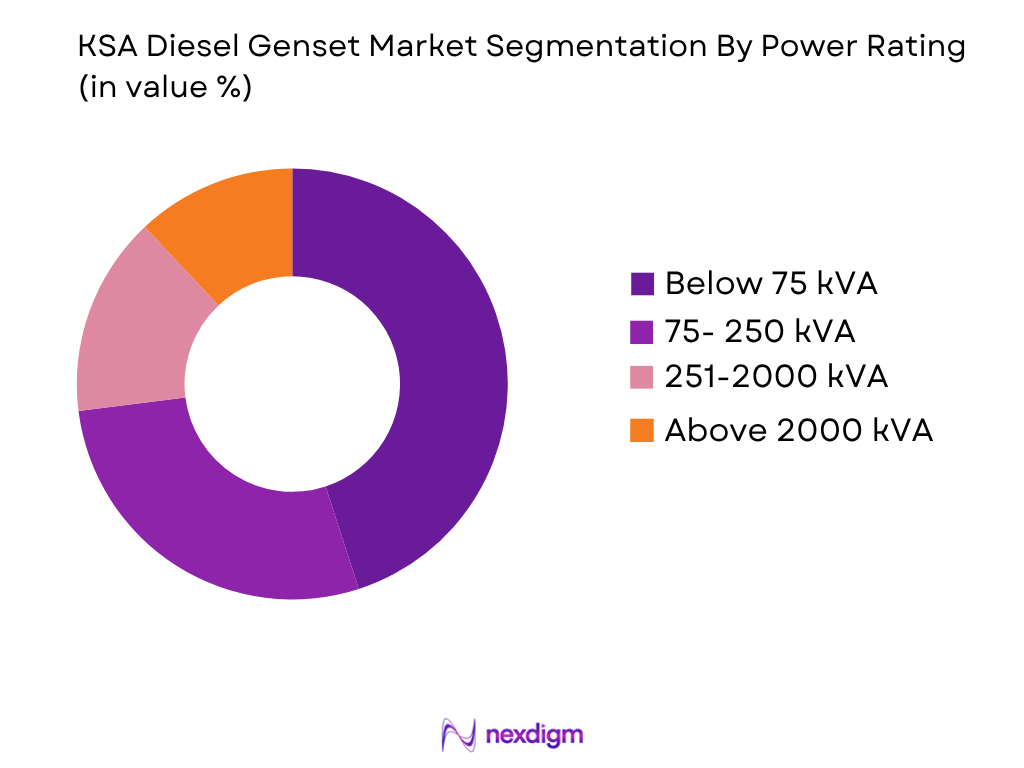
By Power Rating
The KSA Diesel Genset Market is segmented into below 75 kVA, 75–250 kVA, 251–500 kVA, 501–1,000 kVA, 1,001–2,000 kVA and above 2,000 kVA. The 501–1,000 kVA segment holds the dominant analytical market share, reflecting the balance between Saudi Arabia’s existing distribution/service infrastructure and the emergence of larger industrial manufacturing loads. This range can support individual factory utility blocks, large workshops, warehouses, compressors, HVAC systems and production buildings while also permitting modular parallel deployment. Higher-capacity systems are becoming increasingly important as Ceer and Lucid establish integrated manufacturing facilities containing paint, body, assembly and utility operations. Cummins’ global diesel portfolio extends from 15 to 3,750 kVA, demonstrating the availability of equipment suitable for both smaller service applications and multi-megawatt industrial standby configurations.
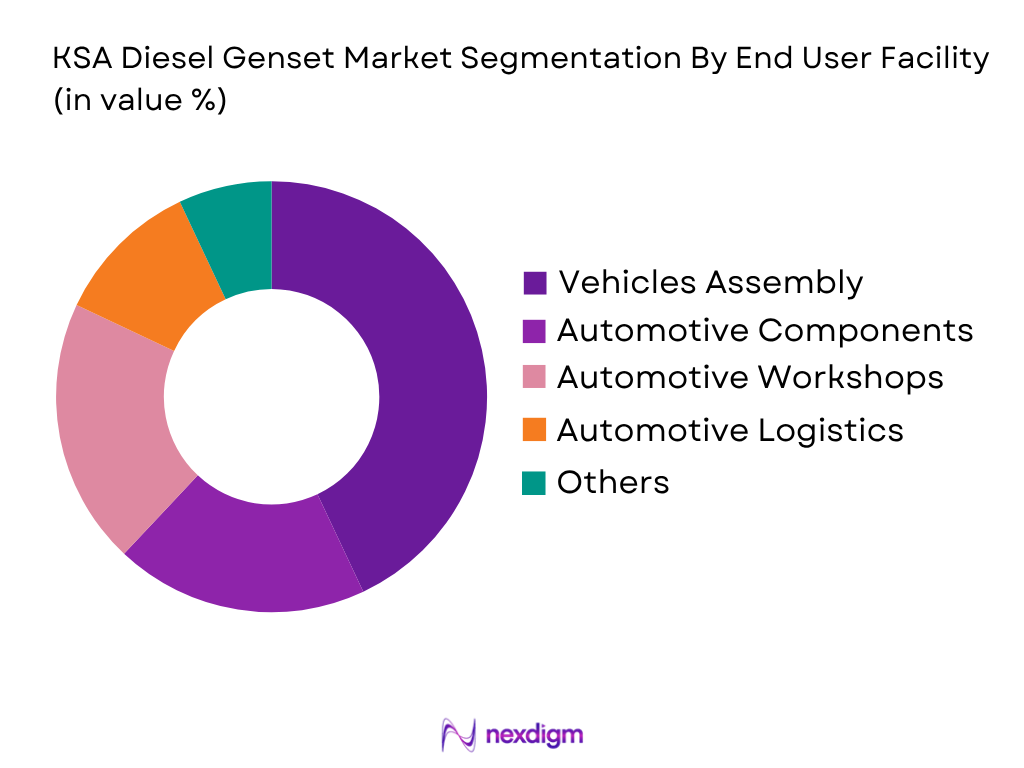
By Facility Type
The KSA Diesel Genset Market is segmented into vehicle assembly and EV plants, component facilities, dealerships and workshops, logistics/PDI facilities, and fleet-maintenance depots. Vehicle assembly and EV manufacturing facilities hold the dominant analytical market share, because Saudi Arabia’s localization strategy is introducing large industrial sites with substantially higher critical loads than conventional dealerships. Ceer’s manufacturing complex covers approximately 530,000 square metres and includes press, body, paint and general assembly areas, together with warehouses, water treatment and testing infrastructure. Lucid’s KAEC operation adds another anchor manufacturing facility. Such sites can require multiple high-kVA generators supporting centralized factory utilities and safety systems. Component suppliers should become increasingly important as Saudi localization deepens, while workshops, dealerships and fleet depots maintain broad distributed demand for smaller standby gensets.
Competitive Landscape
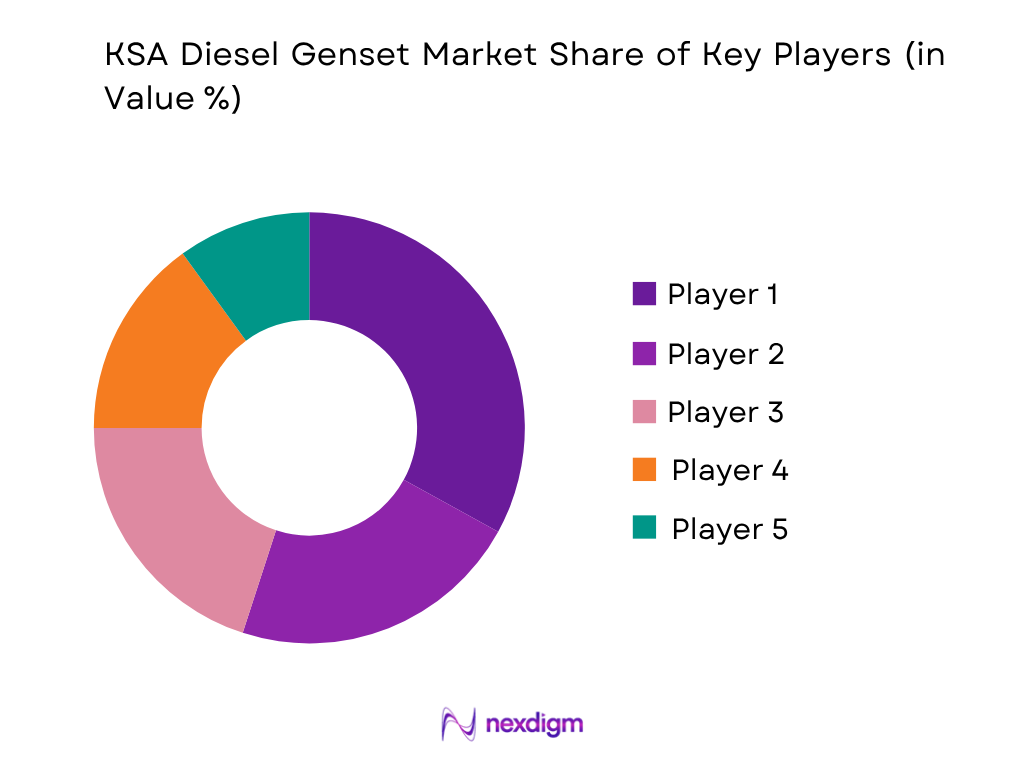
The KSA Diesel Genset Market combines global integrated generator manufacturers with established Saudi distributors, service organizations and rental providers. Competition depends on considerably more than rated engine output. customers evaluate high-ambient performance, synchronization, automatic-transfer capability, spare-parts availability, rapid field response and the ability to support equipment across Riyadh, Jeddah, KAEC and the Eastern Province. Cummins Arabia is headquartered in Al Khobar, while Caterpillar’s Saudi ecosystem is supported by Zahid Tractor.
| Major Player | Established | Headquarters | Diesel Genset Position | KSA Route-to-Market | High-Ambient Capability | Controls & Paralleling | Application Fit | Service Capability |
| Cummins Inc. / Cummins Arabia | 1919 | Columbus, USA / Al Khobar regional HQ | ~ | ~ | ~ | ~ | ~ | ~ |
| Caterpillar Inc. / Zahid Tractor | 1925 | Irving, USA | ~ | ~ | ~ | ~ | ~ | ~ |
| Atlas Copco | 1873 | Stockholm, Sweden | ~ | ~ | ~ | ~ | ~ | ~ |
| FG Wilson | 1966 | Northern Ireland, UK | ~ | ~ | ~ | ~ | ~ | ~ |
| Rolls-Royce Power Systems – mtu | 1909 heritage | Friedrichshafen, Germany | ~ | ~ | ~ | ~ | ~ | ~ |
KSA Diesel Genset Market Analysis
Growth Drivers
Manufacturing Localization and Expansion of Industrial Production
Saudi Arabia’s transition from a predominantly vehicle-import market toward localized manufacturing is creating a stronger industrial demand base for diesel gensets. Ceer’s manufacturing complex in King Abdullah Economic City spans more than 1,000,000 square metres, with approximately 530,000 square metres under roof, incorporating press, body, paint and general assembly operations. These production areas require continuous operation of ventilation, compressed air, factory automation, water-treatment equipment, fire systems, IT infrastructure and material-handling equipment, making standby generation relevant even where grid supply is normally stable. Lucid is simultaneously expanding its AMP-2 facility in KAEC from initial assembly toward full vehicle production, with the company confirming in April 2026 that recruitment is underway across manufacturing, engineering, quality, operations and supply-chain functions. Saudi Arabia’s broader industrial environment supports this transition. The General Authority for Statistics reported that the manufacturing activity index increased by 12.4 points for every 100 points of comparable activity in October 2024, while non-oil industrial activity also strengthened during several months of the year. In April 2025, the manufacturing sub-index increased by 7.4 points per 100, indicating continued industrial expansion. Macroeconomic fundamentals reinforce the investment environment: World Bank data place Saudi Arabia’s nominal GDP at approximately USD 1.24 trillion in 2024, with GDP per capita of USD 35,121.7, while the IMF recorded 2.0 units of real GDP growth for every 100 units of output and 4.5 units of non-oil GDP expansion for every 100 units. The IMF also recorded Saudi Arabia’s population at 35.3 million people in 2024, creating a large domestic mobility and industrial-consumption base. For diesel gensets, the key implication is that each new assembly line, supplier plant, paint shop, battery operation and logistics building creates additional critical electrical loads. Greenfield projects also require temporary generators during construction and commissioning, while operational plants require standby sets, automatic transfer switches, synchronized systems and lifecycle maintenance.
Vision 2030 Non-Oil Investment and Development of an Supplier Ecosystem
Saudi Arabia’s diversification strategy is creating a wider addressable market for diesel gensets because vehicle assembly is increasingly being accompanied by component production, logistics, warehousing and specialist industrial services. The official Vision 2030 transformation review identifies Lucid’s Saudi manufacturing operation and Ceer as major components of the emerging domestic ecosystem, while Ceer’s KAEC complex incorporates dedicated manufacturing, warehousing, testing and utility infrastructure. Lucid’s AMP-2 remains another anchor facility, and in 2026 the company confirmed that the plant was moving from initial assembly toward complete production while adding roles in manufacturing, engineering, quality, supply chain and operations. This transition is relevant to gensets because localization does not generate demand only inside final vehicle plants. Stamping suppliers, plastics manufacturers, electrical-component factories, electronics operations, logistics facilities, machine shops and Tier suppliers all require standby electrical architecture. Saudi Arabia’s non-oil economy provides a favorable macroeconomic base for these investments. The IMF reported that non-oil real GDP expanded by 4.5 units for every 100 units of economic activity in 2024, while private-sector credit increased by 13.4 units for every 100 units, indicating substantial financing activity supporting businesses and capital expenditure. Saudi Central Bank net foreign assets stood at approximately USD 415 billion, providing a strong external buffer during the ongoing investment cycle. World Bank data show nominal GDP of approximately USD 1.24 trillion and GDP per capita of USD 35,121.7 in 2024, while unemployment stood at 3.5 people per 100 members of the labor force, supporting continued industrial labor-market participation. Industrial indicators provide additional confirmation: GASTAT reported manufacturing activity increasing by 4.6 units per 100 in July 2024 and 12.4 units per 100 in October 2024, while manufacturing expanded by 7.4 units per 100 in April 2025. These data indicate that the localization push is taking place inside a broader industrial expansion rather than in isolation. For diesel genset suppliers, this generates a multi-layered opportunity covering factory standby systems, mobile commissioning generators, rental power, synchronization panels, automatic mains-failure equipment, high-ambient cooling packages and maintenance contracts. The supply chain is therefore likely to become progressively more important than dealership-only demand as domestic production deepens.
Market Challenges
High Grid Reliability and Limited Generator Operating Hours at Modern Facilities
One structural challenge for the KSA Diesel Genset Market is that newly developed plants are being located inside planned industrial zones designed around modern utility infrastructure. In such facilities, diesel gensets are generally resilience assets rather than primary sources of electricity, limiting annual running hours and placing pressure on vendors to justify equipment through reliability, redundancy and risk avoidance. This challenge becomes more pronounced as Saudi Arabia expands electricity, gas and industrial infrastructure alongside Vision 2030 projects. GASTAT reported that electricity, gas, steam and air-conditioning supply activity increased by 8.2 units for every 100 units of comparable activity in July 2024 and by 6.2 units per 100 in October 2024, indicating continued expansion in the infrastructure that supports industrial facilities. Manufacturing itself increased by 12.4 units per 100 in October 2024, meaning new industrial demand is developing alongside stronger utility capacity. The macroeconomic environment also encourages operators to invest in sophisticated resilience alternatives. World Bank data place Saudi Arabia’s GDP at approximately USD 1.24 trillion in 2024, while the IMF reported private-sector credit growth of 13.4 units per 100, suggesting strong access to financing for advanced electrical systems such as UPS equipment, battery energy storage, redundant feeders and smart power-management systems. The challenge for diesel genset suppliers is therefore not insufficient industrial activity but increased competition for the resilience budget within modern plants. A Ceer-type facility covering more than 1,000,000 square metres, including approximately 530,000 square metres under roof, requires substantial emergency-power architecture, but plant engineers may allocate short-duration interruption protection to UPS and battery systems while reserving diesel gensets for prolonged outages. This changes procurement priorities. customers increasingly evaluate black-start capability, automatic transfer speed, load acceptance, N+1 configuration, remote monitoring and integration with battery systems rather than simply selecting a generator based on rated kVA. Low annual operating hours also create technical concerns such as wet stacking, insufficient engine loading, fuel deterioration and extended standby maintenance intervals. Suppliers therefore need sophisticated service packages, load-bank testing and integrated controls to demonstrate value in facilities where the diesel generator may operate infrequently but must perform immediately when required.
High-Ambient Engineering Requirements and Shortage of Specialized Technical Capabilities
Saudi Arabia’s operating environment creates significant technical challenges for diesel gensets serving plants. High ambient temperatures, airborne dust and prolonged outdoor exposure can reduce engine, alternator and cooling-system performance unless generators are specifically engineered for local conditions. This matters increasingly as manufacturing becomes more automated and interruption-sensitive. Ceer’s manufacturing facility contains press, body, paint and assembly shops within approximately 530,000 square metres of covered manufacturing space, meaning an emergency generator failure can affect large interconnected utility loads rather than a single workshop. Lucid’s 2026 AMP-2 expansion also includes hiring across engineering, manufacturing, quality, supply-chain and operations functions, highlighting the technical workforce requirements associated with operating an advanced manufacturing ecosystem. The generator service ecosystem must expand alongside this manufacturing workforce. High-temperature applications may require oversized radiators, carefully engineered generator-room ventilation, derating calculations, heavy-duty filters, upgraded starting batteries, coolant monitoring and more frequent inspection of air-intake systems. Industrial expansion places additional pressure on qualified technicians: GASTAT reported manufacturing activity rising by 12.4 units per 100 in October 2024, followed by a 7.4-unit increase per 100 in April 2025, while the IMF recorded non-oil GDP expansion of 4.5 units for every 100 units of activity in 2024. This means generator service companies are competing for engineers and technicians with a growing pool of manufacturing, construction and infrastructure employers. The overall unemployment rate was only 3.5 people for every 100 members of the labor force in 2024, according to World Bank and IMF data, which can further tighten availability of technically trained personnel. At the same time, Saudi Arabia’s population stood at 35.3 million, supporting a large labor base but not automatically supplying specialists experienced in synchronizing panels, PLC-based generator controls, engine electronic diagnostics, ATS systems and high-kVA alternators. Generator OEMs and distributors therefore face a market-development challenge extending beyond equipment supply: they need localized technical training, mobile field-service teams, spare-parts stocking, engine-overhaul capability and response coverage around KAEC, Jeddah, Riyadh and the Eastern Province. For customers, insufficient specialist availability can increase downtime risk and discourage switching to unfamiliar generator brands even when the equipment itself meets required specifications.
Market Opportunities
Digital Monitoring, Hybrid Power Architecture and Advanced Generator Controls
Technological modernization provides a substantial opportunity for the KSA Diesel Genset Market because newly developed plants can adopt digitally integrated critical-power systems from the beginning rather than retrofit decades-old infrastructure. Ceer’s manufacturing complex of more than 1,000,000 square metres, including approximately 530,000 square metres under roof, will incorporate press, body, paint and final-assembly processes along with warehouses, utilities and testing infrastructure. This type of facility creates a technically suitable environment for multiple synchronized diesel gensets connected through digital controllers, automatic transfer systems and centralized monitoring. Lucid’s 2026 expansion of AMP-2 from initial assembly toward complete production similarly increases the number of critical manufacturing loads requiring structured power-continuity management. The opportunity is not limited to selling larger generator engines. Remote telemetry can monitor coolant temperature, battery voltage, fuel level, engine hours, fault codes and transfer-switch condition, allowing maintenance teams to identify developing problems before an emergency start is required. Hybrid genset–battery architectures can further improve operating behavior by allowing battery systems to serve instantaneous or low-load events while diesel generators provide sustained emergency energy. Saudi Arabia’s wider digital and economic environment is well suited to such systems: World Bank data indicate that 100 people out of every 100 people represented in its internet-use indicator were internet users in 2024, while nominal GDP reached approximately USD 1.24 trillion. The IMF reported private-sector credit growth of 13.4 units per 100 in 2024, supporting investment in industrial equipment and automation, while non-oil GDP expanded by 4.5 units per 100. Industrial data also show manufacturing activity increasing by 12.4 units per 100 in October 2024 and 7.4 units per 100 in April 2025, demonstrating an active industrial base capable of adopting advanced power systems. For genset suppliers, future growth can therefore be captured through complete resilience packages incorporating generators, ATS equipment, synchronization panels, remote monitoring, SCADA integration, battery storage compatibility and predictive maintenance. This shifts supplier positioning from hardware sales toward long-term critical-power system partnerships with OEMs and Tier suppliers.
Supplier Localization, Greenfield Facilities and Lifecycle Service Expansion
The continuing localization of Saudi Arabia’s value chain creates a future growth opportunity extending well beyond the initial Ceer and Lucid vehicle plants. Ceer’s manufacturing complex incorporates approximately 530,000 square metres of covered production space, while Lucid confirmed in 2026 that AMP-2 is transitioning from initial assembly toward full production and recruiting across manufacturing, supply chain, engineering and quality functions. These anchor manufacturers create the conditions for Tier suppliers, logistics companies, component warehouses, testing facilities and maintenance operations to establish nearby capacity. Each supplier facility requires an independent assessment of emergency electrical loads, creating a diversified pipeline for smaller and medium-sized gensets even where assembly plants use multi-megawatt systems. Current industrial indicators support the opportunity without relying on speculative future statistics. Manufacturing activity increased by 12.4 units per 100 in October 2024, while non-oil industrial activity recorded expansion during the same industrialization cycle. Manufacturing activity subsequently increased by 7.4 units per 100 in April 2025, providing evidence of ongoing industrial momentum. The IMF reported Saudi non-oil real GDP growth of 4.5 units per 100 in 2024, alongside private-sector credit expansion of 13.4 units per 100, while World Bank data put national GDP at approximately USD 1.24 trillion and GDP per capita at USD 35,121.7. These conditions provide a substantial economic base for localization projects and associated utility investment. For diesel genset suppliers, the opportunity includes greenfield equipment sales during facility construction, temporary rental sets for commissioning, permanent standby generators, synchronization panels and automatic-transfer equipment. As the installed base expands, additional revenue opportunities arise from preventive maintenance, load-bank testing, coolant and radiator servicing, fuel-system maintenance, starting-battery replacement, engine overhaul, remote monitoring and controller retrofits. Localization can also support Saudi-based generator packaging and service activity: local fabrication of enclosures, fuel tanks and control panels can reduce dependency on imported complete systems while improving project responsiveness. The most attractive growth strategy is therefore to follow localization from OEM assembly plants into the wider supplier ecosystem, securing early specification positions with EPC contractors and industrial developers and converting those equipment placements into recurring service agreements.
Future Outlook
The KSA Diesel Genset Market is forecast to expand at approximately ~ CAGR during 2026–2035 as Saudi Arabia develops a domestic vehicle manufacturing and component-supply ecosystem. Growth should increasingly shift from small distributed workshop demand toward industrial standby systems for OEMs, suppliers and logistics facilities. Ceer and Lucid provide anchor demand around which component manufacturers, warehouses, testing facilities and supporting infrastructure can cluster. The Saudi Ministry of Industry identifies the King Salman Complex in KAEC as part of the Kingdom’s expanding traditional and electric-vehicle manufacturing ecosystem. Diesel gensets are likely to retain a central position in long-duration industrial backup because high-capacity processes require substantial emergency energy. However, battery energy storage will increasingly complement generators for short interruptions, low-load operation and peak support. Atlas Copco already markets modular hybrid systems combining diesel generation with BESS, illustrating the direction of industrial power architecture. High-ambient engineering will remain a differentiator. Saudi projects require radiator, filtration, battery-starting and ventilation systems engineered for severe heat and dust. Generator suppliers with local engineering, spare-parts inventory and field technicians should therefore have an advantage over equipment-only importers. Replacement and aftermarket revenue will expand alongside the installed base. Preventive maintenance, load-bank testing, fuel-system servicing, controller upgrades, ATS retrofits, synchronization panels and remote monitoring can generate recurring opportunities after initial generator installation.
Major Players
- Cummins Inc. / Cummins Arabia
- Caterpillar Inc. / Zahid Tractor
- Saudi Diesel Equipment Company
- Jubaili Bros KSA
- Atlas Copco Saudi Arabia
- FG Wilson
- Rolls-Royce Power Systems – mtu
- Rehlko
- HIMOINSA
- Mitsubishi Heavy Industries Engine & Turbocharger
- Yanmar Holdings Co., Ltd.
- Denyo Co., Ltd.
- Doosan Bobcat
- Baudouin
- Perkins-Powered Generator Assemblers
Key Target Audience
- OEM Manufacturers
- EV and Battery Manufacturing Companies
- Tier-1, Tier-2 and Tier-3 Suppliers
- Logistics, PDI and Vehicle Distribution Operators
- Diesel Genset Manufacturers, Distributors and Rental Power Providers
- EPC, MEP and Industrial Power-System Companies
- Investments and Venture Capitalist Firms
- Government and Regulatory Bodies (Ministry of Industry and Mineral Resources, Saudi Standards, Metrology and Quality Organization, Saudi Authority for Industrial Cities and Technology Zones, National Industrial Development Center, Public Investment Fund)
Research Methodology
Step 1: Identification of Key Variables
The initial phase develops an ecosystem map of the KSA Diesel Genset Market covering generator OEMs, distributors, manufacturers, component suppliers, rental companies and industrial developers. Key variables include genset kVA, installed base, facility type, operating mode, replacement age, localization status, high-ambient configuration and service requirements. Secondary research incorporates manufacturing projects, vehicle-market activity, generator product portfolios, industrial development and supply-chain information. The purpose is to establish the variables required for both top-down and bottom-up market construction.
Step 2: Market Analysis and Construction
The top-down approach assesses Saudi industrial diesel-generation demand before isolating manufacturing, logistics, service and fleet applications. The bottom-up approach maps vehicle plants, component facilities, logistics centers, dealerships and workshops and assigns appropriate generator configurations to each facility category. Unit demand, installed kVA, replacement requirements and new facility additions are reconciled to avoid double counting. investment pipelines are separately assessed to distinguish existing installed demand from greenfield opportunities.
Step 3: Hypothesis Validation and Expert Consultation
Market hypotheses are validated through computer-assisted telephone interviews with generator distributors, utility managers, EPC contractors, facility engineers, service providers and rental-power companies. Discussions examine generator sizing, redundancy, operating mode, preferred brands, replacement cycles, ambient derating and maintenance requirements. Supplier-side responses are cross-checked against customer and contractor perspectives. This process validates assumptions concerning market structure, procurement channels, distributor positioning and the importance of field-service capability.
Step 4: Research Synthesis and Final Output
Primary research is triangulated with -project information, vehicle-demand indicators and generator supply data to construct the final market model. Demand is segmented by power rating, facility type, operating mode, procurement channel and geographic cluster. Forecasting incorporates OEM manufacturing ramp-up, supplier localization, replacement cycles, rental demand and BESS integration. Scenario analysis tests the sensitivity of generator demand to project delays, accelerated localization and technology substitution.

- Executive Summary
- Research Methodology (Market Definitions and Assumptions, Diesel Genset Market Boundary, Abbreviations, Top-Down Market Sizing, Bottom-Up Facility Mapping, OEM Plant Mapping, Tier Supplier Mapping, Generator Shipment Assessment, Import and Local Assembly Assessment, Installed-Base Estimation, Replacement-Cycle Analysis, Demand-Side Assessment, Supply-Side Assessment, Primary Industry Interviews, Distributor Interviews, Facility Interviews, Rental Fleet Assessment, Pricing Benchmarking, Data Triangulation, Forecasting Framework, Scenario Analysis, Limitations and Future Conclusions)

- Definition and Scope
- Market Evolution and Industry Genesis
- Evolution of Manufacturing in Saudi Arabia
- Saudi Industrialization Roadmap
- OEM Manufacturing Ecosystem

- Growth Drivers (Manufacturing Localization, EV Factory Development, Tier Supplier Localization, Industrial Capacity Expansion, Automation, Production Continuity, Logistics Development)
- Market Challenges (Grid Reliability, Diesel Emissions, High-Ambient Conditions, Dust Exposure, Fuel Storage, Capital Intensity, BESS Competition, Skilled Workforce)
- Market Opportunities (Greenfield Plants, Supplier Localization, Replacement Demand, High-Ambient Systems, Hybrid Power, Remote Monitoring, AMC, Rental Power)
- Market Trends (Digital Controllers, High-Ambient Cooling, Remote Monitoring, Modular Paralleling, HVO Compatibility, Hybridization, Predictive Maintenance)
- SWOT Analysis
- Porter’s Five Forces Analysis
- PESTLE Analysis

- By Market Value (2020-2025)
- By Unit Shipments (2020-2025)
- By Installed Diesel Genset Base (2020-2025)

- By Power Rating (In Value %)
Below 75 kVA
75–250 kVA
251–500 kVA
501–1,000 kVA
1,001–2,000 kVA - By Facility Type (In Value %)
Passenger Vehicle Assembly Plants
Electric Vehicle Assembly Plants
Commercial Vehicle and Bus Assembly Plants
Tier-1 Component Plants
Tier-2 and Tier-3 Component Plants - By Customer Ownership (In Value %)
Saudi OEMs
PIF-Backed Manufacturers
International Vehicle Manufacturers
Manufacturing Joint Ventures
Saudi-Owned Component Suppliers - By Region (In Value %)
Western Region
Central Region
Eastern Region
Northern Region
Southern Region

- Market Share of Major Players by Market Value
- Cross Comparison Parameters (Diesel Genset kVA Portfolio Coverage, KSA Installed References, High-Ambient Cooling and Derating Capability, Saudi Local Assembly and Content Capability, Kingdom-Wide Dealer and Field-Service Coverage, Spare Parts Availability and Engine-Overhaul Capability, ATS–Synchronization–Remote Monitoring Integration, AMC and Emergency Response Capability)
- SWOT Analysis of Major Players
- Detailed Profiles of Major Companies
Cummins Inc. / Cummins Arabia
Caterpillar Inc. / Zahid Tractor
Saudi Diesel Equipment Company
Jubaili Bros KSA
Atlas Copco Saudi Arabia
FG Wilson
Rolls-Royce Power Systems – mtu
Rehlko
HIMOINSA
Mitsubishi Heavy Industries Engine & Turbocharger
Yanmar Holdings Co., Ltd.
Denyo Co., Ltd.
Doosan Bobcat
Baudouin
Perkins-Powered Generator Assemblers

- Installed Generator Fleet Assessment
- Average Genset Capacity by Facility
- Average Genset Count per Site
- Annual Operating Hours
- Testing and Exercise Hours

- By Market Value (2026-2035)
- By Unit Shipments (2026-2035)
- By Installed Genset Base (2026-2035)


 Request a Sample
 Ask for Customization
 Get a Quote
 Enquire Now