
 Download PDF
Market Overview
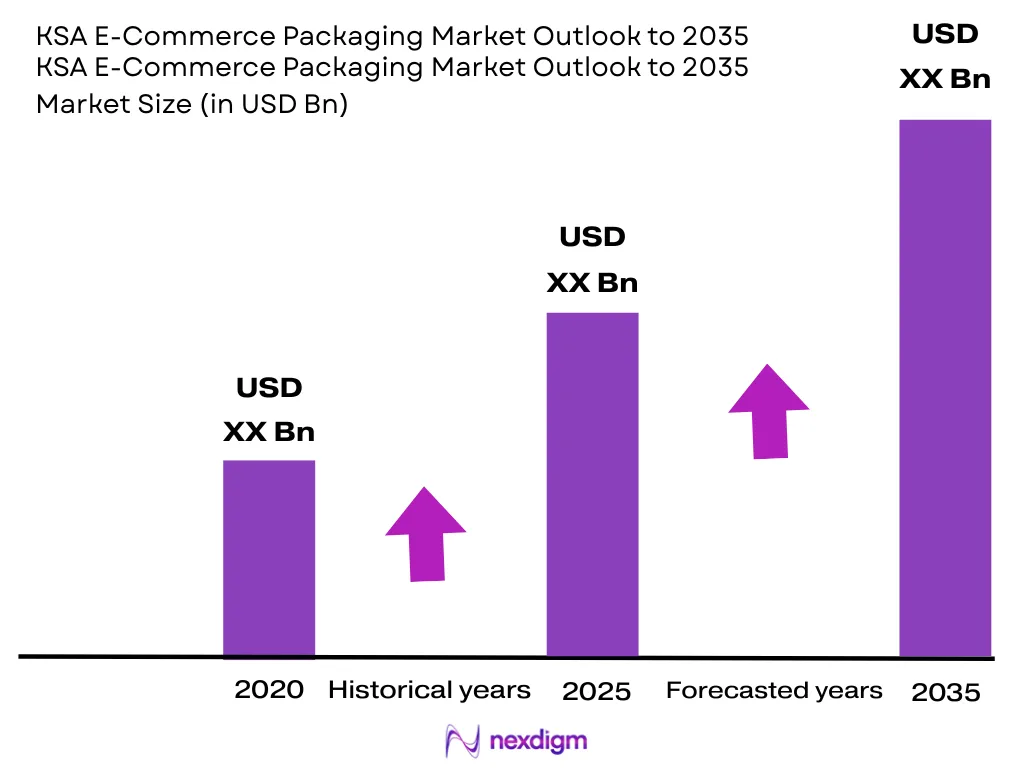
The KSA E-Commerce Packaging Market was valued at USD ~ Billion in 2024 and is anticipated to expand at a CAGR of ~ % during 2026–2035. The market is primarily driven by rapid growth of national online sales, expansion of same-day and quick-commerce delivery platforms, and rising automation in fulfillment centers. According to Packaging Market Insights, the Saudi Arabia e-commerce packaging market stood at USD ~ billion in 2024 and is anticipated to grow to USD ~ billion by 2033, with the Kingdom holding approximately 3.74 percent of the global e-commerce packaging market as of 2024. National online sales surged to USD 52.64 billion in 2024, representing a 25.82 percent year-over-year jump, according to Mordor Intelligence, directly translating into explosive corrugated board orders and sustaining consistent demand for protective and shipping packaging across electronics, groceries, fashion, and beauty e-commerce categories.
Market Segmentation
By Product Type
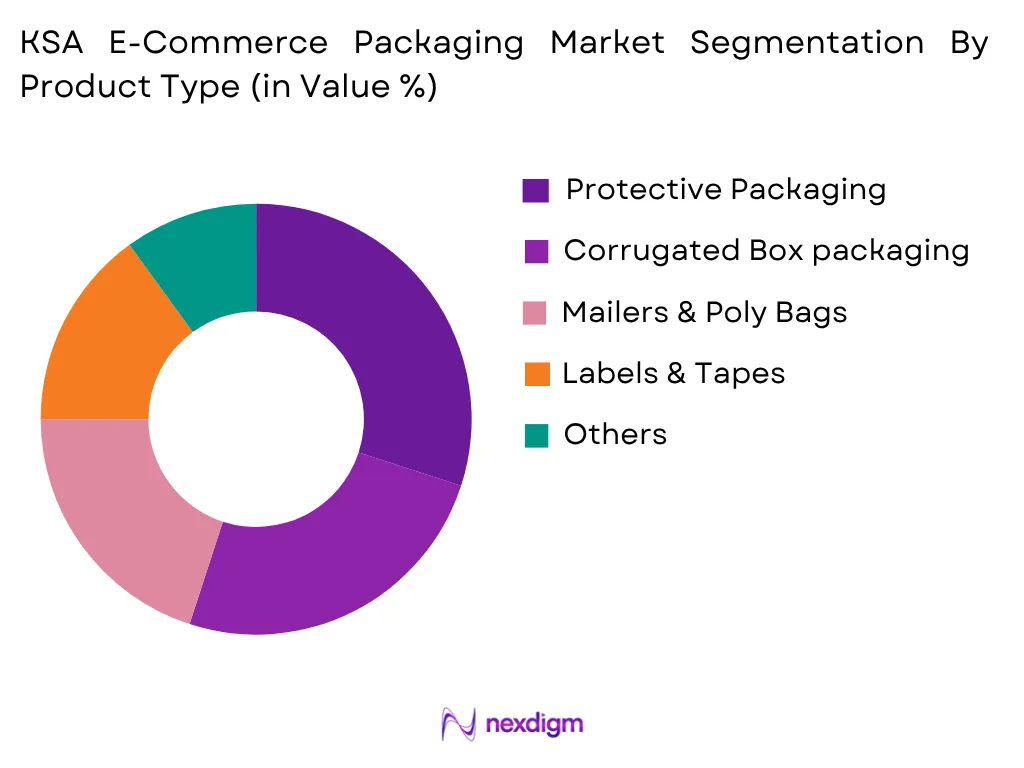
Among these, Protective Packaging accounted for the highest share of the KSA E-Commerce Packaging Market by product in 2024, according to Packaging Market Insights, reflecting retailers’ emphasis on parcel integrity across the Kingdom’s expanding multi-node delivery networks. Parcel integrity over multi-node delivery now outranks aesthetic factors, so converters design double-wall boxes with edge-crush targets above 40 ECT, according to Mordor Intelligence. At the same time, Corrugated Box packaging is set to register the highest growth rate during the forecast period, making it the most lucrative product segment going forward. The Saudi Arabia paper and paperboard packaging market, which underpins the majority of e-commerce shipping formats, reached USD 1.99 billion in 2025, according to IMARC Group, with Corrugated Boxes capturing an estimated 45.52 percent share of the broader paper and paperboard packaging market in 2024, serving as a critical backbone for the Kingdom’s booming logistics and manufacturing sectors.
By End-Use Category
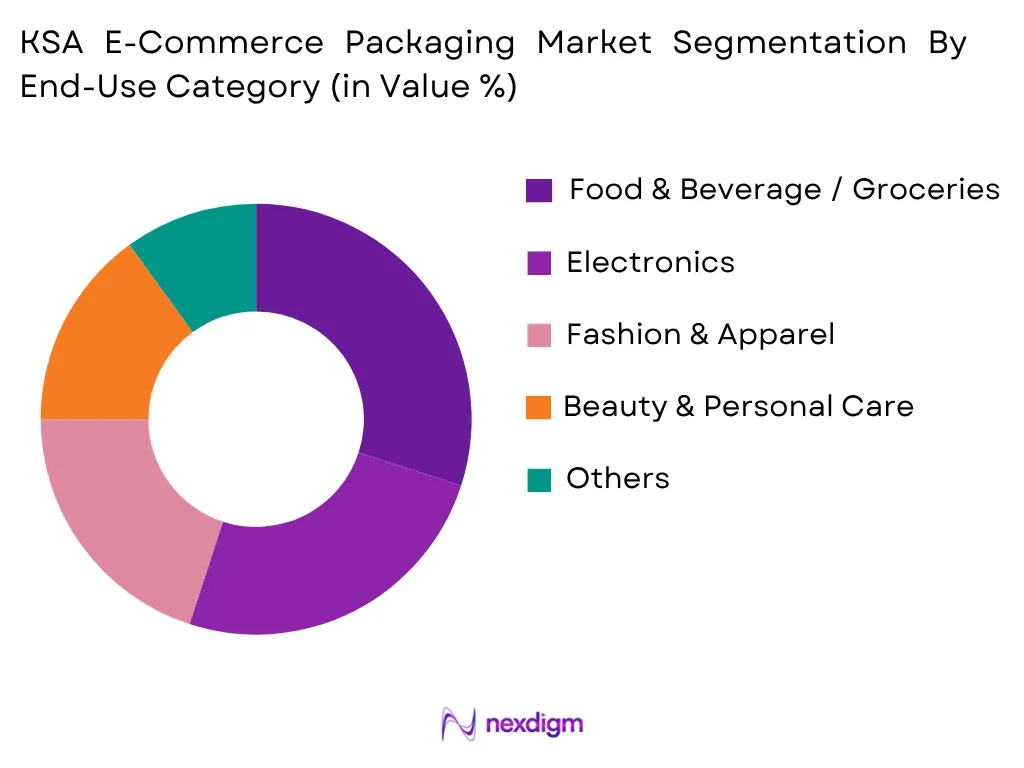
The Food & Beverage / Groceries segment holds a leading share, with food and beverage applications commanding 57.31 percent of the Saudi Arabia paper and paperboard packaging market in 2024, according to Ken Research, anchored by domestic processing capacity and the Kingdom’s growing role as a date and poultry exporter. Same-day delivery platforms such as Jahez and HungerStation continue pushing demand for lightweight yet protective paper-based mailers and corrugated inserts that maintain product integrity across multi-node delivery networks, according to a Futurism industry analysis. Meanwhile, Electronics e-commerce packaging is expanding rapidly, with demand for electronics in Saudi Arabia’s e-commerce market increasing alongside a rising middle class, increasing internet penetration, and higher disposable incomes, according to Mordor Intelligence. Retailers such as BinDawood have allocated USD 390 million to new delivery hubs, locking in long-term corrugated contracts to support grocery and general merchandise fulfillment across the Kingdom.
Competitive Landscape
The KSA E-Commerce Packaging Market is moderately consolidated, combining domestic petrochemical and packaging majors with multinational specialists expanding local capacity. SABIC, the Kingdom’s leading petrochemical producer, supplies captive and third-party converters with plastic resins used across flexible and protective e-commerce packaging formats. ALPLA reported 2024 growth driven by new recycling lines and capacity investment in Saudi Arabia, according to Mordor Intelligence, reflecting continued multinational investment in domestic circular packaging manufacturing. Domestic players such as Napco National, Hotpack Packaging Industries, and Saudi Modern Packaging Co. Ltd. compete alongside multinational corrugated and protective packaging specialists including Smurfit WestRock, International Paper, and DS Smith. Automated fulfillment centers in Riyadh require packaging compatible with robotic pick-and-place systems, prompting suppliers across the competitive landscape to rethink carton dimensions and substrate specifications to support the Kingdom’s logistics infrastructure investment, backed by approximately USD 266 billion in spending.
| Company | Established | Headquarters | Primary Product Portfolio | Natural Color Portfolio | Manufacturing Presence | Major End-Use Industries | Key Strategic Focus | Certifications & Compliance |
| SABIC | 1976 | ~ | ~ | ~ | ~ | ~ | ~ | ~ |
| Napco National | 1990 | ~ | ~ | ~ | ~ | ~ | ~ | ~ |
| ALPLA Group | 1955 | ~ | ~ | ~ | ~ | ~ | ~ | ~ |
| Hotpack Packaging Industries | 1988 | ~ | ~ | ~ | ~ | ~ | ~ | ~ |
| Saudi Modern Packaging Co. Ltd. | 1998 | ~ | ~ | ~ | ~ | ~ | ~ | ~ |
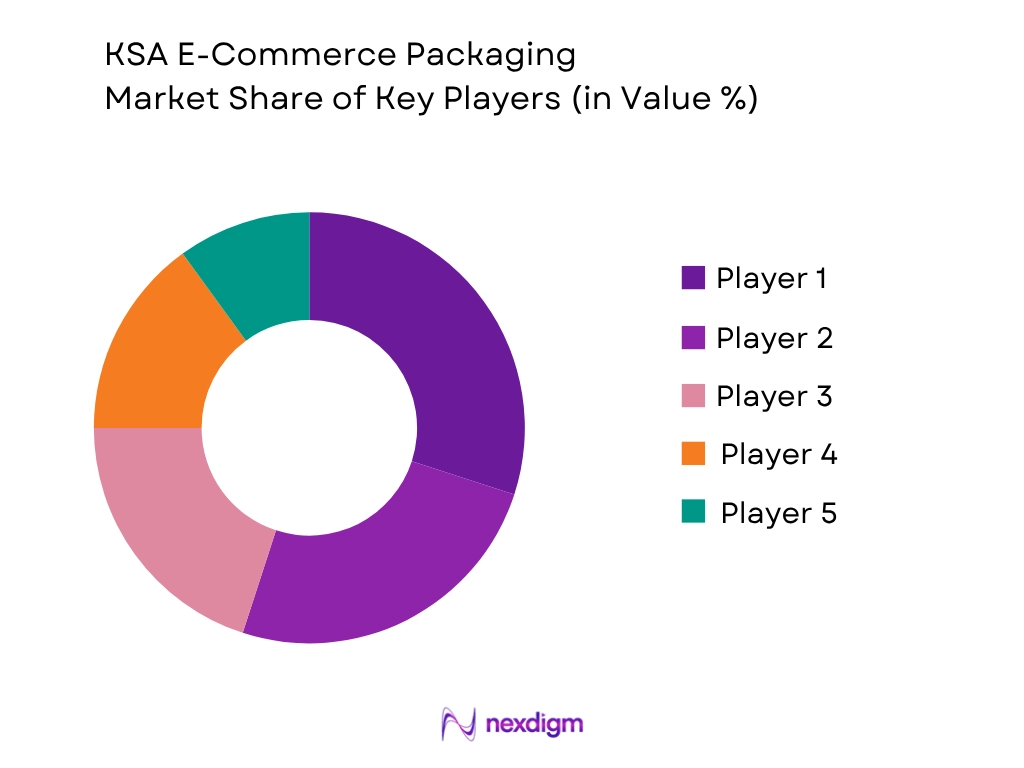
KSA E-Commerce Packaging Market Analysis
Growth Drivers
Rapid Growth of National Online Sales and Digital Payments
The KSA e-commerce packaging market is experiencing sustained growth due to rapid expansion of national online sales and digital payment penetration. The National Payment Network processed USD 52.6 billion in e-commerce sales during 2024, a 25.8 percent lift from 2023, according to Mordor Intelligence. Contactless Mada debit cards interoperate with Apple Pay and mada Pay, enabling PIN-free transactions below SAR 100 and deterring cash-on-delivery usage, while government wage digitalization funnels salaries directly into accounts, reinforcing card habits and raising the Kingdom’s e-commerce electronic-payment penetration. The Saudi Arabia e-commerce market itself is projected to grow from USD 31.29 billion in 2026 to USD 54.87 billion by 2031, at a CAGR of 11.92 percent, with major platforms including Amazon, Noon, Jarir Marketing Company, and United Electronics Company driving sustained parcel volume growth across the Kingdom.
Expansion of Quick-Commerce and Logistics Infrastructure Investment
The steady expansion of same-day and quick-commerce delivery platforms, combined with substantial logistics infrastructure investment, remains a major driver for e-commerce packaging consumption in Saudi Arabia. Same-day delivery platforms such as Jahez and HungerStation are pushing demand for lightweight yet protective paper-based mailers and corrugated inserts that maintain product integrity across multi-node delivery networks, according to a Futurism industry analysis. Logistics infrastructure, backed by USD 266 billion in spending, shortens lead times and pushes SKU proliferation, according to Mordor Intelligence, while retailers such as BinDawood allocate USD 390 million to new delivery hubs, locking in long-term corrugated contracts. Automated fulfillment centers in Riyadh increasingly require packaging compatible with robotic pick-and-place systems, prompting suppliers to rethink carton dimensions and substrate specifications across the Kingdom’s rapidly modernizing fulfillment network.
Market Challenges
Volatility in Imported Resin and Containerboard Prices
Despite steady demand growth, the KSA e-commerce packaging market remains vulnerable to fluctuations in imported resin and containerboard prices, given the Kingdom’s continued reliance on imported paper pulp and specialty packaging inputs alongside domestic petrochemical feedstocks. Parcel integrity over multi-node delivery now outranks aesthetic factors, requiring converters to design double-wall boxes with edge-crush targets above 40 ECT, according to Mordor Intelligence, adding material cost and complexity relative to standard single-wall formats. In addition, automated fulfillment centers in Riyadh requiring robotic pick-and-place compatible packaging create pressure for suppliers to invest in redesigned carton dimensions and substrate specifications, increasing development costs for packaging manufacturers serving Saudi Arabia’s rapidly modernizing logistics infrastructure.
Regulatory Compliance Complexity and Import Dependency
The Kingdom’s evolving regulatory framework for sustainable packaging presents a significant compliance challenge for e-commerce packaging manufacturers. SASO’s Technical Regulation for Oxo-Biodegradable Plastics, which became fully enforceable in 2024, requires polyethylene and polypropylene films under 250 microns to incorporate oxo-biodegradable additives and display certification logos, directly affecting mailers and flexible protective packaging formats used across e-commerce shipments. Saudi Arabia’s continued dependence on imported paper pulp and specialty resins exposes packaging manufacturers to currency and supply chain volatility, particularly given the Kingdom’s growing e-commerce parcel volumes requiring consistent, high-quality packaging materials across food, electronics, and fashion delivery categories.
Market Opportunities
Rising Investment in Domestic Corrugated and Recycling Capacity
Saudi Arabia’s booming e-commerce sector and Vision 2030 localization targets create significant opportunities for investment in domestic corrugated manufacturing and circular recycling capacity. ALPLA’s reported 2024 growth, driven by new recycling lines and capacity investment in Saudi Arabia, according to Mordor Intelligence, illustrates the commercial viability of expanding domestic circular packaging manufacturing to meet Vision 2030’s green initiatives. Industry trends toward sustainability strongly favor corrugated boxes due to their high recyclability, aligning with Vision 2030’s environmental goals, according to Verified Market Research. As logistics infrastructure investment continues at scale, backed by approximately USD 266 billion in spending, manufacturers investing early in domestic containerboard and recycling capacity are positioned to capture growing demand from the Kingdom’s expanding e-commerce and fulfillment sectors.
Expansion of Robotic-Compatible and Smart Unboxing Packaging
The Kingdom’s rapid adoption of automated fulfillment technology creates substantial long-term opportunities for e-commerce packaging manufacturers offering robotic-compatible and smart packaging solutions. Automated fulfillment centers in Riyadh require packaging compatible with robotic pick-and-place systems, prompting suppliers to rethink carton dimensions and substrate specifications, according to a Futurism industry analysis. E-commerce platforms additionally request inside-print branding for customer unboxing, increasing average unit value, according to Mordor Intelligence. As the Saudi Arabia e-commerce market continues expanding toward USD 54.87 billion by 2031, packaging manufacturers investing in dimensionally consistent, automation-compatible formats with premium branding capabilities are well positioned to capture growing demand from major platforms and retailers scaling their fulfillment operations across the Kingdom.
Future Outlook
The KSA E-Commerce Packaging Market is expected to witness sustained expansion over the forecast period, supported by continued growth in national online sales, expanding quick-commerce and logistics infrastructure investment, and increasing adoption of robotic fulfillment-compatible packaging formats. Continued investment in domestic corrugated manufacturing, circular plastic recycling capacity, and smart unboxing-focused packaging will further accelerate innovation across the industry. The market is also likely to benefit from Saudi Arabia’s Vision 2030 logistics and localization targets, enabling greater investment in advanced, sustainable, and damage-reducing packaging technologies capable of serving both the domestic market and the wider GCC e-commerce fulfillment region.
Major Players
- SABIC
- Napco National
- ALPLA Group
- Hotpack Packaging Industries
- Saudi Modern Packaging Co. Ltd.
- Tetra Pak Saudi Arabia
- Amcor plc
- Mondi plc
- Smurfit WestRock
- International Paper Company
- DS Smith plc
- Berry Global Group, Inc.
- Sealed Air Corporation
- Packaging Products Company
- LAMINA
Key Target Audience
- E-Commerce Packaging Manufacturers
- Online Retailers and Marketplace Operators
- Quick-Commerce and Same-Day Delivery Platforms
- Third-Party Logistics and Fulfillment Providers
- Last-Mile Delivery and Courier Companies
- Investment and Venture Capitalist Firms
- Government and Regulatory Bodies (Saudi Standards, Metrology and Quality Organization (SASO), Ministry of Investment, National Center for Waste Management (MWAN))
- Packaging Material Suppliers and Industrial Raw Material Distributors
Research Methodology
Step 1: Identification of Key Variables
The research process begins with identifying the complete ecosystem of the KSA E-Commerce Packaging Market, including raw material and resin suppliers, packaging converters and manufacturers, online retailers and marketplaces, third-party logistics providers, last-mile delivery companies, and regulatory authorities. Extensive secondary research is conducted using company annual reports, government publications, trade associations, customs statistics, industry journals, and proprietary databases to determine the variables influencing market demand, pricing, production, consumption, and technological developments.
Step 2: Market Analysis and Construction
Historical market information is collected and analyzed to estimate market size, production volumes, import-export activity, application-wise demand, and pricing trends. A combination of top-down and bottom-up approaches is used to estimate market revenues and validate segment-level performance. Consumption patterns across food and beverage, electronics, fashion, and beauty e-commerce categories are evaluated to establish an accurate representation of the industry.
Step 3: Hypothesis Validation and Expert Consultation
The preliminary findings are validated through Computer-Assisted Telephone Interviews (CATIs) and structured discussions with e-commerce packaging manufacturers, procurement managers, fulfillment operations executives, logistics experts, and senior executives operating within the KSA e-commerce packaging industry. These interviews help verify market assumptions, competitive developments, technology adoption trends, pricing dynamics, and future investment opportunities while refining the overall market estimates.
Step 4: Research Synthesis and Final Output
The final stage integrates insights obtained from primary interviews with quantitative information collected through secondary sources. Data triangulation techniques are applied to reconcile differences between supply-side and demand-side estimates, ensuring robust market forecasting. The report is then reviewed through multiple quality assurance checkpoints to deliver a comprehensive analysis covering market size, segmentation, competitive landscape, future outlook, and strategic recommendations for industry stakeholders.

- Executive Summary
- Research Methodology (Market Definitions and Assumptions, Abbreviations, Market Sizing Approach, Top-Down Analysis, Bottom-Up Analysis, Demand-Side Assessment, Supply-Side Assessment, Primary Industry Interviews, Secondary Research Validation, Data Triangulation, Forecasting Framework, Limitations and Future Conclusions)

- Definition and Scope
- Market Evolution and Industry Genesis
- Timeline of Major Industry Developments
- E-Commerce Packaging Industry Value Chain Analysis
- Supply Chain Analysis

- Growth Drivers (Rapid Growth of National Online Sales and Digital Payment Penetration, Expansion of Same-Day and Quick-Commerce Delivery Platforms, Rising Automation in Fulfillment Centers, Growing Logistics Infrastructure Investment Under Vision 2030, Increasing Internet and Smartphone Penetration, Growth of Electronics and Grocery E-Commerce Categories)
- Market Challenges (Volatility in Imported Resin and Containerboard Prices, Parcel Integrity Requirements for Multi-Node Delivery Networks, Regulatory Compliance Complexity Under SASO Standards, Dependence on Imported Packaging Raw Materials, Limited Domestic Molded Fiber Manufacturing Capacity, Rising Cost of Robotic-Compatible Packaging Redesign)
- Market Opportunities (Investment in Domestic Corrugated and Recycling Capacity, Growth in Robotic Fulfillment-Compatible Packaging Formats, Expansion of Cold-Chain and Grocery Delivery Packaging, Smart Packaging with Inside-Print Branding for Unboxing, Sustainable and Circular Plastic Packaging Adoption, Export-Oriented Packaging Manufacturing for GCC Markets)
- Market Trends (Rising Adoption of Double-Wall Corrugated Boxes for Parcel Integrity, Growth in Inside-Print Branding for Unboxing Experience, Automation-Compatible Carton Dimensioning, Same-Day Delivery-Driven Lightweight Mailer Adoption, Circular Plastic Recycling Capacity Expansion, Industry Consolidation Through Investment)
- Government Regulations (Saudi Standards, Metrology and Quality Organization (SASO) Technical Regulations, Vision 2030 Logistics and Localization Targets, Oxo-Biodegradable Plastics Regulation, Saudi Food and Drug Authority (SFDA) Requirements for Food and Pharma E-Commerce, National Center for Waste Management (MWAN) Plastic Reduction Targets, Import Compliance and Customs Regulations)
- Import and Export Analysis (Trade Volume, Major Import Sources, Export Destinations, HS Code Analysis, Trade Balance)
- Raw Material Availability Analysis (Containerboard and Linerboard, Plastic Resins and Petrochemical Feedstocks, Molded Fiber Feedstock, Recycled Paper Fiber)
- Technology Landscape (Robotic Pick-and-Place Compatible Packaging, Double-Wall Corrugated Manufacturing, Automated Sortation Systems, Circular Plastic Recycling Technology, Smart and Inside-Print Branding Packaging)
- Sustainability Assessment (Recyclability and Post-Consumer Recycled Content, Circular Plastic Recycling Capacity, Carbon Footprint Reduction, Vision 2030 Green Initiative Alignment, Circular Economy Integration)
- PESTLE Analysis
- SWOT Analysis
- Porter’s Five Forces Analysis
- Stakeholder Ecosystem
- Competition Ecosystem

- By Market Value (2020-2025)
- By Volume Consumption (2020-2025)
- By Average Selling Price (2020-2025)

- By Product Type (In Value %)
Protective Packaging
Corrugated Boxes
Mailers & Poly Bags
Labels & Tapes - By Material (In Value %)
Corrugated Board & Paper
Plastics
Molded Fiber - By Packaging Function (In Value %)
Primary & Retail-Ready Packaging
Protective Packaging
Shipping & Transit Packaging - By End-Use Category (In Value %)
Food & Beverage / Groceries
Electronics
Fashion & Apparel
Beauty & Personal Care
Furniture & Home Appliances - By Region (In Value %)
Central Region (Riyadh)
Western Region (Jeddah, Mecca, Medina)
Eastern Region (Dammam, Khobar)
Southern Region

- Market Share of Major Players (By Value, Volume, Material Type, Application Industry, Product Category)
- Cross Comparison Parameters (Material Portfolio Breadth, Sustainable Packaging Portfolio, Robotic-Compatible Packaging Capability, Application Technical Support Capability, Manufacturing Capacity, Regulatory Compliance & Certifications, E-Commerce Customer Base, Innovation & New Product Launch Frequency)
- SWOT Analysis of Major Players
- Pricing Analysis by Product Category and SKU
- Production Capacity Analysis
- Manufacturing Footprint Analysis
- Distribution Network Analysis
- Innovation Benchmarking
- Detailed Profiles of Major Companies
SABIC
Napco National
ALPLA Group
Hotpack Packaging Industries
Saudi Modern Packaging Co. Ltd.
Tetra Pak Saudi Arabia
Amcor plc
Mondi plc
Smurfit WestRock
International Paper Company
DS Smith plc
Berry Global Group, Inc.
Sealed Air Corporation
Packaging Products Company
LAMINA

- Consumption Pattern Analysis (Industrial Usage, Batch Size, Product Category Penetration, Seasonal Demand, Reformulation Activity)
- Purchasing Criteria (Damage Protection Performance, Cost Efficiency, Recyclability, Cube Utilization, Regulatory Compliance, Brand and Unboxing Experience)
- Procurement and Supplier Selection Analysis
- Sustainable Packaging Adoption Assessment
- Premium vs Standard Packaging Demand
- Product Attribute Preference Analysis (Edge-Crush Strength, Cube Efficiency, Recyclability, Tamper-Evidence, Inside-Print Branding Quality, Unboxing Appeal)
- Consumer Sustainability and Delivery Experience Influence on Packaging Design
- Pain Point Analysis
- Decision-Making Process

- By Market Value (2026-2035)
- By Volume Consumption (2026-2035)
- By Average Selling Price (2026-2035)


 Request a Sample
 Ask for Customization
 Get a Quote
 Enquire Now