
 Download PDF
Market Overview
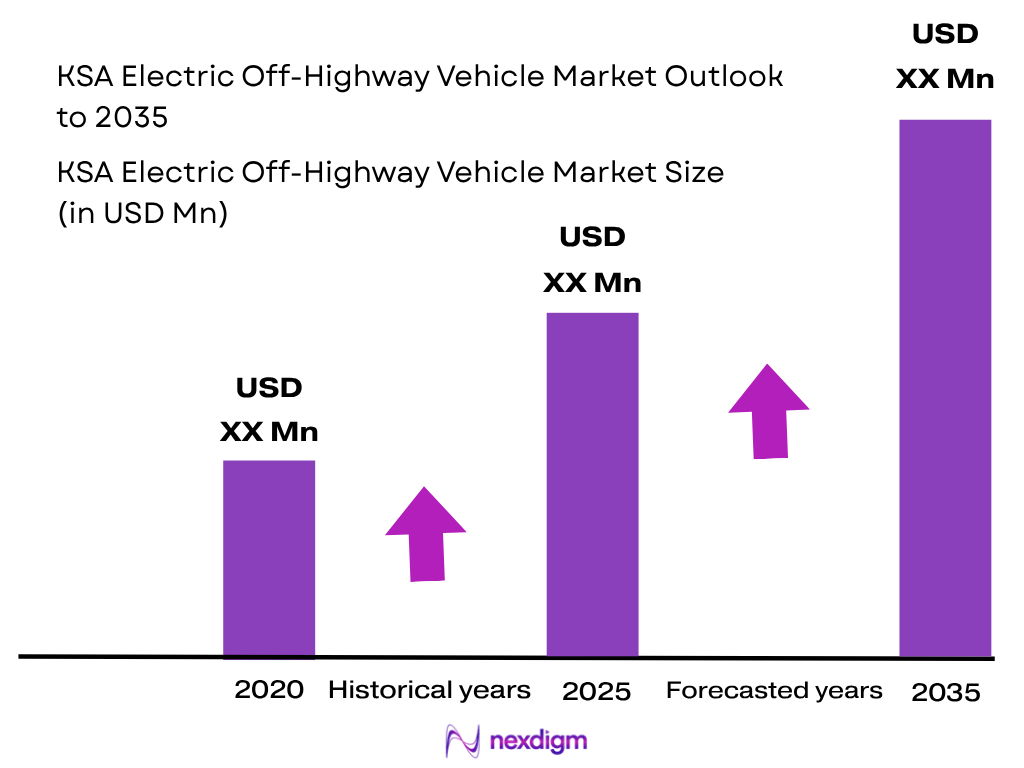
The KSA Electric Off-Highway Vehicle Market is valued at ~USD [XX] billion, supported by construction, mining, logistics, manufacturing and large-scale infrastructure activity. Saudi Arabia’s nominal GDP reached SAR4,070 billion in 2024, while construction generated SAR362.6 billion of nominal GDP and transportation and storage generated SAR263.1 billion. (General Authority for Statistics) Electrification is developing alongside this industrial base, particularly where equipment operates on predictable routes or at fixed sites, making battery-electric excavators, wheel loaders, forklifts, cranes, port equipment and other machines increasingly relevant to fleet modernization.
Riyadh, Jeddah, Dammam and the Eastern Province, NEOM/Tabuk, and major mining and industrial clusters represent the most important demand centers. Riyadh benefits from government, infrastructure and urban-development activity; Jeddah from construction, logistics and port operations; Dammam and the Eastern Province from petrochemicals, manufacturing, logistics and industrial activity; while NEOM and other giga-project locations provide controlled environments for deploying low-emission equipment. The concentration of industrial activity is particularly relevant because Saudi Arabia’s manufacturing sector generated SAR757.4 billion in nominal GDP in 2024, while construction generated SAR362.6 billion.
Market Segmentation
By Equipment Type
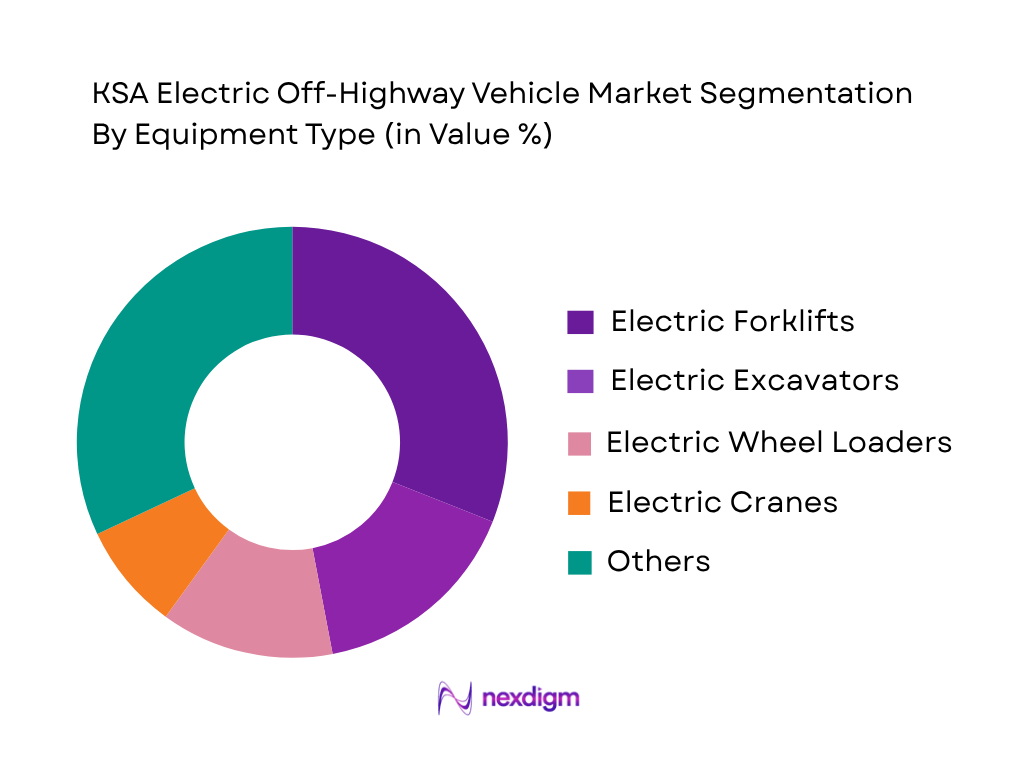
The KSA Electric Off-Highway Vehicle Market is segmented by equipment type into electric excavators, electric wheel loaders, electric forklifts, electric cranes, electric mining equipment, electric telehandlers, electric aerial work platforms, electric compact construction equipment, electric agricultural machinery and electric utility equipment. Electric Forklifts are expected to represent the dominant equipment category because material-handling operations provide comparatively favorable conditions for electrification. Forklifts commonly operate within warehouses, distribution centers, factories, ports and industrial compounds where routes are predictable and charging can be centralized. This reduces the range constraints associated with mobile construction equipment and enables depot-based charging. Saudi Arabia’s transportation and storage sector generated SAR263.1 billion in nominal GDP in 2024, while manufacturing generated SAR757.4 billion, creating a large installed base of logistics and industrial applications. (DataSaudi) Electric forklifts also offer zero tailpipe emissions and lower noise, making them particularly suitable for enclosed or semi-enclosed facilities. The increasing development of logistics hubs and industrial cities further expands their addressable operating environment. Electric excavators and wheel loaders have significant potential in construction, but their adoption is more dependent on battery capacity, charging infrastructure, operating hours and duty cycles. Consequently, material-handling equipment provides an earlier electrification pathway, while larger earthmoving and mining machines represent higher-value opportunities as battery technology and charging infrastructure mature.
By Application
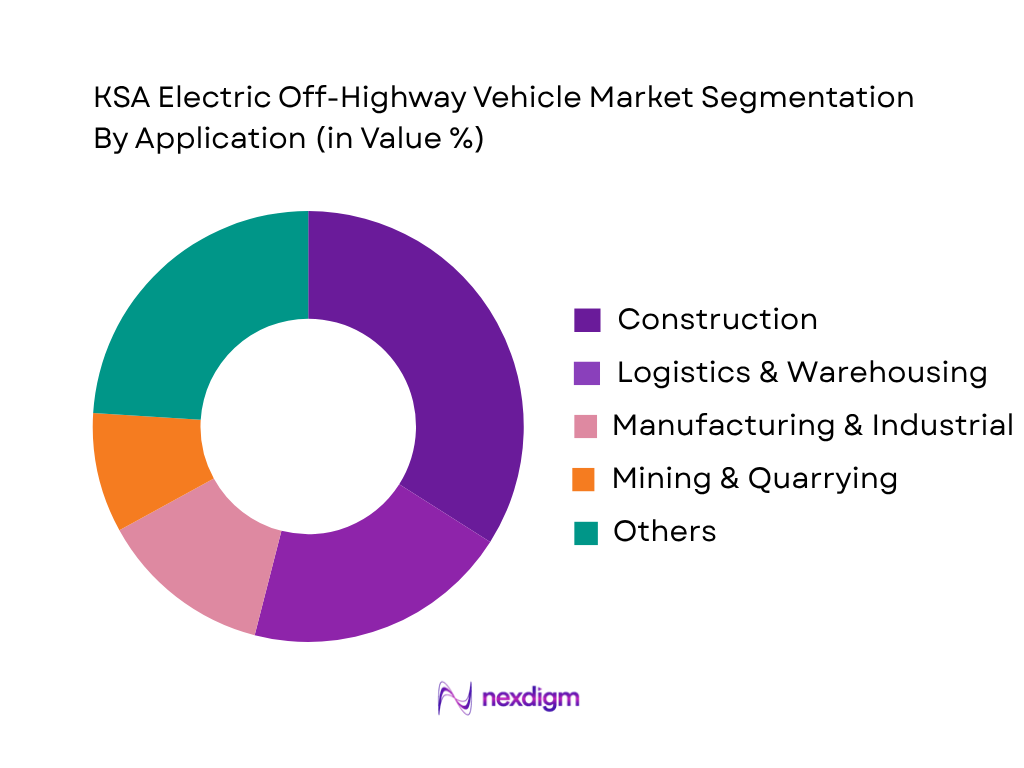
The KSA Electric Off-Highway Vehicle Market is segmented by application into construction, mining and quarrying, logistics and warehousing, ports and terminals, manufacturing and industrial facilities, agriculture, oil and gas support, municipal services, landscaping and infrastructure maintenance. Construction is expected to remain the leading application because of Saudi Arabia’s extensive infrastructure pipeline, urban development and giga-project ecosystem. GASTAT reported construction-sector operating revenues of SAR470.6 billion in 2024, up from the previous year, while real construction GDP increased 4.2%. (DataSaudi) Electric compact excavators, wheel loaders, telehandlers, aerial platforms and cranes are particularly suited to projects where noise and local emissions are important considerations. Construction sites located in urban or environmentally sensitive areas can derive additional value from zero tailpipe emissions and reduced noise. At the same time, mining and quarrying provide an important long-term opportunity because Saudi Arabia is expanding its mining and minerals ecosystem under its industrial-diversification agenda. Logistics and warehousing provide another relatively accessible electrification segment because equipment can be charged at centralized depots. The application landscape therefore differs by duty cycle: compact construction equipment and forklifts can electrify earlier, while large mining and earthmoving equipment requires substantially greater battery capacity and site-level energy infrastructure.
Competitive Landscape
The KSA Electric Off-Highway Vehicle Market is characterized by global construction-equipment, mining-equipment and material-handling manufacturers competing through electric machine portfolios, battery technologies, charging ecosystems, telematics, dealer support and total-cost-of-ownership propositions. Major manufacturers are increasingly developing complete electrification ecosystems rather than standalone electric machines. Caterpillar, for example, combines battery-electric machines with charging, energy storage, telematics and digital monitoring solutions.
| Company | Established | Headquarters | Electric Equipment Focus | Key Equipment Categories | Battery / Powertrain Capability | Digital & Telematics | KSA Relevance |
| Caterpillar | 1925 | Irving, Texas, USA | ~ | ~ | ~ | ~ | ~ |
| Komatsu | 1921 | Tokyo, Japan | ~ | ~ | ~ | ~ | ~ |
| Volvo Construction Equipment | 1832 | Gothenburg, Sweden | ~ | ~ | ~ | ~ | ~ |
| Liebherr | 1949 | Bulle, Switzerland | ~ | ~ | ~ | ~ | ~ |
| JCB | 1945 | Rocester, UK | ~ | ~ | ~ | ~ | ~ |
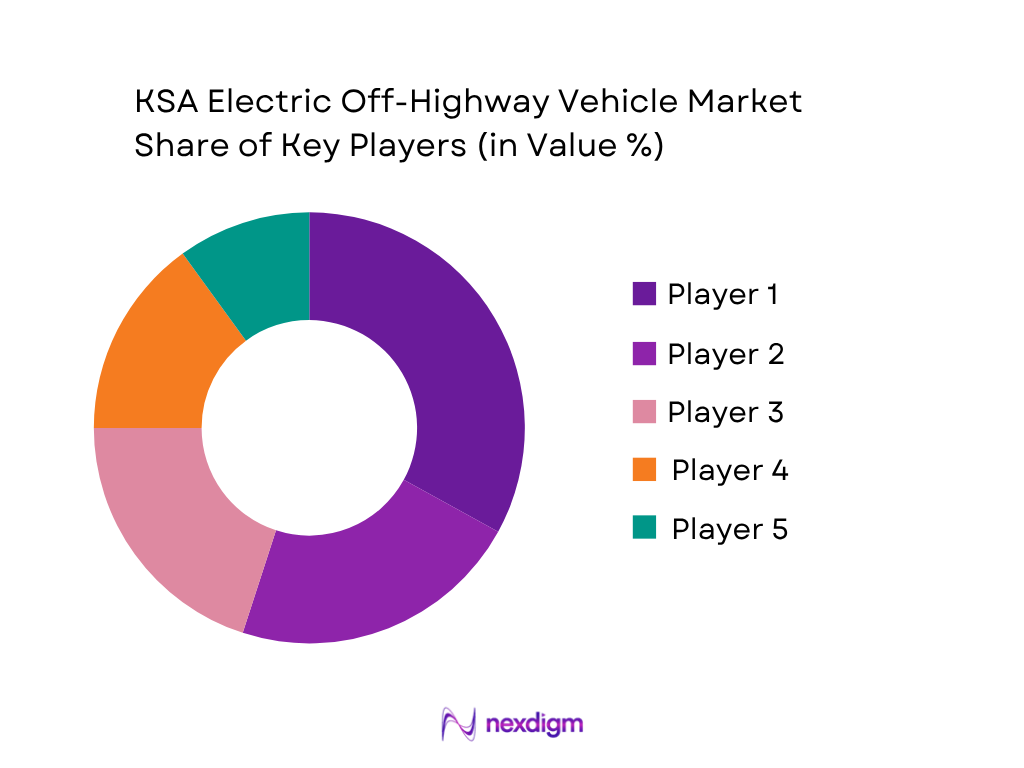
KSA Electric Off-Highway Vehicle Market Analysis
Growth Drivers
Vision 2030 Projects and Construction Demand
Saudi Arabia’s Vision 2030 development pipeline continues to create a broad operating base for electric off-highway equipment across construction, infrastructure, utilities, tourism developments and industrial zones. The IMF reported that non-oil real GDP expanded by 4.5% in 2024, with construction among the leading contributors, while non-oil private investment increased by 6.3%. Vision 2030’s project ecosystem includes NEOM, The Line, Qiddiya, Diriyah, ROSHN developments, King Salman International Airport and major infrastructure programs, creating applications for electric excavators, wheel loaders, compact construction equipment, cranes and telehandlers. The logistics ecosystem further strengthens equipment utilization: GASTAT recorded 23 activated logistics centers covering 34.6 million square meters, compared with 22 centers in 2023, alongside 12,234 licensed commercial warehouses with more than 22 million square meters of combined area. Saudi Arabia also recorded 331.3 million tonnes of maritime freight and 25.7 million tonnes through road ports, creating material-handling requirements around ports, warehouses and distribution facilities. These conditions support electrification particularly where equipment operates within defined construction sites, warehouses or industrial compounds. Electric machinery can also align with project-level environmental objectives by reducing direct diesel emissions and noise in urban developments. The combination of construction investment, logistics infrastructure and non-oil economic expansion therefore provides multiple demand channels for electric off-highway equipment rather than relying on a single end-use industry.
Mining, Industrial Localization and Logistics Electrification
Saudi Arabia’s diversification strategy is expanding the operating environments in which electric off-highway vehicles can be deployed, particularly through mining development, industrial localization, warehousing, ports and renewable-energy projects. The IMF reported 4.5% non-oil real GDP growth in 2024, while non-oil private investment grew 6.3%, demonstrating continued investment momentum outside hydrocarbons. The logistics sector provides a particularly measurable equipment base: GASTAT recorded 12,234 licensed commercial warehouses, 1,189 construction warehouses, 23 activated logistics centers and more than 290 million fulfilled delivery orders. These facilities require forklifts, compact loaders, electric utility vehicles and other material-handling equipment with repetitive duty cycles that are comparatively suitable for battery-electric operation. Maritime freight reached 331.3 million tonnes, while road-port freight reached 25.7 million tonnes, reinforcing demand for cargo-handling equipment around ports and logistics clusters. Renewable-energy development adds another industrial application pathway. Saudi Arabia’s renewable-energy program targets annual tendering of 20 GW of new renewable projects, with a stated objective of reaching 100–130 GW by 2030; six new projects totaling 6.7 GW had already been tendered from the beginning of 2024 according to the Saudi Press Agency. Solar installations, substations, construction sites and maintenance facilities can require telehandlers, loaders, cranes and utility equipment. As industrial projects become more concentrated and digitally managed, fleet operators have greater scope to introduce electric equipment alongside charging, telematics and centralized maintenance systems. This makes Saudi Arabia’s industrial localization and logistics expansion an important structural driver for electric equipment adoption.
Market Challenges
High Acquisition Requirements and Battery Performance
Electric off-highway equipment faces operational barriers in Saudi Arabia because machines must deliver reliable performance under high temperatures, heavy-duty workloads and extended operating cycles. The challenge is particularly relevant for excavators, wheel loaders, mining equipment and large telehandlers, where energy consumption can rise substantially under high loads. The country’s economic environment remains investment-intensive: IMF data show that non-oil private investment expanded 6.3% in 2024, while imports of goods increased 12.2%, reflecting the scale of investment-linked equipment and industrial supply requirements. This creates a market in which fleet operators must assess electric equipment against established diesel alternatives on utilization, uptime, charging requirements and residual value. Battery capacity and operating range are especially important for remote construction and mining sites where equipment may operate for long shifts without convenient access to grid electricity. Extreme heat also places additional demands on battery thermal management, power electronics, cooling systems and charging infrastructure. The problem becomes more pronounced for high-load applications in which battery depletion can interrupt operations or require opportunity charging. Saudi Arabia’s industrial-production statistics also demonstrate the importance of large industrial operating environments, with GASTAT maintaining dedicated monthly and annual industrial-production datasets covering manufacturing, mining and electricity activity. Electric equipment therefore needs to demonstrate durability under demanding site conditions rather than only laboratory performance. Until battery technology, thermal management, charging speed and duty-cycle efficiency improve sufficiently for intensive applications, operators may continue to deploy electric machines selectively, concentrating first on predictable routes and controlled sites.
Charging Gaps and Imported Technology Dependence
Charging infrastructure and technology availability remain important constraints because many electric off-highway vehicles operate in locations that are not comparable to conventional road-vehicle charging environments. Construction sites, mines, quarries, remote infrastructure projects and temporary industrial compounds may lack high-capacity electrical connections, requiring mobile chargers, temporary power systems or dedicated site infrastructure. Saudi Arabia’s logistics and industrial ecosystem is large and geographically distributed: GASTAT recorded 23 activated logistics centers, 12,234 licensed commercial warehouses, 331.3 million tonnes of maritime freight and 15.6 million tonnes of railway freight in 2024. These volumes indicate extensive equipment activity but also mean that electrification requirements differ substantially between fixed warehouses, ports, factories and remote projects. Technology dependence adds another layer because advanced batteries, electric drivetrains, power electronics, thermal-management systems and specialized control systems may require international supply chains and technical support. IMF data show Saudi goods imports increased 12.2% in 2024, consistent with the investment-intensive nature of the economy. For electric-equipment operators, imported technology can create longer qualification, spare-parts and service requirements than conventional equipment with established local maintenance networks. The challenge is particularly significant for mining and construction fleets where equipment downtime can disrupt project schedules. Consequently, charging availability, technician training, battery servicing, replacement-part inventories and warranty support become critical components of the purchasing decision. Suppliers that can combine equipment with mobile charging, local service capability, remote diagnostics and battery-management systems can reduce these barriers, while operators are likely to prioritize electrification first in facilities with predictable operating schedules and accessible electrical infrastructure.
Market Opportunities
Electric Construction, Mining and Port Equipment
Saudi Arabia’s current infrastructure, industrial and logistics activity provides multiple controlled operating environments in which electric off-highway equipment can expand beyond pilot deployments. Construction is particularly relevant because the IMF identified construction as one of the leading contributors to non-oil economic growth, with non-oil real GDP increasing 4.5% in 2024. Electric excavators, compact loaders, wheel loaders, telehandlers and cranes can be targeted at urban construction sites, infrastructure projects and developments where equipment operates within defined boundaries and can return to a central charging location. Ports provide another attractive environment because operations are concentrated, repetitive and increasingly technology-enabled. GASTAT recorded 331.3 million tonnes of maritime freight in 2024, providing a large operating base for cargo-handling machinery. Logistics infrastructure is similarly substantial, with 23 activated logistics centers covering 34.6 million square meters and 12,234 licensed commercial warehouses. These facilities are natural candidates for electric forklifts, warehouse vehicles and compact utility equipment because charging can be centralized and duty cycles can be monitored. Renewable-energy development creates an additional equipment application base: Saudi Arabia has a program targeting 20 GW of renewable-energy project tendering annually, with 6.7 GW of new projects tendered from the beginning of 2024. Solar construction and maintenance can require electric telehandlers, compact loaders and cranes where low-emission operation provides an operational advantage. These existing activity indicators support a gradual expansion from warehouse electrification toward construction, port and industrial applications, creating opportunities for equipment manufacturers that can provide application-specific battery capacities, charging systems and after-sales support.
Fleet Electrification Solutions and Equipment-as-a-Service
The development of integrated fleet solutions creates an opportunity to address the principal barriers to electric off-highway adoption by combining machines, charging, telematics, maintenance and financing rather than selling equipment as a standalone asset. Saudi Arabia’s logistics ecosystem already provides a substantial base for this model: GASTAT recorded more than 290 million fulfilled delivery orders, 140,000 active Saudi drivers and 302,000 non-Saudi drivers in the logistics sector, alongside 23 activated logistics centers and 12,234 licensed commercial warehouses. Such concentrated operating environments allow fleet operators to measure utilization, charging patterns, energy consumption and maintenance requirements across multiple machines. The model can extend to construction and industrial fleets supported by the broader diversification program. IMF data show non-oil private investment increased 6.3% in 2024, while non-oil real GDP grew 4.5%, creating an expanding base of private-sector industrial and infrastructure activity. Renewable-energy development can further support mobile and distributed charging solutions, with the national program targeting 20 GW of annual renewable-energy project tendering and 100–130 GW of renewable capacity by 2030. Equipment-as-a-service can reduce the technology and residual-value risk faced by customers by shifting responsibility for battery performance, maintenance, charging availability and equipment replacement toward specialized providers. Telematics can additionally monitor battery state of charge, utilization hours, charging cycles and preventive-maintenance requirements. This creates opportunities for equipment manufacturers, leasing companies, charging providers and fleet-management firms to develop bundled electrification packages tailored to Saudi construction sites, warehouses, ports, mines and industrial facilities.
Future Outlook
The KSA Electric Off-Highway Vehicle Market is expected to move from pilot deployments and selected fleet applications toward broader commercial adoption as equipment technology, charging infrastructure and operator familiarity improve. The strongest early opportunities are expected in forklifts, compact excavators, compact wheel loaders, access equipment and controlled industrial applications, where charging can be centralized and operating cycles are predictable.
Larger electric earthmoving and mining equipment should progressively become more commercially relevant as battery energy density, high-power charging, thermal management and machine autonomy improve. Saudi Arabia’s infrastructure build-out also creates opportunities for integrated providers combining electric equipment, charging, energy storage, telematics, maintenance and fleet-management services. EVIQ, backed by PIF and Saudi Electricity Company, has stated an objective of deploying more than 5,000 fast chargers across 1,000 locations, providing an important foundation for the wider national electrification ecosystem.
Major Players
- Caterpillar Inc.
- Komatsu Ltd.
- Volvo Construction Equipment
- Liebherr Group
- JCB
- Hitachi Construction Machinery
- SANY Group
- XCMG Group
- HD Hyundai Construction Equipment
- Doosan Bobcat
- Toyota Material Handling
- KION Group
- Jungheinrich AG
- Hyster-Yale Materials Handling
- Manitou Group
Key Target Audience
- Construction contractors and giga-project developers
- Mining, quarrying and mineral-processing operators
- Logistics, warehousing and port operators
- Industrial manufacturing and material-handling fleets
- Oil & gas and energy-sector equipment operators
- Investments and venture capitalist firms (Public Investment Fund, Saudi Industrial Investment Group, venture capital and infrastructure investment firms)
- Government and regulatory bodies (Ministry of Industry and Mineral Resources, Ministry of Transport and Logistic Services, Ministry of Energy, National Center for Environmental Compliance, Saudi Standards, Metrology and Quality Organization)
- Equipment distributors, dealers, fleet-financing providers and charging-infrastructure companies
Research Methodology
Step 1: Identification of Key Variables
The research begins with an ecosystem map covering OEMs, dealers, fleet operators, construction contractors, mining companies, logistics operators, charging providers, battery suppliers and regulators. Market variables include equipment deployment, electrification status, machine utilization, battery capacity, charging requirements, application suitability and fleet-replacement cycles.
Step 2: Market Analysis and Construction
Historical and current market indicators are compiled across construction, mining, logistics, manufacturing, ports and agriculture. Equipment-level demand is assessed using fleet deployment, application intensity, operating hours, replacement requirements and electric-equipment availability to construct the market’s bottom-up demand base.
Step 3: Hypothesis Validation and Expert Consultation
Market hypotheses are validated through structured discussions with equipment manufacturers, dealers, fleet managers, contractors, mining operators, logistics companies and charging-infrastructure stakeholders. Interviews focus on purchase criteria, electric-equipment adoption barriers, battery performance, charging availability, maintenance requirements and total-cost-of-ownership considerations.
Step 4: Research Synthesis and Final Output
The final analysis triangulates primary findings with official economic, industrial, construction, mining and transportation statistics. OEM product specifications and deployment evidence are cross-checked against application requirements to establish a validated market structure, competitive landscape, segmentation framework and forward-looking adoption assessment.

- Executive Summary
- Research Methodology (Market Definition and Scope, Electric Off-Highway Vehicle Taxonomy, ICE-to-Electric Replacement Framework, Top-Down Market Assessment, Bottom-Up Unit Validation, Equipment-Level Demand Mapping, Fleet-Level Analysis, OEM and Distributor Interviews, Primary Research, Secondary Research, Data Triangulation, Adoption Curve Modelling, Forecasting Framework, Scenario Analysis, Assumptions and Limitations)

- Definition and Scope
- Evolution of Electric Off-Highway Equipment in Saudi Arabia
- KSA Off-Highway Equipment Ecosystem
- KSA Electric Off-Highway Vehicle Value Chain
- Saudi Construction and Mega-Project Equipment Landscape
- Mining and Quarrying Electrification Landscape

- Growth Drivers (Vision 2030 Mega-Projects, Mining Expansion, Construction Equipment Demand, Port Modernization, Industrial Localization, Warehouse Electrification, Renewable-Energy Development, Fleet Modernization)
- Market Challenges (High Initial Acquisition Requirements, Extreme Heat Exposure, Battery Runtime, Charging Infrastructure Gaps, Heavy-Duty Duty Cycles, Imported Technology Dependence, Limited Specialized Service Capability, Residual-Value Uncertainty)
- Market Opportunities (Electric Construction Equipment, Electric Mining Equipment, Electric Port Equipment, Electric Forklifts, Electric Compact Loaders, Mobile Charging, Battery Leasing, Equipment-as-a-Service, Fleet Electrification Solutions)
- Emerging Technology Trends (LFP Batteries, High-Voltage Architecture, Fast Charging, Electric Hydraulics, Regenerative Systems, E-Axles, Thermal Management, Battery Swapping)
- Government and Regulatory Framework (Vision 2030, Saudi Green Initiative, NIDLP, Environmental Standards, Industrial Decarbonization, EV Policies, Battery Management, Waste and Recycling Regulations)
- Porter’s Five Forces Analysis
- PESTLE Analysis
- SWOT Analysis

- By Market Value
- By Unit Sales
- By Average Selling Value
- By Equipment Type
- By Application
- By Propulsion Technology
- By Battery Capacity

- By Equipment Type (in value %)
Electric Excavators
Electric Mini Excavators
Electric Wheel Loaders
Electric Skid-Steer Loaders
Electric Backhoe Loaders
Electric Cranes
Electric Dumpers
Electric Forklifts
Electric Reach Trucks
Electric Agricultural Tractors
Electric Utility Vehicles
Electric Mining Equipment
Electric Quarrying Equipment
Electric Road Construction Equipment
Electric Port and Terminal Equipment - By Application (in value %)
Construction and Infrastructure
Mining and Quarrying
Ports and Terminals
Warehousing and Logistics
Manufacturing and Industrial Facilities
Agriculture and Horticulture
Road Construction and Maintenance
Landscaping and Municipal Operations
Oil and Gas Support Operations
Airports and Aviation Ground Operations - By Propulsion Technology (in value %)
Battery Electric
Hybrid Electric
Plug-in Hybrid Electric
Hydrogen Fuel Cell
Hydrogen Internal Combustion
Other Alternative Powertrains - By Battery Capacity (in value %)
Below 50 kWh
50–150 kWh
151–300 kWh
301–500 kWh
Above 500 kWh - By Power Output ( in value % )
Below 50 kW
50–100 kW
101–200 kW
201–400 kW
Above 400 kW - By Operating Weight (in value %)
Below 5 Tons
5–10 Tons
10–20 Tons
20–40 Tons
Above 40 Tons

- Market Share of Major Players (By Revenue, Unit Sales, Equipment Type, Application, Propulsion Technology, Battery Capacity, Operating Weight and Region)
- Cross Comparison Parameters (Electric Equipment Portfolio Breadth, Electric Model Count, Battery Capacity Range, Maximum Operating Power, Operating Runtime, Charging Technology Capability, KSA Dealer and Service Network Coverage, Telematics and Autonomous Technology Capability)
- SWOT Analysis of Major Players
- Detailed Profiles of Major Companies
Caterpillar
Komatsu
Volvo Construction Equipment
JCB
Hitachi Construction Machinery
Liebherr
SANY
XCMG
Hyundai Construction Equipment
Doosan Bobcat
Toyota Material Handling
Mitsubishi Logisnext
Jungheinrich
Manitou
BYD

- Equipment Buyer Profile
- Purchase Decision-Making Factors
- Electric Equipment Adoption Behavior
- Application-Specific Demand Assessment
- Equipment Utilization Analysis
- Total Cost of Ownership Perception

- By Market Value (2026-2035)
- By Unit Sales (2026-2035)
- By Average Selling Value (2026-2035)
- By Equipment Type (2026-2035)
- By Application (2026-2035)
- By Propulsion Technology (2026-2035)
- By Battery Capacity (2026-2035)


 Request a Sample
 Ask for Customization
 Get a Quote
 Enquire Now