
 Download PDF
Market Overview
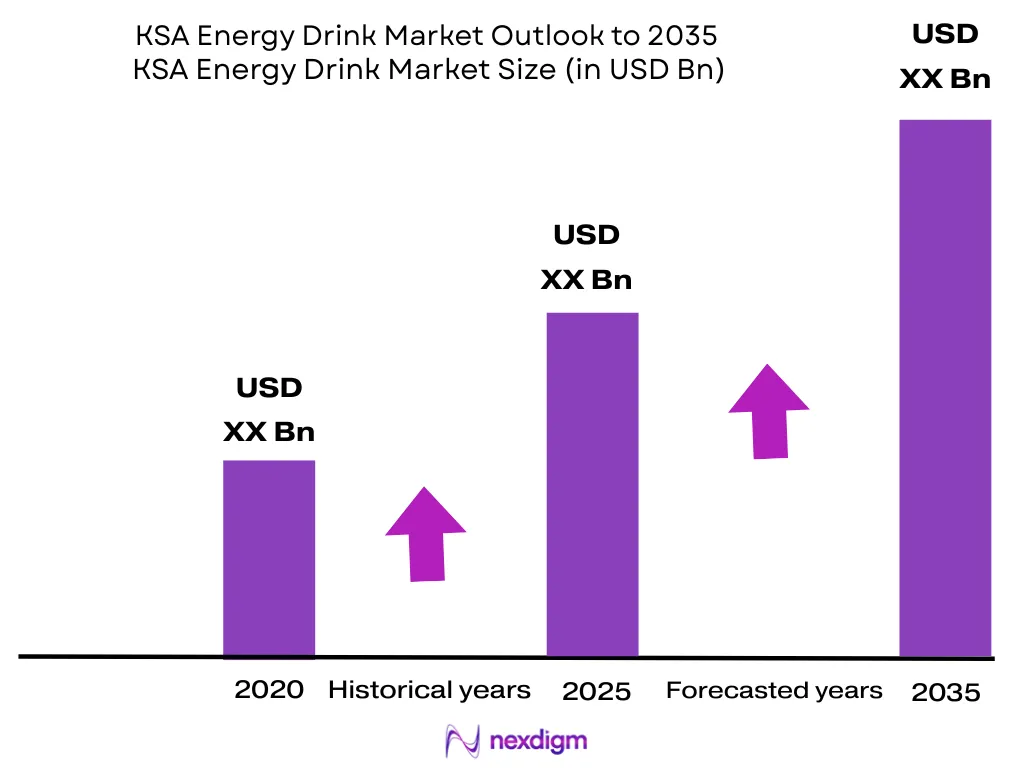
The KSA Energy Drink Market is valued at USD ~ billion, based on the latest country-level market assessment, while another Saudi-specific benchmark places the market at USD 398.41 million, reflecting differences in retail-value scope and channel coverage. The forecasted CAGR for the 2026–2035 period is benchmarked at 9.1%, based on the available long-term Saudi energy drink outlook. Demand is driven by young consumers, fitness activity, work productivity, gaming, driving and convenience-led consumption. The KSA Energy Drink Market is dominated by Riyadh, Jeddah, Makkah, Madinah, Dammam, Khobar and Dhahran due to high retail density, petrol stations, universities, corporate offices, gyms, events, tourism and pilgrimage movement. Saudi Arabia’s population is 35,300,280, compared with 33,702,731 in the preceding base, supporting a larger addressable beverage consumer pool. Riyadh Region benefits from offices and entertainment, Makkah Region from Jeddah retail and pilgrimage, and Eastern Province from energy-sector workers and highway mobility.
Market Segmentation
By Product Type
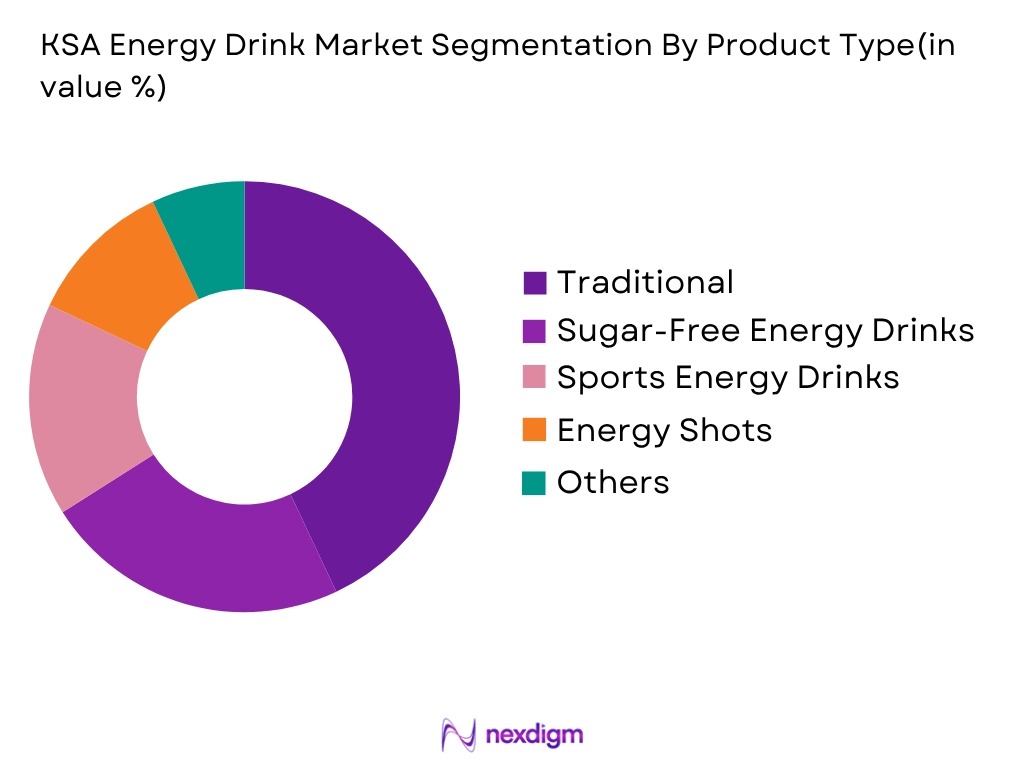
KSA Energy Drink Market is segmented by product type into traditional energy drinks, sugar-free energy drinks, sports energy drinks, energy shots and powdered or functional energy mixes. Recently, traditional energy drinks have a dominant market share in KSA under product type segmentation due to their entrenched consumer familiarity, strong brand recall, wide availability and direct fit with stimulant beverage occasions. Brands such as Red Bull, Monster, Power Horse, Bison, Code Red, HELL, Hype and XL Energy compete through caffeine-taurine positioning, chilled can visibility and strong placement across hypermarkets, baqalas, petrol stations, convenience stores and e-commerce platforms. Traditional energy drinks are also relevant for students, office workers, drivers, gamers, delivery riders and outdoor workers. Sugar-free and sports energy products are expanding through gym and wellness channels, but traditional energy drinks remain dominant because they are deeply associated with instant alertness, taste familiarity and high-visibility single-serve purchases.
By Packaging Type
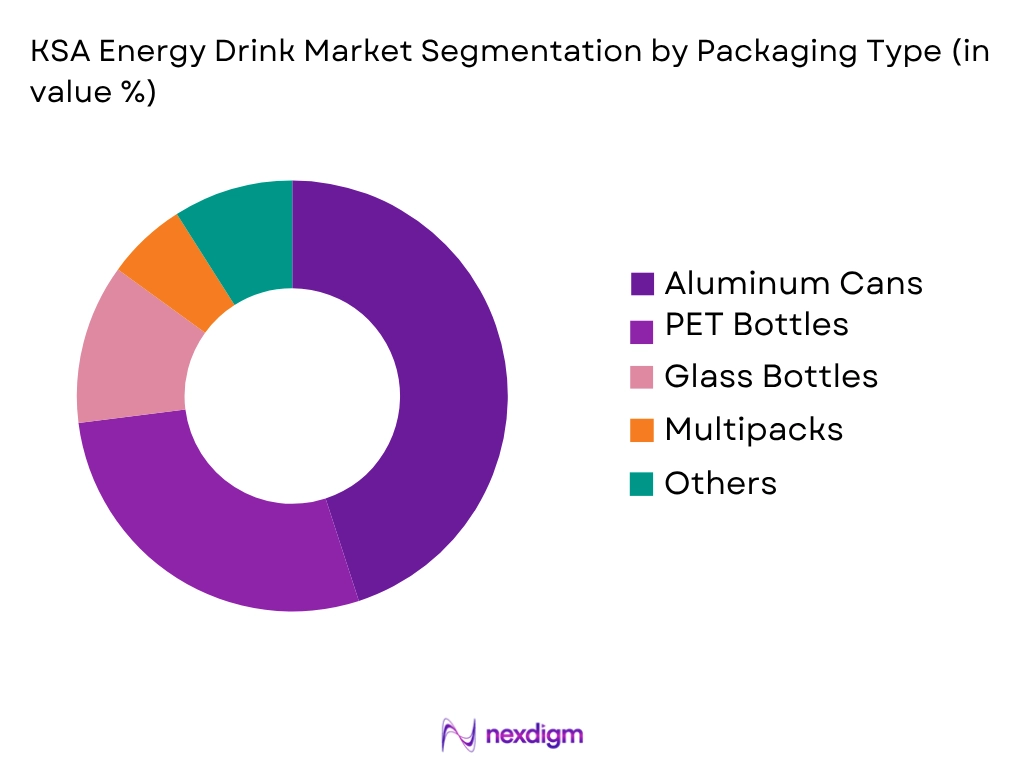
KSA Energy Drink Market is segmented by packaging type into aluminum cans, PET bottles, glass bottles, multipacks, shots and powder formats. Recently, aluminum cans have a dominant market share in KSA under packaging type segmentation because they are the preferred format for mainstream and premium energy drinks. Cans support carbonation stability, rapid chilling, strong shelf branding, single-serve consumption and convenience-led purchase behaviour across supermarkets, petrol stations, baqalas, gyms, cafés and entertainment venues. Red Bull’s slim-can architecture, Monster’s large-can format, Power Horse’s premium can positioning and imported European brands such as HELL, Effect and XL reinforce this packaging dominance. PET bottles remain relevant for resealable travel and value-led consumption, while multipacks are concentrated in hypermarkets and online retail. The broader global energy drink market also identifies cans as the largest packaging format, supporting the category’s can-led structure.
Competitive Landscape
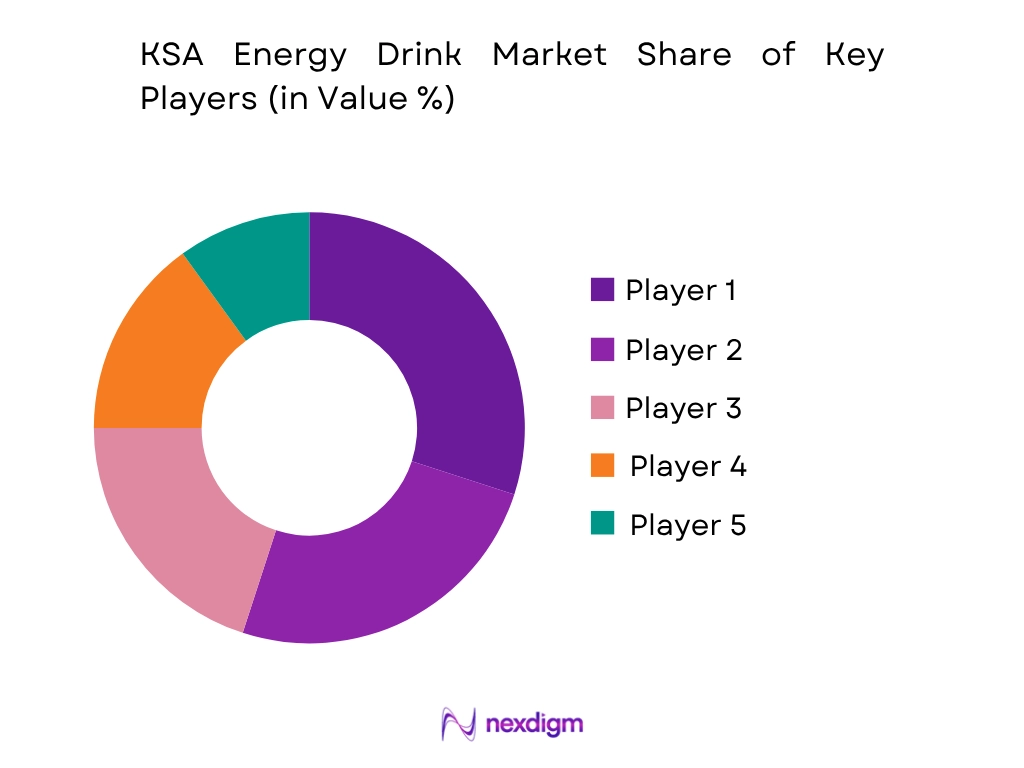
The KSA Energy Drink Market is led by global premium brands, GCC-recognized energy brands, Saudi and regional challengers, and imported European value-premium SKUs. Red Bull and Monster dominate premium visibility through modern retail, petrol stations, events, motorsport, gaming and lifestyle positioning. Power Horse, Bison, Code Red, HELL, Hype and Effect compete through regional familiarity, price-pack formats and broad supermarket visibility. Competition is intense because the category is exposed to 100% excise tax, SFDA/GSO compliance, Arabic labelling requirements and limited cold-shelf space.
| Company | Establishment Year | Headquarters | Core Energy Portfolio | KSA Positioning | Packaging Focus | Distribution Strength | Product Innovation Focus | Market-Specific Edge |
| Red Bull GmbH | 1984 | Fuschl am See, Austria | ~ | ~ | ~ | ~ | ~ | ~ |
| Monster Beverage Corporation | 1935 | Corona, California, USA | ~ | ~ | ~ | ~ | ~ | ~ |
| PepsiCo Saudi Arabia | 1965 | Purchase, New York, USA | ~ | ~ | ~ | ~ | ~ | ~ |
| Power Horse Energy Drinks | 1994 | Linz, Austria | ~ | ~ | ~ | ~ | ~ | ~ |
| Alesayi Beverage Corporation | 1959 | Jeddah, Saudi Arabia | ~ | ~ | ~ | ~ | ~ | ~ |
KSA Energy Drink Market Analysis
Growth Drivers
Urban Mobility, Airports and Highway Retail Consumption
KSA Energy Drink Market is supported by mobility-led consumption across airports, petrol stations, highways, convenience stores, baqalas and transport corridors. GASTAT reported that Saudi airport passenger traffic exceeded 128 million passengers, with international passengers exceeding 69 million and domestic passengers exceeding 59 million in 2024, supporting travel-retail and on-the-go beverage occasions. King Abdulaziz International Airport handled around 49 million passengers, while King Khalid International Airport handled 37.6 million passengers, strengthening Jeddah and Riyadh as chilled energy drink demand hubs. World Bank reported Saudi GDP at USD 1.24 trillion and GDP per capita at USD 35,121.7, supporting premium cans and functional beverage purchases.
Large Employed Base and Work-Fatigue Energy Occasions
KSA Energy Drink Market benefits from a large working population using energy drinks for alertness, long shifts, commuting, office productivity, logistics, construction, retail and service work. Labour-market data shows total employed persons reached 12,438,485 in Q4 2024 and 12,798,787 in Q1 2025, creating a broad consumer base for workday and shift-based stimulant beverages. Service and sales workers reached 925,609 in Q4 2024 and 940,798 in Q1 2025, directly supporting convenience-store, baqala and foodservice-adjacent consumption occasions. Saudi GDP per capita stood at USD 35,121.7, allowing brands to sell premium imports, sugar-free variants and value-positioned cans across urban and worker-heavy channels.
Market Challenges
Excise Tax and Sugar-Profile Compliance Pressure
KSA Energy Drink Market faces a structural policy challenge because energy drinks are listed by ZATCA as goods subject to 100% excise tax, while sweetened and carbonated beverages face separate excise treatment. This directly affects importers, distributors and retailers because energy drink portfolios must be registered, declared and managed under excise-tax rules before reaching hypermarkets, baqalas, petrol stations and e-commerce platforms. ZATCA’s official excise-tax page also distinguishes energy drinks from soft drinks and sweetened beverages, increasing the need for accurate product classification. With Saudi GDP growth reported at 2.0 in World Bank data, manufacturers must protect demand while managing tax, compliance and SKU-mix pressure.
Caffeine Limits, Labelling and Restricted Promotion Rules
KSA Energy Drink Market faces regulatory execution pressure because SFDA’s energy drink requirements prohibit production or import before registration and require clear product compliance before market circulation. SFDA guidance states energy drinks are “high in caffeine,” with caffeine content not to exceed 320 mg per litre, creating a direct formulation and labelling constraint for brands using caffeine-taurine positioning. SFDA also reported strict controls including restrictions on advertising, free distribution for promotion, and sales in certain government, education, health, lounge, sports-club and gym facilities. With Saudi airport traffic exceeding 128 million passengers, broad channel reach increases inspection exposure across travel retail, convenience, forecourt and urban outlets.
Market Opportunities
Hajj, Umrah, Tourism and Event-Channel Expansion
KSA Energy Drink Market has future growth opportunity through pilgrimage, tourism, hotels, airports, convenience retail, entertainment venues and event-led consumption. The Pilgrim Experience Program’s 2024 annual report is an official Vision 2030 source focused on Hajj, Umrah and visitor-visa facilitation, supporting beverage demand across Makkah, Madinah, Jeddah airports, hotel corridors and transport nodes. GASTAT reported more than 128 million airport passengers in 2024, including over 69 million international passengers, while King Abdulaziz International Airport handled around 49 million passengers. These current movement indicators support chilled cans, multipacks, zero-sugar SKUs and Arabic-labelled imported variants across travel, pilgrimage and event retail.
Zero-Sugar, Sports Energy and Fitness-Led Product Innovation
KSA Energy Drink Market has future growth opportunity in zero-sugar, low-calorie, sports-energy and functional energy products because macro indicators support premium urban consumption and lifestyle-led retailing. World Bank reported Saudi GDP at USD 1.24 trillion and GDP per capita at USD 35,121.7, while Saudi Arabia’s population reached 35,300,280 people, expanding the addressable base for branded functional beverages. Riyadh Region had 8,591,748 people in the latest region dataset, making it a priority market for gyms, convenience stores, e-commerce, offices and entertainment venues. Brands can use these current demand clusters to expand sugar-free cans, amino-energy, electrolyte-energy and focus-oriented products.
Future Outlook
The KSA Energy Drink Market is expected to grow steadily over the forecast period, supported by a young consumer base, active lifestyles, sports participation, long-distance mobility, modern retail development, event-led consumption and pilgrimage-linked movement. The long-term forecast CAGR is benchmarked at 9.1% for the 2026–2035 window, while shorter country-level benchmarks indicate moderate growth depending on market scope and channel coverage.
Over the next phase, KSA’s market will remain shaped by Riyadh, Jeddah, Makkah, Madinah and the Eastern Province. Riyadh will support premium cans, corporate consumption, entertainment events, gaming and gyms. Jeddah and Makkah will support tourism, pilgrimage, hotel, airport and convenience retail demand. Dammam, Khobar and Dhahran will support work-fatigue occasions linked to industrial, energy-sector and road-mobility consumption.
Zero-sugar and reduced-sugar energy drinks will gain relevance as excise tax, calorie concerns and fitness culture push brands toward reformulation. Sports energy, amino-energy, electrolyte-energy, natural caffeine and nootropic energy concepts can expand through gyms, sports clubs, pharmacies, e-commerce and premium supermarkets. However, full-sugar traditional energy drinks will remain structurally important because they already hold broad distribution, strong taste familiarity and high brand recall.
Petrol stations, baqalas and hypermarkets will remain essential channels. Forecourts serve drivers, delivery riders, commuters and long-distance travellers, while baqalas provide neighbourhood accessibility. E-commerce and quick-commerce will increasingly support variety packs, imported flavours, limited editions and multipacks, especially among young consumers and urban professionals in Riyadh, Jeddah and Dammam.
Major Players
- Red Bull Saudi Arabia
- Monster Energy KSA
- PepsiCo Saudi Arabia
- The Coca-Cola Company KSA
- Power Horse Energy Drinks
- Bison Energy Drink
- Code Red Energy Drink
- HELL Energy Saudi Arabia
- Hype Energy Drinks
- Effect Energy Drink
- XL Energy Drink
- Boom Boom Energy Drink
- Black Energy Drink
- Wild Tiger Energy Drink
- Double Horse Energy Drink
Key Target Audience
- Energy drink manufacturers and brand owners
- Functional beverage companies
- Carbonated soft drink and packaged beverage companies
- Hypermarket, supermarket and baqala retail chains
- Petrol station, convenience and highway retail operators
- Sports nutrition, gym and pharmacy channel operators
- Investments and venture capitalist firms
- Government and regulatory bodies (Saudi Food and Drug Authority, Zakat, Tax and Customs Authority, Saudi Standards, Metrology and Quality Organization, Ministry of Commerce, Ministry of Health, General Authority for Competition)
Research Methodology
Step 1: Identification of Key Variables
The initial phase involves constructing an ecosystem map for the KSA Energy Drink Market, covering brand owners, importers, local beverage manufacturers, distributors, hypermarkets, baqalas, petrol stations, gyms, pharmacies, e-commerce platforms and regulators. The objective is to identify key variables such as sugar profile, caffeine positioning, packaging type, excise-tax exposure, channel reach and regional demand clusters.
Step 2: Market Analysis and Construction
In this phase, historical data for the KSA Energy Drink Market is compiled through country-level market benchmarks, company portfolios, SKU listings, retail shelf checks, e-commerce availability and channel mapping. The assessment reviews traditional energy drinks, sugar-free variants, cans, PET bottles, multipacks, petrol-station visibility, hypermarket displays, baqala distribution and online product breadth.
Step 3: Hypothesis Validation and Expert Consultation
Market hypotheses are validated through computer-assisted telephone interviews with beverage distributors, supermarket category buyers, petrol-station retail managers, baqala suppliers, gym retailers, e-commerce sellers and importers. These consultations provide operational insights into SKU velocity, chilled shelf placement, excise-tax impact, consumer switching, flavour demand, promotional activity and region-specific product acceptance.
Step 4: Research Synthesis and Final Output
The final phase triangulates top-down market benchmarks with bottom-up brand, SKU, pack and channel evidence. Direct engagement with beverage manufacturers, distributors and retail stakeholders helps verify product segmentation, competitive positioning, regional demand, pricing architecture, SFDA/GSO compliance exposure and future opportunity areas in the KSA Energy Drink Market.

- Executive Summary
- Research Methodology [market definitions and assumptions, RTD energy drink classification, stimulant beverage scope, GCC energy drink standard mapping, SFDA registration framework, ZATCA excise-tax adjustment, top-down sizing, bottom-up sizing, retail audit checks, distributor interviews, SKU-level benchmarking]

- Definition and Scope
- Overview Genesis
- Timeline of Major Players
- Business Cycle
- Supply Chain and Value Chain Analysis

- Growth Drivers (youth consumers, tourism, gyms, entertainment, petrol stations, e-commerce, convenience retail, Vision 2030 lifestyles)
- Market Challenges (100% excise tax, caffeine warnings, sugar scrutiny, import dependency, high competition, regulatory approval)
- Market Opportunities (zero sugar, sports energy, natural caffeine, local flavors, events, pilgrimage, forecourt, quick commerce)
- Market Trends (zero sugar, premium cans, sports energy, local flavors, e-commerce, gaming, events, sugar-tax response]
- SWOT Analysis
- Porter’s Five Forces

- By Value (2020-2025)
- By Volume (2020-2025)
- By Unit Sales (2020-2025)

- By Product Type (In Value %)
Carbonated RTD Energy Drinks
Non-Carbonated Energy Drinks
Sugar-Free Energy Drinks
Sports Energy Drinks - By Packaging Type (In Value %)
Aluminum Cans
PET Bottles
Glass Bottles
Multipacks
Slim Cans - By Distribution Channel (In Value %)
Hypermarkets and Supermarkets
Baqalas and Traditional Groceries
Convenience Stores
Petrol Stations and Forecourts
Pharmacies and Health Retail - By Region (In Value %)
Riyadh Region
Makkah Region
Eastern Province
Madinah Region
Qassim

- Market Share of Major Players on the Basis of Value and Volume
- Cross Comparison Parameters (caffeine mg per litre, sugar grams per 100 ml, zero-sugar SKU mix, 100% excise-tax exposure, SFDA and GSO label compliance, hypermarket and forecourt distribution depth, Arabic/local flavor portfolio, sports-gaming-event activation intensity])
- SWOT Analysis of Major Players [brand equity, importer strength, channel access, reformulation capability, price exposure, regulatory compliance]

- Market Demand and Utilization
- Purchasing Power and Budget Allocation
- Regulatory and Compliance Requirements
- Needs, Desires and Pain Point Analysis
- Decision-Making Process

- By Value (2026-2035)
- By Volume (2026-2035)
- By Unit Sales (2026-2035)


 Request a Sample
 Ask for Customization
 Get a Quote
 Enquire Now