
 Download PDF
 Download PDF
Market Overview
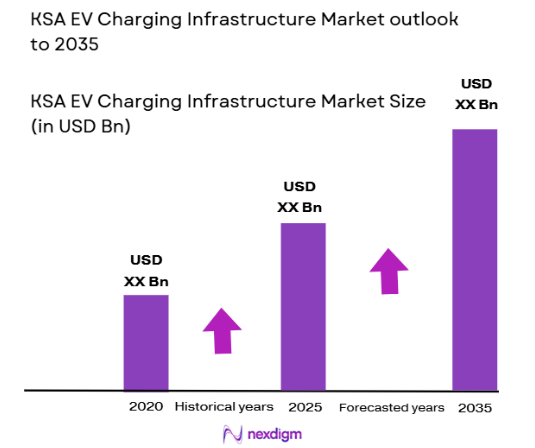
The KSA EV Charging Infrastructure market is projected to see considerable growth, with the market size driven by rapid advancements in electric vehicle adoption and government incentives. The growing demand for electric vehicles in the Kingdom of Saudi Arabia (KSA) is further amplified by government initiatives such as Vision 2030, which supports eco-friendly transportation. As of recent historical assessments, the market size for EV charging infrastructure in KSA is valued at USD ~ billion, with rapid growth in installations and technology advancements contributing to this increase. The market is propelled by national policies, technological advancements, and strategic public-private partnerships.
Key drivers of growth in the KSA EV Charging Infrastructure market include government-backed funding for EV infrastructure, international collaboration with global EV manufacturers, and the increasing need for sustainable urban mobility solutions. The major cities driving the demand for EV charging stations include Riyadh, Jeddah, and Dammam, where large-scale infrastructure projects are underway. These cities benefit from robust government support, favorable policies, and an expanding automotive market, positioning them as key hubs for EV infrastructure development.
Market Segmentation
By System Type
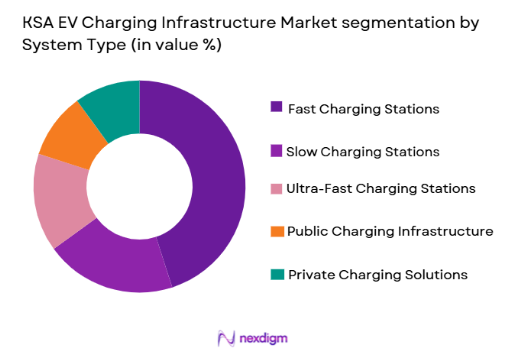
The KSA EV Charging Infrastructure market is segmented by system type into Fast Charging Stations, Slow Charging Stations, Ultra-Fast Charging Stations, Public Charging Infrastructure, and Private Charging Solutions. Fast Charging Stations currently dominate the market due to their ability to charge vehicles quickly and meet the high demand for efficient EV refueling. Factors such as the growing number of electric vehicle owners, the convenience of rapid charging, and the availability of these stations in urban centers have contributed to their widespread adoption. These stations are critical in reducing downtime for EVs and enhancing the overall user experience, thus driving their dominant market share.
By Platform Type
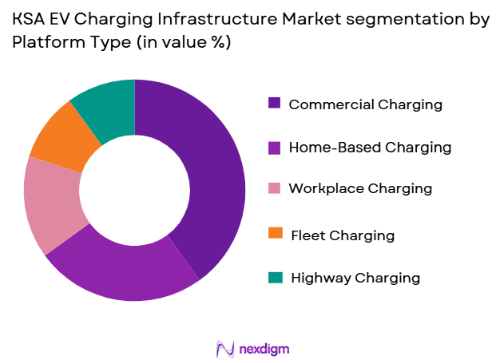
The KSA EV Charging Infrastructure market is segmented by platform type into Home-Based Charging, Commercial Charging, Workplace Charging, Fleet Charging, and Highway Charging. Commercial Charging infrastructure has the largest market share, as businesses and retail locations are increasingly installing EV chargers to attract customers and comply with government regulations. The convenience of commercial stations in high-traffic areas, combined with government incentives and the demand from business fleets, contributes to the dominance of this segment.
Competitive Landscape
The competitive landscape of the KSA EV Charging Infrastructure market is shaped by a mix of international companies and local startups. Major players in the market are focusing on increasing their infrastructure footprint through partnerships and investments in the Kingdom’s growing electric vehicle sector. The market is witnessing consolidation as large players acquire smaller firms or form joint ventures to tap into the expanding demand for EV infrastructure. The influx of international players, along with robust local regulations, ensures a competitive yet collaborative environment in the EV infrastructure market.
| Company Name | Establishment Year | Headquarters | Technology Focus | Market Reach | Key Products | Revenue (USD) | Market-Specific Parameter |
| ABB | 1988 | Switzerland | ~ | ~ | ~ | ~ | ~ |
| Siemens | 1847 | Germany | ~ | ~ | ~ | ~ | ~ |
| Tesla | 2003 | USA | ~ | ~ | ~ | ~ | ~ |
| Enel X | 2009 | Italy | ~ | ~ | ~ | ~ | ~ |
| Shell Recharge | 1907 | Netherlands | ~ | ~ | ~ | ~ | ~ |
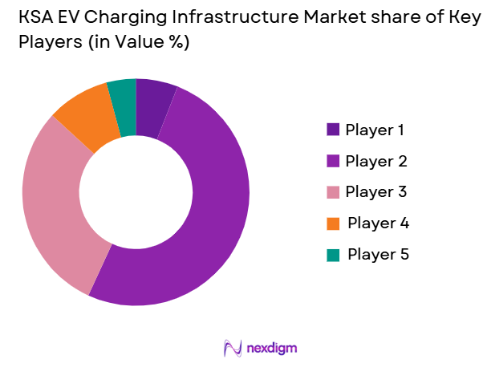
KSA EV Charging Infrastructure Market Analysis
Growth Drivers
Government Support for Clean Mobility
The Saudi government’s commitment to Vision 2035 is a key driver for the adoption of electric vehicles (EVs) and their associated charging infrastructure. This includes significant investments in green technologies, with EV charging stations being a crucial part of this agenda. A key initiative under Vision 2030 is the Saudi Green Initiative, which aims to increase the country’s reliance on renewable energy, thereby supporting the growth of the EV ecosystem. This policy support fosters a favorable environment for EV infrastructure expansion, encouraging investments from both local and international players. Furthermore, government-backed incentives for businesses and consumers alike, such as subsidies for installing charging stations, further bolster this growth. These measures will accelerate the establishment of nationwide charging networks, ensuring accessibility and convenience for EV users.
Technological Advancements in Charging Infrastructure
As electric vehicle adoption grows, the demand for advanced, fast, and reliable EV charging stations has increased. Innovations in charging technology, such as ultra-fast charging systems, energy management software, and seamless integration with renewable energy sources, are key factors driving the market forward. Technological advancements not only improve the efficiency and speed of EV charging but also reduce the cost of charging infrastructure deployment. The increasing availability of software solutions for charging management and the integration of artificial intelligence for load balancing will further enhance the customer experience. These innovations, combined with growing consumer preference for EVs, will stimulate market demand, supporting the expansion of charging infrastructure.
Market Challenges
High Infrastructure Costs
One of the main challenges facing the EV charging infrastructure market in KSA is the high upfront cost of establishing charging stations. Despite government incentives, the installation of both fast and ultra-fast charging stations remains capital-intensive, particularly in less developed areas. This challenge is compounded by the need for ongoing maintenance and network integration. The high cost of advanced charging equipment, along with the requirement for grid connectivity, poses significant financial barriers for new market entrants and smaller businesses. While costs are expected to decrease over time as technology advances, the initial capital expenditure remains a significant hurdle for widespread adoption.
Limited Charging Network Accessibility
While major cities in KSA are seeing rapid expansion of EV charging infrastructure, rural areas and less-populated regions still lack sufficient charging stations. This accessibility issue is particularly important for long-distance EV travel, as users must rely on a well-distributed network of charging points. The challenge is further exacerbated by inconsistent charging speeds and types of connectors, which complicate the user experience. The lack of uniformity in charging infrastructure and the slow rollout in less urbanized regions present a barrier to broader adoption of electric vehicles and the growth of a nationwide charging network.
Opportunities
Integration of Renewable Energy
The KSA EV charging infrastructure market has a significant opportunity to integrate renewable energy sources, such as solar power, into its network of charging stations. As Saudi Arabia has vast amounts of solar energy potential, integrating solar-powered EV chargers can offer an eco-friendly, cost-effective solution to meet the increasing demand for EV charging. This integration could not only help in reducing the overall carbon footprint of electric vehicles but also provide a decentralized power supply that can support charging stations in remote areas. The strategic alignment of EV charging stations with solar energy will contribute to the country’s sustainability goals and enhance the overall market appeal.
Partnerships with Automakers and Fleet Operators
Another key opportunity for growth in the KSA EV charging infrastructure market lies in forming strategic partnerships with automakers and fleet operators. With increasing EV sales in the Kingdom, collaborations between infrastructure providers and automobile manufacturers can ensure seamless integration of charging networks with the vehicles themselves. Fleet operators, particularly in the logistics and transportation sectors, are also expected to play a significant role in the adoption of electric vehicles, further driving the demand for charging stations. These partnerships can also facilitate the development of specialized charging stations catering to commercial fleets, which will help diversify the market and increase the adoption rate of EVs.
Future Outlook
Over the next five years, the KSA EV charging infrastructure market is poised for substantial growth driven by continued government support, technological advancements, and the increasing demand for sustainable mobility solutions. With the development of ultra-fast charging networks and the integration of renewable energy sources, the market is set to meet the challenges of higher adoption rates. Moreover, the expansion of EV charging networks into rural and remote areas will be crucial in ensuring the widespread adoption of electric vehicles, ultimately aligning with KSA’s Vision 2035.
Major Players
- ABB
- Siemens
- Tesla
- Enel X
- Shell Recharge
- ChargePoint
- General Electric
- Schneider Electric
- Al Futtaim
- Riyadh EV
- Aljazira Electric
- Voltway
- GreenLots
- Hitachi ABB Power Grids
- DCS Group
Key Target Audience
- Investments and venture capitalist firms
- Government and regulatory bodies
- Electric vehicle manufacturers
- Energy infrastructure developers
- Large commercial fleet operators
- Auto retailers and service providers
- Municipalities and city planners
- Charging station developers
Research Methodology
Step 1: Identification of Key Variables
Identify key market factors such as EV adoption rates, charging infrastructure needs, and government policies.
Step 2: Market Analysis and Construction
Build a comprehensive market model considering all driving forces and restraints.
Step 3: Hypothesis Validation and Expert Consultation
Engage with industry experts and consult primary and secondary sources for data validation.
Step 4: Research Synthesis and Final Output
Compile findings and create the final research report, ensuring it is coherent and accurate.

- Executive Summary
- Research Methodology (Definitions, Scope, Industry Assumptions, Market Sizing Approach, Primary & Secondary Research Framework, Data Collection & Verification Protocol, Analytic Models & Forecast Methodology, Limitations & Research Validity Checks)

- Market Definition and Scope
- Value Chain & Stakeholder Ecosystem
- Regulatory / Certification Landscape
- Sector Dynamics Affecting Demand
- Strategic Initiatives & Infrastructure Growth

- Growth Drivers
Government Incentives for EV Adoption
Rise in Electric Vehicle Sales
Increased Focus on Sustainable Mobility
Technological Advancements in Charging Systems
Growing Infrastructure Investment - Market Challenges
High Initial Infrastructure Costs
Lack of Public Awareness
Limited Charging Network Accessibility
Integration with Renewable Energy Sources
Technological Interoperability Issues - Market Opportunities
Integration of Solar-Powered Charging Stations
Partnerships with Auto Manufacturers
Expansion of Fast Charging Networks - Trends
Development of Ultra-Fast Charging Stations
Increased Deployment of Public Charging Points
Emergence of Wireless Charging Solutions
Growth of Smart Charging Technologies
Advancements in EV Battery Technologies - Government Regulations & Defense Policy
Supportive EV Policies
Regulations on Charging Station Standards
Government Grants for Charging Infrastructure - SWOT Analysis
- Stakeholder and Ecosystem Analysis
- Porter’s Five Forces Analysis
- Competition Intensity and Ecosystem Mapping

- By Market Value, 2020-2025
- By Installed Units, 2020-2025
- By Average System Price, 2020-2025
- By System Complexity Tier, 2020-2025

- By System Type (In Value%)
Fast Charging Stations
Slow Charging Stations
Ultra-Fast Charging Stations
Public Charging Infrastructure
Private Charging Solutions - By Platform Type (In Value%)
Home-Based Charging
Commercial Charging
Workplace Charging
Fleet Charging
Highway Charging - By Fitment Type (In Value%)
Standalone Solutions
Integrated Solutions
Public Sector Solutions
Private Sector Solutions
Commercial Property Solutions - By End User Segment (In Value%)
Residential Users
Commercial Fleet Operators
Government Institutions
Corporate Fleets
Transportation Providers - By Procurement Channel (In Value%)
Direct Procurement
Third-Party Distributors
Public Tenders
Private Sector Bidding
Online Platforms - By Material / Technology (In Value%)
Battery Storage Systems
Charging Station Hardware
Renewable Energy Integration
Software Management Solutions
Electric Vehicle Battery Technologies

- Market structure and competitive positioning
- Market share snapshot of major players
- Cross Comparison Parameters (System Type, Platform Type, Procurement Channel, End User Segment, Fitment Type, Material/Technology, Government Regulations, Charging Network Accessibility, Charging Speed, Infrastructure Investment)
- SWOT Analysis of Key Players
- Pricing & Procurement Analysis
- Key Players
ABB
Siemens
Tesla
ChargePoint
Schneider Electric
Enel X
Iberdrola
Shell Recharge
EVgo
Al Futtaim
Riyadh EV
Aljazira Electric
General Electric
GreenLots
Voltway

- Government’s Role in EV Infrastructure Development
- Private Sector Investment in Charging Networks
- Corporate Fleets and Charging Solutions
- Consumer Adoption of EV Charging Stations

- Forecast Market Value, 2026-2035
- Forecast Installed Units, 2026-2035
- Price Forecast by System Tier, 2026-2035
- Future Demand by Platform, 2026-2035


 Request a Sample
 Ask for Customization
 Get a Quote
 Enquire Now