
 Download PDF
Market Overview
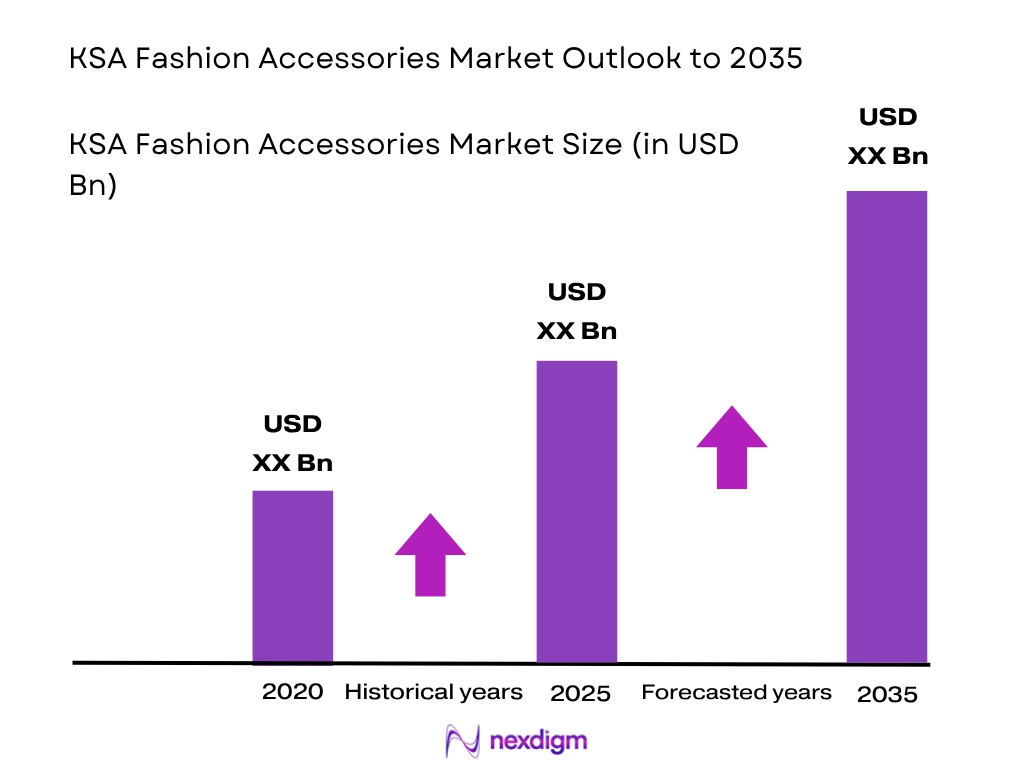
The KSA Fashion Accessories Market is valued at USD ~ billion, based on historical market assessment of product categories including handbags, eyewear, watches and jewellery. The market is forecast to reach USD ~ billion, with a source-published CAGR of 7.91% for the available forecast period; this is used as the CAGR benchmark for the extended outlook period. Growth is driven by luxury buying, handbags as the largest product segment at USD ~ billion, and online fashion accessory retail valued at USD ~ billion.
Riyadh, Jeddah and Dammam dominate the KSA Fashion Accessories Market because they combine dense urban populations, high mall concentration, premium retail districts, international brand presence, and stronger e-commerce fulfilment infrastructure. Saudi Arabia had 36.84 million internet users and 35,300,280 people, supporting mobile-first fashion retail demand. Riyadh and Jeddah also benefit from corporate employment, tourism flows, luxury malls and gifting demand, while Dammam and Khobar serve affluent Eastern Province consumers.
Market Segmentation
By Product Type
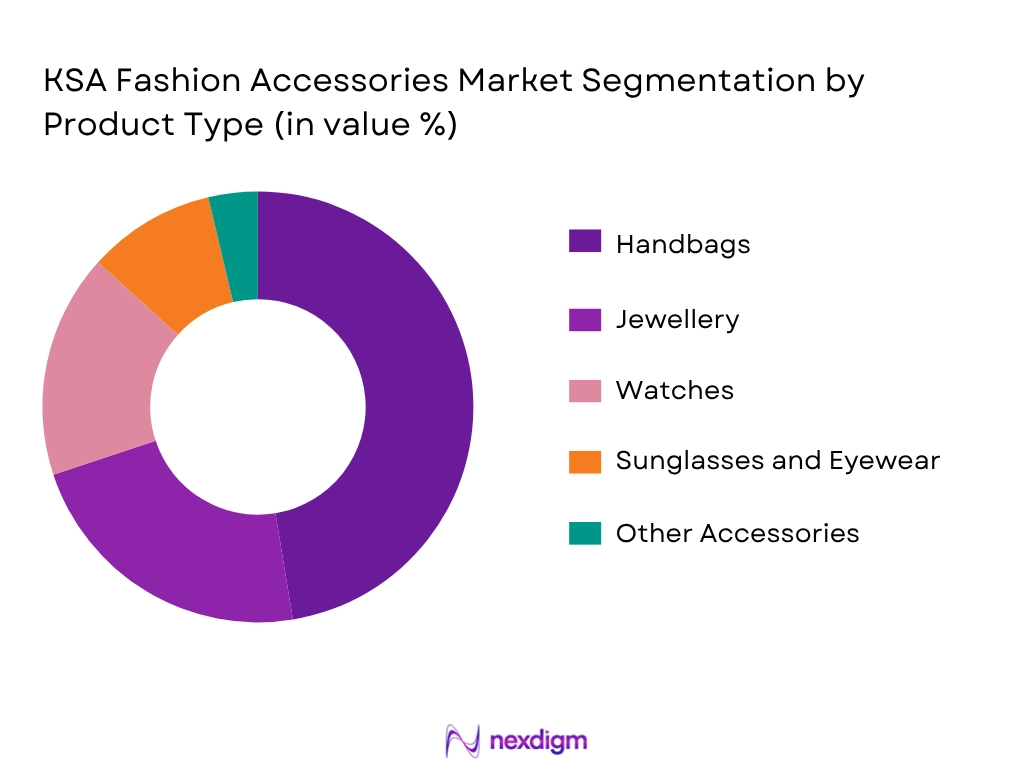
The KSA Fashion Accessories Market is segmented by product type into handbags, jewellery, watches, eyewear and other accessories. Recently, handbags have a dominant market share in the KSA Fashion Accessories Market under product type, as handbags operate across luxury, premium, mid-market and fast-fashion price points. Demand is supported by women consumers, gifting occasions, office wear, modest fashion styling and aspirational luxury purchases. International brands use handbags as a key entry product for Saudi customers because they carry visible brand value and higher repeat purchase potential than several durable categories. Handbags also benefit from strong retail visibility in malls, department stores, mono-brand stores and online luxury platforms. Nexdigm identifies handbags as the largest product segment and discloses handbag revenue at USD ~ billion, which supports the segment’s leadership in the product mix.
By End User
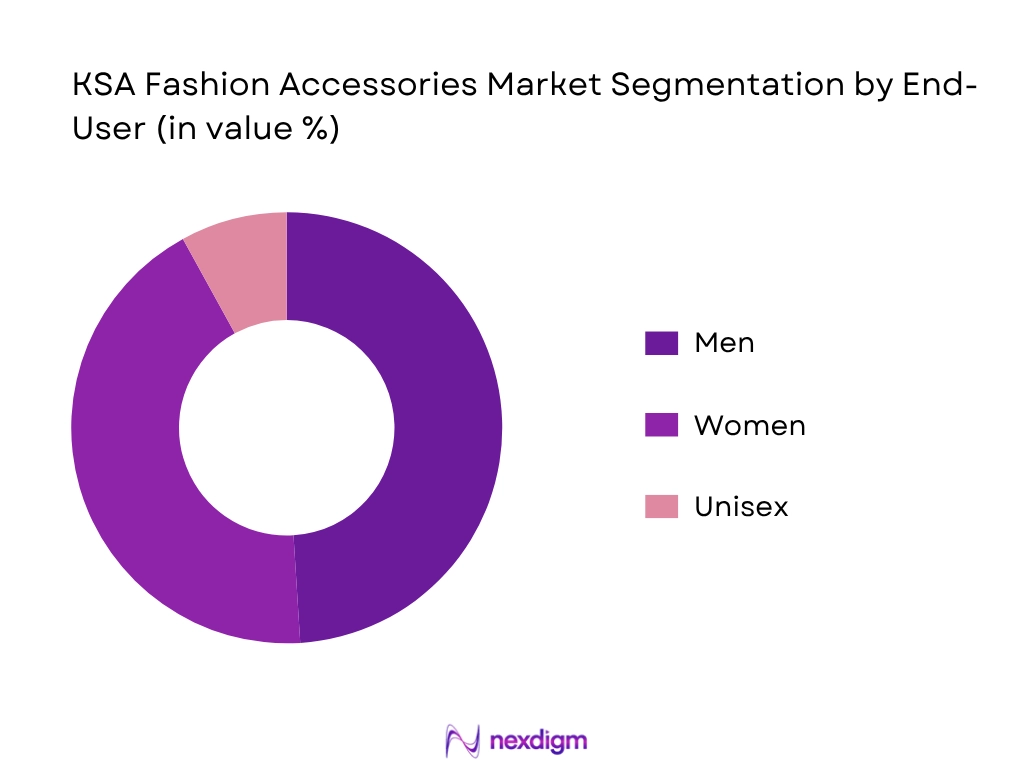
The KSA Fashion Accessories Market is segmented by end user into men, women and unisex consumers. Recently, men have a dominant market share in the KSA Fashion Accessories Market under end-user segmentation, supported by high-value watch purchases, wallets, belts, sunglasses, premium leather goods and corporate gifting. The segment benefits from affluent male consumers in Riyadh, Jeddah and the Eastern Province, where luxury watches, branded eyewear and leather accessories are purchased as status-led and utility-led items. At the same time, women remain central to handbags, fashion jewellery, scarves and occasion-led accessories, making the market highly balanced across gendered buying occasions. Nexdigm discloses men’s accessories revenue at USD ~ billion, making it the largest published end-user category in its segmentation table.
Competitive Landscape
The KSA Fashion Accessories Market is served by a combination of regional franchise groups, Saudi retail operators, luxury distributors, online fashion platforms and global fast-fashion brands. Chalhoub Group is especially relevant in luxury and premium accessories, while Alshaya Group, Apparel Group, Landmark Group and Cenomi Retail support broad retail access through malls, franchise stores and omnichannel fashion portfolios. Online competition is strengthened by platforms such as Namshi, Ounass, Noon, Amazon.sa and SHEIN.
| Company | Establishment Year | Headquarters | KSA Accessory Positioning | Key Accessory Categories | Channel Strength | Brand Portfolio Role | Omnichannel Capability | Market-Specific Strength |
| Chalhoub Group | 1955 | Dubai, UAE | ~ | ~ | ~ | ~ | ~ | ~ |
| Alshaya Group | 1890 | Kuwait City, Kuwait | ~ | ~ | ~ | ~ | ~ | ~ |
| Apparel Group | 1996 | Dubai, UAE | ~ | ~ | ~ | ~ | ~ | ~ |
| Landmark Group | 1973 | Dubai, UAE | ~ | ~ | ~ | ~ | ~ | ~ |
| Cenomi Retail | 1990/1991 | Riyadh, Saudi Arabia | ~ | ~ | ~ | ~ | ~ | ~ |
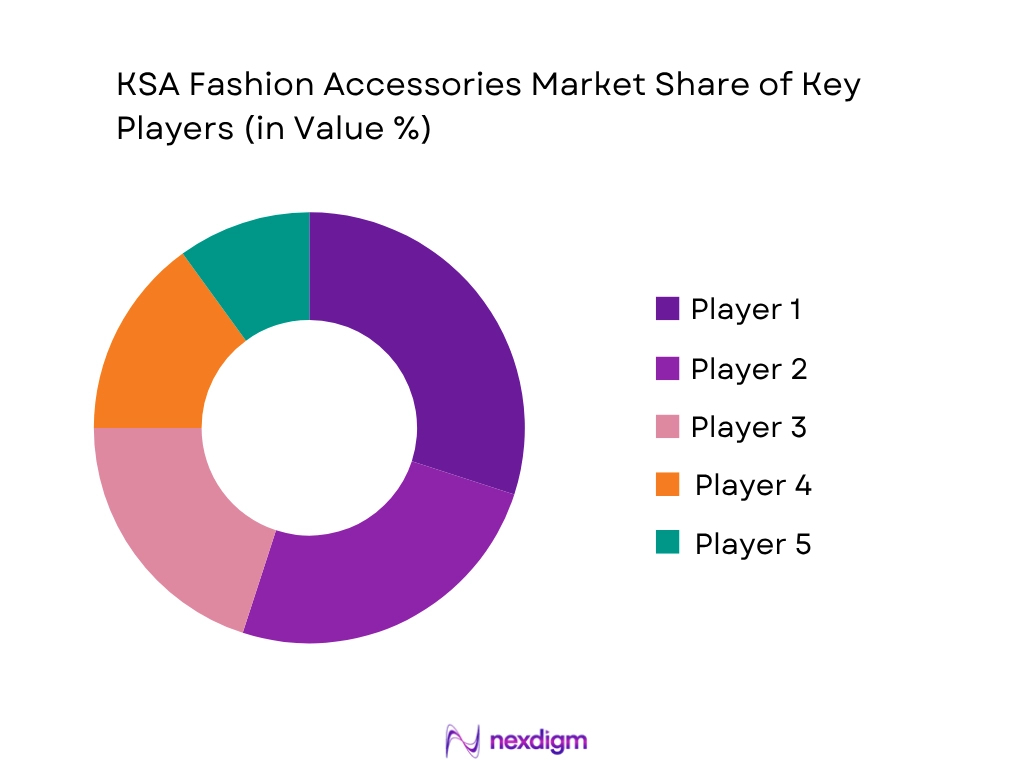
KSA Fashion Accessories Market Analysis
Growth Drivers
Disposable Income
Saudi Arabia’s high-income macro base supports discretionary spending on handbags, watches, sunglasses, jewellery, belts, wallets and premium modest-fashion accessories. World Bank data records Saudi Arabia’s GDP at USD 1.24 trillion and GDP per capita at USD 35,121.7, while GASTAT records the national population at 35,300,280. For fashion accessories, this creates a large consumer base with the income capacity to buy both utility-led and status-led products. Low consumer inflation of 1.7% also helps protect purchasing power for non-essential retail categories such as branded bags, eyewear and fashion jewellery. This is market-specific because accessories are strongly linked to disposable income, gifting, workwear styling, luxury consumption and mall-based retail. The same income base also supports premium retailers in Riyadh, Jeddah and Eastern Province, where accessories are often purchased as visible fashion statements rather than only functional products.
Women Workforce
Women’s rising participation in Saudi Arabia’s workforce is a direct growth driver for fashion accessories because employed women increase demand for office handbags, jewellery, scarves, sunglasses, wallets, watches and daily styling products. GASTAT reported Saudi female labour-force participation at 36.0%, the employment-to-population ratio at 31.8%, and Saudi female unemployment at 11.9% in Q4. The Saudi Women’s Statistics Report also records Saudi women’s unemployment at 13%, compared with 19% two years earlier, showing broader improvement in women’s economic participation. This matters for the KSA Fashion Accessories Market because workwear, social occasions, business events and mall shopping increase the need for formal and semi-formal accessories. A larger working female consumer base also strengthens premium handbag demand, modest styling accessories, jewellery layering, eyewear and gifting-led purchases. Retailers can localize collections around professional women, daily commute needs, corporate gifting and Ramadan/Eid wardrobe upgrades.
Market Challenges
Counterfeit Products
Counterfeit products remain a critical challenge for the KSA Fashion Accessories Market because handbags, watches, sunglasses, jewellery and branded leather goods are highly exposed to fake-product circulation. The U.S. Chamber’s International IP Index, citing SAIP border-enforcement reporting, states that SAIP and ZATCA seized close to 7 million counterfeit articles from 29 exporting markets in 2024. This is highly relevant to fashion accessories because brand authenticity is central to consumer trust in luxury handbags, eyewear, watches and jewellery. Counterfeits weaken brand equity, reduce confidence in online and informal channels, and create warranty and after-sales issues for legitimate retailers. For premium accessory players, anti-counterfeit control becomes a commercial requirement, not only a regulatory issue. Retailers must strengthen authenticity certificates, traceable imports, authorized distribution, marketplace screening and return inspection processes. In a market where gifting and visible branding matter, counterfeit leakage can directly affect consumer confidence and repeat purchase behaviour
High Import Dependence
High import dependence is a structural challenge because Saudi fashion accessories retail relies heavily on overseas sourcing for bags, clothing accessories, jewellery components, sunglasses, watches and branded SKUs. World Bank WITS/UN Comtrade data shows Saudi Arabia imported USD 78.36 million worth of clothing accessories under HS 621710, with 7,944,620 kg imported. China alone supplied USD 53.96 million and 6,306,600 kg, followed by Hong Kong at USD 11.02 million and Italy at USD 5.16 million. Handbags under HS 420229 also recorded USD 6.68 million in imports, with China at USD 3.64 million, Italy at USD 1.71 million and France at USD 251,520. This exposes accessory retailers to shipping lead times, customs delays, currency movements, supplier concentration and seasonal stock risk. For fast-moving accessories, missed delivery windows can directly affect Ramadan, Eid, wedding and tourism-season merchandising.
Market Opportunities
Local Designer Accessories
Local designer accessories represent a strong growth opportunity as Saudi Arabia builds a domestic fashion identity through official ecosystem support. The Fashion Commission’s Saudi 100 Brands initiative is specifically designed for 100 Saudi fashion companies, brands and designers to develop their potential, giving local accessory designers a formal platform for scaling. This matters for handbags, jewellery, scarves, headwear, belts and modest styling accessories because Saudi designers can integrate local aesthetics, Arabic identity, regional craftsmanship and occasion-led demand better than imported mass brands. The opportunity is supported by the broader macro base of 35,300,280 residents and GDP per capita of USD 35,121.7, which provides a commercially meaningful domestic market for premium local brands. Local accessories can also reduce reliance on imports and differentiate against global fast-fashion products. For retailers, curated Saudi designer accessory corners, capsule collections and tourism-facing Saudi-made gifting ranges can become high-value categories.
Modest-Fashion Styling
Modest-fashion styling is a major opportunity for the KSA Fashion Accessories Market because scarves, shawls, jewellery, handbags, belts, eyewear and hair accessories are central to Saudi wardrobe coordination. Current official tourism and pilgrimage data strengthens this opportunity: DataSaudi records 116 million tourists, including 29.7 million inbound tourists and 86.2 million domestic tourists, while other insights reported 1,833,164 Hajj pilgrims. It also reported approximately 2,906,239 domestic Umrah performers in Q3, including 1,023,040 female performers. These numbers support demand for culturally aligned, travel-friendly and occasion-led accessories around religious visits, family gatherings, gifting and modest wardrobe styling. Accessories are especially relevant because they allow consumers to refresh looks without replacing full outfits. Retailers can build collections around abaya-compatible handbags, neutral scarves, elegant jewellery sets, eyewear, travel pouches and Ramadan/Eid capsules. The opportunity is future-facing, but it is supported by current tourism, pilgrimage and resident-consumer scale.
Future Outlook
The KSA Fashion Accessories Market is expected to expand steadily, supported by premiumization, growing e-commerce penetration, social commerce, tourism-led spending and higher participation of young consumers in global fashion trends. Luxury handbags, jewellery, eyewear and watches will remain core revenue pools, while local designer accessories, personalized jewellery and sustainable materials will create newer whitespace opportunities. The source-published CAGR benchmark for the available forecast window is 7.91%, with the market projected to reach USD 30.19 billion by the end of the source forecast horizon. Growth will be concentrated around Riyadh, Jeddah and Eastern Province, but Tier-II cities will become increasingly relevant as mall infrastructure, online delivery coverage and BNPL usage improve. The online fashion accessories retail market, valued at USD ~ billion, will continue gaining relevance because Saudi Arabia has near-universal internet access and a young, mobile-first consumer base.
Major Players
- Chalhoub Group
- Alshaya Group
- Rubaiyat Modern Luxury
- Apparel Group
- Landmark Group
- Cenomi Retail
- Azadea Group
- Namshi
- Ounass
- Noon
- Amazon.sa
- Inditex / Zara
- H&M
- SHEIN
- Charles & Keith
Key Target Audience
- Luxury fashion accessory brands
- Fashion and lifestyle retail chains
- Online fashion marketplaces
- Mall developers and retail real estate owners
- Franchise operators and brand distributors
- Investments and venture capitalist firms
- Government and regulatory bodies (Saudi Fashion Commission, Ministry of Commerce, Zakat, Tax and Customs Authority, Communications, Space and Technology Commission, Saudi Standards, Metrology and Quality Organization)
- Logistics, fulfilment and payment solution providers
Research Methodology
Step 1: Identification of Key Variables
The initial phase involves mapping the KSA Fashion Accessories Market ecosystem, including luxury distributors, franchise retailers, mall operators, marketplaces, fashion brands, logistics providers and payment enablers. The objective is to identify market variables such as product mix, ASP movement, channel performance, import dependence, consumer demographics, gifting demand and regional demand clusters.
Step 2: Market Analysis and Construction
In this phase, historical market data is compiled and analyzed across handbags, jewellery, watches, eyewear and other fashion accessory categories. The approach combines top-down fashion retail sizing with bottom-up validation using SKU pricing, store count, category revenue benchmarks, online GMV, mall retail presence and available company disclosures.
Step 3: Hypothesis Validation and Expert Consultation
Market hypotheses are validated through structured interviews with retailers, distributors, online sellers, mall leasing teams, fashion category managers and industry experts. These discussions help validate category dominance, regional demand patterns, pricing tiers, online return issues, consumer preference changes and the competitive role of international versus local brands.
Step 4: Research Synthesis and Final Output
The final stage synthesizes secondary research, primary interview findings, competitive intelligence and triangulated sizing outputs into a validated market view. Product segmentation, end-user segmentation, competitive positioning and future outlook are aligned with market realities such as luxury spending, e-commerce growth, social media influence and Saudi retail transformation.

- Executive Summary
- Research Methodology (Market definitions and exclusions, fashion accessories taxonomy, revenue recognition approach, GMV-to-net-sales adjustment, ASP benchmarking, SKU basket mapping, mall-footfall validation, online marketplace scraping, retailer interviews, brand distributor interviews, import/export triangulation, primary research with consumers and retailers, bottom-up store economics, top-down apparel and luxury spend allocation, limitations and forecast assumptions)

- Definition and Scope
- Market Genesis and Evolution of Fashion Accessories Retail in KSA
- Timeline of Major Market Participants
- Business Cycle
- Value Chain and Supply Chain Analysis
- KSA Fashion Accessories Ecosystem
- Role of Vision 2030, Tourism, Entertainment and Women Workforce Participation
- Offline-to-Online Shift in Accessories Retail
- Imported vs Local Fashion Accessories Landscape

- Growth Drivers (Disposable income, women workforce, fashion awareness, tourism, mall expansion, mobile commerce, influencer-led discovery)
- Market Challenges (Counterfeit products, high import dependence, discounting pressure, return logistics, fragmented local brands, rental cost inflation)
- Market Opportunities (Local designer accessories, modest-fashion styling, Saudi-made accessories, sustainable materials, personalized jewellery, resale luxury, omnichannel loyalty)
- Market Trends (Quiet luxury, logo-light handbags, statement jewellery, social commerce, Arabic localization, BNPL, mobile-first retail, limited drops)
- Government Regulations and Compliance (E-commerce law, consumer protection, VAT, import duties, product labelling, intellectual property, data privacy, return policy transparency)
- SWOT Analysis (Luxury demand, omnichannel scale, imported-brand exposure, local designer opportunity)
- Porter’s Five Forces Analysis (Supplier concentration, buyer bargaining power, marketplace competition, substitute products, new entrant threat)
- Stakeholder Ecosystem (Brand principals, franchise operators, mall developers, marketplaces, logistics providers, payment providers, influencers, regulators)
- Supply Chain Risk Analysis (Import lead time, SKU seasonality, customs clearance, inventory ageing, reverse logistics, high-value product security)
- Pricing and Margin Pool Analysis (ASP ladder, gross margin by category, markdown dependency, commission cost, fulfilment cost, return cost)
- Consumer Journey Mapping (Discovery, comparison, trial, purchase, fulfilment, return, loyalty, repeat purchase)
- Demand Heat Map (Riyadh, Jeddah, Eastern Province, holy cities, tourism corridors, premium mall catchments)

- By Value (2020-2025)
- By Volume (2020-2025)
- By Average Selling Price
- By Online GMV (2020-2025)
- By Offline Retail Sales (2020-2025)
- By Luxury and Premium Accessories Sales (2020-2025)

- By Product Type (In Value %)
Handbags and Purses
Fashion Jewellery
Watches
Sunglasses and Eyewear
Belts and Wallets
Scarves, Shawls and Wraps
Hair Accessories
Hats, Caps and Headwear
Travel Accessories and Small Leather Goods - By Consumer Segment (In Value %)
Women
Men
Children
Unisex
Gen Z and Young Millennials
Affluent and High-Net-Worth Consumers - By Price Positioning (In Value %)
Luxury
Premium
Bridge-to-Luxury
Mid-Market
Value and Budget
Fast-Fashion Accessories - By Distribution Channel (In Value %)
Mono-Brand Stores
Multi-Brand Luxury Boutiques
Department Stores
Hypermarkets and Lifestyle Stores
Online Marketplaces
Brand-Owned Websites and Apps
Social Commerce
Cross-Border E-commerce
Airport, Travel Retail and Hotel Retail - By Region and City Cluster (In Value %)
Riyadh
Jeddah
Dammam and Khobar
Makkah and Madinah
Abha and Southern Region
Tier-II and Tier-III Cities - By Material Type (In Value %)
Leather
Vegan Leather and PU
Precious Metals and Plated Metals
Stainless Steel and Alloy
Textile and Fabric
Acetate and Plastic
Sustainable and Recycled Materials - By Occasion and Usage (In Value %)
Daily Wear
Workwear and Office Styling
Wedding and Festive Wear
Ramadan and Eid Gifting
Luxury Gifting
Travel and Leisure
Athleisure and Casual Styling - By Brand Origin (In Value %)
International Luxury Brands
Regional GCC Brands
Saudi Local Designer Brands
Turkish and Asian Import Brands
Private Label Accessories - By Purchase Mode (In Value %)
Planned Purchase
Impulse Purchase
Occasion-Led Purchase
Gift Purchase
Influencer-Led Purchase

- Market Share of Major Players (By value, online GMV, store footprint, luxury accessories sales, product category strength, Channel)
- Cross Comparison Parameters (Company overview, KSA store footprint by city/mall, accessory category breadth, luxury/premium brand portfolio, online GMV and AOV, omnichannel capability, localization and Arabic UX, influencer/social commerce strength, return and fulfilment performance, pricing and discounting strategy, private label strength, supplier partnerships, customer loyalty program, recent developments, revenue, strengths, weaknesses)
- Competitive Benchmarking Matrix (Luxury depth, affordability, delivery speed, assortment width, authenticity assurance, consumer trust, loyalty, personalization)
- Pricing Analysis by SKU Basket (Handbags, wallets, sunglasses, watches, fashion jewellery, scarves, belts, hair accessories)
- Promotion and Discounting Analysis (Ramadan offers, Eid campaigns, White Friday, payday promotions, loyalty coupons, BNPL offers)
- Omnichannel Capability Analysis (Store pickup, ship-from-store, app integration, real-time inventory, returns, loyalty integration)
- SWOT Analysis of Major Players (Retail footprint, brand access, e-commerce scale, margin pressure, counterfeit protection, localization)
- Detailed Profiles of Major Companies
Chalhoub Group
Alshaya Group
Rubaiyat Modern Luxury
Apparel Group
Landmark Group
Cenomi Retail
Azadea Group
Namshi
Ounass
Noon
Amazon.sa
Inditex / Zara
H&M
SHEIN
Charles & Keith

- Demand and Utilization Pattern (Daily wear, office wear, festive wear, gifting, travel, luxury statement purchases)
- Purchasing Power and Basket Size (AOV, ASP, purchase frequency, premium spend share, BNPL adoption)
- Needs, Desires and Pain Points (Authenticity, fit/style confidence, fast delivery, Arabic UX, easy returns, product warranty, premium packaging)
- Decision-Making Process (Brand recall, influencer impact, peer validation, mall browsing, online reviews, price comparison)
- Customer Cohort Analysis (Gen Z, millennials, working women, affluent households, tourists, modest-fashion buyers)
- Brand Loyalty and Switching Behaviour (Discount sensitivity, loyalty programs, exclusive drops, after-sales service, omnichannel experience)
- Gifting Behaviour Analysis (Ramadan, Eid, weddings, graduation, corporate gifting, luxury gifting)

- By Value (2026-2035)
- By Volume (2026-2035)
- By Average Selling Price (2026-2035)
- By Online GMV (2026-2035)
- By Offline Retail Sales (2026-2035)
- By Luxury and Premium Accessories Sales (2026-2035)


 Request a Sample
 Ask for Customization
 Get a Quote
 Enquire Now