
 Download PDF
Market Overview
The KSA fertilizer market is one of the most strategically significant agricultural input markets in the Middle East, underpinned by the Kingdom’s dual role as both a major global fertilizer producer and a country with an ambitious domestic agricultural development agenda under Vision 2030. Saudi Arabia cultivates approximately 3 million hectares of agricultural land, producing wheat, date palms, vegetables, fruits, alfalfa, and a growing range of greenhouse crops under highly challenging desert conditions. Fertilizer consumption is shaped by the Kingdom’s food security imperatives, large-scale government-linked farming enterprises, rapid expansion of protected and controlled-environment agriculture, and the widespread adoption of fertigation and precision irrigation systems that require water-soluble and slow-release nutrient formulations. At the same time, Saudi Arabia hosts two of the world’s most significant fertilizer producers — SABIC Agri-Nutrients and Ma’aden — making the KSA both a substantial domestic fertilizer consumer and a globally important exporter of nitrogen and phosphate fertilizer products.
Market Segmentation
By Nutrient Type
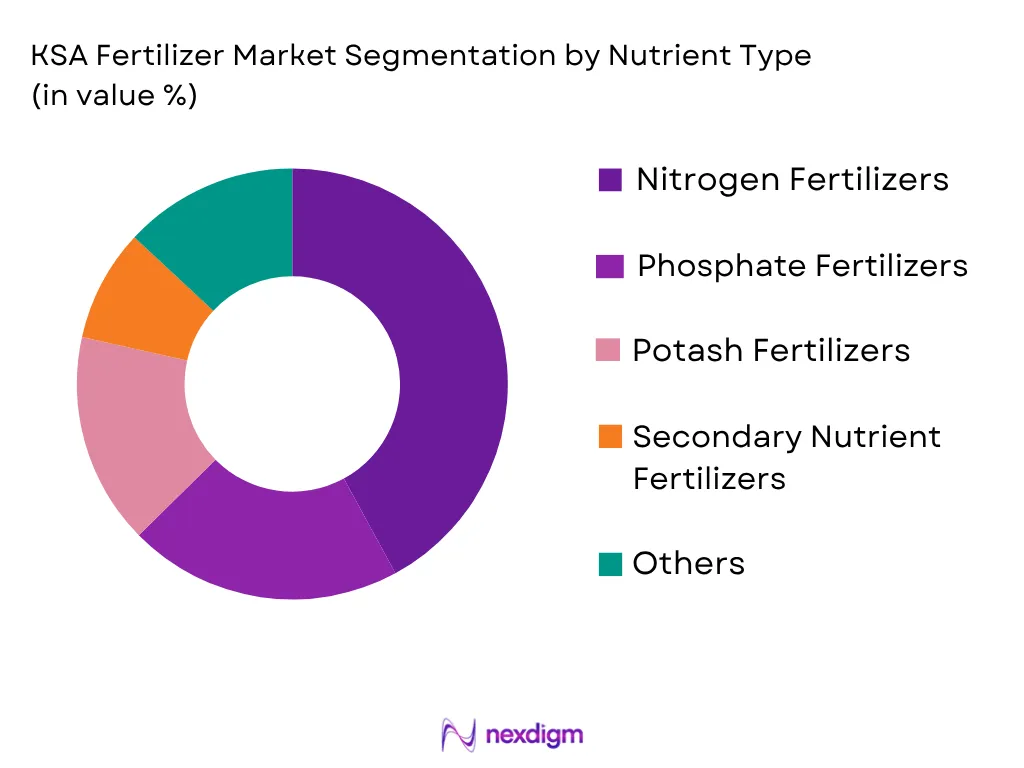
Nitrogen fertilizers dominate the KSA fertilizer market due to the widespread cultivation of wheat, date palms, vegetables, and alfalfa across the Kingdom, all of which require consistent nitrogen applications to sustain productivity in nutrient-poor desert and sandy loam soils. Saudi soils are inherently low in organic matter and nitrogen content, making regular fertilization essential for achieving commercially viable yields. The extensive use of center-pivot irrigation, drip fertigation, and greenhouse growing systems further amplifies nitrogen demand, as water-soluble nitrogen-based formulations are the preferred delivery method in precision-managed farms. Growing adoption of advanced nutrient management programs by large government-linked agricultural companies including NADEC, Almarai, TADCO, and HADCO continues to reinforce the dominance of nitrogen fertilizers across the KSA market.
By Crop Type
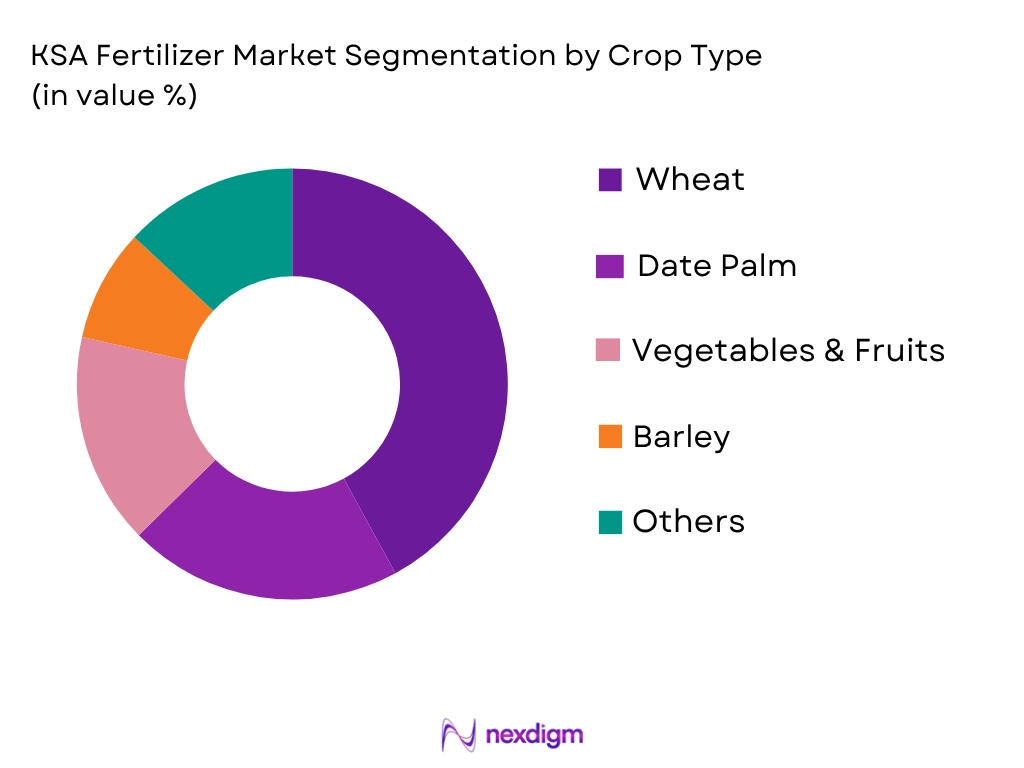
Wheat represents the dominant crop segment within the KSA fertilizer market, as it has historically been the centerpiece of Saudi Arabia’s food self-sufficiency strategy and continues to occupy a significant share of irrigated commercial farmland. Despite policy shifts that reduced domestic wheat procurement subsidies, wheat production remains strategically important across Al Qassim, Tabuk, Hail, and the Eastern Province, with large-scale commercial farms relying on intensive fertilization programs to maximize yields under water-constrained growing conditions. Wheat requires substantial applications of nitrogen, phosphorus, and micronutrients to achieve competitive grain yields in arid environments. Additionally, rising policy interest in food security under Vision 2030 is encouraging renewed investments in domestic grain production using advanced irrigation efficiency and precision nutrient management technologies. Consequently, wheat farming remains the largest single contributor to fertilizer consumption throughout the Kingdom.
Competitive Landscape
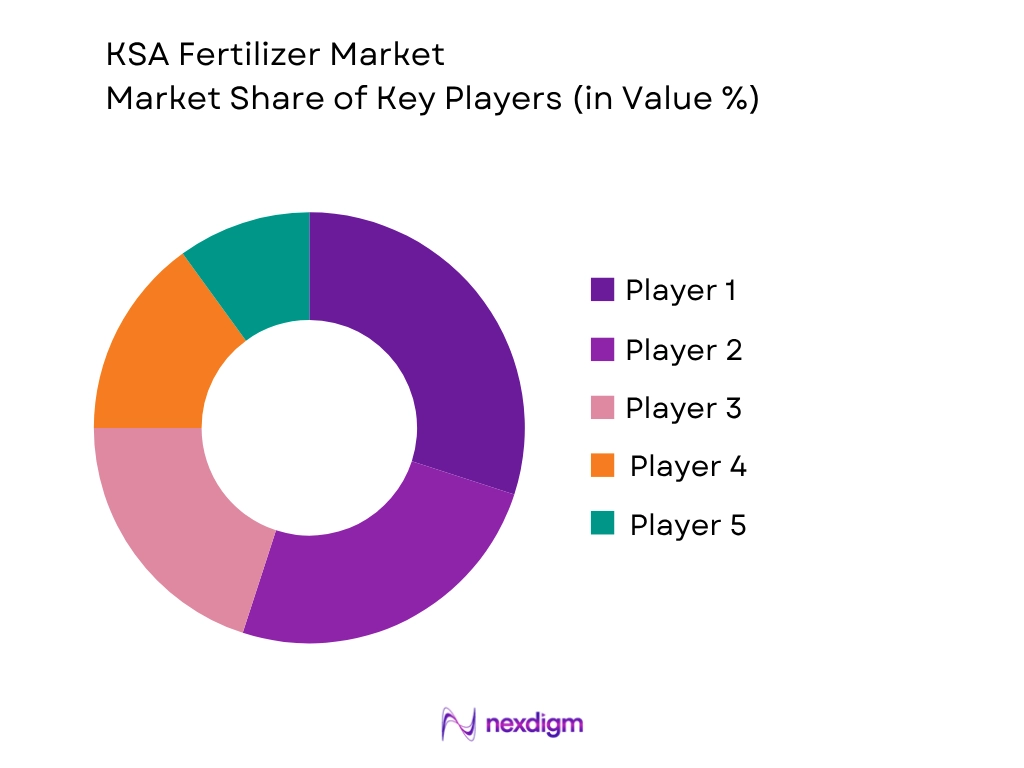
The KSA fertilizer market is characterized by a highly unique competitive structure in which large state-linked petrochemical and mining companies dominate domestic production while international specialty fertilizer companies serve the growing demand for advanced and customized nutrient solutions. SABIC Agri-Nutrients and Ma’aden together represent some of the world’s largest capacity nitrogen and phosphate fertilizer producers, exporting a substantial portion of their output while also supplying the domestic agricultural sector. International companies including Yara, Haifa Group, ICL, and SQM compete in the specialty and water-soluble segment, which is rapidly expanding alongside Saudi Arabia’s protected agriculture sector. Companies compete through product quality, technical agronomic support, supply reliability, and the ability to deliver crop-specific nutrient programs tailored to arid-climate farming systems.
| Company | Establishment Year | Headquarters | Product Portfolio | Production & Blending Facilities
|
Import Infrastructure | Distribution Reach | Specialty Fertilizer Portfolio | Agronomic Support Network |
| SABIC Agri-Nutrients | 1976 | ~ | ~ | ~ | ~ | ~ | ~ | ~ |
| Ma’aden Phosphate Company | 2009 | ~ | ~ | ~ | ~ | ~ | ~ | ~ |
| Yara Saudi Arabia | 1905 | ~ | ~ | ~ | ~ | ~ | ~ | ~ |
| Haifa Group Saudi Arabia | 1966 | ~ | ~ | ~ | ~ | ~ | ~ | ~ |
| ICL Specialty Fertilizers KSA | 1968 | ~ | ~ | ~ | ~ | ~ | ~ | ~ |
KSA Fertilizer Market Analysis
Growth Drivers
Food Security Strategy and Vision 2030 Agricultural Development Programs
The KSA fertilizer market is fundamentally driven by the Kingdom’s national food security agenda and the sweeping agricultural development goals embedded within Vision 2030. According to the Saudi Ministry of Environment, Water and Agriculture (MEWA), Saudi Arabia imports approximately 80% of its food requirements, creating strategic urgency to expand domestic agricultural production across a wide range of crops. Vision 2030’s agricultural pillar targets substantial growth in domestic food output, greenhouse farming, vertical cultivation, and precision irrigation systems, all of which require consistent and high-quality fertilizer inputs. The Saudi government has directed significant investment toward large state-linked agricultural enterprises including NADEC, Almarai, TADCO, HADCO, and SADO, which operate extensive irrigated farmlands across Al Qassim, Tabuk, Hail, and the Eastern Province. According to the World Bank, Saudi Arabia’s GDP exceeded USD 1.06 trillion in 2024, providing substantial fiscal capacity to fund agricultural infrastructure, input subsidies, and rural development programs. The Saudi Agricultural Development Fund provides concessional financing to commercial and smallholder farmers for fertilizer procurement, irrigation upgrades, and crop intensification. These strategic programs create consistent and growing demand for nitrogen, phosphate, potassium, and specialty fertilizer products, particularly water-soluble formulations suited to fertigation and controlled-environment agricultural systems throughout the Kingdom.
Expansion of Protected Agriculture and Controlled-Environment Farming
The rapid expansion of protected agriculture, greenhouse cultivation, and controlled-environment production systems is a major structural driver of fertilizer demand in Saudi Arabia. According to MEWA, the area under greenhouse and shaded net house cultivation has grown substantially over recent years as farmers seek to overcome the limitations of extreme heat, water scarcity, and sandy soils that constrain open-field productivity. The Kingdom’s year-round sunshine, combined with advanced cooling technologies and drip fertigation systems, makes controlled-environment agriculture increasingly economically viable for high-value vegetable, fruit, and herb production. Water-soluble fertilizers, liquid nutrient concentrates, and controlled-release formulations are essential inputs within these production systems, supporting consistent fertilizer demand independent of seasonal variation. Saudi Arabia’s population exceeded 36 million in 2024, driving domestic consumption of fresh vegetables, fruits, and dairy products that are increasingly produced domestically. The International Monetary Fund recorded robust economic activity in Saudi Arabia supported by oil revenues and non-oil sector growth, enabling continued public and private investment in advanced agricultural infrastructure. As commercial greenhouse clusters expand across Riyadh, Al Qassim, Tabuk, and Jizan, demand for specialized fertilizer products adapted to substrate-based, hydroponic, and aeroponic growing systems continues to strengthen across the KSA fertilizer market.
Market Challenges
Severe Water Scarcity and Groundwater Depletion
The most fundamental challenge facing the KSA fertilizer market is the Kingdom’s extreme water scarcity, which directly constrains the scale, sustainability, and economics of domestic agricultural production. Saudi Arabia has no permanent rivers or lakes and relies almost entirely on non-renewable fossil groundwater aquifers, desalination plants, and limited treated wastewater for agricultural irrigation. According to MEWA, Saudi Arabia’s total renewable freshwater resources are among the lowest per capita globally, and extensive groundwater extraction for center-pivot wheat irrigation over past decades has significantly depleted major aquifer systems including the Saq and Wajid aquifers. The Saudi government’s policy decision to phase out subsidized wheat production from rainfall-free zones was directly driven by unsustainable groundwater depletion. Water scarcity reduces the potential area of irrigated agriculture, limits the expansion of fertilizer-intensive crop systems, and increases the cost of agricultural production. Fertilizer use efficiency is also affected by sandy soils with low water retention capacity, high evaporation rates, and salinity accumulation from long-term irrigation. These constraints require specialized fertilizer formulations, soil conditioners, and precision nutrient delivery systems that increase input complexity and cost for Saudi farmers, creating ongoing operational challenges throughout the KSA fertilizer market.
Dependence on Imported Specialty Fertilizers and Crop Policy Adjustments
While Saudi Arabia is a major producer of nitrogen and phosphate fertilizers through SABIC and Ma’aden, the KSA fertilizer market remains dependent on imported specialty fertilizers, potassium products, and advanced micronutrient formulations that domestic producers do not manufacture at scale. Potash fertilizers are entirely imported, with major supply origins including Russia, Belarus, Canada, and Jordan, exposing the market to global commodity price fluctuations and geopolitical supply risks. Specialty water-soluble fertilizers, biostimulants, controlled-release coatings, and micronutrient chelates required by the growing greenhouse and protected agriculture sector are predominantly sourced from European, Israeli, and Asian manufacturers. Additionally, historical policy shifts — particularly the reduction and eventual elimination of domestic wheat purchase subsidies — have created structural adjustments in crop selection, cultivated area, and fertilizer demand patterns. Farmers have responded by shifting toward date palms, vegetables, fruits, and alfalfa, which have distinct fertilizer requirements compared to wheat. These crop portfolio changes require fertilizer distributors and agronomic advisors to continually adapt product recommendations, supply chains, and blending formulations, adding complexity to market operations and creating transitional demand uncertainty across several fertilizer product categories.
Market Opportunities
Expansion of Ma’aden and SABIC Domestic Fertilizer Production Capacity
Saudi Arabia’s world-class fertilizer production assets represent a significant opportunity to deepen domestic supply chains, expand product range, and increase the volume of specialty and value-added fertilizer products available to Saudi farmers. Ma’aden operates the integrated phosphate mining and processing complex at Wa’ad Al Shamal in the Northern Borders region, with production capacity covering diammonium phosphate (DAP), monoammonium phosphate (MAP), and granular urea. SABIC Agri-Nutrients operates nitrogen fertilizer plants in Jubail Industrial City, producing urea, ammonia, and ammonium sulfate for both export and domestic use. According to Ma’aden’s annual reports, ongoing capacity expansions and downstream processing investments are expected to increase production volumes and product diversity over the coming years. Leveraging these production assets to develop a broader range of crop-specific and water-soluble formulations tailored to Saudi agricultural conditions represents a strategic opportunity to reduce specialty fertilizer import dependency and increase the competitiveness of domestically produced inputs. Government incentives under Vision 2030’s industrial development programs and the National Industrial Development and Logistics Program (NIDLP) further support investment in value-added fertilizer manufacturing and downstream blending operations across the Kingdom.
Growth of Specialty, Biological, and Sustainable Fertilizers Aligned with Vision 2030 Sustainability Goals
Saudi Arabia’s commitment to sustainability under Vision 2030, including targets for renewable energy, carbon emissions reduction, and environmental stewardship, is creating meaningful opportunities for specialty and biological fertilizer products. The Saudi Green Initiative, launched in 2021, targets the planting of 10 billion trees across the Kingdom and the restoration of degraded land, indirectly supporting demand for soil amendment and organic fertilizer products. Commercial farms, government agricultural enterprises, and research institutions are increasingly seeking nutrient solutions that minimize environmental impact, reduce water consumption, and improve soil organic matter in heavily degraded desert soils. Biostimulants, biofertilizers, slow-release nitrogen formulations, and organomineral blends are gaining acceptance across the protected agriculture and date palm cultivation sectors. The King Abdullah University of Science and Technology (KAUST) and the Saudi Grains Organization are actively supporting agricultural research into sustainable nutrient management practices suited to arid environments. Additionally, Saudi Arabia generates substantial volumes of date processing waste, animal manure from large dairy and poultry operations, and agro-industrial residues that present opportunities for compost-based and organomineral fertilizer development. These trends position biological and sustainable fertilizers as a growing and strategically important segment within the KSA fertilizer market over the forecast period.
Future Outlook
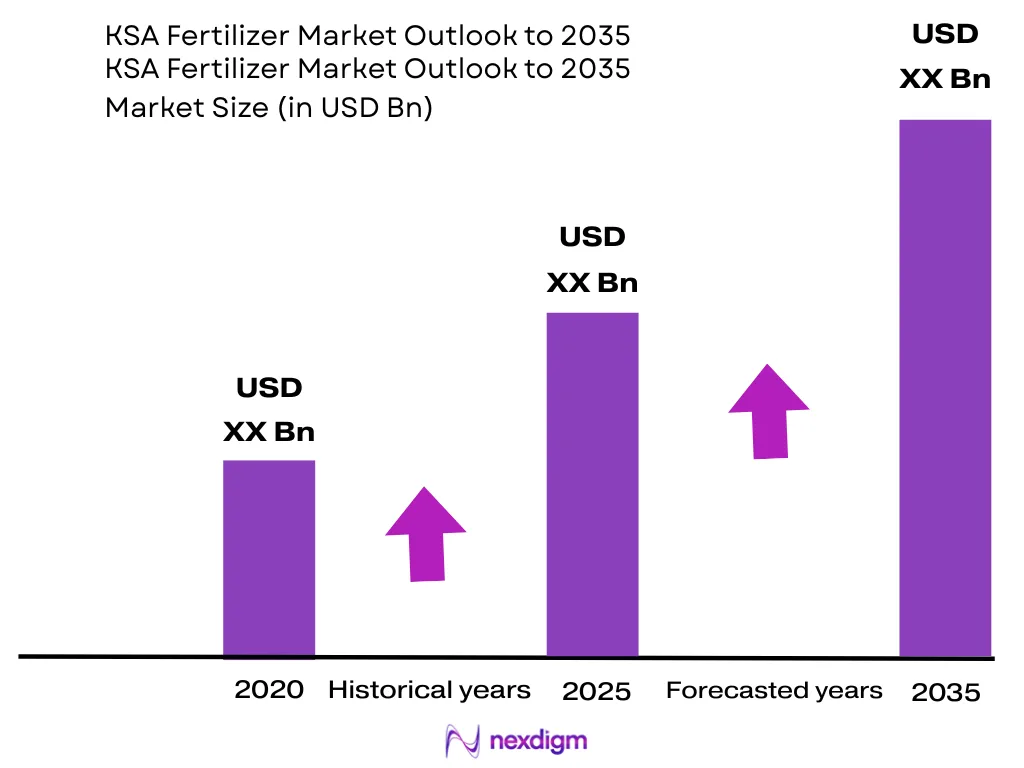
The KSA fertilizer market is expected to witness sustained growth over the forecast period driven by continued Vision 2030 agricultural investments, rapid expansion of protected and controlled-environment farming, and the Kingdom’s growing commitment to domestic food production and food security. Government programs channeled through MEWA, the Saudi Agricultural Development Fund, and large state-linked agricultural enterprises are expected to sustain investment in precision irrigation, fertigation, and advanced nutrient management practices. Rising demand for specialty fertilizers, micronutrients, water-soluble formulations, and biological solutions will further support market expansion. Additionally, Ma’aden and SABIC’s capacity development programs, combined with growing downstream blending and formulation capabilities, are likely to strengthen both domestic supply and the Kingdom’s position as a global fertilizer export hub over the long term.
Major Players
- SABIC Agri-Nutrients Company
- Ma’aden Phosphate Company (MPC)
- Ma’aden Wa’ad Al Shamal Phosphate Company (MWSPC)
- Yara Saudi Arabia
- Haifa Group Saudi Arabia
- ICL Specialty Fertilizers KSA
- SQM Saudi Arabia
- Compo Expert Middle East
- Agri Advanced Industries KSA
- Al Rajhi Agriculture
- Saudi Agricultural Development Company (SADO)
- National Agricultural Development Company (NADEC)
- Almarai Agricultural Division
- Tabuk Agricultural Development Company (TADCO)
- Hail Agricultural Development Company (HADCO)
Key Target Audience
- Fertilizer Manufacturers and Petrochemical Companies
- Agricultural Input Distributors and Retailers
- Commercial and Government-Linked Farming Enterprises
- Agribusiness Investment Companies
- Investments and Venture Capitalist Firms
- Government and Regulatory Bodies (Ministry of Environment Water and Agriculture – MEWA, Saudi Agricultural Development Fund, Saudi Food and Drug Authority, National Center for Agricultural Technology)
- Fertilizer Importers and Exporters
- Precision Agriculture Technology Providers
Research Methodology
Step 1: Identification of Key Variables
The initial phase involves constructing an ecosystem map encompassing all major stakeholders within the KSA Fertilizer Market. Extensive secondary research is conducted through industry publications, government databases, company annual reports, trade associations, and agricultural statistics. The objective is to identify critical variables influencing fertilizer demand, supply, pricing, imports, exports, and crop production.
Step 2: Market Analysis and Construction
This phase focuses on gathering and analyzing historical information regarding fertilizer production, exports, imports, nutrient consumption, crop acreage, and agricultural output. Market revenues are estimated through analysis of fertilizer volumes, average selling prices, and nutrient demand trends. Both supply-side and demand-side assessments are incorporated to develop comprehensive market estimates.
Step 3: Hypothesis Validation and Expert Consultation
Preliminary findings and market assumptions are validated through structured interviews with fertilizer manufacturers, distributors, agricultural enterprises, agronomists, and industry specialists. These consultations provide valuable insights into purchasing patterns, nutrient application trends, production economics, and future market developments.
Step 4: Research Synthesis and Final Output
The final stage integrates findings obtained from primary and secondary research. Data triangulation techniques are applied to ensure consistency and reliability across all market estimates. The resulting report provides a comprehensive assessment of market structure, competitive dynamics, growth opportunities, and long-term industry outlook for the KSA Fertilizer Market.

- Executive Summary
- Research Methodology (Market Definitions and Assumptions, Abbreviations, Market Sizing Approach, Top-Down Analysis, Bottom-Up Analysis, Fertilizer Demand Assessment by Crop Area, Nutrient Consumption Analysis, Import-Export Assessment, Primary Industry Interviews, Data Triangulation, Forecasting Framework, Limitations and Future Conclusions)

- Definition and Scope
- Market Evolution and Industry Genesis
- Timeline of Major Industry Developments
- KSA Agricultural Production Ecosystem
- Fertilizer Industry Value Chain Analysis

- Growth Drivers (Expansion of Wheat and Date Palm Cultivation, Rising Food Security Priorities under Vision 2030, Increasing Adoption of Precision Agriculture and Smart Irrigation, Government-Subsidized Agricultural Programs, Growth in Greenhouse and Protected Farming, Rising Demand for Water-Efficient Nutrient Solutions)
- Market Challenges (Severe Water Scarcity and Groundwater Depletion, Dependence on Imported Fertilizer Products, Harsh Arid Climatic Conditions and Soil Infertility, High Agricultural Production Costs, Reduction of Wheat Subsidy and Crop Policy Shifts)
- Market Opportunities (Domestic Fertilizer Production Expansion via SABIC and Ma’aden, Specialty Fertilizer Growth, Biofertilizer Adoption, Precision Nutrient Management Solutions, Growth in Vertical and Controlled-Environment Farming)
- Market Trends (Increased Use of Water-Soluble and Slow-Release Fertilizers, Digital Agriculture Integration, Customized Nutrient Blends for Arid Soils, Carbon-Efficient Crop Nutrition, Expansion of Biological and Organic Inputs)
- Government Regulations (Ministry of Environment Water and Agriculture Standards, Saudi Food and Drug Authority Requirements, Environmental Licensing Standards, Nutrient Quality Regulations, Import and Trade Policies)
- Import Dependency Assessment (Potash Import Ratio, Phosphate Import Ratio, Nitrogen Self-Sufficiency Assessment, Supplier Country Concentration)
- Raw Material Analysis (Natural Gas and Petrochemical Feedstock Availability, Phosphate Rock Reserves, Potash Availability, Sulfur Supply from Oil and Gas Processing)
- Fertilizer Consumption Intensity Analysis (Kg per Hectare, Nutrient Use Efficiency, Crop-Wise Consumption, Regional Application Rates)
- Price Trend Analysis (Urea Prices, MAP Prices, DAP Prices, Potash Prices, NPK Prices)
- Supply-Demand Gap Analysis (Domestic Production Capacity, Installed Capacity Utilization, Export Volumes, Import Requirements, Inventory Levels)
- SWOT Analysis
- Porter’s Five Forces Analysis
- PESTLE Analysis
- Stakeholder Ecosystem
- Competition Ecosystem

- By Market Value (2020-2025)
- By Production Volume (2020-2025)
- By Average Selling Price (2020-2025)

- By Nutrient Type (In Value %)
Nitrogen Fertilizers
Phosphate Fertilizers
Potash Fertilizers
Secondary Nutrient Fertilizers
Micronutrient Fertilizers
Specialty and Customized Fertilizers - By Application Method (In Value %)
Soil Application
Fertigation
Foliar Application
Seed Treatment
Precision Agriculture Application - By Crop Type (In Value %)
Wheat
Date Palm
Vegetables
Fruits
Barley
Alfalfa and Forage Crops
Greenhouse Crops
Herbs and Spices
Others - By Region (In Value %)
Riyadh
Eastern Province
Makkah
Madinah
Al Qassim
Tabuk
Other Regions (Hail, Jizan, Asir, Najran, Al Jawf, Northern Borders) - By Distribution Channel (In Value %)
Government Agricultural Bodies and Cooperatives
Agricultural Retailers
Direct Sales by Manufacturers
Distributors and Wholesalers
Digital Agricultural Platforms

- Market Share Analysis of Major Players (By Value, By Volume, Nutrient Segment, Crop Segment, By Region)
- Market Concentration Analysis
- Cross Comparison Parameters (Product Portfolio Diversity, Annual Fertilizer Production Capacity, Blending Capacity, Export Infrastructure, Distribution Network Reach, Agronomic Technical Service Coverage, Specialty Fertilizer Portfolio Strength, Crop-Specific Nutrient Solution Capability)
- SWOT Analysis of Major Players
- Pricing Analysis by Product Type and Nutrient Grade
- Detailed Profiles of Major Companies
SABIC Agri-Nutrients Company
Ma’aden Phosphate Company (MPC)
Ma’aden Wa’ad Al Shamal Phosphate Company (MWSPC)
Yara Saudi Arabia
Haifa Group Saudi Arabia
ICL Specialty Fertilizers KSA
SQM Saudi Arabia
Compo Expert Middle East
Agri Advanced Industries KSA
Al Rajhi Agriculture
Saudi Agricultural Development Company (SADO)
National Agricultural Development Company (NADEC)
Almarai Agricultural Division
Tabuk Agricultural Development Company (TADCO)
Hail Agricultural Development Company (HADCO)

- Crop Nutrient Consumption Assessment (Crop Area, Yield Targets, Nutrient Removal Rates, Fertilizer Intensity)
- Farm Size Analysis (Small-Scale Farms, Medium Farms, Large Commercial and Government-Linked Farms)
- Purchasing Power Analysis (Farm Income Levels, Subsidy Access, Fertilizer Budget Allocation)
- Seasonal Demand Assessment (Planting Cycles, Crop Calendar, Procurement Patterns)
- Farmer Purchasing Behavior (Brand Preference, Nutrient Preference, Price Sensitivity)
- Precision Agriculture Adoption Analysis (GPS-Based Application, Variable Rate Technology, Digital Farm Management)
- Sustainability Adoption Analysis (Carbon Reduction Practices, Soil Health Management, Water Conservation Agriculture)
- Pain Point Analysis (Input Costs, Water Availability, Nutrient Availability, Logistics Challenges, Agronomic Support)
- Purchase Decision-Making Process

- By Market Value (2026-2035)
- By Production Volume (2026-2035)
- By Average Selling Price (2026-2035)


 Request a Sample
 Ask for Customization
 Get a Quote
 Enquire Now