

 Download PDF
Market Overview
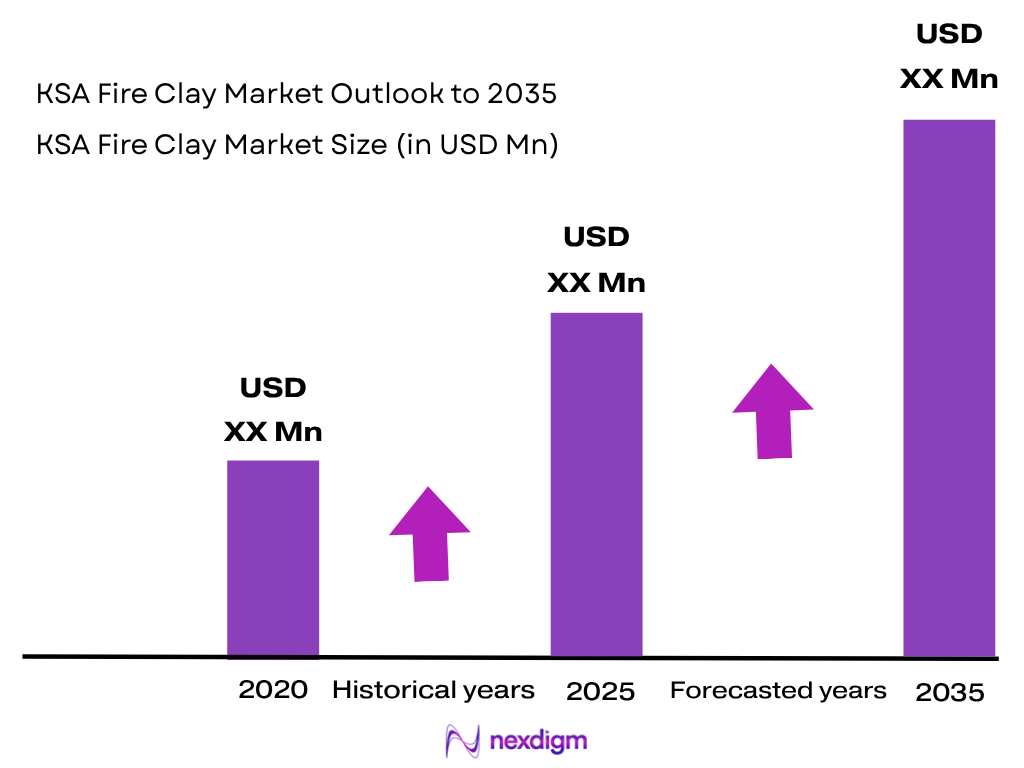
The KSA Fire Clay Market is valued at approximately USD ~ million, supported by demand from refractory manufacturing, steelmaking, cement kilns, petrochemical furnaces and other high-temperature industrial applications. Saudi Arabia imported 2.94 million kg of fire clay valued at USD 1.23 million in the preceding comparable period, while the subsequent trade period recorded approximately 1.96 million kg valued at USD 1.40 million. The market is consequently characterized by specialized industrial consumption, imported raw-material dependence and growing interest in domestic refractory localization.
Jubail, Dammam and the wider Eastern Province form the principal demand concentration for the KSA Fire Clay Market because these locations contain major petrochemical, refining, metals and industrial-processing infrastructure. Riyadh also represents an important consumption and distribution center, while Jeddah and western industrial areas support cement, construction-material and manufacturing demand. Jubail is becoming particularly important for refractory localization, with a new 16,300-square-meter refractory manufacturing facility designed to supply steel, cement, petrochemical, aluminum and non-ferrous industries from within Saudi Arabia.
Market Segmentation
By Product Grade
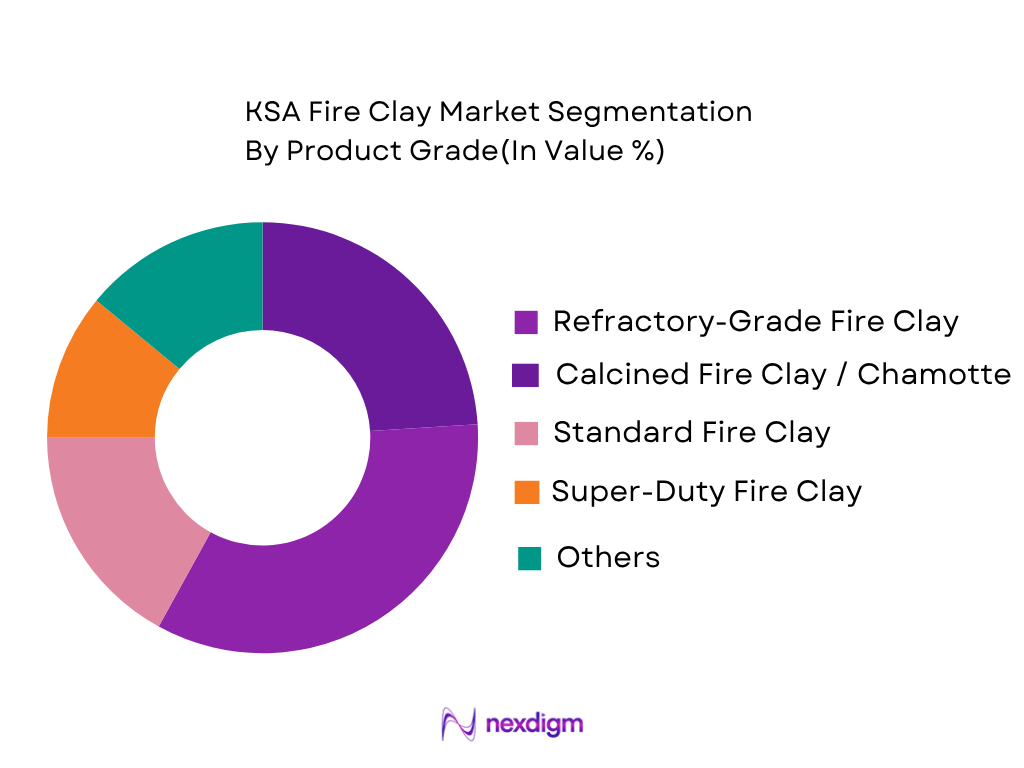
The KSA Fire Clay Market is segmented by product grade into standard fire clay, refractory-grade fire clay, super-duty fire clay, flint clay, binding clay and calcined fire clay/chamotte. Refractory-grade fire clay holds the dominant modeled share because Saudi demand is closely associated with industries operating kilns, furnaces, reactors and other thermal-processing equipment. Refractory-grade material provides the aluminosilicate characteristics required for firebricks, castables, mortars and related heat-resistant products. Saudi Arabia’s broader refractory ecosystem provides a substantial downstream demand base: imports of refractory cements, mortars and similar compositions reached 106.43 million kg, while imports of refractory bricks under HS 690290 reached 30.10 million kg. Fire clay represents only one raw-material component of this much broader refractory system, but the scale of refractory material movement demonstrates the industrial ecosystem into which refractory-grade fire clay is supplied.
By End-Use Industry
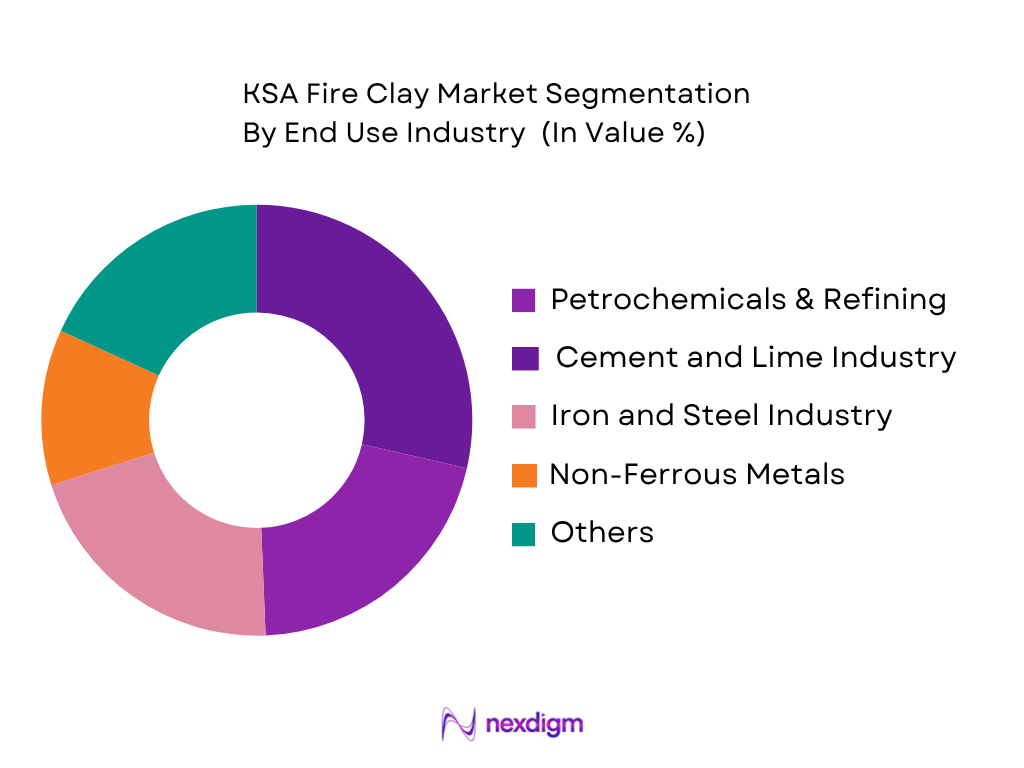
The KSA Fire Clay Market is segmented by end-use industry into iron and steel, cement and lime, petrochemicals and refining, non-ferrous metals, glass and ceramics, foundries, and other thermal-processing industries. Iron and steel represents the dominant modeled segment because refractory linings are essential across reheating furnaces, ladles, tundishes and other high-temperature steelmaking equipment. Saudi government investment material identifies steelmaking as the largest refractory-consuming activity within the broader Saudi/GCC refractory ecosystem. Fire clay and aluminosilicate materials compete with higher-alumina, magnesia and other specialized refractories depending on operating conditions. The strength of the broader refractory requirement is illustrated by an identified Saudi localization opportunity addressing a 66,000-ton annual refractory-brick demand-supply gap, with a proposed domestic plant capacity of 68,000 tons.
Competitive Landscape
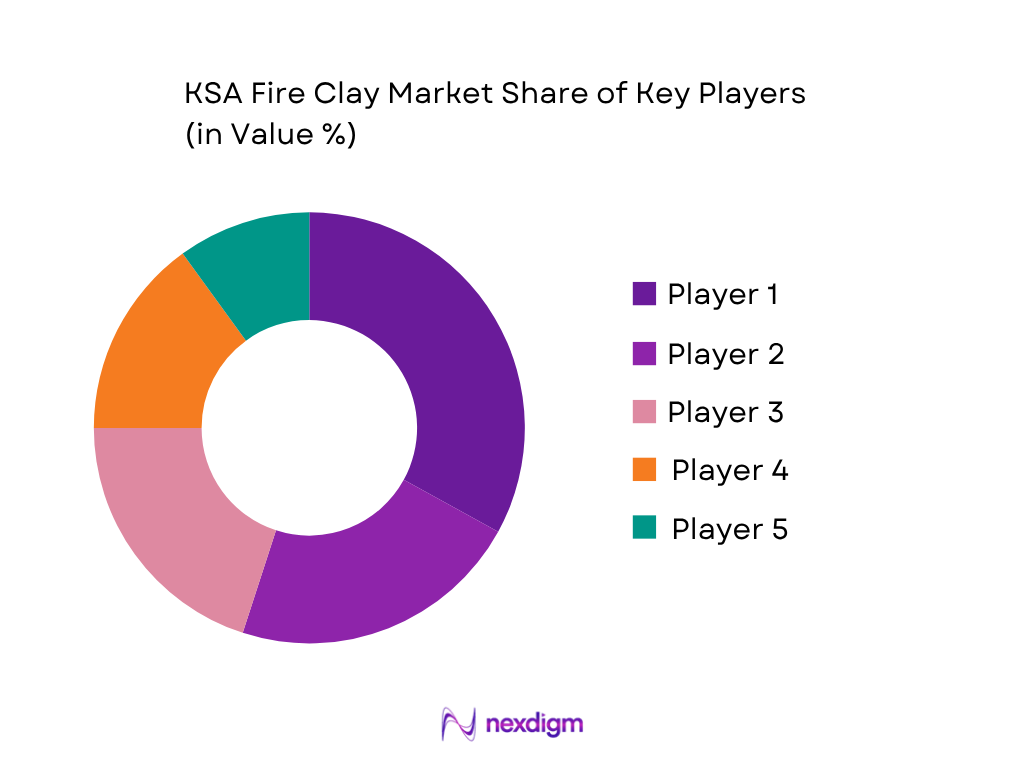
The KSA Fire Clay Market operates within a broader refractory-material ecosystem comprising domestic refractory manufacturers, international refractory technology companies, industrial-mineral suppliers and engineering/service providers. Competition extends beyond raw fire clay because industrial customers increasingly procure complete refractory solutions comprising bricks, castables, mortars, precast shapes, engineering, installation and shutdown services. Localization is strengthening: Calderys and Binzagr are developing a 16,300-square-meter Jubail facility with monolithic and precast production lines, illustrating the transition toward greater in-country refractory production and shorter industrial supply chains.
| Major Player | Establishment Year | Headquarters | Core Refractory Capability | Fire Clay/Aluminosilicate Relevance | Shaped Refractories | Monolithic Refractories | Major End-Use Coverage |
| Saudi Refractory Industries | 1994 | Dammam, Saudi Arabia | ~ | ~ | ~ | ~ | ~ |
| Calderys / HWI | 2005* | Paris, France | ~ | ~ | ~ | ~ | ~ |
| RHI Magnesita | 2017* | Vienna, Austria | ~ | ~ | ~ | ~ | ~ |
| Vesuvius | 1704* | London, United Kingdom | ~ | ~ | ~ | ~ | ~ |
| Refratechnik Group | 1950 | Ismaning, Germany | ~ | ~ | ~ | ~ | ~ |
KSA Fire Clay Market Analysis
Growth Drivers
Expansion of Domestic Steelmaking Capacity
Saudi Arabia’s expansion of steelmaking and metals-processing capacity is strengthening the underlying requirement for fire clay and aluminosilicate refractory materials. Steel production involves continuous exposure of furnaces, reheating units, ladles, tundishes and auxiliary thermal equipment to extreme temperatures, creating recurring refractory replacement requirements. The Kingdom has identified an annual 66,000-ton refractory-brick demand-supply gap, while a proposed localized refractory facility has a planned capacity of approximately 68,000 tons annually. This industrial gap is particularly relevant for fire-clay-based and aluminosilicate refractory products used where operating conditions permit. Saudi Arabia is simultaneously expanding its downstream manufacturing and mineral-processing ecosystem, creating additional high-temperature equipment requiring refractory protection. The localization of refractory production also increases the strategic importance of securing qualified domestic clay feedstock with controlled alumina, silica, iron oxide and alkali characteristics. As steelmaking capacity, fabrication activity and furnace utilization increase, refractory consumption is supported not only by new installations but also by scheduled relining, repair and maintenance cycles, creating recurring demand for refractory-grade raw materials.
Cement, Petrochemical and High-Temperature Industrial Demand
Saudi Arabia’s extensive cement, petrochemical, refining and mineral-processing infrastructure creates another structural demand base for fire-clay-containing refractory systems. Cement manufacturing requires refractory linings across rotary kilns, preheaters, coolers and associated thermal equipment, while petrochemical and refining facilities employ refractory materials in process heaters, reformers, boilers, incinerators and flue systems. The scale of the downstream refractory ecosystem is illustrated by Saudi imports of approximately 106.43 million kg of refractory cements, mortars and similar compositions and approximately 30.10 million kg of refractory bricks within a major refractory customs category. These figures cover broader refractory products rather than fire clay alone, but demonstrate the depth of Saudi high-temperature material consumption. Refractory linings are consumable industrial assets because thermal cycling, chemical attack, mechanical abrasion and operational stress progressively deteriorate lining performance. Consequently, existing industrial plants create recurring replacement demand alongside demand generated by new capacity. Fire clay remains relevant where aluminosilicate formulations provide the required balance between refractoriness, thermal stability, workability and mechanical performance.
Market Challenges
Domestic Mineralogy and Refractory-Grade Quality Consistency
One of the principal constraints facing domestic fire-clay development is achieving consistent mineralogical and chemical characteristics at industrial scale. Fire clay performance depends heavily on alumina and silica composition, iron oxide and alkali impurities, particle-size distribution, plasticity, loss on ignition, fired shrinkage and refractoriness. Saudi Geological Survey documentation characterizes fireclay as a fine-grained plastic clay containing approximately 25–30 parts alumina per 100 parts of material, while distinguishing fireclay, flint clay and binding clay according to their refractory characteristics. Commercial refractory producers require predictable batch-to-batch performance because variations in impurities can influence firing behavior, refractoriness, porosity and final refractory life. Domestic resources therefore cannot automatically substitute imported refractory raw materials merely because suitable clay occurrences exist. Deposits require geological characterization, selective mining, crushing, screening, blending and, where necessary, beneficiation and calcination before they can satisfy industrial specifications. Establishing reliable mine-to-plant quality control consequently becomes a critical commercialization hurdle, particularly for suppliers seeking qualification with steel, cement and petrochemical customers operating equipment where refractory failure can cause costly production interruptions.
Competition from Advanced Refractories and Imported Materials
Fire clay faces competition from high-alumina, magnesia, dolomite, silicon-carbide and other specialized refractory systems capable of delivering superior performance under particularly aggressive thermal, chemical or mechanical operating conditions. This limits fire clay’s addressable application range and requires suppliers to focus on installations where aluminosilicate materials provide appropriate technical performance. Import dependence adds another competitive dimension. Saudi Arabia imported approximately 1.96 million kg of fire clay in the verified trade period, while imports of downstream refractory products run at substantially larger volumes. Domestic suppliers therefore compete not only against imported raw fire clay and calcined materials such as chamotte but also against finished refractory systems supplied by established international producers. Calcination presents an additional challenge because converting suitable clay into stable chamotte requires controlled high-temperature processing, energy inputs, crushing, grading and quality assurance. Domestic commercialization therefore depends on achieving consistent industrial specifications rather than simply increasing mined tonnage. Producers must demonstrate chemical stability, refractoriness, thermal performance and reliable supply before industrial customers can substitute qualified imported materials with locally processed alternatives.
Market Opportunities
Domestic Fire Clay Beneficiation and Chamotte Localization
A significant opportunity exists in moving Saudi fire clay further downstream from mineral extraction toward beneficiation, calcination and refractory-grade chamotte production. Saudi Arabia imported approximately 1.96 million kg of fire clay in the verified trade period, demonstrating existing reliance on external supply even before accounting for imported calcined refractory raw materials and finished refractory products. Domestic deposits that meet technical requirements could therefore be processed through crushing, washing, classification, blending, drying and controlled calcination to produce more standardized refractory feedstocks. Localization becomes particularly relevant as Saudi refractory manufacturing capacity expands. A planned 16,300-square-meter refractory manufacturing facility in Jubail includes monolithic and precast production capabilities intended to serve steel, cement, petrochemical, aluminum and other non-ferrous industries. Such investment creates an industrial environment in which locally qualified aluminosilicate feedstocks could progressively enter refractory formulations. The higher-value opportunity is consequently not limited to selling untreated clay; it encompasses establishing integrated mine-to-beneficiation-to-calcination supply chains capable of delivering controlled alumina content, impurity levels, particle sizing and thermal characteristics required by domestic refractory manufacturers.
Firebrick, Monolithic Refractory and Circular-Material Localization
Saudi Arabia has an opportunity to connect domestic fire-clay development directly with refractory-product localization rather than treating clay extraction as an isolated mining activity. The identified 66,000-ton annual refractory-brick demand-supply gap provides a tangible downstream industrial base, while proposed domestic capacity of approximately 68,000 tons annually demonstrates the scale at which localized refractory manufacturing could operate. Suitable fire clay and calcined chamotte can support selected firebricks, refractory mortars, castables, ramming materials and other aluminosilicate products, subject to application-specific qualification. Localization could also extend into recycled refractory aggregates, where spent refractory materials are sorted, processed and reincorporated into suitable formulations, reducing dependence on virgin imported feedstocks. Joint ventures between Saudi mineral processors and international refractory technology companies could accelerate formulation development, testing, kiln-processing expertise and customer qualification. The opportunity is particularly relevant around Jubail and other industrial clusters because proximity to steel, cement, petrochemical and metals-processing customers can support shorter supply chains, technical servicing and collection of spent refractory materials for processing and reuse.
Future Outlook
The KSA Fire Clay Market is expected to expand at a placeholder CAGR of ~% during the forecast period, with future development increasingly influenced by domestic refractory localization, mineral-resource development and expansion of Saudi Arabia’s steel, cement, mining, aluminum and petrochemical industries. The opportunity is likely to shift gradually from simple imported raw-material distribution toward beneficiation, calcination, chamotte processing and locally manufactured refractory products. Domestic manufacturing is particularly important to the outlook. Saudi investment authorities have identified a 66,000-ton annual local demand-supply gap for refractory bricks and an opportunity for a domestic plant with 68,000 tons of capacity. This creates a potential downstream outlet for suitable locally sourced or processed aluminosilicate feedstocks, including fire clay where technical specifications permit.
Major Players
- Saudi Refractory Industries
- Calderys / HarbisonWalker International
- RHI Magnesita
- Vesuvius
- Refratechnik Group
- ALFRAN
- Allied Mineral Products
- Krosaki Harima Corporation
- Shinagawa Refractories
- Morgan Advanced Materials
- Saint-Gobain
- IFGL Refractories
- INTOCAST
- Steuler Group
- Resco Products
Key Target Audience
- Fire Clay and Industrial Mineral Producers
- Refractory Brick and Monolithic Refractory Manufacturers
- Iron, Steel and Non-Ferrous Metal Producers
- Cement, Lime, Glass and Ceramic Manufacturers
- Petrochemical, Refining and High-Temperature Process Operators
- Mining and Mineral Beneficiation Companies
- Investments and Venture Capitalist Firms
- Government and Regulatory Bodies (Ministry of Industry and Mineral Resources, Saudi Geological Survey, Saudi Standards, Metrology and Quality Organization, National Industrial Development and Logistics Program)
Research Methodology
Step 1: Identification of Key Variables
The initial phase involves developing the complete ecosystem of the KSA Fire Clay Market, including fire-clay resources, mining companies, mineral processors, refractory manufacturers, distributors and end-user industries. Variables such as alumina content, silica content, refractory grade, mineralogy, domestic production, imports, calcination capability, refractory consumption and downstream steel, cement and petrochemical requirements are identified through structured secondary research.
Step 2: Market Analysis and Construction
Historical supply-demand analysis is constructed using fire-clay trade flows, domestic mineral-resource information, refractory production, downstream industrial activity and product consumption patterns. A top-down approach evaluates the wider Saudi refractory industry before isolating fire-clay-dependent applications, while the bottom-up methodology assesses raw fire clay, calcined clay, chamotte, firebricks, castables and other relevant product flows across identified industrial consumers.
Step 3: Hypothesis Validation and Expert Consultation
Initial market hypotheses are validated through interviews with fire-clay suppliers, refractory producers, procurement managers, refractory contractors, steel manufacturers, cement operators and petrochemical-industry specialists. Interviews focus on material qualification, alumina requirements, refractoriness, domestic-versus-imported procurement, replacement cycles, supplier selection, application suitability and the potential for locally processed refractory raw materials.
Step 4: Research Synthesis and Final Output
The final stage triangulates customs statistics, mineral-resource information, industrial capacity, refractory consumption and primary-industry feedback. Bottom-up calculations are reconciled with top-down industrial demand to eliminate double counting between raw fire clay and finished refractory products. The resulting dataset is structured by grade, processing form, application, end-use industry, supply source and region to develop the final KSA Fire Clay Market outlook.

- Executive Summary
- Research Methodology (Market Definition and Scope, Fire Clay Classification Framework, Refractory Clay versus Fire Clay Delineation, Alumina Content Mapping, Silica Content Assessment, Mineralogical Composition Analysis, Refractoriness Assessment, Plasticity Evaluation, Particle Size Distribution Mapping, Fired Shrinkage Assessment, Porosity Analysis, Bulk Density Assessment, Pyrometric Cone Equivalent Evaluation, Domestic Deposit Mapping, Mining and Beneficiation Assessment, Import-Export Assessment, Fire Clay Consumption Modeling, Refractory Production Assessment, Firebrick Manufacturing Mapping, Chamotte and Calcined Clay Assessment, Steel Industry Demand Mapping, Cement Industry Demand Mapping, Petrochemical Furnace Demand Assessment, Glass Industry Demand Assessment, Ceramics Demand Mapping, Supply-Side Assessment, Demand-Side Assessment, Top-Down Market Sizing, Bottom-Up Market Sizing, Primary Industry Interviews, Data Triangulation, Forecasting Framework, Scenario Analysis, Research Limitations)

- Definition and Scope
- KSA Fire Clay Industry Evolution
- Fire Clay Industry Value Chain Analysis
- Fire Clay Supply Chain Analysis

- Growth Drivers (Expansion of Domestic Steelmaking Capacity, Cement and Lime Kiln Refractory Demand, Petrochemical Furnace Maintenance, Refractory Localization, Industrial Manufacturing Expansion, Growth of High-Temperature Processing Industries, Increased Domestic Mineral Utilization, Furnace and Kiln Relining Cycles)
- Market Challenges (Variability in Domestic Fire Clay Mineralogy, Alumina and Silica Consistency Requirements, Iron Oxide and Alkali Impurity Control, Beneficiation Requirements, Competition from High-Alumina and Basic Refractories, Imported Chamotte Competition, Energy-Intensive Calcination, Quality Consistency Requirements, Limited High-Grade Deposit Commercialization)
- Market Opportunities (Domestic Fire Clay Deposit Development, Refractory-Grade Clay Beneficiation, Calcined Fire Clay and Chamotte Localization, Firebrick Manufacturing Expansion, Domestic Monolithic Refractory Manufacturing, Steel Refractory Localization, Cement Kiln Refractory Supply, Petrochemical Furnace Applications, Joint Ventures with Global Refractory Producers, Refractory Recycling and Secondary Raw Materials)
- Market Trends (Localization of Refractory Production, Increased Use of Beneficiated Clay, Growth of Monolithic Refractories, Development of Low-Cement Castables, Increasing Calcined Clay Consumption, Customized Refractory Formulations, Longer Refractory Campaign Life, Refractory Recycling, Local Raw Material Qualification)
- Government Regulations and Mining Framework (Ministry of Industry and Mineral Resources Mining Licensing, Saudi Mining Investment Law, Mineral Resource Classification, Industrial Licensing Requirements, Saudi Geological Survey Resource Mapping, Environmental Permitting, Mine Development Requirements, Industrial Mineral Localization, SASO Product Conformity Requirements)
- SWOT Analysis
- PESTLE Analysis
- Porter Five Forces

- By Market Value (2020-2025)
- By Fire Clay Consumption Volume (2020-2025)
- By Domestic Production Volume (2020-2025)
- By Imported Fire Clay Volume (2020-2025)
- By Refractory-Grade Fire Clay Consumption (2020-2025)
- By Calcined Fire Clay and Chamotte Consumption (2020-2025)

- By Fire Clay Grade (In Value %)
Standard Fire Clay
Refractory-Grade Fire Clay
Super-Duty Fire Clay
Flint Clay
Binding Clay
Calcined Fire Clay / Chamotte - By Alumina Content (In Value %)
Lower-Alumina Fire Clay
Conventional Fire Clay
Higher-Alumina Refractory Clay
High-Alumina Clay Feedstock
Blended Aluminosilicate Feedstock - By Processing Form (In Value %)
Run-of-Mine Fire Clay
Crushed and Sized Fire Clay
Beneficiated Fire Clay
Dried and Milled Fire Clay
Calcined Fire Clay
Chamotte / Grog
Prepared Refractory Clay Blends - By Refractory Product Application (In Value %)
Fire Clay Bricks
High-Alumina and Aluminosilicate Bricks
Refractory Castables
Refractory Mortars
Ramming Mixes
Gunning and Repair Mixes
Precast Refractory Shapes
Ceramic Refractory Components - By End-Use Industry (In Value %)
Iron and Steel
Cement and Lime
Petrochemicals and Refining
Glass Manufacturing
Non-Ferrous Metals
Ceramics and Structural Clay Products
Foundries
Power and Industrial Boilers
Other High-Temperature Industrial Processes - By Refractory Service Application (In Value %)
Rotary Kilns
Industrial Furnaces
Steel Ladles and Tundishes
Reheating and Heat-Treatment Furnaces
Petrochemical Furnaces and Reactors
Boilers
Incinerators
Chimneys and Flue Systems
Other Thermal Processing Equipment - By Supply Source (In Value %)
Domestic Mined Fire Clay
Domestic Beneficiated Fire Clay
Imported Raw Fire Clay
Imported Calcined Fire Clay / Chamotte
Captive Industrial Supply
Merchant Market Supply - By Region (In Value %)
Eastern Province
Riyadh Region
Makkah Region
Madinah Region
Qassim Region
Northern Mining Areas
Southern Industrial Regions
Rest of KSA

- Market Share of Major Players (By KSA Fire Clay and Refractory Revenue, Raw Material Portfolio, Fire Clay-Based Refractory Portfolio, Shaped Refractory Capability, Monolithic Refractory Capability, Steel Industry Coverage, Cement Industry Coverage, Petrochemical Coverage, Manufacturing Footprint, Local Inventory, Technical Services, Installation Capability, Raw Material Integration, KSA Industrial Customer Base)
- Cross Comparison Parameters (Fire Clay and Aluminosilicate Raw Material Access, Alumina and Impurity Control Capability, Fire Clay Brick and Shaped Refractory Portfolio, Monolithic and Castable Manufacturing Capability, Maximum Service Temperature and Refractoriness Performance, Steel-Cement-Petrochemical Application Coverage, KSA Manufacturing and Local Inventory Footprint, Refractory Engineering-Installation and Shutdown Service Capability)
- SWOT Analysis of Major Players
- Detailed Profiles of Major Companies
Saudi Refractory Industries
Calderys / HarbisonWalker International
RHI Magnesita
Vesuvius
Refratechnik Group
Refractory International / ALFRAN
Allied Mineral Products
Krosaki Harima Corporation
Shinagawa Refractories
Morgan Advanced Materials
Saint-Gobain
IFGL Refractories
INTOCAST
Steuler Group
Resco Products

- Raw Material Procurement Assessment
- Refractory Manufacturer Requirement Analysis
- Steel Industry Demand Assessment
- Cement and Lime Industry Demand Assessment
- Petrochemical and Refining Demand Assessment
- Glass Industry Demand Assessment

- By Market Value (2026-2035)
- By Fire Clay Consumption Volume (2026-2035)
- By Domestic Production Volume (2026-2035)
- By Imported Fire Clay Volume (2026-2035)
- By Refractory-Grade Fire Clay Consumption (2026-2035)
- By Calcined Fire Clay and Chamotte Consumption (2026-2035)


 Request a Sample
 Ask for Customization
 Get a Quote
 Enquire Now