
 Download PDF
 Download PDF
Market Overview
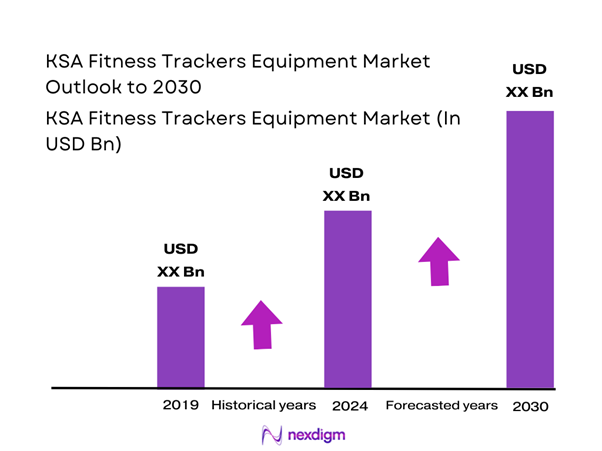
The KSA Fitness Trackers Equipment Market is valued at USD ~ billion, supported by sustained device shipments exceeding ~ wearable units across the Kingdom. Demand is primarily driven by rising obesity and diabetes prevalence, with over ~ adults classified as overweight or obese. Additionally, smartphone penetration exceeding ~ active mobile connections enables seamless integration of fitness trackers with digital health ecosystems, accelerating adoption across consumer, corporate wellness, and fitness infrastructure segments.
The market is dominated by Riyadh, Jeddah, and Dammam, driven by higher disposable income, dense gym and fitness club penetration, and corporate wellness adoption. Riyadh leads due to concentration of government offices, multinational employers, and insurer-linked wellness programs. Jeddah benefits from strong retail electronics penetration and lifestyle-driven fitness culture, while the Eastern Province gains traction from corporate-led wellness initiatives linked to industrial employers and oil & gas enterprises prioritizing workforce health monitoring.
Market Segmentation
By Product Type
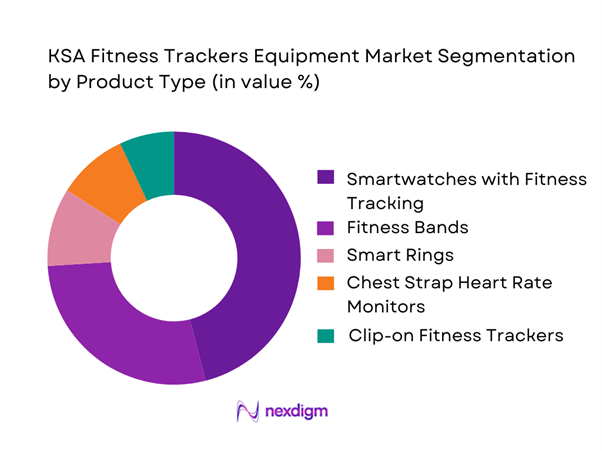
The KSA Fitness Trackers Equipment Market is segmented by product type into fitness bands, smartwatches with fitness tracking, smart rings, chest-strap heart rate monitors, and clip-on fitness trackers. Smartwatches with fitness tracking dominate the product type segment, driven by their multifunctionality, premium positioning, and strong brand pull from Apple, Samsung, and Huawei. These devices serve as both lifestyle accessories and advanced health monitoring tools, offering heart rate, SpO₂, ECG, GPS, and sleep tracking within a single form factor. Saudi consumers show a strong preference for consolidated devices rather than single-function wearables, particularly in urban regions. Additionally, smartwatch bundling by telecom operators and installment-based retail financing significantly boosts adoption. Integration with Arabic-enabled apps and Apple Health / Samsung Health ecosystems further strengthens dominance across both consumer and enterprise wellness deployments.
By End User
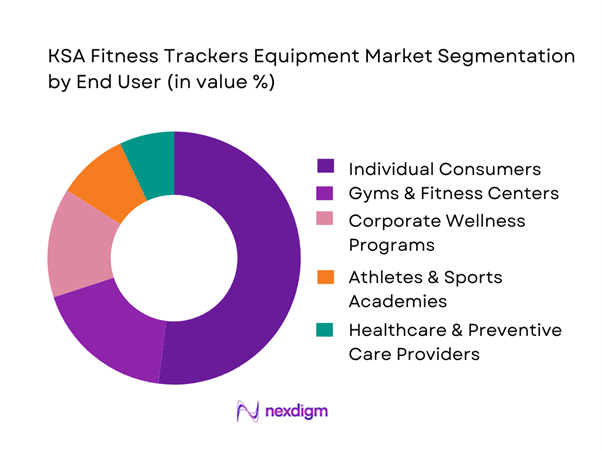
The market is segmented into individual consumers, gyms & fitness centers, corporate wellness programs, athletes & sports academies, and healthcare & preventive care providers. Individual consumers represent the dominant end-user segment, supported by lifestyle-driven adoption, social fitness trends, and rising awareness of personal health metrics. Saudi Arabia’s young population, with over ~ residents below age ~, exhibits strong engagement with app-based fitness challenges and wearable-linked social ecosystems. Additionally, individual buyers increasingly view fitness trackers as essential daily devices rather than optional accessories. The growth of women-only gyms and female fitness participation further expands the consumer base. Easy availability through online marketplaces and electronics retailers accelerates repeat purchases and upgrades, reinforcing consumer dominance over institutional segments.
Competitive Landscape
The KSA Fitness Trackers Equipment Market is moderately consolidated, dominated by global consumer electronics brands with strong ecosystem control and distribution reach. Apple and Samsung lead the premium segment, while Huawei and Xiaomi drive volume through competitively priced devices. Garmin and Fitbit maintain relevance in sports performance and health-focused niches. Local assembly is limited, but distributor partnerships and telecom bundling play a critical role in market penetration.
| Company | Establishment Year | Headquarters | Core Product Focus | Ecosystem Strength | Distribution Reach in KSA | Battery Performance | Price Tier | After-Sales Network |
| Apple | 1976 | USA | ~ | ~ | ~ | ~ | ~ | ~ |
| Samsung Electronics | 1969 | South Korea | ~ | ~ | ~ | ~ | ~ | ~ |
| Huawei | 1987 | China | ~ | ~ | ~ | ~ | ~ | ~ |
| Xiaomi | 2010 | China | ~ | ~ | ~ | ~ | ~ | ~ |
| Garmin | 1989 | USA | ~ | ~ | ~ | ~ | ~ | ~ |
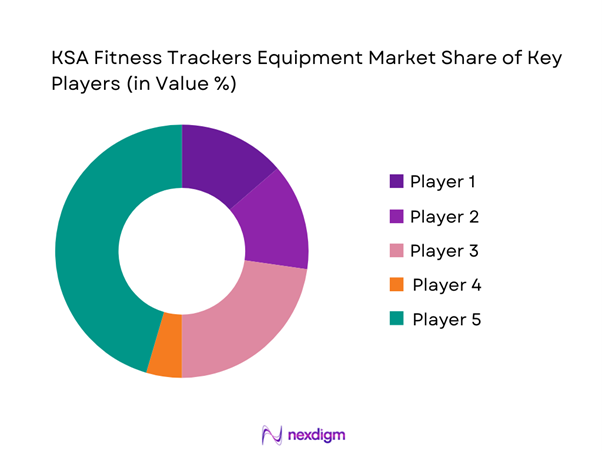
KSA Fitness Trackers Equipment Market Analysis
Growth Drivers
Population fitness adoption
Saudi Arabia’s fitness-tracker demand is increasingly anchored in measurable “daily movement” behavior rather than niche sports. Government health statistics show ~ of adults achieve ~ minutes of weekly activity, while average sedentary time is ~ hours per day, making step-counting, active-minute goals, sleep tracking, and HR-based coaching the highest-utility tracker features in everyday use cases. Riyadh, Jeddah, and Dammam/Khobar lead device activation because they concentrate gyms, running/cycling communities, malls, and employer campuses that normalize wearables. On the purchasing-power side, Saudi Arabia’s economy supports premium-device adoption: GDP is USD ~ trillion and GDP per capita is USD ~, while inflation is ~, keeping discretionary electronics demand comparatively resilient for mid–upper income cohorts. This combination pushes trackers from “nice-to-have” gadgets into routine health companion devices used across commuting, work, and leisure.
Vision 2030 lifestyle initiatives
Vision-linked lifestyle programming is expanding the addressable user base by making fitness access easier and more visible. Saudi sports infrastructure expansion is evidenced by licensing scale, with ~ licensed gyms and sports centers, plus ~ academies and ~ private clubs, which directly increases the number of locations where trackers are recommended, bundled, or socially reinforced. Meanwhile, national measurement of activity strengthens “quantified lifestyle” habits: official statistics highlight ~ minutes as a benchmark, and sedentary behavior is tracked at ~ hours daily for adults, both of which map cleanly to tracker dashboards. Macro tailwinds also matter because consumer tech adoption tracks confidence and spending capacity: final consumption expenditure is USD ~, indicating a large base of household and government consumption supporting electronics and lifestyle categories, while inflation is ~ maintains affordability of recurring device upgrades for many segments.
Challenges
Device accuracy perception
In KSA, the biggest adoption ceiling is not awareness but whether users trust the readings enough to act on them, especially when trackers are used for weight management, heart-rate zones, sleep scoring, or wellness flags. This trust issue intensifies because the population is being encouraged to monitor behavior quantitatively: national health statistics explicitly anchor ~ minutes as a benchmark for adults and track ~ hours of sedentary time daily, so consumers expect their devices to be precise when measuring activity minutes, intensity, and recovery. At the same time, digital-health usage is mainstream, with platforms exceeding ~ users and offering ~ services, raising expectations that health-related tools are clinical-grade. When perceived accuracy lags expectations, users delay upgrades or revert to phone-only tracking, slowing unit velocity.
Price sensitivity
Even with strong national income indicators, price sensitivity exists because the fitness tracker category spans entry bands to premium smartwatches, and replacement is discretionary. Saudi macro indicators show scale and stability, with GDP at USD ~ trillion, GDP per capita at USD ~, and inflation at ~, but consumers still trade off wearables against phones, tablets, and other electronics, especially when inflation pressure appears in everyday categories such as housing. The challenge becomes sharper for multi-device households, where low-cost trackers face trust concerns and premium devices face upgrade hesitation. In addition, an internet indicator at ~ supports easy price comparison and cross-border e-commerce, increasing transparency and pushing consumers to seek discounts, bundles, or subsidies rather than full-price purchases.
Opportunities
Corporate wellness adoption
Corporate programs are a near-term growth lever because they distribute devices at scale and convert non-buyers into daily users through challenges, incentives, and wellbeing KPIs. Saudi labor market signals show a large private-sector base, with ~ million Saudi employees in the private sector and total workers reaching ~, creating a large employer-driven channel for wearables. This opportunity is reinforced by measurable national activity gaps, with sedentary time recorded at ~ hours daily and a weekly activity benchmark set at ~ minutes for adults, both of which are easy to operationalize in corporate step challenges. Macroeconomic stability supports sustained HR wellness budgets, with inflation at ~ and GDP per capita at USD ~, helping employers justify benefits in talent attraction and retention markets.
Insurer-linked incentives
Insurer-linked programs can expand wearable penetration by shifting purchase logic from consumer gadget to health outcome enabler, using rewards for activity adherence, preventive screenings, or chronic-risk coaching. The Saudi insurance ecosystem is sizable and structured, with ~ insurers and ~ TPAs servicing ~ million beneficiaries under regulation, alongside ~ million visitors in the same system, indicating the scale at which incentives can be deployed. Digitally, the environment supports these programs, with platforms serving ~ users and providing ~ services, enabling insurers and employers to align wearables with preventive pathways. With GDP at USD ~ trillion and an internet indicator at ~, KSA has both the economic capacity and connectivity backbone for incentive-linked behavioral programs that increase device attachment and sustained usage.
Future Outlook
Over the next five years, the KSA Fitness Trackers Equipment Market is expected to witness strong momentum driven by preventive healthcare adoption, insurer-linked wellness incentives, and deeper integration of wearables into digital health platforms. Government focus on reducing lifestyle disease burden, expansion of fitness infrastructure, and rising acceptance of data-driven personal health monitoring will continue to accelerate demand. Device innovation around AI-driven insights, longer battery life, and localized Arabic user interfaces will further enhance market penetration across both consumer and enterprise segments.
Major Players
- Apple
- Samsung Electronics
- Huawei
- Xiaomi
- Fitbit
- Garmin
- Amazfit
- Polar Electro
- Suunto
- Withings
- Whoop
- Oura
- OnePlus
- Honor
Key Target Audience
- Consumer electronics manufacturers and OEMs
- Wearable technology distributors and importers
- Fitness chains and gym operators
- Corporate wellness program providers
- Health insurance companies and payers
- Sports academies and professional training centers
- Investment and venture capital firms
- Government and regulatory bodies
Research Methodology
Step 1: Identification of Key Variables
The research began with mapping the KSA fitness wearables ecosystem, identifying OEMs, distributors, retailers, fitness operators, and corporate wellness stakeholders. Secondary sources including government health statistics, global wearables databases, and telecom adoption data were analyzed to define key demand variables.
Step 2: Market Analysis and Construction
Historical shipment data, retail sales trends, and pricing benchmarks were compiled to estimate market value and volume. Device penetration rates and ecosystem adoption were assessed to validate revenue generation across segments.
Step 3: Hypothesis Validation and Expert Consultation
Market assumptions were validated through structured interviews with distributors, gym operators, and digital health platform providers. Insights on pricing, replacement cycles, and consumer behavior were incorporated.
Step 4: Research Synthesis and Final Output
Final market sizing was cross-validated using bottom-up and top-down approaches, ensuring consistency across device shipments, retail revenue, and ecosystem adoption metrics.

- Executive Summary
- Research Methodology (Market Definitions and Assumptions, Abbreviations, Scope Delineation Between Medical-Grade vs Consumer Fitness Trackers, Market Sizing Logic, Demand-Side & Supply-Side Triangulation, Primary Interviews with Distributors, Retailers, Gyms, Corporate Wellness Providers, Limitations and Assumptions)

- Definition and Scope
- Market Evolution and Adoption Genesis in Saudi Arabia
- Timeline of Key Technology Milestones and Brand Entry
- Industry Business Cycle Mapping
- Fitness Trackers Value Chain and Supply Chain Analysis

- Growth Drivers
Population fitness adoption
Vision 2030 lifestyle initiatives
Obesity reduction focus
Digital health ecosystem readiness - Challenges
Device accuracy perception
Price sensitivity
Data privacy concerns
Replacement cycle length - Opportunities
Corporate wellness adoption
Insurer-linked incentives
Women fitness participation
Youth & sports academies - Trends
AI-driven insights
Subscription-based analytics
Localized Arabic apps
Integration with smart gyms - Regulatory & Policy Landscape
- SWOT Analysis
- Stakeholder & Ecosystem Analysis
- Porter’s Five Forces Analysis
- Competitive Intensity & Ecosystem Mapping

- By Value, 2019–2024
- By Volume, 2019–2024
- By Average Selling Price, 2019–2024

- By Technology Architecture (in Value %)
Fitness Bands
Smartwatches with Fitness Tracking
Chest Strap Heart Rate Monitors
Smart Rings and Compact Wearables
Clip-on / Modular Fitness Trackers - By Application (in Value %)
Activity & Step Tracking
Heart Rate & HRV Monitoring
Sleep & Recovery Tracking
SpO₂, Stress & Advanced Health Metrics
GPS-Enabled Performance Tracking - By Connectivity Type (in Value %)
Bluetooth-Only Devices
Bluetooth + GPS
Cellular-Enabled Wearables
App-Centric Cloud Ecosystems
Enterprise / API-Integrated Platforms - By End-Use Industry (in Value %)
Individual Consumers
Fitness Enthusiasts & Athletes
Gyms & Fitness Centers
Corporate Wellness Programs
Healthcare & Preventive Health Programs - By Region (in Value %)
Central Region
Western Region
Eastern Region
Southern & Northern Regions

- Market Share of Major Players
- Cross Comparison Parameters (Product Portfolio Breadth, Sensor Accuracy & Certification Level, Battery Life Benchmarking, Ecosystem & App Depth, Localized Arabic Interface Availability, Distribution Reach in KSA, Average Selling Price Positioning, After-Sales & Warranty Network)
- SWOT Analysis of Major Players
- Pricing Analysis
- Detailed Profiles of Major Companies
Apple
Samsung Electronics
Huawei
Xiaomi
Fitbit
Garmin
Amazfit
Polar Electro
Whoop
Oura
Withings
Suunto
OnePlus
Honor
Realme

- Usage Patterns and Engagement Levels
- Budget Allocation and Purchasing Behavior
- Decision-Making Criteria
- Pain Points and Unmet Needs
- Switching Behavior and Brand Loyalty

- By Value, 2025–2030
- By Volume, 2025–2030
- By Average Selling Price Evolution, 2025–2030


 Request a Sample
 Ask for Customization
 Get a Quote
 Enquire Now