

 Download PDF
Market Overview
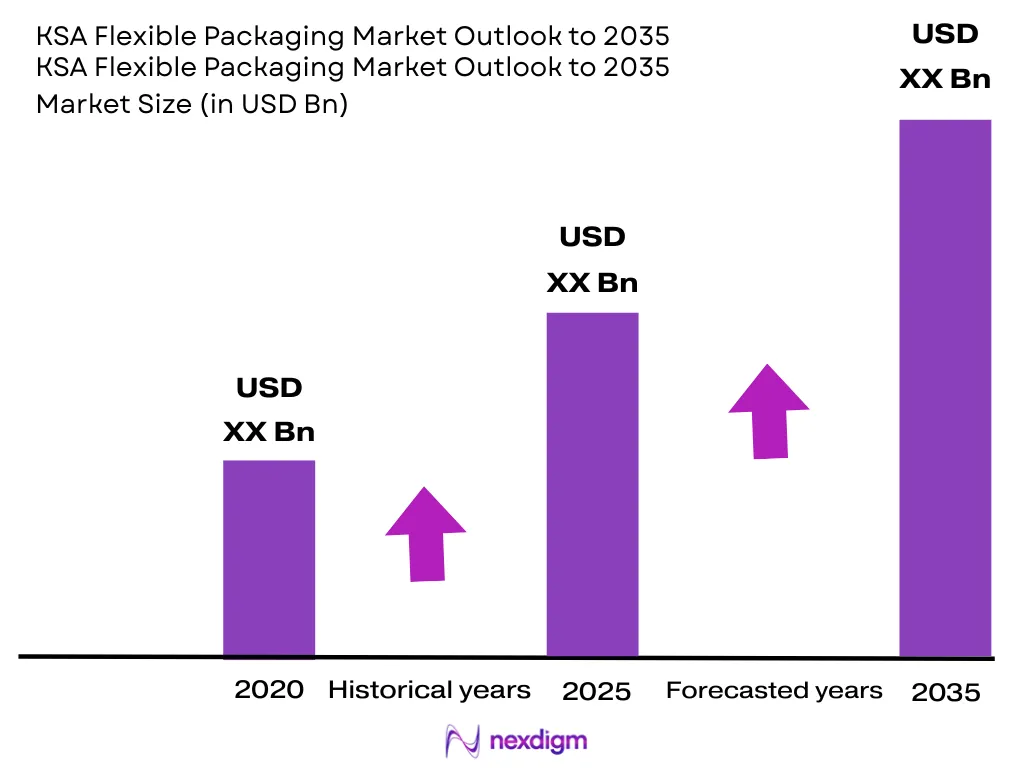
The KSA Flexible Packaging Market was valued at USD ~ Billion in 2024 and is anticipated to expand at a CAGR of ~% during 2026-2035. The market is primarily driven by the Kingdom’s expanding food and beverage sector, valued at approximately USD 24.29 billion in 2025 and representing the single largest consumer of flexible packaging, alongside rapid e-commerce growth that reached USD 52.64 billion in national online sales in 2024, up approximately 25.82% year-on-year. Industry estimates place the broader Saudi flexible packaging market at approximately USD ~ billion in 2025, with flexible formats capturing nearly half of the Kingdom’s total packaging market value. Saudi Arabia’s position as the source of approximately 67% of GCC plastic resin production, anchored by SABIC’s integrated petrochemical complexes in the Eastern Province, provides converters with a structural feedstock cost advantage, even as the Kingdom’s Vision 2030 sustainability agenda and tightening SASO standards push the industry toward recycled-content and mono-material packaging solutions.
Market Segmentation
By Material
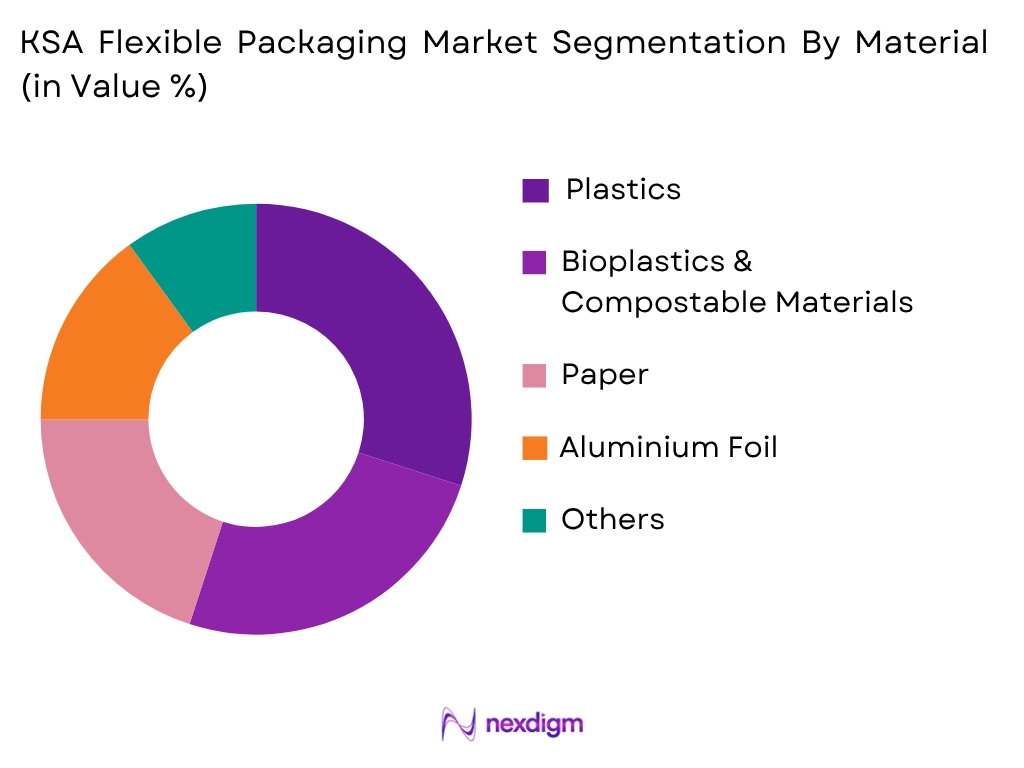
Plastic, primarily polyethylene and polypropylene, dominates the KSA Flexible Packaging Market with approximately 61.88% share in 2025, supported by Saudi Arabia’s abundant and cost-competitive domestic resin supply from SABIC and other integrated petrochemical producers. Polyethylene alone commands roughly 31% of plastic packaging revenue, reflecting its versatility across shrink film, squeezable tubes, and flexible bags. Bio-based and certified circular resins are gaining traction at a faster growth rate, supported by SABIC’s TRUCIRCLE program, which supplies ISCC+ certified circular polymers to converters seeking to meet brand owner net-zero commitments and tightening recycled-content expectations. Paper and aluminum foil retain specialized niches, with recyclable kraft laminates addressing new produce-pack rules and aluminum foil remaining essential for oxygen-sensitive nutraceutical and pharmaceutical applications where barrier performance requirements are highest.
By Product Type
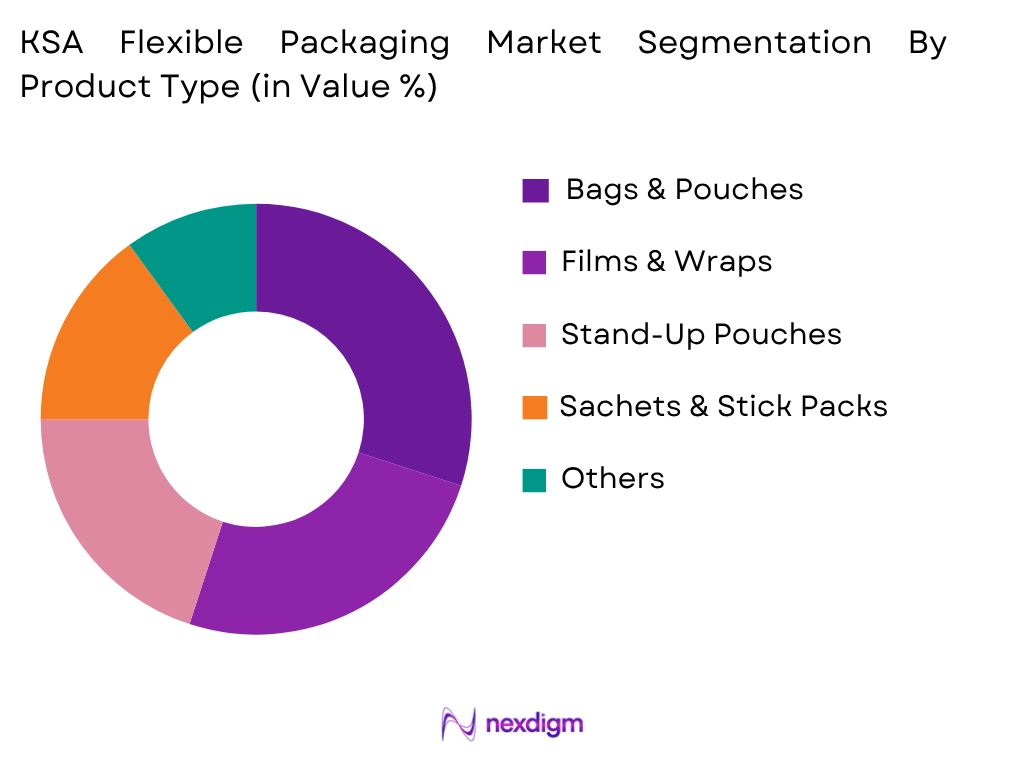
Bags & Pouches represent the largest product-type segment, capturing nearly 47% of the KSA Flexible Packaging Market in 2025, driven by urbanization, a youthful demographic, and rising demand for portion-controlled, on-the-go packaging formats such as stand-up pouches and refill packs. Saudi Arabia ranks among the world’s highest per-capita meat consumers, with consumption reaching approximately 2.11 million tons in 2024, sustaining strong demand for flexible packaging formats that preserve freshness in the Kingdom’s harsh climate. Films & Wraps represent the fastest-growing product form, supported by domestic manufacturers such as Taghleef Industries introducing high-barrier food packaging films specifically engineered to shield products from moisture, oxygen, and heat. Growing female workforce participation has further accelerated demand for packaged, easy-to-prepare meals, reinforcing multilayer film adoption among domestic ready-meal manufacturers seeking to extend shelf life and reduce food waste.
Competitive Landscape
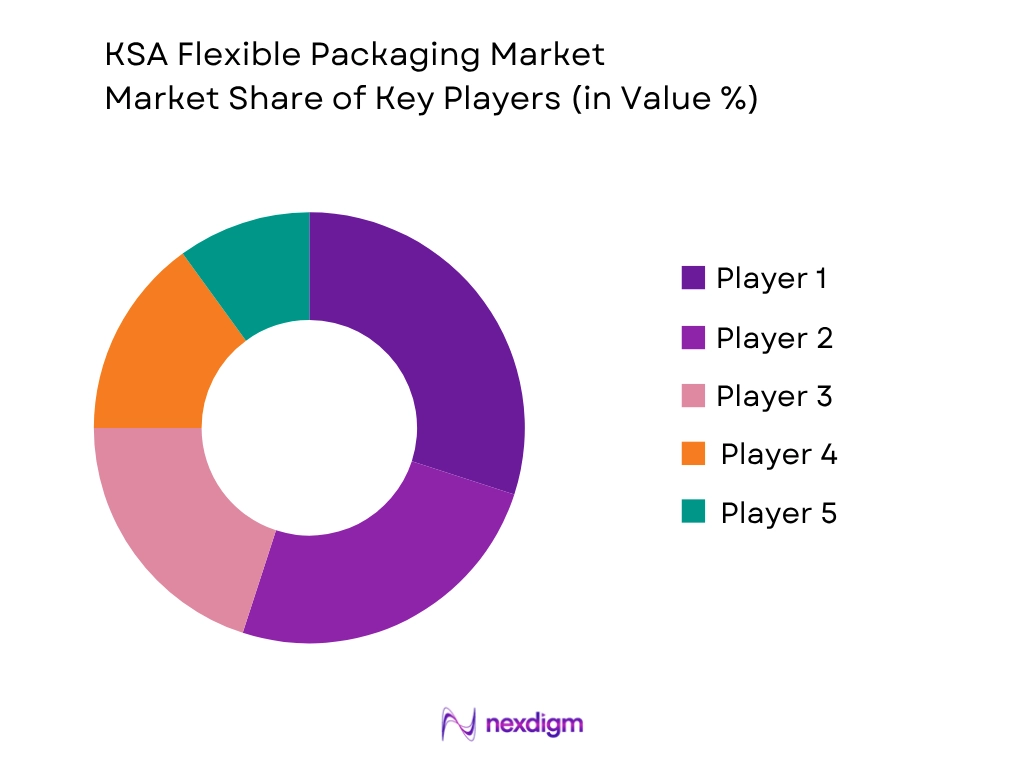
The KSA Flexible Packaging Market operates in a moderately concentrated structure, with the top five suppliers controlling approximately 45% of total tonnage, leaving considerable space for mid-tier and regional specialists. Napco National has emerged as the Kingdom’s most acquisitive domestic converter, having acquired UAE-based Rotopak in 2023 and Arabian Flexible Packaging in August 2025 through its Dubai-based subsidiary, while also commissioning an HP Indigo 25K digital printing line in October 2025 to serve short-run e-commerce and promotional SKUs. Obeikan Flexible & Film Co. Ltd. and Zamil Plastic Industries maintain strong positions leveraging proximity to domestic food processors for just-in-time delivery, while global majors including Amcor, Mondi, and Sealed Air introduce mono-material retort pouches and active-barrier coatings developed through global R&D that local converters often license rather than replicate. SABIC’s TRUCIRCLE program continues to shape competitive dynamics industry-wide by determining preferential allocation of certified circular polymer streams to converter partners.
| Company | Establishment Year | Headquarters | Primary Product Portfolio | Flexible Packaging Portfolio
|
Manufacturing Presence | Major End-Use Industries | Key Strategic Focus | Certifications & Compliance |
| Napco National | 1993 | ~ | ~ | ~ | ~ | ~ | ~ | ~ |
| Obeikan Investment Group | 1985 | ~ | ~ | ~ | ~ | ~ | ~ | ~ |
| Amcor | 1860 | ~ | ~ | ~ | ~ | ~ | ~ | ~ |
| Sealed Air | 1960 | ~ | ~ | ~ | ~ | ~ | ~ | ~ |
| Zamil Plastic Industries | 1978 | ~ | ~ | ~ | ~ | ~ | ~ | ~ |
KSA Flexible Packaging Market Analysis
Growth Drivers
Expansion of Food & Beverage Sector and E-Commerce
The KSA flexible packaging market is experiencing sustained growth due to the rapid expansion of Saudi Arabia’s food and beverage industry, valued at approximately USD 24.29 billion in 2025 and representing the single largest end-use consumer of flexible packaging in the Kingdom. Saudi Arabia’s youthful, increasingly urbanized population continues to drive demand for portion-controlled and convenience packaging formats, while rising female workforce participation has accelerated adoption of packaged, easy-to-prepare meals that rely on multilayer flexible films for shelf-life extension. National online sales reached approximately USD 52.64 billion in 2024, a year-on-year increase of approximately 25.82%, creating substantial downstream demand for durable, lightweight protective flexible packaging formats across e-commerce and quick-commerce channels. Saudi Arabia’s status among the world’s highest per-capita meat-consuming nations, with consumption reaching approximately 2.11 million tons in 2024, further reinforces sustained demand for flexible packaging formats engineered to preserve freshness in the Kingdom’s harsh climate conditions.
SABIC Feedstock Integration and Vision 2030 Downstream Industrialization
Saudi Arabia’s dominant position in regional petrochemical production, accounting for approximately 67% of total GCC plastic resin output, provides domestic flexible packaging converters with a structural feedstock cost advantage over regional competitors reliant on imported resin. SABIC’s integrated petrochemical complexes clustered around Dammam and Jubail in the Eastern Province provide feedstock security and direct export port access to GCC nations, attracting Austrian, Chinese, and European converters to colocate extrusion lines within these industrial zones to capture reduced logistics costs and government incentives. Vision 2030’s downstream industrialization agenda continues to redirect resin streams from bulk export toward higher-value domestic packaging manufacturing, supported by the Kingdom’s ‘Saudi Made’ initiative, which reimburses qualifying exporters for up to 20% of international marketing costs. This combination of feedstock security and export-oriented industrial policy continues to attract global converter investment into Saudi Arabia’s flexible packaging manufacturing base.
Market Challenges
Resin Price Volatility and Converter Margin Pressure
The KSA flexible packaging market remains exposed to significant resin price volatility linked to global naphtha and polyethylene spread fluctuations. Spot LDPE prices swung by approximately 27% across 2024-2025, eroding gross margins for non-integrated converters by nearly 400 basis points according to industry estimates. SABIC itself reported a net loss of approximately SAR 1.2 billion in early 2025, citing unfavorable spreads between naphtha and polyethylene feedstocks, illustrating the extent to which even the Kingdom’s dominant integrated petrochemical producer remains exposed to global commodity cycles. Smaller, non-integrated flexible packaging converters lacking direct access to SABIC’s feedstock pricing face particular difficulty hedging input costs, prompting accelerated interest in long-term off-take agreements with domestic crackers as a defensive strategy against continued resin price uncertainty.
Low Domestic Recycling Infrastructure Despite High Resin Production
Despite producing approximately 67% of the GCC’s plastic resin, Saudi Arabia recycles only an estimated 5-7% of its plastic waste, representing a substantial infrastructure gap that constrains the availability of post-consumer recycled feedstock for flexible packaging converters seeking to meet tightening sustainability requirements. The National Center for Waste Management has set a target of achieving a 40% recycling rate by 2035, and five city master plans currently cover only approximately 60% of national waste generation, leaving secondary regions significantly underserved by formal collection infrastructure. Multilayer film contamination continues to complicate PET recycling streams, restricting the availability of post-consumer recycled feedstock specifically suited for flexible packaging applications. While SABIC’s TRUCIRCLE advanced-recycling resins offer an interim solution, these certified circular polymers carry cost premiums that price-sensitive converters often resist, creating a persistent supply-demand imbalance between the volume of recycled content brand owners increasingly require and the recycling infrastructure currently available to supply it.
Market Opportunities
Circular Economy Partnerships and TRUCIRCLE Certified Polymer Adoption
Growing brand owner commitment to certified circular packaging creates substantial opportunity for converters investing in TRUCIRCLE and ISCC+ certified polymer capabilities. In May 2024, SABIC, Napco National, and FONTE collaboratively launched Saudi Arabia’s first fully circular bread packaging using 100% mass-balanced certified circular polyethylene from SABIC’s TRUCIRCLE program, demonstrating commercially viable closed-loop flexible packaging solutions using food-contact qualified resin derived from pyrolysis oil. In August 2024, Alesayi Beverage Corporation, which holds approximately 60% market share in Saudi Arabia’s energy drinks sector, partnered with SIG to deploy sustainable bag-in-box packaging using the SIG SureFill 42 Aseptic filling system at its newly built 98,000 square meter Jeddah facility. With approximately 64% of Saudi consumers expressing environmental concern and 63% actively sorting plastic packaging for recycling according to industry surveys, converters that can credibly demonstrate certified circular content are increasingly well positioned to capture premium contract positioning from major regional brand owners.
Consolidation and Digital Printing Capacity Expansion
Accelerating consolidation among Saudi Arabia’s leading flexible packaging converters is creating opportunity for scaled players to expand regional footprint and technical capability. Napco National’s acquisition of Arabian Flexible Packaging in August 2025 added rotogravure printing capability and diverse substrate expertise spanning polypropylene, polyester, nylon, polyethylene, foil, and paper, following the company’s earlier 2023 acquisition of UAE-based Rotopak. Napco’s October 2025 commissioning of an HP Indigo 25K digital printing line reflects broader industry investment in digital printing capacity, enabling economic production of short runs below 5,000 square meters for e-commerce and promotional SKUs that would be uneconomical on traditional flexographic or rotogravure equipment. As HP’s confirmed advanced-manufacturing site in Saudi Arabia fosters a broader domestic ecosystem for inks, coatings, and spare parts, converters investing early in digital printing infrastructure are well positioned to capture growing demand for shorter, more customized production runs across both domestic and export-oriented Saudi Made packaging.
Future Outlook
The KSA Flexible Packaging Market is expected to witness steady expansion over the forecast period, supported by continued food and beverage sector growth, rapid e-commerce expansion, and Vision 2030’s downstream industrialization agenda. Continued investment in TRUCIRCLE certified circular polymers, mono-material recyclable films, and digital printing capacity will further shape competitive positioning across the industry. The market is also likely to benefit from Saudi Arabia’s structural feedstock cost advantage as the GCC’s dominant plastic resin producer, alongside export growth opportunities created by the Kingdom’s ‘Saudi Made’ international marketing incentive program.
Major Players
- Napco National
- Obeikan Investment Group
- Amcor
- Sealed Air
- Zamil Plastic Industries
- Sonoco Products Company
- Mondi
- Taghleef Industries
- Arabian Plastic Industrial Co. (APICO)
- Takween Advanced Industries
- Al Watania Plastics
- Gulf Packaging Industries Co.
- Printopack Co. Ltd.
- Advanced Flexible Packaging Co.
- SABIC
Key Target Audience
- Flexible Packaging Manufacturers
- Food & Beverage Processing Companies
- Healthcare & Pharmaceutical Companies
- Personal Care & Cosmetics Manufacturers
- E-Commerce & Retail Companies
- Investment and Venture Capitalist Firms
- Government and Regulatory Bodies (Saudi Food and Drug Authority (SFDA), Saudi Standards, Metrology and Quality Organization (SASO), National Center for Waste Management)
- Raw Material Suppliers and Petrochemical Producers
Research Methodology
Step 1: Identification of Key Variables
The research process begins with identifying the complete ecosystem of the KSA Flexible Packaging Market, including raw material suppliers, packaging converters, printing technology providers, brand owners, retailers, and regulatory authorities. Extensive secondary research is conducted using company annual reports, government publications, trade associations, customs statistics, industry journals, and proprietary databases to determine the variables influencing market demand, pricing, production, consumption, and technological developments.
Step 2: Market Analysis and Construction
Historical market information is collected and analyzed to estimate market size, production volumes, import-export activity, application-wise demand, and pricing trends. A combination of top-down and bottom-up approaches is used to estimate market revenues and validate segment-level performance. Consumption patterns across food and beverage, healthcare, and e-commerce packaging are evaluated to establish an accurate representation of the industry.
Step 3: Hypothesis Validation and Expert Consultation
The preliminary findings are validated through Computer-Assisted Telephone Interviews (CATIs) and structured discussions with flexible packaging converters, procurement managers, distributors, packaging engineers, regulatory experts, and senior executives operating within the Saudi Arabian packaging industry. These interviews help verify market assumptions, competitive developments, technology adoption trends, pricing dynamics, and future investment opportunities while refining the overall market estimates.
Step 4: Research Synthesis and Final Output
The final stage integrates insights obtained from primary interviews with quantitative information collected through secondary sources. Data triangulation techniques are applied to reconcile differences between supply-side and demand-side estimates, ensuring robust market forecasting. The report is then reviewed through multiple quality assurance checkpoints to deliver a comprehensive analysis covering market size, segmentation, competitive landscape, future outlook, and strategic recommendations for industry stakeholders.

- Executive Summary
- Research Methodology (Market Definitions and Assumptions, Abbreviations, Market Sizing Approach, Top-Down Analysis, Bottom-Up Analysis, Demand-Side Assessment, Supply-Side Assessment, Primary Industry Interviews, Secondary Research Validation, Data Triangulation, Forecasting Framework, Limitations and Future Conclusions)

- Definition and Scope
- Market Evolution and Industry Genesis
- Timeline of Major Industry Developments
- Flexible Packaging Industry Value Chain Analysis
- Supply Chain Analysis

- Growth Drivers (Expansion of Food & Beverage Sector, Rapid E-Commerce Growth, SABIC Feedstock Integration, Vision 2030 Downstream Industrialization, Rising Demand for Portion-Controlled Packs, Growth in Date & Agricultural Export Packaging)
- Market Challenges (Resin Price Volatility, Low Domestic Recycling Infrastructure, SFDA & SASO Compliance Complexity, Multilayer Film Recycling Contamination, Energy Cost Increases, Import Competition from Regional Converters)
- Market Opportunities (Circular Economy Partnerships & TRUCIRCLE Adoption, Consolidation via Mergers & Acquisitions, Growth in Digital Printing Capacity, Export Growth under Saudi Made Initiative, Healthcare Cold-Chain Packaging Demand, NEOM & Ras Al Khair Investment Zones)
- Market Trends (Shift Toward Mono-Material Recyclable Films, Growth in Bag-in-Box Formats, ISCC+ Certified Polymer Adoption, Digital & HP Indigo Printing Expansion, Refill Pouch Programs, Smart Packaging with QR & Freshness Indicators)
- Government Regulations (SFDA Food-Contact Packaging Approvals, SASO Standards & Life-Cycle Assessment Requirements, Oxo-Biodegradable Additive Mandates, National Center for Waste Management Recycling Targets, Import Compliance, Deposit-Return Pilot Programs)
- Import and Export Analysis (Trade Volume, Major Import Sources, Export Destinations, HS Code Analysis, Trade Balance)
- Raw Material Availability Analysis (Polyethylene & Polypropylene Resins, TRUCIRCLE Certified Circular Polymers, Recycled PET & PCR Feedstock, Kraft Paper & Pulp, Aluminum Foil Stock)
- Technology Landscape (Multilayer Coextrusion Technologies, HP Indigo & Digital Printing Systems, Barrier Coating Technologies, Chemical & Mechanical Recycling Technologies, AI-Enabled eProcurement Systems)
- Sustainability Assessment (Post-Consumer Recycled Content Adoption, Mono-Material Recyclability, ISCC+ Certification Coverage, Renewable Energy Manufacturing Adoption, Circular Economy Partnerships)
- PESTLE Analysis
- SWOT Analysis
- Porter’s Five Forces Analysis
- Stakeholder Ecosystem
- Competition Ecosystem

- By Market Value (2020-2025)
- By Volume Consumption (2020-2025)
- By Average Selling Price (2020-2025)

- By Material Type (In Value %)
Plastic (Polyethylene & Polypropylene)
Paper-Based Laminates
Aluminum Foil
Bioplastics & Compostables
Multilayer Composite Films - By Product Type (In Value %)
Bags & Pouches
Films & Wraps
Stand-Up Pouches
Sachets & Stick Packs
Laminates & Rollstock
Shrink & Stretch Films - By Printing Technology (In Value %)
Flexography
Rotogravure
Digital Printing
Offset Printing
Others - By End User (In Value %)
Food & Beverage
Healthcare & Pharmaceutical
Personal Care & Cosmetics
Household & Home Care
E-Commerce & Retail
HORECA (Hotel, Restaurant & Catering)
Agriculture & Date Export Packaging - By Region (In Value %)
Riyadh Region
Makkah Region
Eastern Province
Madinah Region
Asir Region

- Market Share of Major Players (By Value, Volume, Material Type, Application Industry, Product Category)
- Cross Comparison Parameters (Product Portfolio Breadth, Feedstock Integration, Barrier Technology Performance, Application Technical Support, Manufacturing Capacity, Regulatory Compliance & Certifications, Food & Beverage Customer Base, Innovation & New Product Launch Frequency)
- SWOT Analysis of Major Players
- Pricing Analysis by Product Category and SKU
- Production Capacity Analysis
- Manufacturing Footprint Analysis
- Distribution Network Analysis
- Innovation Benchmarking
- Detailed Profiles of Major Companies
Napco National
Obeikan Investment Group
Amcor
Sealed Air
Zamil Plastic Industries
Sonoco Products Company
Mondi
Taghleef Industries
Arabian Plastic Industrial Co. (APICO)
Takween Advanced Industries
Al Watania Plastics
Gulf Packaging Industries Co.
Printopack Co. Ltd.
Advanced Flexible Packaging Co.
SABIC

- Consumption Pattern Analysis (Industrial Usage, Batch Size, Product Category Penetration, Seasonal Demand, Reformulation Activity)
- Purchasing Criteria (Barrier Performance, SFDA/SASO Compliance, Cost Efficiency, Recyclability, Print Quality, Shelf Appeal)
- Procurement and Supplier Selection Analysis
- Recycled-Content Adoption Assessment
- Premium vs Conventional Packaging Demand
- Product Attribute Preference Analysis (Oxygen Transmission Rate, Moisture Barrier Performance, Seal Integrity, Print Definition, Recyclability, Shelf Life Extension)
- Sustainability & Regulatory Compliance Influence on Product Development
- Pain Point Analysis
- Decision-Making Process

- By Market Value (2026-2035)
- By Volume Consumption (2026-2035)
- By Average Selling Price (2026-2035)


 Request a Sample
 Ask for Customization
 Get a Quote
 Enquire Now