
 Download PDF
Market Overview
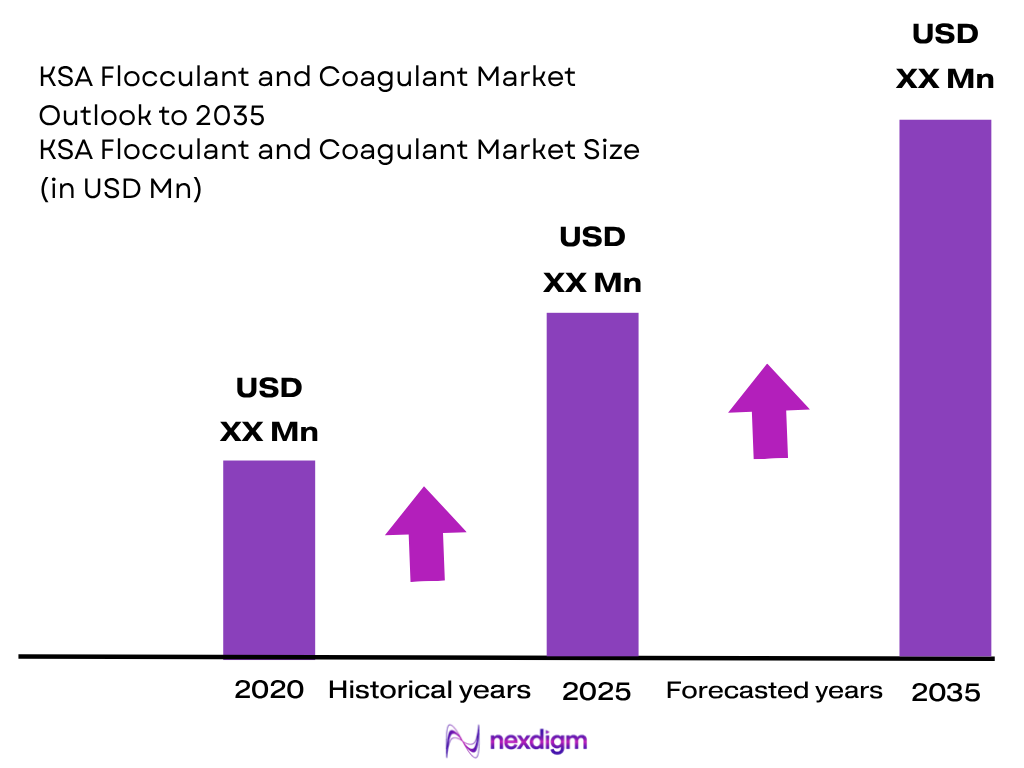
The KSA Flocculant and Coagulant Market is valued at approximately USD ~XX.X million, supported by the country’s large-scale water-treatment, desalination, municipal wastewater and industrial-treatment infrastructure. Saudi Arabia recorded USD 1,239.8 billion in GDP and USD 35,121.7 in GDP per capita, while economic activity expanded by 2.0 in the latest World Bank data. The market is driven by demand for coagulation, flocculation, clarification and sludge dewatering across municipal utilities, desalination facilities, oil and gas, petrochemicals, mining and power generation.
The KSA Flocculant and Coagulant Market is concentrated around Riyadh, Jeddah and the Eastern Province because these locations combine municipal populations with large industrial, energy, desalination and wastewater-treatment infrastructure. Riyadh represents the principal government and municipal-services hub, while Jeddah supports major urban, commercial and water-treatment requirements. The Eastern Province is particularly important because of its concentration of oil, gas, petrochemical and industrial operations. Saudi Arabia produced approximately 9.0 million barrels per day of crude oil in the latest EIA data, reinforcing the importance of industrial water and produced-water treatment.
Market Segmentation
By Product Type
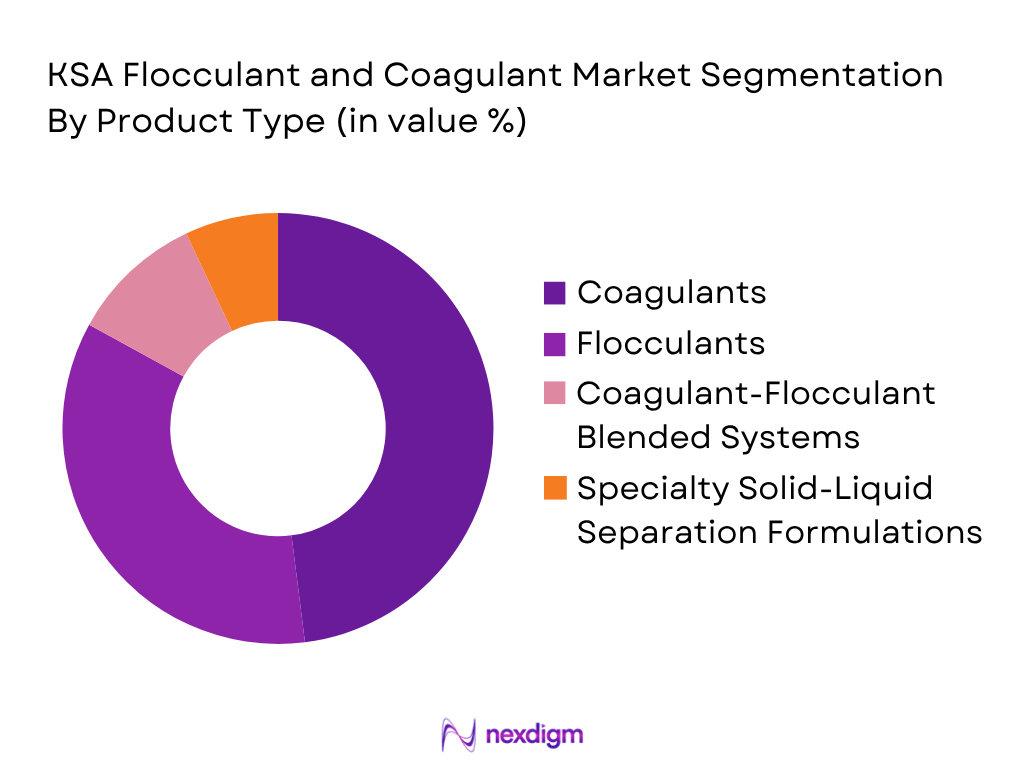
The KSA Flocculant and Coagulant Market is segmented by product type into coagulants, flocculants, coagulant-flocculant blended systems and specialty solid-liquid separation formulations. Coagulants are expected to represent the dominant sub-segment because they are extensively used at the initial stage of water clarification to destabilize suspended and colloidal particles. Aluminum-based and iron-based products are applicable across municipal drinking-water treatment, wastewater treatment, desalination pretreatment and industrial effluent clarification. Their broad compatibility with different treatment processes supports recurring consumption by water utilities and industrial operators. Flocculants subsequently promote particle aggregation and improve settling and sludge separation, particularly in wastewater and sludge-dewatering applications. Blended systems address facilities seeking simplified chemical programs, while specialty formulations serve demanding industrial streams. The country’s large oil and gas ecosystem, expanding industrial infrastructure and extensive water-treatment requirements create demand for chemical programs capable of handling high suspended-solid loads and variable water chemistry. Saudi Arabia’s industrial base also supports continued application of coagulation and flocculation in petrochemical, mining, food processing and power-generation facilities.
By End-Use Industry
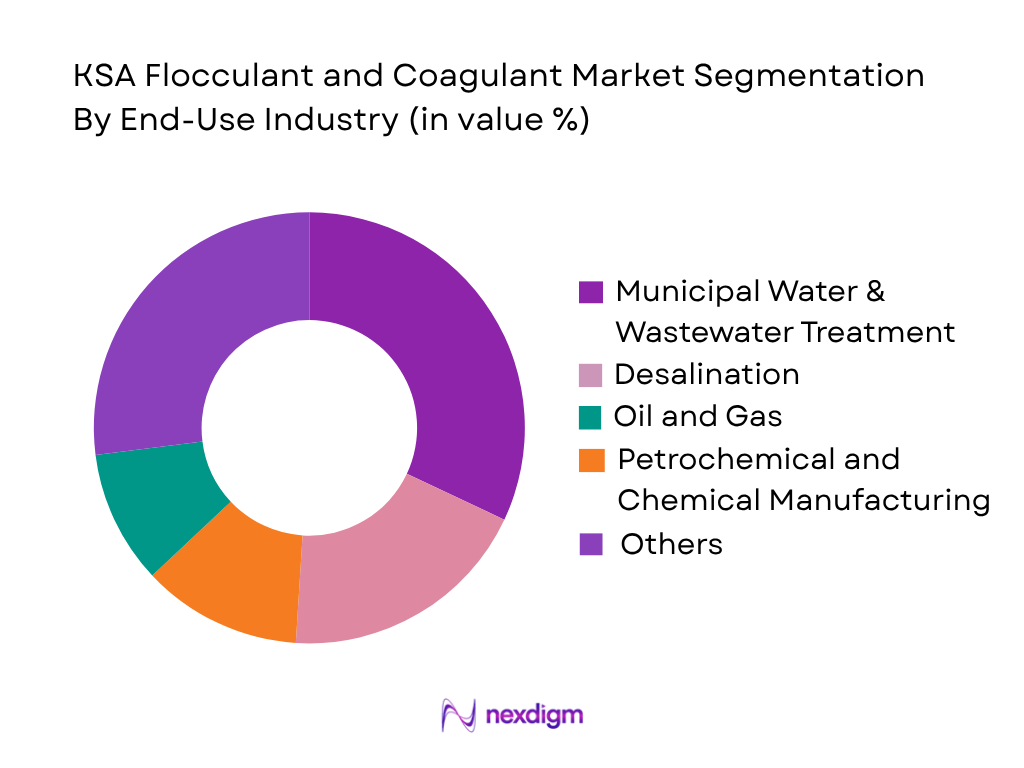
The KSA Flocculant and Coagulant Market is segmented by end-use industry into municipal water and wastewater treatment, desalination, oil and gas, petrochemical and chemical manufacturing, mining and mineral processing, power generation, food and beverage, pharmaceutical manufacturing, pulp and paper and other industrial applications. Municipal water and wastewater treatment is expected to represent the dominant sub-segment because coagulation and flocculation are fundamental stages in drinking-water clarification, wastewater treatment and sludge management. Desalination also creates substantial chemical-treatment requirements because pretreatment systems need effective removal of suspended solids and colloidal material before membrane processes. Oil and gas represents another technically important demand center, particularly for produced-water treatment and oil-water separation. Saudi Arabia’s energy sector remains exceptionally large, with crude-oil production averaging 9.0 million barrels per day in 2024. Industrial water demand is further supported by the country’s USD 1,239.8 billion economy and continued diversification of manufacturing and infrastructure activity.
Competitive Landscape
The KSA Flocculant and Coagulant Market comprises global water-treatment chemical suppliers, specialty polymer manufacturers and integrated water-treatment companies serving municipal, desalination and industrial customers. Competition is shaped by product chemistry, technical formulation capability, application engineering, local distribution, inventory availability and the ability to qualify chemicals for demanding treatment processes. International suppliers including SNF, Kemira, Ecolab, Solenis, BASF, SUEZ and Veolia participate alongside regional distributors and treatment-service providers. The importance of industrial applications is reinforced by Saudi Arabia’s large energy sector and continued infrastructure development.
| Company | Establishment Year | Headquarters | Product Portfolio | Key Application | Polymer Capability | KSA Presence | Technical Service | Distribution Reach |
| SNF Group | 1978 | Andrézieux, France | ~ | ~ | ~ | ~ | ~ | ~ |
| Kemira Oyj | 1920 | Helsinki, Finland | ~ | ~ | ~ | ~ | ~ | ~ |
| Ecolab Inc. | 1923 | St. Paul, USA | ~ | ~ | ~ | ~ | ~ | ~ |
| Solenis LLC | 1907 | Wilmington, USA | ~ | ~ | ~ | ~ | ~ | ~ |
| BASF SE | 1865 | Ludwigshafen, Germany | ~ | ~ | ~ | ~ | ~ | ~ |
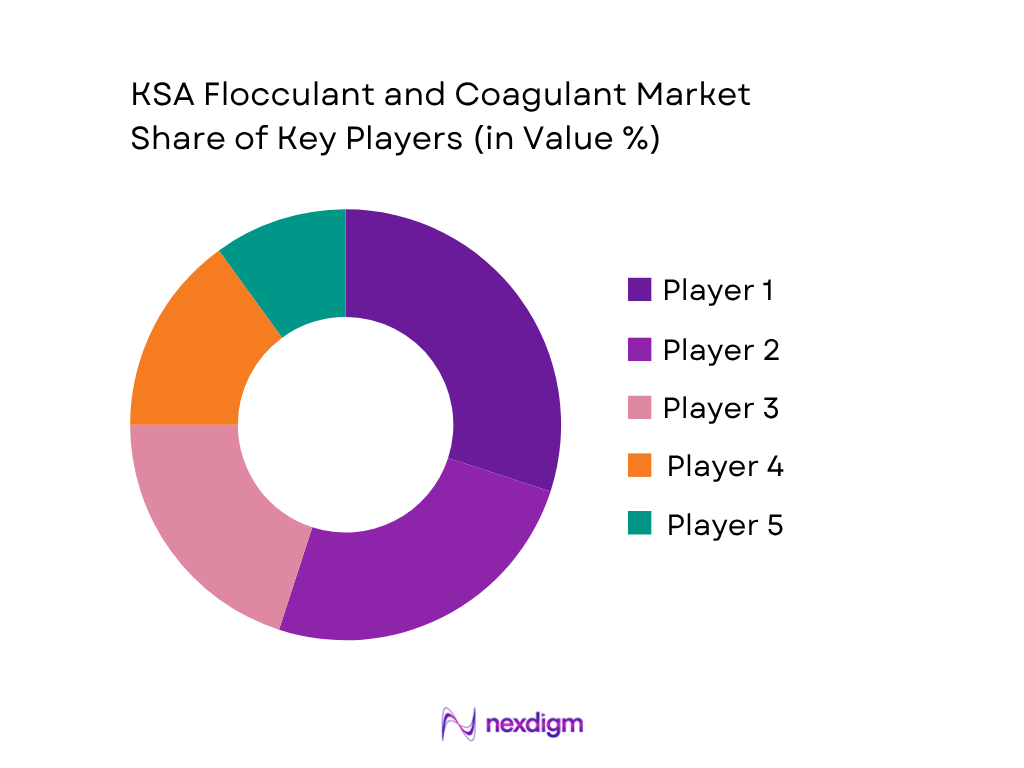
KSA Flocculant and Coagulant Market Analysis
Growth Drivers
Expansion of Desalination and Water Treatment Infrastructure
The KSA Flocculant and Coagulant Market is supported by the Kingdom’s extensive desalination and water-treatment infrastructure, where coagulation and flocculation chemicals are required for pretreatment, clarification, suspended-solids removal and downstream process protection. Saudi Arabia’s urban water demand was approximately 15.47 million m³ per day, while current and planned independent water plants represented combined desalination supply capacity of 4.16 million m³ per day. The Kingdom’s broader water system also includes 36 seawater desalination plants, 160 wastewater treatment plants, 11,000 km of desalinated-water transmission pipelines and 127,500 km of distribution networks. In addition, the National Water Company completed 118 water and sanitation projects, adding 478,000 m³ per day of wastewater-treatment capacity and benefiting approximately 1.8 million residents. These infrastructure volumes create recurring requirements for inorganic coagulants, organic polymers and specialty flocculants across drinking-water and wastewater facilities. The continued expansion and upgrading of treatment capacity also increases demand for chemicals used in clarification, sludge separation and pretreatment. As new facilities are commissioned and existing plants are modernized, chemical suppliers can address requirements through higher-efficiency formulations, automated dosing systems and application-specific treatment programs.
Industrialization and Oil & Gas Water-Treatment Requirements
Industrial development is another major growth driver for the KSA Flocculant and Coagulant Market because industrial facilities require chemical treatment for process water, wastewater, produced water, clarification and sludge management. Saudi Arabia’s real GDP increased by 1.3 in 2024, while non-oil activities expanded by 4.3, demonstrating continued diversification of economic activity beyond hydrocarbons. Manufacturing activity increased by 6.3 in December 2024, with chemical manufacturing activity increasing by 4.8 and coke and refined petroleum-product manufacturing increasing by 9.3. These activities generate wastewater streams requiring coagulation and flocculation before discharge, recycling or further treatment. The energy sector remains particularly important, with Saudi Arabia’s crude-oil production reaching approximately 8.91 million barrels per day in December 2024, creating substantial produced-water treatment requirements throughout oil-producing and processing operations. Industrial wastewater applications require different polymer charge densities, molecular weights and formulations depending on suspended solids, hydrocarbons and process chemistry. Expansion of petrochemical, chemical, manufacturing and energy operations therefore broadens the customer base for specialty treatment chemicals and application-specific formulations. Increasing industrial water-reuse requirements can further increase demand for treatment chemicals capable of achieving consistent clarification and solids-removal performance. This creates opportunities for suppliers with technical expertise in dosage optimization, wastewater characterization and customized polymer selection.
Market Challenges
Chemical Supply, Logistics and Treatment-System Complexity
The KSA Flocculant and Coagulant Market faces operational challenges associated with chemical logistics, specialized formulations and the geographical scale of water infrastructure. Saudi Arabia operates approximately 11,000 km of desalinated-water transmission pipelines and 127,500 km of distribution networks, meaning treatment chemicals must be reliably supplied across geographically dispersed municipal and industrial facilities. The Kingdom also operates 574 dams with combined storage capacity of approximately 2.6 billion m³, alongside 8,835 drinking-water wells and 407 monitoring wells. Different water sources and treatment configurations create varying requirements for coagulant selection, polymer charge density, molecular weight, dosage and sludge-management performance. Industrial facilities add further complexity because wastewater composition can change according to production cycles and feedstock characteristics. Chemical suppliers therefore require local inventories, technical-service capabilities and application specialists capable of performing jar testing, dosage optimization and process troubleshooting. Large desalination systems also require chemical programs that protect downstream membrane operations from fouling and suspended material. Maintaining consistent chemical quality across municipal, desalination and industrial customers can consequently increase operational complexity. Suppliers must also maintain reliable transportation, storage and handling systems because interruptions in chemical availability can affect continuous treatment operations. The need for localized technical support and rapid response further increases the operational requirements associated with serving geographically dispersed treatment assets.
Environmental and Resource-Efficiency Requirements
Environmental compliance and resource efficiency create another challenge for the KSA Flocculant and Coagulant Market because treatment operators increasingly need solutions that improve water recovery while controlling chemical residues and sludge generation. Saudi Arabia’s water strategy emphasizes sustainable water-resource management, wastewater services and improved efficiency across the water sector. The Kingdom currently operates 160 advanced wastewater-treatment plants, while national water infrastructure distributes approximately 11.4 million m³ of water per day. Wastewater treatment therefore involves substantial chemical consumption and creates corresponding sludge streams requiring thickening, dewatering, transportation and disposal. Chemical selection must balance clarification performance with downstream sludge characteristics, residual concentrations and overall treatment efficiency. Desalination facilities add another technical requirement because pretreatment chemicals must support membrane protection and stable plant operation. Saudi Arabia has also identified wastewater reuse as a strategic priority, requiring treatment systems capable of producing consistent-quality reclaimed water for industrial and other applications. As reuse systems expand, treatment chemicals must perform reliably under tighter process specifications. Suppliers therefore need to address treatment efficiency, residual control, sludge handling and compatibility with water-reuse systems. This increases the importance of product testing, process monitoring and application engineering, particularly where treatment facilities must maintain stable performance despite variations in feedwater quality and operating conditions.
Market Opportunities
Wastewater Reuse and Advanced Sludge-Dewatering Applications
The expansion of wastewater reuse creates a significant opportunity for the KSA Flocculant and Coagulant Market because higher levels of water recovery require reliable clarification, solids separation and sludge-treatment processes. Saudi Arabia’s National Water Company completed 118 water and sanitation projects, investing more than SAR 5.57 billion and adding 478,000 m³ per day of wastewater-treatment capacity. The projects benefited approximately 1.8 million residents, creating additional treatment infrastructure requiring coagulants and flocculants. The Kingdom’s broader water system includes 160 advanced wastewater-treatment plants, while current water distribution is approximately 11.4 million m³ per day. These facilities generate opportunities for high-performance polymers used in primary clarification, secondary treatment, sludge thickening and mechanical dewatering. Wastewater reuse can also require tighter control of suspended solids and residual contaminants before water enters industrial or other reuse applications. This supports demand for customized polymer formulations, low-residual coagulants, automated dosing and application-specific treatment programs. Suppliers can further differentiate through dosage optimization, online monitoring and technical support rather than commodity chemical supply alone. Advanced sludge-dewatering systems can additionally reduce the volume of sludge requiring transportation and disposal, making polymer selection an important component of overall treatment economics. The combination of expanding wastewater capacity and increasing emphasis on water recovery creates a broader application base for specialized flocculant and coagulant technologies.
Specialty Treatment Chemicals for Desalination and Industrial Water
The development of specialized desalination and industrial-water applications provides an opportunity for higher-performance flocculants and coagulants in the KSA market. Saudi Arabia’s water system has more than 16 million m³ per day of fresh-water production capacity, while current and planned independent water projects include approximately 4.16 million m³ per day of desalination capacity. Individual projects include Ras Al Khair 3 with 400,000 m³ per day and Rabigh 5 with 400,000 m³ per day, illustrating the scale of new treatment assets. These facilities require effective pretreatment to remove suspended and colloidal material before membrane processes, creating demand for application-specific coagulants and flocculants. Industrial diversification creates an additional opportunity, with manufacturing activity increasing by 6.3 in December 2024 and chemical-product manufacturing increasing by 4.8. This combination of water infrastructure and industrial expansion supports opportunities for specialty polymers, optimized coagulant blends, automated dosing systems and treatment formulations designed for difficult industrial effluent. Desalination pretreatment also creates opportunities for products engineered around membrane protection, stable clarification and reduced solids loading. Industrial applications can similarly require customized formulations for petrochemical, chemical, manufacturing and energy-sector wastewater. Suppliers with local technical support, application laboratories and customized dosing capabilities can therefore address increasingly specialized treatment requirements rather than competing solely on commodity chemical supply.
Future Outlook
The KSA Flocculant and Coagulant Market is expected to expand as Saudi Arabia continues developing desalination, municipal wastewater treatment, industrial water reuse and environmental infrastructure. Demand is also likely to benefit from oil and gas produced-water treatment, petrochemical processing, mining development and power-generation requirements. Saudi Arabia’s economic scale, with GDP of USD 1,239.8 billion, provides a substantial industrial and infrastructure base for continued water-treatment investment. The increasing requirement for efficient solid-liquid separation is expected to encourage higher-performance polymers, specialty coagulants, automated dosing and application-specific treatment formulations. Oil and gas will remain an important industrial application, with Saudi Arabia producing approximately 9.0 million barrels per day of crude oil in 2024.
Major Players
- SNF Group
- Kemira Oyj
- Ecolab Inc.
- Solenis LLC
- BASF SE
- SUEZ Water Technologies & Solutions
- Veolia Water Technologies
- Kurita Water Industries Ltd.
- Feralco Group
- Dow Inc.
- Nouryon
- Buckman Laboratories International, Inc.
- Kronos Worldwide, Inc.
- Aries Chemical, Inc.
- Avista Technologies, Inc.
Key Target Audience
- Water and wastewater treatment chemical manufacturers
- Desalination plant operators and water utilities
- Oil and gas and petrochemical companies
- Mining and mineral processing companies
- Industrial wastewater treatment operators
- Investments and venture capitalist firms
- Government and regulatory bodies (Saudi Water Authority, Ministry of Environment, Water and Agriculture, National Center for Environmental Compliance)
- Engineering, procurement and water-treatment equipment companies
Research Methodology
Step 1: Identification of Key Variables
The initial phase involves constructing an ecosystem map covering chemical manufacturers, polymer suppliers, distributors, municipal utilities, desalination operators, industrial wastewater facilities and end-use industries within the KSA Flocculant and Coagulant Market. The assessment identifies product chemistry, dosage requirements, treatment applications, production capacity, import dependency and customer procurement variables. Public-sector water infrastructure and industrial activity indicators are incorporated to establish the underlying demand environment.
Step 2: Market Analysis and Construction
Historical market information is compiled across coagulants, flocculants, blended formulations and specialty solid-liquid separation products. The analysis evaluates consumption by chemistry, application, end-use industry, distribution channel and region while separately assessing municipal, desalination and industrial demand. Bottom-up calculations are constructed using consumption volumes, customer categories, treatment applications and supplier-level operating information, with cross-checks against macroeconomic and industry indicators.
Step 3: Hypothesis Validation and Expert Consultation
Market hypotheses are developed around product adoption, treatment-chemical consumption, application intensity, supplier positioning and customer procurement behavior. Interviews with water-treatment chemical suppliers, municipal treatment operators, desalination specialists, industrial water managers and distributors are used to validate assumptions. Expert inputs are compared with documented operating information to refine product, application and end-use estimates.
Step 4: Research Synthesis and Final Output
The final phase integrates supply-side and demand-side findings to produce a validated assessment of the KSA Flocculant and Coagulant Market. Company-level information is used to benchmark product portfolios, technical capabilities, distribution networks and application coverage. The resulting analysis connects market size, segmentation, competitive positioning and future demand drivers into a consistent market model.

- Executive Summary
- Research Methodology (Market Definition and Scope, KSA Flocculant and Coagulant Market Classification, Flocculant and Coagulant Product Mapping, Chemistry-Level Assessment, Polymer-Level Assessment, Charge-Type Assessment, Form-Level Assessment, Application-Level Demand Analysis, End-Use Industry Assessment, Water Treatment Process Mapping, Production Capacity Mapping, Domestic Manufacturing Assessment, Import and Export Trade Analysis, Raw Material Supply Assessment, Municipal Demand Assessment, Industrial Demand Assessment, Desalination Demand Assessment, Demand-Side Assessment, Supply-Side Assessment, Top-Down Market Sizing, Bottom-Up Market Sizing, Primary Industry Interviews, Data Triangulation, Forecasting Framework, Market Share Validation, Limitations and Future Conclusions)

- Definition and Scope
- KSA Flocculant and Coagulant Industry Evolution and Development of Municipal Water Treatment, Desalination Infrastructure, Industrial Wastewater Treatment, Water Reuse Systems and Advanced Solid-Liquid Separation Technologies
- Flocculant and Coagulant Value Chain Analysis
- Flocculant and Coagulant Supply Chain Analysis
- Chemical Feedstock Suppliers, Polymer Manufacturers, Coagulant Manufacturers, Flocculant Formulators, Water Treatment Chemical Suppliers, Distributors, Municipal Water Utilities, Desalination Operators, Wastewater Treatment Operators, Engineering and EPC Companies, Industrial End Users, Oil and Gas Operators, Mining Companies
- Flocculant Integration Across Drinking Water Treatment, Municipal Wastewater Treatment, Desalination Pretreatment, Industrial Effluent Treatment, Mining and Mineral Processing, Oil and Gas Produced Water, Petrochemical Processing, Food and Beverage and Power Generation

- Growth Drivers (Expansion of Desalination Capacity, Municipal Wastewater Treatment Development, Water Reuse and Recycling Expansion, Oil and Gas Produced Water Treatment, Petrochemical Manufacturing Growth, Mining and Mineral Processing Development, Industrial Water Treatment Requirements, Water Security Infrastructure Investments, Increasing Demand for High-Efficiency Solid-Liquid Separation)
- Market Challenges (Raw Material Price Volatility, Dependence on Imported Specialty Chemicals, Desalination Pretreatment Complexity, High Chemical Qualification Requirements, Chemical Storage and Logistics Constraints, Harsh Operating Conditions, Sludge Disposal Requirements, Supply Chain Disruptions, Skilled Water Treatment Operator Requirements)
- Market Opportunities (Advanced Desalination Pretreatment, High-Performance Polyacrylamide Formulations, Industrial Water Recycling, Oilfield Produced Water Treatment, Mining Tailings Dewatering, Municipal Sludge Management, Local Chemical Manufacturing, Bio-Based Flocculant Development, Automated Chemical Dosing and Process Optimization)
- Market Trends (High-Performance Polymer Flocculants, Advanced Desalination Pretreatment, Water Reuse Technologies, Industrial Wastewater Recycling, Automated Chemical Dosing, Digital Water Treatment Monitoring, Advanced Sludge Dewatering, Low-Residual Coagulants, Sustainable Flocculant Development, Localized Chemical Supply)
- Government Regulations and Standards (Saudi National Water Strategy Requirements, Saudi Water Authority Standards, Ministry of Environment Water and Agriculture Requirements, National Center for Environmental Compliance Regulations, Saudi Environmental Law, Saudi Standards Metrology and Quality Organization Standards, Industrial Wastewater Discharge Requirements, Drinking Water Quality Requirements, Chemical Handling and Storage Regulations)
- SWOT Analysis
- Porter’s Five Forces Analysis
- PESTLE Analysis
- Stakeholder Ecosystem
- Competition Ecosystem

- By Market Value (2020-2025)
- By Market Volume (2020-2025)
- By Flocculant Consumption Volume (2020-2025)
- By Coagulant Consumption Volume (2020-2025)
- By Organic Flocculant Consumption Volume (2020-2025)
- By Inorganic Coagulant Consumption Volume (2020-2025)
- By Domestic Production Volume (2020-2025)
- By Import Volume (2020-2025)
- By Export Volume (2020-2025)
- By Average Selling Price (2020-2025)

- By Product Type (In Value %)
Flocculants
Coagulants
Coagulant-Flocculant Blended Systems
Specialty Solid-Liquid Separation Formulations - By Application Type (In Value %)
Coagulation
Flocculation
Clarification
Sedimentation
Sludge Thickening
Sludge Dewatering
Dissolved Air Flotation
Produced Water Treatment
Solid-Liquid Separation
Water Recycling and Reuse - By End-Use Industry (In Value %)
Municipal Water and Wastewater Treatment
Desalination
Oil and Gas
Petrochemical and Chemical Manufacturing
Mining and Mineral Processing
Power Generation
Food and Beverage
Pharmaceutical Manufacturing
Pulp and Paper
Other Industrial Applications - By Water Treatment Application (In Value %)
Drinking Water Treatment
Municipal Wastewater Treatment
Desalination Pretreatment
Industrial Wastewater Treatment
Process Water Treatment
Produced Water Treatment
Cooling Water Treatment
Water Reuse and Recycling
Sludge Treatment - By Distribution Channel (In Value %)
Direct Industrial Sales
Direct Municipal Utility Sales
Authorized Water Treatment Distributors
Specialty Chemical Distributors
Desalination and Water Treatment Service Companies
Engineering and EPC Procurement
Industrial Supply Networks
Online Industrial Platforms - By Region (In Value %)
Riyadh
Eastern Province
Makkah Province
Madinah Province
Jazan
Asir
Tabuk
Other Saudi Arabian Regions

- Market Share of Major Players (By KSA Revenue, Flocculant Sales Volume, Coagulant Sales Volume, Product Chemistry Portfolio, Polymer Production Capacity, End-Use Industry Exposure, Municipal Customer Coverage, Industrial Customer Coverage, Distribution Network Coverage, Regional Presence, Water Treatment Application Coverage, Technical Service Capability, R&D and Application-Laboratory Capability)
- Cross Comparison Parameters (Flocculant and Coagulant Revenue, Organic and Inorganic Product Portfolio Breadth, Polyacrylamide Technology Coverage, Desalination Treatment Capability, Municipal Water Treatment Capability, Industrial Wastewater Treatment Coverage, Oil and Gas and Mining Application Coverage, KSA Distribution Network Reach)
- SWOT Analysis of Major Players
- Competitive Positioning Matrix
- Flocculant Product Portfolio and Application Benchmarking
- Major Companies
SNF Group
Kemira Oyj
Ecolab Inc.
Solenis LLC
BASF SE
SUEZ Water Technologies & Solutions
Veolia Water Technologies
Kurita Water Industries Ltd.
Feralco Group
Dow Inc.
Nouryon
Buckman Laboratories International, Inc.
Kronos Worldwide, Inc.
Aries Chemical, Inc.
Avista Technologies, Inc.

- Municipal Drinking Water Utility Procurement Assessment
- Municipal Wastewater Treatment Plant Chemical Requirement Analysis
- Desalination Plant Pretreatment Chemical Requirement Analysis
- Oil and Gas Produced Water Treatment Requirement Analysis
- Petrochemical Wastewater Treatment Assessment
- Mining and Mineral Processing Flocculant Requirement Assessment
- Power Generation Water Treatment Chemical Procurement Analysis
- Food and Beverage Wastewater Treatment Assessment
- Chemical Manufacturing Effluent Treatment Analysis
- Sludge Dewatering Chemical Procurement Assessment
- Water Treatment Engineering and EPC Procurement Analysis

- By Market Value (2026-2035)
- By Market Volume (2026-2035)
- By Flocculant Consumption Volume (2026-2035)
- By Coagulant Consumption Volume (2026-2035)
- By Organic Flocculant Consumption Volume (2026-2035)
- By Inorganic Coagulant Consumption Volume (2026-2035)
- By Domestic Production Volume (2026-2035)
- By Import Volume (2026-2035)
- By Export Volume (2026-2035)
- By Average Selling Price (2026-2035)


 Request a Sample
 Ask for Customization
 Get a Quote
 Enquire Now