

 Download PDF
Market Overview
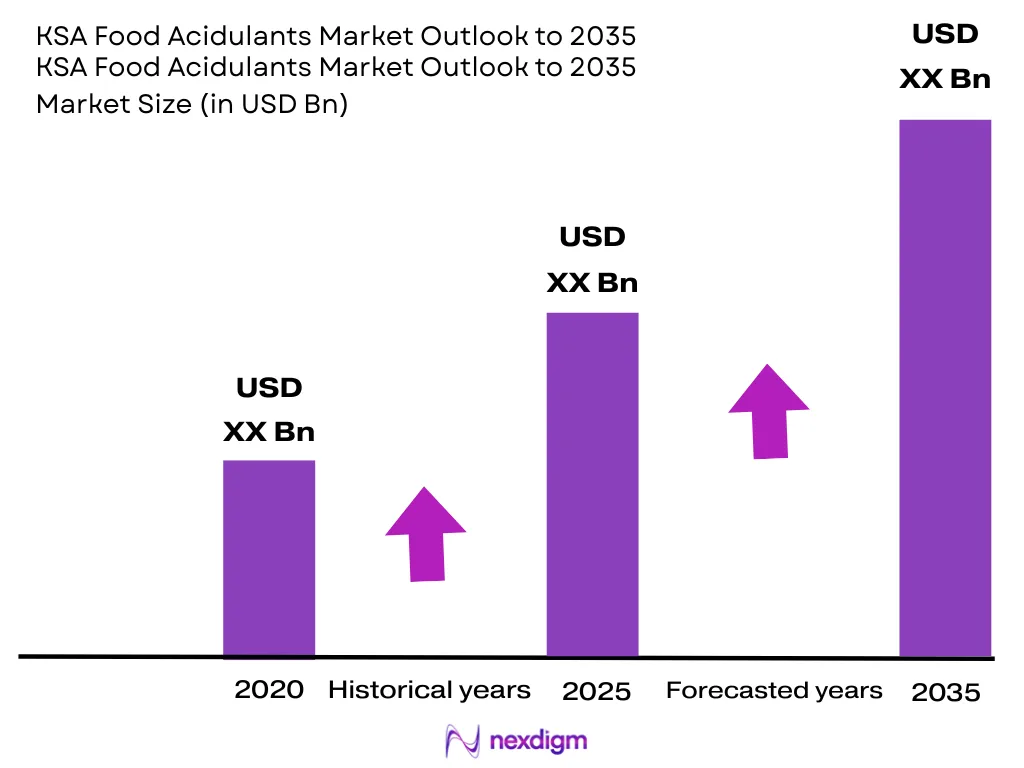
The KSA Food Acidulants Market was valued at USD ~ million in 2024 and is projected to expand at a CAGR of ~% during the 2026–2035 forecast period. According to data published by the Saudi Food and Drug Authority (SFDA), the General Authority for Statistics (GASTAT), and the Saudi Authority for Industrial Cities and Technology Zones (MODON), Saudi Arabia’s food and beverage manufacturing sector continues to grow as a priority pillar of the Kingdom’s Vision 2030 economic diversification strategy, expanding its domestic food production base and progressively reducing reliance on food imports. Food acidulants, encompassing organic acids such as citric acid, lactic acid, malic acid, tartaric acid, fumaric acid, and acetic acid, as well as inorganic acids including phosphoric acid and functional acid systems such as glucono delta-lactone (GDL), are essential functional ingredients used across the Kingdom’s beverage manufacturing, dairy processing, bakery, processed meat and poultry, sauces, canned food, and functional nutrition applications. Saudi Arabia’s food acidulant market is almost entirely supplied through imports, given the absence of domestic organic acid fermentation manufacturing capacity, with procurement primarily routed through specialty chemical and food ingredient distributors operating across the Kingdom’s major commercial hubs in Riyadh, Jeddah, and Dammam. The market’s growth trajectory is closely aligned with Saudi Arabia’s expanding food manufacturing investment under Vision 2030, strong seasonal demand during Ramadan and Eid celebrations, the country’s young and growing consumer population, and the Kingdom’s strategic ambition to develop a regionally significant food manufacturing and export sector.
Market Segmentation
By Acidulant Type
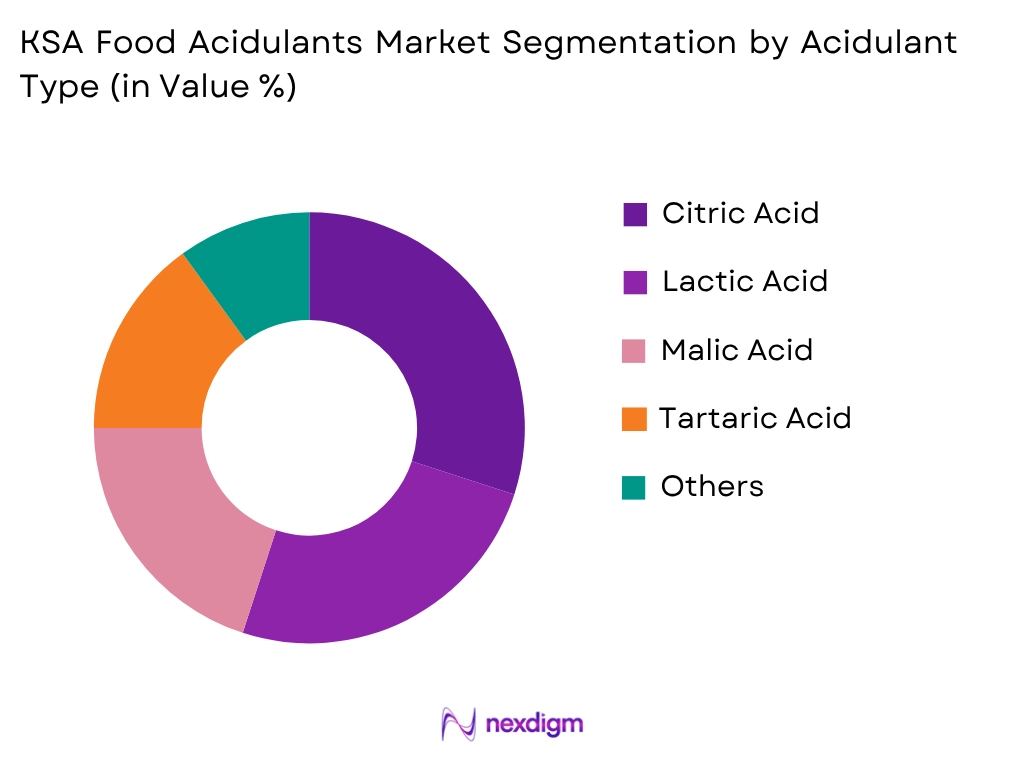
Citric acid dominates the KSA Food Acidulants Market by both value and volume, reflecting its essential role as a pH regulator, flavour enhancer, preservation aid, chelating agent, and antioxidant synergist across the Kingdom’s most commercially significant food and beverage manufacturing categories. According to SFDA market data and industry association inputs, citric acid is the single most widely consumed food acidulant in Saudi Arabia’s beverage manufacturing sector, which encompasses a substantial carbonated soft drink industry led by international brands including The Coca-Cola Company Saudi Arabia, PepsiCo Saudi Arabia, and Aujan Industries, as well as a rapidly growing non-alcoholic malt beverage, functional drink, and juice sector that relies on citric acid for consistent flavour balance and pH management across hot climate storage conditions. Saudi Arabia’s non-alcoholic character as a predominantly Muslim country has driven the development of a distinctive and innovative non-alcoholic beverage market, including sophisticated malt beverages, sparkling fruit drinks, and functional hydration products that use citric acid, malic acid, and tartaric acid to achieve flavour complexity that compensates for the absence of alcohol as a sensory ingredient. Lactic acid represents the second most significant acidulant segment, driven by Saudi Arabia’s dairy processing sector, the large-scale fermented dairy product industry producing laban, yoghurt, and ayran, processed meat and poultry preservation requirements across the country’s halal-certified meat processing industry, and growing demand for natural preservation systems in packaged food products. Continuous investments by international ingredient distributors and multinational food companies in SFDA-compliant supply chains, Halal-certified ingredient sourcing, and cold chain-compatible logistics across the Kingdom’s extreme climate have further reinforced citric acid’s market leadership while creating growth opportunities for specialty acidulants across functional food and premium beverage applications.
By Distribution Channel
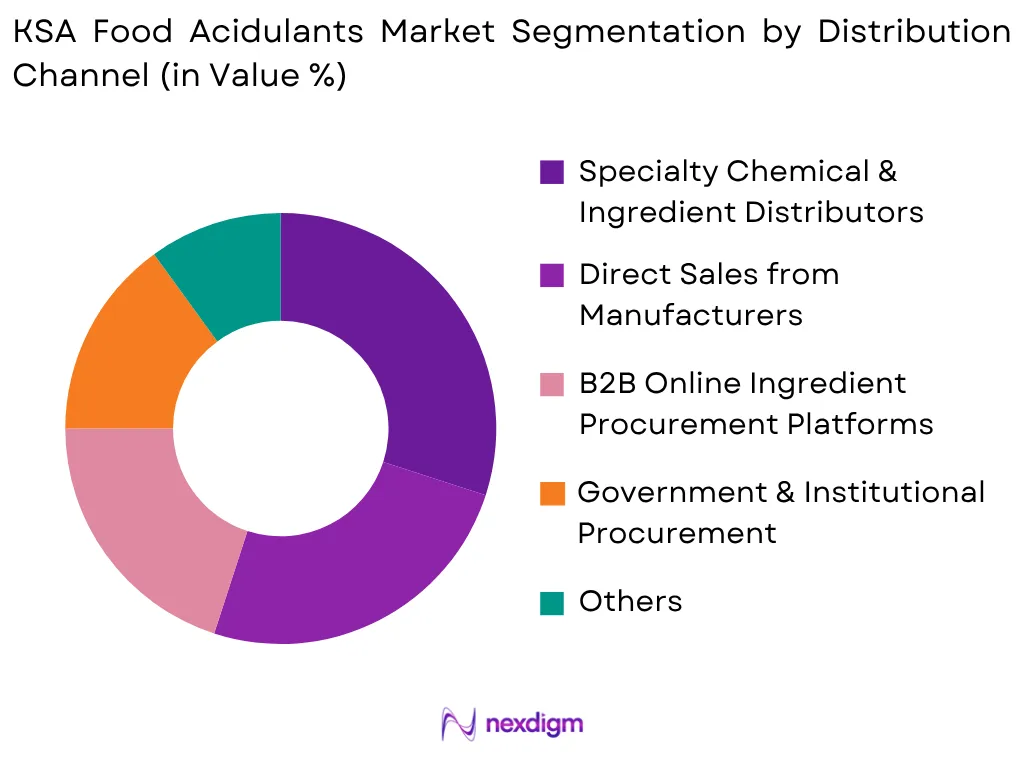
Specialty chemical and ingredient distributors represent the dominant distribution channel in the KSA Food Acidulants Market, as Saudi Arabia’s absence of domestic acidulant manufacturing means that virtually all acidulant volumes are imported and channelled to food manufacturers through a network of established specialty ingredient and chemical distribution companies. Leading multinational distributors including Brenntag Saudi Arabia, IMCD Saudi Arabia, and Univar Solutions Saudi Arabia maintain extensive warehousing networks, SFDA-compliant product documentation, and technical sales teams that serve the Kingdom’s food and beverage manufacturers across Riyadh, Jeddah, Dammam, and regional commercial centres. Direct sales from international acidulant manufacturers to large Saudi food and beverage companies represent a secondary channel, particularly for high-volume citric acid procurement by major carbonated beverage bottlers, dairy processors, and food conglomerates that maintain sufficient purchasing scale to justify direct import arrangements with global producers. Import agents and trading companies serve as an important supplementary channel, particularly for commodity-grade citric acid sourced from Chinese producers, enabling smaller Saudi food manufacturers to access competitively priced ingredient volumes without the administrative burden of managing direct international procurement. Government and institutional procurement through the Saudi e-government procurement portal (Etimad) is relevant for acidulant supply contracts to government-affiliated food processing operations, Saudi Aramco catering and food services, and institutional catering organisations serving pilgrims during Haj and Umrah seasons at Makkah and Madinah, which generate significant short-duration demand spikes for food ingredient procurement.
Competitive Landscape
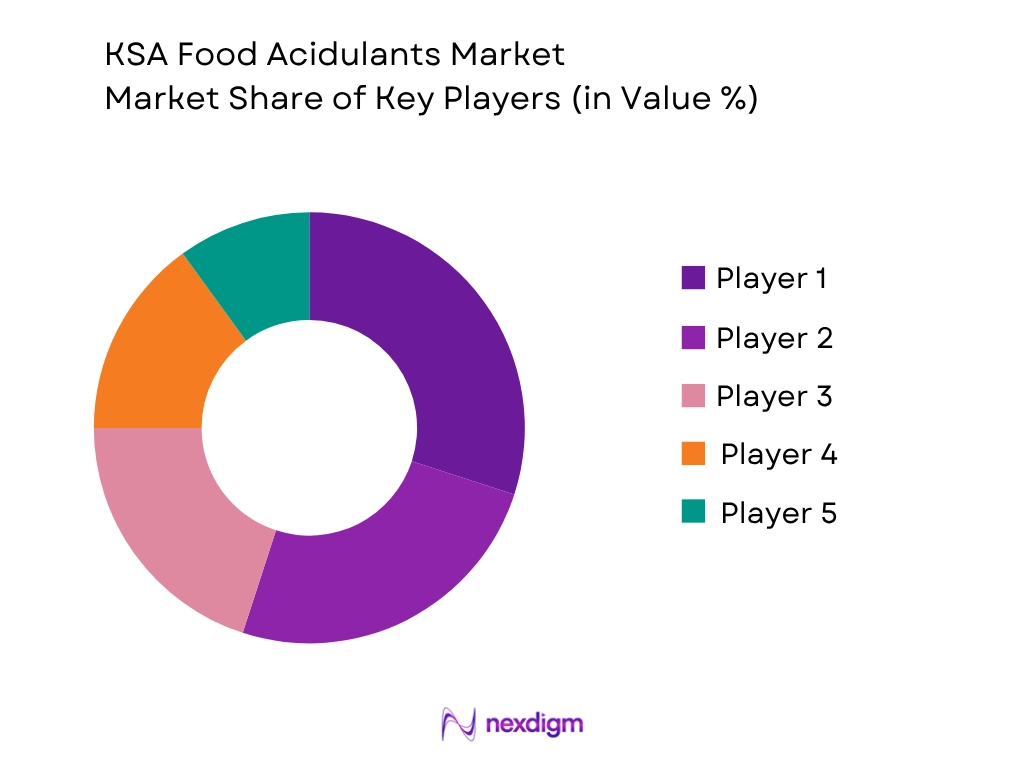
The KSA Food Acidulants Market is served almost entirely by specialty ingredient and chemical distribution companies that import acidulants from global manufacturers and supply the Saudi food and beverage industry through established distributor networks, as no significant domestic acidulant manufacturing capacity exists within the Kingdom. Multinational distribution leaders including Brenntag Saudi Arabia, IMCD Saudi Arabia, and Univar Solutions Saudi Arabia dominate the market through their extensive logistics infrastructure, broad acidulant product portfolios, SFDA and GSO regulatory compliance capabilities, Halal certification documentation management, and technical sales support for food manufacturer customers across the Kingdom’s major industrial and commercial centres. Specialty acidulant manufacturers including Jungbunzlauer, Corbion, and Tate & Lyle serve the Saudi market through authorised regional distributor arrangements or direct commercial engagement with major food company accounts, competing on product quality, fermentation-derived natural and Halal positioning, and differentiated specialty acidulant portfolios. Competition in the commodity citric acid segment is particularly intense due to the significant price competitiveness of Chinese-origin material, while natural, Halal-certified, and bio-based specialty acidulant segments offer higher margin opportunities for technically differentiated suppliers.
| Company | Establishment Year | Headquarters | Primary Acidulant Portfolio | Key Application Industries
|
Manufacturing Presence | R&D Capability | Distribution Network | Clean Label Solutions |
| Brenntag Saudi Arabia | 1874 | ~ | ~ | ~ | ~ | ~ | ~ | ~ |
| IMCD Saudi Arabia | 1897 | ~ | ~ | ~ | ~ | ~ | ~ | ~ |
| Univar Solutions Saudi Arabia | 1924 | ~ | ~ | ~ | ~ | ~ | ~ | ~ |
| Al Ahlia Chemicals (Acidulants Division) | 1980 | ~ | ~ | ~ | ~ | ~ | ~ | ~ |
| Jungbunzlauer Middle East (KSA) | 1867 | ~ | ~ | ~ | ~ | ~ | ~ | ~ |
KSA Food Acidulants Market Analysis
Growth Drivers
Vision 2030 Food Manufacturing Expansion and Rising Domestic Food Production
Saudi Arabia’s Vision 2030 economic transformation programme and its associated National Industrial Development and Logistics Programme (NIDLP) continue to be the most significant structural growth drivers for the KSA Food Acidulants Market by driving sustained investment in domestic food manufacturing capacity, progressively expanding the Kingdom’s food processing industry and correspondingly growing demand for food ingredient inputs including acidulants. According to the Ministry of Investment Saudi Arabia (MISA) and the Saudi Authority for Industrial Cities and Technology Zones (MODON), Saudi Arabia has attracted significant foreign direct investment in food manufacturing across industrial cities including Riyadh Second Industrial City, Jeddah Second Industrial City, and King Abdullah Economic City (KAEC), with new food processing facilities being established across beverage bottling, dairy processing, bakery manufacturing, and packaged food production categories. The World Bank estimated Saudi Arabia’s GDP at approximately USD 1.1 trillion in 2024, reflecting the largest economy in the GCC and a strong fiscal foundation for sustained industrial investment and food manufacturing development under Vision 2030. The General Authority for Statistics (GASTAT) reported that Saudi Arabia’s food and beverage manufacturing sector has been among the most actively growing industrial categories, benefiting from government support through SIDF (Saudi Industrial Development Fund) financing, industrial land allocation in MODON-managed industrial cities, and regulatory facilitation through the SFDA’s enhanced food manufacturing support services. The Saudi government’s strategic objective of achieving greater food self-sufficiency and reducing the Kingdom’s food import bill, which historically represents one of its largest import expenditure categories given near-total food import dependency, is incentivising both domestic and international food manufacturers to establish or expand production operations in Saudi Arabia, creating growing and diversifying demand for food acidulant ingredients across an expanding range of domestic food manufacturing applications.
Strong Seasonal Demand, Non-Alcoholic Beverage Innovation and Young Consumer Population
Saudi Arabia’s strongly seasonal food and beverage consumption patterns, anchored by Ramadan and Eid celebrations that generate substantial demand surges across beverage, dairy, confectionery, and packaged food categories, combined with the Kingdom’s young and growing population and its distinctive non-alcoholic beverage market, continue to create robust and diversified demand for food acidulants across multiple application categories. According to the General Authority for Statistics (GASTAT), Saudi Arabia’s population exceeded 35 million people in 2024, with a substantial proportion aged under 35 years, providing a large and expanding consumer base for packaged beverages, snacks, dairy products, and processed foods that represent the primary applications for citric acid, malic acid, lactic acid, and phosphoric acid in food manufacturing. The International Monetary Fund (IMF) projected continued non-oil GDP growth for Saudi Arabia supported by Vision 2030 diversification, improving household purchasing power and sustaining the growth of domestic consumer food spending. Saudi Arabia’s non-alcoholic beverage market is one of the most innovative in the Middle East, driven by the cultural and religious absence of alcoholic beverages, which has stimulated the development of sophisticated non-alcoholic malt drinks, sparkling fruit beverages, premium juices, and functional hydration products by companies including Aujan Industries, Saudia Dairy and Foodstuff Company (SADAFCO), and international beverage companies with Saudi manufacturing operations. These non-alcoholic categories require citric acid, malic acid, and tartaric acid at comparable volumes to their alcoholic equivalents for pH management, flavour enhancement, and preservation, generating consistent acidulant demand. Ramadan beverage consumption alone generates a significant annual demand spike, as Saudi households dramatically increase consumption of juices, fruit drinks, laban, and functional beverages during the holy month, creating predictable pre-Ramadan procurement surges that reinforce acidulant supply chain planning requirements for the Kingdom’s food and beverage manufacturers.
Market Challenges
Near-Total Import Dependency and Extreme Climate Logistics Challenges
The KSA Food Acidulants Market faces a fundamental structural challenge arising from Saudi Arabia’s complete absence of domestic organic acid or inorganic food acidulant manufacturing capacity, making the Kingdom entirely dependent on imported acidulant volumes sourced from global production hubs in China, Europe, and North America and channelled through the Kingdom’s import infrastructure at Jeddah Islamic Port and King Abdulaziz Port in Dammam. According to the Saudi Food and Drug Authority (SFDA) and GASTAT trade statistics, Saudi Arabia imports 100 percent of its food acidulant requirements, with citric acid predominantly sourced from China and specialty acidulants including lactic acid, malic acid, and GDL primarily imported from European producers including Corbion, Jungbunzlauer, and Tate & Lyle. This complete import dependency exposes Saudi food manufacturers to global commodity price volatility, shipping and freight cost fluctuations affecting Red Sea and Gulf maritime routes, potential supply disruptions from geopolitical events or trade restriction measures, and foreign exchange exposure linked to the Saudi riyal’s peg to the US dollar affecting procurement competitiveness when sourcing from non-dollar-denominated production regions. Saudi Arabia’s extreme desert climate, with summer temperatures frequently exceeding 45 degrees Celsius, imposes significant additional logistical costs and operational complexity on the acidulant supply chain, as certain specialty liquid acidulants and hygroscopic dry acid powders require temperature-controlled storage and handling throughout warehousing and distribution to preserve product quality, pH specification, and physical integrity. The cost of maintaining climate-controlled warehouse and transportation infrastructure across Riyadh, Jeddah, Dammam, and regional distribution points during the extended Saudi summer period represents a material recurring operational expense for acidulant distributors and food ingredient suppliers, adding to the landed cost of imported acidulants and compressing distributor margins relative to more temperate food ingredient markets.
Halal Certification Compliance for Fermentation-Derived Acidulants and SFDA Regulatory Complexity
The requirement for Halal certification compliance across fermentation-derived food acidulants, combined with the regulatory complexity of the Saudi Food and Drug Authority’s food additive approval and import accreditation framework, creates specific and operationally demanding compliance challenges for acidulant suppliers and food manufacturers operating in the KSA market. Fermentation-derived acidulants including lactic acid, citric acid, and glucono delta-lactone are produced through microbial fermentation processes that may utilise growth media or process aids containing animal-derived ingredients, including certain fermentation nutrients, antifoaming agents, or clarifying agents, that require careful scrutiny and documentation to ensure compliance with Halal standards accepted in Saudi Arabia. The Saudi Food and Drug Authority and the Saudi Halal Centre require comprehensive Halal certification documentation from recognised international and Saudi-approved Halal certification bodies, including evidence of ingredient sourcing, fermentation substrate composition, processing aid declarations, and facility audit compliance, adding administrative complexity and cost to the qualification process for fermentation-derived acidulants in the Saudi market. SFDA’s food additive regulatory framework, aligned with GSO Gulf Standards Organization harmonised standards and the Codex Alimentarius, specifies permitted acidulant types, maximum usage levels by food category, purity specifications, and labelling requirements that must be strictly maintained by all importers and food manufacturers, with non-compliance carrying import suspension, product recall, or manufacturing licence consequences. The SFDA’s enhanced regulatory oversight of food ingredient imports, including physical inspection and laboratory testing requirements for certain ingredient categories, can also extend customs clearance timelines at Saudi ports, creating additional supply chain management challenges for time-sensitive acidulant procurement ahead of peak Ramadan production seasons.
Market Opportunities
Vision 2030 Food Manufacturing Localisation and GCC Regional Export Development
Saudi Arabia’s Vision 2030 ambition to develop a regionally significant domestic food manufacturing base and establish the Kingdom as a food export hub for the broader Middle East and North Africa region presents a substantial long-term growth opportunity for food acidulant suppliers positioned to support the Kingdom’s expanding food processing industry. The National Industrial Development and Logistics Programme (NIDLP) and the Saudi Food and Agriculture Authority (SFAA) have identified food manufacturing localisation as a strategic priority, with SIDF financing programmes, MODON industrial city infrastructure, and investment facilitation by MISA collectively supporting the establishment of new food processing operations across dairy, meat, bakery, beverage, and packaged food categories that will require growing volumes of domestically supplied or locally stocked food acidulants. The General Authority for Statistics (GASTAT) and the Ministry of Commerce project continued growth in Saudi food manufacturing output through 2035, driven by population growth, rising domestic consumption, growing tourism inflows from Vision 2030 giga-project development, and the Saudi government’s strategic food self-sufficiency agenda. The GCC Standardization Organization (GSO) harmonised food additive regulatory framework facilitates relatively streamlined commercial expansion of SFDA-compliant food ingredient supply across all six GCC member states, enabling acidulant distributors and food manufacturers established in Saudi Arabia to serve the UAE, Kuwait, Qatar, Bahrain, and Oman markets from a single regulatory compliance platform. As Saudi food manufacturers develop export-oriented production capabilities targeting the broader Arab world, Africa, and South Asia, the demand for internationally compliant, Halal-certified, and SFDA-documented food acidulant ingredients will expand correspondingly, positioning well-established acidulant suppliers with comprehensive regulatory capabilities to capture growing volumes from Saudi Arabia’s developing food export industry.
Non-Alcoholic Beverage Innovation and Reduced-Sugar Product Acidulant Systems
Saudi Arabia’s distinctive non-alcoholic beverage culture and the Kingdom’s growing market for reduced-sugar and functional packaged food and drink products are creating significant innovation-driven demand for specialty acidulant systems that deliver superior flavour complexity, natural preservation, and nutritional positioning in a market that has unique formulation requirements relative to global beverage standards. According to GASTAT and the Saudi Food and Drug Authority, Saudi Arabia’s non-alcoholic beverage market has been growing rapidly, with the introduction of new beverage categories including premium sparkling fruit drinks, sophisticated non-alcoholic malt and botanical beverages, energy and functional hydration products, and premium juice blends that require precisely designed acidulant systems combining citric acid, malic acid, tartaric acid, and specialty organic acid blends to achieve the flavour depth and complexity that compensates for the absence of alcoholic fermentation-derived sensory characteristics. The Saudi Ministry of Health and the SFDA have been progressively strengthening nutritional awareness initiatives and discussing front-of-pack labelling frameworks that are expected to accelerate reduced-sugar reformulation activity among Saudi food and beverage manufacturers, creating parallel demand for acidulant systems that maintain consumer-acceptable taste profiles in reduced-sugar products through enhanced tartness perception, flavour modulation, and mouthfeel optimisation using malic acid, tartaric acid, and blended citric-malic acid systems. Ramadan-specific product innovation by Saudi food companies, including premium date-infused beverages, sophisticated non-alcoholic sparkling drinks, and fortified functional beverages designed for Suhoor and Iftar consumption, represents a seasonal but commercially significant application development opportunity for specialty acidulant suppliers able to provide tailored formulation support and technically differentiated ingredient solutions to Saudi beverage and food manufacturers seeking product differentiation during the Kingdom’s highest-consumption season.
Future Outlook
The KSA Food Acidulants Market is expected to witness sustained growth throughout the forecast period, supported by Saudi Arabia’s Vision 2030-driven food manufacturing expansion, a young and growing consumer population generating rising packaged food and beverage demand, strong seasonal consumption patterns during Ramadan and Eid, continued non-alcoholic beverage innovation, and the Kingdom’s progressive development of a GCC-serving food export manufacturing base. Acidulant distributors and ingredient suppliers are increasingly investing in SFDA and GSO regulatory compliance infrastructure, Halal-certified ingredient portfolio development, national distribution network depth across Riyadh, Jeddah, Dammam, and emerging regional commercial centres, and technical application support capabilities tailored to Saudi food manufacturer requirements. Growing functional beverage innovation, reduced-sugar product reformulation, and Vision 2030 giga-project-driven institutional food demand will create additional market growth opportunities. Continued investments in import supply chain diversification, climate-resilient logistics infrastructure, and Halal-certified specialty acidulant portfolios will strengthen the long-term competitive positioning of acidulant suppliers in the KSA market through 2035.
Major Players
- Brenntag Saudi Arabia
- IMCD Saudi Arabia
- Univar Solutions Saudi Arabia
- Al Ahlia Chemicals (Acidulants Division)
- Jungbunzlauer Middle East (KSA)
- Corbion Middle East (KSA)
- Tate & Lyle Middle East (KSA)
- Cargill Saudi Arabia (Ingredient Division)
- National Chemical Company (NCC) – Saudi Arabia
- Arabian Trading Supplies (ATS)
- Gulf Cryo (Industrial Gases and Chemical Distribution)
- Al-Rajhi Chemicals
- Sadara Chemical Company (Specialty Chemicals)
- Saudi Basic Industries Corporation (SABIC) – Food Grade Chemicals
- Ingredion Middle East (KSA)
Key Target Audience
- Food & Beverage Manufacturers and Product Developers
- Beverage Producers, Juice Processors and Non-Alcoholic Drink Manufacturers
- Dairy Processors and Fermented Food Manufacturers
- Processed Meat and Poultry Manufacturers
- Bakery and Confectionery Manufacturers
- Investments and Venture Capitalist Firms
- Government and Regulatory Bodies (Saudi Food and Drug Authority (SFDA), General Authority for Statistics (GASTAT), Saudi Authority for Industrial Cities and Technology Zones (MODON), Ministry of Investment Saudi Arabia (MISA), Saudi Industrial Development Fund (SIDF), GCC Standardization Organization (GSO))
- Specialty Chemical and Food Ingredient Distributors
- Halal Certification Bodies and Compliance Consultants
Research Methodology
Step 1: Identification of Key Variables
The research begins by identifying the major stakeholders across the KSA Food Acidulants value chain, including international acidulant manufacturers, importers, specialty chemical and ingredient distributors, food and beverage manufacturers, dairy processors, meat and poultry processors, beverage producers, Halal certification bodies, and regulatory agencies including the SFDA and GSO. Extensive secondary research is conducted using SFDA publications, GASTAT trade and manufacturing statistics, MODON industrial development data, GSO regulatory frameworks, company annual reports, and proprietary food ingredient market databases to establish the key variables influencing market performance.
Step 2: Market Analysis and Construction
Historical market information is compiled and evaluated to estimate overall market size, acidulant import volumes by type, pricing dynamics, application penetration across food and beverage manufacturing segments, and revenue generation by acidulant category. Both demand-side indicators, including beverage production volumes, dairy processing output, processed food manufacturing statistics, and Ramadan season demand patterns, and supply-side indicators, including import volumes by acidulant type, distributor network coverage, and SFDA import accreditation status, are analysed using bottom-up and top-down approaches to construct a comprehensive market model.
Step 3: Hypothesis Validation and Expert Consultation
Preliminary market estimates and assumptions are validated through Computer Assisted Telephone Interviews (CATIs) and structured discussions with food ingredient company commercial and technical directors, food and beverage manufacturer procurement and R&D managers, specialty chemical distributors, beverage industry formulation specialists, SFDA regulatory affairs consultants, and Halal certification experts. These consultations provide critical insights into acidulant procurement patterns, pricing dynamics, Halal compliance requirements, seasonal demand behaviour, and formulation innovation priorities specific to the Saudi food manufacturing context.
Step 4: Research Synthesis and Final Output
The final stage integrates primary research findings with secondary data to develop a comprehensive market assessment covering acidulant type segments, application categories, functional use profiles, regional distribution patterns, competitive landscape, and future growth opportunities. Multiple validation techniques, including cross-verification with SFDA import accreditation data, GASTAT trade statistics, and GSO regulatory documentation, are employed to ensure the consistency and credibility of the final market report.

- Executive Summary
- Research Methodology (Market Definitions and Assumptions, Abbreviations, Market Taxonomy, Market Sizing Approach, Top-Down Analysis, Bottom-Up Analysis, Demand-Side Assessment, Supply-Side Assessment, Primary Industry Interviews, Secondary Research Validation, Data Triangulation, Forecasting Framework, Limitations and Future Conclusions)

- Definition and Scope
- Market Evolution and Industry Genesis
- Timeline of Major Industry Developments
- Industry Value Chain Analysis
- Supply Chain Analysis

- Growth Drivers (Expanding Beverage Manufacturing Under Vision 2030, Rising Food Manufacturing Localisation, Ramadan and Festive Season Demand Surge, Growing Non-Alcoholic Beverage and Functional Drink Innovation, Expansion of Modern Retail and Foodservice Channels, Halal-Certified Acidulant Demand, Increasing Processed and Packaged Food Consumption, GCC Regional Food Export Development)
- Market Challenges (Near-Total Import Dependency for All Acidulant Ingredients, Extreme Climate Conditions Impacting Storage and Logistics, High Cost of Speciality Acidulants Relative to Market Size, SFDA Regulatory Approval Complexity for Novel Ingredients, Price Competition from Chinese Commodity Citric Acid Suppliers, VAT Impact on Ingredient Procurement Costs, Limited Domestic Food Ingredient Manufacturing Base, Halal Certification Compliance for Fermentation-Derived Acidulants)
- Market Opportunities (Vision 2030 Food Manufacturing Investment and Import Substitution, GCC Unified Food Standards Facilitating Regional Trade, Functional and Reduced-Sugar Beverage Acidulant Innovation, Non-Alcoholic Malt and Specialty Drink Category Growth, Halal-Certified Bio-Based Acidulant Sourcing, Ramadan and Eid Seasonal Product Reformulation, NEOM and Giga-Project Food Manufacturing Demand, Saudi Food Export Market Development)
- Market Trends (Clean-Label and Natural Acidulant Adoption, Halal-Certified Fermentation-Derived Acids, Reduced-Sugar Beverage Acidulant Systems, Specialty Acidulant Blends for Functional Foods, Non-Alcoholic Beverage Category Innovation, Digital B2B Ingredient Procurement, Sustainable Sourcing Credentials, Precision Fermentation-Derived Acidulant Interest)
- Government Regulations and Policies (Saudi Food and Drug Authority (SFDA) Food Additive Standards, GSO Gulf Standards Organization Harmonised Food Additive Regulations, Halal Certification Requirements by SASO and SFDA, Saudi VAT Framework on Imported Ingredients, Saudi Standards Specifications and Metrology Organization (SASO) Standards, Import Documentation and Customs Clearance Requirements, Ministry of Commerce Trade Regulations, Vision 2030 National Industrial Development Programme)
- Raw Material and Import Supply Analysis (Citric Acid Import Sources – China and Europe Dependency, Lactic Acid and Lactate Import Chains, Phosphoric Acid Supply from Petrochemical and Fertiliser Industry, Specialty Acidulant Import Volumes, Freight and Port Logistics via Jeddah Islamic Port and Dammam)
- Import and Trade Flow Analysis (Acidulant Import Volumes by Type, GCC Intra-Trade Framework, Re-Export from UAE Hubs, Anti-Dumping Measures, SFDA Import Accreditation Requirements)
- Beverage Industry Demand Analysis (Carbonated Soft Drink Acidulant Use, Non-Alcoholic Malt Drink Formulations, Juice Acidulant Requirements, Energy Drink and Functional Beverage Formulations, Ramadan Beverage Demand Surge)
- Halal Compliance Analysis (Halal Status of Fermentation-Derived Acidulants, Animal-Derived Ingredient Risk Assessment, Halal Certification Bodies Recognised in KSA, Consumer and Retailer Halal Preference)
- SWOT Analysis
- Porter’s Five Forces Analysis
- PESTLE Analysis
- Stakeholder Ecosystem
- Competition Ecosystem

- By Market Value (2020-2025)
- By Volume Consumption (2020-2025)
- By Average Selling Price (2020-2025)

- By Acidulant Type (In Value %)
Citric Acid
Lactic Acid
Acetic Acid & Vinegar-Based Acidulants
Malic Acid
Fumaric Acid
Phosphoric Acid
Tartaric Acid
Glucono Delta-Lactone (GDL)
Other Acidulants (Adipic Acid, Succinic Acid, Propionic Acid) - By Application (In Value %)
Beverages
Bakery & Confectionery
Dairy & Fermented Products
Processed Meat & Poultry
Sauces, Dressings & Condiments
Snacks & Savoury Products
Canned & Preserved Foods
Functional & Nutraceutical Foods - By Function (In Value %)
pH Regulation & Buffering
Preservation & Antimicrobial Activity
Flavour Enhancement & Taste Modulation
Texture & Gel Formation
Colour Stabilisation
Leavening Agent Activation
Chelation & Mineral Binding - By Distribution Channel (In Value %)
Direct Sales from Manufacturers
Specialty Chemical & Ingredient Distributors
B2B Online Ingredient Procurement Platforms
Government & Institutional Procurement
Import Agents & Trading Companies - By Region (In Value %)
Riyadh Region
Makkah Region (Jeddah & Makkah)
Eastern Province (Dammam & Al Khobar)
Madinah Region
Other Regions (Asir, Qassim, Tabuk, Jazan, Hail and others)

- Market Share Analysis (By Value, Acidulant Type, Application Segment, End-User Category, Region)
- Cross Comparison Parameters (Product Portfolio Breadth Across Acidulant Types, Application Coverage, KSA and GCC Regional Distribution Network Depth, SFDA and GSO Regulatory Compliance Capabilities, Halal Certification Coverage, Import Sourcing Diversification, Bio-Based and Natural Acidulant Portfolio Strength, Technical Sales and Food Application Support Capability)
- SWOT Analysis of Major Players
- Pricing Analysis (By Acidulant Type, Purity Grade, Source, Application Segment, Volume Tier, Contract Duration)
- Detailed Profiles of Major Companies
Brenntag Saudi Arabia
IMCD Saudi Arabia
Univar Solutions Saudi Arabia
Al Ahlia Chemicals
Jungbunzlauer Middle East (KSA)
Corbion Middle East (KSA)
Tate & Lyle Middle East (KSA)
Cargill Saudi Arabia
National Chemical Company (NCC) – Saudi Arabia
Arabian Trading Supplies (ATS)
Gulf Cryo
Al-Rajhi Chemicals
Sadara Chemical Company
Saudi Basic Industries Corporation (SABIC)
Ingredion Middle East (KSA)

- Procurement Pattern Analysis (Long-Term Supply Contract Preference, Spot vs Annual Contract Purchasing, Direct vs Distributor Sourcing, Import Agent vs Direct Manufacturer Procurement)
- End-User Demand Analysis (Beverage Manufacturer Requirements, Dairy Processor Needs, Meat and Poultry Processor Specifications, Bakery and Confectionery Manufacturer Preferences)
- Budget and Expenditure Analysis by Application Segment
- Premium vs Commodity Acidulant Preference Analysis
- Halal Certification and Clean-Label Acidulant Preference
- Technical Support and Application Development Service Preference
- Product Attribute Preference Analysis (Purity Grade, SFDA and GSO Compliance, Halal Certification, Solubility, pH Buffering Capacity, Taste Profile, Price, Country of Origin, Sustainability Credentials)
- Technology Adoption in Acidulant Application and Formulation
- Online vs Traditional Ingredient Sourcing Behaviour
- Buyer Pain Point Analysis
- Supplier Switching and Long-Term Contract Behaviour

- By Market Value (2026-2035)
- By Volume Consumption (2026-2035)
- By Average Selling Price (2026-2035)


 Request a Sample
 Ask for Customization
 Get a Quote
 Enquire Now