
 Download PDF
Market Overview
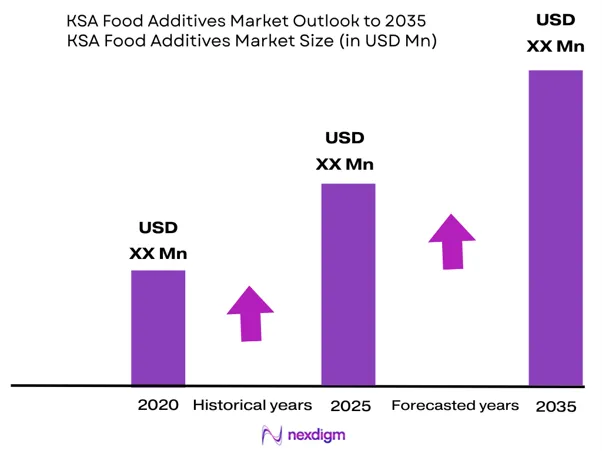
The KSA Food Additives Market is valued at USD ~ million, based on a five-year historical analysis, and is forecast to grow at % CAGR during the forecast period. Demand is driven by bakery, dairy, beverages, confectionery, meat processing, snacks, sauces and QSR foods. Saudi Arabia’s food and beverage market was valued at USD 57.93 billion, while the economy grew 1.3% in 2024 and non-oil activity expanded 4.3%. The KSA Food Additives Market is dominated by Riyadh, Jeddah, Makkah, Dammam, Al Kharj, Qassim, King Abdullah Economic City and the Eastern Province. Riyadh dominates through FMCG headquarters, retail procurement and QSR demand, while Jeddah and Makkah dominate through port access, foodservice, tourism and imported ingredients. Al Kharj and Qassim dominate through dairy and poultry processing. Nestlé’s SAR 270 million MODON factory agreement reinforces local manufacturing momentum.
Market Segmentation
By Additive Type
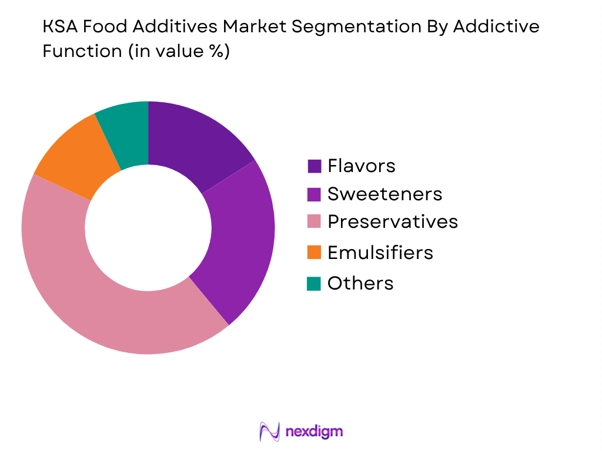
KSA Food Additives Market is segmented by additive type into preservatives, flavours, flavour enhancers, emulsifiers, stabilizers, sweeteners, colours, acidity regulators, antioxidants, hydrocolloids, enzymes and other functional additives. Recently, preservatives have a dominant market share in KSA under the additive type segmentation due to the country’s hot climate, strong reliance on packaged foods, import-led ingredient flows, long-distance distribution and fast-growing foodservice ecosystem. Preservatives are widely used in bakery products, dairy items, beverages, sauces, ready meals, processed meats, confectionery and snacks to control microbial spoilage, mould growth, oxidation and quality deterioration. Their dominance is reinforced by the need for shelf-life extension across supermarket, hypermarket, convenience-store, QSR, HoReCa and e-commerce distribution. Saudi manufacturers also require preservative systems aligned with SFDA and GSO permissions, halal documentation, Arabic labelling and product category-specific maximum-use levels.
By Application
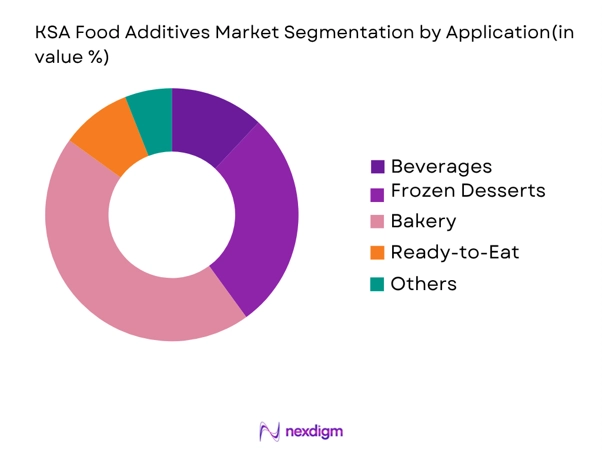
KSA Food Additives Market is segmented by application into bakery and confectionery, beverages, dairy and frozen desserts, meat and poultry products, sauces, condiments, ready meals, snacks, savoury foods, dates, fruit preparations, nutritional foods, fortified foods and plant-based foods. Recently, bakery and confectionery have a dominant market share in KSA under the application segmentation because the category uses several additive systems simultaneously. Industrial bakeries require emulsifiers, preservatives, enzymes, acidity regulators, humectants and texture improvers for dough strength, crumb softness, mould control and shelf-life stability. Confectionery producers use colours, glazing agents, sweeteners, acidulants, stabilizers and flavour systems for sensory appeal and consistency. Demand is supported by supermarkets, convenience retail, QSRs, cafés, school snacks, packaged cakes, biscuits, wafers, chocolates and premium bakery formats. The segment’s additive intensity makes it structurally stronger than single-function applications.
Competitive Landscape
The KSA Food Additives Market is shaped by global ingredient companies, GCC distributors, Saudi food ingredient traders, specialty chemical suppliers and application solution providers. The market remains import-led for specialty additives such as hydrocolloids, enzymes, natural colours, sweeteners, stabilizer blends and high-specification functional systems. Competitive advantage is increasingly defined by SFDA/GSO documentation, halal certification, local stockholding, Arabic label support, formulation troubleshooting, customer-specific technical service and distribution reach across Riyadh, Jeddah and Dammam. Large dairy, bakery, beverage, QSR and meat-processing companies prefer suppliers that can support permitted-use verification and commercial scale-up.
| Company | Establishment Year | Headquarters | Core Additive Focus | KSA Market Role | Key Applications | Distribution Strength | Compliance Capability | Market-Specific Capability |
| Kerry Ingredients Saudi Arabia | 1972 | Tralee, Ireland | ~ | ~ | ~ | ~ | ~ | ~ |
| Cargill Middle East | 1865 | Wayzata, USA | ~ | ~ | ~ | ~ | ~ | ~ |
| DSM-Firmenich Middle East | 2023 | Maastricht / Geneva | ~ | ~ | ~ | ~ | ~ | ~ |
| Givaudan Saudi Arabia | 1895 | Vernier, Switzerland | ~ | ~ | ~ | ~ | ~ | ~ |
| Brenntag Saudi Arabia | 1874 | Essen, Germany | ~ | ~ | ~ | ~ | ~ | ~ |
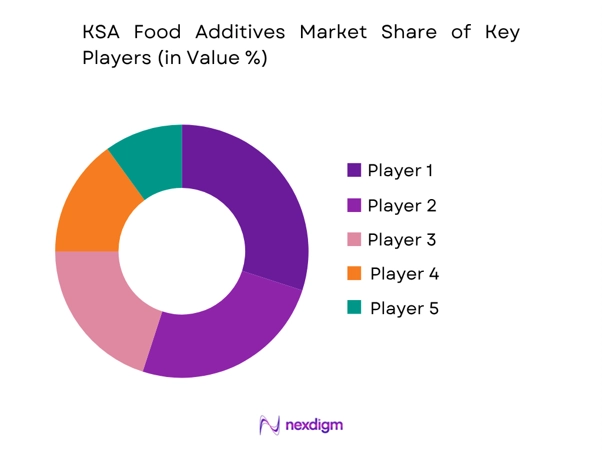
KSA Food Additives Market Analysis
Growth Drivers
Food manufacturing expansion and non-oil industrial growth
KSA Food Additives Market is supported by the Kingdom’s expanding food manufacturing base, where preservatives, emulsifiers, stabilizers, flavours, sweeteners, colours, acidity regulators, antioxidants and hydrocolloids are used across bakery, dairy, beverages, confectionery, snacks, meat processing and ready meals. GASTAT reported that Saudi Arabia’s real GDP grew 1.3 units per 100 units in 2024, while non-oil activities expanded 4.3 units per 100 units and government activities expanded 2.6 units per 100 units. The Ministry of Industry and Mineral Resources stated that Saudi Arabia hosts more than 1,900 food factories, with investments exceeding SAR 88 billion. This supports additive demand because factory-scale food manufacturing requires consistent ingredient systems for shelf-life extension, heat stability, batch consistency, texture improvement and flavour standardisation. The country’s hot climate and long logistics corridors between Riyadh, Jeddah, Dammam, Makkah, Qassim and Al Kharj increase the need for preservatives, antioxidants, stabilizers and emulsifier systems in packaged food distribution.
Tourism, QSR and foodservice-led packaged food demand
KSA Food Additives Market is driven by tourism, hospitality, QSR expansion and institutional foodservice because these channels require standardized bakery products, sauces, meat preparations, beverages, frozen desserts, ready meals and snacks with stable taste, texture, colour and shelf life. Saudi Press Agency, citing the Ministry of Tourism, reported around 116 million domestic and inbound tourists in 2024 and total tourism spending of approximately SAR 284 billion. GASTAT’s Tourism Establishments Statistics reported 959,175 employees in tourism activities during Q2 2024, including 245,905 Saudi employees. These figures support additive demand because foodservice and tourism-linked consumption increases the need for beverage stabilizers, dairy texturizers, bakery emulsifiers, sauce thickeners, meat-processing antioxidants and ready-meal preservatives. For Saudi manufacturers, the opportunity is not limited to retail products; hotels, pilgrimage catering, cafés, entertainment venues, airline catering, QSR chains and cloud kitchens require reliable additive systems that perform under high-volume preparation, chilled storage, ambient distribution and Arabic-labelled packaged food supply.
Market Challenges
SFDA/GSO compliance and additive-category control
KSA Food Additives Market faces a major challenge from additive-specific regulation because food additives are governed by permitted lists, functional classes, food categories, maximum use levels and labelling requirements. SFDA lists “Additives Permitted for Use in Food Stuffs,” while Saudi market compliance is tied to SFDA and GCC frameworks such as SFDA.FD/GSO 2500. This matters directly for suppliers of preservatives, colours, sweeteners, antioxidants, acidulants, emulsifiers, stabilizers, enzymes and flavour enhancers because every ingredient must be checked against its intended food category and technological purpose. Saudi Arabia’s food factory base of more than 1,900 units and investments exceeding SAR 88 billion means compliance work affects a large industrial customer base rather than a small niche segment. Product developers must also manage Arabic labels, halal documentation, certificates of analysis, import clearance files and category-specific formulation limits. Compliance delays can affect bakery, dairy, beverages, meat processing, confectionery, sauces and QSR supply products, especially when global formulations are adapted for Saudi regulatory requirements.
Import dependence and technical reformulation constraints
KSA Food Additives Market is constrained by import dependence for specialty additives such as hydrocolloids, enzymes, natural colours, high-intensity sweeteners, encapsulated acidulants, specialty preservatives and stabilizer blends. USDA FAS stated that Saudi Arabia imports more than USD 20 billion of food and agricultural products annually, reflecting the country’s strong dependence on international food and ingredient flows. At the same time, the Saudi economy grew 1.3 units per 100 units in 2024, while non-oil activities rose 4.3 units per 100 units, increasing demand for local manufacturing inputs. This creates operational pressure because food manufacturers need imported additive supply to be reliable, documented and technically suitable for local processing conditions. Reformulation is difficult because replacing a preservative, sweetener, emulsifier, stabilizer, colour or antioxidant can change pH, viscosity, water activity, mouthfeel, colour migration, sweetness profile and shelf life. Smaller manufacturers may lack application labs, while large processors require formal trials, sensory validation, heat-stability checks, halal documentation and SFDA-permitted-use verification before commercial rollout.
Market Opportunities
Halal, clean-label and health-oriented additive systems
KSA Food Additives Market has an opportunity in halal-certified, clean-label and health-oriented additive systems as Saudi food processors respond to regulatory scrutiny, healthier consumption and demand for simpler ingredient declarations. USDA FAS noted that Saudi consumer demand is shifting toward healthier food options, particularly beverages and snacks, while online grocery and food delivery services are thriving. This creates room for natural colours, plant-based hydrocolloids, fermentation-derived preservatives, natural antioxidants, reduced-sugar sweetener blends, flavour masking systems and clean-label stabilizers. The opportunity is supported by a large manufacturing base of more than 1,900 food factories and investments exceeding SAR 88 billion, which creates an installed customer base for documentation-ready ingredients. Suppliers that provide halal certificates, Arabic label support, SFDA/GSO compliance guidance, certificates of analysis and application testing can target bakery, dairy, beverages, confectionery, meat products, sauces, ready meals and QSR supply chains. The most relevant opportunity is application-specific: low-sugar drinks need sweetener-acid balance, dairy needs stabilizers, and bakery needs clean-label emulsifier and preservative alternatives.
Local food manufacturing and GCC-ready ingredient supply
KSA Food Additives Market has a growth opportunity in locally stocked, GCC-ready additive supply because Saudi Arabia is expanding domestic food manufacturing while serving retail, QSR, hospitality and regional distribution channels. Nestlé signed a MODON agreement for its first Saudi food factory with an investment of SAR 270 million, indicating multinational commitment to local food manufacturing. Saudi Arabia’s tourism base of around 116 million domestic and inbound tourists and spending of approximately SAR 284 billion also increases demand for locally available ingredients that support hotels, cafés, QSRs, pilgrimage catering and packaged food manufacturers. The opportunity for additive suppliers lies in Saudi warehousing, multi-origin sourcing, halal documentation, Arabic label support, and SFDA/GSO category mapping. Domestic stockholding can reduce lead-time risk for preservatives, stabilizers, emulsifiers, sweeteners, colours, flavours, antioxidants and hydrocolloids. Suppliers can also serve GCC-oriented manufacturers that require scalable additive systems for bakery, beverages, dairy, snacks, meat products, sauces and ready meals, especially where consistency, shelf life and regulatory documentation determine supplier approval.
Future Outlook
Over the forecast period, the KSA Food Additives Market is expected to expand steadily through food manufacturing localization, Vision 2030 industrial diversification, QSR growth, tourism-led foodservice, dairy processing, beverages, bakery and convenience food demand. Food additives will remain central to shelf-life extension, taste standardization, texture control, colour stability, pH management, oxidation control and high-temperature supply-chain performance.
Dairy and frozen desserts will remain a strong application area due to demand for stabilizers, emulsifiers, thickeners, sweeteners, flavours and functional systems. Saudi dairy processors require heat stability, mouthfeel control, suspension stability and longer shelf life across fresh, ambient and chilled formats.
Beverages will continue to drive demand for acidity regulators, sweeteners, colours, flavour systems, clouding agents, preservatives and beverage emulsions. Low-sugar beverage innovation will increase the need for sweetener blends, masking agents, acid-sweetness balancing and stabilizer systems.
Bakery and confectionery will remain structurally additive-intensive. Industrial bakery growth will support emulsifiers, enzymes, preservatives and dough conditioners, while confectionery will support colours, glazing systems, acidulants and sweetener systems.
Meat and poultry processing will create specialized demand for phosphates, antioxidants, moisture-retention systems, curing ingredients, colour stabilizers and halal-compliant functional blends. Local processing investments will strengthen this application area.
Clean-label and natural ingredient demand will increase. Natural colours, plant-based hydrocolloids, fermentation-derived preservatives, natural antioxidants and sugar-reduction systems will gain relevance as Saudi brands align with health-oriented food trends and regulatory scrutiny.
Major Players
- Kerry Ingredients Saudi Arabia
- Cargill Middle East
- BASF Saudi Arabia
- ADM Middle East
- DSM-Firmenich Middle East
- International Flavors & Fragrances Saudi Arabia
- Givaudan Saudi Arabia
- Symrise Middle East
- Tate & Lyle Middle East
- Roquette Middle East
- Brenntag Saudi Arabia
- IMCD Saudi Arabia
- Azelis Saudi Arabia
- Corbion Middle East
- Middle East Food Solutions Company
Key Target Audience
- Food additive manufacturers
- Food and beverage processing companies
- Bakery, confectionery and snack manufacturers
- Dairy, beverage and frozen dessert manufacturers
- Meat, poultry and ready-meal processors
- Ingredient importers and specialty ingredient distributors
- Investments and venture capitalist firms
- Government and regulatory bodies (Saudi Food and Drug Authority, Ministry of Industry and Mineral Resources, Ministry of Environment Water and Agriculture, Saudi Standards Metrology and Quality Organization, Zakat Tax and Customs Authority, Ministry of Investment)
Research Methodology
Step 1: Identification of Key Variables
The initial phase involves constructing an ecosystem map covering additive manufacturers, importers, ingredient distributors, dairy processors, bakery manufacturers, beverage companies, QSR suppliers, meat processors and foodservice operators. This step is underpinned by desk research, regulatory review, trade indicators and company-level mapping. The objective is to define variables such as additive type, application, source, functionality, compliance type, region and distribution model.
Step 2: Market Analysis and Construction
In this phase, historical data is compiled across food manufacturing activity, food and agricultural imports, industrial investment, retail demand, QSR activity and end-user procurement patterns. The top-down approach evaluates macroeconomic and food-sector indicators, while the bottom-up approach assesses additive usage across bakery, beverages, dairy, meat, snacks, sauces and ready meals. This supports value, volume and segment-level modelling.
Step 3: Hypothesis Validation and Expert Consultation
Market hypotheses are validated through computer-assisted telephone interviews with additive suppliers, ingredient distributors, food technologists, dairy formulators, bakery ingredient specialists, beverage developers and procurement teams. These consultations help verify preservative dominance, application-level demand, SFDA/GSO compliance requirements, halal documentation needs and clean-label reformulation trends. Expert inputs are used to refine segmentation, competitive structure and future outlook.
Step 4: Research Synthesis and Final Output
The final phase integrates secondary research, SFDA regulatory review, company benchmarking, import indicators, channel checks and expert consultations into a consolidated market model. Data triangulation is applied across manufacturer demand, distributor movement, application usage and food-category requirements. The final output includes market size, segmentation, competitive landscape, future outlook and strategic recommendations for KSA Food Additives Market participants.

- Executive Summary
- Research Methodology (Market Definitions and Assumptions, Abbreviations, INS/E-Number Mapping, SFDA Food Category Mapping, SFDA.FD/GSO 2500 Additive Standard Mapping, HS Code Mapping, Market Sizing Approach, Top-Down Analysis, Bottom-Up Analysis, Demand-Side Assessment, Supply-Side Assessment, Import-Export Assessment, Food Processor Procurement Checks, Distributor and Trader Interviews, Primary Industry Interviews, Data Triangulation, Forecasting Framework, Limitations and Future Conclusions)

- Definition and Scope
- Market Evolution and Industry Genesis
- Timeline of Major Industry Developments
- Role of Food Additives in Saudi Food Manufacturing and Foodservice
- SFDA and GCC Food Additives Regulatory Framework

- Growth Drivers (Expansion of Food and Beverage Manufacturing, Vision 2030 Local Food Production Push, High Dependence on Packaged and Imported Foods, QSR and HoReCa Demand, Dairy and Beverage Manufacturing Expansion, Bakery and Confectionery Demand, Longer Shelf-Life Requirements in Hot Climate, Halal-Certified Ingredient Demand)
- Market Challenges (Import Dependency for Specialty Additives, SFDA and GSO Compliance Complexity, Arabic Labelling Requirements, Trans Fat and Health-Oriented Reformulation Pressure, Clean-Label Reformulation Difficulty, Heat-Stability Requirements, Documentation Burden for Imported Additives, Supplier Lead Time Risk)
- Market Opportunities (Natural Colours and Natural Preservatives, Halal-Certified Additive Systems, Clean-Label Hydrocolloids, Sugar Reduction Sweetener Systems, Beverage Stabilizer Blends, Bakery and Dairy Functional Blends, Local Food Manufacturing Ingredient Supply, GCC Export-Ready Additive Systems)
- Market Trends (Shift from Synthetic to Natural Additives, Clean-Label Ingredient Lists, Low-Sugar Beverage Reformulation, Increased Use of Stabilizers in Dairy and Frozen Desserts, Halal and Vegan Ingredient Claims, Customized Emulsifier and Stabilizer Systems, Artificial Trans Fat Elimination, Application-Specific Additive Blends)
- SWOT Analysis
- Porter’s Five Forces Analysis
- PESTLE Analysis

- By Market Value (2020-2025)
- By Consumption Volume (2020-2025)
- By Import Value (2020-2025)

- Market Share of Major Players (By Value, Volume, Additive Type, Application, End User, Region, Distribution Channel, Domestic vs Imported Portfolio)
- Cross Comparison Parameters (SFDA/GSO Compliance Capability, Halal Documentation Strength, Additive Portfolio Breadth, Natural and Clean-Label Product Range, Saudi Stockholding and Warehousing Strength, Food Category-Specific Formulation Expertise, Distribution Reach Across Riyadh-Jeddah-Dammam Corridors, Technical Support and Shelf-Life Testing Capability)
- SWOT Analysis of Major Players
- Detailed Profiles of Major Companies
Kerry Ingredients Saudi Arabia
Cargill Middle East
BASF Saudi Arabia
ADM Middle East
DSM-Firmenich Middle East
International Flavors & Fragrances Saudi Arabia
Givaudan Saudi Arabia
Symrise Middle East
Tate & Lyle Middle East
Roquette Middle East
Brenntag Saudi Arabia
IMCD Saudi Arabia
Azelis Saudi Arabia
Corbion Middle East
Middle East Food Solutions Company

- Food and Beverage Manufacturer Analysis
- Dairy and Frozen Dessert Processor Analysis
- Beverage Manufacturer Analysis
- Bakery and Confectionery Manufacturer Analysis
- Meat and Poultry Processor Analysis

- By Market Value (2026-2035)
- By Consumption Volume (2026-2035)
- By Import Value (2026-2035)


 Request a Sample
 Ask for Customization
 Get a Quote
 Enquire Now