
 Download PDF
Market Overview
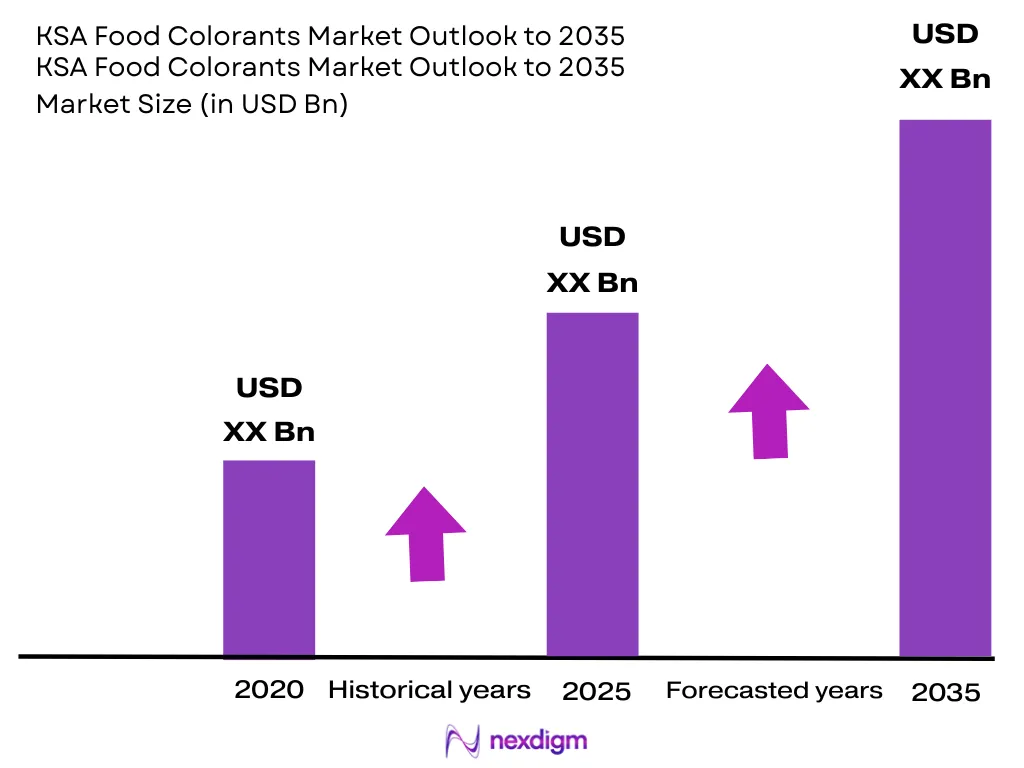
The KSA Food Colorants Market was valued at USD ~ Billion in 2024 and is anticipated to expand at a CAGR of ~% during 2026–2035. The market is primarily driven by the Kingdom’s expanding processed food and beverage sector, rising demand for clean-label ingredients, and the accelerating diversification of the domestic food manufacturing base under Vision 2030. Industry estimates place Saudi Arabia’s overall food and beverage market at close to USD 60 billion in 2024, supported by a young and rapidly urbanizing population; the General Authority for Statistics (GASTAT) has reported that approximately 71% of Saudi nationals are below the age of 35. Continued government-backed investment in local dairy, bakery, confectionery, beverage, and snack production has sustained demand for functional ingredients such as food colorants across bakery, dairy, beverages, snacks, and processed meat applications.
Market Segmentation
By Source Type
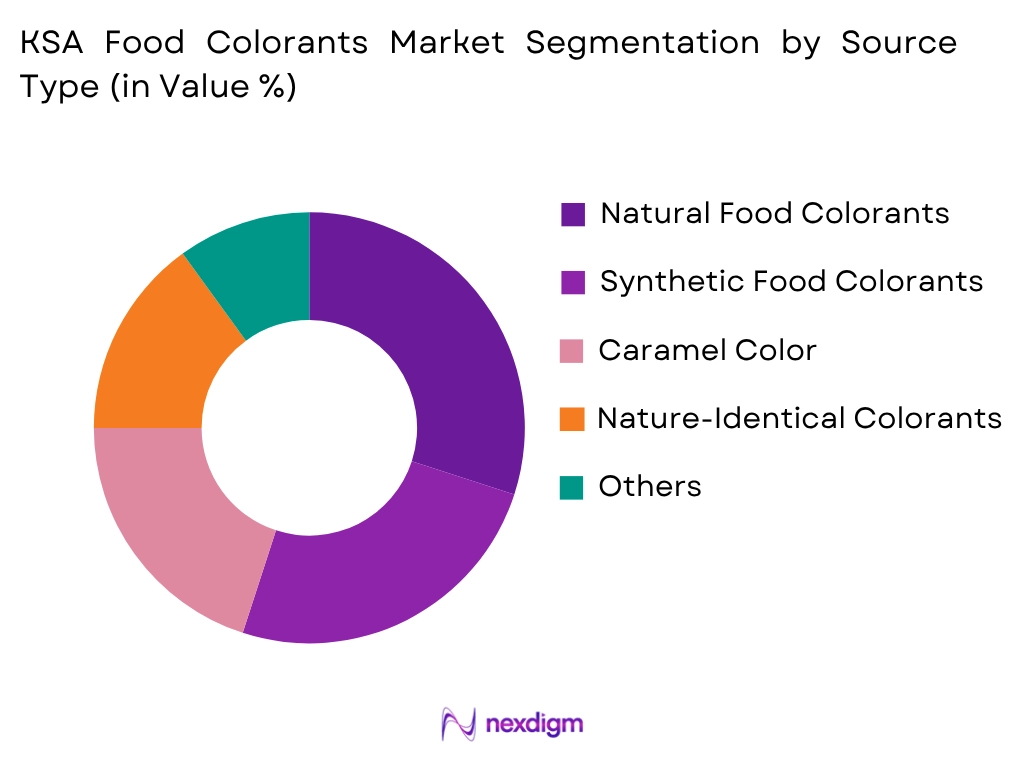
Among these, Natural Food Colorants dominate the KSA Food Colorants Market owing to the rising shift toward clean-label formulations, growing regulatory emphasis on food additive transparency under the SFDA’s GSO 2500 technical regulation, and increasing consumer awareness of naturally sourced ingredients. Saudi food manufacturers are progressively reformulating products by replacing synthetic dyes with botanical extracts such as turmeric, annatto, beetroot, paprika, and spirulina to meet the expectations of health-conscious and premium consumer segments. Because the Kingdom’s arid climate limits domestic cultivation of most pigment-yielding crops, natural colorant demand is met almost entirely through imports, encouraging multinational ingredient suppliers to expand regional distribution hubs and technical support capabilities across the GCC. Sustained investment in the Kingdom’s food processing sector under Vision 2030, together with rising demand from dairy, bakery, confectionery, and beverage manufacturers, continues to reinforce the leadership of natural colorants across the market.
By Application
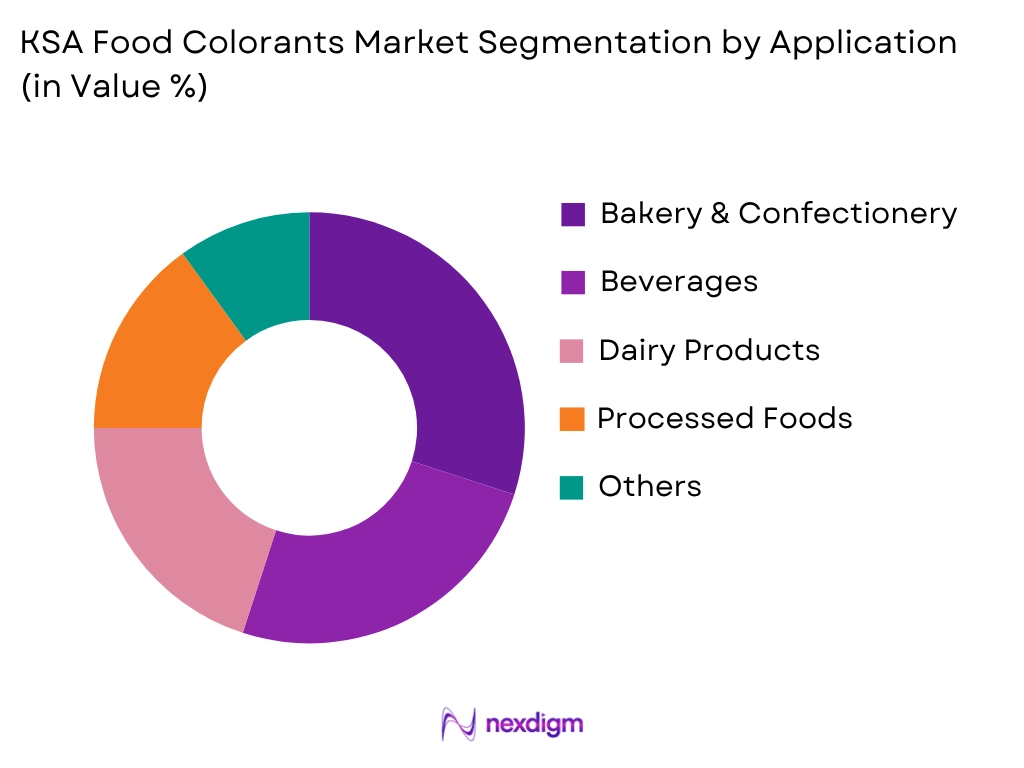
The Bakery & Confectionery segment holds the largest share owing to the extensive use of food colorants for product differentiation, seasonal product launches, and premium positioning within the Kingdom’s rapidly expanding retail bakery and modern trade landscape. Manufacturers increasingly rely on stable natural pigments to enhance cakes, cookies, chocolates, fillings, candies, gummies, and decorative toppings while remaining compliant with SFDA food safety standards. The growth of premium confectionery brands, artisanal bakery chains, and seasonal campaigns tied to Ramadan, Eid, and national celebrations has further increased demand for customized color solutions offering heat stability, pH stability, and extended shelf life. In addition, the continued expansion of hypermarkets, quick-service restaurants, and modern retail formats across Riyadh, Jeddah, and Dammam has made colorants an essential functional ingredient that directly influences consumer purchasing decisions and brand recognition.
Competitive Landscape
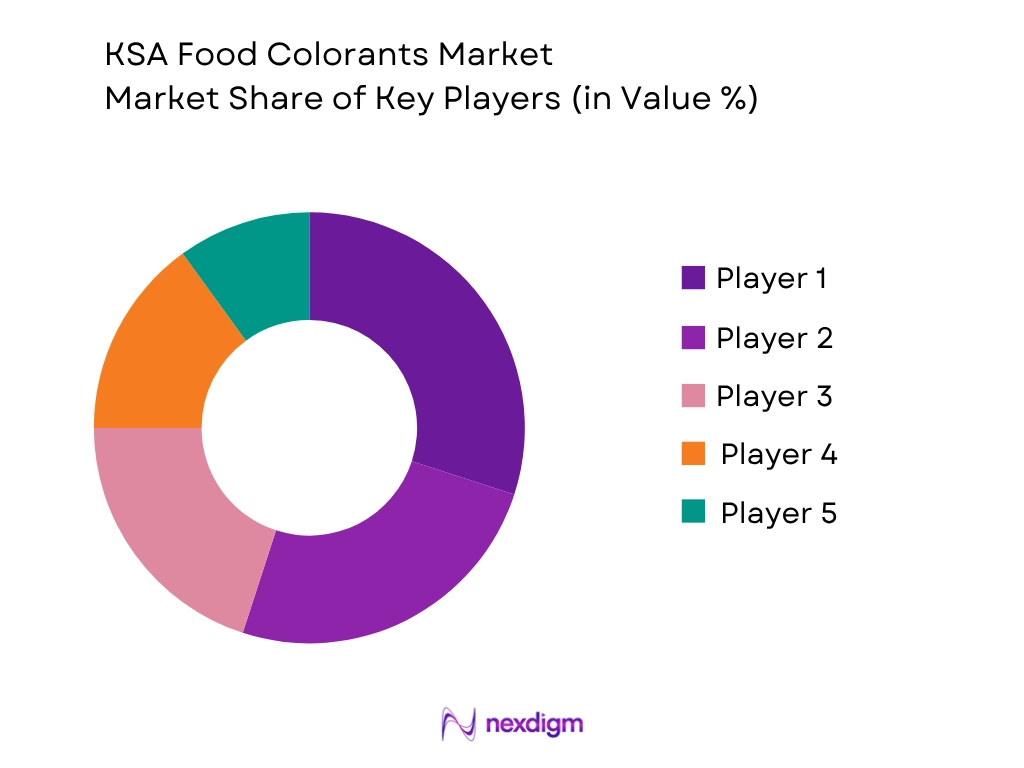
The KSA Food Colorants Market is moderately consolidated, dominated by multinational ingredient manufacturers that serve the Kingdom through regional distribution hubs, application laboratories, and technical support centers located across the Gulf Cooperation Council (GCC). Because Saudi Arabia imports the majority of its natural and synthetic colorant raw materials, competition is centered on supply chain reliability, SFDA and GSO regulatory compliance, application-specific formulation support, and the ability to provide Halal-certified, clean-label solutions. Companies are increasingly investing in regional application centers, cold-chain logistics, and local technical service teams to strengthen relationships with Saudi food and beverage manufacturers. Strategic distribution partnerships, GCC-wide certifications, and expanding footprints near Jeddah Islamic Port and King Abdullah Economic City continue to shape the competitive landscape as global suppliers compete to serve the Kingdom’s growing bakery, dairy, beverage, and confectionery industries.
| Company | Establishment Year | Headquarters | Primary Product Portfolio | Natural Color Portfolio
|
Manufacturing Presence | Major End-Use Industries | Key Strategic Focus | Certifications & Compliance |
| Roha Group | 1972 | ~ | ~ | ~ | ~ | ~ | ~ | ~ |
| Givaudan | 1895 | ~ | ~ | ~ | ~ | ~ | ~ | ~ |
| DSM-Firmenich | 2023 | ~ | ~ | ~ | ~ | ~ | ~ | ~ |
| Sensient Technologies | 1882 | ~ | ~ | ~ | ~ | ~ | ~ | ~ |
| Döhler | 1838 | ~ | ~ | ~ | ~ | ~ | ~ | ~ |
KSA Confectionary Market Analysis
Growth Drivers
Rapid Expansion of Food Processing under Vision 2030
The KSA food colorants market is benefiting from the Kingdom’s broad push to expand and localize its food manufacturing base under the Vision 2030 economic diversification program. Saudi Arabia’s food and beverage market was valued at close to USD 60 billion in 2024 and continues to expand on the back of rising disposable incomes, urbanization, and demographic growth. According to GASTAT, close to three-quarters of the Saudi population is under the age of 35, sustaining strong demand for packaged foods, ready-to-eat meals, dairy products, confectionery, and beverages in which food colorants play an essential role. The Kingdom’s dairy sector has reportedly surpassed 121% self-sufficiency and now contributes close to 46% of agricultural GDP, led by integrated producers such as Almarai and the National Agricultural Development Company (NADEC), both of which continue to expand flavored milk, yogurt, and dessert lines that rely on natural and synthetic colorants for product differentiation. Recent capital commitments, including Almarai’s investment of close to USD 4.8 billion in seafood and red meat production and PepsiCo’s establishment of a regional headquarters and research facility in Riyadh, illustrate the scale of manufacturing expansion feeding demand for coloring solutions across processed food categories.
Growing Preference for Clean-Label, Halal-Certified Ingredients
Rising consumer awareness of ingredient transparency, combined with the Kingdom’s strict Halal certification requirements, continues to shape demand for compliant and naturally derived food colorants. All food colorants sold in Saudi Arabia must conform to the SFDA’s GSO 2500 technical regulation on additives permitted for use in foodstuffs, which maintains separate annex tables for approved natural and synthetic colors and requires Arabic-language labeling under GSO 9. Manufacturers seeking to differentiate their products increasingly favor natural pigments that simplify ingredient declarations and support Halal positioning, particularly as tourism and foodservice activity expand; the Ministry of Tourism reported more than 4.2 million leisure visitors in just the first seven months of 2024, while the Kingdom’s foodservice market was estimated at close to USD 28.7 billion in the same year. This growing base of dine-out and tourism-linked consumption, layered on top of a young, digitally engaged population with a strong appetite for international cuisines and quick-service formats, continues to widen the addressable market for clean-label and Halal-certified color solutions across bakery, beverage, and confectionery applications.
Market Challenges
Heavy Dependence on Imported Raw Materials
Saudi Arabia’s arid climate and limited arable land mean that virtually all botanical feedstocks used in natural food colorant production, including annatto, turmeric, paprika, beetroot, and spirulina, must be imported. This creates exposure to global commodity price volatility, shipping disruptions, and currency fluctuations that can materially affect the cost and consistency of natural pigment supply. Imported colorant shipments must also be cleared through the SFDA’s Fasah platform and comply with country-of-origin labeling, Halal certification, and approved-establishment requirements, adding administrative complexity for suppliers. Because natural pigments require consistent concentration and quality to perform reliably in food applications, disruptions in the sourcing regions of major exporting countries can create downstream challenges for local manufacturers seeking to reformulate products with natural alternatives while maintaining shelf stability and consistent shade performance.
Complex Regulatory and Halal Compliance Requirements
The Saudi regulatory environment for food additives is comprehensive and continually evolving. The SFDA’s GSO 2500 “Additives Permitted for Use in Food Stuffs” regulation runs to several hundred pages and defines permitted natural and synthetic colors, maximum usage levels by food category, and applicable conditions of use, while GSO 9 governs mandatory bilingual labeling of prepackaged foods. Colorant suppliers and food manufacturers must additionally secure Halal certification from bodies accredited by the SFDA’s Halal Center, and imported products are subject to facility registration and approval requirements administered through the SFDA’s electronic systems. For multinational ingredient companies, aligning global product portfolios with Saudi-specific and wider Gulf Cooperation Council (GSO) standards, on top of Halal and labeling obligations, extends product registration timelines and increases the cost of market entry for new color solutions.
Market Opportunities
Localization of Ingredient Manufacturing under Vision 2030
Saudi Arabia’s Vision 2030 program and associated food security initiatives are creating openings for ingredient manufacturers to establish local blending, formulation, and application-support facilities rather than relying solely on imports. Government-linked programs increasingly favor suppliers that can demonstrate local content, and industry reporting has highlighted local-content requirements of as much as 40% for companies seeking access to certain public-sector food contracts. Large-scale projects such as NEOM’s investment in precision fermentation, targeting tens of thousands of metric tons of alternative protein output by 2030, point toward a broader push to build domestic ingredient and biotechnology capacity that could eventually extend into fermentation-derived natural pigments. Ingredient manufacturers that establish regional formulation and technical service hubs within the Kingdom, rather than serving it purely through GCC-based distribution, are well placed to benefit from this localization drive.
Expansion of Premium, Functional, and Date-Derived Food Innovation
The continued growth of tourism, premium retail, and functional food categories is creating new demand for innovative and application-specific coloring solutions. Saudi Arabia’s tourism sector has expanded rapidly, with tens of millions of visitor arrivals recorded in recent years and sustained government investment in hospitality, entertainment districts, and food and beverage venues in Riyadh, Jeddah, and AlUla. This is expanding demand for premium bakery, confectionery, and beverage products that rely on visually distinctive, stable natural colors. At the same time, the Kingdom’s position as one of the world’s largest producers of dates offers a distinctive opportunity for ingredient innovation: date-derived concentrates and pigments are increasingly being explored as natural coloring and sweetening bases for products such as date-based colas and confectionery, building on recent domestic launches of date-derived beverages. Combined with rising demand for plant-based and functional foods among health-conscious urban consumers, these trends are expected to support continued innovation in natural, Halal-certified, and locally relevant coloring solutions.
Future Outlook
The KSA Food Colorants Market is expected to witness sustained expansion over the forecast period, supported by continued government investment in food manufacturing localization, rising consumer preference for naturally derived and Halal-certified ingredients, and ongoing product reformulation by food and beverage manufacturers. Growing investment in premium confectionery, functional beverages, and clean-label dairy products, alongside the Kingdom’s expanding tourism and foodservice sectors, will further accelerate demand for innovative coloring solutions. The market is also likely to benefit from growing regional distribution infrastructure and technical support capacity established by multinational ingredient suppliers seeking to strengthen their presence across the GCC.
Major Players
- Givaudan
- DSM-Firmenich
- Sensient Technologies
- Döhler
- Roha Group
- Oterra
- Chr. Hansen
- IFF (International Flavors & Fragrances)
- Naturex
- Kalsec
- ADM
- Kerry Group
- Symrise
- GNT Group
- DDW, The Color House
Key Target Audience
- Food Colorant Manufacturers
- Food & Beverage Processing Companies
- Bakery and Confectionery Manufacturers
- Dairy Product Manufacturers
- Nutraceutical and Functional Food Manufacturers
- Investment and Venture Capitalist Firms
- Government and Regulatory Bodies (Saudi Food and Drug Authority – SFDA, Saudi Standards, Metrology and Quality Organization – SASO, Ministry of Environment, Water and Agriculture – MEWA)
- Food Ingredient Distributors and Industrial Raw Material Suppliers
Research Methodology
Step 1: Identification of Key Variables
The research process begins with identifying the complete ecosystem of the KSA Food Colorants Market, including raw material importers, pigment distributors, ingredient blenders, food processors, retailers, and regulatory authorities. Extensive secondary research is conducted using company reports, government publications, trade associations, customs statistics, industry journals, and proprietary databases to determine the variables influencing market demand, pricing, production, consumption, and technological developments.
Step 2: Market Analysis and Construction
Historical market information is collected and analyzed to estimate market size, import volumes, application-wise demand, and pricing trends. A combination of top-down and bottom-up approaches is used to estimate market revenues and validate segment-level performance. Consumption patterns across bakery, dairy, beverages, confectionery, processed foods, and nutraceuticals are evaluated to establish an accurate representation of the industry.
Step 3: Hypothesis Validation and Expert Consultation
The preliminary findings are validated through Computer-Assisted Telephone Interviews (CATIs) and structured discussions with food ingredient distributors, procurement managers, food technologists, regulatory experts, and senior executives operating within the Saudi food industry. These interviews help verify market assumptions, competitive developments, technology adoption trends, pricing dynamics, and future investment opportunities while refining the overall market estimates.
Step 4: Research Synthesis and Final Output
The final stage integrates insights obtained from primary interviews with quantitative information collected through secondary sources. Data triangulation techniques are applied to reconcile differences between supply-side and demand-side estimates, ensuring robust market forecasting. The report is then reviewed through multiple quality assurance checkpoints to deliver a comprehensive analysis covering market size, segmentation, competitive landscape, future outlook, and strategic recommendations for industry stakeholders.

- Executive Summary
- Research Methodology (Market Definitions and Assumptions, Abbreviations, Market Sizing Approach, Top-Down Analysis, Bottom-Up Analysis, Demand-Side Assessment, Supply-Side Assessment, Primary Industry Interviews, Secondary Research Validation, Data Triangulation, Forecasting Framework, Limitations and Future Conclusions)

- Definition and Scope
- Market Evolution and Industry Genesis
- Timeline of Major Industry Developments
- Food Colorants Industry Value Chain Analysis
- Supply Chain Analysis

- Growth Drivers (Growing Clean Label Food Demand, Rising Consumption of Processed Foods, Expansion of Beverage Manufacturing, Increasing Demand for Natural Pigments, Premiumization of Food Products, Growth in Plant-Based Foods)
- Market Challenges (High Cost of Natural Colorants, Color Stability Issues, Raw Material Import Dependency, Regulatory and Halal Compliance Complexity, Limited Shelf Stability of Natural Pigments, Currency and Logistics Volatility)
- Market Opportunities (Localization of Ingredient Manufacturing, Fermentation-Based Natural Pigments, Organic Food Expansion, Functional Food Innovation, Date-Derived Pigment Innovation, Clean Label Reformulation Projects)
- Market Trends (Replacement of Synthetic Colors, Blue Spirulina Adoption, Botanical Extract Innovation, Halal-Certified Pigment Sourcing, Heat-Stable Natural Color Development, Multi-Functional Ingredients)
- Government Regulations (SFDA Food Additive Regulations, GSO Food Labeling Requirements, Maximum Permitted Usage Levels, Natural Color Approval Standards, Halal Certification Requirements, Food Safety Standards)
- Import and Export Analysis (Trade Volume, Major Import Sources, Export Destinations, HS Code Analysis, Trade Balance)
- Raw Material Availability Analysis (Imported Annatto Extracts, Turmeric, Paprika, Beetroot, Spirulina, Date-Derived Pigment Sources)
- Technology Landscape (Extraction Technologies, Encapsulation Technologies, Spray Drying, Fermentation Technologies, Stability Enhancement Technologies)
- Sustainability Assessment (Imported Renewable Raw Materials, Carbon Footprint Reduction, Local Sourcing Initiatives, Waste Valorization, Eco-Friendly Processing)
- PESTLE Analysis
- SWOT Analysis
- Porter’s Five Forces Analysis
- Stakeholder Ecosystem
- Competition Ecosystem

- By Market Value (2020-2025)
- By Volume Consumption (2020-2025)
- By Average Selling Price (2020-2025)

- By Source Type (In Value %)
Natural Food Colorants
Synthetic Food Colorants
Nature-Identical Colorants
Caramel Color
Mineral-Based Colorants
Fermentation-Derived Colorants - By Application (In Value %)
Bakery & Confectionery
Beverages
Dairy Products
Processed Foods
Snacks & Savory Products
Meat, Poultry & Seafood Products
Frozen Foods
Plant-Based Foods
Nutraceuticals & Functional Foods
Infant Nutrition - By Distribution Channel (In Value %)
Direct Sales to Food Manufacturers
Ingredient Distributors
Industrial Ingredient Suppliers
Online B2B Ingredient Platforms
Specialty Ingredient Suppliers - By End User (In Value %)
Food Processing Companies
Beverage Manufacturers
Bakery Manufacturers
Confectionery Manufacturers
Dairy Processors
Nutraceutical Manufacturers
Foodservice Manufacturers - By Region (In Value %)
Central Region
Western Region
Eastern Province
Southern Region
Northern Region

- Market Share of Major Players (By Value, Volume, Source Type, Application Industry, Product Category)
- Cross Comparison Parameters (Natural Colorant Portfolio Breadth, Synthetic Colorant Portfolio, Color Stability Performance, Application Technical Support Capability, Manufacturing Capacity, Regulatory Compliance & Certifications, Food & Beverage Customer Base, Innovation & New Product Launch Frequency)
- SWOT Analysis of Major Players
- Pricing Analysis by Product Category and SKU
- Production Capacity Analysis
- Manufacturing Footprint Analysis
- Distribution Network Analysis
- Innovation Benchmarking
- Detailed Profiles of Major Companies
Givaudan
DSM-Firmenich
Sensient Technologies
Döhler
Roha Group
Oterra
Chr. Hansen
IFF (International Flavors & Fragrances)
Naturex
Kalsec
ADM
Kerry Group
Symrise
GNT Group
DDW, The Color House

- Consumption Pattern Analysis (Industrial Usage, Batch Size, Product Category Penetration, Seasonal Demand, Reformulation Activity)
- Purchasing Criteria (Color Stability, Regulatory Compliance, Cost Efficiency, Heat Stability, Light Stability, Shelf Life)
- Procurement and Supplier Selection Analysis
- Clean Label Adoption Assessment
- Premium vs Conventional Product Demand
- Product Attribute Preference Analysis (Hue Consistency, Dispersion Performance, pH Stability, Solubility, Natural Origin, Label Friendliness)
- Consumer Health & Wellness Influence on Product Development
- Pain Point Analysis
- Decision-Making Process

- By Market Value (2026-2035)
- By Volume Consumption (2026-2035)
- By Average Selling Price (2026-2035)


 Request a Sample
 Ask for Customization
 Get a Quote
 Enquire Now